
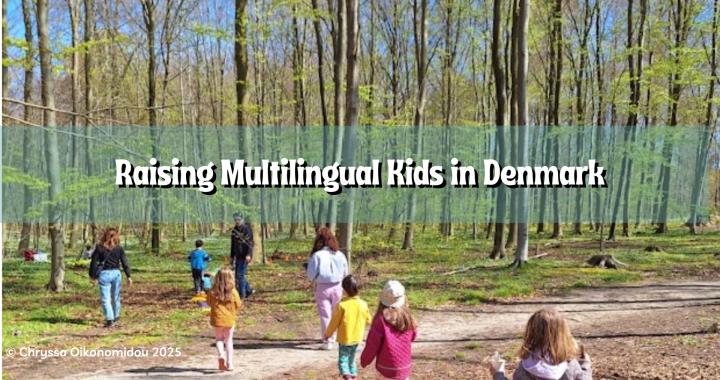
Some years ago, I received the results of a language test for one of my kids. When I saw the low bars and the yellow color, I immediately went into panic mode! Everyone knows that red and yellow are not good colors when it comes to test results. As a new parent, I was alarmed – and for good reason. My husband and I are Greek, living in Denmark. We speak Greek at home, while our children are exposed to the majority language at their institutions and schools – something completely out of our control. And I admit it: I am a control freak!
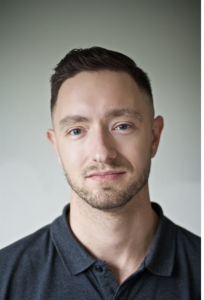
Justin Markussen-Brown, Founder of Sprogklar
So, long story short – after my initial panic, I called every single person I knew, looking for support in navigating and understanding the Danish system and these language tests.
Luckily, Tina Bollerslev pointed me in the direction of Justin Markussen-Brown, the founder of Sprogklar, a Danish company specializing in education and IT solutions for first and second language acquisition. Sprogklar also has a speech-language pathology focus and runs a clinic.
In addition to his work at Sprogklar, Justin is an assistant professor of social education at UC Lillebælt in Odense, where he focuses on language acquisition and language pedagogy for children.
That’s how I met Justin, and now it’s time to introduce him to all of you – expat parents in Denmark or anywhere in the world raising multilingual kids.
Justin, can you tell us a little about yourself and the work you do at Sprogklar?
I am educated as a linguist and have a Ph.d. from the university of Southern Denmark. I founded Sprogklar in 2015 on the coattails of my Ph.d.-work. Sprogklar has three main areas of business:
1) We do professional development for educators, teachers, support workers and speech-language pathologists;
2) We develop and run an online platform for Danish municipalities where they can access language stimulation materials and can take online courses;
3) We run a speech-language pathology clinic.
I’ve also written a few Danish language books on language acquisition for practitioners and parents.
What inspired you to create a company that bridges research and practice in early language development?
Children’s language acquisition was not at the time an area of focus in the early childhood education programme in Denmark. This was also evident for me in my Ph.d. fieldwork, where I visited several hundred preschool classrooms, and could see that the quality of the language environment required improvement. We also had some research that indicated that the educator could improve their practice significantly, if they received professional development. So that was basically the original business case of Sprogklar: To offer educators professional development in how you support language development in children.
How do you see language playing a role in shaping a child’s cultural identity, especially in multilingual families?
In my research, it’s a clear trend that it’s hard for children with a multilingual language background to create a unique cultural identity, when they don’t have fluency in their parents’ mother tongues. So I see language skills as being very important in this regard, and I encourage parents who have a different language than the majority language to focus on giving their own language to their kids.
Multilingual Expat Families in Denmark and Language Development
What should expat parents who speak one or two non-Danish languages at home know about the Danish early childhood education system?
They should know that the Danish early childhood education system is very high quality in many regards. The workers with a BA in pedagogy have a lot of knowledge about kids’ development. They may or may not give advice on how to support multilingual children, and if you’re in doubt, you can contact the public speech-language pathologist for advice.
How does the system support children learning Danish as an additional language?
It is very different from municipality to municipality and from practitioner to practitioner. All children will have their Danish skills evaluated at the age of two or three, and if they think that the child’s Danish is behind, then they might suggest some sort of language intervention. Unfortunately, they don’t take the child’s skills in other languages into account (this is also methodologically difficult, but possible). In general, you should expect a lot of focus on your child’s Danish, and maybe very little interest in your child’s development of additional languages (although again, this will vary from educator to educator).
What are some unique aspects of the Danish language environment that expat families or Danes living abroad might find surprising or challenging?
Phonology is the hard part. Danish has a lot of phonetic vowels, and many consonants can be pronounced a bit like a vowel, which creates an unstable phonological structure.
What practical steps can parents take to ensure their children develop proficiency in Danish while maintaining their home languages?
There are a lot of things to do. First of all, I would focus on the child’s home language, because that is the one that usually ends up being underdeveloped. Secondly, I would make sure that the child goes to daycare regularly, and has friends to play with that speak Danish. During long holidays, parents can make sure to expose their kid to a little Danish every day to avoid losing Danish skills, e.g. watching public Danish children’s programming like Ramasjang.
For those interested, are there any specific resources, practices, or activities that you recommend for creating a strong foundation in Danish?
I’m actually not so convinced that Danish skills are the big problem. The main thing is ensure that the child is engaged linguistically in general, and that can also be through the mother tongue. Generally speaking, a good language environment provides a lot of cognitive stimulation, which supports the child’s ability to learn other languages.
Going regularly to daycare will ensure that the child has exposure to the Danish language, and I would try to find a daycare, where they seem to have a good language environment, and play and talk a lot with the kids.
A good language environment provides a lot of cognitive stimulation, which supports the child’s ability to learn other languages.
Navigating Language Tests (Ages 3 and 5)
I understand that children in Denmark undergo an obligatory language test at age 3, typically conducted in their børnehave, and an optional test at age 5. Could you guide us through these tests? What are they designed to assess, and how are they carried out?
They can also legally do it at 2 years. It’s good to know that the test is only obligatory if the child shows signs of language impairment/difficulties, and it is up to the personnel to decide this.
The test is designed to screen for language impairment. It’s normed on monolingual Danish speakers, so when testing multilingual children, it will often be very unreliable with regards to predicting impairment. But it will give an indication of how much Danish the child has compared with monolinguals.
In some cases, especially when these language tests are administered to multilingual children who are not exposed to Danish at home, we often see results marked in red or yellow, particularly in the vocabulary section of the test, indicating that compared to their monolingual peers they don’t have the same amount of vocabulary in Danish. Could you explain why this happens? Is there any research to help us understand these results?
Because they’re only testing Danish, the test does not capture the entirety of the child’s conceptual vocabulary. For example, the child may know what a “tie” is called in their own language, but they fail the item in Danish, because they don’t know that it’s called a “slips”. But in reality, the child knows what a tie is and what it is called in a language. Just not Danish.
So it’s rather normal for a multilingual child to be evaluated to “red” or “yellow”, which means they are in the low end of distribution compared to same-age monolinguals. However, some multilingual children also DO have language impairment, so the thing to look out for is whether the child’s language acquisition is proceeding normally in the other language. If there are challenges in both languages, then it can indicate that there actually is an issue, and I would then consult a speech-language pathologist.
The test [at 2 years] (…) is normed on monolingual Danish speakers, so when testing multilingual children, it will often be very unreliable with regards to predicting impairment. (…) [It] does not capture the entirety of the child’s conceptual vocabulary.
Some expat families panic when they see red or yellow results. They often feel lost and uncertain about how to address the situation. One thing we know for sure is that they should not stop speaking their native language(s) to their children. What advice would you offer to these families? How can expat parents support their children in expanding their Danish vocabulary, even when they don’t speak Danish at home? What role does the institution (børnehave) play in such situations and how can parents collaborate with educators and other professionals to support their child’s language development in such cases?
It’s a bit of an unfortunate situation, because the educators presenting the results need to be very good at explaining that the test is standardized on monolinguals. If they don’t explain this, then parents might freak out. My advice is that parents should expect that the child will score lower on the test, especially if neither of the parents are Danish. It is also a myth that children are very speedy at learning multiple languages. It’s not true at all and sets parents up for unrealistic expectations. Generally speaking, it takes 3-6 years for a child to catch up to monolinguals, because they have twice as much work than the monolinguals.
It is not an appropriate strategy for parents to stop speaking their language to their child, as this will only result in the child missing out on high quality language input via the mother tongue.
My suggestion is that the educators do their best to create a language stimulating environment in the preschool. The child would also profit from being in groups with children with stronger language skills, but sometimes educators make the judgement of grouping all the multilingual children together, which in a way is the opposite of what they need.
Parents should be advised in language stimulation techniques so that they can continue to support their child’s language development in their own language, but with renewed focus. Often, the child’s mother tongue will stagnate a little when they start going to daycare/preschool, but parents can counteract that but being extra good language stimulators at home in the evenings and weekends.
It is (…) a myth that children are very speedy at learning multiple languages. It’s not true at all and sets parents up for unrealistic expectations. Generally speaking, it takes 3-6 years for a child to catch up to monolinguals, because they have twice as much work than the monolinguals.
Looking ahead to the school years, are there additional language tests conducted? If so, how often do they occur, and what do they assess?
Yes there is similar mandatory Danish language screening in 0. Class. It tests basically the same things, plus a little more phonological awareness.
Finally, do you have any additional tips or advice for expat parents living in Denmark to help support their children’s language development effectively?
Be patient — it takes longer time to learn two or more languages. Don’t give up giving your language to your child – it’s the greatest gift and they will be so thankful when they get older.
Danish Multilingual Families
Living Abroad
What are the challenges faced by Danish Multilingual Families Living Abroad with maintaining the Danish language?
It’s the exact same issues that expat families face in Denmark. I can recommend speaking with Tina Bollerslev from Dansk med Tina who knows a lot about this. As I understand it, families experience challenges in supporting their children’s Danish acquisition.
What practical tips would you share with Danish families living abroad to help their children maintain and develop their Danish language skills, especially if they are surrounded by a different language environment?
I would recommend starting so early as possible. If the Danish speaker is married with a non-Danish speaker, then it’s important to get their support to the project, even though they may feel a little left out. Above all, resist the urge to use the majority language with the child. Keep using Danish in all situations and explain to others that you do it to ensure that the child learns Danish.
Navigating multilingual parenting can feel like a rollercoaster – filled with moments of pride, occasional panic, and a lot of learning along the way. But as Justin reminds us, language development is a journey, not a race. Instead of stressing over test colors, let’s focus on creating rich, engaging language environments where our children can thrive in all their languages. Whether it’s speaking our mother tongues at home, playing with Danish-speaking friends, or singing along to Ramasjang, every little bit counts. And most importantly, let’s remember that multilingualism is a superpower – one that takes time to grow but lasts a lifetime.
Read more about Sprogklar here: https://sprogklar.dk/
