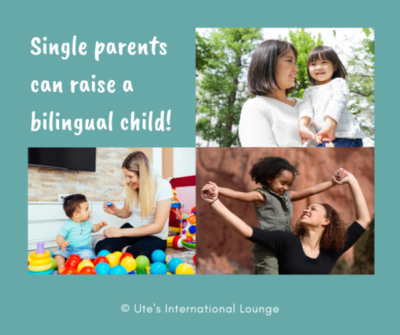
Single parents can raise a bilingual child

Although most of the literature about bilingual or multilingual children has a traditional family setting in mind, it is about time to focus on other kind of families.

What about patchwork families, part-time families (where one parent lives in another country and the one living with the children is in charge of all the languages), single parents where the partner is present occasionally, and single parents with no partner etc.?

In my workshops and talks I use the term of family in a very broad sense, more with the meaning of “micro-speaking community”. The members of this family don’t need to be present all the time, but they need to be in the picture somewhere, with some consistency to be part of the inner circle

Even if the father or mother of the child is not part of the every day life of the child, they have a presence that is necessary. Even those who left forever shouldn’t be forgotten – but I won’t focus on family dynamics and all the different possible situations.

Let’s focus on situations where one parent is with the children most of the time and is responsible for all the languages.

First and foremost it is important that this parent has chosen a primary language to speak with the child. This is the language the parents speaks with the child since day one, the language that allows being most spontaneous and to speak about emotions and a very broad variety of topics. This primary language is the one we want to foster the most and that we ideally want our children to use their whole life.
I have explained this more in detail in this video:


Can a single parent raise a bilingual/multilingual child?

The answer is: yes. If we are a single parent and speak both languages, we can opt for a Time and Place (T&P; I like to use the term “time and context”) strategy. Please use this strategy only with “older” children. If our child is too young to understand the concept of time, this strategy might not get the desired results.

What our youngest children do understand very early on is that we can speak one language when we’re alone with the child and the other one in societal contexts, i.e. when speakers of the other languages are with us. Fact is that in those situations we might not always address our child in that “other” language, certainly not if the child was only exposed to this additional language passively, i.e. without people expecting a response from our child.

When the “other” language is the community language this is fairly easy to implement. If the other language is not the dominant language in the community, we need to find a group of speakers to create a “full immersion” situation for us and our child, at least from time to time (some choose Saturdays or Sundays for playgroups, coffee mornings and later on, more guided learning of the language in “weekend schools” – especially if the language is not supported by school and society).

It is a matter of language ideology: which language is more important for us and our child at that moment, and in the context we’re living. What language or languages does our child need to function every day, at home and outside home?

To make an example, if I speak Italian and Swiss-German and live in the Netherlands where I have a great community of Italian speakers, but only a few Swiss-German speakers, I would probably choose to rather speak Italian with my child. If my child needs to be able to communicate in Swiss-German with grandparents I would also try to foster Swiss-German, but the daily need for me and my child would rather be to speak Italian – and the local language, of course…

We only have a limited time per day to foster our childrens’ languages, so, I usually recommend to carefully assess the personal situation in order not to let language acquisition and learning become a burden and too much of a challenge!

A single parent can pass on also a language that he or she is not that fluent in, the same way a non-native speaking parent can raise a child with that “other” language.

One needs to be very aware of what we can achieve when we have different levels of fluency in the languages we want our children to speak – and that they need to learn (make sure to define the “need”!) – There are many other aspects to consider that would take way more space than a (already long!) post like this…


When I get asked if a single parent can raise a bilingual child I always ask questions like:

  1. What is the reason for you to add this language right now?
  2. How well do you speak this language?
  3. Who else, in your community (friends, extended family etc.) speaks that other language?

The answer to the first question might seem obvious as many parents want to pass on the other language as soon as possible. They want to make sure the children acquire and develop the other language, possibly to a high level of proficiency. For multilingual parents this language is also one of their heritage languages. But what about the child’s need to understand, speak, read and write the language? The way our children use and perceive various languages is different from what we experienced.

It is very important to set realistic goals and be honest about ones time and available resources, as consistency is the key. Also, it is important to set clear short and long term goals about all the languages the single parent wants to foster.

Depending on your response to this question, you can choose to either speak both languages from birth (simultaneous bilingualism) or you can start with one language first, and add the second one later (sequential bilingualism).

But first and foremost you need to know what languages your children need. Your answer also depends on the age of your child, the kind of communicator your child is and what stage of their development they are. 

In the first months or year, the main focus of language is about forming connections. You use the language to sooth your baby, your little one learns to take turns, connect with you through gestures, behavior and he/she learns that her/his basic needs are met etc.. In this phase it is crucial that you use the language you are most fluent in, you feel most comfortable using as the primary language. Although research clearly states that “children don’t get confused when exposed to multiple languages early on”, these researches are all based on families, not single parents, so they all assume that each parent transmits another language, not that one parent transmits multiple languages…

Children learn that languages can be used to communicate their intentions – requests, protests, rejections etc. – and it is an important part of the childs’ sense of belonging that the language(s) used with him/her are not constantly changing.

The second question does NOT imply that if you don’t speak it at a nearly-native level you won’t succeed… – on the contrary!
Again, we are talking about additional language to transmit to our children. I have seen parents transmit a language they weren’t fluent in at the beginning (A2, B1 level) in a very successful way, as they were committed to improve their language skills whilst speaking it with their children, reading to them and learning to write it. It was a pleasure supporting them because whilst they grow their passion for the other language, they were a true inspiration for their children to do the same! – Never underestimate the power of role models!

The third question is related to the second one, and is particularly important if you want your child to become fluent in the other language and maintain it throughout their life.

If this is your goal, you need a village, a village that speaks this other language and your language, in order to foster them all in a way that is “healthy” and encouraging for your child.  I always say you need a multilingual village to raise a multilingual child, therefore, find people in your community, among your friends, find peers, other adults, and maybe family members for your children who speak all the languages you want them to acquire and learn. Especially if one or both of your home languages are not the community language, you will need to find people making it necessary and pleasant for your child to use the languages!

You can speak two or more languages with your children and help them grow up bi/multilinguals, but like with everything else, they need more people to speak these languages with.

What is the role of the partner – if there is one?

If there is a partner present in your child’s life, it is important that they accept and agrees on their role as the person who is responsible for the language.

One important aspect that I can’t stress enough is, that parents – no matter if they are living together or not – need to support their partners’ language! Language can easily become the scapegoat between contending parents and the connection and communication with the child will always be affected. 

Our partners should at least try to learn the basics of our language and always (!) be supportive. This behavior doesn’t only reflect positively on the children’s language learning, but it is the healthiest environment for a child to become bilingual in both parents’ languages. This is even more relevant when one or both (!) of the parents’ languages are minority languages in the community the children grow up in. – If you are having troubles of getting your partner agree on this, you are very welcome to contact me.

I have set up a Family Language Plan© for this reason, not only because every family deserves a person tailored solution, but because:

A goal without a plan is just a wish (quoting Antoine de St Exupéry) 

It is always helpful to have a common goal and to design clear steps on how to achieve it. In this case it is for the benefit of our children.

Once you have found your answers to my first 3 questions, you may want to find a language strategy that works for you. I won’t list up the many different solutions there are – I mentioned two here above, just as examples, but there are more and they can be combined to support your very personal language situation. I’m always happy to help with finding the most suitable solution, so, don’t hesitate to contact me or leave a comment here below.

One last tip and hint: be prepared to talk, sing and read a lot with your child. If you are not used to talk much, you may find this difficult, but I can promise you that you won’t regret it!

– Are you a single parent raising a child with more than one language?

Then, please, leave a comment here below. I’d be happy to know more about what kind of support, advice you need and I’m very curious to know what works for you and your child.

I invite you to also watch my video about this topic.


Signs of Communication Disorders

One of the reasons parents approach me as Language Consultant is that they wonder if their children who are exposed to multiple languages at home and in the community, aren’t having some kind of communication disorders.

Especially when we’re given the advice to either talk only one language at home or to even only talk the community language with our children, we wonder if “all those languages don’t cause not only a delay but a general confusion of our children” (I quote a parent who attended one of my workshops on Raising bilingual children).

I usually ask parents what makes them worry, what signs they observe in their children and in what contexts they observe them.

I am not a speech pathologist, but I know what signs one should worry about and when to reach out to other professionals for further assessments and intervention.

On the ASHA site (American Speech Language Hearing Association), you can find an overview of the signs of communication disorders that you can easily assess at home. 

Abby Gilbert Aubin, speech pathologist at Communicate without borders, suggests “the European organization for SLPs, CPLOL. It is mainly aimed at professionals rather than parents”, “also RADLD, a site from the UK has useful information for the general public about language disorders (…) and Talkingpoint has a lot of resources for parents and professionals in regards to speech, language and communication needs, as well as The Communication Trust.” 

As for the children’s acquisition of consonant sounds, this article shows when to expect our children to be able to produce these sounds: you may need to be trained in phonetics and phonology in order to fully understand the content of the article.

(these are only a few of the languages mentioned in the article)

Although some of these sites are mainly aimed at professionals, parents tend to become semi-professionals when it comes to anything related to their children’s health and wellbeing. Therefore I prefer sharing informative sites that require more study so that you can get the best possible information before you ask a professional for help. If you have any further question about this topic, please don’t hesitate to book a consultation with me

Let’s talk about: Multilingual children and Speech Therapy – an interview with Millie Slavidou

Speech therapy and multilingual children is a topic that needs more attention and research, and speech therapists, teachers and health practitioners need to be more informed about it.

When I shared articles and best practices about this in facebook groups, I had very interesting feedback and discussions on- and offline, and in personal chats.

It is specifically one with Millie Slavidou, a British mother of three, currently living in Cyprus, that caught my attention as she experienced most of the situations parents are confronted with when getting the diagnosis or the information that their child needs special support. – She was kind enough to share her story with me and to answer some questions.

About the topic

Many families get the advice that their children need speech therapy or other kind of special support. Some get this advice at a very early stage, some a bit later. Fact is, that this advice or diagnosis can have a great impact on families who live in their own country, but it can mean an even bigger challenge to those who live abroad. Navigating an unfamiliar system when facing any kind of hardship can be daunting. We’re far away from our families and considering that finding suitable support is already difficult for locals, it is even more arduous.

Millie and I are linguists and know about language acquisition and learning, and about bilingualism. We know what is possible, what the best practices and strategies are, what is realistic and what not, and we know what to search for in order to find even more answers. But what about those who are not experts, don’t know how to react if someone tells you to do something you feel is not right?

I asked Millie to share her experience in a short interview because what happened to her is what happens to many families who speak multiple languages around the world and we hope that her story can help others who are in a similar situation.

Interview with Millie Slavidou

Millie, can you please share about your background and tell us your story?

Yes, thank you, it’s a great pleasure. About myself and my background: I have lived in Cyprus now for about three years, prior to this I was in Greece for 16 years. I speak Greek fluently: I translate Greek and Italian, as I lived in Italy prior to coming to Greece. I studied languages and linguistics at University in Britain.

Languages, bilingualism, multilingualism: these are a major part of my life.

With my children I speak exclusively in English, although I do sometimes throw in a phrase in Italian, but they only speak back in English. I don’t speak to them in Greek, although they know that I am fluent and they hear me speak it in social settings. We try to be strict.

As for my story: I have three children. The youngest of my children has special needs that are severe enough that he has been going to speech therapy for many years now, and he has cognitive delays.

When we went initially to a clinic to get a referral for a speech therapist, as this is how the system works in Greece where we lived at that time, the first time we tried, we were told that we can’t get the referral, they were actually very rude to me personally, and also to my husband who is a Greek national.

We were told “you can’t have speech therapy because you are bilingual and this is what is causing the problem”. They actually accused me of sabotaging my child by insisting on being bilingual. – I was very shocked to say the least.

I pointed out that my other two children are doing very well and had a very good age-appropriate vocabulary at that time in both their languages. But they said “that is different. This child has special needs and children with special needs cannot be bilingual. You’re causing the problem“.

I had to take the matter to the director of the clinic. I was very angry, as you can imagine. I was determined to report this to the police and to report the clinic for racism. I was told that “there must have been a misunderstanding”, and that everything would be all right… They signed all of the papers eventually so that I could get the speech therapy for my son, and as aIl I wanted to get was speech therapy, I dropped the matter.

I knew that it would continue, that there would be others saying the same thing to other parents. In fact, I have heard from other parents that they got the same advice to drop a language and, trusting the healthcare professionals, some of them actually did.

Now their children only speak or understand one of their family languages, and one parent is left communicating with their children in a foreign language. (Millie)

So, we went to a speech therapist. There is a certain number of approved speech therapists, an official list to choose from.

The first we went to, was very negative. We were, again, advised to “stop bilingualism” and she didn’t want me to be in the room with my child when he was having his speech therapy sessions. She said that I’m a distracting influence because I spoke another language to him.

You can imagine that I decided to change speech therapist. The second one wasn’t exactly positive towards bilingualism but wasn’t negative either: she tried to ignore it as much as she could.

I made some more inquiries because I thought that maybe there is somebody else that could be more suitable for us, but as I didn’t find anybody I stopped and stayed with this one. ­ At least, neutral is better than negative.

When my son started the education system, first at kindergarten, the first thing the teacher said was “you’ve got to stop speaking English with your child”.

My other two children had already been to the same kindergarten. It was a large kindergarten and had more than one teacher for each year group. But they had a different teacher. She was very positive and happy that I was speaking English to them and teachers were helping them at school; overall it was a very positive experience with my other two children.

But this other teacher told us to stop speaking English with our son. She said that it is a disadvantage, that we’re holding him back. She said that he won’t progress because at the time his vocabulary was very poor and Greek should be his main and community language.

When he pointed out that my son is a child with special needs, and as by the time his active vocabulary was extremely limited – he had maybe 5 words in either language – I made my point clear that this had nothing to do with bilingualism, it had to do with his cognitive delay. They were adamant: in their opinion I was causing the problem.

I couldn’t bear it… My son had to attend kindergarten, I couldn’t just pull him out and there wasn’t anywhere else I could send him. The options were very limited, especially when you have a child with special needs. – I actually have no experience at nursery school with my son, simply because they didn’t accept him at nursery school…


How did you solve the problem?

To be frank, I am not sure if I did solve the kindergarten problem! I persevered in sending my son to the school, as I didn’t have a lot of choice. The teacher made my life difficult, but after a while she must have got tired of it. She continued to be rude, with lots of passive-aggressive sighs whenever she heard me speaking in English, but she stopped mentioning it to me. I don’t think she ever helped him much in the class, but I think he may have got something from the social interaction with the other children.

Millie, this is a lot you had to go through. It seems to me you were like a Jeanne D’Arc, fighting for the rights of her son. It sounds like a constant battle…


I do agree. You do feel that it’s just you standing up against the world, and you have to be quite strong to deal with this. Some people can’t. And I resent being patronized by doctors because they assume that you don’t know anything. They speak to you as if you were completely ignorant and I know what can be done, I know what I’m talking about. You really feel you’re fighting an uphill battle…

This kind of problems can take a huge toll on us especially when we live in another country, with no close family or friends supporting us. When you take care of a child with special needs, you totally focus on that child and your family. Millie, did you get support from your family or from someone else?


My British relations, i.e. my parents and siblings all live in the UK so they were very far away. My husbands relations were about 100 km away from the town where we lived in Greece. They couldn’t of course on a daily basis because they didn’t live close enough, but we would meet at weekends and sometimes they would take the children to give us a bit of a break. As for support about bilingualism: they didn’t know about bilingualism and they couldn’t really support us. This was a new concept for them. When my first son was born, I remember my father-in-law said to me “are you sure you should speak to him in English?”, and I said “yes, don’t worry” and he just left it like that, but I could see that it was troubling him a little bit. I accepted that he wasn’t aware about what it means but he wasn’t going to make it an issue.


Your son is 9 and a half years old today, and you told me in our chat that the situation in Cyprus now is much better?


I don’t know how it would have been if he had been born here and grown up here, maybe we would still have had the same problems.

When we arrived here, he was already in primary school and they have a very good system here for special needs children at primary school. He went into a special unit within the mainstream school, where there’s a lot of support.

One of the teachers is, I think, either bilingual or she has a bilingual family member, she knows a bit more about bilingualism and is very supportive.

The speech therapist here was very helpful to find the right person. We’ve been very lucky here, it has been much better.

Some families decide to move to another country in order to get the support for one of their children. When the situation becomes very difficult for one child, it can cause an international move…

Yes, it can be. But it is not always possible. Not everybody has the resources and the means to move internationally. We thought about this a lot before we came here, and one of the reasons why we came to Cyprus was that they speak Greek here too, and my husband was very concerned about putting our son into a new linguistic environment.

He has the Greek and he has the English already from home. If we had to move to Germany, just to make an example, he would have to suddenly learn German and I’m not sure it is a good idea. Not for the additional language, but  how would it impact his overall development? Here in Cyprus, the underlying culture is Greek, and more familiar to him. But it wasn’t an easy decision.

I agree that moving to another country and adding another language would have meant for you all a great change, which is already a considerable step for many of us, but it can have an immense impact a child with special needs. (Ute)


Millie, what tips would you give to parents who are in a similar situation?

First of all, I would say, you have to trust your own instincts. Because your instinct says that no, you’re not harming your child. How can a language harm? You have to trust that initial thought.

Second: be prepared. You have to research the bilingualism aspect, you have to research your child’s condition, whatever the condition is, because you will come up against a big wall, constantly, with people being negative about it and you need to know and to be able to say that this is the research.

Speech therapists, teachers and doctors are simply humans. They can’t know everything. We’re only discovering now in the past few years how the human brain works. There is a lot of new research on bilingualism, multilingualism and the function of the brain. But not everyone is aware of all this research.

Therefore you have to be prepared to do your research and look into it. Educators especially, have no training on bilingualism, in my experience. They know how to teach, they know about teaching methods, and all the pedagogical aspects of it, but they don’t know about bilingualism as it is not part of the programme.

And if they don’t have anything to draw on, they give you this kind of advice and ask you to stop with the language.

Third: you have to stand up. It can be difficult but ignore the inner voice that keeps you back and go for it. Keep going.

You could even be part of some future research. Future generations of children could benefit from your experience.

There are more children born with the same condition or similar to your child, and their parents will also need some support and they’ll need help, maybe you can be part of that help in some way.

Fourth: There are online communities you can join for parents of children with all kinds of conditions (see the links here below). Children with special needs are very very common, and one doesn’t need to feel like hiding it. There is nothing to be ashamed of.

Some of these online groups are very knowledgeable, they refer you to a paper, a piece of research, you can really find a lot of help from them!

Which website or online group did you find specifically helpful?

I knew where to look for scientific research and I looked up recent research at the Centre of Bilingualism from Bangor University.

For very specific aspects and speech therapy, the website TalkNua, a site run by a speech therapist from Ireland, was very helpful for me.

Specialneedsjungle is also a great resource for all kinds of special needs, the fb group autisminclusivity for families with an autistic member and Mumsnet, where you can find all kind of information and they have a special needs discussion board (see links here below).

It is important to join these groups not only to gather some information but also because you need to feel that you’re not the only one who is dealing with this.

Thank you very much, Millie, for taking the time and for sharing your story and experience on this topic!

What we wish for is for teachers, educators, health practitioners to be more aware of the benefits of multilingualism and that this should be part of the program at the Universities, and wherever they study to become teachers, not only in primary schools, but also from nursery school, before you start formal education.

– Do you have a child with special needs or that needs speech therapy? Then please share your story in the comments here below!

– We would also be very thankful if you could let us know, which site, what resources helped you the most – in any language!

Some resources:

Centre of Bilingualism (Bangor University)

Talk Nua a website by an Irish Speech Therapist

A resource for all kinds of special needs: https://specialneedsjungle.com

– and their fb group

fb group for families with an autistic member:

https://www.facebook.com/groups/autisminclusivity/

Mumsnet has a special needs discussion board and information for parents


About Millie Slavidou

Millie Slavidou is a British writer who has worked in translation and teaching in Greece and Cyprus. She regularly writes for Jump Mag, an online publication aimed at pre-teens, as well as writing articles primarily on etymology on her own blog, Glossologics. She is the author of the Lucy Evans Instaexplorer series for pre-teens, and Sparky, a first chapter book for younger readers. She also administrates a Facebook group for bilingual families using Greek, where she is frequently known to give advice and support. Millie currently lives in Cyprus with her family, including one bilingual child with significant special needs.

Related posts:

The advantage of being bilingual for children with ASD

Can SEN children become bilingual?

Can children with language impairments learn two languages?

If you are looking for Speech Therapists:

NaLogo (Milan, Italy: German, English, Italian)

French Online Resources

Here you can find a list of online resources to acquire and learn French.

The first section is for children and the second for teenagers and adults.

If you can recommend an online resource for French, please leave a comment here below: I’ll be happy to add it to the list!

– Merci beaucoup à l’avance!

Sites pour améliorer / étudier le français

Savio


Ressources pour les enfants

Avec MultiMalin les enfants apprennent la langue (orthographie) et les maths de façon ludique.

Comptines et chansons pour enfants

Comptines TV

This is a great video of 19 comptines that you can sing (and re-learn) with your toddler.

Hello World gives you access to more than 700 free French games and activities

Radio pour les enfants

Here are some online radio channels for your children to get used to listen to French:

Radio-Junior 

Radio Enfant

Radio Barbouillots

Allzic Enfants 0/4 ans

Allzic Comptines

Radio Ouistiti

Audio-livres

FranceCulture 

FrTipee

Littérature Audio pour tout âge


Livres et histoires en ligne

Il était une histoire

Bookbox (select the French section)

Monde des Titounis contains a great range of French resources, from classic tales and more international ones, like Goldilocks and the Three Bears and Little Red Riding Hood. It can help children who are more fluent in another language to listen to the same story in two languages.

Télé

Zone Jeunesse

Caillou is a Canadian cartoon following the adventures of an energetic four year old who loves to have fun. Caillou YouTube channel, has more than 400 videos with stories to explore in French.

Varia

Dinolingo offers a great variety of French resources for different age groups and levels of fluency.

On Fluentu you find more resources and fantastic tips on how to make French learning an exciting adventure for you and your children! 

Sur le site DULALA vous trouvez du matériel pédagogique (avec, entre autres, des jeux de langues) et des vidéos etc. à propos de tout ce qu’il faut savoir du bilinguisme


Ressources pour adolescents les adultes

Si vous aimeriez approfondir votre connaissance du français, voici quelques sites que je trouve intéressants:

TV5 Monde

Merci Professeur (avec Bérnard Cerquiglini)
Découvrir le français

Jouer avec le français

Apprendre le français (découvrez votre niveau de français etc.)

Pour ceux et celles qui veulent enseigner le français

German Language Resources

If you want to help your children acquire and learn German, here are some resources online and “offline” (as in books etc.).

I will regularly update this list and… wenn du selber eine gute Seite gefunden hast, die hier noch nicht aufgeführt ist, teile es mir bitte in einem Kommentar hier unten oder einer Email mit (info@UtesInternationalLounge.com).

Herzlichen Dank!

Children’s books to read online

Auf der “Einfach Vorlesen” Seite, sind jede Woche neue Bücher zum Vorlesen verfügbar!

Kindergeschichten und Märchen zum Vorlesen und Anhören.

Homeschooling

Homeschooling ist nicht in allen Ländern erlaubt, aber wenn du vor Ort keine Deutschstunden findest, die deinen Kindern weiterhelfen:


Deutsche Fernschule 

Planet Schule ist ein multimediales Schulfernsehen von SWR und WDR

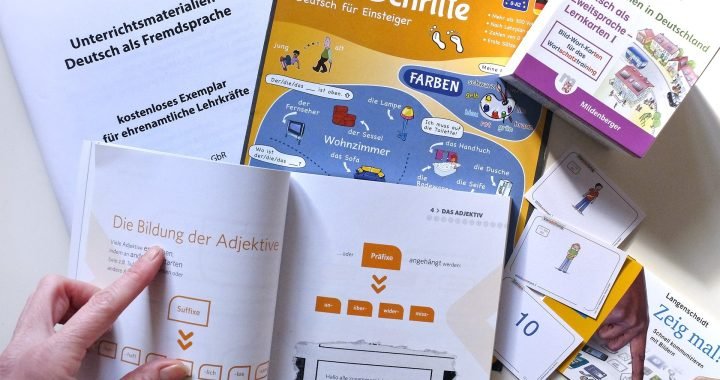
Deutsch.fit bietet kostenloses Deutsch-Lehrmaterial für ehrenamtliche Lehrer

Mauswiesel bietet Lehrmaterial vom ABC lernen bis Rechtschreibung und Themen (schreiben und lesen)

Auf dieser Seite findet ihr viele Arbeitsblätter zum runterladen. 

Online TV

KiKa (Kinderkanal /channel for children) offers a considerable amount of valuable shows, games, riddles, and lists of books for children of any age.

My children liked to watch “Die Sendung mit der Maus” (some video and youtube excerpts here ) on Sundays, as well as the “Sonntagsmärchen” (Sunday tales, mainly Grimms’ tales but also from other cultures).

At “Check Eins” you find online TV programs for children and teenagers; online games like memory, quizzes and downloadable color in sheets with comic characters;  series of pictures from videos that you can use to retell stories or videos the children have watched.

TV Stream und Download:

ARD Mediathek Programme der letzten sieben Tage im Stream.

Arte Programme der letzten sieben Tage im Stream.

MediathekView Programm zum Downloaden und archivieren von Sendungen und Filmen, die die deutschen öffentlich-rechtlichen Fernsehsender in den letzten 30 Tagen gesendet haben.

ZDF Mediathek Programme der letzten sieben Tage im Stream.

Die Sendung mit der Maus Klassiker unter den Wissensendungen für Kinder.

Galileo Wissenssendung. Im Archiv unter ‚Rubriken‘ und ‚Themengebiete‘ stöbern.

logo! Nachrichtensendung für Kinder und Jugendliche. Neueste Sendung im Stream, Texte und anschauliche Videos zu aktuellen Themen.

neuneinhalb Jede Woche eine neuneinhalb Minuten lange Sendung zu aktuellen Themen.

Planet Schule Filme und multimedial aufbereitete Inhalte für Lehrer und Schüler.

Planet Wissen Filme, Artikel und Podcasts.  Praktisch für die Einführung in ein Thema oder als Quelle für Schüler für Vorbereitung auf einen Vortrag.

Tatort Klassiker unter den deutschen Krimis. (nicht für alle Altersstufen geeignet!)

Wissen macht Ah!  25 minütige Sendungen für junge Zuschauer. Viel Hintergrundwissen auf der Website.

Unterrichtsmaterial für Filmwissen findet man auf folgenden Seiten:

Bundeszentrale für politische Bildung   Filmhefte und filmpädagogische Begleitmaterialien zu deutschen und internationalen Filmen.

Goethe-Institut Brüssel  Ausgezeichnete Arbeitsblätter zu einer Anzahl von Filmen kostenlos zum Download.

Goethe Institut – Film ab! Kurzfilme und Werbespots für den Deutschunterricht mit Didaktisierungen.

Kinofenster   Filmhefte und filmpädagogische Begleitmaterialien zu deutschen und internationalen Filmen.

Kino macht Schule Kostenloses Unterrichtsmaterial zum Download von A wie ‚Almanya‘ bis Z wie ‚Zorros Bar Mizwa‘.

Deutsche Welle Unzählige kurze Videos zum Deutschlernen für Selbstlerner und für den Unterricht. 

Videos sind mit deutschen Untertiteln, ergänzend umfangreiche Unterrichtsmaterialien.

Zum Beispiel:

Video-Thema: interessante Beiträge zu vielfältigen Themen.
Telenovela ‚Jojo sucht das Glück‘: die brasilianische Studentin Jojo, findet ihr neues Zuhause in Köln.
Das Bandtagebuch: Videotagebuch der Hip-Hop Band EINSHOCH6 aus München, Unterrichtsmaterial,                Songs der Band zum mitrappen.
Ticket nach Berlin: sechs junge Deutschlerner entdecken Deutschland auf einer turbulenten Reise.
Stadtbilder: kurze Filme über deutsche Städte (z.B. über Leipzig und Heidelberg) und ihre Attraktionen.

Audiobooks online

Gratis Hörspiele

Tausendkind-Hörbücher

Einfach vorlesen

Toniebox

Podcasts

SlowGerman is a podcast for adults who want to foster their listening skills – there is also the option to download the texts!

News Sites for Children / Nachrichten für Kinder

On the German tivi site, children can watch news and choose the topics they’re interested in.

Sprachspiele usw.

Das Bewegte ABC: Material zur Sprachförderung und Leseförderung

ABC Deutschkurs mit pdf zum runterladen

ABC via Youtube “Lern mit mir – ABC 123”

Kids TV mit Englischen Reimen auf Deutsch

For teenagers

If your children are learning German and you want them to read or listen to current topics, here are some interesting sites:

  • Yaez is a great site about “Schule, Stars & Trends” 
  • The Goethe Institut links to some other child appropriate sites with topics of different content and also one with youth literature.
  • Personally, I like the site of the Deutsche Welle where one can listen to the audio of the articles, find a vocabulary at the end of it and also do a little comprehension test.
  • On this site, you can even choose the level of proficiency (and comprehension).
  • On the Deutschlernen Blog one can find many different kinds of texts, audiotexts, “German for children”, German exams etc., whereas the Deutschlerner Blog II is more for advanced students.
  • On the Deutschlandradio site, you can listen to news and audio articles.
  • And you can access some TV channels like ZDF via the mediathek site.
Deutsch: “Lebenslanges Lernen” (Sonderbriefmar...

Deutsch: “Lebenslanges Lernen” (Sonderbriefmarke), Nominal: 110 Pf. / 0,56 EUR, Maß: 43,0 × 25,5 mm, Papierqualität: Postwertzeichenpapier DP 2 Text: also lautet ein beschluss dass der mensch was lernen muss. lernen kann man, gott sei dank, aber auch sein leben lang . (Photo credit: Wikipedia)

I like to use songs to teach German to teenagers. On the website of the Goethe Institut you can find some good ones.

From the Deutsche Welle site (where you can find many more links!) for children who learn German as Additional Language or as First Language:

Although I check these sites regularly, please, do double-check if the links work and about the age-appropriateness of the content of the sites I mention in this post! 

If you have any other site that you would recommend for teenagers who are learning German – or who would like to improve their German – please leave the link in the comments here below and I’ll be happy to add them!

International Day of Multilingualism: 27 March

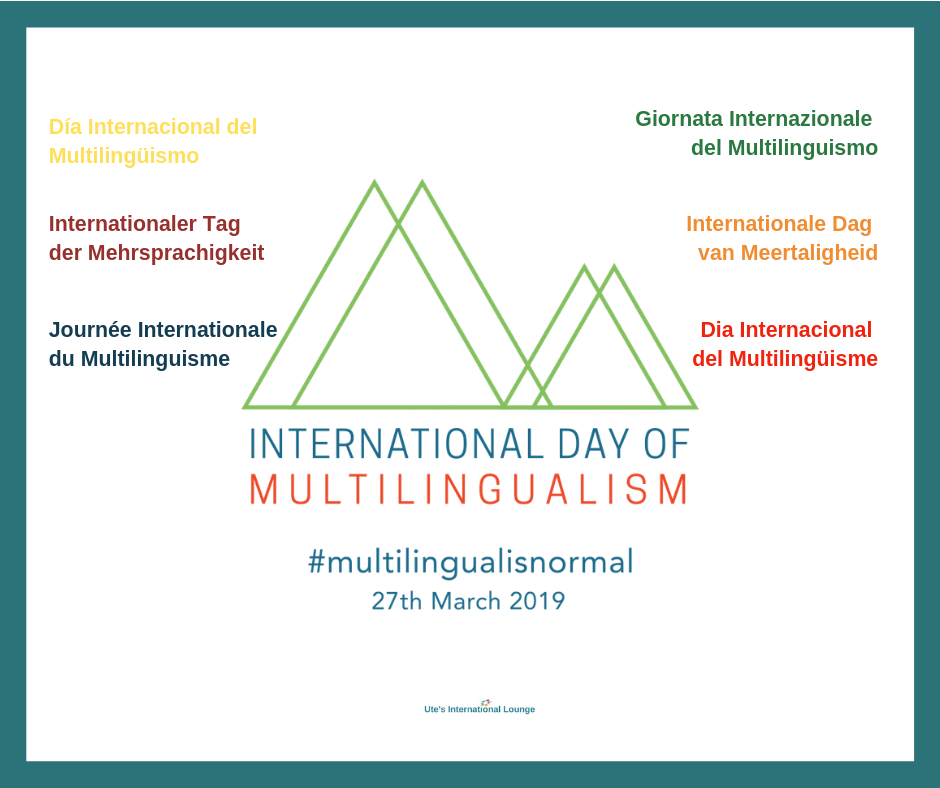
Together with a group of other linguists and language enthusiasts,  we propose the 27th March as the International Day of Multilingualism. This is the day we want to embrace the variety of languages that we all hear, speak, read and write to different extents on a daily, weekly, monthly basis.

Because more than half of the worlds’ population speaks more than one language it is time to establish that #multilingalisnormal.


Why the 27th of March?

The 27th March was chosen for the International Day of Multilingualism because this is the date engraved on the Rosetta Stone: 27 March 196 BC,  the world’s most famous multilingual text, engraved with Ancient Egyptian, in hieroglyphic, Demotic and Ancient Greek. The Rosetta Stone was the key to unlocking new understanding of Egyptian hieroglyphics because linguists in the 1800s were able to decode the hieroglyphs by translating the Ancient Greek text and comparing it to the Demotic text, looking for overlapping phonic or ideographic clues.


The overlapping of languages, the clues that one language provides for another, and the way that we use languages in a multi-layered, multi-lingual way in our lives was the reason for choosing the triangles symbol in the logo for the International Day of Multilingualism. They symbolize the many languages, and the many different ways of learning and speaking them.

On this first International Day of Multilingualism we celebrate that Multilingual is normal!

You can also support the first International Day of Multilingualism on 27th March 2019 by:
1 – sharing a photo/quote/fact related to languages across as many of your social media accounts as possible
2 – using the #multilingualisnormal hashtag in all posts
3 – posting at 09:00 and 21:00 GMT on Wednesday 27th March 2019
4 – scheduling multiple posts to create a simultaneous wave of support

Let’s get the topic trending, and get people talk!

You can join the International Day of Multilingualism Facebook group here, and discuss ideas on how to take part with other interested parties.

The official website can be accessed here.


Who is multilingual?

A multilingual person is someone who can communicate in more than one language, either actively (through speaking, writing, or signing) or passively (through listening, reading, or perceiving) – other similar terms are also polyglot or plurilingual.


Some important facts about multilingualism 

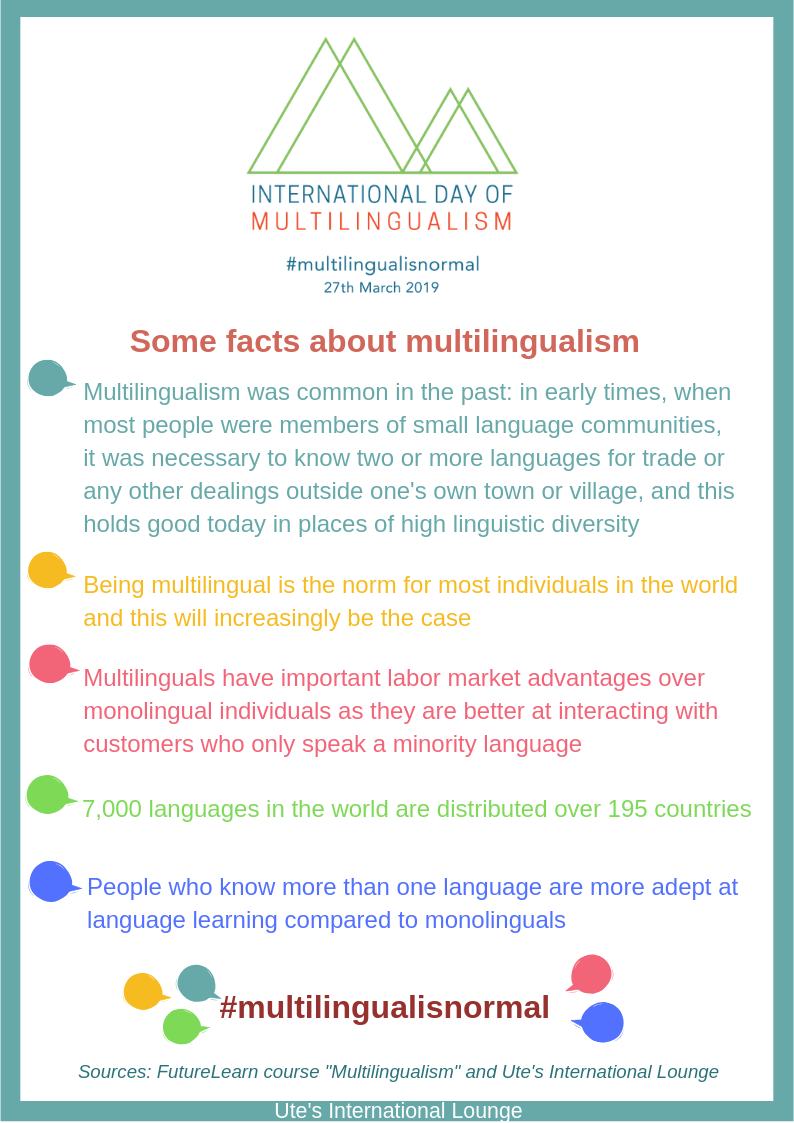
  1. There are 7,000 languages in the world distributed over 195 countries: thus, every country in the world is multilingual. 
  2. The amount of languages spoken in a region differs greatly. For example, Europe as a region features less languages than many equivalent sized regions in Asia or Africa.*
  3. Being multilingual is the norm for most individuals in the world and this will increasingly be the case.*
  4. Most languages can be clustered in different families but some are completely unrelated to any other known language.*
  5. The number of speakers of a language differs if we also count those learning the language as a foreign language (i.e. through a school).*
  6. People who know more than one language have been reported to be more adept at language learning compared to monolinguals.
  7. Bilinguals might have important labor market advantages over monolingual individuals as bilingual people are able to carry out duties that monolinguals cannot, such as interacting with customers who only speak a minority language
  8. Multilingualism was common in the past: in early times, when most people were members of small language communities, it was necessary to know two or more languages for trade or any other dealings outside one’s own town or village, and this holds good today in places of high linguistic diversity such as Sub-Saharan Africa and India


* from FutureLearn course “Multilingualism”


Related posts:

Multilingual is Normal 

The 1st International Day of Multilingualism

International Day of Multilingualism 27th of March #multilingualisnormal


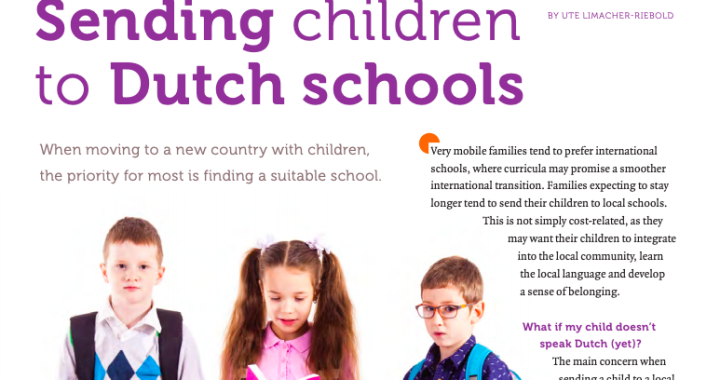
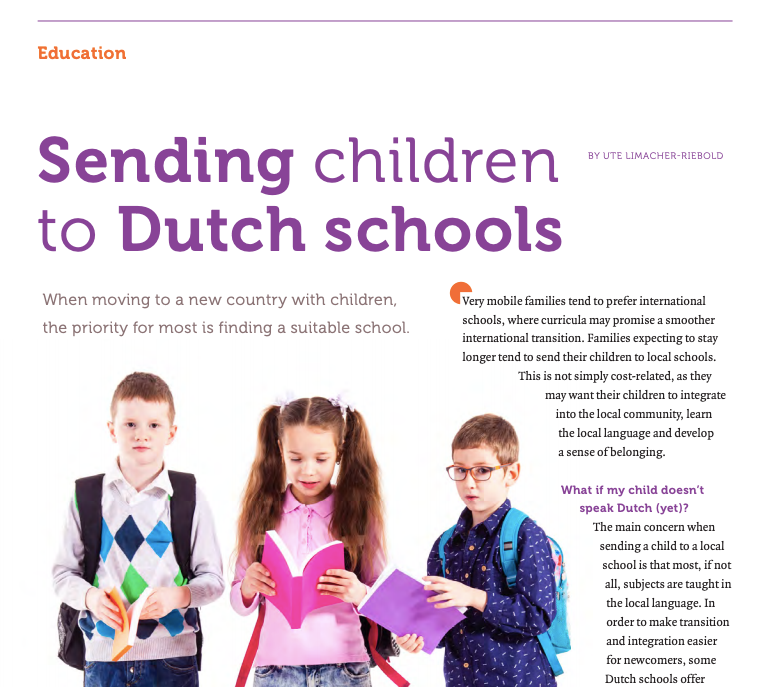
Sending children to Dutch schools (article in ACCESS magazine March 2019)

When moving to the Netherlands with family, one of the first things internationals want to find is a school for their children. Although very mobile families tend to prefer international schools, but more and more choose to send their children to local schools.

In this article for ACCESS magazine (issue Spring 2019) I shared some aspects to consider and check before the move.

I want to add one important aspect to what I mentioned in the article: if you have a child in secondary school that needs special support, and you plan to stay in the Netherlands only for a few years you may want to reconsider your decision. 

Although some international schools offer some kind of support for children who are already at their school, many internationals experience a different treatment when they apply for one of the schools and indicate what need their child needs support with. 


It seems that schools tend to turn down children who have been assessed before coming to the Netherlands and the only option for them is to enroll in a Dutch school. This means, of course, that you have to consider the time it takes for your child to become sufficiently fluent in the Dutch language to be able to join peers. I know that many families with SEN children in secondary school decide against the move for exactly this reason.

For more information about this, please contact me at info@UtesInternationalLounge.com or visit the site inclusion4all.com.

International Mother Language Day


The 21rst of February is the day we share ways on how to support “mother languages” in our community.
I personally would prefer the term of “home” or “family languages” as the term of “mother language” is not including all language situations in families. It should at least include “father language”, and ideally all other languages that are fostered at home.

Some background information about the International Mother Language Day

Since 2000 the International Mother Language Day is celebrated worldwide on the 21 February in remembrance of the 21 February 1952, when “students demonstrating for recognition of their language, Bengali, as one of the two national languages of the then Pakistan, were shot and killed by police in Dhaka”, the capital of what is now Bangladesh.

The Mother Language Day was proclaimed on 17 November 1999 by the General Conference of the United Nations Educational, Scientific and Cultural Organization (UNESCO) (30C/62).

On the 16th of May 2007, the United Nations General Assembly called upon Member States “to promote the preservation and protection of all languages used by peoples of the world” in its resolution A/RES/61/266. By the same resolution, the General Assembly proclaimed to promote unity in diversity and international understanding, through multilingualism and multiculturalism.

  • Languages ensure access to knowledge and permit its transmission and its plurality. Local languages are perfectly capable to transmit the most scientific knowledge in mathematics, physics, technology etc., therefore, recognizing these languages opens “the door to a great deal of often overlooked traditional scientific knowledge to enrich our overall knowledge base… Excluding languages means excluding those who speak them from their fundamental human right to scientific knowledge“.
  • Languages shape minds in the broadest sense.
  • They help building global citizenships.
  • Intercultural understanding is only possible through language and dialogue. “In today’s world, the norm is to use at least three languages, including one local language, one language of wider communication and one international language to communicate at both the local and global levels. – Linguistic and cultural diversity are our best chance for the future: for creativity, innovation and inclusion”.

Speaking one’s mother language is still not something we all can take for granted, especially in places where local mother tongues are threatened by more dominant languages.

***

The following video was produced by the UNESCO Liaison Office in New York in 2010, on the occasion of the International Mother Language Day, to raise awareness on the importance on languages today.

“Linguistic diversity is under threat. More than the half of the 7000 languages spoken in the world may die out over the next few generations. This loss not only erodes individual communities and cultures, but more broadly the very make up (?) of our society” (Irina Bokova UNESCO Director General (0:00-0:37)

“We focus on multilingualism as a way to preserve our valuable linguistic inheritance” (1:22)

If languages do not exist, cultures disappear” (1:26)

Part of our identity is the language that we speak” (1:41)

 “Children who learn their mother language do better in school. Literacy progress in mother languages bring learners the self confidence that they need to participate in their communities and make informed choices” (2:30-38).

96 % of these languages are spoken by a mere 4 % of the world’s population. Only a few hundred languages have genuinely been given pride of place in education systems and the public domain, and less than a hundred are used in the digital world.

Less than a quarter of all languages in the world are used in educational and cyber space. This is why we have to assist governments in both safeguarding linguistic diversity and promoting multilingual competences” Irina Bokova UNESCO Director General (4:08-4:23).

Languages are the most powerful instruments of preserving and developing our tangible and intangible heritage. All moves to promote the dissemination of mother tongues will serve not only to encourage linguistic diversity and multilingual education but also to develop fuller awareness of linguistic and cultural traditions throughout the world and to inspire solidarity based on understanding, tolerance and dialogue.

—from the United Nations International Mother Language Day microsite

***

2019

The message from Ms Audrey Azoulay, Director-General of UNESCO says on occasion of International Mother Language Day,

“Indigenous peoples have always expressed their desire for education in their own languages, as set out in the United Nations Declaration on the Rights of Indigenous Peoples. Since 2019 is the International Year of Indigenous Languages, the theme of this year’s International Mother Language Day will be indigenous languages as a factor in development, peace and reconciliation.

Indigenous peoples number some 370 million and their languages account for the majority of the approximately 7,000 living languages on Earth. Many indigenous peoples continue to suffer from marginalization, discrimination and extreme poverty and are the victims of human-rights violations (…). On this International Mother Language Day, I thus invite all UNESCO Member States, our partners and education stakeholders to recognize and enforce the rights of indigenous peoples.” 

The topic of this year focuses on the indigenous languages that are minoritized by a more international or dominant language. These local languages transmit cultures, values and traditional knowledge. 

In March 2013, Rita Izsák, UN Independent Expert on minority issues, said that “protection of linguistic minority rights is a human rights obligation and an essential component of good governance, efforts to prevent tensions and conflict, and the construction of equal and politically and socially stable societies“.

***

No matter where we live, our children should have the opportunity to acquire, learn and master their first languages – or mother/father tongues – not only in speech but also in reading and writing. If we don’t get support by the community, school etc., we, parents, caregivers etc. want to make sure our children use our language the best they can.

Language is not only a means of communication but it is the most powerful instrument of preserving and developing our tangible and intangible heritage.

Like for all “special days”, my personal wish is that in the very near future we won’t need to celebrate any International Mother Language Day anymore, because all languages will get recognized and fostered every day of the year. 

I am aware that this is still wishful thinking, therefore I invite you to start with speaking (reading and writing) your languages today

And as it is all about finding ways to support our home languages today, here are my tips on how to help our teenagers bilingualism and biculturalism:

  • bear in mind that teenagers rate peers higher than parents!
  • foster social networking: chatting via webcams is a great way to keep the other language alive. It is a great alternative to Saturday schools or parents teaching these languages at home!
  • be open minded when it comes to slang (and swearwords!). While growing up abroad, bilinguals will use the language in an “artificial context”. Allowing your child to use the slang their monolingual peers use, will help them fit in easier once you visit the country.
  • help them find resources to have access to the local slang.
  • make sure they know about the habits and values of peers in the other culture.
  • travel as often as you can to different places of your family languages and offer them opportunities to meet peers (by enrolling them in some local activities they like).
  • if you can’t travel that often and provide full language immersion, look out to other families that speak the same language where you live.
  • find penpals for your children – using social media may also be an option, but if you would like your children to improve their written skills in the other language(s), writing in the “old fashioned way” is advisable.

***

The theme of the IMLD in 2021 is “Fostering multilingualism for inclusion in education and society“, recognizes that languages and multilingualism can advance inclusion, and the Sustainable Development Goals’ focus on leaving no one behind. UNESCO believes education, based on the first language or mother tongue, must begin from the early years as early childhood care and education is the foundation of learning. (UNESCO website of the day)

Please find more information in the folder for the IMLD 2021 here

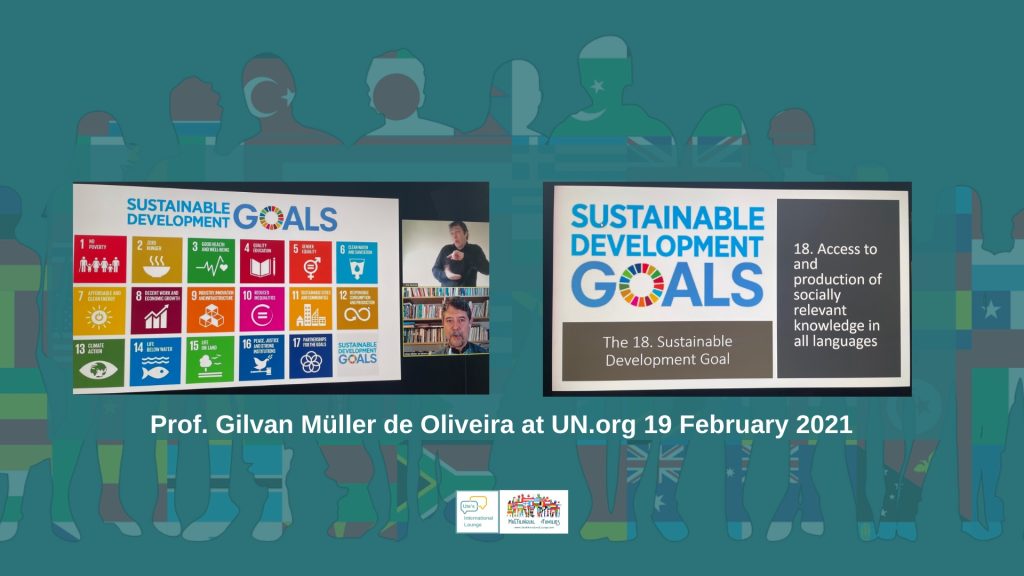
During the webinar held on the 19 February 2021, Prof. Gilvan Müller de Oliveira expressed what I guess we all aim for, that the UN adds the Access to and production of socially relevant knowledge in all languages as the 18th of the Sustainable Development Goals:


If you want to participate in the celebration of this day, have a look at the UNESCO.org website.

Ana Elisa Miranda and I are happy to contribute to celebrating all our home languages by offering our Toolbox for Multilingual Families for free on amazon from 20.-21.2.2021.


– Please share your thoughts and the way you celebrate or support your languages today in the comments.

European Charter for Regional or Minority Languages

J’aime mon accent, et toi?

Ceci est un poème de Miguel Zamacoïs, romancier, auteur dramatique, poète et journaliste français. 

On parle toujours des accents, on juge les personnes selon leurs accents, mais nos accents sont plus que des mots prononcés d’une certaine manière, intonations “différentes”…: c’est notre invisible bagage, le parler de chez soi qu’on emporte en voyage.

People talk about accents and tend to judge, categorize people by accents and languages. Accents are more than words pronounced in a certain way, different intonations… : it’s our invisible bagage, the way we talk at home that we carry with us when we travel.


« De l’accent ! De l’accent ! Mais après tout en-ai-je ?
Pourquoi cette faveur ? Pourquoi ce privilège ?
Et si je vous disais à mon tour, gens du Nord,
Que c’est vous qui pour nous semblez l’avoir très fort
Que nous disons de vous, du Rhône à la Gironde,
« Ces gens là n’ont pas le parler de tout le monde ! »
Et que, tout dépendant de la façon de voir,
Ne pas avoir l’accent, pour nous, c’est en avoir…

Eh bien non ! je blasphème ! Et je suis las de feindre !
Ceux qui n’ont pas d’accent, je ne puis que les plaindre !
Emporter de chez soi les accents familiers,
C’est emporter un peu sa terre à ses souliers,
Emporter son accent d’Auvergne ou de Bretagne,
C’est emporter un peu sa lande ou sa montagne !
Lorsque, loin du pays, le cœur gros, on s’enfuit,
L’accent ? Mais c’est un peu le pays qui vous suit !
C’est un peu, cet accent, invisible bagage,
Le parler de chez soi qu’on emporte en voyage !
C’est pour les malheureux à l’exil obligés,
Le patois qui déteint sur les mots étrangers !

Avoir l’accent enfin, c’est, chaque fois qu’on cause,
Parler de son pays en parlant d’autre chose !…
Non, je ne rougis pas de mon fidèle accent !
Je veux qu’il soit sonore, et clair, retentissant !
Et m’en aller tout droit, l’humeur toujours pareille,
En portant mon accent fièrement sur l’oreille !
Mon accent ! Il faudrait l’écouter à genoux !
Il nous fait emporter la Provence avec nous,
Et fait chanter sa voix dans tous mes bavardages
Comme chante la mer au fond des coquillages !
Écoutez ! En parlant, je plante le décor
Du torride Midi dans les brumes du Nord !
Mon accent porte en soi d’adorables mélanges
D’effluves d’orangers et de parfum d’oranges ;
Il évoque à la fois les feuillages bleu-gris
De nos chers oliviers aux vieux troncs rabougris,
Et le petit village où les treilles splendides
Éclaboussent de bleu les blancheurs des bastides !
Cet accent-là, mistral, cigale et tambourin,
À toutes mes chansons donne un même refrain,
Et quand vous l’entendez chanter dans ma parole
Tous les mots que je dis dansent la farandole ! »


Language acquisition versus language learning


What is the difference between language acquisition and language learning.


Some people use the term of language acquisition for all the phases that lead to language fluency, including learning to read and write. Others use the term of language learning even for babies and very young, pre-school children. – But there is a fundamental difference between these two terms.


Children acquire language through a natural, subconscious process during which they are unaware of grammatical rules. This happens especially when they acquire their first language(s). They repeat what is said to them and get a feel for what is and what is not correct.
In order to acquire a language, they need a source of natural communication, which is usually the mother, the father, or the caregiver. Children who grow up with multiple languages, will acquire these languages in the most natural way. They will repeat what they hear, try out sound chains until they make sense (i.e. others will understand their meaning), and they will use them purposefully in their communication. – Some distinguish infant language acquisition – as defining the process of acquiring the first language(s) – from second language acquisition, which takes place "later" and in addition to speech, includes also reading and writing.

As many parents tend to think that they need to teach their language to their children, it is important to make sure the whole concept is clear!

We do not teach our children the first language(s)! We transmit our languages through verbal and non-verbal communication. We do not need to explain all the objects around us. We don't need to show our child what an apple is and say "this is an apple", or a cup "this is a cup". We simply need to use our language like we always do and our children will acquire it by simple and regular exposure. We need though to involve them in conversations with us – also non-verbal ones count! – and encourage them to use our language.

In German we distinguish between Spracherwerb and Sprachenlernen, in Italian between acquisizione di una lingua and apprendimento di una lingua, in French acquisition du language and apprentissage d'une langue.


Language learning, on the other hand, is the result of direct instruction in the rules of language. Language learning is not an age-appropriate activity for very young children as learning presupposes that learners have a conscious knowledge of the new language and can talk about that knowledge.

Language learners usually have a basic knowledge of the grammar of their first languages they acquired. They know the differences in intonation, the sound of words, what a grammatically correct word order is in a sentence in the language, that words can have multiple meanings etc..

When we learn a new language we have a deductive approach to the intonations, phonology, morphology, syntax of the target language. This happens when we start being schooled in this language, when we learn to read and write.
Reading and writing are not skills that come naturally. They are not intuitive. We need to learn that signs (letters and letter combinations) represent a sound, that by combining them we form words that have a meaning, which we can use to convey our thoughts. We learn that there are rules for each language, concerning the position of the words in a sentence, that intonation can vary and change the meaning of a word and a sentence, that one word can have many different meanings, depending on the context. For example, in "I like the green apple", depending on the intonation and accentuation of one word, we can convey different meanings:

I like the green apple = It's not Tom who likes it!
I like the green apple = Really, I'm honest!
I like the green apple = Not the red one!
I like the green apple = Not the kiwi!


©Fernandes Arung 2016 (see below)


From a neurolinguistic point of view, language acquisition and language learning are processed in two different ways in the brain.

There are many areas of the brain involved in language acquisition and learning, and in the understanding and articulation of languages.

The two main areas are the Broca’s area, which is situated in the left frontal cortex, and is the word production center of the brain, i.e. responsible to the production of the patterns in vocal and sign language.
The Wernicke’s area, in the left temporal cortex, is the word recognition center, which is primarily involved in language comprehension.

Roughly said, the Broca’s area is the one actively involved in language acquisition processes, whereas the Wernicke’s area is active in the language learning process – where the understanding speech takes place.

During speech processing and language learning, these two areas collaborate with multiple other areas of the brain, like the Angular Gyrus – where the assembling of information takes place, and where understanding of words and concepts happens –, the Supramarginal Gyrus, which is involved with language perception and processing, and the Primary Auditory Cortex, where auditory signals are recognised, memorised and may result in a response...


To learn more about how this works, have a look at the video with Kenneth Pugh (Haskins Laboratories/Yale University) and Arturo E. Hernandez (University of Houston):


About Co-Evolution of Language and the Brain: https://blogs.ntu.edu.sg/hss-language-evolution/wiki/chapter-16/


Acquisition:

  • unconscious process

  • does not presuppose teaching

  • the child controls the pace

Learning:

  • intentional process

  • presupposes teaching

  • the teacher controls the pace

Some articles:

Ambridge, B., & Lieven, E.V.M. (2011), Language Acquisition: Contrasting theoretical approaches. Cambridge: Cambridge University Press.

Arung, Fernandes, (2016), Language Acquisition and Learning on Children, Journal of English Education, Vol. 1, No. 1, March 2016, 1-9. 

Brooks, Patricia & Vera Kempe (eds.), Encyclopedia of language development, Thousand Oaks, Sage. 

Chomsky, N. (1965), Aspects of the Theory of Syntax, MIT Press.

De Houwer, A., (in press 2019) Uninstructed language acquisition in multiple language learners in Jeroen Darquennes, Joseph Salmons & Wim Vendenbussche, Language Contact. An International Handbook, Berlin, Germany, Mouton de Gruyter, 183-196.

Pecchi, Jean Stillwell, 1994, Child Language, London, Routedge.

Pine, J.M., Conti-Ramsden, G., Joseph, K.L., Lieven, E.V.M., & Serratrice, L. (2008). Tense over time: testing the Agreement/Tense Omission Model as an account of the pattern of tense-marking provision in early child English, Journal of Child Language, 35(1), 55-75.

Pinker, S. (1994), The Language instinct, New York, W.W.Morrow.

Pinker, S. (1995), The New Science of Language and Mind, Penguin.

Rowland, C. F., & Noble, C. L. (2010), The role of syntactic structure in children’s sentence comprehension: Evidence from the dative, Language Learning and Development, 7(1), 55-75.

Skinner, B.F. (1957). Verbal Behavior, Acton, MA, Copley Publishing Group.

Smith, N. (1989). The Twitter Machine: Reflections on Language, Oxford, Blackwell.

Theakston, A.L., & Lieven, E.V.M. (2005), The acquisition of auxiliaries BE and HAVE: an elicitation study, Journal of Child Language, 32(2), 587-616.

Tomasello, M. (2005), Constructing A Language: A Usage-Based Theory of Language Acquisition. Harvard University Press.

You can find more articles about Language Acquisition here.

"Playing the Language Game." Program Two: Acquiring the Human Language. The Human Language Series. Videocassette. New York: Equinox Films, 1995.

How it works: Video

Research about Language Acquisition:

Utrecht Institute of Linguistics

Radboud University Nijmegen

MIT Language Acquisition Lab

And please watch this very inspiring video which shows the way I acquired most of my languages!