When you end up talking another language with your child…


Many internationals end up talking another language with their child than the one they chose at the beginning.


There are different reasons for this:


– They live in a country where their mother tongue is not recognized as an important (= prestigious enough...) language, i.e. it is not supported by the school and society, and there is not a linguistic community which could help to support these families to keep on talking this language – at least in private.

– They don't consider their family language important enough to pass it on to their children – because they don't have family and friends who share this language, and are second or third generation speakers themselves.

– Doctors and teachers told them to drop their family language in order to help their children integrate easier into the local school and perform better.

This last reason is, alas, the most common one. In many countries, schools and societies are getting more and more aware of the importance to maintain the heritage languages, since research clearly proves the benefits of it on the childrens' academical  performances on the long run.


But what about the other two? – When a language is considered "not important enough" by a society (and, consequently, by schools, teachers, doctors, locals...), and there are no resources available for these families to foster the language in a spontaneous and natural way – communities, libraries, language learning opportunities etc. – it is almost impossible for parents to maintain a language "alive" in their family.

If they manage despite these difficult circumstances, the language becomes tendentially "artificial". In order to keep a language "alive", it needs to be practiced on different levels: to become fluent and confident in a language one needs to be able to distinguish between several registers, understand slang for example and a broader range of meanings.

This situation becomes even more complex for bilingual parents: Which language should they choose to talk with their children? Do they need to choose or can they pass on both or all of their languages?

Linguists usually recommend to speak the “mother-tongue(s)” (i.e. the parents' language(s), the family language(s)) to our children. But which is the mother-tongue if you are a balanced bilingual and if your extended family talks both or even more languages? – When it comes to agreeing on the languages to speak to our children when we, parents, are already bilinguals (= understand /talk /read /write two or more languages), there is not one-size-fits-all solution. 


My personal experience...

I am a multilingual parent and grew up with 2 languages myself (Italian and German). We were living in Italy when our son was born and as Italian is one of my dominant languages and actually the one I'm most spontaneous in, it was natural for me to speak Italian to him from the beginning.

Our home languages were Italian (me and my son), Swiss German (my husband and my son) and German (my husband and I) and we knew that he would pick up German automatically too.

When we moved to the Netherlands our son was 2,5 years old. Two months after he started attending a Dutch daycare, he stoped responding in Italian to me. 

My husband was still speaking Swiss German to him and I noticed that my son preferred to answer me in Swiss German or even Dutch. Nevertheless, I kept on speaking Italian, assuming that this was just a phase.

When children are exposed to another language in a "full immersion" way, like it was at the daycare for my son, they tend to prefer that language to the other languages (cfr. the "home-" or "family-languages")  and once they feel more comfortable in both (or more languages), and the input in all languages is still enough and there is a proper need for them to speak all the languages, they get back at speaking them all. – So I persisted with Italian, knowing that he would at least gain a passive competence in this language.

Unfortunately in this period we didn’t find Italian families with children of his age and I was the only person he would speak Italian with. Also, he realized that I understand and talk the other languages too: I learned Dutch with him and perfectly speak Swiss German and German too.

So, all he was doing was following the economic principle in languages: he didn't see why he should keep on speaking Italian with me, there was no real need for him to do so.

The concept of economy – a tenet or tendency shared by all living organisms – may be referred to as "the principle of least effort", which consists in tending towards the minimum amount of effort that is necessary to achieve the maximum result, so that nothing is wasted. Besides being a biological principle, this principle operates in linguistic behaviour as well, at the very core of linguistic evolution. In modern times it was given a first consistent definition by André Martinet, who studied and analysed the principle of economy in linguistics, testing its manifold applications in both phonology and syntax.(Alessandra Vicentini, The Economy Principle in Language, 2003)

I still kept speaking Italian to my son and to my twin daughters who were born a year after we arrived to the Netherlands, confident that when they would start speaking Italian, my son would follow them and everything would be fine.

In fact, all three spoke Italian to me for almost four months when my daughters were 11-15 months old : my daughters started forming monosyllables around month 10/11 in Swiss German, Italian and Dutch).

When plans change...

But then, my daughters started to communicate in an autonomous language that had nothing in common – neither phonetically, nor morphologically – with the languages they were exposed to.

This secret language became a problem in our family because nobody could understand what they were saying. It was mainly because our son was suffering from this situation – he couldn't understand his sisters and we weren't able to "translate" the meaning of the words they used either – that we decided to choose German as our family language. I was fully aware of the problems that could arise – confusion, subtractive bilingualism, language refusal from all children, loss of emotional bond if my husband and I would cease speaking Swiss German, respectively Italian with our children, only to name a few... –  and this would surely not be something I'd advise parents to do! But to avoid that my son would feel excluded and that his level of anxiety would worsen, and for the sake of a healthy linguistic atmosphere in our multilingual home, we decided to give it a try. It was very important for me to include our son in the decision making process! I am a firm believer, and research confirms this, that children's agency, their active involvement in this kind of situations is of great importance!  

Cummins draws the distinction between additive bilingualism in which the first language continues to be developed and the first culture to be valued while the second language is added; and subtractive bilingualism in which the second language is added at the expense of the first language and culture, which diminish as a consequence. Cummins (1994) quotes research which suggests students working in an additive bilingual environment succeed to a greater extent than those whose first language and culture are devalued by their schools and by the wider society.

We did not completely stop speaking Swiss German and Italian at home. We shifted the focus on German, but maintained the other two languages in one on one settings and when reading and singing with our children, and, of course, when speaking with our Swiss German and Italian speaking members of the family. I was constantly monitoring my children's reaction and behaviour.

Luckily our children responded very well to this change: after two months our daughters completely stopped speaking the secret language and started speaking German and our son showed a very positive reaction to us speaking German all together. They increasingly searched to communicate with us in German and would also enjoy listening to the other languages. We agreed that their Italian and Swiss German would, for the moment, rather be passive (receptive multilingualism), knowing that understanding our languages would make it easier later on to activate the languages and become verbal.
It is important to add that our daughters started going to a Dutch daycare 1, later 2, then 3 days a week, starting from 7 months. They were in separate groups with the possibility to meet over the day and play together if they wanted. The reason for this early socialization was that I observed them assuming a clear behaviour of giver and taker, which I first tried to balance with playdates. Arranging regular gatherings with other parents of infants was not possible and I saw that it didn't work as my daughters would rather prefer playing with each other than with other children. My intent was to make them experience play and interaction with other children of the same age, to learn socialise with others and find their very own way of being and interacting. I know that many twins can't stay apart, or suffer when they don't see or hear their twin. My daughters were different from the beginning. They would search physical contact when napping or during the night, but not so during the day. They enjoyed discovering the world each in her very own specific way. – The development of this autonomous language, also known as cryptophasia, came "out of the blue" and both were already verbal in our languages. I know that some twins or siblings develop this secret language at different times in life, but what I didn't know was how long it would take until this phase is over. I didn't want to risk the health of my son and the bond we have as a family, that was compromised by this isolating language...

More than 10 years later...

More than 10 years later, my children speak English, Dutch and German on a daily basis, they also speak French and Spanish on a basic level, and our son is learning Chinese. They all understand and speak Italian on a A1/A2 level, and Swiss German. In order to support Swiss German and Italian we used to spend our summer holidays in Switzerland, meeting family and friends who would provide the necessary input during our stay. We stoped with these language immersion holidays three years ago, because we decided all together to focus on the languages we need in our daily life: German, Dutch and English.
I observe that all three have very different preferences when it comes to languages, and I am happy to see that they don't refuse any of them. They have attained different levels of fluency, and that is enough for what they need right now. Should they ever need to improve any of their less dominant languages at some point, I know we have planted the seeds. We have watered the plants regularly, some more than others, but that's how it goes. We can't expect to be perfectly balanced in all our languages, that isa huge myth many parents want to make true. What I'm sure though is that they all are aware of the gift of languages they have, they are proud of it and they know what to do should they want to improve their language skills in any of them!

How we did it

For multilingual parents maintaining one or more minority languages* requires a considerable effort and is a greater commitment and challenge. Some families follow the Time and Place strategy, ie. they have fix situations and times where they talk one or the other language. – I usually recommend this strategy  with older children who have already a sense of time and understand why a parent would switch to another language. In our family we have agreed on times when we speak English or Dutch at home: during the week, after school and when we have guests who don't speak German. 

When my son was born we thought he would become fluent in Italian and German – attending a school in Italy –  but when we moved to the Netherlands we had to reassess our language situation. He went to a Dutch daycare and we thought he would attend a Dutch school later; so Dutch became the dominant language for a year. When we decided to send him to an English speaking school, this changed again: English, Dutch and at that time German, became his most dominant languages.
For our daughters, who started speaking Swiss German and Italian, Dutch and German were the most dominant languages until age 3 and English replaced the Dutch when they started attending the same school as their brother.

We never had long term language goals as we knew that all can change and would change, due to international moves and our children being schooled in their fifth language (chronologically speaking), and growing up in a highly multinational and multilingual community.

When my son asked me explicitly to restart speaking Italian with him more regularly because he noticed that when I was talking Italian with friends, I would remind him of earlier and he wanted to connect through this language with me, we agreed on a plan to speak Italian to each other during our one on one time. 

Unfortunately our school doesn't provide sufficient language tuition and I gave my children language lessons in German for 2 years. Only 2 years because I noticed that it didn't work to be mum and teacher with my children. We agreed that they would watch German TV, listen to German podcasts and audiobooks, and read books in German.


In 2017, this was our situation:
"my daughters recently (May 2017) asked me to teach them Italian and I now dedicate 2 hours per week to "teaching" them Italian in a natural way – we read texts, do role plays, listen to music. As all three children have an analytical approach to Italian I introduce grammar (how you form plurals, according adjectives etc.) to them in a context based way, i.e. when we listen to a song or read a text I will focus on one aspect, for example the form and agreement of adjectives in Italian. 

At the moment I dedicate 6 hours per week to teach my children German, Italian and French. – The goal that we have agreed on is for them to become nearly native in German (C2 level) and confident enough in Italian and French (both B2 or C1). "

In 2020, the situation is very different. I don't teach any language to my children anymore. They have made the commitment and took the responsibility to work on their language skills independently. Reading in German or Italian is not what they do spontaneously, or at least, it is not their first choice. Two of my children are book worms and I fully welcome this no matter the language. German is a language they find too difficult to read ("the sentences are so long... and so boring..."), so they tend to opt for shorter texts – posts, online articles, and whenever possible, prefer videos... 

In 2024, all my children are adults and they have a native and nearly-native level in English, Dutch and German. They understand, speak, read and write Italian, Spanish and French to different levels of proficiency, and understand and speak also Swiss German. In the past 4 years my son has started learning Mandarin Chinese and Japanese independently, and keeps improving his French. One of my daughters is learning Russian, the other one Thai and Mandarin Chinese. 

Never give up!

Many of my clients struggle with accepting that their children don't speak their language, that they don't respond in the family language. Not sharing their language with their children deeply affects them and many surrender.

One of my clients managed to talk Italian to his daughter for 10 years, not getting any response in Italian, only in Dutch or English. His daughter was perfectly able to understand Italian and would also speak basic Italian with extended family, but knowing that her father was fluent in English and Dutch. Growing up in a highly international environment where English and Dutch are the dominant languages, made her prefer these two languages even when speaking with her Italian father. 

We all identify with the languages we know, with the cultures they represent and everything that we associate with the language. Not speaking a language we feel very connected with with our loved ones feels like missing out the opportunity to share the most spontaneous thoughts and emotions with them.

Speaking German with my children feels like speaking through a filter, whereas when I speak Italian, I speak from my soul: this is why I never gave up on Italian!

I always ask my clients: if you could fast forward 10 years, would you be happy not to speak your language with your child?

What about when you become grandparent? If you feel that you have to silence part of you by not speaking your language, that you don't feel comfortable with it in some way, then don't stop talking your language to your child, no matter how your child responds.*

The daughter of my client did the same as my son and my daughters: after several years she started talking Italian again. She had listened to his Italian for years and built a passive/receptive vocabulary, and knew exactly how to form sentences and is now (at age 18) nearly native!

* I must add that there are some extreme situations where I would not advise to keep talking your language to your child, but these are very extreme (for more information about this you can contact me anytime) 

When the dominant language wins... again

Many internationals whose mother tongue or L1 is a minority language know how it feels like when their children prefer a more dominant language even at home. When they almost forget their family language(s) or consider it "not worth to be learned". – For parents this equals with a personal rejection from their children – although this is usually not the children's intention!  

With my clients who are in this situation I do regular assessments to analyze their language situation, the way their children cope with it.

I consider this very important as we all, our situations and our language preferences change over time, and we should let all members of the family know what our expectations are and try to adjust and agree on which languages to maintain. (Ute)

As I mentioned before, we never had unrealistic language goals with our children, and I made sure that our children always had a say when it came to language choices! 

We always have to look at the bigger picture and follow the long term goal which, for my family, is to keep on learning languages, stay flexible, and adjust to the different situations and needs. ~Ute's International Lounge @UtesIntLounge


Parents of bilingual children have to make choices that may not be the ones they wanted in the beginning, but that are necessary for their children to adapt to the situation they find themselves in.


I sometimes wonder: if the situation with my daughters wouldn’t have happened, my children would still speak Italian and Swiss German at home, and be less fluent in German. My children wouldn't be in the German native-speaker class at school – but among the Italian native-speakers. To be honest, it doesn't make a big difference for me, as German and Italian are my first languages, my two L1's. As for Swiss German: it is an oral language only, and therefore it was not difficult to accept that our children would learn it "on the side" – they understand everything today, and can also distinguish and understand different Swiss German dialects, which is, in my opinion, a fantastic achievement, considering that they spend on average 1 week in Switzerland per year!

When my son told me that he would like to speak Spanish and French at home too, I first got anxious because my children spend most of their time at school, have after school activities and homework to do, so the time to practice on those languages is not enough to foster these languages too. But it wasn't about reaching nearly native fluency! My son only wanted to exercise these languages with me, speak them and analyze them with me. 

We agreed on the fluency he wants to achieve in all the languages he is learning and improving, and so far I am very pleased to see that he takes this with the right spirit: he enjoys speaking the languages he chose and make the best out of it. He has published a guidebook for students preparing for their GCSE and is currently learning Chinese and Japanese.  


Heute we speak quasi ogni giorno alle taalen, pero no es importante qu'on les parle parfaitement: it's more important, Spaß dabei zu haben en ze alle heelemaal te genieten!


*minority language: a minority language is a language that is different from the official language(s) of a state and usually spoken by less than 50% of the population of a society/ community.

The term "bilingual" is here used to define people who understand and speak two or more language to a certain extent.


If you would like to know more about this and are interested in an assessment of your family language situation, contact me at info@UtesInternationalLounge.com – and have a look at my services here.


© Ute Limacher-Riebold, 2024 


Related articles

Mother tongue, first language, native language or dominant language?


What term should we use when talking about the first language we acquired and learned? Mother tongue is not ideal for many reasons.
Have you ever wondered what is the difference between mother tongue, first language (L1), dominant language etc., and what is the correct term to use? 


Mother tongue and L1

About the origin of the term mother tongue

“The origin of the term mother tongue harks back to the notion that linguistic skills of a child are honed by the mother and therefore the language spoken by the mother would be the primary language that the child would learn.” However, this type of culture-specific notion is a misnomer. The term was used by Catholic monks to designate a particular language they used, instead of Latin, when they are “speaking from the pulpit”.That is, the “holy mother of the Church” introduced this term and colonies inherited it from the Christianity as a part of their colonial legacy, thanks to the effort made by foreign missionaries in the transitional period of switching over from 18th-century Mercantile Capitalism to 19th-century Industrial Capitalism in India.” (cfr. wikipedia)


In one sense, we all have a mother tongue as we all have only one "mother", the one that uses her language with us. Whether this is now the birth mother, the biological mother or adoptive mother, the most important aspect is that it is the person that interacts with us from early on and transmits her language to us.
So, this can mean that the language our mother talked to us is automatically our mother tongue. But what about the father tongue? Or caregiver tongue, should someone else raise us?

The term of mother tongue refers historically speaking to a traditional/conventional family situation where the mother is the person who transmits the language to the child and is the main provider for input in that language for the children in their first years. This scenario is not very accurate anymore, surely not in today's world where fathers and other care givers are involved in providing input in the home language too, as well as for birth mothers, or adoptive mothers for example.

A friend of mine was adopted when she was 2 and grew up in a Dutch family: would her mother tongue be Swahili because her biological mother was talking Swahili to her – and which she recognized when exposed to it as a teenager – or would it be Dutch, the language the mother who adopted her talked to her daily?

Usually, mother tongue – or father tongue to be politically correct! –  defines the first language we were exposed to, chronologically speaking, our L1, the first language we understand and speak. It's the language we grow up with or that our parents (or caregivers) speak with us. – And usually people tend to speak this language for a long time.

If we want to define the chronologically first language we acquired, the term first language can seem more appropriate.

But what happens if we are exposed to two or more languages in our family because our parents and/or caregivers speak different languages with us and among them?

We can have multiple "first languages" or L1's. Some suggested to label them as La, Lb etc., but whatever number or letter we add to the "L" (language) this label always suggests some kind of hierarchy between the languages. Which language "deserves" to be "a" or "1". This only leads to power struggles that should be avoided when transmitting our languages to our children.

Talking about L1, L2, or La, Lb etc. only makes sense, if the languages are acquired or learned successively*, i.e. not simultaneously.

*Simultaneous bilinguals or multilinguals are exposed to more than one (or two) languages since day one. Successive bilinguals or multilinguals, are those who add other languages after having acquired the first language(s).

I personally prefer using the term of family languages or home languages, considering the (societal) context the language is spoken: one language with one parent, another one with the other parent, an additional language with the caregiver etc..

This not only allows us to avoid any kind of power struggle or hierarchy between the languages, it also makes it easier to distinguish the languages at home from those in the community – if they differ: home languages vs community languages (or daycare / school languages).


My languages

Allow me to share my personal language situation: my parents only spoke German with me and my sister, so German was our home language, but we were exposed to Italian since day one. We didn’t “learn” it in the conventional, academical way, we acquired it by exposure to the language in the community (including children of our age who would just play with us speaking Italian). So Italian counts as our community language, but as our friends and neighbours were part of our daily life and we would switch to Italian when they were at our home – and this happened daily! – I consider Italian as my other home language. Both languages have always been equally important and valuable for me.


Language shift

If I look at the different phases in my life, there were phases where Italian, German or French were dominant languages. In one phase (of almost 6 years) I exclusively spoke Italian and French (and studying Old-French and Old-Provençal made my experience of "frenchness" even more intense!). During this period I had difficulties communicating in German and couldn't form a complete sentence in my parents' language anymore.

Only when this everyday situation changed and I focused more on German and Swiss German, my German improved again and even became as dominant as Italian and French for a short (!) period.

In the following phase, Italian was the main language I spoke and it was the language I chose to speak to my son.

Another switch occurred when English, which is chronologically speaking the fourth language I learned, and that I didn't use regularly between age 20 to 38, became more dominant. I did re-activate and improve it when we moved to the Netherlands and its use increased even more when our children started attending an English school. At the same time I acquired and improved Dutch.

You can watch my video about Language Shift here below.


Dominant language

In the past 15 years, my most dominant languages were German, English and Dutch, with Italian (the language that still feels like the closest to my heart!), French and Swiss German in the "background", which means that they are not used daily and adding Spanish to the picture which I have a great passive knowledge in but where I'm working on the verbal fluency).

They are most dominant in terms of me using them on a daily basis, as well as doing most reading and writing in these languages. But English and Dutch are chronologically speaking my 4th and 6th language, that I learned and acquired at different stages of my life (one at 11 yo, the other at 39yo). Therefore, a dominant language is a language that is most important for us at some point in life. It doesn't need to be our first language, it can be any other language we acquired or learned at any stage.


What about our children’s languages?

From a chronological point of view, Italian and Swiss-German are the "first languages" for all of my children, but only for their first years.

When our twin daughters were 1,5 years old and their secret language had a significant impact on our communication, we decided to only speak German as a family. At that point our children were exposed to German on a daily basis as it was the language my husband and I communicated in (and it was our babysitter's language, and part of our extended family speaks it). We still kept on reading and singing with our children in Swiss-German and Italian.

This language situation changed again when our children started attending the Dutch daycare and then an English school.

Today – I should better say “at the moment”...– our children consider English, German and Dutch as their most important and preferred languages. English is their most dominant language, the one they are most fluent in and where their word use and choice is most accurate and complex. Dutch and German are their second "most dominant" languages for the same reasons.

Our children don’t feel very confident in Swiss-German or Italian at the moment, but I know by my own experience that this can change if the linguistic situation changes again or if they just decide to speak them more often.

In multilingual families, the linguistic situation within the family and social context changes constantly.


So, no first language or mother tongue, what about native language?

The first language or mother tongue plays an important role in sociolinguistics, as it is the basis for many people’s sociolinguistic identity. Terms like native language or mother tongue refer to an ethnic group rather than to the chronological first language. This all confuses families and teachers as, usually, one needs to indicate the mother tongue of the children when signing them up for a daycare or school. This is why I always recommend to indicate also the languages that our children are most exposed to, most fluent and confident in at the moment... 


Native speakers are considered to be “authority on their given language due to their natural acquisition process regarding the language, versus having learned the language later in life”.

By focussing on the natural acquisition process, my personal native languages would be German, Italian, Swiss-German and Dutch because I did acquire them naturally, i.e. without "studying" them. I did not “learn” them in a formal setting. I imitated speakers, copied sentences and became fluent by "trial and error". I then learnt how to read and write German, Italian and Dutch – for Swiss-German not being a written language, this wasn't possible.

The fact that someone is a native speaker because he or she acquired the language at an early stage, may be qualifying him or her as a fluent speaker (reader and writer), and it might indicate the absence of any foreign accent – but we all have accents...

Fact is, it should not matter when we acquired or learned the language and in what setting.

We all can acquire a language in a “natural” way also at a later stage of our life.


If we nurture the language, learn the different meanings of words, form longer sentences, find out what register to use in different settings, learn the semantics of words, pragmatics and so much more, when we achieve a high level of fluency, accuracy and complexity in the language, this language can become our most dominant one.

And if any of our additional languages becomes our most dominant language, our first language or mother tongue can become a secondary language (and sometimes even be lost; eg. language attrition).

In his lecture “English and Welsh” in 1955, J.R.R. Tolkien distinguishes the native tongue from the cradle tongue. The cradle tongue being the language we learn during early childhood and the native tongue “may be different, possibly determined by an inherited linguistic taste, and may later in life be discovered by a strong emotional affinity to a specific dialect (Tolkien confessed to such an affinity to the Middle English of the West Midlands in particular)”  (pdf of “English and Welsh” by J.R.R. Tolkien)

We each have our own personal linguistic potential: we each have a native language. But that is not the language that we speak, our cradle-tongue, the first-learned. Linguistically we all wear ready-made clothes, and our native language comes seldom to expression, save perhaps by pulling at the ready-made till it sits a little easier. But though it may be buried, it is never wholly extinguished, and contact with other languages may stir it deeply.

My main chief here is to emphasize the difference between the first-learned language, the language of custom, and an individual’s native language, his inherent linguistic predilections: not to deny that he will share many of these with others of his community. He will share them, no doubt, in proportion as he shares other elements in his make-up. ( “English and Welsh” by J.R.R. Tolkien, p.18)


The term of "native speaker" should anyways be avoided as it has "mud on its face", like Jean-Marc Dewaele, Thomas H Bak and Lourdes Ortega mention in their article. ( I mention this in the video here below)

There is so much to say (and write) about this topic! One could add the term of heritage language, which is often misunderstood as a synonym of mother language/tongue... But I'll stop here. I invite you though to watch my video about these different terms and how we can understand and use them:


The predilection of a language is more important than the chronological place it has in our language acquisition and learning history. (Ute Limacher-Riebold)


For me, personally, the language I prefer speaking and that is closest to my heart and I’m more spontaneous in, is not the language my parents transmitted to me during the first period of my life.

– What about you?

– Do you (still) prefer speaking the first language you learnt – chronologically speaking –, or is another language more important for you right now?


Please read my other post about How to portray, feel and explain language use for a multilingual.


To quote this post using the APA style (please insert the date indicated here below as it refers to the latest update of the post!):
Limacher-Riebold, U. (2021, December 22). Mother-tongue, first language, native language or dominant language?. Retrieved from https://utesinternationallounge.com/mother-tongue-first-language-native-language-or-dominant-language/


Language preference among bilingual siblings

©Ute Limacher-Riebold 2010

We can find many studies about how to raise “a” or “one” bilingual child, but what happens when you have more than one child (and maybe twins)?

  • Will it be possible to keep the initial bilingual situation within the family?
  • Do children influence the language dynamic in the family?
  • Do all the children in the same family prefer the same language?
  • Do they influence each other regarding the preference of the language?

Suzanne Barron-Hauwaert talks about this in Bilingual Siblings: Language Use in Families, a great guide for parents and teachers. Even if a family shares the same experiences, if the child gets more or less out of a situation, depends on multiple factors.

The same applies to all the languages the family is in touch with. Within the same family we can find children who embrace the languages wholeheartedly and others who are more reluctant.

One may seem literally to absorb every language, while another one chooses only a few, and the next one prefers only one.

In my experience, we have to adapt our language situation within our family to the individual needs of our children, and to their attitudes towards the languages – either the single languages or the amount of languages we are using.

How it works in our multilingual family

I’ve already mentioned the linguistic situation in our family in an other post.

In our family we now (in 2022) mainly talk German and English with each other, but also switch to Dutch, Swiss-German and occasionally Italian (not French anymore, like a few years ago, because our children have chosen to not continue learning French (for now)). 

We switch between languages when we talk about an experience we had when using a particular language, when we have friends over who don’t understand one of the languages, or when our children are among them.

Our children are mainly used to talk German, Dutch and English. The other languages (including Swiss-German) are only used during face-times with family, visits in the country or when they meet people who speak the target language. They usually prefer reading and writing in English – the language of their education – but are keen to implement their writing and reading skills in German and Dutch, as well as other languages (Italian, Japanese and Chinese). Since they were babies and toddlers, we used to sing songs and listen to audiobooks in a variety of languages. 

I’ll try to answer to some questions Suzanne Barron-Hauwaert asked in her book and that can help to shed light on your linguistic situation too:

1) Which language(s) do the siblings prefer to speak together?

Our children mainly talk German and English to each other, but they can switch to Dutch if they talk about a topic they shared with a Dutch friend. The

2) What happens when there are two or more children at different stages of language development?

Usually, when you have children from different age groups, it’s natural that they are in different stages of language development.

Those who are older can help the younger ones to develop their language skills.

When my children were younger it could happen that my son (my older child) used baby talk (or baby / infant directed speech) with his younger sisters.

Our children are all on a different stage of language development.

Our son is fluent in all the languages I’ve mentioned – learned French and Spanish at school (until 2016) and now learns Japanese and Chinese (as autodidact). Our daughters are fluent in English, Dutch, German, and also learned French and Spanish at school – but only to a basic A1/2 level, alas – and Italian.

One of our daughters prefers English to German and Dutch, whereas the other one is interested in improving her Italian.

When they were 4-7 years old, my daughters used to mix up the syntactic structure of German and English which lead to very interesting speech productions. It used to affect our conversations, but thanks to consistent modeling (i.e. repeating the sentence in the right order etc.), they are now nearly native in all three languages.


3) Could one child refuse to speak one language while another child is fluently bilingual?

Our son refused to talk Italian when he was 2.5 as a reaction to our moving to the Netherlands and his exposure to Dutch and German.

Since we switched to only German as our family language , our children grew up with mainly German as family language. Since 2015 our son restarted talking Italian: it was his wish to talk Italian with me when we are alone, so I introduced it with the T&P (Time and Place) strategy, which is working pretty well so far. He is very interested in learning different languages and has now added basic knowledge of Latin, French and Spanish.

All three children are now fluently multilingual in German, English and Dutch.

It’s not that one of our children does really refuse to talk a language whilst the other one(s) speak it, but one of our daughters would prefer talking only English (and this was once German, so she changed her preference in the last 10 years!). She is less interested in languages than our other two children, which is very interesting to observe! 


– I personally still prefer talking Italian… which is very dominant especially when I’m upset or very happy. Talking Italian then is more natural for me.

4) How do factors of birth order, personality or family size interact in language production?

In our family, personality is the most important factor that decides about the languages we use.

We all speak two to four languages per day and these are not always the same ones. Our children decided on a very early stage which languages they wanted to talk and it were external factors who influenced us all on this.

When we moved to the Netherlands we didn’t find Italian friends in the first months and I was the only person talking Italian to my son.

He also knew that I was perfectly able to talk and understand Swissgerman and Dutch (I learned Dutch alongside with my son), and his refusal to talk Italian was very economic and natural.

I persisted talking Italian to him until my daughters were 15 months old. We then narrowed down the languages within our family from three to one because our girls developed a secret language.

So, in the end: birth order and personality influenced the languages in our family.

All our children behave in different ways in linguistic terms and we are aware that the situation may change in the future.


What is the language history of your family? Did your children also develop along uniquely individual linguistic paths?


If you want to find out more about the linguistic preferences of your children book a consultation with me.


MultilingualBu?cher


This post has been republished on Expatica.com on 17/09/2013.

8 things to say to a bilingual

Many bilinguals (and with this term I mean people who talk two or more languages, so including also plurilinguals)  feel annoyed by all kind of questions that refer to them being able to understand, speak, write and read two or more languages. Instead of listing up these negative examples, I think it would be good to once focus on the positive aspects of being bilingual.

1. “Did you live in all the places you know the language from?”

Plurilinguals are often also multicultural and they usually grow up very open minded. Therefore questions like “Where do you come from?” seem too restrictive and some consider them really alienating.

Plurilinguals often possess more than one passport and have lived in more than one place. Or at least they visit their passport countries on a regular basis.

They don’t need to have lived in all the places they know the language from. – “Did you live in all the places you know the language from?” always gives us the possibility to either answer it by a simple “yes” or “no”, or to start a broader discussion about where the languages are spoken around the world, how many people talk them or why we didn’t or did live in the places they’re the national language.

2. “How would you say [fill in the blank] in [one of the languages the person talks]?”

People often are very curious to hear a child (or a grown up!) talking the other languages. Especially if these are considered more “exotic”.

It’s not unusual to be asked to tell something in that other language. The only thing others don’t consider is that it’s difficult to “just say something in the other language”. – What exactly do thy want to hear? – My tip is to suggest a sentence like “Hello, how are you?” or “Hi, my name is X and I come from Y” etc. This helps the bilingual to not just be struck dump…

The positive side effect of this kind of questions is that we can point out the syntactical, lexical, phonetical differences among the languages we know. And this is something most bilinguals or plurilinguals like doing.

3. “It’s amazing how you can switch from one language to the other!”

I know that this might sound a bit too much, but many bilingual children get to hear that they surely are not as proficient in language A as in language B (and C, D etc.) and that their tendency to switch from one language to the other is a sign of weakness or that they don’t master the languages yet.

Against all those clichés or false myths see: code switching is actually a sign of great mastery of both languages, people should recognize it as a sign of mastery!

4. “You’re such a great example to (other) children!”

When children grow up bilingual, they usually not only switch languages frequently but they also change from one cultural group to the other, adapting and embracing diversity.

This is a very positive side effect and it is worth to be recognized because it gives those children a very open mindset. They usually don’t judge others by the language they speak or by the culture they come from, and they tend to be much more curious and accepting.

In this time of increasingly more global living families, this is an important asset that should be praised. – The same applies, of course, to adults!

5. “When did you learn all those languages?”

This is actually a question I’ve been asked a few times and I really liked it for two reasons: first, because I felt like the other person is interested in the languages I speak, and second, because it gave me the possibility to tell more about myself.

The conversation was not as superficial as it sometimes can be with monolinguals, or bilinguals who speak other languages than ourselves.

In fact, one person who asked me this was a bilingual herself and we ended up talking about how difficult or easy it is to learn certain languages at some point of our life, about when to start to learn an imparented language or when even it would be appropriate not to.

6. “Which language was easier to learn for you and why, except for those you learned naturally?”

This is a very intelligent question and it reflects that the other person is aware of the different level of difficulty in learning a language.

Some are completely different from the mothertongue or one of the “family-tongues” (i.e. languages spoken within one family) but this doesn’t mean that they are more difficult to learn.

Sometimes it is even easier to learn a language from a completely different language-family than one that is imparented with one we already know.

And the second part of the question shows that the person is aware of the different ways someone can acquire (=naturally learning) and learn (=at school) a language.

7. “Do you speak all those languages on a regular basis?”

Being bilingual or multilingual is hard work. Keeping up with all the languages we acquired and learned, and using them actively on a regular basis is not easy.

First, our parents need to provide inputs for us in all the languages we’re supposed to become proficient for social, emotional or very practical reasons.

And then, once we’re adults, we need to find people who speak all our languages in order to keep them active and we need to find situations where to practice those languages.

It is the challenge of a lifetime for people who want to stay bilingual! – Personally, I couldn’t imagine to live in a strictly monolingual culture, it would be too hard for me to give up one of my languages and I honestly need to speak my languages on a regular basis to feel at ease.

8. “Do you have one (or more) dominant languages?”

This kind of question is obviously not very common.

Surely nobody would ask this to a child. It is a question that linguists or people who know about linguistics would ask.

We all have one or more dominant languages, also depending on the social context we’re living in: if we need more than one language in order to interact with our environment, those will probably be our most dominant languages.

We still know the others too, but if we don’t practice them regularly, they’ll become more passive, secondary. – By asking this kind of question, people can get an idea about our linguistic situation and our preferences.

And what really should be avoided….

Even though I usually avoid telling what not to do and prefer giving positive advice about what to do, there are some really inappropriate things people can say to a bilingual person that I would shortly mention here.

First of all, one should always avoid to be judgmental.

When someone says "you have hardly any accent”. Some people might really be honestly thinking that you don’t have any accent, i.e. you really speak like a native. Others would say this just because they really think you have one. What this comment shows us is that the other person is looking for a sign that you are not a native speaker...

I want to point out once and for all that accents are not a sign of weakness or of not being proficient in a language. They just are our very personal “finger-print” and surely shouldn’t be criticized! Everyone has some kind of accent, intonation, way to articulate sounds, even in the same society.

In general, a bilingual person shouldn’t be corrected in the presence of others. If one says “You said that wrong!” shouldn’t be said to anyone. Making mistakes is part of the learning process. Especially with children, the best way to correct is remodelling, i.e. repeating the same sentence in the right way without pointing out the mistake. 

One other thing that should be avoided is to compare to siblings, friends, partners, spouses etc.. We all pick up languages and speak them in our own very personal way.

We all have preferences when it comes to languages and this is as natural as having an accent or having blond or brown hair etc..

One last thing: never ask which language they prefer the most.

Every time people asked me this, I felt like they asked me to decide if I loved my father or my mother the most. – This is just impossible!

If you would like to know more on how to make sure that family and friends are more sensible about your or your children's being bilingual, contact Ute.

When a bilingual child turns quiet

This is an extended version of an answer I gave to parents who asked me for advice about their 7 yo boy turning silent.

One or the biggest myths about bilingual children is that they are all like sponges and that they become fluent in no time…

Fact is, that during language acquisition, children go through different stages:

  • Pre-production,
  • Early Production,
  • Speech Emergent,
  • Beginning Fluency,
  • Intermediate Fluency,
  • Advanced Fluency.

There is silent period and silent period in particular circumstances

In the late ’70ies, early ’80ies silent period was considered a part of the language learning. With silent period they defined the period of time when the child or adult is first introduced to the second language and the time when they begin to speak. Fact is, that in those times, second (or additional) languages were taught in a grammar-based language instruction, i.e. in a formal setting.
Learners were first confronted with the grammar of the new language and not encouraged to speak until they were “ready”. This is a completely other approach to current language learning practices.
That kind of silent period was indeed reinforced by the way languages were taught.
Nowadays, children (and adults!) are encouraged to speak naturally. Students will listen for a while and start speaking on their own. Fact is that sometimes nature needs a little help. We need to know how to speak to our children in ways that engage them in speech and conversation at their level. We have, indeed, to help them directly with sounds, vocabulary and semantics (meanings).

When a child turns silent there is usually a reason

In the many years I have been studying this topic as a mother and a linguist – for my personal interest and curiosity – I observed that when children that have acquired another language turn silent, whether in the additional language or the first language, there is always a reason.

The reason can seem insignificant to parents but can have a major impact for the children. – Maybe they went through a major change during the last few months, or anything else happened like: the family moved country, or the child is attending daycare or school in another language, a sibling was born or there are other major changes in the family or at daycare or school that have a major impact.


It is important for any parent, teacher, speech therapist etc. to know if the children stoped talking both (or all) languages at the same time or not, if there are specific situations and with certain persons that they turn silent, and what could have triggered this reaction.

During adaptation time in a new environment (new country, new school, new language, new friends etc.) a child needs time acclimatizing to the new context, to begin to tune into the sounds of all languages involved.

Some children may rehearsing the new language silently to themselves and practice “private speech”. We would notice this when they play by themselves and let toys talk. Or they would feel more confident in speaking with a peer, feel more at ease in a small group etc. They might processing the language internally and building up confidence to try out the language before “going public”.

Many schools have trained staff members who can help children adjust to the school language. In many countries exist classes for newcomers that allow them to learn the school language in settings where they are encouraged to use the target language as soon as possible (without being judged by others).

What we can do

What we, our partner and everyone interacting with the children can do, is to reassure and encourage them by making them feel accepted member of the group/family/society.

I know that the pressure from society, family, friends, teachers etc. can be very hard and frustrating, but I suggest to entirely focus on our children’s needs.

We need to let our children decide when they are ready to talk.


Here are some suggestions about what to do:

1. Continue talking even when your children do not respond verbally. But make eye contact or touch your children gently on the shoulder when speaking with them.

2. Try to include you children in small groups (1-2) with other children who speak the same language – possibly in relaxed settings.

3. Use varied questions, especially open questions, where your children can’t only nod or shake the head, but need to respond with words or sentences.

4. Help your children find the words in the target language by modeling possible answers, without expecting them to repeat.

5. Include other children in the conversation.

6. Use the first language – or the language your children are most fluent in to start conversations.

7. Accept non-verbal responses, and add a possible verbal response without asking your children to use words: they will do so if ready.

8. Praise minimal efforts, but not in an exaggerated way. If your children say something or try to say something, you can praise with a smile or by repeating what they said (in a calm voice). This will comfort and reassure them, and foster their confidence.

9. You can try to sing more songs with your children. – Through music, rhythm and movement, the body can relax and children may try to sing the tune too.

10. The practice through role play can be very beneficial: let them choose a puppet or a toy and try to let them talk on the toys’ behalf. 


What if my child still doesn’t speak (in certain situations)?

If children don’t speak and you know that they are capable to express themselves in the target language but do not in certain situations, it can be that the reason is of other nature.

Especially when the “silence” is limited to situations – for example in class, with certain people or in specific situations – it can be the case of selective mutism. It often gets undetected because people would excuse it with children being shy, or with the children “just still learning the language” or it is interpreted as “rude behavior”.

It can be that the children are experiencing social anxiety. – If children don’t talk in given situations, even if prepared for the situation, and you know they are able to speak the language to certain extent, it might be that they experience shame as a consequence of their silence, or any other kind of judgment that they is not feeling comfortable and confident with.

Selective mutism can be characterized as follows:

  • Consistent failure to speak in specific social situations (in which there is an expectation for speaking, e.g. at school) despite speaking in other situations.
  • The disturbance interferes with educational or occupational achievement or with social communication.
  • The duration of the disturbance is at least 1 month (not limited to the first month of school).
  • The failure to speak is not due to a lack of knowledge of, or comfort with, the spoken language required in the social situation.
  • The disturbance is not better accounted for by a communication disorder (e.g., childhood-onset fluency disorder) and does not occur exclusively in people with autism spectrum disorders, or psychotic disorders such schizophrenia. (source: Wikipedia and American Psychiatric Association (2013). Diagnostic and Statistical Manual of Mental Disorders (Fifth ed.). Arlington, VA: American Psychiatric Publishing. p. 195)

If you wonder if your child might be experiencing selective mutism, I always advice to seek professional advice. 

Child Psychologist Jet Sichterman recommends parents and teachers to look for support if a child:

  • remains silent more than 6 months,
  • speaks the new language confidently in certain settings but not in others for more than two months, or
  • seems to experience intense resistance or anxiety around speaking in certain settings.

If you have any further questions, please don’t hesitate to contact me at info@UtesInternationalLounge.com.

Keep cool and stay bilingual


Stay

We can find many suggestions about how to support our children to become bilinguals* when they are toddlers, in preschool or primary school. But what happens when they are teenagers and young adults? Can we still support them with their family languages or other languages they’re learning along the way?

If culture was a house,

then language was the key to the front door,

to all the rooms inside

(Khaled Housseini)

Being bilingual and a teenager can be challenging, for both parents and children. Adolescence is a very intense period of physical and mental change, and all seems to revolve around finding an identity and fitting in with a group of friends.

How do teenagers juggle speaking two (or more) languages and belonging to two nationalities or cultures?

In my personal experience, talking two or more languages is not a problem per se during those years. Discovering literature in all the other languages I learned during my childhood and being able to really immerse into the cultures and the mindset of these cultures during holidays was (and still is!) very fascinating and enriching.

If we want our teenagers to stay  bilingual,

they need to know about the cultures

(Ute Limacher-RIebold)

What I found more challenging was the expectation locals would have. People would expect me to know what peers in that other culture and country would rave about.

My parents made sure that we would visit Germany once or twice per year for an extended period. They wanted to make sure that we could meet peers in order for us to get to know the culture through peers’ eyes, even if only for a few days.

I recall that despite very easy beginnings – after all, we all spoke the same language! – we would soon discover that we have different expectations. Locals would expect us to understand their slang, jokes and to know what they were talking about (TV shows, what is “in” etc.).

I quickly realised that I didn’t share the same taste in food, music, literature. I wouldn’t know about the latest movies, spots, sport idols. I wouldn’t know the newest gossips and soon feel alienated and “different”. Knowing that I didn’t have to stay for a long time, made me yet enjoy those moments and appreciate the short but intense friendships.

One year I had to stay 4 weeks alone with my extended family, with nobody to talk Italian with, to share my daily experience with teenage life in Germany. It was full immersion and my first reaction was to turn silent. I became a listener, an observer. I tried to fit in at every level: wearing the same clothes, eating the same things (although I didn’t always like it…), listen to their favourite songs and try to talk like they did. It was like discovering language from scratch. I remember talking with the local intonation, how it felt weird at first and became a habit within a few days. I realized that I was experiencing a shift: a shift in my personality. I wasn’t becoming someone else, I was discovering a skill I didn’t know I had. The skill to “fit in”, to blend in. These 4 weeks felt long and short at the same time. Long for I was away from home, from my friends and I didn’t get to speak “my” favourite language, Italian – except the few times we bought ice-creams but even there, the seller was 3rd generation Italian and he prefered talking German… Short, because I knew the day I left that this kind of life felt possible for me. I had never pictured myself living in Germany, but that summer I got a taste of what it would be to be German in Germany.

***

Nowadays, thanks to internet etc., being in touch with cultures around the world is much easier. – We can all access informations in no time and get a virtual impression of the “other” culture.

Today, I encourage my children to watch news from the different countries we want them to be more familiar with. They know about the idols, they understand – most of the – jokes and, up to now, do not feel alienated when they spend some days with peers in Germany or southern Switzerland (the Italian speaking part of Switzerland!) twice per year.
I know that peer pressure is very important and being the main reference for them who talks German and Italian, who explains the other cultures to them is not going to suffice. We have friends with children in my children’s age groups in southern Switzerland  and this helps already a lot. We don’t have the same in Germany when we visit their grandparents, but we have some German children in our community here in the Netherlands – which is not the same, of course, but better than nothing.

Some tips for parents who want to support their teens bilingualism and biculturalism:

  • bear in mind that teenagers rate peers higher than parents!
  • foster social networking: chatting via webcams is a great way to keep the other language alive. It is a great alternative to Saturday schools or parents teaching these languages at home!
  • be open minded when it comes to slang (and swearwords!). While growing up abroad, bilinguals will use the language in an “artificial context”. Allowing your child to use the slang their monolingual peers use, will help them fit in easier once you visit the country.
  • help them find resources to have access to the local slang.
  • make sure they know about the habits and values of peers in the other culture.
  • travel as often as you can to different places of your family languages and offer them opportunities to meet peers (by enrolling them in some local activities they like).
  • if you can’t travel that often and provide full language immersion, look out to other families that speak the same language where you live.
  • find pen-pals for your children – using social media may also be an option, but if you would like your children to improve their written skills in the other language(s), writing in the “old fashioned way” is advisable.

(* I use the term of bilingual also for plurilinguals.)

A previous version of this post was published on my other blog.


Multilingual Switzerland


I’ve often been asked if I was able to talk Swiss, as I’ve lived there for a long time. Even if this kind of comment seems funny to those who live in or close to Switzerland, it is quite a common assumption among people coming from other continents, that Swiss talk Swiss, like Swedish people speak Swedish, Italians speak Italian, Germans speak German etc.

Bildschirmfoto 2013-02-15 um 12.04.19

(© wikipedia, Marco Zanoli)

Switzerland is a multilingual country with four national languages: German, French, Italian and Rumantsch (you can find it transcribed also as Romansh, Romansch, Rhaeto-Romanic or Rhaeto-Romance etc.). But only German, French and Italian maintain equal status as official languages at the national level within the Federal Administration of the Swiss Confederation.

According to the federal census of 2000, 63.7% of the Swiss population speaks German, 20.4% French, 6.5% Italian, 0.5% Rumantsch and 9.0% speaks other languages.

People talk German in the German Region (Deutschschweiz) that would be northern, central and eastern Switzerland. In the Romandie (French Region), in western Switzerland, people speak mainly French, whereas Italian is spoken in the Svizzera Italiana, the Italian Region in southern Switzerland. Rumantsch is the native language of the population in Graubünden (Grisons) in southeastern Switzerland.

The cantons of Fribourg, Bern and Valais are officially bilingual (French-German), whereas Graubünden is officially trilingual (Rumantsch-German-Italian).

Why is Switzerland multilingual?

The Swiss do not form a single ethnic group, they are a confederation (Confoederatio Helvetica: CH).

Historically, the Swiss derive from an amalgamation of Gaulish or Gallo-Roman, Alemannic and Raetic stock.

In the German speaking region (Deutschschweiz) we find the Alemannic German, historically amalgamated from the Gallo-Roman population and the Alemannii and Burgundii, including subgroups like the Walser. The term „Swiss“ from the 16th and 18th centuries referred to this group exclusively and only with the expansion of the Swiss confederation following the Congress of Vienna (1814-1815) the term was applied to non-Alemannic territories. Closely related German speaking people are the inhabitants of Alsace, Vorarlberg and the Swabians.

In the French speaking region (Romandie) people speak Franco-Provençal dialects. Today these dialects are assimilated to the standard Swiss French and amalgamated from the Gallo-Roman population and Burgundians (the historical Upper Burgundy). These dialects are closely related to the French (especially those of Franche-Comté).

In the Svizzera Italiana, people speak a variety of the Lombard language,Ticinese, partly assimilated to the standard Swiss Italian language, amalgamated from Raetians and Lombards. They are closely related to the Italian regions of Lombardy and Piedmont.

The Rumantsch is a Rhaeto-Romance language, closely related to the French, Occitan and Lombard. It was spoken in a larger territory in the early Middle Ages, that reached from the Grisons (Canton Graubünden) to the Lake Constance, whereas today, it’s limited to some parts of Graubünden.


Some thoughts about fluency in language

What does it mean to be “fluent” in a language?

What is fluency? There are many different definitions of fluency, so for example it can be “the property of a person or of a system that delivers information quickly and with expertise”, or “the smoothness or flow with which sounds, syllables, words and phrases are joined together when speaking quickly” (Bruce Harrell, 2007).

Usually we consider someone fluent in a language when he/she has a high level of language proficiency. But what would be a high level, and what makes you say that someone is proficient in a language?

When it comes to defining the level of fluency of someone in a foreign language or a learned language, fluency seems to determine the spontaneous, “flowing” language use, as opposed to slow, halting use.

But is fluency necessary or even sufficient to determine – or even define – one’s language proficiency?

A person can be a fluent language user (i.e. use the language in a quick, not-halting way) but with a narrow vocabulary, limited discourse strategies and an inaccurate word use. One may even be illiterate but a fluent speaker. In fact, native language speakers are often incorrectly referred to as fluent.

When one considers the term of fluency in correlation of multilinguals, fluency is the ability to be understood by both native and non-native listeners. And when one becomes native or nearly native in the other language – whatever native or nearly native means! – , he/she can be considered multilingual; no matter if the two or more languages were learnt simultaneously or subsequently (i.e. one after the other).

This definition of “bilingual” or “multilingual” is dated. Since the 80ies a bilingual is not defined by his/her level of fluency! In fact, to be bilingual – or multilingual for that matter! –, one should be able to use two (or more!) languages on a regular basis. This implies   that one is able to speak both languages to an extent to be understood and to make himself/herself clear in conversations.

A person would be an emergent bilingual or multilingual, if he/she is learning an additional language, starts understanding it and speaking it on a beginners’ level. 

In terms of proficiency, fluency encompasses some skills that can be related but also taken separately: comprehension, speaking, reading (reading comprehension), writing. These skills can be acquired simultaneously or separately.

That after age 11 it is “impossible” to acquire a language (i.e. in the more natural way, using memory based processes), is a myth!

Everyone can acquire another language also later in life, it just requires more effort to attain the same results, especially on a phonetic level. (more about this in another post)


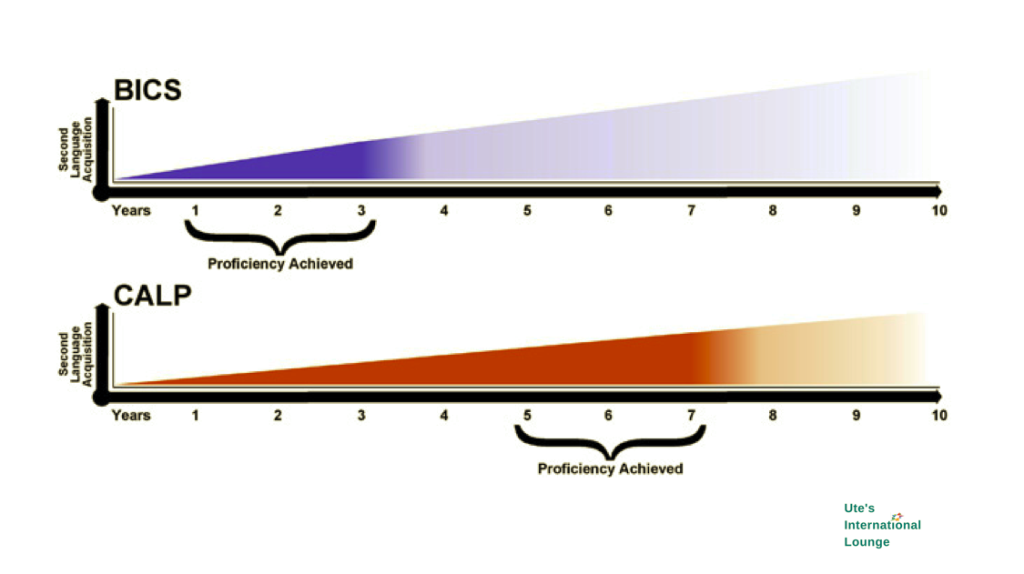
BICS is the language that is necessary for day to day living, indulging conversations with friends and informal interactions. CALP is the language we need to understand and discuss content in the classroom. If we compare BICS and CALP: BICS is rather context embedded, which means that the conversation is often face-to-face, and offers many cues to the listener such as facial expressions, gestures and concrete objects of reference. CALP, on the other hand, is rather context-reduced. It is the language of the classroom in which there are fewer non-verbal cues and the language is more abstract.

On a cognitive level, the BICS is undemanding. It is easy to understand, deals with everyday language and occurrences and uses simple language structures. CALP is a more demanding language and relates to abstract concepts, has a specialized vocabulary and uses a more complex language structure.
If we look at Jim Cummin’s quadrant about the BISC/CALP, along two scales and with some school activities and subjects added in the quadrants of the chart:


The BISC/CALP can be used to describe the language proficiency of single language students, but it is primarily used as a way to understand and evaluate the language level of students learning an additional language; in Cummins’ studies: English as a second language. Cummins studies of second language learners indicates that children can develop BICS (social language) in 3 years, but it takes 5-7 years for a child to work on the same level as native speakers in CALP. 


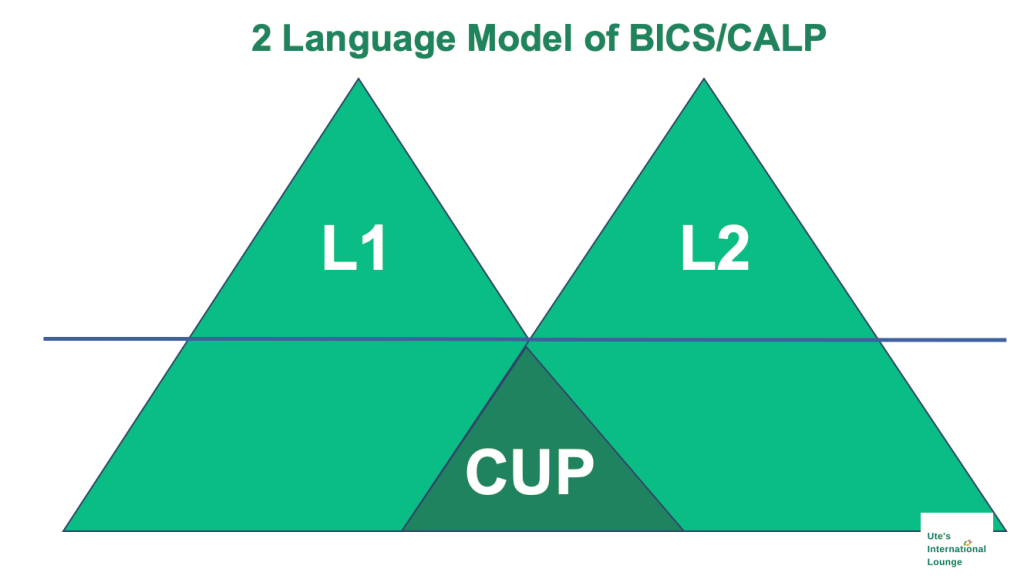
If we consider BICS and CALP on an iceberg model, where BICS is the part we see on the surface and CALP what lies underneath the surface (the biggest part to be achieved in language learning!), in a bilingual person – with L1 and L2 – there is a common area of language proficiency which provides the foundation for the use of both languages, the Common Underlying Proficiency (CUP).

Fact is that our L2 or any additional language we learn, grows from the foundation of the L1 or the languages we have acquired and learned before. Therefore, the stronger the first language(s), especially the CALP level of it or them (!), the stronger the additional language can be. Our language ability can easily be over-estimated by looking at the BISC and not realizing the complexity and difficulty that second or additional language students have in acquiring CALP in the other language.

___________________________________________________________________________

When talking about fluency or the linguistic competence of bilinguals or multilinguals it becomes even more complicated as “bilingual” is, in itself not a very clear-cut term.

In defining a bilingual, “the pronunciation, morphology and syntax used by the speaker in the language are key criteria used in the assessment”.

Also the mastery of the vocabulary is taken into consideration, but the lexicon can be easily learnt without knowing the proper use of it. – The proper use of vocabulary requiring a more in-depth study of the semantics.

Fact is, that testing or assessing the grammatical competence of a speaker is much easier than communicational competence.

Furthermore, we have to consider that we learn languages for different purposes and use them in different contexts, for what François Grosjean (1997, 2010) defines as the Complementary Principle, that “states that bilinguals usually acquire and use their languages for different purposes, in different domains of life, with different people. Different aspects of life often require different languages. Some languages will cover many domains of life, others less, and some will cover domains along with another language(s). Rare will be the bilinguals who will have all domains of life covered by all their languages.”

The Complementary Principle impacts:

– the fluency : “since if a language is spoken in a reduced number of domains and with a limited number of people, then it will not be developed as much as a language used in more domains and with more people” (Grosjean, 2015)

– language dominance: “many bilinguals are dominant in a language (…) as opposed to balanced. Dominance is difficult to define and is based not only on language fluency and language use, but also on how the languages are distributed across domains of life” (Grosjean, 2015)

translation: “unless bilinguals have domains covered with two languages or have acquired the language they are translating into in a manner that puts the emphasis on translation equivalents, hence building a bridge between their languages, they may find themselves without the resources to produce a good translation” (Grosjean, 2015)

In order to have a clearer picture of ones communicational competence, multilinguals should be assessed through the use of appropriate utterances in different settings.
You can find countless articles and videos about “fluency” in languages…


Fluency, accuracy and complexity, in formal settings

Fluency can focus on the content and what the learner is communicating. It refers to how well learners communicate meaning in the target language. It is about with how much ease learners can speak and how well they can communicate without pauses or hesitations, without needing to search for words or phrases, without having to consider the language of what they are about to say. When learners are fluent, they might not necessarily be 100% accurate but they are generally comprehensible.
Examples of fluency activities are conversations, role plays, debates, and projects.

Accuracy refers to the form and focuses on how the learner is communicating. It is about how grammatically correct a learner uses the language system, if the use of tenses, verb forms, collocations, and colloquialisms are “correct” in the target language.

Important side-note: nobody (!) is 100% accurate all the time!

Accuracy activities focus on grammar exercises, gap fills, noticing activities etc. Usually this practice takes place in controlled and formal settings, like schools. Most of the time, these activities do not allow much variation and rather focus on “right” and “wrong”…
Teachers focus on correcting errors and that the highest level of accuracy is achieved. 

Complexity refers to how the language production and performance is elaborate and varied.

Accuracy-oriented activities focus on the linguistic form and on the controlled production of grammatically correct linguistic structures in the L2 (Housen & Kuiken 2019). Fluency, Accuracy, and Complexity, are equally important for a skilled communicator.


What does “fluency” mean to you? What level of fluency do you think you have in your first, second, third… language? And how do you think you can improve your language skills?

In my language trainings I focus on the individual goals the client wants to achieve in the given language and together we choose the way and method that works better.


What I read so you don’t have to:

Cummins, Jim, ‘Cognitive/academic language proficiency, linguistic interdependence, the optimum age question and some other matters’, Working Papers on Bilingualism 19, 1979, 121–129.

Cummins, Jim, ‘Psychological assessment of immigrant children: Logic or intuition ?’, Journal of Multilingual and Multicultural Development 1, 1980, 97–111.

Cummins, Jim, The role of primary language development in promoting educational success for language minority students’, in California State Department of Education (ed.), Schooling and Language Minority Students: A Theoretical Framework, Evaluation, Dissemination and Assessment Center California State University, Los Angeles, 1981.

Cummins, Jim, Teaching for Cross-Language Transfer in Dual Language Education: Possibilities and Pitfalls, 2005.

Cummins, Jim, BICS and CALP: Empirical and Theoretical Status of the Distinction, in Brian V. Street and Stephen May, Literacties and Language Education,  2017, 59-71.

Grosjean, François, The bilingual individual. Interpreting: International Journal of Research and Practice in Interpreting, 2, 1997, 163–87.

Grosjean, François, Bilingual: Life and reality. Cambridge, MA: Harvard University Press, 2010.

Grosjean, François, Bicultural Bilinguals, International Journal of Bilingualism 2015, Vol. 19(5), 2015, 572–586.

Housen, Alex and Folkert Kuiken, Complexity, Accuracy, and Fluency in Second Language Acquisition, Applied Linguistics, vol.30, issue4, Dec. 2009, 461-473.

Noshik, Wartan, Complexity, Accuracy and Fluency in Second Language Acquisition: Speaking Style or Language Proficiency?, MA in UvL, 2019.

Michel, Marije, Complexity, Accuracy and Fluency (CAF), in Shawn Loewen & Masatoshi Sato, The Routledge Handbook of Instructed Second Language Acquisition, London, Routledge, 2017.

Benati, Alessandro, Focus on Form and Focus on Forms in Implicit Grammar Teaching Strategy, CUP, 2021.


Can adults acquire a language the same way as children?

Have you ever wondered why most of the language lessons for adults are based on learning grammar? Couldn’t adults learn (or acquire) a language in a more natural way, like children?

When adults learn a new language, they usually try to find their way through a myriad of grammar rules and patterns, and most of them would sign up for traditional language lessons. Some of them drop out of language lessons because it is too conceptional, too time consuming and out of touch with reality, i.e. not practice-oriented enough.

Children and adults have of course important cognitive and developmental differences, but this does not imply that language should be presented to adults as a rigid set of rules and patterns that are essential to master, preferably to a very high level of fluency before even attempting to speak it.  It surely doesn’t help when adults raise the bar unrealistically high when it comes to learning additional languages.

English: illustration from Leech's comic latin...

English: illustration from Leech’s comic latin grammar (Photo credit: Wikipedia)

I know by my own experience, that we can acquire a language in a very child-like way. I acquired Swiss-German and Dutch in my 20ies and late 30ies, the same way I acquired German and Italian as a child: in a very natural way, by listening and trying to imitate what was said.

I acquired Dutch alongside my son (who was then 2.5 years old), by repeating short sentences, singing songs with him, talking – and making many mistakes!

Of course, I already knew other languages’ grammar and rules that made the acquisition process more systematic: for example I would compare the use of adjectives or articles to similar languages I already had in my repertoire. The ability to read helped me to understand the phonetic rules on another cognitive level than a child that doesn’t read yet.

The whole acquisition process took place in a spontaneous way, which means that I would acquire the vocabulary of what I read and I talked about it with locals. I copied the way people greet each other, what they say when leaving: I observed locals very attentively, i.e. not only what they said but also how they said it and their non-verbal communication.
I studied the folders at the supermarket and offices, read all the posters, signs and children books I could find, trying to figure out how to pronounce the words and what they meant.  Swiss-German was helpful at times. It is not a written language, and I also learned it by repeating what others said. So, for both languages, Swiss-German and Dutch, I heavily relied on real life interactions, songs,  TV and radio.


The importance of comprehensible input


There is one aspect that plays a major role in language acquisition “the children’s way”, and that is comprehensible input. If we can not make sense of what is said, because we don’t understand the context, the learning process is arduous if not impossible.  Have  a look at Prof. Stephen Krashen’s video about this:


–We also interviewed him about this topic at Raising Multilinguals LIVE.

Fact is that adults can acquire languages like children if they focus on comprehensible input, on contexts they need and are interested in. In addition they have the time and the courage to make mistakes are surely necessary to achieve good results.

For me, personally, a merely grammar based approach to learning a language has proven to be very ineffective and discouraging. Even when learning dead languages like Latin, Old Provençal and Old French: what worked best for me was to understand and like (!) the topic of the text, and to make sense of the rules that came with learning these languages. 

I am a linguist, a philologist to be precise, and I teach languages since more than 30 years, to adults and teenagers. I have never had any problem of making someone speak or “utter words”, understand words and concepts, because I used Kashen’s approach. I teach privately which means that I can choose how and with what tools I teach the languages (German, Italian and French): I only choose tools that are interesting for my students, that they can understand and put in relation with what they know in the other languages they already speak.

Getting through the process of acquiring and learning multiple languages myself, learning about the language acquisition and learning process on a cognitive and neurological level, but also on a phonetic level (how to pronounce certain sounds), makes me focus on the speaking, on the communication first.

A way one can acquire a language as an adult is explained in this inspiring video:


At the moment (2020) I am trying to acquire Korean by watching series and exploring the language education feature on Netflix. I also try to decode the language with the help of some apps and youtube videos. I have not the opportunity to live in Korea and enjoy full immersion in the language, which certainly would accelerate the language acquisition and learning process, but by merely listening to the language on a regular basis I have reached a decent level of understanding.

– How do you managed to speak all your languages?


Related posts:

Language Acquisition and Language Learning

Can monolingual parents raise bilingual children?


Bildschirmfoto 2015-02-26 um 16.25.06


The answer is “yes”, but…

Many parents wonder if they can succeed in raising their children bilingually. Most of the studies of the ’60-’80 about bilingualism were about monolingual parents who wanted their children to become bilingual. Some parents would share the same home language and the community language would be L2, in some other studies only one of the parents would share the community language etc..

I think that defining a monolingual parent becomes more and more difficult because talking “only” one language, i.e. being monolingual, nowadays is almost impossible – at least for all those who don’t have English as home language. Everyone studies another language at some point, and will acquire some kind of knowledge in it. Therefore, being exclusively monolingual parents, living in a continuously monolingual context is almost impossible. Especially if we count dialects as languages. – If we agree with François Grosjean‘s definition of a bilingual:

“Bilinguals are those who use two or more languages (or dialects) in their everyday lives”

we can define accordingly a monolingual:

“Monolinguals are those who use only one language (or dialect) in their everyday lives”.


***

Every family raising bilingual children need a language plan. There are several strategies that can work for monolingual families or monolingual parents. In a (almost) monolingual situation, the strategy would look like this:

                            Parent 1                    Parent 2                    Community

 Strategy 1          Language A              Language A               Language A

Parents would speak their native language and the child would associate the second language (not indicated in this figure) with a certain place or certain person, such as special classes or trips to visit relatives or friends. With an environment not providing a regular input to the child, the parents would need to make more effort in providing exposure to the second language (cfr. playgroups in the other language, language lessons, care givers who talk the other language – and DVDs, CDs, audiobooks, books etc.).

Monolingual parents who want to raise their children bilingually but are not able to support this at home, need to reach out for help and provide a regular input from someone else. With the help of technology this is surely possible and I know many families who succeeded, but in the long run, either one parent (or both) would learn the other language and the parents would need to offer regular full immersion programs to their children – during holidays etc. – to foster the learning.

If one of the parents has the knowledge of another language, but the family lives in a Language A community, one of the parents would always address the child in his or her non-native, second language.

                            Parent 1                    Parent 2                    Community

Strategy 2      Language A               Language A                 Language A

                           Language B

These first two strategies require a special effort and commitment from the parents to provide regular input in Language B, with the advantage that in Strategy 2, one parent would be the regular dialogue partner for the child. On the long run, the child (and the parent) may need more people to share this language with. Playgroups, peers, collaborative teachers and family who either share the same language or at least support the bilingual upbringing can be very beneficial.

***

If both parents have the same home language but live abroad, the scenario can look like this:

                            Parent 1                    Parent 2                    Community

Strategy 3          Language A              Language A             Language B

Both parents would talk Language A to the child and leave the second language (B) to the environment and school. Usually, parents in this situation would learn language B at some point and would probably also be able to understand and support their child during his learning process.

When one of the parents has some knowledge of the community language, this could be the scenario:

                            Parent 1                    Parent 2                    Community

Strategy 4          Language A              Language A                Language B

                           Language B

One parent would always talk the community language (B) with the child, while the other parent would be consistent talking the other one. Language A being the minority language in this case, parents would need to support the child by offering other opportunities to speak language A (with peers, playgroups etc.).

For all the scenarios listed here above, it would be beneficial for the bilingual child if parents would agree on a language planning, be confident, creative, committed and consistent – and flexible, if the language situation within the family changes due to a move abroad or else.

***

My parents adopted strategy 3 in raising my sister and me bilingually: with German as home language and Italian as the local language. Both my parents spoke also Italian and other languages (English, French and local German dialects).
I can say that they succeeded: my sister and I are both bilinguals talking up to 6 languages and raising our children with multiple languages too.


Sign in Switzerland's four official languages

Sign in Switzerland’s four official languages (Photo credit: Wikipedia)

 (this post has been published (in another version) on my “other” blog expatsincebirth)