Bridging Languages and Learning: A Short Guide to BICS, CALP, CUP & CALS for Multilinguals

Many multilingual children experience a paradox: some may chat fluently in a new language but struggle academically, whilst others may grasp complex academic concepts yet find casual conversations about everyday topics difficult.

This is where four essential concepts – BICS (Basic Interpersonal Communicative Skills), CALP (Cognitive Academic Language Proficiency), CUP (Common Underlying Proficiency), and CALS (Core Academic Language Skills) – help us understand multilingual development and learning success.

1 – Understanding BICS, CALP and CUP

Jim Cummins (1979, 2000) introduced the distinction between BICS and CALP to explain why multilingual children may appear fluent in a language yet struggle in school.

 
BICS: Basic Interpersonal Communicative Skills
  • BICS refers to everyday social language used in informal interactions – this is the language used on the playground, when greeting people, or the language used in casual conversations.
  • This type of language develops relatively quickly (within 6 months to 2 years) once a child is exposed to a new language.
  • However, conversational fluency can be misleading – just because a child speaks effortlessly in daily situations does not mean they have the language skills required for academic success. This is where the language development of children who were exposed to the target language since day one and those who start learning it at school converge: they are all language learners!
  • However, multilingual children exposed to the new language only in formal settings, and learn the academic language (CALP) first, may struggle with BICS in that language and find it difficult to engage in informal conversations about everyday topics.
 
CALP: Cognitive Academic Language Proficiency
  • CALP is the ability to understand, process, and use language in academic settings – when reading textbooks, writing essays, and solving math problems.
  • Developing CALP takes significantly longer than BICS – typically 5 to 7 years, and in some cases even longer, depending on the way the academic language is transmitted and fostered over the years.
  • Academic skills within CALP include critical thinking, reasoning, analyzing texts, summarizing, inferring, comparing and contrasting, and writing structured arguments.
  • Multilingual children who lack CALP often struggle with schoolwork. They might appear fluent when reading (decoding), but might not fully grasp the meaning of what they are learning.

This distinction explains why some multilingual children can engage in friendly chatter but struggle with schoolwork, and why others excel academically but find informal social interactions challenging.

Most studies about multilingual learners focus on successive multilinguals, i.e. children who learn the additional language usually in formal settings and after having achieved a great level of proficiency in their first language. Children who have been exposed to multiple languages early on, i.e. simultaneous multilinguals, often have different approaches to learning additional languages, as we explain in our post about Compound, Coordinate and Subordinate Multilinguals.


CUP: The Bridge Between Languages

The Common Underlying Proficiency (CUP) model (Cummins, 1981) explains how knowledge and skills transfer across languages.

  • Language learning is not isolated – once a child develops academic language in one language (in the picture here below: language orange for example), they can apply these skills in another (here below: language blue).
  • This means that strong literacy and academic skills in the home/heritage language will support learning in the school language, and vice versa.
  • Concepts such as problem-solving, reading comprehension, and logical reasoning exist independently of language and can be transferred across languages. Multilinguals who learn these skills in the language of instruction, need opportunities to make this transfer to the home/ heritage language(s) – ideally at school and at home.

For parents and educators, CUP highlights the importance of supporting the home/heritage language, as it strengthens overall academic success in multilingual children.


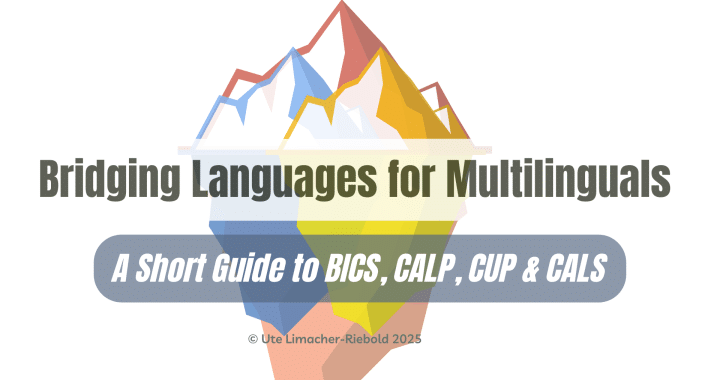
The dual Iceberg metaphor illustrates Cummins’ Developmental Interdependence Hypothesis which addresses the functional interdependence between the development of  language orange and language blue skills. The tips of the iceberg above the surface of the water represent the BICS in the two separate languages, that can appear to be qualitatively distinct.

Languages often appear to have fundamentally different features when looking at them from the surface. The part of the iceberg underneath the surface of the water representing CALP (and CALS; see here below), represents Cummins’ idea that learning the two (or more) languages involves the same basic processes and skills and that learning one makes it easier to learn another (or others), thanks to the CUP .


2 – Expanding CALP for Academic Success with CALS

Core Academic Language Skills (CALS), also developed by Cummins, extends the concept of CALP. CALS focuses on the specific language skills needed for academic success in different subjects.

CALS reflect the discourse patterns and challenges of language and literacy use within he social context of schooling to a greater exent than other registers of language development (Cummins, 2021 and Barr et al., 2019).

  • Academic language is not uniform – the language of math is different from the language of science, history or geography.
  • CALS includes subject-specific vocabulary, complex sentence structures, and different ways of reasoning and presenting arguments.
  • Students need explicit instruction in CALS to effectively navigate different academic registers and genres.

Ideally, multilingual students would learn subjects in both or several of their languages, following CLIL (Content and Language Integrated Learning), from early on.

3 – Supporting BICS, CALP, and CALS in Successive Multilinguals

As mentioned before, studies about multilingual learners focus on successive multilinguals – i.e. children who learn the additional language after the first language(s) have been consolidated, usually in formal settings, emphasising that their strongest language plays a crucial role in developing academic success. However, they may not have had the opportunity to develop BICS in the school language before they are expected to perform academically and build their CALP.

How to Support BICS in Successive Multilinguals
  • Create social opportunities: Playdates, extracurricular activities, and peer interactions help children develop social fluency in the new language.
  • Encourage role-playing: Practicing common phrases, small talk, and real-life scenarios boosts confidence in informal interactions.
  • Use visual and contextual support: Gestures, facial expressions, and visual cues help children grasp social language in context.
  • Promote bilingual peer support: Having a buddy who speaks both the home/heritage language and school language eases communication and builds confidence.

It is important to notice that once successive multilinguals have achieved a certain level of fluency, they might not benefit from continuous translating to their home/heritage language, but prefer to fully immerse into the target language.

How to Support CALP and CALS in Successive Multilinguals

The following should be practiced at school and at home:

  • Encourage reading across genres: Exposing children to fiction, nonfiction, and subject-specific texts strengthens academic vocabulary.
  • Discuss school topics in multiple languages: Talking about science, math, and history in the home/heritage language supports concept development and knowledge transfer.
  • Develop metalinguistic awareness: Helping children recognize connections between languages enhances language learning and academic success.
  • Provide structured academic language practice: Encourage debates, structured discussions, and presentations in different languages to build confidence in academic registers.
  • Use scaffolding techniques: Graphic organizers, sentence starters, and guided questioning support academic language development.
How to support BICS, CALP and CALS in Simultaneous Multilinguals

It is crucial to recognize that simultaneous multilingual learners do not learn additional languages in the same way as successive multilinguals. Simultaneous multilinguals develop their languages alongside each other from early on, often without a clear dominance. When one of their early learned languages is the language of instruction, their learning will barely differ – if at all! – from the one of monolingual learners. If the language of instruction is an additional language to those they aquired from early on, their learning is likely to procede first through the mediation of the first languages (as subordinate multilinguals) and they might need some support during the early stages of language learning. However, they will very likely be reaching higher levels of proficiency faster than successive multilinguals, and they will rather learn the additional language in a coordinate way, i.e. preferring to keep their languages separated for example by topic, subject area, setting, person etc..

Their BICS may emerge naturally in all regularly used languages through play and social interaction in everyday situations, whereas CALP and CALS will require more intentional scaffolding across all contexts. Thanks to CUP, cognitive and conceptual knowledge will be transferred between their languages, and rich conceptual discussions will be nurtured in any language that the children are required to share their knowledge in. In the same way, their academic language will be strengthened across all those languages (Cummins, 2008). 

Simultaneous multilingual learners benefit from the exposure to a wide range of vocabulary, genres, and registers in each language they are expected to use academically. However, for this to happen across all their languages, simultaneous multilinguals who learn an additional language at school will need exposure to the language of instruction also outside of the classroom setting.

Maintaining regular use of each language in cognitively demanding contexts – discussing books, explaining reasoning, making predictions etc. – helps deepen CALP and CALS simultaneously. Parents, teachers and other professionals should though not expect any “balanced” proficiency in all the languages. The opposite, with one or two languages being more dominant than others, is more realistic.

In our videos on Activities for Multilingual Families and The Toolbox for Multilingual Families we share ideas on how to support multilingual children’s language skills in a motivating and effective way. Crucially, support should be consistent, contextualised, and responsive to each child’s evolving language constellation (Limacher-Riebold, 2022).

 
Conclusion

Understanding the differences between BICS, CALP, CUP, and CALS is essential for supporting all multilingual learners. It is necessary though to tailor the support to the different kinds of multilingual learners. While conversational fluency may come quickly to some, academic proficiency takes years to develop and requires intentional support in both or all languages. Encouraging the use of the home/heritage language alongside the school language strengthens overall academic success.

– The content of this post is part of my trainings, workshops and webinars for parents, teachers and other professionals at Ute’s International Lounge.


References

  • Barr, C.D., Uccelli, P. and Phillips Galloway, E. (2019) Specifying the academic language skills that support text understanding in the middle grades: The design and validation of the core academic language skills construct and instrument. Language Learning 69, 978-1021.
  • Cummins, J. (1979). Cognitive/Academic Language Proficiency, Linguistic Interdependence, the Optimum Age Question, and Some Other Matters. Working Papers on Bilingualism, (19), 121-129.
  • Cummins, J. (1981). Age on arrival and immigrant second language learning in Canada: A reassessment. Applied Linguistics, 2(2), 132-149.
  • Cummins, J. (2000). Language, Power and Pedagogy: Bilingual Children in the Crossfire. Multilingual Matters.
  • Cummins, J. (2008). Teaching for Transfer: Challenging the Two Solitudes Assumption in Bilingual Education. In J. Cummins & N. Hornberger (Eds.), Encyclopedia of Language and Education (Vol. 5). Springer.
  • Cummins, J. (2021). Rethinking the Education of Multilingual Learners, Multilingual Matters, p.183.
  • Limacher-Riebold, U. (2024, April 5). How to help multilingual children with homework. Multilingual-Families.com (https://multilingual-families.com/how-to-help-multilingual-children-with-homework/)
  • Snow, C. E., & Uccelli, P. (2009). The challenge of academic language. In Olson, D. & Torrance, N. (Eds.), The Cambridge Handbook of Literacy, 112-133.

I invite you to watch my video about balancing multiple languages at home.


How to Help Multilingual Children Feel Proud of Their Language and Identity

Belonging, self-esteem, and the everyday superpower of growing up between languages.

Language is more than words. It’s culture, it’s the sound of our childhood, the rhythm of family, the invisible thread that binds identity and belonging. For multilingual families raising children away from their heritage homeland, the challenge often lies not only in passing on a language—but in nurturing pride in it.

I recently had the chance to discuss with Dimitris Karagiorgas — a psychiatrist specialized in child and adolescent mental health, with a background in cognitive behavioral and art therapy — and we explored the deep connection between language, belonging, and identity. Dimitris reminded me that belonging is not just a feeling. It is a deep psychological need:

“Belonging is a harbor from which the ships of exploration set sail. It is identity, spatial and temporal anchoring, a sense of security and understanding.”

But for many migrant families, this sense of belonging is fragile. Moving to a new country can mean leaving behind not just people and places, but parts of ourselves. As Dimitris told me:

“Migration is not just the act of relocating. It is also a separation from one’s culture, habits, language, family and friends—often with an undefined end date.”

This separation, when unacknowledged or unsupported, may lead to a lingering sense of exile. Children—those “sensitive sensors of the family system,” as Karagiorgas puts it—can feel this tension, even if they cannot name it. Their identities form at the intersection of multiple worlds: school and home, local culture and ancestral memory, dominant and minority languages.

So how do we help them build pride in who they are?

1. Start with Yourself

Our children watch us closely. If we are ashamed, hesitant, or apologetic about our language and culture, they will be too. If we embrace our multilingual reality with joy, they will feel free to do the same.

Dimitris emphasizes that:

“Children show us, through the way they exist, how well we as adults are defending this condition of multilingual, multicultural life.”

2. Honor All the Worlds Your Children Inhabit

Children in multilingual families live in-between. And that’s okay. Rather than pushing them to “choose” one identity, we can celebrate the richness of their in-between-ness. Every language they speak, every culture they experience, is part of who they are.

“If the soul of a people is to be found somewhere, it is in its language.”

Let’s not ask our children to choose which soul to keep. Let them have both.

3. Create Community

“Where I participate, I live,” Karagiorgas says. Community support is key. Children—and their families—need spaces where their multilingualism is not “different,” but normal. Heritage language programs, playgroups, cultural activities, and friendships with others in similar situations help children feel seen.

4. Make Your Language Their Language 

Language is not just a skill to be learned—it’s a relationship to be nurtured. When we connect it with love, humor, play, music, storytelling, emotions, memories, then it becomes meaningful. It becomes alive. It becomes theirs.


5. Accept the Complexity

Not every child will speak every language equally. That’s okay. What matters most is not “perfect fluency,” but a sense of connection. A child who feels that their language and culture are valued is more likely to embrace them, now and in the future.

A gentle reminder:

Let’s remind our children — and ourselves — that multilingualism is a superpower.
The ability to speak more than one language is a gift. A super skill.
And yes, if it helps, don’t be afraid to call them superheroes.
Because that’s what they are: cultural superheroes, navigating worlds with courage, humor, and heart.

To conclude

In the discussion I had with Dimitris, he said something that shook me:

“Whoever has held a suitcase in their hand, even once, may never feel like they fully belong again.”

It sounded so dramatic, so definite — and in a way, it struck a nerve.

But then I took those words and reflected on my life, raising multilingual children abroad, my multicultural friends, all the wonderful families I have met, juggling 2, 3, even 4 languages and the communities we’ve all built around us.
That’s when I realized: through language, love, and community, we can help our children carry that suitcase with pride. Not as a burden, but as a treasure chest — full of voices, songs, stories, and the confidence to say:

“I belong to many places, and all of them belong to me.”

And maybe that’s the beauty of it all.

“Only when you share someone else’s culture do you become richer.
It is the only kind of sharing that doesn’t make you poorer.
Usually, when you share something, you are left with less.
But when you share culture, you lose nothing.”

Hélène Glykatzi-Ahrweiler

Repeat, expand, recast – three discourse strategies to boost our children’s language skills

Raising multilingual children is a rewarding yet complex journey. Parents play a pivotal role in shaping their children’s linguistic development, and one of the most effective ways to support this process is through parental discourse strategies (read also our post about 4 parental discourse strategies).

Techniques such as repetition, expansion, and recasting create a rich linguistic environment, providing children with the tools they need to navigate and master multiple languages. In this post, we’ll explore these strategies, why they are effective, and how they can be implemented in everyday interactions.

Understanding Parental Discourse Strategies

Parental discourse strategies refer to the techniques parents use during conversations to support their children’s language learning. These strategies are not only tools for communication but also mechanisms for scaffolding linguistic development. They serve to model correct language usage, expand vocabulary, and reinforce grammatical structures.

Research highlights the importance of these strategies, particularly for multilingual families. Studies, such as those conducted by Annick De Houwer (2007), show that children’s proficiency in multiple languages is significantly influenced by the quantity and quality of parental input. By using targeted discourse strategies, parents can maximize the effectiveness of their input.


Key Strategies for Multilingual Families

1. Repetition

Repetition is a foundational strategy for reinforcing language structures and vocabulary. By repeating what children say, parents confirm the message and provide a model for correct pronunciation and grammar. For example, if a child says, “Apple,” the parent can respond, “Yes, that’s an apple.”

Why it works: Repetition creates a sense of familiarity, making it easier for children to internalise language patterns. It also signals to the children that their attempts to communicate are valued and understood.

How to implement:

  • During mealtimes, name and repeat the items on the table. For instance, “This is bread. Bread is delicious!”

  • When reading a story, emphasize repeated phrases or key vocabulary, such as, “The cat is on the mat. The cat is very happy.”

  • Repetition is very effective at each stage of language development. School aged children and even adults who are learning an additional language benefit from hearing and using new terms and sentences multiple times and in a variety of contexts.
2. Expansion

Expansion involves taking the children’s utterance and adding complexity to it. This strategy helps children learn how to construct more sophisticated sentences and introduces new vocabulary in context. For example, if a child says, “Dog running,” a parent might respond, “Yes, the dog is running fast in the park!”

Why it works: Expansion enriches children’s linguistic input, encouraging them to pay attention to how sentences are constructed. It also provides a natural way to introduce new words and grammar structures.

How to implement:

  • During play, expand on your children’s observations. For instance, “Car!” can become, “That’s a red car. It’s moving very quickly.”

  • While describing daily routines, add details to their statements. For example, “Eat cookie” can be expanded to, “You’re eating a chocolate cookie. I like chocolate cookies too.”

  • For older children expansion allows to explore broader contexts and become more confident in forming longer and more detailed sentences. For instance, we can explore synonyms of adjectives, verbs, adverbs and nouns. Or, if learning an additional language like German, support the use of articles, or cases like Genitive, Dative etc..
3. Recasting

Recasting involves rephrasing a child’s incorrect or incomplete sentence into a grammatically correct one. This strategy gently corrects mistakes without discouraging children from attempting to communicate. For example, if a child says, “I goed to park,” a parent might respond, “Oh, you went to the park? That sounds fun!”

Why it works: Recasting provides implicit feedback, allowing children to learn from their mistakes in a supportive environment. It fosters confidence while simultaneously reinforcing correct language forms.

How to implement:

  • During conversations, focus on the content of what your children are saying while modeling the correct form. For example, “Him is playing” can be recast as, “Yes, he is playing.”

  • Avoid over-correcting every error to maintain a positive and encouraging atmosphere. Instead, prioritize errors that impact comprehension or are critical for language development.

  • Recasting can help older learners correct themselves in a more motivating way.

The Benefits of Parental Discourse Strategies

Using these strategies consistently has a profound impact on children’s language development, especially in multilingual settings. Here are some key benefits:

  1. Enhanced Vocabulary Development: By exposing children to a wide range of words and phrases, these strategies help expand their lexicon across languages.

  2. Improved Grammar Skills: Techniques like expansion and recasting model correct sentence structures, enabling children to grasp complex grammatical rules.

  3. Increased Confidence: Positive reinforcement through repetition and recasting helps children feel supported and motivated to use multiple languages.

  4. Stronger Parent-Child Bond: Engaging in meaningful conversations fosters emotional connections and builds trust.

  5. Facilitation of Code-Switching Skills: These strategies help children navigate between languages more fluidly, an essential skill for multilingual communication.


Tips for Success

To maximize the effectiveness of parental discourse strategies, consider the following tips:

  • Be Consistent – but Mindful: Use these strategies regularly during daily interactions, such as mealtimes, play, and bedtime. But be mindful of the moments you use them. If your children are tired, stressed or busy, or you are not in a calm and understanding mood, prioritize communication over correct language use!

  • Focus on the Positive: Enjoy that your children make efforts to communicate, regardless of errors.

  • Adapt to Your Children’s Needs: Tailor your approach based on your children’s age, language proficiency, and individual learning style.

  • Mix It Up: Incorporate a variety of activities, such as storytelling, role playing, singing, and games, to keep interactions engaging.

  • Be Patient: Language development is a gradual and very long process. Provide consistent support and give your children the time they need to progress.


Overcoming Challenges

While these strategies are highly effective, parents may encounter challenges, particularly in multilingual contexts. Common concerns include:

  • Balancing Multiple Languages: The goal to an equal exposure to all languages is not realistic. Consider creating routines that incorporate each language, such as designating specific times or activities for each one. Fostering each language on a regular basis and to the extent the children’s need it in that given phase of their life will be enough! 

  • Managing Code-Mixing: Code-mixing is a natural part of multilingual development. Rather than discouraging it, use recasting to guide your children toward distinguishing between languages should this be necessary for mutual comprehension. If all interlocutors share the languages mixed in the conversation: enjoy the flow!

  • Finding Time: Busy schedules can make it challenging to prioritize language interactions. Integrate these strategies into everyday tasks, such as cooking or commuting, to make the most of available time. A conversation of 5 minutes is better than being exposed to languages in a passive way, i.e. without interaction.


Conclusion

Parental discourse strategies – repetition, expansion, and recasting – are powerful tools for supporting multilingual children’s language development. By creating a rich and responsive linguistic environment, parents can help their children build strong communication skills in multiple languages. Remember, consistency, patience, and a positive attitude are key. Every interaction is an opportunity to nurture your children’s multilingual journey.

For further reading, consider Annick De Houwer’s study on parental input patterns and their impact on children’s bilingual use (Applied Psycholinguistics, 28(3), 411-424).

Let us know:

How do you incorporate these strategies into your daily routine?

Share your experiences in the comments below!


Raising Multilingual Kids in Denmark: Language Tests, Challenges & Insights from Justin Markussen-Brown

Some years ago, I received the results of a language test for one of my kids. When I saw the low bars and the yellow color, I immediately went into panic mode! Everyone knows that red and yellow are not good colors when it comes to test results. As a new parent, I was alarmed – and for good reason. My husband and I are Greek, living in Denmark. We speak Greek at home, while our children are exposed to the majority language at their institutions and schools – something completely out of our control. And I admit it: I am a control freak!

Justin Markussen-Brown, Founder of Sprogklar

So, long story short – after my initial panic, I called every single person I knew, looking for support in navigating and understanding the Danish system and these language tests.

Luckily, Tina Bollerslev pointed me in the direction of Justin Markussen-Brown,  the founder of Sprogklar, a Danish company specializing in education and IT solutions for first and second language acquisition. Sprogklar also has a speech-language pathology focus and runs a clinic.

In addition to his work at Sprogklar, Justin is an assistant professor of social education at UC Lillebælt in Odense, where he focuses on language acquisition and language pedagogy for children.

That’s how I met Justin, and now it’s time to introduce him to all of you – expat parents in Denmark or anywhere in the world raising multilingual kids.

Justin, can you tell us a little about yourself and the work you do at Sprogklar?

I am educated as a linguist and have a Ph.d. from the university of Southern Denmark. I founded Sprogklar in 2015 on the coattails of my Ph.d.-work. Sprogklar has three main areas of business:

1) We do professional development for educators, teachers, support workers and speech-language pathologists;

2) We develop and run an online platform for Danish municipalities where they can access language stimulation materials and can take online courses;

3) We run a speech-language pathology clinic.

I’ve also written a few Danish language books on language acquisition for practitioners and parents.

What inspired you to create a company that bridges research and practice in early language development?

Children’s language acquisition was not at the time an area of focus in the early childhood education programme in Denmark. This was also evident for me in my Ph.d. fieldwork, where I visited several hundred preschool classrooms, and could see that the quality of the language environment required improvement. We also had some research that indicated that the educator could improve their practice significantly, if they received professional development. So that was basically the original business case of Sprogklar: To offer educators professional development in how you support language development in children.

How do you see language playing a role in shaping a child’s cultural identity, especially in multilingual families?

In my research, it’s a clear trend that it’s hard for children with a multilingual language background to create a unique cultural identity, when they don’t have fluency in their parents’ mother tongues. So I see language skills as being very important in this regard, and I encourage parents who have a different language than the majority language to focus on giving their own language to their kids. 

Multilingual Expat Families in Denmark and Language Development

What should expat parents who speak one or two non-Danish languages at home know about the Danish early childhood education system?

They should know that the Danish early childhood education system is very high quality in many regards. The workers with a BA in pedagogy have a lot of knowledge about kids’ development. They may or may not give advice on how to support multilingual children, and if you’re in doubt, you can contact the public speech-language pathologist for advice.

How does the system support children learning Danish as an additional language?

It is very different from municipality to municipality and from practitioner to practitioner. All children will have their Danish skills evaluated at the age of two or three, and if they think that the child’s Danish is behind, then they might suggest some sort of language intervention. Unfortunately, they don’t take the child’s skills in other languages into account (this is also methodologically difficult, but possible). In general, you should expect a lot of focus on your child’s Danish, and maybe very little interest in your child’s development of additional languages (although again, this will vary from educator to educator).

What are some unique aspects of the Danish language environment that expat families or Danes living abroad might find surprising or challenging?

Phonology is the hard part. Danish has a lot of phonetic vowels, and many consonants can be pronounced a bit like a vowel, which creates an unstable phonological structure.

What practical steps can parents take to ensure their children develop proficiency in Danish while maintaining their home languages? 

There are a lot of things to do. First of all, I would focus on the child’s home language, because that is the one that usually ends up being underdeveloped. Secondly, I would make sure that the child goes to daycare regularly, and has friends to play with that speak Danish. During long holidays, parents can make sure to expose their kid to a little Danish every day to avoid losing Danish skills, e.g. watching public Danish children’s programming like Ramasjang.

For those interested, are there any specific resources, practices, or activities that you recommend for creating a strong foundation in Danish?

I’m actually not so convinced that Danish skills are the big problem. The main thing is ensure that the child is engaged linguistically in general, and that can also be through the mother tongue. Generally speaking, a good language environment provides a lot of cognitive stimulation, which supports the child’s ability to learn other languages. 

Going regularly to daycare will ensure that the child has exposure to the Danish language, and I would try to find a daycare, where they seem to have a good language environment, and play and talk a lot with the kids.

A good language environment provides a lot of cognitive stimulation, which supports the child’s ability to learn other languages.


Navigating Language Tests (Ages 3 and 5)

I understand that children in Denmark undergo an obligatory language test at age 3, typically conducted in their børnehave, and an optional test at age 5. Could you guide us through these tests? What are they designed to assess, and how are they carried out?

They can also legally do it at 2 years. It’s good to know that the test is only obligatory if the child shows signs of language impairment/difficulties, and it is up to the personnel to decide this.

The test is designed to screen for language impairment. It’s normed on monolingual Danish speakers, so when testing multilingual children, it will often be very unreliable with regards to predicting impairment. But it will give an indication of how much Danish the child has compared with monolinguals.

In some cases, especially when these language tests are administered to multilingual children who are not exposed to Danish at home, we often see results marked in red or yellow, particularly in the vocabulary section of the test, indicating that compared to their monolingual peers they don’t have the same amount of vocabulary in Danish. Could you explain why this happens? Is there any research to help us understand these results?

Because they’re only testing Danish, the test does not capture the entirety of the child’s conceptual vocabulary. For example, the child may know what a “tie” is called in their own language, but they fail the item in Danish, because they don’t know that it’s called a “slips”. But in reality, the child knows what a tie is and what it is called in a language. Just not Danish. 

So it’s rather normal for a multilingual child to be evaluated to “red” or “yellow”, which means they are in the low end of distribution compared to same-age monolinguals. However, some multilingual children also DO have language impairment, so the thing to look out for is whether the child’s language acquisition is proceeding normally in the other language. If there are challenges in both languages, then it can indicate that there actually is an issue, and I would then consult a speech-language pathologist.

The test [at 2 years] (…) is normed on monolingual Danish speakers, so when testing multilingual children, it will often be very unreliable with regards to predicting impairment. (…) [It] does not capture the entirety of the child’s conceptual vocabulary.

Some expat families panic when they see red or yellow results. They often feel lost and uncertain about how to address the situation. One thing we know for sure is that they should not stop speaking their native language(s) to their children. What advice would you offer to these families? How can expat parents support their children in expanding their Danish vocabulary, even when they don’t speak Danish at home? What role does the institution (børnehave) play in such situations and how can parents collaborate with educators and other professionals to support their child’s language development in such cases?

It’s a bit of an unfortunate situation, because the educators presenting the results need to be very good at explaining that the test is standardized on monolinguals. If they don’t explain this, then parents might freak out. My advice is that parents should expect that the child will score lower on the test, especially if neither of the parents are Danish. It is also a myth that children are very speedy at learning multiple languages. It’s not true at all and sets parents up for unrealistic expectations. Generally speaking, it takes 3-6 years for a child to catch up to monolinguals, because they have twice as much work than the monolinguals. 

It is not an appropriate strategy for parents to stop speaking their language to their child, as this will only result in the child missing out on high quality language input via the mother tongue. 

My suggestion is that the educators do their best to create a language stimulating environment in the preschool. The child would also profit from being in groups with children with stronger language skills, but sometimes educators make the judgement of grouping all the multilingual children together, which in a way is the opposite of what they need. 

Parents should be advised in language stimulation techniques so that they can continue to support their child’s language development in their own language, but with renewed focus. Often, the child’s mother tongue will stagnate a little when they start going to daycare/preschool, but parents can counteract that but being extra good language stimulators at home in the evenings and weekends.

It is (…) a myth that children are very speedy at learning multiple languages. It’s not true at all and sets parents up for unrealistic expectations. Generally speaking, it takes 3-6 years for a child to catch up to monolinguals, because they have twice as much work than the monolinguals. 


Looking ahead to the school years, are there additional language tests conducted? If so, how often do they occur, and what do they assess?

Yes there is similar mandatory Danish language screening in 0. Class. It tests basically the same things, plus a little more phonological awareness.

Finally, do you have any additional tips or advice for expat parents living in Denmark to help support their children’s language development effectively?

Be patient — it takes longer time to learn two or more languages. Don’t give up giving your language to your child – it’s the greatest gift and they will be so thankful when they get older. 

Danish Multilingual Families

Living Abroad


What are the challenges faced by Danish Multilingual Families Living Abroad with maintaining the Danish language?

It’s the exact same issues that expat families face in Denmark. I can recommend speaking with Tina Bollerslev from Dansk med Tina who knows a lot about this. As I understand it, families experience challenges in supporting their children’s Danish acquisition. 


What practical tips would you share with Danish families living abroad to help their children maintain and develop their Danish language skills, especially if they are surrounded by a different language environment?

I would recommend starting so early as possible. If the Danish speaker is married with a non-Danish speaker, then it’s important to get their support to the project, even though they may feel a little left out. Above all, resist the urge to use the majority language with the child. Keep using Danish in all situations and explain to others that you do it to ensure that the child learns Danish. 


Navigating multilingual parenting can feel like a rollercoaster – filled with moments of pride, occasional panic, and a lot of learning along the way. But as Justin reminds us, language development is a journey, not a race. Instead of stressing over test colors, let’s focus on creating rich, engaging language environments where our children can thrive in all their languages. Whether it’s speaking our mother tongues at home, playing with Danish-speaking friends, or singing along to Ramasjang, every little bit counts. And most importantly, let’s remember that multilingualism is a superpower – one that takes time to grow but lasts a lifetime. 

Read more about Sprogklar here: https://sprogklar.dk/

Multilingual Societies

Multilingual societies are a testament to the vibrancy and complexity of human culture, where multiple languages coexist and evolve within a shared social framework. These societies are not simply collections of diverse linguistic groups but intricate networks of communication that weave together histories, cultural identities, and social dynamics. The interplay between various languages and dialects in multilingual communities creates rich tapestries that reflect the diverse experiences and traditions of their members.

Defining Multilingual Societies

A multilingual society is one in which multiple languages and dialects are actively used across different domains – be it in the home, at school, in the workplace, or in public life.

The coexistence of these languages is not only a matter of daily communication but also a reflection of the community’s diverse histories and the continuous interaction of various social, cultural, and political forces.

The ability to speak and navigate between multiple languages provides individuals in these societies with a deeper understanding of their own identities while promoting understanding and collaboration between different groups.

In such societies, the use of language can be fluid, shifting depending on the context, purpose, and the participants involved in the interaction. This dynamic nature of multilingualism is what makes multilingual societies particularly interesting – they are always in flux, adapting to changing social realities while preserving the unique cultural heritage of each language.

Key Characteristics of Multilingual Societies

1. Diglossia and the Role of Varieties

One of the defining characteristics of many multilingual societies is the phenomenon of diglossia, where two or more varieties of the same language coexist, each having a distinct role in society. This concept, first introduced by sociolinguist Charles Ferguson in the 1950s, is particularly evident in societies like those in the Arab world. For example, Modern Standard Arabic (MSA) is typically used in formal contexts, such as in the media, literature, and religious settings. On the other hand, local dialects, such as Egyptian Arabic, are used in everyday interactions and casual conversations. This distinction between high and low varieties of a language serves as a way to maintain both cultural and social order, allowing for functional diversity within the same linguistic system.

Diglossia exists not only in the Arabic-speaking world but also in many other multilingual societies. In Switzerland, for example, German, French, and Italian are spoken in distinct regions, and these languages are used in formal and governmental settings. Meanwhile, regional dialects play an important role in social interactions, demonstrating how different linguistic varieties have their place in different domains of life.

2. The Richness of Dialects

Another fascinating aspect of multilingual societies is the presence of dialects, which add depth and texture to the linguistic landscape. Dialects are variations of a language that are often regionally or socially distinct. While Standard Italian is the official language of Italy, it coexists with a variety of regional dialects, such as Neapolitan, Venetian, or Sicilian. These dialects are not simply colloquial forms of the language but have their own unique lexicons, grammar, and cultural histories.

The presence of dialects within a multilingual society enriches cultural identity by reflecting the historical and geographical diversity of the community. Dialects are more than just ways of speaking; they are repositories of local traditions, folklore, and ways of life. For example, a speaker of Venetian might use words and expressions that reflect the history of the region, its unique interactions with other cultures, and its role in maritime trade.

While there is often a tension between the prestige of a standard language and the value of dialects, multilingual societies offer the potential for dialects to be celebrated and preserved. In places like Italy, the revival of interest in regional dialects is part of a larger cultural movement to maintain connections with local traditions and histories, even as the country embraces globalization and modernity.

3. Code-Switching and Language Shifts

Individuals in multilingual societies often shift between languages or dialects depending on the context in which they are communicating. This code-switching is a common phenomenon in these societies, where speakers fluidly alternate between languages or varieties of language within a conversation.

India provides a rich example of code-switching in action. In many urban areas, it is not uncommon for individuals to mix Hindi and English within a single sentence, especially in workspaces or social settings. This practice – often referred to as Hinglish – reflects the intersection of India’s rich linguistic diversity with the global influence of English. In multilingual societies, code-switching serves as a pragmatic tool for communication, allowing speakers to express themselves more effectively by drawing from a wider range of linguistic resources.

Code-switching can also serve as a marker of social identity and group membership. In multilingual societies, speakers often shift between languages to signal their affiliation with a particular group, region, or social class. For instance, a person in Spain might alternate between Catalan and Spanish depending on whether they are speaking with family, friends, or colleagues. These language shifts are not just about communication but about positioning oneself within a social context, reinforcing shared experiences, and maintaining a sense of belonging.

4. The Cognitive Benefits of Multilingualism

Living in a multilingual society also has cognitive advantages. Research has shown that multilingual individuals often exhibit enhanced mental agility and adaptability. Exposure to different languages and dialects helps improve cognitive flexibility, as individuals constantly switch between different linguistic systems. This ability to switch between languages fosters better problem-solving skills, increased creativity, and an enhanced capacity for multitasking.

Moreover, multilingualism is linked to improved executive functions, such as working memory, attention control, and the ability to focus. In a multilingual society, individuals who are constantly interacting with different languages and linguistic varieties develop stronger mental skills that can be transferred to other areas of life, including academic achievement, professional success, and interpersonal relationships.

The Role of Multilingual Societies in Fostering Communication

Multilingual societies are more than just linguistic landscapes; they are spaces of cross-cultural exchange and communication. In such societies, languages serve as bridges that connect diverse communities, fostering collaboration, mutual understanding, and social cohesion. Through language, individuals from different linguistic backgrounds can share ideas, build relationships, and negotiate shared meanings.

The use of multiple languages in a society also supports the preservation of diverse traditions and histories.

Languages are not static: they evolve and adapt to the needs of the communities that use them. In multilingual societies, this linguistic dynamism allows for the ongoing revitalization of cultural practices, as speakers continue to innovate and adapt their languages to new social realities.

Challenges of Multilingual Societies

While multilingual societies offer a wealth of opportunities, they also present challenges. One of the most significant challenges is the unequal prestige of languages. In many multilingual societies, certain languages are seen as more prestigious or valuable than others. For example, in Switzerland, while German, French, and Italian enjoy official status, the Romansh language has been marginalized, despite being one of the country’s national languages. Similarly, in many post-colonial countries, the dominance of colonial languages like English or French can overshadow indigenous languages, leading to their gradual decline.

The challenge of linguistic inequality is further compounded by globalization and the increasing prominence of English as a global lingua franca. As English becomes the dominant language of business, science, and technology, languages that are considered less prestigious on a global scale are at risk of disappearing, especially in societies where language shift is already occurring.

Ensuring linguistic equity is therefore a key challenge for multilingual societies. Governments, educational systems, and social institutions must work together to promote the value of all languages, ensuring that minoritised languages are not left behind. This requires policies that actively promote the use of these languages in public life, education, and media, and that support the teaching of these languages alongside more widely spoken ones.

Conclusion: Embracing Linguistic Creativity and Resilience

Despite the challenges, multilingual societies are a living proof of linguistic creativity and resilience. When languages and dialects are celebrated and nurtured, they enrich the cultural and social fabric of a society, making it more inclusive, dynamic, and adaptable.

Multilingual societies are spaces of constant linguistic innovation, where languages evolve and adapt to the needs of the people who speak them.

As we look towards the future, it is important to remember that multilingualism is not a challenge to be overcome but a resource to be cherished. In a world that is increasingly interconnected, multilingual societies offer valuable lessons in how to live together in linguistic harmony while celebrating the diversity that makes us unique.


References

  • Fishman, J. A. (1967). Bilingualism with and Without Diglossia; Diglossia with and Without Bilingualism. Journal of Social Issues, 23(2), 29-38.
  • Edwards, J. (2012). Multilingualism: Understanding Linguistic Diversity. Continuum.
  • Aronin, L., & Singleton, D. (2012). Multilingualism. Oxford University Press.

Dialects at Risk: Arvanitika Through the Eyes of a High School Student

A few weeks ago, a social media post caught my attention. It referred to a documentary made by a young student, Lambrini Papachristodoulou, about a disappearing language, Arvanitika. Initially, my interest was piqued by the fact that a young high school student had created a documentary, so I looked into it further, watched the documentary, and browsed the website Lambrini created. I wanted to learn more about how her interest in such a topic arose. In my search, I came across her words:

“Language is the core of culture. When we lose our language, we lose a part of our cultural wealth. Songs, fairy tales, poems, and customs are inextricably linked to the language, and when it disappears, they fade away. It’s like erasing a chapter from a book that will never be rewritten.”

With Lambrini’s words echoing in my mind, I decided to contact her and ask her to share her story with us.

Lambrini and her Documentary

Can you tell us a bit about yourself?

My name is Lambrini Papachristodoulou and I was born and raised in Athens, Greece. I was raised in a multicultural environment; my father is Greek-American while my mother is from a village in Peloponnesus called Limnes. In Limnes other than Greek a second language is spoken: Arvanitika, a dialect of Albanian.

How did your interest in the Arvanitika dialect begin? What inspired you to create a documentary about this dying dialect?

Growing up I realized that while my maternal grandparents spoke Greek with me, when referring to each other they would switch in an unfamiliar, secretive tongue. In my early years I didn’t pay much attention to it, thinking that this was a common experience amongst children. Yet, year after year the peculiarity of the situation became more apparent to me. I remember when I started asking about Arvanitika I was discouraged by my mother to seek further information but my spark for exploration and discovery was too strong and nothing could hold my curiosity.

I have always been a fan of documentaries, so creating one myself seemed the best way to go. I wanted to educate people on this minority language since few Greeks even know of its existence. Furthermore, it proved to be a good way to collect samples of the language being spoken by its native speakers and a good way to record elements of its oral tradition, like fables and folktales, Arvanitic songs and idioms.

What challenges did you encounter while researching and documenting the Arvanitika dialect?

The number of its native speakers is rapidly declining and with their loss an important part of the Arvanitic identity is threatened to be forever lost in time. A significant number of traditional music and folk stories disappear since the people who carry that knowledge have nowhere to transfer it. For cultural reclamation and linguistic revitalization, efforts need to be established and further research needs to be conducted.

How do the speakers of Arvanitika feel about the language’s decline? Is there a sense of urgency or resistance to change?

The last fluent speakers are very proud of their identity and are always willing to aid anyone who shows interest in their heritage and experiences. There is much generational shame within generation X, the ones that are passive speakers and didn’t allow their children to learn the language. However, I believe the latest generations show a significant interest in potential revitalization efforts and are proud of their identity.

What impact do you hope your documentary will have on the younger generation and the future of Arvanitika?

I would be grateful if even one young person would reflect on the documentary and understand the benefits of diversity and uniqueness of Arvanitic and endangered languages in general.

The Arvanitika Dialect

Could you briefly explain what Arvanitika is and how it has evolved over the centuries?

Arvanites are the speakers of Arvanitika, one of the primary dialects of Albanian. In the late 12th century to early 13th a population from North Epirus migrated to Central Greece, Peloponnesus and to the Peloponnesian islands. There they created independent communities that stayed isolated for 8 centuries, allowing the language to stay true to its original, ancient form and the distinct culture of the Arvanites to thrive.

Why is Arvanitika considered an endangered dialect, and what are the main reasons for its decline?

Arvanitika has been categorized by UNESCO as a “critically endangered” dialect. This can be attributed to its rapid decline in the past sixty years. Following the Great War the isolated communities of the Arvanites started to come in contact with other solely Greek speaking populations. For the first time marriages between speakers and non-speakers of Arvanitika formed and the number of households using it as the primary language started declining. Later on the schools that opened in these villages greatly restricted its use in daily life and using Arvanitika in an academic setting was highly discouraged. More on the topic can be found in my documentary.  

What do you think the future holds for Arvanitika? Are there any ongoing efforts to revitalize or protect the dialect?

Efforts to revive and protect the dialect exist mainly through promoting Arvanitic traditions, customs, dances and songs. The cultural center of the village successfully organizes events, exhibitions and activities to promote the use and the teaching of the language and educate people about the Arvanites. Many children from local villages know and regularly sing songs in Arvanitika and dance its dances. As a next step, the publication of an Arvanitika-Greek dictionary and the installation of a language course would help provide a chance for new Arvanitika families to raise an Arvanitika speaking family.

How can we encourage the younger generations to engage with and learn their ancestral languages, especially those that are endangered?

We can encourage younger generations through the cultural actions I mentioned and via promoting sociability, diversity and respect for individuality. Linguistic diversity enriches the communities in which we live. I would further recommend anyone interested to download the free study guide I offer on my website https://arvanitika.eu.

Lessons & Takeaways for Multilingual Families

Based on your work, what advice would you give to multilingual families trying to maintain and pass on their language while living abroad or even a dialect at risk of disappearing?

To emphasize the importance of preserving their diversity, to take pride in their roots, and to strive to transmit their language to younger generations alongside the language of the country they live in. The host country’s language will naturally be learned, but their own language will only be preserved if they actively use and transmit it.

What role do you think community efforts and local initiatives play in language preservation?

Communities and local initiatives play a primary role in language preservation as knowledge starts and is passed on from there.

Epilogue

The Greek name “Lambrini” means “bright” or “radiant.” It refers to someone who shines or emits light. Lambrini Papachristodoulou is such a radiant Lambrini, whose light shone so brightly that it reached me even from afar — even if I am based in Denmark and her in Greece. Thank you, Lambrini. Thank you for delving into something you found interesting and for sharing your experience and thoughts with us.

The language we speak at home is our treasure. No one should ever feel ashamed of this treasure.

Watch the documentary here:


More information about Lambrini, her documentary, and Limnes Argolidas here

You can read the Greek version of this interview with a slightly different angle here.

Compound, Coordinate and Subordinate Multilinguals

Understanding different Types of Multilinguals

Multilinguals are not all the same.

Most studies focus on successive and compound bi/multilinguals, assuming their “languages are all present at all times”. This misconception leads to an overgeneralization that is as misleading as the assumption that “multilinguals are multiple monolinguals in one”.

The way we acquire and organize languages varies significantly, depending on the individual contexts and learning experiences.

Understanding the distinctions between compoundcoordinate, and subordinate multilingualism helps us better support language development of multilinguals in families and educational settings.

These terms were introduced by Uriel Weinreich already in 1953, and they provide very important insights into how bilinguals/multilinguals process and use their languages.

Compound Multilinguals


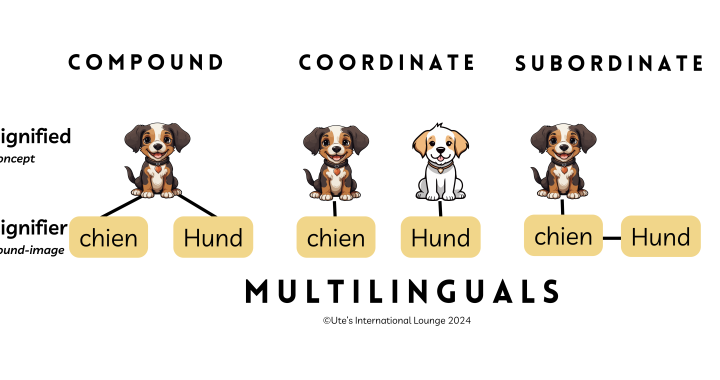
Compound multilinguals acquire two or more languages in the same context, associating both languages with the same concepts. For example, a child exposed to French and German at home from birth might connect both chien and Hund to the same mental image of a dog.

This results in an integrated cognitive system, where languages are closely interwoven. According to Grosjean (1982), compound multilinguals often engage in code-switching and code-mixing, effortlessly drawing on resources from both languages to express themselves.

Example:

A child whose parents use two languages interchangeably during everyday conversations develops compound multilingualism, associating ideas, emotions, and experiences with both languages.

Why is it important?

  • Compound multilinguals tend to have native-like pronunciation and deep cultural insights into both languages.
  • They benefit from enhanced cognitive flexibility, as navigating multiple languages fosters problem-solving skills and executive function.


Coordinate Multilinguals


Coordinate multilinguals acquire their languages in distinct settings, creating separate mental systems for each language. For instance, a child might speak Polish at home and use English exclusively at school, associating each language with a specific domain of life.

This separation allows for clear boundaries between languages, which can reduce interference and facilitate context-specific language use (Hamers & Blanc, 2000).

Example:

A teenager raised in a bilingual environment may use French exclusively with family members and German for academic purposes, keeping the two languages distinct in their mind.

Why is it important?

  • Coordinate multilinguals often develop strong precision in language use, as they associate each language with specific contexts.
  • This distinction supports academic success, especially in settings where multilingual proficiency is essential.


Subordinate Multilinguals


Subordinate multilinguals learn a new language by relying on their dominant language for understanding and expression. Instead of linking the new language directly to concepts, they use translation as a bridge. This type of multilingualism is common in classroom settings or when a language is learned later in life.

While subordinate multilingualism is often an initial phase, with practice and immersion, learners can transition to a more balanced form of multilingualism, leading to coordinate multilingualism.

Example:

A 10 year old child learning English through Italian translations — equating gatto with “cat” rather than directly associating it with the concept of a cat.

Why is it important?

  • Subordinate multilinguals may initially struggle with fluency, but translation can serve as a helpful scaffold for learning.
  • Structured exposure and immersion can accelerate fluency and help learners develop direct associations with the new language.


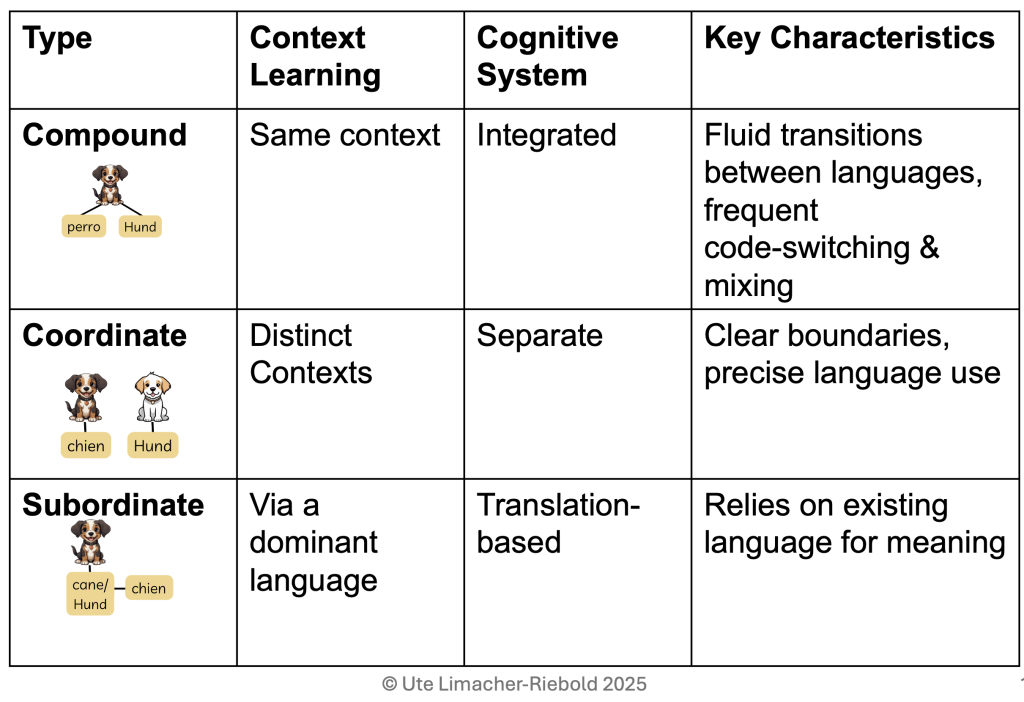
Comparison of Multilingual Types:

Practical Implications for Families and Educators

Understanding these types of multilinguals is essential for fostering effective language learning. Here is how to best support them:

  1. Compound Multilinguals:
    • Encourage frequent and natural use of multiple languages at home to build an integrated system.
    • Embrace code-switching as a sign of linguistic competence, not confusion.
  2. Coordinate Multilinguals:
    • Establish distinct contexts for language use, such as MLAH (Minority Language at Home) strategies, to strengthen compartmentalization.
    • Reinforce the use of each language in its respective domain.
  3. Subordinate Multilinguals:
    • Move learners beyond translation by exposing them to immersive experiences in the target language.
    • Use storytelling, conversation, or multimedia to encourage direct connections with the language.


Final Thoughts

Understanding compound, coordinate, and subordinate multilinguals allows us to appreciate the diverse ways they organize and use their languages.

By tailoring language practices to these patterns, families and educators can create supportive environments that maximize multilingual potential.

Bibliographical References

  • De Saussure, F. (1972). Cours de linguistique générale, Paris, Payot.
  • Grosjean, F. (1982). Life with Two Languages: An Introduction to Bilingualism. Harvard University Press.
  • Grosjean, F. (2010). Bilingual: Life and Reality. Harvard University Press.
  • Hamers, J. F., & Blanc, M. H. A. (2000). Bilinguality and Bilingualism (2nd ed.). Cambridge University Press.
  • Weinreich, U. (1953). Languages in Contact: Findings and Problems. Mouton Publishers.

Please read also my post on Simultaneous and Sequential/Successive Bilinguals

Please find the Greek version of this post by Chryssa Oiconomidou on the Paidokipos site.

Vermeide diese 10 Gewohnheiten mit deinen mehrsprachigen Kindern

Die Erziehung mehrsprachiger Kinder ist eine lohnende und zugleich komplexe Aufgabe, die durchdachte Strategien und ein unterstützendes Umfeld erfordert.

Jede Familie muss herausfinden, was in den vielen (!) unterschiedlichen Phasen der Sprachentwicklung und des Sprachenlernens der Kinder (und Eltern!) am besten funktioniert.


Als Eltern machen wir uns oft Sorgen, wenn andere Bemerkungen machen oder besser zu wissen scheinen, was für uns oder unsere Kinder gut ist. Besonders wenn es sich um Autoritätspersonen oder Fachleute handelt,  bezweifeln wir ob das, was wir tun, „richtig“ ist oder ob wir vielleicht „etwas falsch machen“.

Bitte stellet immer eure Familie, eure Kinder an erste Stelle! Beobachtet, was für euch funktioniert, was ihr zu bewältigen bereit seid, und überlegt anschließend, eure Gewohnheiten anzupassen oder zu ändern.

Basierend auf meiner mittlerweile lebenslangen Erfahrung als Mehrsprachige, nun mehr als 20 Jahren mehrsprachiger Erziehung meiner eigenen Kinder, und  Unterstützung mehrsprachiger Familien möchte ich euch einladen, zehn Gewohnheiten abzulegen, um eine erfolgreiche mehrsprachige Erziehung eurer Kinder zu fördern:


1 Das Erwarten sofortiger Ergebnisse: Sprachentwicklung braucht Zeit.

Vermeidet, eure Kinder unter Druck zu setzen, “perfekt zu sprechen” oder “sofort die Sprache zu wechseln” (Paradis, Genesee & Crago, 2011).


2 Inkonsequent sein: Konsistenz ist entscheidend.

Vor allem in den ersten Jahren! Ein häufiger und abrupter Wechsel der Strategien oder der Sprache (d. h. ohne dass dies nötig ist oder ohne dass eure Kinder den Grund dafür verstehen) kann kleine Kinder verwirren.

Bleibt bei eurem gewählten Ansatz, sei es One Person One Language (OPOL) oder Minority Language at Home (MLAH) (Barron-Hauwaert, 2004), oder später Time and Place (T&P) oder eine Kombination unterschiedlicher Strategien.

Ich lade euch ein, mein Video über Code-Switching und Code-Mixing und Sprachstrategien für mehrsprachige Familien sowie die Vielfalt mehrsprachiger Familien anzusehen.


3 Jeden Fehler korrigieren: Ständige Korrekturen können Kinder entmutigen.

Konzentriert euch auf Kommunikation statt auf Perfektion. Durch den natürlichen Kontakt und die reine Nutzung von Sprachen werden die Sprachfähigkeiten unserer Kinder nach und nach verfeinert (Lightbown & Spada, 2013; Lanza, 1997 & 2004; Meisel, 2019; Nakamura, 2020).

In diesem Video teile ich einige wirksame Diskursstrategien für mehrsprachige Familien.


4 Überladung mit Sprachen: Zu viele Sprachen auf einmal zu lernen, kann unsere jüngsten Kinder überfordern.

Vor allem dann, wenn sie von derselben Person übermittelt werden und für die Kinder kein erkennbarer Bedarf besteht, sie zu lernen. Führt zusätzliche Sprachen schrittweise ein, basierend auf der Kapazität eurer Kinder und dem Kontext (De Houwer, 2009, 2019, 2021).

Schaut euch hierzu meine Videos an, welche Sprache wir zuerst mit unserem Kind sprechen sollten, warum es nie zu spät ist, eine Sprache später hinzuzufügen, und ob „früher tatsächlich besser“ ist


5 Die Gemeinschaftssprache ignorieren: Das Gleichgewicht zwischen Herkunfts- und Gesellschaftssprachen ist von entscheidender Bedeutung.

Stellt sicher, dass eure Kinder die in Ihrem Umfeld vorherrschende Sprache beherrschen, um soziale Integration und akademischen Erfolg zu erleichtern (Cummins, 2000). Für unsere Kinder ist es sehr motivierend zu sehen, dass auch wir Eltern unsere Sprachkenntnisse in der Gesellschaftssprache verbessern.

In diesem Video gebe ich einige Tipps, wie ihr die Gesellschaftssprache auch zu Hause nutzen könnt.


6 Sich ausschließlich auf formale Bildung verlassen: Das Sprachenlernen wird durch alltägliche Interaktionen, Spiel und kulturelle Erfahrungen gefördert.

Die Schaffung einer reichhaltigen sprachlichen Umgebung außerhalb des Klassenzimmers (Grosjean, 2010) ist für Familien, die zu Hause nicht die Gesellschafts- oder Schulsprache verwenden, von entscheidender Bedeutung.

Das bedeutet: Bietet euren Kindern Möglichkeiten, ihre Sprachkenntnisse mit anderen Kindern verschiedener Altersgruppen und Erwachsenen, zu einem breiten Themenspektrum anzuwenden und zu verbessern. Motivation ist der Schlüssel zum erfolgreichen Sprachenlernen und unsere Kinder sind noch motivierter, ihre Sprachkenntnisse in der Schulsprache zu verbessern, wenn sie erleben, dass wir diese Sprachen auch benutzen.

Wenn wir unsere Lernerfahrungen teilen und was es bedeutet, Sprachkenntnisse (oder überhaupt andere Fähigkeiten!) zu verbessern, wird es für unsere Kinder ganz selbstverständlich sein, dasselbe zu tun.


7 Beschränkung des Sprachgebrauchs auf bestimmte Kontexte: Fördert  die Verwendung aller Sprachen in unterschiedlichen Kontexten.


Diese Flexibilität steigert die Kompetenz und das Selbstvertrauen (Bialystok, 2011). Wir alle lernen Sprachen von verschiedenen Menschen, für unterschiedliche Zwecke und in unterschiedlichem Umfang. Wenn wir wollen, dass unsere Kinder ihre Sprachkenntnisse in einer bestimmten Zielsprache verbessern, müssen wir Möglichkeiten dafür schaffen.

Das Gleiche gilt für die Verwendung alle ihrer Sprachen, wenn sie möchten und dazu bereit sind! Ich nenne das das Paradoxon der mehrsprachigen Kindererziehung.

In diesem Video spreche ich über dieses Paradoxon (hauptsächlich in Bezug auf unsere jüngsten Kinder). Sobald unsere Kinder älter sind, können wir problemlos zwischen allen Sprachen wechseln, die wir teilen. Ich mache das mit meinen inzwischen erwachsenen Kindern sowie mit meinen mehrsprachigen Freunden.


8 Vergleichen Sie Ihre Kinder mit anderen: Die Sprachreise jedes Kindes ist einzigartig.

Vergleiche können übermäßigen Stress erzeugen und unsere Kinder demotivieren (Döpke, 1992). Wenn ihr das Gefühl habt, dass andere Kinder die Zielsprache “besser” beherrschen, versucht, einen Schritt zurückzutreten und euch auf eure Kinder und ihre individuelle Entwicklung zu konzentrieren.

Gibt es Anzeichen von Stagnation, die nicht durch eine große Veränderung (Umzug, Kita- oder Schulwechsel, Übergangszeit, Veränderung in der Familie etc.) erklärt oder gerechtfertigt werden können?

Macht euch Notizen über die Entwicklungsstadien eurer Kinder (es ist nicht notwendig, dies täglich zu tun, einmal pro Woche oder gelegentlich ist in Ordnung und hilft auch dabei, die Entwicklung unserer Kinder bei Arztbesuchen zu erklären) und werft einen Blick auf das Gesamtbild.

Solltet ihr euch dennoch Sorgen machen, könnt ihr jederzeit einen Beratungstermin mit mir vereinbaren, in meiner privaten Facebook-Gruppe „Multilingual Families“ eine Frage stellen oder einen meiner  Online-Kurse buchen, in denen ihr herausfinden könnt, welche Möglichkeiten sich euch bieten.


9 Die Macht des Spiels unterschätzen: Spielen ist eine natürliche und effektive Möglichkeit, Sprachen zu lernen.

Beteiligt euch an Spielen, Geschichtenerzählen und Liedern, um das Lernen angenehm zu gestalten (Toth, 2010). Das gilt nicht nur für die ersten paar Jahre! Schaut euch bitte meine Toolbox für mehrsprachige Familien und den YouTube-Kanal “Aktivitäten für mehrsprachige Familien” an, wo wir Aktivitäten und Spiele teilen, die das Verstehen, Sprechen, Lesen und Schreiben bei Kindern im Alter von 0 bis 15 Jahren fördern.


10 Eure Sprache vernachlässigen: Behaltet  eure Kenntnisse in eurer Herkunftssprache bei und verbessern eure Kenntnisse, indem ihr über die Entwicklung und Veränderungen eurer Sprache auf dem Laufenden bleibt.

Kinder brauchen starke Vorbilder und konsequenten Input von fließenden Sprechern (Yamamoto, 2001). Ihr seid jederzeit herzlich willkommen, an meinen monatlichen kostenlosen Online-Meetings teilzunehmen, bei denen wir auch darüber sprechen, wie wir als Eltern unsere Sprachen im Ausland aufrecht erhalten können!


Das Vermeiden dieser Gewohnheiten kann ein unterstützendes Umfeld für eure Kinder schaffen und eine effektive Mehrsprachigkeit und interkulturelle Kompetenz fördern.


Im Text zitierte Werke:

  • Barron-Hauwaert, S. (2004). Language Strategies for Bilingual Families: The One-Parent-One-Language Approach. Multilingual Matters.
  • Bialystok, E. (2011). Bilingualism in Development: Language, Literacy, and Cognition. Cambridge University Press.
  • Cummins, J. (2000). Language, Power, and Pedagogy: Bilingual Children in the Crossfire. Multilingual Matters.
  • De Houwer, A. (2009). Bilingual First Language Acquisition. Multilingual Matters.
  • De Houwer, A. (2019). Input, context and early child bilingualism: implications for clinical practice. 
  • De Houwer, A. (2021). Bilingual development in childhood. Cambridge: Cambridge University Press.
  • Döpke, S. (1992). One Parent, One Language: An Interactional Approach. John Benjamins Publishing.
  • Grosjean, F. (2010). Bilingual: Life and Reality. Harvard University Press.
  • Lanza, Elizabeth, Language Mixing in Infant Bilingualism. A Sociolinguistic Perspective. Oxford, OUP, 1997.
  • Lanza, Elizabeth, Language Mixing in Infant Bilingualism: A Sociolinguistic Perspective, Oxford, OUP, 2004.
  • Lightbown, P. M., & Spada, N. (2013). How Languages are Learned. Oxford University Press.
  • Meisel, Jürgen, Bilingual Children. A Guide for Parents, CUP, 2019.
  • Nakamura, J. (2020). Multilingualism in Children: Strategies for Effective Communication. Journal of Multilingual and Multicultural Development, 41(3), 256-272.
  • Paradis, J., Genesee, F., & Crago, M. B. (2011). Dual Language Development & Disorders: A Handbook on Bilingualism and Second Language Learning. Brookes Publishing.
  • Toth, P. D. (2010). The Impact of Extended Instruction and Interactive Discourse on the Second Language Acquisition of Grammatical Structures. Language Teaching Research.
  • Yamamoto, M. (2001). Language Use in Interlingual Families: A Japanese-English Sociolinguistic Study. Multilingual Matters.


How to help multilingual children with homework

For parents, especially in multilingual families, one of the biggest challenges is deciding how to support our children with homework. Should we help them in our home language, or should we stick to the school language? This is particularly tricky when it comes to STEM subjects. If you’re facing this dilemma, you’re not alone!

The Struggle is Real

When my children started school in English – a language different from those we used at home and in the community – I faced the same challenges many of you are experiencing. Maths and science concepts, new vocabulary, and reasoning were all things I had to figure out how to help them with. What I realized quickly was that bridging between school and home languages, especially in subjects like maths, is more complex than it seems. Many parents and teachers may not fully understand how to balance supporting home languages while also ensuring children succeed academically in the school language.

Why Translating Doesn’t Always Help

It can be tempting to translate everything into our home language when helping our children. I tried this approach myself but soon noticed it wasn’t as effective as I had hoped. My children often became frustrated, disengaged, and overwhelmed. Juggling two or three languages during homework sessions added unnecessary complexity.

It turns out that it’s often better for children to reason and explain things in the language they learned it in – usually the school language. This not only helps them grasp the subject matter more effectively, but it also builds confidence in the academic language they will need to use in school (Cummins, 2000).

Build a Strong Academic Foundation with the School Language First

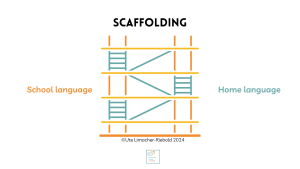
Research shows that multilingual children benefit from developing subject-specific skills, such as mathematical reasoning, in the school language. This process is called scaffolding. Imagine scaffolding as the structured support we provide while our children are building their understanding of new concepts. In this case, the school language acts as the first scaffold that allows children to problem-solve and analyze effectively (Gibbons, 2002). Once they’ve grasped the concept in the school language, we can introduce home language terms to deepen their understanding.

Why It’s Important to Follow Their Lead

One key tip is to follow our children’s lead and let them choose the topics they are most interested in. These topics are the ones they’re more likely to want to talk about in our home language. For example, if our child is working on a math problem, we allow them to reason through the problem in the school language first. They need to understand the question, analyze it, and explain their thinking. Translating everything into the home language can slow down this process and sometimes even confuse them. According to François Grosjean (2010), multilinguals don’t automatically translate everything they learn in one language into another—they store that knowledge in the language they learned it in.

The Complexities of Subject-Specific Language

It’s also important to understand that while children may be fluent in speaking their home languages, they often lack subject-specific vocabulary, especially in areas like maths and science. Once they are confident in explaining concepts in the school language, they might be ready to transfer that knowledge to the home language – but this is not a given!

The time it takes for a child to transfer understanding from the school language to the home language depends on many factors, including their comprehension level, fluency in both languages, and whether they feel the need or desire to do so (Genesee et al., 2004).

The Power of Code-Mixing

What’s likely to happen as our children become more comfortable with STEM subjects is that they’ll switch between languages and code-mix, i.e. insert words from the school language into the sentences in their home language. Code-mixing is a sign of cognitive flexibility and is perfectly normal for multilingual learners. It shows that our children are processing complex information using all the linguistic resources available to them. However, it’s also an indication that they are still learning the terms, and they’ll need to use these terms in various contexts to master them in both languages (Bialystok, 2011) with confidence.

Using Visual Aids as a Support Tool

One way to scaffold learning without relying too much on language is by using visual aids. Diagrams, charts, or hands-on models help children grasp concepts visually, making it easier for them to understand without needing everything explained in words. This is particularly helpful when it comes to explaining maths and science concepts. For example, when teaching geometry, you can use objects around the house to demonstrate shapes and angles. Visual aids work wonders for children of all ages and can be an excellent tool for multilingual learners (Gibbons, 2002).

Scaffolding: Support, Then Independence

Remember, the goal is to provide just enough support to help our children understand, then step back and allow them to work independently. Over time, our children will become more confident in explaining these concepts in both the school language and the home language – if they choose to do so. It’s crucial to follow their pace and not impose an expectation to master everything in all languages.

In Summary: Scaffolding is Key

When supporting our multilingual children with homework, especially in STEM subjects, it’s essential to start by scaffolding their learning in the school language. This ensures they build confidence in academic settings. Once they grasp the concepts, we can introduce home language terms to reinforce their understanding also in the language they use with us. If we consistently scaffold from the school language to the home language, children will develop strong, flexible thinking and language skills, which will serve them well in all areas of life.

A Flexible Approach

Finally, remember that every child is different, and there’s no one-size-fits-all approach to supporting multilingual learners. Some children may quickly transfer knowledge between languages, while others may prefer to keep their academic and home languages separate. The key is to offer support, follow their lead, and provide opportunities to practice and explore topics in multiple languages – if and when they’re ready.

Bibliography:

  • Bialystok, E. (2011). Reshaping the Mind: The Benefits of Bilingualism. Canadian Journal of Experimental Psychology.
  • Cummins, J. (2000). Language, Power, and Pedagogy: Bilingual Children in the Crossfire. Multilingual Matters.
  • Genesee, F., Paradis, J., & Crago, M. B. (2004). Dual Language Development and Disorders: A Handbook on Bilingualism and Second Language Learning. Brookes Publishing.
  • Gibbons, P. (2002). Scaffolding Language, Scaffolding Learning: Teaching Second Language Learners in the Mainstream Classroom. Heinemann.
  • Grosjean, F. (2010). Bilingual: Life and Reality. Harvard University Press.


I invite you to watch my video about this topic:

How to Read Bilingual Books with Emergent Readers: A Guide for Simultaneous and Successive Bilinguals

How to Read Bilingual Books with Emergent Readers: A Guide for Simultaneous and Successive Bilinguals

We can support early literacy and bilingual language development of emergent readers by using bilingual books.
However, it is important to tailor reading strategies to the child’s bilingual background. Children acquiring two languages simultaneously (simultaneous bilinguals) have a different language experience compared to those who learn a second language after establishing a foundation in one language (successive bilinguals).

Both groups can benefit from bilingual books, but their needs and approaches may vary.

Bilingual books are sometimes referred to as “Dual Language Books” or “Side-by-Side-Books”, i.e. with two different languages on the same page, with the one language being the translation of the other. 

With emergent reader we define a person who is interested in books but can’t yet read them independently, or may be able to read some words but requires continued support to make meaning from print.

“Emergent readers are working on lots of goals: they’re learning more letters of the alphabet, expanding their perspectives through new books, and taking big steps toward writing. To support an emergent reader, literacy experts suggest (…) reading strategies to help them advance toward reading fluency.”

(I invite you to read the full article Developing Readers vs Emergent Readers on:  readingteacher.com)

In this short guide, I share how to effectively use bilingual books with emergent readers, and I distinguish between simultaneous and successive bilinguals. Simultaneous or successive multilingual emergent readers require a more tailored support that I will focus on in a separate post.
Here I focus on simultaneous bilingual emergent readers who have acquired both languages from birth (within their first few years) in a natural, spontaneous way, and where the school language or the language they learn to read in a formal setting, is also one of their home languages. They may have a balanced exposure to both languages at home and the community, but this is not a given and is difficult to measure or assess.

First of all, reading is a skill that is not acquired spontaneously like speaking. One does not learn how to read by constantly being read to. We need to “crack the code” of reading, which means that we need to learn how to give meaning to the signs on the page (or screen).
When exposed to reading books to and with them from early on, children will understand what decoding means. They will understand that the characters on the page have a meaning (in another post I explain how emergent readers become skilled readers with the help of the Reading Rope).

Bilingual books are not the only way to foster reading skills in more than one language, but they can be used to foster the same kind of vocabulary in both languages.

1. Choose the Right Bilingual Book

For both simultaneous and successive bilinguals, selecting an age-appropriate and engaging bilingual book is essential. Books with rich illustrations, repetitive patterns, and familiar themes provide the necessary scaffolding for language learning.

However, the linguistic demands of the book should match the child’s language experience.

  • For Simultaneous Bilinguals, books that integrate both their languages naturally and seamlessly are ideal. Look for books where both languages are presented with equal prominence to foster a balanced exposure.

  • Successive Bilinguals are introduced to a second (or additional) language after the foundation of their first language(s), typically after age three. This introduction usually happens in formal settings (at school). They benefit from bilingual books where the stronger language is used to support the acquisition of the weaker language. Books that gradually introduce the second/weaker language, perhaps with more text in their more dominant language and keywords or phrases in the new language, can make the transition smoother.

Tip:

For successive bilingual emergent readers, choose books that start with more content in their dominant language and slowly introduce the target language to ease the learning process.

For simultaneous bilinguals emergent readers, who already know and use both languages, look for books where both languages are given equal weight and representation.

2. Engaging with Both Languages

The way you use both languages during reading sessions should vary based on the children’s bilingual status.

  • Simultaneous Bilinguals are accustomed to switching between languages naturally. However, although they can alternate between the two languages more fluidly when speaking, when it comes to reading, avoid alternating the languages in one setting, i.e. do not read one section in one language, and the next in the other. You can do this in a second step. Once the children can decode (i.e. read) in both languages you can invite them to compare the vocabulary and structure (if they are interested). This metalinguistic approach can help to reinforce both languages in a more balanced way, i.e. they can learn new vocabulary in both their languages. It is crucial to follow the children’s lead: simultaneous bilinguals do not translate or compare their languages! 

Simultaneous bilinguals might be relatively “balanced” in their languages when it comes to speaking, but this does in no way equal their fluency skills when it comes to decoding, i.e. reading! (Ute Limacher-Riebold PhD)

  • Successive Bilinguals who are emergent readers are still gaining proficiency in the second language. This means that they are still learning new words in the second language and need a lot of opportunities to be exposed to both in order to find ways to link new words to the terms they know – and those they are still learning (!) – in their first or more dominant (i.e. “stronger”) language!
    For successive bilinguals it is helpful to first explain or read the text in their more dominant language to ensure comprehension. Afterward, read the same section in the weaker language with them, focusing on key vocabulary or phrases.

This kind of approach from the more dominant to the new language is where children need help with. Language Friendly Schools can support the children by creating opportunities to discover the “new” (school) language through translanguaging activities that involve reading (and writing).

Bilingual books in the home language and the school language are ideal for successive bilinguals and/or newcomers! Children can read them in their home language with their parents first, and then, in class, in the school language. This way they already know what the text is about and can easier transmit their knowledge to the (weaker) school language and, with help of the teachers, easier decode the new language.

The primary goal is to build confidence in the second language without overwhelming the child.

Tip:

For successive bilingual emergent readers you can use the “sandwich technique” which consists in reading a sentence or passage in the dominant language, then in the second language, and again in the dominant language. Emergent readers might manage to decode the script quickly, but you may want to make sure that they also understand what they are reading/decoding!

With simultaneous bilingual emergent readers, try to foster each language at a time, not both together in the same setting. This separation seems a paradox, but simultaneous bilinguals do not constantly compare their languages, and are very good at separating their different languages in speech and when reading!

3. Using Visual Cues for Language Support

Emergent readers who are developing bilingual skills, rely heavily on visual cues to aid comprehension. Bilingual books with vivid illustrations that correspond closely to the text are highly effective for both simultaneous and successive bilinguals.

  • Simultaneous Bilinguals can process both languages concurrently and use the illustrations to bridge understanding between the two languages. Point to the images while reading and encourage the children to describe what they see in the language you are focusing on. Do the same, in another setting, with the other language. This helps them link the two linguistic systems in an effective way.

Never assume that terms and concepts are equally distributed and known in both languages! 

Simultaneous bilinguals learn their languages from different persons, for different purposes, in different domains of life and to various extent.

(Ute Limacher-Riebold; extended version of Grosjean, 2012)

  • For Successive Bilinguals, visuals are particularly important as they provide contextual support when the second language is less developed. Encourage the child to use the illustrations as clues to decode the meaning of unfamiliar words in the second language.

Tip:

For both types of emergent bilingual readers, use the pictures as a way to elicit language production. Ask the child to describe the pictures in the target language or use key vocabulary from the text.


4. Balancing Repetition and Predictability

Repetition is key to language learning, and bilingual books often use predictable patterns and repetitive structures that support language development. However, how repetition is used may vary between simultaneous and successive bilingual emergent readers!

  • Simultaneous Bilinguals benefit from hearing the same story in both languages, as it reinforces linguistic patterns across their two languages. Repetition in both languages helps them recognize equivalent or different structures and vocabulary, strengthening their overall bilingualism. 

  • Successive Bilinguals need more repetition in their dominant language to ensure comprehension before being exposed to the second language. Once they are familiar with the story in the dominant language, repeating it in the second language allows them to focus on understanding without the cognitive load of learning the narrative itself.

Tip:

Read the same book multiple times in both languages, by alternating the languages in two separated sessions with simultaneous bilingual emergent readers. The focus here is to learn how to read in each language.

For successive bilingual emergent readers, ensure they are fully comfortable with the story in the dominant language before introducing more of the second language.

5. Creating a Positive, Interactive Environment

Creating a positive reading environment is critical for both simultaneous and successive bilinguals. Children thrive when they feel that reading is fun and interactive and not a task or lesson.

  • Simultaneous Bilinguals are used to navigating two (or more) languages. Make the reading experience as interactive as possible by using gestures, facial expressions, and even games to help them connect the two languages. (In The Toolbox for Multilingual Families you can find many activities and games that foster reading (and writing) for multilinguals!)

  • With Successive Bilinguals, ensure that the second language does not feel like a burden. Engage the children with interactive reading techniques—such as acting out scenes, using props, or encouraging them to guess what happens next—to make the process enjoyable.

Tip:

Celebrate small wins in both languages. Acknowledge the children’s progress and foster their confidence in both languages! 


Conclusion

Reading bilingual books with emergent readers is an invaluable way to support their bilingual development, but it’s important to tailor your approach to whether the children are simultaneous or successive bilinguals.

Simultaneous bilinguals usually benefit from a more balanced and integrated exposure to both languages when it comes to speaking. With regards to reading though, they are usually faster in the school or more dominant language, i.e. the language they have learned to read first.

Some bilingual children learn to read in multiple languages at the same time, i.e. simultaneously, for example in some CLIL schools. This is, alas, still the exception as it requires schools to offer tuition in both languages from very early on.

Successive bilinguals need additional support in their second language, with a focus on building confidence gradually.

By selecting the right books, using both languages strategically, incorporating visual cues, and fostering a positive reading environment, you can nurture the children’s bilingual abilities and foster a lifelong love of reading.

Simultaneous bilinguals who are exposed to three or more languages from birth and are learning to read in an additional language at school, benefit from reading in both, their home languages and the school language on a daily basis.

In my trainings and consultations I help families find the strategy that best works for them (parents and children!) when it comes to fostering reading skills in two, three or more languages. 

References:

  • Cummins, J. (2021). Rethinking the Education of Multilingual Learners: A Critical Analysis of Theoretical Concepts, Multilingual Matters.
  • De Houwer, A. (2009). Bilingual First Language Acquisition. Multilingual Matters.
  • Genesee, F. (2002). Portrait of the Bilingual Child. Language, Speech, and Hearing Services in Schools.
  • Grosjean, F. (2012). Bilingualism: A short introduction. In F. Grosjean & P. Li (Eds.), The psycholinguistics of bilingualism (pp. 5–25). Hoboken, NJ: John Wiley & Sons.
  • Baker, C. (2011). Foundations of Bilingual Education and Bilingualism. Multilingual Matters.
  • Tabors, P. O. (2008). One Child, Two Languages: A Guide for Early Childhood Educators of Children Learning English as a Second Language. Paul H. Brookes Publishing Co.
  • Gort, M. (2012). Codeswitching Patterns in Bilingual Kindergarteners’ Literacy Practices. Early Childhood Education Journal.