How to adjust your international language

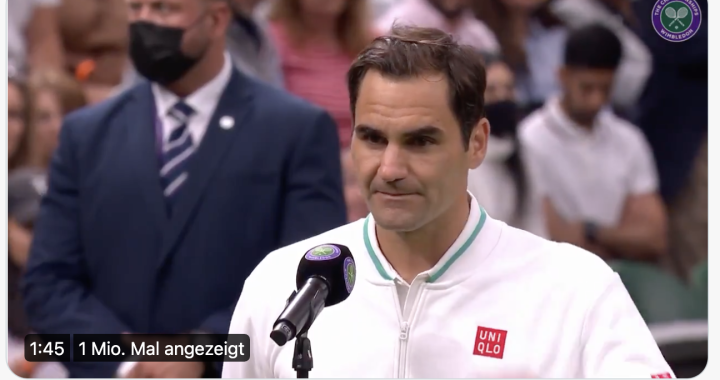
When I saw this interview with Roger Federer the other day, I couldn't resist but share it in my facebook group Multilingual Families.

It is a perfect example for why, when we use our language in international settings, we shouldn't assume that sayings, metaphors (and abbreviations!) are universal.


In this particular example, Roger Federer made it very clear that "his mind went blank" when the journalist asked him if " (his) absence (on Centre Court) made the heart grow fonder (to come back, playing at Wimbledon)" applied to him too.

Let's have a look at the interview:
Journalist: "...is it true what they say that absence (is) making the heart grow fonder, being back here?"

Roger Federer: "I, I... sorry I didn't understand it." (look at his smile, he puts the arms behind his back, smiles to the public) "I heard that something absence, then, I don't know... my mind went blank-"

Journalist (smiles and repeats slightly louder): "I..Is it true they say about absence making the heart grow fonder and being back on Centre Court?"

Roger Federer (still his arms behind his back, shakes his head, looks into the public...): "I don't understand that saying..." (laughs and the public laughs with him; he looks at the interviewer) "My English is not good enough" (continues smiling and laughing...)

Journalist: "Fair enough... So, basically, having missed out last year [Federer: "Yes..."] away from this place for two years, how special is it to be back here?"

Roger Federer: (nods, puts the arms in front of him again) "Yes, there you go (public laughs, then claps, Federer crosses the arms in front of him, touches his face and waits until the public calms down) A good reminder my English is not very good but it's ah... (Journalist: "It's better than mine!") no, no no...  Ah, no, look, ah... I think we're all very happy, all the players, I think including all the fans and the organizers and everybody... that we get a chance to black ah... playing again back on tour overall. Especially here in Wimbledon and plus with the crowd, it would have been the worst to have this term with no fans. This would have been ... absolute killer... (cheering from the public) but it's ah...(applause and cheering from the public). That's... it's... it's such a privilege to play here. (puts his arms again on his back) Look, I couldn't be more excited. I made it after a long hard road last year and so forth, but ah... I'm happy I get a chance for a second match and I'll see how it goes, but I hope everybody else is having a great time (puts his hand up on the side) but even though it's raining but that's normal so (puts his arms on his back again, smiles, nods and talks to the public; the public is cheering) I'll see you at the second round".


This kind of mis-communications happen all the time in international settings (and not only in international settings) for the simple reason that we usually assume that the way we express ourselves is "clear enough", that the other person will understand what we mean and how we mean it. I like to quote Karl Popper: "It is impossible to speak in such a way that you cannot be misunderstood". The same applies to the receiver: you can not assume that you'll understand everything the other person says. Not because you are not "good enough", "fluent enough" (whatever that means!!) in the language, but because the context, the word choice and the intonation, articulation, the use of sayings, metaphors etc. usually allows multiple interpretations and can be misleading.

In this particular situation, the interviewer could have explained what he meant immediately, without putting Federer on the spot. He could have rephrased it, paraphrased it, made an example... But he assumed that Federer "zoomed out" for other reasons – like acoustics, short distraction or because he was tired – and repeated exactly the same question.

Now, in this kind of situation we all know that some people would just ignore, do as if they understood something else and answer whatever they want to share, without letting the other person know that they didn't understand.
It requires a high sense of loyalty towards the interviewer and self confidence to react the way Roger Federer did. His English is very good and the way he reacted was top. After saying that he didn't know the saying he added "my English is not so good" – like an excuse. For this last comment or self-judgment people on twitter said that "he might have British humor after all". 
I think it has more to do with Federer being used to international settings and not taking this kind of situation too seriously, not personally. Federer is perfectly able to laugh at himself – a skill that comes with being multilingual and multi-cultural.

It is always ok to ask for clarification, no matter if in a private conversation or, like here, in front of a big public and when we're put on the spot. Roger Federer, who is perfectly capable of adjusting to the British communication patterns, gave the journalist the chance to reformulate the question by saying overtly what happened: his mind went blank which means: "something triggered my mind to go blank, aka, I didn't understand what you just said...".

This is a very polite and indirect way to signalize that one needs clarification. People who are used to "reading the air" or "reading in between the lines" would have reacted accordingly, without putting him on the spot. But in this particular situation, the journalist assumed that this meant that Federer didn't "hear" him (acoustically). He took it at face value, i.e. that Federer really didn't hear what he just asked, and chose to repeat the question. Let's not forget the situation: the journalist knew how fluent Federer is in English and didn't assume that he wouldn't be familiar with the saying and, he most probably expected a more direct hint.

Federer realized that the journalist didn't understand and specified why his "mind went blank" by adding that he didn't understand that saying. 

Now, one can be quick at judging the journalist and saying that he didn't manage to understand what went wrong. But when Roger Federer said that he didn't know the saying and that his English wasn't "good enough", the journalist replied that "it's better than mine".

I think most people who listened to this interview didn't understand what the journalist wanted to point out here: he realized that he didn't manage to adjust his language in this interviewee, and caused what could have been a very embarrassing situation for Roger Federer. He apologized in his own way. He emphasized with Federer's situation and quickly positioned himself and his English "under" the level of comprehension of his interviewee, which, in my opinion, saved the situation.

When the journalist explains what he means, Federer says "there you go", triggering the public to cheer, and relaxing the situation that could have been quite embarrassing. By responding in this colloquial way, Federer showed his flexibility and capacity to steer the interview back to where it was.

You can tell that I am a fan of Roger Federer – not only because he is Swiss! – but that's not the reason I chose this example. I think we should always look at both participants in a conversation: how are they adjusting to the other's way of communicating? 


I train internationals and those who work with internationals, become internationally fluent or multi-competent in international settings.

There are very effective strategies one can learn to master this kind of situation with dignity, without loosing the face, self respect and the trust of the other person, exactly how Roger Federer and the journalist did in this example.

In every conversation – and interviews are conversations! – both interlocutors need to adjust their "communication game" to the situation. I like to compare turns in a communication to a tennis game, where you want to have "many successful turns" (without dropping the ball...) and where the pass to the other player can trigger some new reaction, a new way of playing/communicating that you may not have explored yet, but that makes it fun and entertaining. Like every effective communication we want it to be enjoyable and to have a positive outcome for everyone involved.


My questions for you:

  • Does it happen to you that in one or more of your languages you don‘t get certain meanings/allusions etc?
  • How do you respond? Do you feel inadequate, or blame yourself?
  • Do you adjust your language to your interlocutor? If so, by doing what exactly?


Please let me know in the comments.


Language use in multilingual families during lockdown

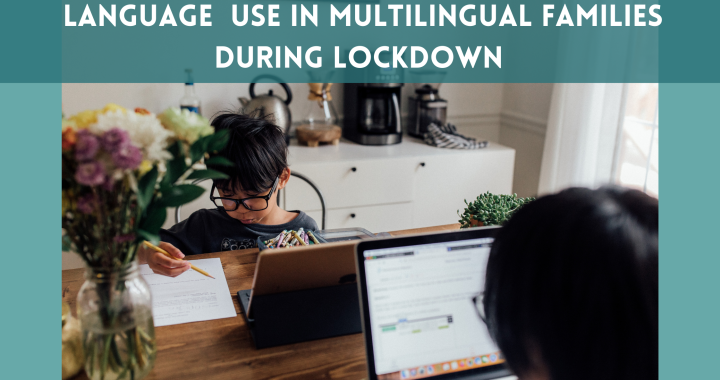
When we all went into our first lockdown due to COVID19 last year, I published a short video for multilingual families who do NOT speak the community language at home, about how to keep up with the school or community languages during lockdown. Especially for very young children who maybe just started daycare, spending more time at home with parents and being more exposed to the home languages, this lockdown maybe caused a “shift back” to the language use they had before attending daycare.  Parents asked me how to support their youngest ones to keep up with their language development in the daycare/community language so that they wouldn’t “lack behind” once daycares and preschools would open again.

In my video I shared the following tips for parents:

  • how to make sure that our children keep up with the home languages and the daycare/school languages
  • how to signalize preschool children when you switch from one language to the other (1:10?-)
  • how to make this with school aged children (2:38?-)
  • how to help our school aged children improve the vocabulary they are learning in the school language (3:40?-)
  • how to collaborate with the school/teachers to make the best out of this situation for your children (4:40?-)

***

A few weeks later, Prof. Ludovica Serratrice from the University of Reading, launched a survey for multilingual families about the use of home languages during the first lockdown in the UK and Ireland, together with colleagues from the Centre for Literacy and Multilingualism at the University of Reading, colleagues from UCL, Oxford, Cambridge, Mother Tongues and We Live Languages.

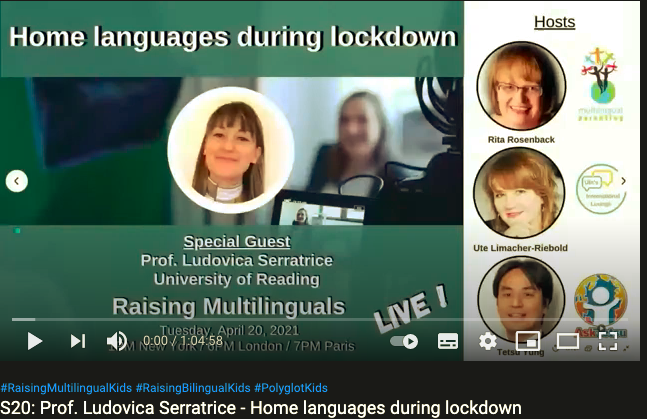
We interviewed Prof. Ludovica Serratrice for our broadcast Raising Multilinguals LIVE! on the 20th April 2021 and I am very thankful that she allowed me to share some insights about her survey. 

In this survey they asked families:

– How they use their languages during the COVID19 pandemic?

– What factors* would predict changes in language practices – such as children’s age, children’s existing use of the language use? (* they looked at other predictors including parental education and self-rated proficiency too)

– About the amount of language and literacy practices in English and home languages.

– Whether there had been an increase in children’s opportunity to hear and use the language more during lockdown and to read and write more. 

– Whether parents were worried about the effects of lockdown on English.

For the purposes of this project we included families with at least one child between the ages of 0 and 18 who are typically in school or childcare, and who are living together during the lockdown period and the social distancing measures during the COVID19 pandemic.

[As for the definition of who would qualify as multilingual family:]

A family is multilingual if one or more languages other than English are used among family members either on their own or together with English (Prof. Ludovica Serratrice)

They collected answers from 1000 parents, [with around 750ish families presenting valuable data], with 95 different languages whose use of languages in the family were like follows (all data is from Ludovica Serratrice):

Parents:

    • In 46% of families the parents speak different languages, and in half of the cases it’s because one parent is a monolingual English speaker
    • In 36% of families one of the parents speaks English at home.
    • In 36% of families both parents speak English at home.
    • In 28% of families neither parent speaks English at home. 

Children:

    • 35% only-child families
    • Only 6% of children speak only the other language to their siblings
    • 46% speak English and other language(s)
    • 48% speak only English to their siblings

Demographics of the children: 30% were primary only, 20% preschool only, 19% primary and secondary and 16% secondary only children.

“There was A LOT of variation, more so for the non-English languages – as you would expect”, and “in absolute terms still more activities in English”, Ludovica Serratrice pointed out in the interview and the presentation  with MultiLing on the 22 April 2021 (see the video here below).

  • For literacy activities in the home language, children read more if they already used that language with the home language-speaking parent.
  • When we asked about the increased opportunities to hear and speak the home language more, we found that this was particularly true for pre-schoolers (age effect), and for all children when they were already using the other language with the parent (language match effect).
  • For reading (primary and secondary only) we found no differences. The amount was overall quite low anyway and no effect of language match. So, while there was a relationship between amount of literacy activities and language match in absolute terms, there was not a relationship in terms of change. (Ludovica Serratrice)

I personally would have liked to know what effect the lockdown had on the home languages in  multilingual families where neither parent speaks English at home (mL@h). Although the effect on preschool children was what we all expected, what was the effect on school aged children? And did siblings who were used to speak the community language to each shift to the home language due to lockdown and the reduced opportunity to speak with peers on a regular basis?

In the UK, many children didn’t have school for a longer period of time – unlike here in the Netherlands, where several schools provided online learning opportunities very quickly. Assuming that they had learned to read and write before lockdown, were children in the UK and Ireland more prone (or willing) to read, maybe write in their home languages? And what about children who were just starting to read and write in the school language and who were now exposed to home languages only: would their parents take the opportunity to teach them to read and write in the home languages during lockdown? What additional support (from extended family, friends etc. via zoom/skype/facetime) did these families have during (and after!) lockdown, and how did this influence their children’s language development? What resources were particularly helpful for multilingual families not only during lockdown, but during this whole last year? 

Ludovica Serratrice shared that “lockdown gave parents time and breathing space from the everyday routine, the commute, the many extra curricular activities (e.g. “because lockdown was very strict, the only pleasure that he really was getting were new books through the post”). For some families this was the opportunity to see a “home language explosion” in speaking and for some in reading. Time to read, time to learn to read together. Because online schooling was not that strict during the first lockdown [in the UK and Ireland; Ute] there was just more time in general to dedicate to non-school activities that are typically associated with English.”

It was, obviously, “not possible to measure the children’s language skills directly”, and “by the time we conducted the survey and the interviews not all of them had been back at school. However, parents in the survey were not worried about their children’s English, and children who took part in the interviews had no anxieties about their English either.” – I wonder if a similar survey among internationals in other countries would have had similar outcomes. Especially families who speak multiple languages at home and the community or school language is only spoken sporadically.

For the other languages, patterns didn’t seem to have changed dramatically, especially for speaking and hearing, “but from the interview data we saw that for some children that were already reading in the other language, lockdown was an opportunity to read more (one child read all of the Harry Potter books in German for example).” 

This confirms my observations in my own children and my client’s children (all between 1,5 and 18 years old) during and after the first lockdown in the Netherlands, France, Belgium and Italy: they were all more prone to read, find alternative ways to being online (as I guess they all were experiencing some kind of online fatigue already), which had a positive effect on their home language skills – at least this was the subjective observation from their parents. 

What about longer lasting effects caused by lockdown on the language development of children in the different age groups?

“The most likely longer lasting changes are with younger children. In cases in which lockdown offered the opportunity for a qualitative change in the pattern of language interaction, e.g. starting to use the other language or using it more, or learning to read, then it could be that if this qualitative shift is preserved, quantitative changes will affect children’s quantity and, potentially, quality of input (e.g. access to literacy, making new friends who are also speakers of their other language) with important consequences for the development of vocabulary and other structural aspects of language.”

What seems like a prolonged holiday effect, might fade though, as “the pull of the societal language is very strong”, and not only for children in secondary school! “Whether this effect will stand the test of time is an empirical question.”

As the pandemic is still not over and many of us have experienced a second and third lockdown, it would be interesting to see how the families are doing now, a year later. After a year of on-and-off from school, where many uncertainties have affected us all to different extent, I wonder how multilingual families who do not speak the school language at home – except for discussing school topics – managed to foster their home languages AND the school languages. Especially because extra curricular language lessons in the home language were not an option for many of us, children had even less input and in some cases were less motivated to continue with any kind of tuition. Furthermore, most children didn’t get to experience their annual full immersion into their home language due to travel restrictions…

I would also be very curious to know how many parents who speak the dominant language (societal language or the language of their children’s education) took the chance to support the minoritized* language during lockdown, knowing that the input in this language would certainly decrease. I know that some parents took this opportunity to participate in activities their partner did with their children in the minoritized language and proudly shared that they improved their language skills thanks to this lockdown situation. – What about parents from the survey who speak English at home? Did they take the opportunity to learn their partner’s language, just a little bit?

While we’re still at home (or at home again!), we can still create meaningful contexts for the use of the home language and make the best out of this situation!

I’d like to end on this  final quote from a parent, Ludovica Serratrice shared with me:
“Lockdown really showed the power of necessity and opportunity to me, that you keep reading on multilingualism, necessity and opportunity. And I know I’ve been like one thousand percent consistent in me speaking Italian to her since birth, but it didn’t matter until she really was home.”

– All quotations in the text are from Prof. Ludovica Serratrice. 

* I prefer using the term minoritized language instead of minority language, as it emphasizes the active part of the society to make a language “less important than…”, and because every language is dominant somewhere (no matter if on a micro, meso or macro level).

*****

– What is your experience during lockdown: did you observe a language shift in the use of languages in your family?

– How did your school support your children with the school language, and what support did you get for your home languages?

– What resources are / were particularly useful for you / your children to foster your home languages?

I’d love to know. Please let me know in the comments.

Further readings: 

En parlant du bilinguisme avec François Grosjean (podcast Tea with KBC)

– Interview with Prof. em François Grosjean par Kathryn Baxter from Tea with KBC (you can find the English transcript of this interview here)

Dans un interview Prof. em. François Grosjean avec Kathryn Baxter  (podcast Tea with KBC) au sujet du bilinguisme, il partage son parcours personnel, ses théories, les principes, la définition, sa mission.

Même si la plupart de la population du monde parle – ou “utilise” – plus d’une langue chaque jour, il est frappant de voir que le monolinguisme, la personne monolingue,  soit encore considéré la norme: “ll faut changer l’attitude du public envers le bilinguisme.”

Il me semble beaucoup plus important que:

“La coexistence et l’interaction de deux ou de plusieurs langues ont crée un ensemble linguistique qui n’est pas décomposable. Le bilingue a sa propre identité linguistique, qui doit être étudiée, décrite, et surtout acceptée (!) en tant que telle.” (et avec bilingue on inclut aussi les personnes qui utilisent/parlent plus de deux langues!)

Le monolingue étant malheureusement la référence pour tout ce qui concerne les compétences linguistiques des bi-/multilingues, François Grosjean partage un  message important à toute personne qui utilise régulièrement deux ou plusieurs langues: ne critiquez pas vos compétences!
En fait, il ne faut pas s’inquiéter des propres capacités linguistiques!

Le fait même qu’on utilise nos langues de façon régulière devrait être suffisante à nous encourager et à nous faire sentir compétents, et, pourquoi pas, fiers de pouvoir nous exprimer en plusieurs langues!

Dans mes ateliers et réunions je partage toujours la définition de bilinguisme et de ce qu’est un bilingue que François Grosjean répète dans cet interview:


Le bilinguisme est l’utilisation régulière de deux ou plusieurs langues, ou dialectes (!), dans la vie de tous les jours.

– Prof. François Grosjean


On ne met pas l’accent sur la compétence linguistique, et non plus sur le moment où la personne acquiert ou apprend les langues!


Le bilinguisme est possible à tout âge


Le Principe de Complémentarité (par François Grosjean):

Les bilingues apprennent en utilisant leurs langues dans des situations différentes, avec des personnes variées, pour des objectifs distincts. Les différentes facettes de la vie requièrent différentes langues. Bien entendu, il existent des domaines et activités où il est possible de servir de plusieurs langues, mais un certain nombre de domaines d’activité sont réservés strictement à une langue.


Si l’on utilise une langue dans des domaines et situations bien particuliers, le vocabulaire se développera dans ces domaines.

L’exemple que Prof François Grosjean fait à propos du principe de complémentarité est ce que j’ai observé chez moi-même: J’ai appris l’histoire et la géographie en français et il m’a fallu beaucoup d’effort pour faire les liens avec les termes, les faits et les noms (!) en français et allemand ou italien (qui sont mes premières langues). Il en va de même pour la mathématique: je l’ai apprise en allemand, tandis que mes enfants l’ont apprise en anglais. Quoique le sujet soit technique et qu’on s’attend que la traduction entre les langues ne devrait pas être difficile, car les termes sont “transparents”, il me semble quand-même que le transfer ne se fasse pas de façon automatique ou intuitive…


Le mode langagier

En tant que bilingues on navigue dans des différents modes langagiers. On peut s’imaginer un continuum qui va du mode langagier monolingue au mode langagier des bilingues qui acceptent (toutes) nos langues et qui acceptent de mélanger les langues.

Le mélange des langues est bien normal entre multilingues!

Il est important de noter que lorsqu’on est bi/multilingue et bi/multiculturel, il est difficile de rester dans un mode langagier monolingue, de se comporter d’une façon mono-culturelle.

Lorsqu’on grandit avec deux ou plusieurs langues et deux ou plusieurs cultures, on ne peut pas seulement passer d’une langue à l’autre, mais aussi d’un contexte culturel à l’autre!


Voici quelques avantages du bilinguisme mentionnés dans cet interview:

  • Le bilinguisme est un atout linguistique qui permet de communiquer avec des personnes de langues et de cultures différentes. 
  • Le bilinguisme ouvre l’esprit et donne des perspectives différentes.
  • Être bilingue offre plus de possibilités de travail. 
  • La personne bilingue peut lire des auteurs étrangers dans la version d’origine.
  • Le bilinguisme nous oblige à avoir un recul sur la langue. Et ça nous permet d’avoir une reflection métalinguistique.
  • Le bilinguisme permet une médiation pour résoudre des conflicts.


Pour les parents qui veulent que leurs enfants grandissent avec plusieurs langues, François Grosjean suggère un projet linguistique.

Il est important de s’informer, et il faut avoir un nombre de questions comme:

  1. Quand ajouter une autre langue?
  2. Quel approche linguistique veut-on adopter à la maison? 
  3. Est-ce que l’enfant ressentira-t’il le besoin d’utiliser chaque langue? 


Le besoin gouverne une grande partie du succès et il faut créer des situations naturelles pour l’enfant, pour qu’il puisse utiliser ses langues régulièrement.

Ne dévalorisez pas vos compétences linguistiques et aidez votre enfant à être fier de ses langues!


Do multilingual children automatically become multilingual adults?

Everyone is talking about multilingualism. Until recently there were still many concerns about a multilingual upbringing – it was feared that children would not be able to speak one or the other language ‘properly’ (whatever this means!) – we now know that multilingualism has all sorts of positive effects on speaking, thinking and acting.

It is no longer difficult for parents-to-be to find information and specific advice on how to raise a child with multiple languages. However, the vast majority of guides, academic projects, and articles on multilingualism focus solely on the toddler and preschool years. Most of the guides encourage parents to maintain and support the family languages. They should also not be intimidated by advice that suggests to prioritize the use of the local language over the family languages, because the first few years are oh so important for a solid language acquisition.

The older the children get, the fewer advice from professionals one can find. It seems that multilingual exposure that needs to be supported especially in the earlier years of language acquisition, is completed once children start attending school. Or as if it is assumed that a good start leads to lifelong success.

Many families manage to support their family languages at home, sometimes with the help of babysitters or friends who speak the same language. But as soon as children start preschool, kindergarten or school, where they are increasingly exposed to the community language, many parents begin to doubt whether and how they can keep their family languages up to speed. Some let teachers and others convince them that the language of the community or school is now more important for their child to fully integrate in school and society, and be academically successful.

The fact that this goes to the expense of the family language is considered by many families as a natural consequence of linguistic and cultural integration. Others, who have the intent to preserve the family language, do not see enough opportunities to do so in everyday life and are looking for help.

Weekend schools are a popular solution.

Once a week, children can immerse themselves in their family languages outside of the family, and learn to read and write. Families who cannot afford these extra hours per week or who are not offered this opportunity either come to terms with a decrease or gradual loss of family language, or they revert to their own resources. Some parents become language teachers – with varying degrees of success.

Additional family language lessons work for younger school children, but the older children get, the more these lessons compete with sports and other hobbies. Furthermore, once children are in secondary school, there is simply no more time for extra lessons – not to mention the adolescents’ diminishing desire for attending them.

Many parents and teachers turst that the language skills children learn at school can automatically be transferred to the family language – this has been mentioned in research since the 1970s (see Jim Cummins Linguistic Interdependence Hypothesis and subsequent studies). The fact that language skills – understanding, speaking, reading and writing – are transferable skills is not an issue. However, the required active participation of parents and teachers in the school for this to happen is often underestimated.

Children improve their school language skills enormously as soon as they start their education. They learn to read and write in the school language, they learn spelling rules, and they learn to tell stories and to write in a coherent manner. While the focus is on the school language, the linguistic goals in the family languages tend to be neglected. Children are encouraged to read in the school language and although many of them were eagerly read to in their family languages when they were preschoolers, they do not reach for a book in the non-school language once they start school. The step from being read to to independent reading is not a given. The pace of language development in the non-school language slows down early on. Elementary – or emergent to early-fluent – reading and writing is usually also possible in the family language, but children’s literacy skills often do not go beyond a short letter (or email) to grandma or a short text message.

The support schools offer in the family languages varies considerably. International schools offer lessons in some family languages for native speakers; other schools offer foreign language lessons. Even if one’s family language is taught as a subject, the language goal is often to be expected at the lower level of competence. Furthermore, the same teaching material is used for native speakers as for second language learners, which means that native speakers experience their family language as unappealing and boring, and drop the subject. Other students fail because of the teacher’s insistence on memorizing grammar rules or translating verbatim – but simultaneous bilinguals are not translators, they ‘store’ their languages separately and use them in different contexts.

Reading and writing a language does not come naturally like understanding and speaking. As Dr. Louisa Moats emphasizes: learning to read is rocket-science. Marianne Wolf (2008: 222) explains this difficulty with the emphasizing that brains are not wired to read: 

“Each brain of each ancestral reader had to learn to connect multiple regions in order to read symbolic characters. Each child today must do the same. Young novice readers around the globe must learn how to link up all the perceptual, cognitive, linguistic, and motor systems necessary to read. These systems, in turn, depend on utilizing older brain structures, whose specialized regions need to be adapted, pressed into service, and practiced until they are automatic ”.

Parents who raise their children multilingually should ask themselves the following questions:

  • What are the short term and long term goals of a multilingual upbringing?
  • After the initial enthusiasm when fostering your family languages with your babies and toddlers, what exactly do you want to achieve in the end?
  • Who can support your children (and you!) to attain their linguistic goals?
  • Do you find it sufficient if your child can converse with relatives in your home country?
  • Would you like your children to be able to function in two or more languages as adults, i.e. to be able to write and read in such a way that they can cope with their studies or professional life?

If the latter is the goal, this is hardly possible without appropriate instruction. After all, the school language is also a school subject from the first to the last day of school – here we do not assume that it suffices to hear, read and speak this language everywhere outside of school.

Why then should the use of a family language be enough to achieve full competence in all language skills? Only because you have learned to argue in language A does not mean that you can do the same in language B, even if you use language B as naturally as language A.

We know from Dutch students who after completing their education in the Dutch school system start studying in English, that even if they have successfully completed their school English lessons and at the corresponding CEFR level, they find it difficult to formulate in English as precisely as they could do in their mother tongue*. – How should this even work in a language that they not even received formal instruction in? 

What solutions do we suggest?

  • It is important to decide at an early stage who is part of our multilingual village and to establish in a realistic way which language goals are possible for the children in the social and linguistic environment in which they grow up.

“We need a multilingual village to raise a multilingual child” – Ute Limacher-Riebold

  • Parents should continue to cultivate their family languages, i.e. not only speak, but also carry on offering their children the opportunity to expand and deepen their language skills. If not otherwise possible, with the help of weekend courses and other activities in the family language. It is equally important for young people that parents set a good example: that they maintain their family language themselves, for example by reading or watching a film. One should also not forget the culture that is closely linked with the family language. The love for a language can go through the stomach – with typical dishes, typical celebrations etc.. Holidays in the home country or countries of the parents can intensify the young people’s knowledge and connection with this country.

“Language doesn’t stand alone. A language always includes a culture that is conveyed along with the language. ” – Katja B. Zaich

  • Teachers who have native speakers or bilingual speakers in their foreign language classes can accommodate these students with just a few resources. Most of them have little trouble with understanding, speaking, and reading, but with a little guidance they could improve their writing skills tremendously. Given their existing language skills, they benefit more from grammar in context than from memorized rules, lists and tricks. Although they need to expand their vocabulary, there is little point in dealing with bilingual vocabulary lists. This does not mean any significant extra work for the teachers and can be a valuable asset to the lessons for everyone.

Therefore, if we want our children to stay multilinguals, i.e. keep on improving their language skills in their home languages, we need to set clear and realistic goals, and find the right support throughout their childhood (and beyond).


Dr. Katja B. Zaich is a Germanist and lives as a language trainer, translator and author in the Netherlands. For years she has been teaching bilingual primary school children as part of a “weekend course” in their mother tongue, German. She is the author or co-author of several German textbooks for (adult) Dutch-speaking learners. She has two bilingual teenage daughters. www.zaich.nl

Dr. Ute Limacher-Riebold is a linguist and offers professional support and advice to multilingual families at Ute’s International Lounge, with the aim of promoting family languages and efficient communication in multilingual families. Her S.M.A.R.T. Family Language Plan© can be tailored to suit any multilingual family. She currently collaborates at a EU project PEaCH, which aims to “preserve and promote the European language and cultural heritage by strengthening bilingual children and families”. She is the co-author of the guide “How to raise a bilingual child” which was created as part of the project, and of “The Toolbox for Multilingual Families”. She has three multilingual teenage children. UtesInternationalLounge.com

* We use the term mother tongue as “person has grown up speaking from early childhood” / “their most dominant language”/ “the language they are most fluent in” .

Mentioned in the article:

Cummins, Jim, Linguistic interdependence and the educational development of bilingual children, Review of Educational Research, 1979, 49, 222–251. (and many other studies that followed!)

Wolf, Marianne, Proust and the Squid: The Story and Science of the Reading Brain, Harper Perennial, 2008. 

Louisa C. Moats, is project director, Washington D.C. site of the National Institute of Child Health and Human Development (NICHD) Early Interventions Project, and clinical associate professor of pediatrics, University of Texas, Houston, Health Sciences Center. Louisa C. Moats is a nationally recognized authority on how children learn to read and why some fail to learn. Widely acclaimed as a researcher, speaker, consultant, and trainer, Moats has developed the landmark professional development program LETRS for teachers and reading specialists (find out more here).

– This article has been published by the authors also on LinkedIn – in German, Dutch and English. 

Language Portrait


Originally developed as a language awareness exercise in education, the Language Portrait is now increasingly used as a research tool investigating how speakers themselves experience and interpret their heteroglossic practices and repertoires (Busch 2018).

It allows a multimodal approach as it combines discursive and presentational forms of symbolization (Langer 1948).

By providing a body image, body portraits offer the possibility of reflecting on one’s communicative repertoire both from the ‘inner’ perspective of the experiencing subject-body as well as from an ‘external’ perspective on the object-body.

In research, the Language Portrait became more widespread through the work of Krumm who collected and commented the portraits in Krumm & Jenkins 2001. Most studies that use the whole-body mapping are about themes like health, trauma, social inequality, political advocacy, migration, community development and education.

In German-speaking countries, the Language Portrait has been adopted in pre-school education, but also adult education and teacher training (Gogolin 2015), while the bodily and emotional dimensions of language learning has been emphasized by others (Coffey 2015). It is a great instrument to stimulate language awareness, not only in schools where it emphasizes that "languages and language-learning are linked to emotions, belonging and biographical experience" (Krumm & Jenkins 2001). We can explore language ideologies, the problematic classification of one person's first languages and the individual linguistic biography, as well as the overall experience in the context of social exclusion. Language Portraits can be used as a tool to gain insight into everyday linguistic practices of bodily and emotional language experience, as well as ideologically informed ideas and attitudes. 

With bi-modal "image-text" representation, invites to create meaning using both modes that are not necessarily (intrinsically) the translation or illustration of each other. The image functions rather as a means of opening a conversation and as a point of reference within the conversation. Through the creative process of visualization, participants experience the possibility of reflecting on linguistic practices and preferences.  


What is a Language Portrait?

The Language Portrait is an exercise I do with my clients and during my group trainings. The goal is for participants to visualize their linguistic repertoire using the outline of a body silhouette – or one they draw or design themselves.

In a Language Portrait, the languages we acquired and learned are not listed according to the degree of competence, nor the chronological order in which we learned them. When designing the portrait, talking about it, commenting and interpreting it, we become aware of the linguistic resources we usually may not deem important.

I have observed participants adding some of their languages in peripheral areas around the silhouette of the portrait, for several reasons: because they learned the language later in life, acquired it in informal contexts, or considered the language as less prestigious, or their fluency not proficient enough to be mentioned or included in the portrait itself.

By assessing (or re-assessing) our own language repertoire and validating it, we get a sense of self-empowerment. We can reflect on normative expectations and patterns and the way we perceive them and react to them.

The visualization allows us to explore our attitudes towards our languages, our bodily and emotional aspects of experiences with the languages. What Kramsch (2009: 60) observes about foreign languages applies to all our languages: "Far from being perceived as primarily a tool for communication and exchange of information the foreign language is first and foremost experienced physically, linguistically, emotionally, artistically". 

Language portraits can become performative, as they create a reality that we might not have expressed and realized before.

The multi-modal aspect of a language portrait allows us to change from one mode to the other. We can switch from the representation of language as an object, to the representation of moments in lived experience of language as a bodily-emotional state, to the representation of language ideologies, and attitudes towards particular languages or their use. During this process the image should not be considered as the representation of a hidden truth, but rather as a gesture that shows the interaction between language and emotion, language and perception (Busch 2018). – I personally prefer leaving a psychological interpretation to  professionals in the field. As a linguist, I merely use the language portrait to let participants become aware of their vast repertoire of languages, of the many layers and facets of communication they have across all their languages. In school settings, the language portrait can be used to explore and elaborate school language profiles (Busch 2010).

Furthermore, the Language Portrait is always a representation of the individual language repertoire in a given situation and setting, it is a synchronic view, a snap shot of the language use. Our experience with languages change over time. The way we perceive our languages, and the way others perceive them, influences us and changes our attitude towards them and our use of them.

Personally I find that asking participants to "use a different color for every language that you speak", like mentioned in most studies, can be limiting. Not only have colors different meanings across cultures, we also have individual preferences that should not play a role in this exercise. Therefore I suggest that whenever possible, a combination of colors and text should be allowed and not be object of discussion.


How to start this exercise: 

Like I just mentioned, I personally don't ask participants to choose colors that fit the different languages as I prefer them to be drawn naturally to choosing what they like. Instead of colors one can also draw different shapes (little circles, lines, triangles etc.), which can be as expressive.

With children I introduce this exercise like a fun activity to discover where our languages can be placed in our body:

"Show me where you would place your languages in this silhouette."

With adults I introduce this exercise the same way as for children, adding some more details:

"I would like you to indicate in the silhouette the languages and ways of speaking that are important for you. You can include dialects, registers, any kind of language or linguistic repertoire you prefer, including sign language."

After completion, participants will then present their portrait and explain, interpret their drawings. It is important to specify that there is no "right" or "wrong", not a "better" or "worse", and that changes can be made at any moment.

Further questions can be:

  • How do you experience your languages in your daily life?
  • Do you use different registers of your languages? (colloquial, slang etc.)
  • Do you use different varieties of your languages? (dialects, regional variants etc.)
  • How do you experience using your languages in your family, in your community, at work, in the broader society?
  • Are there any languages that you used to speak that are not in the portrait?
  • Are there languages you only speak in specific contexts and circumstances?
  • Do you understand, speak, read and write these languages?
  • If you use sign language and gestures: with whom, how and when do you use it? 

etc.


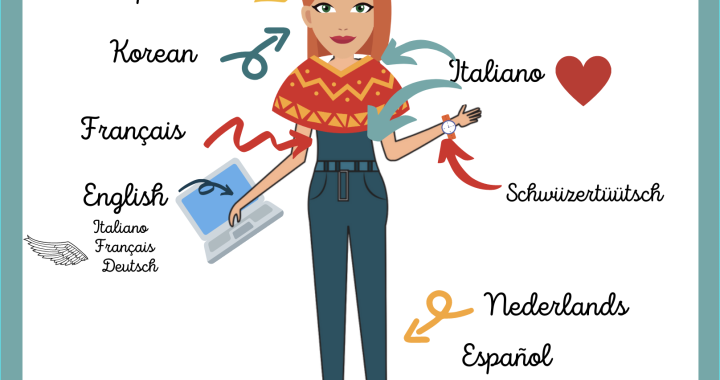
Explanation about the Language Portrait in the picture of this post

The Language Portrait of this post is one I did on Instagram for a challenge on IG (by @creciendoconlaspalabras). Here is why I placed my languages where you can find them in the portrait:

German: I place the language my parents speak in my head, together with Italian. It reflects my way of thinking and communicating. People assume that because I am German I would think and speak in a certain way, but then they are surprised that I don't meet their expectations. I am very organized in my way of working and I like to organize things (always have a plan B and C...), but in my planning I am also very flexible and even need to be. I use my imagination to adjust things if needed, which can be disorienting for some, but also refreshing for others. 

Italian: Italian is the language of my emotions, hence the position in my heart. It's the language I use most spontaneously (my children know that when I say something in Italian, it's getting serious...) I think very fast and speak fast, in Italian and in other languages too, when the situation allows me to. I can adjust to other paces, but my most natural one would be rather fast. I get impatient and loose interest when people take too long to explain things. 

French: French is my third language, chronologically speaking. I learned it at age 6 and never stoped since. I wrote most of my scientific work including my PhD in French (and Italian), I love French medieval literature (lit. provençale / occitane et ancien française), and fin de siècle

Swiss German: I placed it on my wrist because it's my "watch", it's my sense of punctuality. I learned being punctual the hard way when I moved to Switzerland at age 18 for my studies. Since then I always make sure to be 5-10 minutes early to every appointment. I acquired Swiss German at age 4 through watching TV (receptively) which made it easier to activate it once I moved to Switzerland 14 years later.

Spanish: I like Spanish music and funnily I started reading Spanish in my early 20ies for my studies, but never got to really learn how to speak it. I understand my friends when they talk Spanish, but will need to work on my oral skills to "get there". This is why the arrow points at my ears. I hope to soon be able to add another arrow pointing at my mouth.

English: I learned English at school when I was 11 (until I was 18) and didn't use it much until my late 30ies. It's only during the past 9 years that English has become the language I write in the most. Before it was Italian, French and German (that's why they are placed on my right hand & computer). I am constantly working on my writing skills in English though (currently I'm following a course on "memoire writing": I am very much aware that my vocabulary is rather technical in the field of linguistics and philology...)

Dutch and Spanish: I place both in my legs and feet because I love to dance (Rumba, Cha-cha-cha, Merengue, Samba, Salsa, Jive etc.), cycle and walk. Dutch makes me "move" – I live in the Netherlands and run my business from the Netherlands, so I was very eager to learn the language as quickly as possible. I now speak, read and write it, and hold workshops in Dutch too.

Korean: Korean is a language I want to learn by myself. I am teaching it to myself by watching Korean series, youtube videos and am also slowly starting to read it. But I'm still in the "listening" phase, so it will take some time to hear me speak it (I do practice speaking, but for now only when I am alone).


Musical Language Portrait


When I saw this reel of "Irish Eyes" by @rosebettmusic appear on IG I immediately thought that this could be a great musical alternative to the "picture" of a language portrait. You can find the lyrics of the song here.
What you can do is replace the Irish/English etc. by other nationalities/cultures/languages even, and find alternatives – for example, instead of "under stormy skies", "under blue blue skies" or whatever the person prefers.
Also "mother/father/sister/nana" etc. can be replaced by those people we ask about how they see us. 

What I particularly like is the many facets Rose Betts highlights in this song, and that everyone is "a map of the world".


How would your Language Portrait look like?
How would your Musical Language or Culture Portrait look like?
Please let me know in the comments! 


Busch, Brigitta, School language profiles: valorizing linguistic resources in heteroglossic situations in South Africa, Language and Education, 24,4, 2010, 283-294.

Busch, Brigitta, The language portrait in multilingualism research: Theoretical and methodological considerations, in Urban Language & Literacies, 2018.

Boehm, Gottfried, Jenseits der Sprache? Anmerkungen zur Logik der Bilder, Christa Maar und Hubert Burda (Eds) Iconic turn. Die neue Macht der Bilder, Köln, Du Mont, 2005, 28-44.

Coffey, Simon, Reframing Teachers' Language Knowledge Through Metaphor Analysis of Language Portraits, The Modern Language Journal 99, 3, 500-514.

Dressler, Roswita, Exploring Linguistic Identity in Young Multilingual Learners, TESL CANADA JOURNAL/REVUE TESL DU CANADA 51 Volume 32, issue 1, 2014, 42-52.

Gogolin, Ingrid, Die Karriere einer Kontur – Sprachenportraits, Inci Dirim et al Impulse für die Migrationsgesellschaft. Bildung, Politik und Religion, Münster, New York, Waymann, 2015, 294-304.

Kramsch, Claire, The Multilingual Subject, Oxford, OUP, 2009, 60.

Krumm, Hans-Jürgen, Jenkins, Eva-Maria, Kinder und ihre Sprachen - lebendige Mehrsprachigkeit: Sprachenportraits gesammelt und kommentiert von Hans-Jürgen Krumm, Wien, Eviva, 2001.

Langer, Suzanne, Philosohpy in a New Key. A Study in the Symbolism of Reason, Rite, and Art, New York, New American Library, 1948.


How many languages are too many?


Have you ever wondered how many languages a child can learn at once or if there is a ‘window’ of opportunity?

Can it ever be “too late” to learn another language?

Can we learn multiple languages at any time?

And what are the cognitive benefits of learning more than one language?


You can find some answers in an interview with research psychologists and a language teacher about how kids acquire second, third or fourth languages and how it helps to feel even more strived to bring up multilingual children.

We don’t need to hear more reasons in favour of bringing up children with multiple languages.

There is no reason to doubt or to fear that it could confuse or overwhelm children. 


1) When should a child begin to “learn” or acquire a second/third etc. language?

This question hasn’t been asked in the interview which in 2024 is, alas, no longer available, but Laura-Ann Pettitto (Professor at the University of Toronto) points out that in early years, when children are still in the acquiring phase of the first language, they will use the same brain tissue for all the other languages they are exposed to. – This has been confirmed by many studies since.

If children are exposed to languages later in life, it seems that different parts of the brain are involved (3:00 sq) because “the part of the brain that is responsible for processing language is on a maturational timetable and we know very clearly what that timetable is, when the periods are most sensitive” (4:00).

Interestingly, this is not the case for all the parts of language. Some parts “remain open for life, like vocabulary and there are other parts of language, which are on a maturational timetable. Our brain reaches a stable processing capacity and then stops because it’s achieved it’s stable state” (4:20). – Now, it’s quite hard to determine when this happens because the different parts of language are affected differently by maturation.

What is important to know is that early exposure is ideal for good phonological competence and good syntactic competence (4:44). – I am always sceptic when someone says “good” or “native” language competence. It is not clear what is meant with that.

Young children have the advantage to articulate sounds easier because of their palate not being hardened yet, but they do need several years to be able to articulate more complex sounds because of the motor skills of their apparato fonatorio, the coordiation of their mouth, lips, tongue, air etc.  

Peter Gazzellone, teacher at the Ryerson Community School, presents the Integrated language program at his school. This program offers Arabic, Mandarin, Spanish and African heritage language lessons.

“The students get to choose from one of these languages and it’s usually the language that they speak at home” (5:29). The children also learn French (from grade 4) and then from kindergarten up to grade 8 all the children at school learn another language. – In Europe we have several immersion programs and know that this program benefits the children.

We all know that the task of acquiring a language later in life, when we’ve already acquired our first language (and learned it at school) is a different, much harder task.


2) Can adults learn new languages as “good” as children?

There is a very clear answer: yes, they can.

If adults want to make it possible and have the time for it, they will succeed.

Ellen Bialystock, Professor at the University of York, points out that “children are given the opportunity to learn languages in a way that supports every part of this very difficult task (…) everyone they interact with interacts with them for the purpose of helping them learn language”.

If adults had this opportunity and would “quit [their] job for five years, use a mentor who will speak to [them] at exactly the level [they] need (…) [they] will be very successful” (2:00 ssq).

Life, usually doesn’t give us that chance and “the main difference about learning languages as a child and as an adult is life“.

If adults want to learn a language, total immersion and the passion to learn it are the most important premisses to succeed.

Ellen Bialystock suggestion is meant for people who want to learn a new language “at home”, who don’t have the opportunity to learn it in loco.

But if we have to learn the language because we move to the country, it’s more probable that we will attain a very good fluency in a very short time due to our full immersion.

If total immersion is not possible, there are many other possibilities to create a monolingual exposure in the target language in real life or online etc. 


3) How much exposure?

There have been published many articles about the quantity of time someone should talk a language – or more than one – per day. For many years, parents were told that 20% of waking time is what we should aim for if we want our children to acquire and learn our language.

But the amount of exposure per day or week depends on our  language goals, our capacities to support our languages. Do we want our children to be able to understand and speak the language, or also to read and write? How much time can we invest? Who else can help us with this?

Laura-Ann Petitto points out that “systematical exposure is more important than the amount of time of the exposure. The human brain doesn’t work on quantity but on quality. Therefore, regular systematic exposure “with stable users across different contexts which are rich and varied” is what will help children reach fluency.

This means that immersion exposure at school only is not enough to become utterly fluent. It has to be enriched by “cultural material, linguistic material, movies etc” also outside the context at school.


4) Do all children have the same ability?

This is like with everything in life: some are more prone to learn languages, others are better in other sectors. Ellen Bialystock points out that “what our minds are prepared to do is make everybody a competent speaker of a language that is in the environment without additional effort” (11.00 ssq.). And to answer the question: “some [children or adults!] will find this fun and exciting and some will find it more effortful”.


5) Will children always have one dominant language?

We all know that there are differences even among multilingual siblings about their language preferences. And Laura-Ann Petitto confirms that “children have preferences for languages and the preferences are set by various things outside of our biology” (12:45 sq).

It depends on the language their friends, their family are speaking. Children are also very economic in their language choice.

About the concept of economy:  “a tenet or tendency shared by all living organisms – may be referred to as “the principle of least effort”, which consists in tending towards the minimum amount of effort that is necessary to achieve the maximum result, so that nothing is wasted.” cfr. Alessandra Vicentini, Università di Milano, The Economy Principle in Language. Notes and Observations from Early Modern English Grammars).

If children know that their parents understand all the languages they’re supposed to speak, they will probably prefer one of the dominant languages in their social context (the host country, school etc.), using the “minimum amount of effort to achieve the maximum result”.

The human biology enables us to extract patterns from one and the other language and to compare and fit them, but language acquisition is more about the need to speak this language.


6) Do multilinguals know less vocabulary than monolinguals?

Don’t worry about the vocabulary children have in one of the languages they are acquiring. Multilingual children seem to be “behind” their monolingual peers, but when we add all the words they understand and use in all their languages, they usually are at the same level if not above the norm. “We know from many studies that a multilingual child knows at least as many words and probably more and at least as many concepts and probably more as monolinguals”. (15:20 ssq). – And we should never forget that these are all averages!

If you look at the distribution of the data, “most children are in the normal part of the curve where it could go either way. The bilingual could have a higher English (or other language) vocabulary than the monolingual” (15:50).

If you take the vocabulary tests that are used to assess vocabulary – and the interesting part is, that they’re usually given out only in one language! – “and you divide the words up into words they are likely to encounter at home and words they are likely to encounter at school there is no difference!” (16:20 ssq).

There is definitely no academic risk or compromise to the main purpose for learning many languages (from an early stage on!).

Two final, very encouraging quotes for every multilingual from Laura-Ann Petitto:

The human vocabulary stays open to work for life.

The brain is not biologically set to learn only one language.


Please watch the interview I had with Prof. Ellen Bialystok in our series Raising Multilinguals LIVE on youtube:


Werden aus mehrsprachigen Kindern automatisch mehrsprachige Erwachsene?

Mehrsprachigkeit ist in aller Munde. Gab es bis vor kurzem noch viele Vorbehalte gegen eine mehrsprachige Erziehung – man befürchtete, dass Kinder so weder die eine noch die andere Sprache richtig beherrschen würden –, so weiß man inzwischen, dass Mehrsprachigkeit allerlei positive Effekte auf das Sprechen, Denken und Handeln hat. 

Inzwischen ist es für werdende Eltern nicht mehr schwierig, Informationen und konkrete Ratschläge für mehrsprachige Erziehung zu finden. Die große Mehrheit der Ratgeber, wissenschaftlichen Projekte und Artikel über Mehrsprachigkeit konzentrieren sich jedoch ausschließlich auf die Kleinkind- und Vorschuljahre. Eltern wird nahegelegt, die Familiensprachen beizubehalten und zu unterstützen. Sie sollen sich auch nicht von eventuellen Ratschlägen einschüchtern lassen, den Familiensprachen doch die Umgebungssprache vorzuziehen, weil doch die ersten Jahre so wichtig für einen soliden Spracherwerb sind. 

Je älter die Kinder werden, desto weniger Fachleute und Ratschläge findet man jedoch. Es ist, als ob mehrsprachige Erziehung vor allem in den Jahren des Spracherwerbs unterstützt werden müsse und danach abgeschlossen sei. Oder als ob man davon ausgeht, dass ein guter Anfang alles schon in die richtigen Bahnen leitet.

Es gelingt vielen Familien, ihre Familiensprachen zu Hause zu unterstützen, manchmal mit Hilfe von Babysittern oder Freunden, die dieselbe Familiensprache sprechen. Doch sobald die Kinder in die KiTa, den Kindergarten oder die Schule gehen, wo sie in zunehmendem Maße der Umgebungssprache ausgesetzt sind, fangen viele Eltern an zu zweifeln, ob und wie sie ihre Familiensprachen beibehalten können. Manche lassen sich von Lehrerinnen und anderen Zeitgenossen überzeugen, dass jetzt die Umgebungssprache wichtiger sei, damit ihr Kind in der Schule und der Gesellschaft voll und ganz integriert wird.

Dass dies auf Kosten der Familiensprache geht, wird von vielen Familien als natürliche Konsequenz der sprachlichen und kulturellen Integration betrachtet. Andere Familien möchten dennoch etwas für den Erhalt der Familiensprache tun, sehen aber im Alltag nicht genügend Möglichkeiten dafür und suchen Hilfe. 

Wochenendschulen sind eine beliebte Lösung. Da können Kinder einmal die Woche in ihre Familiensprachen außerhalb der Familie eintauchen, und sie lernen lesen und schreiben. Familien, die sich diese zusätzlichen Stunden pro Woche nicht leisten können oder denen diese Möglichkeit nicht geboten wird, finden sich entweder mit einem langsamen Verlust der Familiensprache ab oder sie greifen zu eigenen Mitteln. Einige Eltern werden zu Sprachlehrern – mit sehr wechselndem Erfolg. Zudem mag das mit dem zusätzlichen Muttersprachunterricht bei jüngeren Schulkindern noch funktionieren, je älter die Kinder werden, desto mehr konkurriert er mit Sport und anderen Hobbys. Sind die Kinder erst einmal in der weiterführenden Schule, gibt es schlichtweg keine Zeit mehr für extra Unterricht – von der Lust der Jugendlichen darauf mal ganz zu schweigen.

Viele Eltern und Lehrer gehen davon aus, dass die Sprachkompetenzen, die die Kinder in der Schule erlernen, automatisch auf die Familiensprache übertragen werden können – das wird in der Forschung bereits seit den 70ern erwähnt (siehe Jim Cummins Linguistic Interdependence Hypothesis und folgende Studien). Dass Sprachkompetenzen – Verstehen, Sprechen, Lesen und Schreiben – durchaus transferable skills sind, steht nicht zur Debatte. Dass es zu deren Übertragung jedoch aktiver Mitwirkung der Eltern und der Lehrkräfte in der Schule bedarf oder bedürfte, wird jedoch oft vergessen oder unterschätzt.

Fakt ist, dass Kinder ihre Fertigkeiten in der Schulsprache enorm steigern, sobald sie in der Schule sind. Sie lernen in der Schulsprache lesen, schreiben, sie lernen Rechtschreibregeln, zusammenhängend erzählen und schreiben. Während das Augenmerk der Schulsprache zugewandt ist, werden die sprachlichen Ziele in den Familiensprachen vernachlässigt. Das Kind wird angeregt, in der Schulsprache zu lesen, aber viele Kinder, denen im Vorschulalter eifrig in allen Muttersprachen vorgelesen wurde, greifen nicht nach einem Buch in der Nicht-Schulsprache. Der Schritt vom Vorlesen zum Lesen ist nicht selbstverständlich. So verlangsamt sich schon früh das Sprachentwicklungstempo in der Nicht-Schulsprache. Elementares Lesen und Schreiben gelingt meistens auch in der Familiensprache, aber über einen kleinen Brief an die Oma oder eine kurze Textnachricht geht das oft nicht hinaus.

No alt text provided for this image

Die Unterstützung in den Familiensprachen von Seiten der Schulen ist sehr unterschiedlich. In internationalen Schulen gibt es häufig die Möglichkeit, am Muttersprachunterricht teilzunehmen, an gewöhnlichen Schulen kann es sein, dass die Familiensprache des Kindes als Fremdsprache angeboten wird. Aber auch wenn die eigene Familiensprache ein Lehrfach darstellt, ist das Sprachziel doch oft eher am unteren Kompetenzniveau zu erwarten. Zudem wird sehr oft für Muttersprachler das gleiche Unterrichtsmaterial verwendet wie für Zweitsprachler, was dazu führt, dass Muttersprachler ihre Familiensprache als uninteressant und langweilig erfahren und das Fach abwählen. Andere Jugendliche scheitern an dem Beharren der Lehrenden auf dem Auswendiglernen von Grammatikregeln oder dem wörtlichen Übersetzen – Zweisprachige sind aber keine geborenen Übersetzer, sondern speichern ihre Sprachen getrennt. 

Lesen und Schreiben in der Familiensprache geht nicht automatisch. Wie Dr. Louisa Moats mehrheitlich hervorgehoben hat: learning to read is rocket-science. Marianne Wolf (2008:222) begründet diese Schwierigkeit mit der Tatsache dass brains are not wired to read. “Each brain of each ancestral reader had to learn to connect multiple regions in order to read symbolic characters. Each child today must do the same. Young novice readers around the globe must learn how to link up all the perceptual, cognitive, linguistic, and motor systems necessary to read. These systems, in turn, depend on utilizing older brain structures, whose specialized regions need to be adapted, pressed into service, and practiced until they are automatic”.

Eltern, die ihre Kinder mehrsprachig erziehen, sollten sich folgende Fragen stellen:

  • Was sind kurzfristige und langfristige Ziele der mehrsprachigen Erziehung? 
  • Was möchten sie, die sich mit so viel Enthusiasmus bei ihren Babys und Kleinkindern bemühen, letztendlich erreichen? 
  • Wer kann sie und ihre Kinder bei ihren sprachlichen Zielen unterstützen?
  • Finden sie es ausreichend, wenn sich das Kind mit den Verwandten im Heimatland der Eltern unterhalten kann? 
  • Wünschen sie sich, dass ihre Kinder als Erwachsene in zwei oder mehr Sprachen agieren können, d.h. auch Schreiben und Lesen so beherrschen, dass sie im Studien- oder Berufsleben zurechtkommen? 

Wenn letzteres das Ziel ist, geht das kaum ohne passenden Unterricht. Schließlich ist die Schulsprache vom ersten bis zum letzten Schultag auch Schulfach – hier geht man nicht davon aus, dass es ausreicht, diese Sprache auch außerhalb der Schule überall zu hören, zu lesen und zu sprechen. 

Warum sollte der Gebrauch einer Sprache als Familiensprache dann genügen, um eine vollständige zweisprachige Kompetenz zu erlangen? Dass man in Sprache A gelernt hat zu argumentieren, bedeutet lange nicht, dass man das in Sprache B auch kann, selbst wenn man im familiären Umfeld die Sprache B genauso selbstverständlich verwendet wie Sprache A. 

Man weiß von Studierenden, die nach einer Schullaufbahn in der Muttersprache ein englischsprachiges Studium aufnehmen, dass sie – auch wenn sie den schulischen Englischunterricht mit Erfolg und auf dem entsprechenden GER-Niveau abgeschlossen haben – sich schwertun, auf Englisch genauso präzise zu formulieren, wie sie es in ihrer Muttersprache könnten. 

Was sind unsere Lösungsvorschläge?

  • Es ist wichtig, sich schon frühzeitig Gedanken zu machen, wer zu unserem mehrsprachigen Dorf gehört, und in einem realistischen Sprachenplan festzulegen, welche Sprachziele für die Kinder im sozialen und sprachlichen Umfeld, in dem sie aufwachsen, möglich sind.

“We need a multilingual village to raise a multilingual child” – Ute Limacher-Riebold

  • Eltern sollten ihre Familiensprachen weiterhin pflegen, d.h. nicht nur sprechen, sondern den Kindern auch weiterhin die Möglichkeit bieten, ihre Sprachkompetenzen zu erweitern und zu vertiefen. Wenn nicht anders möglich, mithilfe von Wochenendkursen und anderen Aktivitäten in der Familiensprache. Dabei ist auch bei Jugendlichen wichtig, dass die Eltern mit gutem Beispiel vorangehen: dass sie selber ihre Muttersprache pflegen, indem sie zum Beispiel lesen oder einen Film schauen. Vergessen sollte man auch nicht die Kultur, die zu dieser Muttersprache gehört. Auch die Liebe zur Sprache kann durch den Magen gehen – mit typischen Gerichten, typischen Festen. Urlaube im Heimatland der Eltern oder eines Elternteils vertiefen die Kenntnisse und die Verbindung der Jugendlichen mit diesem Land.

“Sprache steht nicht für sich allein. Zu einer Sprache gehört immer auch eine Kultur, die zusammen mit der Sprache vermittelt wird.” – Katja B. Zaich

  • Lehrende an Schulen, die Muttersprachler oder Zweisprachler in ihrem Fremdsprachenunterricht haben, können schon mit wenigen Mitteln diesen Schülern entgegenkommen. Meist haben diese Jugendlichen wenig Probleme beim Verstehen, Sprechen und Lesen, aber sie könnten mit ein bisschen Anleitung ihre Schreibfertigkeiten enorm verbessern. Aufgrund ihrer vorhandenen Sprachkenntnisse profitieren sie mehr von Grammatik im Kontext als in auswendig zu lernenden Regeln, Listen und Tricks. Sie müssen ihren Wortschatz erweitern, ja, aber es ist wenig sinnvoll, sie mit zweisprachigen Vokabellisten zu traktieren. Das bedeutet keine erhebliche Mehrarbeit für die Lehrenden und kann eine wertvolle Bereicherung des Unterrichts für alle sein.

Dr. Katja B. Zaich ist Germanistin und lebt als Sprachtrainerin, Übersetzerin und Autorin in den Niederlanden. Seit Jahren unterrichtet sie zweisprachige Kinder im Grundschulalter im Rahmen eines “Wochenendkurses” in ihrer Muttersprache Deutsch. Sie ist Autorin bzw. Mitautorin mehrerer Lehrbücher für Deutsch für (erwachsene) niederländischsprachige Lernende. Sie hat zwei zweisprachige Töchter im Teenageralter. www.zaich.nl

Dr. Ute Limacher-Riebold bietet bei Ute’s International Lounge mehrsprachigen Familien professionelle Unterstützung und Beratung an, mit dem Ziel die Familiensprachen sowie eine effiziente Kommunikation in mehrsprachigen Familien zu fördern. Sie hat hierfür den S.M.A.R.T. Family Language Plan© entworfen, der auf jede mehrsprachige Familie zugeschnitten werden kann. Sie ist Mitarbeiterin am EU Projekt PEaCH, welches sich “die Bewahrung und Förderung des europäischen Sprach- und Kulturerbes, durch das Stärken von zweisprachigen Kindern und Familien” zum Ziel gesetzt hat. Sie ist Co-Autorin des Leitfadens “Wie man ein Kind zweisprachig erzieht” welcher im Rahmen des Projektes entstanden ist, und von “The Toolbox for Multilingual Families” (bei Amazon erhältlich). Sie hat drei mehrsprachige Kinder im Teenageralter. UtesInternationalLounge.com

Im Artikel erwähnt:

  • Cummins, Jim, Linguistic interdependence and the educational development of bilingual children, Review of Educational Research, 1979, 49, 222–251. – für weitere Studien zum Thema siehe: Linguistic Interdependence Hypothesis in Researchgate
  • Wolf, Marianne, Proust and the Squid: The Story and Science of the Reading Brain, Harper Perennial, 2008. 
  • Louisa C. Moats, is project director, Washington D.C. site of the National Institute of Child Health and Human Development (NICHD) Early Interventions Project, and clinical associate professor of pediatrics, University of Texas, Houston, Health Sciences Center. Louisa C. Moats is a nationally recognized authority on how children learn to read and why some fail to learn. Widely acclaimed as a researcher, speaker, consultant, and trainer, Moats has developed the landmark professional development program LETRS for teachers and reading specialists (find out more here).
 

Dieser Artikel wurde auf LinkedIn publiziert. 

Finger-counting across cultures

[update May 2023]

Finger-counting varies considerably across cultures, and not only: it can vary within a same culture too!


The following examples present conventional finger-counting systems in several countries.


I asked in my facebook groups – and among speakers of different languages in my community – about how people count with their fingers and compared their responses with what I read and observed about this topic.


In countries like Germany, France, Italy etc. it seems that people start counting with the thumb (=1), adding one finger at each number up to five. Some say that in Spanish one would do the same, but when asking Spanish speakers, they said that they would rather follow the US way of counting, where the number one is indicated with the index finger, and one continues counting by adding the other fingers, with the thumb as number 5.

In the picture below, the number 4 is indicated with the thumb down. When counting from 1-5 in German, one would rather keep the little finger (pinky) down. But when indicating "4" as for example when ordering 4 coffees, use the thumb down like illustrated in the picture.

Although some people from the UK seem to count in the same way as in the US and China, it seems that counting starting with the thumb is equally acceptable. – Please have a look at the last video in this post about this.


In Japan, the finger counting system proceeds the opposite way. Instead of showing the numbers by raising the fingers, it is the fingers that are hidden in the hand that indicate the number. You start with the thumb and hide the next fingers in the hand while counting upwards until the closed palm indicates number five. 


Two or not two...

The way to indicate "2" could cause some misunderstanding if someone who is used to count in Chinese is shown a German "2" with the thumb and the index finger, because this would mean "8" in Chinese finger counting (see here below). I find it very interesting (and helpful!) that in Chinese one can count up to 10 by using one hand only!


When indicating number "2" in the UK following the US way (with index and middle finger) one should be careful not to turn the palm towards oneself, inwards, as that gesture is or was (!) perceived as an insult in the UK, Ireland, Australia, New Zealand and South Africa.

Although this gesture seems to loose its offensive connotation, it is advisable to avoid it when in international settings. The origin of its meaning is uncertain. Only in recent years the origin of the V-sign dating it from the Battle of Agincourt has appeared. "The story maintains that British archers were so effective and so feared by their enemy that when the French captured an archer they chopped off the two fingers he needed to draw a bow-string. Bowmen who had not been thus disfigured took to holding up two fingers to taunt their cowardly foes." (see Oxford Reference) Another explanation wants the V-sign "a development from the much older horns symbol (...)"


The V-sign with the palm away from the gesturer has multiple meanings: it indicates the number 2, victory (since the WWII) and peace (since the 1960ies).


The finger counting in India

Finger counting in India goes a step further as per finger one can count up to 4, and therefore count up to 20 with one hand only. In this article you can find a short video about different types of finger counting across the world. Prof. Andrea Bender from the University of Bergen (Norway) has done some research about culture and cognition, and the way people count with their fingers across cultures.


"In the past, researchers have believed that finger counting, and especially the way that we do it in the West, is essential for children when they start to learn counting, and when they try to grasp what numbers actually are. One reason for casting doubt on that is that there is so much cultural diversity in how fingers or body parts are used for counting."


When considering the many different ways to use fingers for counting across cultures and eras – think about the way Romans used to count! – and the way numbers are signed in Chinese, shows that there is much more to this than meets the eye.

Finger-counting differs between regions, ethnicities, and historical periods


In war times, differences in counting were used to distinguish nationalities. In Quentin Tarantino’s Inglorious Bastards there is a scene where a spy outs himself by ordering a drink with three fingers up — his index, middle, and ring finger. A German would have ordered “three” with the index, middle finger, and thumb extended. 


Scene of Inglorious Basterds 


Have a look at this short video where people around the world show how they count with their fingers. I assume that this all changes when we indicate the finger with the index of the other hand though. What do you think?


If you want to know how Romans used to count with their fingers...:


Ken Powell from Write Out Loud was so kind to show us his various ways of counting with fingers.

  • When indicating "first thing... second thing...etc."  starting with his little finger and using the index finger from his other hand to count up to 5, with pointing at the thumb for last.
  • When pointing out a "first task... second task... etc." he'd start with the index.
  • When counting to himself and using one hand he would start with the thumb.
  • When counting in Bangla, he would count with the thumb of the same hand, counting 4 per each finger, i.e. up to 20 on one hand.


I haven't even shared how people count and do maths in India and other countries, as this deserves a separate post...


In international settings at school or at work, I find it is important to understand the different finger-counting systems to avoid misunderstandings. Teachers who adopt translanguaging practices in class, shouldn't assume that their pupils count in the way their parents do: they might count like their peers in class just because they are used to doing maths in the school language. Some children switch ways to count with fingers when switching languages, whereas others adopt one "universal" way to count with their fingers. 


How do you count with your fingers?
What about your friends and colleagues?
Do your children use the same finger counting across all their languages?
Please share in the comments!


I recommend also reading this article mentioned above.

Please read also my other post about What is your maths language?


The importance of developing multilingual listening skills


Did it ever happen to you that people would ask you to repeat what you just said, not because they couldn’t hear you, but because they were incapable of understanding your way of speaking the language?

Or maybe you have asked someone to repeat because you didn’t understand what the other person was saying – because of how they were speaking, the intonation they used, the pitch, the accent?

What happens when someone doesn’t understand what we say, although we use the right words, word order etc.?

Accent, pitch and intonation


Usually people blame the accent, but there is a series of suprasegmental elements, part of what is called prosody, that play a role. Prosody refers to all the properties of syllables and larger units of speech, such as intonationtonestress and rhythm. 

Prosody reflects the emotional state of the speaker, the form of the utterance – statement, question, command –, the presence of irony or sarcasm, emphasis, contrast, focus. 

Intonation, in linguistics, is the variation in spoken pitch, when used, not for distinguishing words as sememes (see this concept in relation with tone*), but for a range of other functions such as indicating the attitudes and emotions of the speaker.

In speech a pitch “is the relative highness or lowness of a tone as perceived by the ear, which depends on the number of vibrations per second produced by the vocal cords”. 

With the intonation we signal the difference between a statement and a question, and between different types of questions. Through our intonation we focus our attention on important elements of a spoken message and it helps us to regulate conversational interaction.

Here is an example. In a sentence like “I sent you the email yesterday”, by simply putting more emphasis on one word of the sentence, we can change the meaning the speech act (Searle) or illocutionary act (Austin) of it:

I sent you the email yesterday  – not John!

I sent you the email yesterday – I am 100% sure!

I sent you the email yesterday – not to Mary! 

I sent you the email yesterday – I didn’t call you! 

I sent you the email yesterday – not 10 minutes ago!

Accents can be a distinctive way of pronouncing a language, especially one associated with a particular country, area, or social class, or a distinct emphasis given to a syllable or word in speech by stress or pitch.

* Tone and Intonation are two types of pitch variation, which are used by speakers of all languages in order to give shape to utterances. More specifically, tone encodes segments and morphemes, and intonation gives utterances a further discoursal meaning that is independent of the meanings of the words themselves. (read more here)

***

We are aware of accents from a very early stage on. Babies can distinguish languages, infants can distinguish accents – they would for example change regional variants depending on who is speaking with them – and around age three or four, children can develop opinions about the languages, dialects, accents they hear.

We can also understand basics of intonations: babies can recognize if the voice is angry, aggressive, demanding, kind, “neutral” etc., and they respond to pitches.

The associations we make between voices and accents, intonations, pitches, the speech of parents, family, friends, our broader community, are what forms what I like to call the multilingual ear, or multilingual hearing or the way we react to a great variety of accents.

We may understand the words of a language, the different meanings – but if the intonation, the pitch, the accent is unexpected, we can struggle with understanding. The perlocutionary act, the intention we had when saying what we said (persuading, convincing, scaring, enlightening etc.) is disturbed. ~ Ute

***

Growing up with multiple languages means to grow up with a variety of linguistic input that involves not only different words, sentence structures, but also intonations and accents.

Accents, intonations and pitches play a considerable role in the formation of our identities because people will try to categorize us depending on them.

Accents tell people where we (might) come from, what our native language or languages (!) might be, what social groups we might belong to etc.

Accents can mark us as insiders or as outsiders. This is why we make great efforts to adjust the way we speak to sound as good as possible, i.e. to blend in with the group. We try to copy the accent, so that we are not recognized as a non-native, or a non-nearly-native speaker, because knowing a language “properly”, considering oneself bi– or multilingual means for all too many still being able to articulate sounds in the target language like a native speaker. – This can lead to frustration when we can not manage to lose our accent! Speech trainers and experts in sound articulation can help with this, should it really be a problem. – In my personal experience, singing in the target language can help to loosen the articulation of not so familiar sounds in the target language. 

Should we (really) work on our accents? 

I personally find accents important because they are like our finger prints. But if they get in the way of being understood, if our accent is “too strong” and distracts the listener from what we are saying, we may need to work on them.
The clearer we articulate, the more effort we put into an effective and clear communication, the more we will avoid judgments and misunderstandings. The more our speech is clear, the better others will understand us.

Speech clarity is determined by how fast we speak, the pitch of our voice, the accent… but also by the background noise, the distance from the speaker, our word choice and… the multilingual listening skill of the other person.

If we are unable to understand what someone is saying in our language or the target language, it is due to our own selective understanding.

With selective understanding I mean that we unconsciously or consciously (!) don’t understand what the other person is saying. Some may call it tunnel listening in analogy to tunnel view, referring with tunnel listening to the limited auditory perception of the receiver. 

With selective understanding I mean the process of people literally selecting what or who they want to understand. Due to the trigger of the different pronunciation, they immediately judge and refuse (or accept). When refusing what they hear they refuse to be flexible in their language perception and understanding and build a wall between them and the other person. They show clear resistance towards what could be a two way conversation, communication and connection. – There are many factors that lead to this kind of reaction, which all have their common denominator in not meeting the expectation.

When we don’t expect that a person speaks in a given way, we react by taking a step back; we analyze, judge, don’t trust and refuse (!) to understand! ~Ute

Many people when confronted with someones’ strong accent, instead of paying attention to what the person says focus on how she says it: is she asking something, making a statement, being angry, upset…? What follows is disconnection from the other person and the flow of the communication stops.

A person with multilingual listening skills would not do that.

What is a multilingual listening skill?

Multilinguals are known to be able to zoom out the not-necessary information and focus on the important one (Ellen Bialystok), they are known for their capacity of focusing on what is essential! They are able to focus on non-verbal clues, as much as on the message. They can ignore the form of it, should the form – intonation, pitch, accent etc. – be hindering the comprehension.

What I mean with Multilingual listening skills are skills that are closely related with this skill to focus on the essential and the skills that multilinguals acquire naturally like code-switching and code-mixing.

When we speak with people with whom we share multiple languages, we mix words from all these languages into the conversation. We can also switch from one language to the other, depending on the person we speak with. This flexibility allows us to quickly adjust our comprehension to changing accents of our interlocutors.

In monolingual settings, where the majority are native speakers, people would simply cease listening when what the other person is saying is not understandable for them, i.e. doesn’t meet their expectations. Monolingual speakers seem not to be able to make the switch from a monolingual listening skill to a multilingual listening skill. They select what they hear – hence selective listening – and focus only on the quality of speech they deem necessary for the conversation to flow.

Not so in multilingual settings. When multilinguals have a conversation in a chosen language, they seem to adapt easier to the different accents, intonations, pitches.

I have observed that multilinguals who speak several languages up to a great level of fluency (not beginners level!), struggle much less with a variety of accents. In multilingual conversations people with very diverse accents manage to communicate with a considerable flow. Something that in a monolingual group would not easily happen.

How can we train our multilingual listening skills? 

1) Embrace the variety of accents in your own language(s)

We can start by training our understanding of several variants of the same language, for example, for Italian speakers, train our understanding of Italian varieties from diverse regions like Lombardy, Piemonte, Liguria, Veneto, Abruzzo, Puglia, Campania, Sicilia etc.


Or, for English speakers, train their ear for the Standard British English, as well as the Cockney, Irish, Scottish, Welsh, some US variants – like accents from Texas, South Carolina, Brooklyn etc. – or Australian, New Zealand ones etc. like in this video by Amy Walker:

https://www.youtube.com/watch?time_continue=55&v=MBtLxuv0-u8&feature=emb_logo

It is not only about understanding what one says using another accent, but also about learning to avoid being negatively triggered by it!

For many this requires hard work, as some are wired to criticize other ways of speaking, i.e. are influenced from early on to consider a certain accent as “funny” or “weird”. – Just think about how accents are used in movies to emphasize the social status, the “otherness”, the credibility of the characters…

2) Embrace the variety of foreign accents in your language

Once we have trained our auditory perception with accents from native variants of our language(s), we can expand to foreign accents in that language: how French pronounce Italian, how Italians pronounce German, how Russians pronounce Spanish etc. and become familiar with a greater variety of accents. Depending on what languages our friends, colleagues, the community we live in speak (if it is an international community), we can train our perception and acceptance towards that variety of ways to speak a given language or a variety of languages. 

We all can understand accents, we only need to train our auditory perception to recognize and understand deviations from what we usually expect in conversations. ~ Ute

Those in the following video have a great level of fluency in English, but it gives you an idea what a conversation can sound should you sit at a table with people from these countries and with their linguistic backgrounds. 

3) Observe the shift…

We usually enjoy conversations where we understand the language, the body language and gestures, the messages in between the lines. For a conversation to be effective we need other people to use the same words as we do, the same anecdotes and metaphors etc.. If we have these conversations in one of our most dominant languages, we can experience them as relaxed, familiar and easy. They can also be very effective – as long as we share the same opinions, values and beliefs.

When we have trained our multilingual listening skills, conversations in our dominant languages with native speakers will still be very pleasant, but there will come a moment where we miss the variety of inputs. 
We might perceive them as boring and tiring because we don’t pay that much attention on what and how things are said because we intrinsically assume that “we get it”. – It is important to acknowledge the shift that takes place in our listening skills as to develop ways to stay tuned in whatever conversation we are, to maintain the connection and to actively listen

Adapting to different communication styles in multilingual conversations, or in conversations in one target language which is not the native language of all participants, can be tiring at the beginning, but it can also become the new normal and incredibly enriching!

I know by my own experience and by what I observe among other multilinguals like myself: we thrive in the variety of languages, accents and cultures!

What about you?
I would like to know what you think about this topic, what kind of listener you are, if you would like to know how to switch from selective listener to all-embracing listener, what kind of conversations you enjoy the most, you find most enriching and why…

Is there a particular accent that bothers you?


Read more about:

– If you want to know more about illocutionary acts and speech acts, have a look at publications by J.L. Austin and John L. Searle.

Code Switching, what to do, when should I worry? 

Find more related articles in the sections Multilingual Families and Intercultural Communication .


The importance of gestures in the language development of babies and infants

Babies start communicating with us from day one. The sounds they utter will become increasable intelligible: from cooing, to babbling, to monosyllable, bi-syllables up to sentences. The journey of language development in babies and infants is quick and has many facets. What many parents forget to consider is that gestures play an important role in the language development of infants.

When parents ask me how to help their children become verbal, I usually ask many questions about the non verbal communication between them and their babies. We are so focussed on verbal communication when it comes to our children’s language development, that we forget the non verbal one, which is very important and will evolve and develop alongside the verbal one across our whole lifespan.
Our infants can understand gestures very early on. They need to gain the motor skills to be able to coordinate their hands, their fingers, to imitate the movements we make.

Parents who use baby sign language, which is a more conventionalized signing where signs are closely linked with words, observe that communication with their infants seems to be more intense and effective than with their other children with whom they didn’t use baby sign language (this is the observation from parents I work with).


The importance of gestures for language acquisition

Around 10 months of age, children start using gestures in a deictic way, which means that they point fingers or use another body part to single out an object of interest.
Gestures are used by children across cultures to express their desires, share their experiences, draw attention and refer to things.
Pointing is a gesture used to communicate. The same way, other gestures and body language is used, like waving to say bye-bye, lifting arms to be carried, stamping feet when upset, clapping hands when excited etc.

Using gestures is something we intuitively teach our children and we can use gestures, explore the possibilities of using gestures to facilitate early communication.

Here you can find a list of the 11 distinct pointing development milestones from birth to two years old.

From gesture to verbal use of language

When parents ask me why their children are not speaking (yet), why they seem not to find any interest in uttering words, I usually ask them to describe a typical conversation with their children for example at the dinner table.
How are their children communicating what they want? Do they point at objects, nod or shake their heads, use facial expressions?

Parents are very good at understanding what their children want, without them needing to use words. Especially when children use a sequence of gestures and body language to communicate with us. “At eleven months of age, some children can produce a sequence of 2 gestures to convey a message (…) by twelve months of age (…) they begin to produce 3-gestures in sequence” (Ishino 2011).

Gestures play an important role in the natural development of spoken language. In hearing children, language and gesture develop in interaction with each other if they are used together. Therefore it is important that we link gestures with words. 


How to help a child become verbal

If our children seem to exclusively (or mainly) communicate through gestures, we can help them increase their use of sounds and words by modeling what words we expect them to use in certain circumstances.


For example, if they point at an object, we may want to accompany their gesture with comments.
If our children point at a cup of milk on the table because they would like to drink, we would say
“Do you want to drink milk?” – they might nod, or shake the head, maybe stomp their feet.

While helping them reach the cup or giving it to them, we should make eye contact and repeat “milk” “drink” in several sentences. If we notice that the children are not responding with a smile a nod or other kind of reaction, we can get their attention by varying the intonation of our words. Sometimes a higher pitch – or a lower pitch – can do the trick. Or repeating a word in a fun way “milk, milk, milk”.

Especially when we see that our children are reluctant speakers, we can try to increase our own use of words, and gently model what we expect our children to start saying.
During this whole transition process between gestures and verbal expressions, we should stay calm and patient. Every child develops at their very own pace. We might need to repeat some words many more frequently, over a longer period of time until our children start trying to articulate them: they’ll all get there in the end!

I know that this period in language development is not an easy one for many parents. It seems like speaking with a wall, and we are very impatient to hear our children speak, to have our first conversations. If we consider gestures, body language already as a form of communication, it is easier to translate the gestures into words and to embrace this phase.

As I work with multilingual families, I find it very interesting to see how gestures change when switching from one language to the other, and how very young children can do this switch even before becoming verbal!

The most important thing in this whole process is to acknowledge the steps we make.

Enjoy all your languages when communicating with each other!

– Is your child using gestures? Are you using baby sign language with your baby or infant? How is this working for you and your multilingual family? Please let me know in the comments!

I invite you to watch the interview with Roya Caviglia:

Suggested readings:

Infant Communication Baby Sign Language with Multilingual Children

Cochet, Helene; Vauclair, Jacques (2012), “Pointing gesture in young children: Hand preference and language development”, in Colletta, Jean-Marc; Guidetti, Michele (eds.). Gesture and Multimodal Development. Amsterdam: John Benjamins Publishing Co. pp. 7–26.

Fasolo, Mirco; D’Odorico, Laura (2012), “Gesture-plus-word combinations, transitional forms, and language development”. Gesture, (12), pp. 1–15.

Gullberg, Marianne;  Kees de Bot (2008), Gestures in language development, Gesture, 8(2).

Ishino, Mika; Stam, Gale (2011), Integrating Gestures : The Interdisciplinary Nature of Gesture. Amsterdam: John Benjamins Publishing Co, pp. 111–112.

Iverson, Jana M.; Goldin-Meadow, Susan (2005-05-01), “Gesture Paves the Way for Language Development”, Psychological Science, 16 (5): 367–371.

Kendon, Adam; Gullberg, Marianne; Seyfeddinipur, Mandana (2014), From Gesture In Conversation To Visible Action As Utterance: Essays In Honor Of Adam Kendon. Amsterdam: John Benjamins Publishing Company, p. 332.

Vallotton, Claire (2012), “Support or competition? Dynamic development of the relationship between manual pointing and symbolic gestures from 6 to 18 months of age”, in Colletta, Jean-Marc; Guidetti, Michele (eds.). Gesture and Multimodal Development. Amsterdam: John Benjamins Publishing Co. pp. 27–48.