Literacy skills and music: how our children learn to think in words or sentences

When parents ask me how to help their not verbal children start speaking I usually suggest techniques that involve music. The same goes with literacy skills. Musical notes and a free style of representing music and the spoken word can help our children understand how language works. How language can be “translated” into sounds, and these sounds represented with signs.
This way to represent Johann Strauß Jr.’s Tritsch Tratsch Polka is a great representation of what I consider very helpful to break down the steps between oral language, sounds, and some kind of representation.

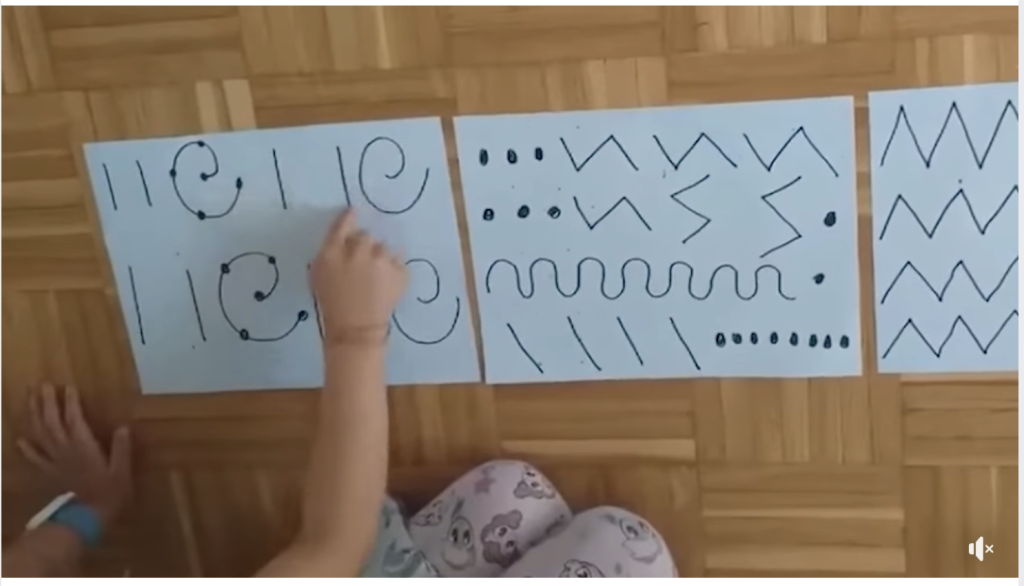
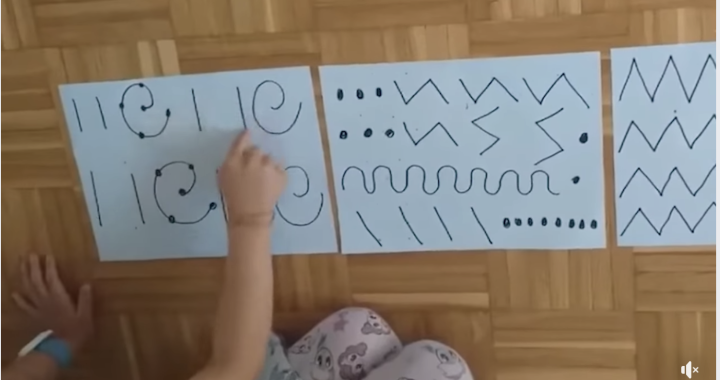
Children can find their very own way to represent music and sounds: through art. They can draw something or design lines like in this example (it is from the Psicomúsica page on facebook; 3 July 2020 – click on the image to access the video):

If you compare this “representation” with the conventional one in the video here below, you can observe the similarity in structure that we, adults, need to help our children with understanding, or better, towards which we can guide your children.

Acquiring fluency in reading requires children to transform symbolic information provided by print into mental representations based on their prior language experience. This literacy acquisition relies heavily on the process of phonological awareness

Every child likes music, likes singing. In fact, singing songs is a great help to foster language acquisition and learning – also at a later stage!
This example is not a song one can sing along as it seems wordless as actual words are not added to the Tritsch Tratsch Polka, but it has clear musical notes.
These are the conventional ones (here below) but one can choose to represent them in all kinds of ways to help children follow the music like in the way it is represented here above, that makes it easier for very young children to “follow with the finger”.


Try to do the same with songs you sing with your child and let your child guide you with shapes, zigzag lines, colors… anything that works for them to represent words or melodies, will help them distinguish words, articulate them, find the rhythm of the language they are learning!

You can transfer this kind of representation illustrated here to words in texts. I got this idea when one of my children wrote a text at age 2, in what I thought were scribbles. When I asked him to tell me what was written there, he traced the lines with his finger and read the text to me. I understood that what were scribbles to me were words to him. So I decided to try to understand how his system worked, not the other way around! My son is now almost 18 and we moved twice since and his first writing attempts unfortunately got lost during the past two moves. But parents can ask their young children to write down what they want to say or words from songs in their own way. I find it mind blowing to see how they structure words and sentences from a very early age!

If you want to take the same signs like in the first video here above, you can for example represent “car” as a dot, “mo-ther” with two dots or a line etc. This method can help older children separating words into syllables, or understand sentences:  “the blue car” can be represented for example as a triangle.

According to Education.com:

Music activities provide an excellent means for increasing children’s listening skills. Four- and five-year-olds can develop listening skills that will help them sing in tune, create melodies, accompany themselves on instruments, and move to music. They can be taught to listen to the expressive elements of music, such as melody, rhythm, and dynamics. In one way or another, music at all levels is focused on listening. The purposes and outcomes of listening may vary with the age of the listener and the musical setting, but there is perhaps no other music behavior so widely valued as good listening.

A way to “translate” this exercise in sentence and syllable awareness  is by focusing on the sequence of words, and repeating them in the way this teacher from InfantEd does, or syllables:

Please let me know what you think about using music to teach language in the comments here below.

Further readings about enhancing literacy skills and music:
https://www.luther.edu/oneota-reading-journal/archive/2012/learning-literacy-through-music/

https://www.researchgate.net/publication/234615237_Developing_Literacy_through_Music

https://www.researchgate.net/publication/229682968_The_Relationship_Between_Musical_Ability_and_Literacy_Skills

https://stateofopportunity.michiganradio.org/post/five-things-know-about-music-and-early-literacy

https://www.frontiersin.org/articles/10.3389/fpsyg.2015.01777/full

Culatta, R. (2012). Social development theory (L. Vygotsky). In Instructional Design. Retrieved September 1, 2012.

Gee, J.P. (1989). What is literacy?. Journal of Education, 171(1), 18-25.

Hansen, D., Bernstorf, E., & Stuber, G.M. (2004). The music and literacy connection. Reston, Virginia: MENC: The National Association for Music Education.

Kimball, K., & O’Connor, L. (2010). Engaging auditory modalities through the use of music in information literacy instruction. Reference & User Services Quarterly, 49(4), 316-319.

McEwing, H.E. (2011). Music, movement, and early literacy: A best practices primer for “Gotta move!”. Children & Libraries: The Journal Of The Association For Library Service To Children, 9(2), 29-35.

Wiggins, D.G. (2007). Pre-k music and the emergent reader: promoting literacy in a music-enhanced environment. Early Childhood Education Journal, 35(1), 55-64.

Infant Communication Baby Sign Language with Multilingual Children

When I first heard about baby sign language, my children were already verbal. Here in Europe it seems not as common to teach babies and infants signs if they are not deaf growing up with deaf parents. I have since read about this and met families who have taught their babies how to sign words in order to communicate before they become verbal.
I was particularly interested in how to use baby sign language to bridge between languages in multilingual families as I believe that it is a great tool to facilitate communication between all family members: the baby, the parents who might speak two different languages and not be fluent in the partner’s language (yet), and siblings, not to mention extended family and caregivers!

I met Roya Caviglia who offers Infant Communication Baby Sign Language courses online and in the Delft area (Netherlands)  and interviewed her on my youtube channel about this topic.

If you have ever wondered how baby sign language can help you communicate earlier with your baby/infant, before they even become verbal, and how it can bridge communication in all your home languages, find out in the interview with Roya.

These are some of the questions we discuss about:
4:23 How does the Infant Communication Baby Sign Language (ICBSL) differ from the official Sign Languages?
8:42 When can we start with learning the ICBSL, and when can we expect our children to respond by using the signs?
12:52 And if my child is already 2,5 years old and verbal: is it too late to start with ICBL, will it hinder my child becoming more verbal?
18:42 Is it not too much for multilingual families to add ICBSL to their other home languages?
25:05 How ICBSL can help daycare and preschool teachers communicate with children who are not verbal (yet) in the required language.
27:57 What happens when my child gets older? How will this ICBSL evolve?

  • Do you use baby sign language with your baby or infant?
  • What is your experience with it?
  • What did you find particularly helpful, and what would you advise new parents about baby sign language?
  • Please let me/ us know in the comments here below!

About Roya:
Roya Caviglia has spent many years teaching people how to improve their communication in English while moving from one European country to another. Now she runs a language school in South Holland looking after international professionals and their families. One day she had kids and started out on the crazy wonderful journey of parenting. It was a shock to find out how challenging and physically demanding being a parent can be. But she also made the wonderful discovery of how much babies have to tell us. Now she is passionate about helping families bond through clear communication before their babies can even speak.

Find out more about Roya’s Infant Communication Baby Sign Language course and the video with babies signing


Further readings on this topic: 
Enhancing early communication through infant sign training “Sign training might facilitate rather than hinder the development of vocal language”! 


How to reactivate languages we have learned and we seem to have forgotten

Did you know that languages we acquired from infancy or learned later can be re-activated at any time?

Even if we have the impression that we forgot all that we knew before, the process of reactivating them can be compared with muscle memory that allows us to ride a bike after years we didn’t practice, or play the piano after we stoped playing it for a long time. If we learned playing piano or ride a bike, or any other skill up to a certain proficiency, once we get back to it, our muscles remember what they need to do. And so does our brain and tongue and mouth, and our ear, when it comes to languages. The brain remembers the rules, our tongue and mouth helps articulate the sounds and words, and the ear helps us recognize them.

When people ask me how to reactivate a language they have learned before, I always ask:

• What is the reason for you to want to speak, read or write it again?
• If the reason is because you have to use it at work or because you’ll move to a country where the language is spoken, I ask : what did you like about that language?
• What are your memories of that language?
• What do you associate with the language?

The reason I ask this is because I experienced language attrition in my early twenties and later in my thirties again. The language was German, one of my L1s, the language my parents used to speak with me when I was a child. The reason I was losing it was because I didn’t like it, and I didn’t need it on a daily basis.– German has never been one of my favorite languages and the memories I associated with it were not very positive for several years which lead to this neglect.
I grew up in Italy and I perceived speaking German as something unpleasant and rather annoying. I was one of those children who would not want to respond in the home language. But as a teenager growing up in Italy I wanted to fit in and belong to the group.
The reason I started welcoming that language into my life again, was that I met other German speakers that were the kind of Germans I could relate to.
I also realized that I had missed speaking German, and discovered a side of the German language and literature that was pleasant.

But let’s go back to the questions:

If you want to reactivate a language, make sure to have a valid reason that is pleasant, enjoyable and that triggers curiosity. For me it was curiosity to learn more about my families history as well as contemporary literature and linguistics, movies, music etc. that made me focus on that language again.

I had good grades in German at school and was able to speak, distinguish different registers – formal, less formal and slang – read and write. I still could do read and write, no problem, but I was out of practice with speaking. Reactivating the language took me several weeks.

Let me share what helped me reactivate my languages.

1) Don’t expect to get back to where you’ve left in no time

Even if you still can read in that language or write emails or letters: getting back into the habit of using the language regularly needs adaptation. You need to make time for it, and invest time and energy.

2) Focus on topics you like
What you liked in the past, when you acquired or learned the language might not be appealing anymore. Choose to read books and texts that you are interested in, and determine what kind of vocabulary you want to use more frequently again.

3) Set your devices in the target language mode
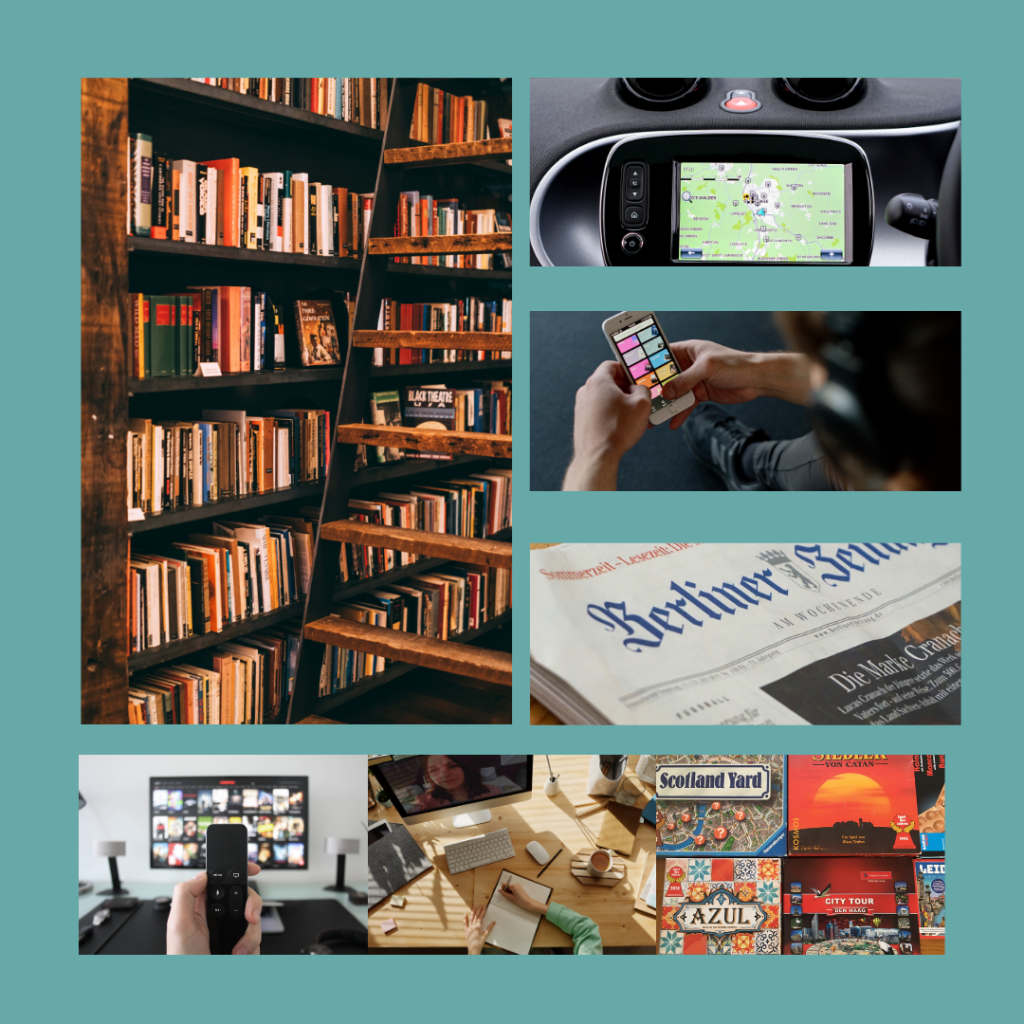
I set all my devices in the language I want to support more. From the GPS to the operation system on my computer. I also watch movies, listen to music, play games in the language.

4) Talk to yourself in that language
Make it a habit to switch to the target language when you think about things you’re going to do, when you talk to yourself.
And try to talk aloud in order to get used to hearing yourself speaking that language again. Adjust the intonation. – It’s a very effective way to get the feeling of the language again!

5) Reduce code-mixing
At the beginning you might insert words of your most dominant language or languages into your target language. Try to take time to remember the word you would use in the target language instead.
If you notice that you are struggling with a certain kind of words – nouns, certain expressions, verbs, verb forms, adjectives or others – make a list of these words and form three to five sentences using these words right away.
For example, when I reactivated my English in my late thirties, I unconsciously mistakenly used “awesome” and “awful” interchangeably with the effect that you can imagine. I would say things like “that play was really awful! I so liked …” to the surprise of people around me, thinking I was slightly disturbed… Funnily awful had the meaning of awesome from 1300 until 1809, and this perfectly made sense to me: on a subconscious level I must have combined awe and full which clearly conveys a positive feeling and image in my head. But the meaning of this word clearly shifted and this shift had to take place for me too.
So what I did was to repeat sentences with awesome that mark the positive meaning, and play with the intonation of it and other sentences with awful with a clear negative meaning and another kind of intonation. – It helped.
If you make a list of the words you are struggling with, try to use them regularly in different contexts until you feel comfortable and confident using them.

6) Don’t feel ashamed when you struggle and make mistakes
When I restarted speaking French more regularly 3 years ago, I was shocked to see how little fluent I had become. – Unbelievable that after writing my PhD in French and most of my scientific articles in this language I would struggle speaking it! – But well, it  happened…
I started watching French TV channel, movies on Netflix and re-read to the x-st time novels and poetry and scientific articles.
Interestingly, my written French didn’t suffer as much as my oral conversational skills. The small talk and talking about every day things was what I mostly struggled with.
When I was asked to hold a talk in French, I noticed that didn’t need to prepare much as I still recalled the vocabulary and was still fluent in holding talks – and the topic was about linguistics/multilingualism.
As for every day conversations to flow again, I took the habit to sing along songs on spotify, watch movies and news in French, and spoke to myself in French whenever possible.

7) Give the language a place in your life again
I know that I don’t want to loose any of my languages again. I really feel the best, the most fulfilled when I can speak all my languages regularly. – I make sure to use at least three per day, and all of them throughout a week.
Giving all my languages all a place in my weekly life again, helps me to keep them all alive, and to enjoy them as often as I wish.
Maintaining them all – German, Italian, French, English, Swiss German and Dutch – is a real challenge for me. Especially because I want not only to speak them regularly, but also write and read in them – except Swiss German as it is an oral language.

When multilinguals are required to focus on one or two languages only due to work or to the linguistic environment they are living in, it requires considerable effort to keep them alive.

In the past 30 years I have experienced language attrition with all of my languages as I had major shifts that lead to the preference and dominance of one or two of them for extended period of time, and consequently the suffering of the other languages.

I know now how I can keep a certain balance among these languages and enjoy them all.

Have you reactivated a language that you had acquired or learned at some point?
Please let me know in the comments.

Read more:
Language Shift in Multilinguals

How to articulate sounds

When we learn a new language as adults, we often struggle with articulating the sounds.
What is relatively easy for children whose palate is still soft, becomes increasingly difficult the older we get. Usually, when children hit puberty, their palate hardens which makes it a bit more difficult for them to articulate new sounds.
Against common assumptions that adults can not become as phonetically fluent as children, it needs to be said that it is possible, if we have the right training and invest enough time to learn.

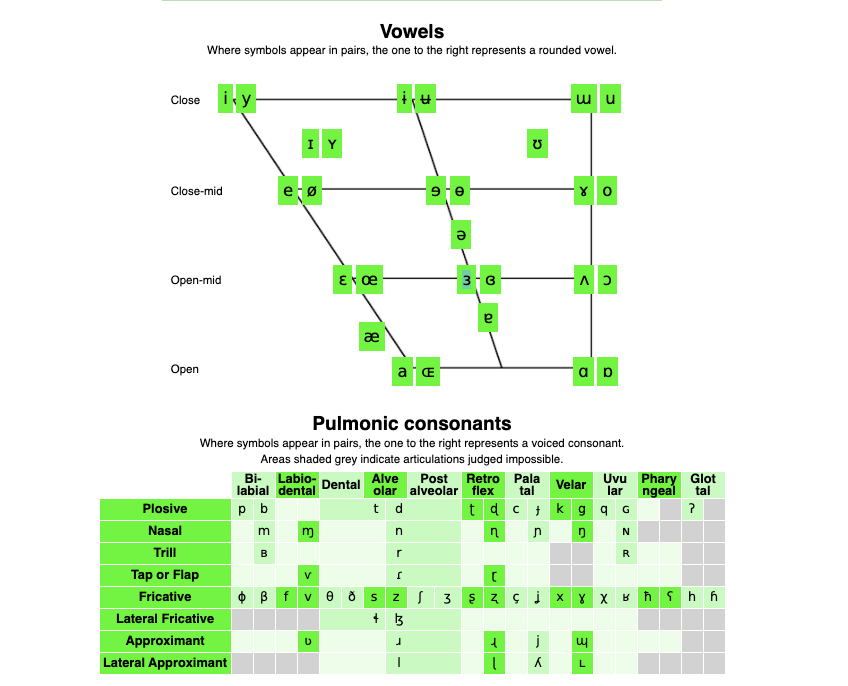
A simplified cross section that might help to get started:

This interactive IPA chart can help you practice articulating sounds.

When parents should NOT speak their L1 with their children

Against the common advice, backed up by countless research that states that parents should speak their L1 – first language – with their children, it is time to explain why this is not always the best solution for multilingual parents. I think there is an important misunderstanding leading to many parents doubting about the decisions they are making. But let’s start with explaining what is meant by L1 and how this differs for multilinguals.

L1 is, chronologically speaking, the language we acquired/learned first. It is the language some still call mother-tongue, and which can also be our native language – if our level of fluency is (nearly)native.

For multilinguals, their first language or L1 is not always the one they feel most comfortable speaking, reading, writing in. Not everyone who grows up with multiple languages will obtain and maintain the highest level of fluency in their L1. 

This is very obvious in the case of those who were adopted at a very early age. Adoptees can loose their L1 if it is not supported and fostered by their new parents. Depending on their age when they were adopted, and on their language development stage in their L1 at that time, they might only have a receptive (some call it “passive”) knowledge of the language, i.e. they might have understood it, but weren’t verbal yet, or were about to speak.

Fact is that the level of fluency in L1 for those who grew up with more than one home language, and live and work in another language, can fluctuate, and this can also happen to simultaneous and sequential (and a combination of both, considering the amount of languages they have learned) bi-/multilinguals too.

Let’s make an example*:

Laura who grew up with Italian and German in Germany, learns French at age 6, English at age 11 and later Spanish, Portuguese and Greek. After studying in Italy, she moved to Spain where she works in a Spanish company. Her partner, Davide, is Portuguese and British, and they speak Italian, Spanish, English and Portuguese together. They then move to the Netherlands, where they both speak English every day at work and in the international community. Of course, they learn Dutch too. – Do you find this unusual? Well, this scenario is not that uncommon! I work with many internationals who have such a scenario; they grew up with two or more languages and added several more during their life, studies and work in different countries. 

I mentioned that language fluency and dominance changes over time. In fact, we tend to invest more time and energy in the language we need for social contacts, school and work, especially when this language is not our L1 (chronologically speaking). If we grew up with multiple languages we may prefer another language than L1 to speak with our partner and colleagues. 

In the example above, Laura has experienced three language shifts.

  1. German was her most dominant language while living in Germany as a child
  2. Italian was her most dominant language when she studied in Italy
  3. Spanish was the language she was using on a daily basis at work and in the community for several years
  4. Now that she lives in the Netherlands, English is the language she speaks, reads and writes on a daily basis

These language shifts have an important impact on multilinguals and their families.

The most common question I get asked from multilingual parents is: what language should I speak with my child? 

Let’s go back to Laura: while living in the Netherlands, she gives birth to a son. Laura and Davide are not sure what languages to speak with their son: should Laura speak German (her mothers’ language) or Italian (her fathers’ language) with him; and Davide, should he speak Portuguese (his father’s language) or English (his mothers’ language) with their son? And what about Spanish? Spanish is the language Laura and Davide worked in for a long time and it is the language that is most spontaneous for both and they are very competent in it…

Considering the most common interpretation of research on this matter, Laura and Davide should both speak their L1 or native language with their son.

For Laura this would be German and/or Italian, for Davide Portuguese and/or English, as these were the languages both parents acquired during their first years of life and these are the languages of their extended families.

  • But are these the languages Laura and Davide feel more comfortable with?
  • Are these the languages they are, at that moment of their life, the most competent or proficient in?

Laura told me that Spanish is the language she likes the most. It’s the language she spontaneously spoke with her son when he was born. Should she switch to German and Italian though? And Davide? He hesitates between Spanish and Portuguese.

What needs to be very clear not only when choosing the language to speak with our children, but also when filling in application forms in daycares and schools: make sure to clearly state what language is the most dominant for you, as a person/parent, at this moment and phase of your life, and what language you are most competent and confident in: this would be your L1.

***

Research says that one should speak the native language to children also because of the emotional bond that is apparently stronger in our native language than in any other language.

This is where we need to further investigate the research on the matter. The research in question was conducted with people using foreign languages in a given situation and compared with the way native speakers would react.

But what was their level of fluency in those languages, how confident were they when they used that “other” language? Was this other language a language they just learned as additional language to one or more other languages they knew before?  What was the emotional and cultural bond they had with those languages? Were they using the “other” language with their partners too? – There are so many parameters that were not explained and taken into consideration in that study (or at least it was not shared overtly), who could have given another outcome than the one we now consider important when choosing the language to speak with our children. – Please don’t get me wrong: we should choose the language we feel most comfortable expressing our feelings in; but this is not necessarily the chronologically speaking “first language” or L1, “native language” in the common use of the term!

Couples who communicate in their 3rd or 4th language with each other and who made that language their emotional language, following this study, could not have a strong emotional bond with their partner because they speak in another language than their native language or L1.

Again, we have to define L1 as the language we are most confident and competent in, the one we have gained a nearly-native fluency; this can be also another language than the language we acquired first, chronologically speaking! 

Therefore I suggest multilingual parents who attained a high level of fluency in a language and feel comfortable expressing their feelings and emotions in it, and can be spontaneous in it, maybe even know nursery rhymes and lullabies in that language – or are willing to learn them! – to consider that as the language to speak with their children. As the language we speak with our children from day one is the one that we build an emotional bond with them, it is extremely important to think about possible scenarios in the future: will we always (!) feel comfortable to speak that language as the primary language with our children? 

But what if we speak one language with our partner and would like to speak another one with our children?
That is a very common situation in multilingual couples. It is the base for the OPOL (One Person One Language) and the 2P2L (Two Persons Two Languages) strategies.

When I work with multilingual couples who wonder what language to speak with their children, I start with assessing their language situation, the past, the present and the foreseeable future, and I ask them a (long!) series of questions. We usually have several sessions over a longer period of time to make sure that they take long term oriented decisions. Furthermore, they get to experience different strategies and asses themselves before taking a decision. 

Here are some standard questions I start with:

  • What is the language you would choose to speak spontaneously with your child?
  • What makes you doubt that this language might NOT be the right one to choose?
  • What language would your child need to be speaking with your parents & extended family?
  • Is it possible that your parents & extended family would speak another language with your child?  Which one?
  • How comfortable do you feel (from 0 to 10) speaking this language with your child? 
  • Do you know some nursery rhymes etc. in that language(s)?

Most multilingual parents want their children to grow up with as many languages as possible. Their first priority is for their children to “have more chances later in life”, and opt for more prestigious languages like English, French, Spanish, German etc. if these are in their repertoire, especially when one of the parents’ languages is a minoritized one. For example, instead of speaking Farsi with their children, they would opt for English, instead of Swiss German, they would prefer German etc. 

 Some further questions I ask are:

  • What languages they speak, read and write on a regular – preferably daily (!) – basis
  • If there will be any changes in their language use in the next 5 years
  • What short and longterm goals look like with regards of living in that country, working for that company, using that language on a daily basis etc.
  • What their short and longterm goals are with regards to their children’s language fluency (understanding, speaking, reading, writing) in all their languages

My main focus is on what languages parents are more comfortable speaking with their children as it is preferably** the language they will be sharing with them throughout their whole life.

If parents can not or do not want to reactivate a language they have not spoken on a daily basis for a long time – and this can be their first language chronologically speaking – it might be less dominant than their L2/3/4 etc. and, as a consequence, they won’t feel comfortable using it on a daily basis with their child. Asking them to speak it with their children would feel like a burden and they would need to put extra effort into it. The attempt to re-animate a “dormant” language can be successful, but only if there is a real need for the parent to do so. If for example the family is living or is going to move to a country where this language is the community language, or if the parent works in that language.
The time and effort the parent puts into re-activating a language can be too overwhelming if the situation and context are not supportive, and eventually lead to frustration, self-doubt and guilt and possibly failure.

****

When we become parents we tend to question which language would be most important for our children to learn.

We think about the importance for our children to understand their grand parents and our extended family, to succeed in the society and community we live in, and later academically. – Generally speaking, if a language becomes less important in our life and it would not be a spontaneous and natural choice to use that language with our children, we should consider alternative solutions.

Please don’t get me wrong: I am a convinced and avid defender of heritage/home language maintenance – but not at every cost!


The reason I do what I do as an Independent Language Consultant is that every family language situation is different and every family deserves a personalized solution, and that is the advice and support they get from me.

When it comes to decide what language to speak to our children we should decide consciously, considering the pros and cons about what is best and most natural for us.

I work with many multilingual parents who face this kind of situation and who very often find themselves discussing about the importance of their heritage languages and the importance for their family to find one, maybe two, languages to speak with their children and to each other. 

Why two, or only two languages?

Because in the long run, many multilingual families – I might say “most multilingual families” – will find it too much to keep up with 4 languages at home, especially when their children are schooled in an additional 5th or even 6th language! Like a parent said to me, juggling 6 languages in one family feels like “having a UN situation at home”. It might sound interesting and exciting at first, but it is very difficult to maintain.   

Laura and Davide both speak each others’ languages, which is not always the case in multilingual couples. They have the imbarazzo della scelta: they can choose whatever language combination they want. The most important aspect for them to consider is what their son will need to be able to speak and to what level of fluency in the setting they are right now and in the next 10ish years.

Did Laura’s and David’s language situation seem complicated to you? It really is not. It is a typical situation for so many cross-cultural couples who live internationally.

The most complex situation I had to work with was the one of a family that had 8 family languages, 6 children, 6 parents – yes, a patchwork family – with 2 community languages, and the parents/couples living in three different countries. 

But let’s go back to Laura and Davide’s family. So, Laura and Davide speak Spanish with each other when their first child is born. Laura speaks mainly Italian with the child, but speaks also Spanish when they are all together as a family, while Davide speaks Portuguese with him and Spanish, like Laura. Instead of OPOL (One Person One Language) they use the 2P2L (Two Persons Two Languages) strategy combined with T&P (Time and Place), which allows them to focus on one language in one-on-one situations and add the other one at specific occasions at home (and outside home).

When their son starts attending daycare in Dutch they also welcome Dutch at home, for specific situations. – When 3 years later a daughter is born, they decide to maintain the same languages at home, until they realize two years later, that their children prefer speaking Dutch with each other, the language of the community and that they speak with their peers. And, just to complicate it a bit more: the whole family is about to move to Germany…

You can imagine that Laura and Davide wonder what to do next. How can they make sure their children will maintain their home languages – Spanish, Italian and Portuguese – and what will happen to Dutch when they move to Germany?
Laura doubts if her first decision was the right one or not, because maybe choosing to speak German with her son from the beginning would have been the “better” option.
Fact is that they couldn’t foresee what would happen and all the decisions they took were right for them, at those moments.
Laura and Davide have set a very clear base of languages in their family and they will continue building on that. Changing the foundation of a house that we are building is never advisable, and neither it is to change the family or home language!
The advantage of this young multilingual family is that their extended family speaks German with their children and this will surely help them adjust to their new life in Germany. 

Life with multiple languages is never straight forward, it is never easy and clear from the beginning. It is a journey. And like for every kind of journey, Laura and Davide will need to readjust the sails. And they do!

If you are a multilingual parent, what language did you choose to speak with your children?
Have you maintained the same language throughout the years or did you change it, or add another one? If so, I would love to know when and what made you change.

Please let me know in the comments!

If you would rather prefer talking about this in person, book a consultation with me.

Related posts
Language Shift in Multilinguals

Language scenarios for multilingual children growing up abroad

The Third Language Model

Internationals struggle passing on their home languages 

* I have changed the names of the parents.

**I say “preferably” because, like in all multilingual families, it can happen that the home language or the language one parent speaks with the children will change. It is not very healthy for the connection between parent and child, but it can happen, usually because of outer circumstances. 

© Ute Limacher-Riebold 2020


Resources to learn and foster Arabic

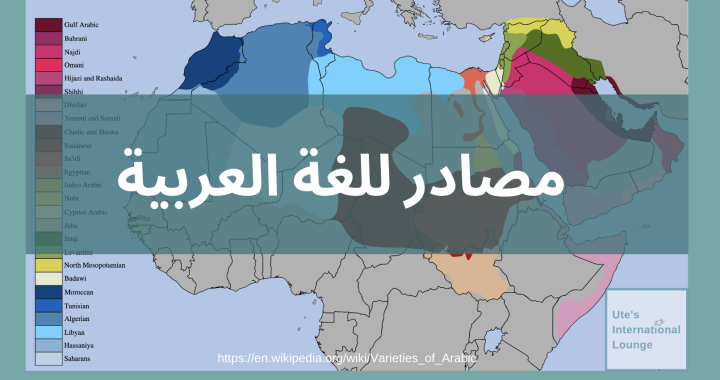
Please find a list of resources you can use to foster Arabic at home. As Arabic is a language I still don’t master (yet), I invite you to share other links to sites that provide resources to teach Arabic – understanding, speaking, reading, writing – for children from 0-18 yo, and also for adults, in the comments here below.

Online sites

On the Lingualism site you can find more links to all kind of resources: flashcards, online tutoring, Arabic podcasts, Arabic TV and movies, reading Arabic online, Arabic books and ebooks, online dictionaries etc.

Madinaharabic is a “free online resource for all students around the world seeking to learn Arabic”.

On the Superprof site you can find lots of suggestions and links to resources for Arabic for Kids (also teenagers); scroll the whole page to find out more!

On Know Arabic you find plenty of free resources, including audio material!

For adult learners

Open Culture is a site where you find free cultural and educational media links on the web. ArabAcademy

Printables and educational resources

On the Qamar Designs site you find free printables and educational resources; on the Isaahan Home Academy, you find material for home schooling, and on the Iconetwork you find the international curricula from preschool to grade 12

ArabicAdventures has plenty of downloadable worksheets. For Free Early Years Printables, have a look at Little Owls Resources : they have free dual language printables (for ex. English-Arabic)

On Pinterest: Arabic Teaching Resources

I can recommend the products offered by DARADAM 

Facebook groups

Adam Wa Mishmish’s facebook group is a fb group that shares entertaining and educational resources for children up to 14ish years.

Youtube channels

For children:

Kids TV Arabic

One4Kids / Zaky – Muslim Cartoons

Arabic alphabet song

Masha and the Bear (here you can find more short cartoons for children)

Toyor Baby TV

Sesame Street in Arabic

mbc3 

Books

Of course, there are millions of books available from many platforms… Please ask in my facebook group if you have questions about age appropriate resources. A mother on my site recommended this book to learn Arabic: Let’s Speak Arabic, by Prof. S.A. Rahman, 2003.  On the Iqra site you find textbooks to teach/learn Arabic.

Where to find some support…

Duolingo Forum French for Arabic speakers

For dyslexic children who learn the Arabic alphabet

On the Raising world citizens site you can find suggestions on how to help your dyslexic children learn the Arabic alphabet, Arabic numbers

Recommended sites:

Spring Brook or Billabong is a site by a multilingual mother, raising her three children with multiple languages, amongst others, Arabic, and sharing her experience of raising biliterate children, talking also about how to support children with learning difficulties – particularly dyslexia, dysgraphia and dyspraxia.

Code Switching and Code Mixing

Before explaining how the terms of code-switching and code-mixing are used, what they mean, let’s have a look at the history of the term of code-switching.


Where does the term of code-switching come from?

The first one introducing the metaphor of a language switch, i.e. the changing from one language to another during a conversation, was Otto Poetzl, an Austrian neurologist and psychiatrist in the 1920ies, when he noticed that a patient, a Czech native speaker (who learned German at age 14) became stuck in one language and wasn’t able to get out of that language, or use it.

Poetzl’s idea was that this wasn’t damage to the language system per se, but that the patient was having difficulties with his ability to switch out of the language.

Since Poetzl this metaphor that there is some sort of a switch to turn one language on, and turn one language off, is commonly used to describe the alternate use of multiple languages.  

This language switch has been studied ever since in the neural science literature with regard to bilingualism and many linguists have analyzed the mechanisms of language-switching, or, more commonly “code-switching”, the term used in linguistics. Code-switching has been used as umbrella term for all kind of contexts there two or more languages are combined in a conversation, in a turn of a discourse or one sentence.


Code-switching as alternation in a multilingual conversation

Code-switching occurs when a speaker alternates between two or more languages, or language varieties, in the context of a single conversation.

Let’s look at this conversation:

Marc: How was your day? 

Carlo: Già, Laura, com’è andata oggi? 

Laura: Non c’è male (looking at Carlo), it was ok (looking at Marc).

Marc: Have you managed to talk to John about the project?

(Important information: Carlo understands English to a certain extent, but doesn’t speak it, same goes for Marc’s Italian)

Laura: Si, sono riuscita a sottoporrli il progetto (looking at Carlo). He didn’t have time to read it yet though (looking at Marc).

In this situation, Laura, Marc and Carlo all speak Italian and English to different levels of fluency. Carlo speaks Italian and understands English, but doesn’t speak it. Marc speaks English and understands Italian, but doesn’t speak it.

Laura and Carlo are used to speak Italian to each other, whereas Laura and Marc usually speak English. Therefore  the conversation is in both languages.

Carlo and Marc both address their questions to Laura in their respective languages, while Laura, who is fluent in both, switches between Italian and English. In this example, Marc and Carlo are not talking to each other, but only  with Laura. The conversation is successful as all participants understand what the others are saying.

In this situation they could have opted for one language to communicate with each other, but everyone who shares two or more languages with family and friends, is  tempted to use them all.

Also, when we are used to speak one language with a friend or family member, it is difficult to switch to another language in other societal situations. 

Depending on the setting, a multilingual will always assess the situation and try to find out if everyone involved in the conversation understands all the languages that are used (more about it here).

If we share more than one language with our interlocutors, chances are high that we switch between those languages when communicating with them . Or not. If we usually speak to a person in one language, it can be difficult to switch to another language when in other societal settings with this person.

Code-switching is a conscious process of alternating the languages, with an intention and a social pragmatic consequence. “Bilinguals switch languages to accommodate the language spoken by their conversational partners” (Annick De Houwer 2019)

Code-switching is a “natural phenomenon in many multilingual societies, where speakers use multiple languages within the same interaction for stylistic reasons – to quote, interject, specify addressee and reiterate or explain a message, but also to express a variety of socio psychological affiliations” (Suzanne Quay and Simona Montanari, 2019: 548)

It can happen in a conversation where one switches from one language to the other, depending on the interlocutor, like in the example with Laura, Marc and Carlo, or involve a word, a phrase or a sentence.

The nomenclature of code-swtiching has a long history in linguistics. Einar Haugen (1956:40) defined it as “when a bilingual introuces a completely unassimilated word from another language into his speech”. Carol Myers-Scotton (1993:3) broadened the definition by saying that code-switching “is the selection by bilinguals or multilinguals of forms from an embedded variety (or varieties) in utterances … during the same conversation”. Eyamba Bokamba (1989:3) distinguishes code-switching and code-mixing: “Code-switching is the mixing of words, phrases and sentences from two distinct grammatical (sub) systems across sentence boundaries within the same speech event … [while] code-mixing is the embedding of various linguistic units such as affixes (bound morphemes), words (free morphemes), phrases and clauses from a co-operative activity where the participants, in order to infer what is intended, must reconcile what they hear with what they understand”. – The latter explanation is the one that illustrates the use and purpose of both strategies:

Code-switching is when we alternate sentences in a conversation with clear intents to highlight parts of our speech, create a special effect for several reasons:

  • using the right word or expression,
  • filling a linguistic need,
  • marking group identity,
  • excluding or including someone,
  • raising our status etc.

Furthermore, code-switching involves a rule-bound use of the “other” language, as such language insertions will fit those matrix language (the main language) rules: we respect the word order of the matrix language. Example: I came to get a cappuccino caldo.

(the speaker here code-switches to mark the intention to mark group identity, including/excluding someone/raise status etc., but respects the right word order in the matrix language – English – and respects the right word order in the “other” language. English would require hot cappuccino whereas in Italian, the adjective follows the noun)


Code-mixing, on the other hand is, when a speaker mixes the codes on morphological (and phonological?) level, and – this is what makes it easier to understand the difference with code-switching – without a specific intention, if not the one to transmit the message with a certain pace, to avoid interrupting the flow of the conversation. Code-mixing happens out of linguistic requirements.

It is a stage of additional language acquisition and learning. Children who grow up with multiple languages naturally mix their languages. They use both languages in a single sentence. And multilinguals do this on a regular basis: they say use the word that first comes to mind and fits the message, no matter the language it comes from.

Code mixing is not a sign that a child or an adult for that matter, is not learning the languages properly, on the contrary, it is a sign that we are acquiring those languages in a quite systematic way (see the example here below)! 


With mixing the languages, we prove to naturally find interchangeable elements of the sentence.

I like to compare this code-mixing to playing with lego. Imagine you have a box full of lego in different colors. Each color stays for another language.

If we want to build a house, we can choose to build a very colorful house, or build a house with one color only. – In other terms, either use one language only, or use more of them.

The house in one color stands for a monolingual conversation, the colorful house for a multilingual conversation where we code-mix.

What a child that is still acquiring and learning the language is finding out in this playful and intuitive way, are the rules of communication and of grammar.

Why do we mix languages?

First of all, if the other person doesn’t speak all the languages, we will choose the language that they have in common, and if the other person share more than one language with us, we have the option to use them all.

With mixing the languages we do not use the languages randomly  but in a way that will make sense and be understood by the other person. In fact we demonstrate our knowledge of the functions and rules of all the elements of the phrase.

Of course, this varies depending on the age and stage of language development of the person mixing the language.

The mixing can be observed on different levels: the phonological, the morphological, the lexical and syntactic level.

Here is a very easy example for code mixing on a syntactic level.

We would not say sentences like:

*I bleu want the car

but rather:

I want the bleu car       OR      I want the car bleu

(I want the blue car)

putting the adjective in the grammatically right position for either an English sentence (I want the bleu car) or a French sentence (I want the car bleu = Je veux la voiture bleue).

Code mixing on a morphological level

Ich möchte das Auto kolorieren.

(I want to color the car.)

The verb kolorieren exists in German, but this particular child had never heard that word used in German, but only ausmalen / anmalen. He used frequently the Italian verb colorare which lead him to use kolorieren in this particular context, where color- is taken from Italian colorare (Voglio colorare la macchina) and –ieren is the ending for some verbs in this German sentence (ex. probieren) and the verb is used instead of the German anmalen/ausmalen.


Code mixing on a lexical level

When er nach Hause kam, war er müde.

(When he came home he was tired)

When is taken from English (When he came home he was tired) instead of als in this German sentence (Als er nach Hause kam ware er müde). Many German-English bilinguals mix these two forms. German has the same form “wenn” which means “when”, but in this particular context als is necessary. 
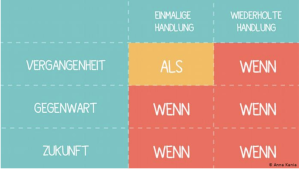


In code-mixing there is always one base language.

From a very early age, bilingual children make conceptually sensitive linguistic choices that draw on a developing knowledge of their separate language systems, switching languages according to the interlocutor. The sociolinguistic situation contributes significantly to the language use of bilingual children, indicating that language mixing requires a high degree of language awareness and competence rather than reflecting a deficiency in linguistic knowledge. (Helen Grech and Barbara Dodd, 2007: 86)


Let’s look at these examples, where the base language is French with integrations in English.

         Vas chercher Marc and bribe him avec un chocolat chaud with             

          cream on top

(Go fetch Marc and bribe him with a hot chocolate with cream on top)

         Des wild guys à cheval

         (Some wild guys on horseback) (Grosjean 1982)


These examples might look like code-mixing at first, as they are insertions of another language in the context of the base language. But when considered in a context where the use of the other language is done either to emphasize the part of the message in order to raise the status of the speaker, or while addressing a person who speaks the other language, both examples illustrate cases of code-switching: they are intentional!

Last but not least, one should not confuse the terms of code-switching and code-mixing with borrowing, where a language is integrated into the other because of the lack of a corresponding word in the language:

         Ça m’étonnerait qu’on ait code-switché autant que ça!

         (I can’t believe we code-switched as often as that!)


“Bilinguals switch languages to accommodate the language spoken by their conversational partners” (Annick De Houwer 2019)

“One main language – called the matrix language – provides the grammatical rules that govern how something is said when there is codeswitching” (Meyers-Scotton, 2002)

“There is purpose and logic in changing languages” (Colin Baker 2011:106)

“Code-switching and code-mixing serve a variety of functions, such as building and reinforcing solidarity among speakers who share these languages.” (Zdenek Salzmann, James Stanlaw, Nobuko Adachi, 2015: 207)


Final quote from Suzanne Romaine:


Many linguists have stressed the point that switching between languages is a communicative option available to a bilingual member of a speech community on much the same basis as switching between styles or dialects is an option for the monolingual speaker. Switching in both cases serves an expressive function and has meaning. The speech functions served by switching are presumably potentially available to all speakers, whether bilingual or monolingual, although it may not be possible to attribute only one meaning to a particular switch since switches may accomplish a number of functions at the same time. Moreover, the ways in which these functions are marked linguistically or the degree to which they are accomplished successfully will depend on the resources available in any particular case. In some cases the resources may come from more than one language, while in others they may come from within what is regarded as one language. This is why many linguists use the term “codeswitching”; the term “code,” like “variety” is a neutral one and does not commit us to taking a decision as to whether the varieties or codes concerned constitute languages or dialects.


Recommended readings:

Baker, Colin, Foundations of Bilingual Education and Bilingualism, 5th Edition, Multilingual Matters, 2011.

Bokamba, Eyamba, Are there syntactic constraints on code-mixing?, World Englishes 8, 1989:277-292.

De Houwer, Annick, and Lourdes Ortega, The Cambridge Handbook of Bilingualism, 2019.

Gardner-Chloros, Penelope, Code-switching, Cambridge, CUP, 2009. 

Grech, Helen and Barbara Dodd, Assessment of Speech and Language Skills in Bilingual Children: An Holistic Approach, in Stem-, Spreek- en Taalpathologie, vol, 15, Nijmegen University Press  2007.

Haugar, Einar, Bilingualism in the Americas: a bibliography and research guide, Tuscaloosa, American Dialect Society, University of Alabama, 1956.

Heller, Monica, Codeswitching: anthropological and sociolinguistic perspectives, Berlin, Mouton de Gruyter, 1988.

Muysken, Pieter, Bilingual SpeechA Typology of Code-mixing, CUP, 2000.

Muysken, Pieter, Mixed Codes, in Peter Auer and Li Wei, Handbook of Multilingualism and Multilingual Communication, Mouton de Gruyter, 2009, 315-340.

Myers-Scotton, Carol, Comparing codeswitching and borrowing, Journal of Multilingual and Multicultural Development, 1992, 13 (1&2), 19-39.

Myers-Scotton, Carol, Duelling Languages: Grammatical Structure in Codeswitching, Oxford, New York, OUP, 1993.

Myers-Scotton, Carol, Social motivations for code switching evidence from Africa, Cambridge, CUP 1993.

Myers-Scotton, Carol, Code-switching, in F. Coulmans (ed.) The Handbook fo Sociolinguistics, Oxford, Blackwell, 1997.

Myers-Scotton, Carol, Contact Linguistics, Cambridge, CUP, 2002.

Quay, Suzanne and Simona Montanari, Bilingualism and Multilingualism, Annick De Houwer and Lourdes Ortega, The Cambridge Handbook of Bilingualism, 2019, 544-560.

Romaine, Suzanne (1995). Bilingualism. Blackwell.

Saville-Troike, Muriel, Introducing second language acquisition, Cambridge, CUP, 2006.

Zdenek Salzmann, James Stanlaw, Nobuko Adachi, Language, Culture, and Society. An Introduction to Linguistic Anthropology, 6th edition, Westview Press, 2015.

5 Stages of additional Language Acquisition


If your child is acquiring Chinese as an additional language, you may find this infographic useful.

Thanks to Yu Xun, a young intern at Ute’s International Lounge,  and Amanda, owner and founder of Miss Panda, my infographic 5 Stages of Additional Language Acquisition got translated into Chinese. 


Following an interesting discussion with some clients and members of my facebook group Multilingual Families who are raising their children with multiple languages, and Chinese is one of them, I realized that the information parents get for Chinese language development is slightly different from what I am used to share.
What is important to know is that children around the world go through the same stages of language acquisition and their first words are all /papa/, /tata/ – an occlusive (in the study here below “non-pulmonic”) sound /p t k/ in combination with the most open vowel sound /a/.

For the consonants, the study by Sharynne McLeod and Kathryn Crowe, Children’s Consonant Acquisition in 27 Languages: A Cross-Linguistic Review, offers an interesting overview about the order young children tend to be able to produce consonants.

This is a chart about English, Japanese, Korean and Spanish consonant sounds.

I find important for parents to know  that “children’s consonant acquisition is a key feature of children’s overall development, enabling them to perceive and produce intelligible speech and interact with members of society. “. Furthermore, “children master some categories of phonemes (manner/place) using a similar pattern of acquisition across languages” and we can observe a “wide range and large standard deviations in the acquisition of some individual phonemes”. 
I usually advise parents to observe their children’s language development, their understanding, speech production, perception and overall cognition skills, their interaction capacities, in all kind of societal contexts (at home, outside of home).

You can find more detailed information about Chinese language development (in Chinese) on this website (https://kknews.cc/baby/8znglgl.html)


The illusion of sound and its meaning in language acquisition and learning

Sound is the most important medium we use when communicating – unless, of course, we use sign language.

Most of us assume that the auditory signal is enough for others to understand us. Some people increase the volume to make sure they are “heard”. Most of my clients are surprised to learn that sound is not enough to communicate effectively and that other cues affect our perception and understanding.


Whenever we talk with someone whom we can also see, we automatically watch the movements of the other person. We look at the lips, the articulatory movements, the gestures.


When listening comprehension becomes difficult, for example when there is background noise, or if we speak with someone in a language we – and/or he/she – are not that fluent in, we may struggle to understand what is said.


Especially when what we hear and what we see (or seem to see) does not match. We are easily irritated when for example we watch a movie and the audio and the image on the screen are not in sync. (cfr. Albert Costa, The Bilingual Brain: And what it tells us about the Science of Language, 2020)

A very interesting effect called the McGurk Effect, shows what can happen. It is an audiovisual illusion that shows clearly that sounds can be perceived very differently. For example the pronunciation of /ba/ and /va/ can sound exactly the same.

The accurate perception of information can involve the participation of more than one sensory system, in this case, vision with sound, which is called multi-modal perception. Senses, in fact, did not evolve in isolation from each other, but work together to help us perceive our world.When multiple senses are stimulated simultaneously, the brain begins to experience and information rich learning experience! (1:00-1:45 of the following video)

Try to analyze the sounds you see and hear in this video:

What this means for bilingual language acquisition in babies

When babies acquire languages they try to build their sound inventory by connecting visual and auditory cues to discriminate between languages.

Babies between four and six month old are able to differentiate between French and English only by watching videos of people speaking in those languages without sound! (Albert Costa, Chapter 1 Bilingual Cradles)

Costa focuses on babies who are between four and six months old because during that time babies fix their gaze on the mouth of a person.

I can confirm that this ability to differentiate between languages by only focussing on the articulatory movements of the lips can be maintained and fostered throughout life.

I recently did this experiment myself by switching of the volume and only looking at the movements of lips. After a few words I managed to recognize the languages: Italian, German, French and English.

It might be that my personal history has to do with this capacity. When I was 4 years old, I was hearing impaired for almost a year. I suffered from chronic ear infections since birth, but when I was about 4 years old, these infections became very severe. My ear drums bursted about 23 times during those years, causing regular hearing impairment. My parents were not aware about the severity of my hearing impairment because I automatically learned to read their lips. I remember hearing sounds – like when we swim under water – but could only understand what people were saying when I could see their lips movements.
I acquired German and Italian during those years and this impairment did not affect my languages in any way. In fact, my parents and the medical doctors were surprised and shocked when they realized how little I was actually hearing. Fortunately, at 5 years a simple tonsillectomy made these ear infections decrease and eventually stop, and I could finally hear without any impairment. People would even say that my hearing was intensified. At school I could understand what people would whisper and I heard sounds others couldn’t hear – my mother used to say that I would hear the sound of bats (which wasn’t really true).

What this means for language acquisition and learning

When we learn a new language, but also when babies acquire languages, we need to learn to distinguish sounds that are present in that language: phonemes.
Phonemes are the smallest units that differentiate words. In English, batcatmat, fat only differ by one phoneme (/b/-/k/-/m/-/f/) that are contrastive, i.e. the alternation of these phonemes results in different words, with different meanings. When we struggle with acquiring contrastive phonemes, we make mistakes.
Children whose first language is Chinese, will struggle with hearing the difference of sound in l and r – unless they are exposed to a language where these are two distinctive phonemes, like in English (rack, lack), German (Latte, Ratte), Italian (lutto, rutto) etc. Studies show that babies who are exposed to contrastive phonemes will be able to differentiate between the language, but apparently, when not exposed to these languages before they reach 12 months of age, they won’t be able to :

after just twelve months of exposure to a language in which the contrast between the two sounds in question was not relevant, the ability to differentiate those sounds was lost (or at least significantly reduced). This shows that the passage of time is critical in terms of our ability to distinguish sounds (Costa, p.18)

This loss of sensitivity seems to be accompanied by an increase of sensitivity to detect subtle differences between the phonemes of the language to which the baby is exposed.
I personally doubt that this sensibility will be completely lost. I rather assume that the focus simply shifts to the most important languages for the child at that developmental stage.
In fact, I observe and experience that even later in life we are still able to distinguish between contrastive sounds in other languages. What I would agree with is that it will be more difficult to distinguish sounds that are very different from those we have in our inventory, but it is not impossible. The approach to distinguishing these sounds may not be as intuitive and natural as in babies, but the same way we can learn new languages also later in life, we can learn about the contrastive phonemes of that language. Costa mentions that the loss of this capacity explains why non-babies or everyone who learns another language beyond childhood would have an accent, but there are enough people in the world who learned languages later in life and had very little or no accent, and who would not make the expected “mistakes” that one would expect.

I do agree though that it requires training to hear the difference of pronunciation and intonation of sounds in tonal languages if ones languages in are all non-tonal languages, the same way an adult Chinese native speaker would struggle with differentiating between /l/ and /r/.

What is your experience with acquiring and learning sounds in a new language?
Have you experienced the McGurk Effect?
Please share in the comments here below.

Sensible and sensitive – in French and English

Like many people who regularly use more than one language, I have some words I use in an incorrect way because the same – or similar – form of the word has a different meaning in another language I speak. Native speakers would probably not make those mistakes, but I personally consider them as an interesting side-effect of being plurilingual. 

In English, for example, I use sensible with the meaning of  sensitive.

sensible (adj.) late 14c., “capable of sensation or feeling;” also “capable of being sensed or felt, perceptible to the senses,” hence “easily understood; logical, reasonable,” from Late Latin sensibilis “having feeling: perceptible by the senses,” from sensus, past participle of sentire “perceive, feel” (see sense (n.)).

Of persons, “aware, cognizant (of something)” early 15c.; “having good sense, capable of reasoning, discerning, clever,” mid-15c. Of clothes, shoes, etc., “practical rather than fashionable” it is attested from 1855.

and

sensitive (adj.), late 14c., in reference to the body or its parts, “having the function of sensation”, also (early 15c.) “pertaining to the faculty of the soul that receives and analyzes sensory information”, from Old French sensitif “capable of feeling” (13c.) and directly from Medieval Latin sensitivus “capable of sensation”, from Latin sensus, past participle of sentire “feel perceive” (like sense (n.)). 

Meaning “easily affected” (with reference to mental feelings) first recorded in 1816; meaning “having intense physical sensation” is from 1849. Original meaning is preserved in sensitive plant (1630s.), which is “mechanically irritable in a higher degree than almost any other plant” (Century Dictionary). Meaning “involving national security” is recorded from 1953.

Other Middle English senses included “susceptible to injury or pain” (early 15c., now gone with sensitive); “worldly, temporal, outward” (c. 1400); “carnal, unspiritual” (early 15c., now gone with sensual). Related: Sensibleness.

When looking at the meanings of sensible and sensitive in English, French and Italian for example, I think it is clearer why I tend to mis-use the term in English.

In French, sensible is equivalent to the English sensitive. This is the explanation from the Larousse :

  • Qui est, qui peut être perçu par les sens : Le monde sensible.
  • Qui est apte à éprouver des perceptions, des sensations : Avoir l’oreille sensible.
  • Qui est très facilement affecté par la moindre action ou agression extérieure : Être sensible de la gorge. Une dent sensible au froid.
  • Se dit d’une partie du corps que l’on ressent, qui est plus ou moins douloureuse : La douleur est moins vive, mais la zone est toujours sensible.
  • Qui éprouve facilement des émotions, des sentiments, notamment de pitié, de compassion : Une nature sensible. Être sensible à la douleur d’autrui.
  • Qui est particulièrement accessible à certaines impressions d’ordre intellectuel, moral, esthétique ; réceptif : Être sensible aux compliments.
  • Se dit d’un appareil, d’un instrument de mesure, qui obéit à de très légères sollicitations : Une balance très sensible.
  • Se dit d’un matériel, d’un produit qui est sujet à des variations de prix dépendant de facteurs extérieurs.
  • Que l’on doit traiter avec une attention, une vigilance particulière : Dossier sensible.
  • Qui fait l’objet d’une surveillance renforcée pour des raisons de sécurité : Vol sensible.
  • Qui est facilement perçu par les sens ou par l’esprit : Une sensible différence de prix.
  • Se dit d’une émulsion photographique, d’un explosif, d’un matériel, etc., doués de sensibilité.

Whereas French sensitif means sensory or oversensitive in English. As, like Larousse says: Sensitif se dit d’un sujet doué de perception extrasensorielle

For some time I also used the term “awful” in its etymological way, i.e. “worthy of respect or fear”, and not with its actual meaning “very bad”. Especially when reacting spontaneously to an awesome situation, it happened that I said awful, not intending it in the modern way, but in the medieval way:

awful (adj.): c.1300, agheful “worthy of respect or fear”, from aghe  an earlier form of awe (n.) + ful. The Old English word was egefull. Weakened sense “very bad” is from 1809; weakened sense of “exceedingly” is by 1818.

Do you also use a word in its etymological way or with the meaning it has in another language? Please share in the comments.