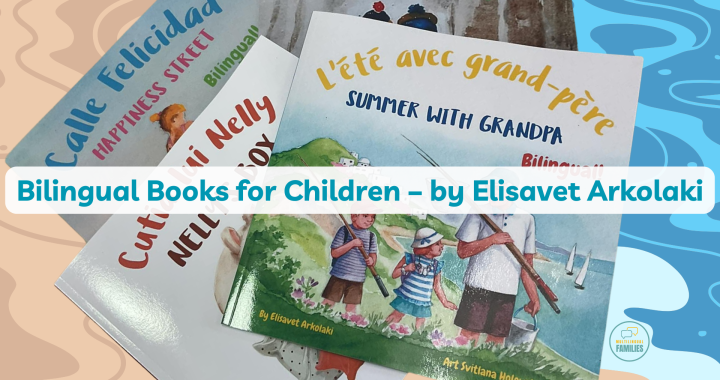
Reading bilingual books can be a powerful tool in fostering multilingualism, maintaining heritage languages and learning new ones. However, it is crucial to approach this activity strategically to maximize the benefits and avoid potential pitfalls. We read these books in a different way depending on the age and proficiency of the reader (or listener).
Bilingual books are sometimes referred to as “Dual Language Books” or “Side-by-Side-Books”, i.e. with two different languages on the same page, with the second (!) language being the translation of the first.
Although advanced readers, i.e. who already read at least in one of the languages or who are learning one of the two languages of the book, can compare vocabulary, language style, grammar and scripts, with babies and toddlers we should read bilingual books in a different way.
How to read bilingual books with babies and toddlers
I have noticed that in some videos on youtube, instagram and TikTok, people read the books by alternating the languages in one setting, eg. reading the text in language blue and right after that, the text in language red, before turning the page.
With babies, toddlers and preschool children it is advisable to not follow this strategy, but to rather read the book in one language per setting and person (i.e. by following the One Person One Language Strategy like mentioned here below).
Here are some key strategies for effectively reading bilingual books with our youngest children.
Keep Languages Separate
One of the most important principles when reading bilingual books with our youngest ones, is to avoid mixing the two languages within a single reading session. This approach helps children clearly distinguish between the languages, preventing confusion and promoting better cognitive organization of each language system. Studies have shown that maintaining clear boundaries between languages can enhance bilingual children’s language development and proficiency (Genesee, 2001; De Houwer, 2009).
When we mix languages too freely – in each sentence or in each reading setting in a way that the sentence is first read in language blue and then in language red – it can lead to children mixing languages within sentences or even words. While code-switching and code-mixing is a very natural phase in bilingual and multilingual language acquisition, it is important for young learners to have consistent exposure to each language independently, particularly during the early stages of language acquisition (Muysken, 2000).
One Person One Language (OPOL) Strategy
For younger children, following the One Person One Language (OPOL) strategy is highly effective when reading bilingual books. This method entails each parent or caregiver consistently speaking and reading to the child in a specific language. For example, one parent might always read the English text, while the other reads the same story in Spanish.
This strategy reinforces language consistency and helps children build strong language associations with each parent or caregiver (Barron-Hauwaert, 2004).
Practical Tips for Reading Bilingual Books
Select High-Quality Bilingual Books: Choose books that offer clear and well-translated texts in both languages. The content should be engaging and relevant to maintain the child’s interest and provide a meaningful context for language learning. Texts that with strong cultural references for one culture and language could have an alienating effect in the other language (eg. when for example in one book young children walk to school by themselves and this is not common in places the other language is used).
Establish a Routine: Create a consistent reading routine where you designate specific times for each language. For instance, read with your child in one language during the morning and let someone else read in the other language in the evening (this can be the other parent, a caregiver, an older sibling of the child etc.)
Use Visual Aids: Utilize the illustrations in the book to support comprehension. Point to pictures and discuss them in the target language to reinforce vocabulary and context. If each parent or caregiver reads the same book with the child but in their target language, the child will be able to link the picture (the character, animal, object etc.) to the respective language, which enhances the children’s metalinguistic competence. They will know that “the blue car” is “la macchina blu” or “das blaue Auto” in Italian, respectively in German.
Interactive Reading: Engage your child by asking questions about the story, encouraging them to predict what happens next, or having them retell parts of the story in their own words. Again, make sure that in one setting you focus on one language, in the next setting, your partner or another caregiver focuses on the other language.
Cultural Context: Provide cultural context for each language. Discuss the cultural significance of certain words, phrases, or story elements, which can enhance the child’s understanding and appreciation of both languages and cultures.
Be Patient and Consistent: Language learning is a gradual process. Consistency and patience are key. Celebrate small milestones and progress in the target language, but avoid comparisons of the different levels of comprehension and use across the different languages your child is acquiring and learning! Learning multiple languages should never be a power struggle or a competition!
By following these strategies with your youngest, emergent multilinguals, you can create effective learning opportunities in the target language.
Remember, the goal is to make language learning an enjoyable and enriching experience, fostering a lifelong love for both languages and cultures.
What if your child doesn’t like the bilingual book?
Not everyone likes bilingual books. When my children were young, they didn’t exist in our languages, so I translated their favourite books on the spot or stuck the translations on post-it notes on every page. The reason I ended up writing it all down was that my son would expect me to use exactly the same words and sentences – children are very smart!…
Needless to say that this was not the best solution: at some point the books were way too many for me and my husband to translate into our respective languages and our son developed a clear preference for specific books and storylines, so he would pick the book with the story he liked the most.
I have proofread and even provided translations of many bilingual books and must say that not all of them were equally appealing and convincing in both or all the languages. Although I understand that bilingual books can be a great option for some, I personally prefer books in their original language. My children are the same. If possible, they preferred and still prefer reading the books in their original language.
- What is your take on bilingual books?
- What bilingual books do you have?
- Do you prefer having books in various languages instead?
- Which ones do you use with your children?
- Which ones do your children prefer?
- Please share your thoughts and experience in the comments here below!
References
- Barron-Hauwaert, S. (2004). Language Strategies for Bilingual Families: The One-Parent-One-Language Approach. Clevedon: Multilingual Matters.
- De Houwer, A. (2009). Bilingual First Language Acquisition. Bristol: Multilingual Matters.
- Genesee, Fred. (2001). Bilingual first language acquisition: Exploring the limits of the language faculty. Annual Review of Applied Linguistics. 21. 153 – 168.
- Muysken, P. (2000). Bilingual Speech: A Typology of Code-Mixing. Cambridge: Cambridge University Press.
Further readings:
Using Bilingual Stories to “Teach un poquito de Español”
How to Read Bilingual Books: for Teenagers and Adults
How to Read Bilingual Books with Emergent Readers: A Guide for Simultaneous and Successive Bilinguals

Ute Limacher-Riebold
Ute Limacher-Riebold, PhD, is the founder of Multilingual-Families.com and Owner of Ute’s International Lounge & Academy.
She empowers internationals to maintain their languages and cultures effectively while embracing new ones whilst living “abroad”.
She grew up with multiple languages, holds a PhD in Romance Studies and has worked as an Assistant Professor at the University of Zurich (Department of Italian Historical Linguistics). She taught Italian historical linguistics, researched Italian dialects and minority languages, and contributed to and led various academic projects.
Driven by her passion for successful language development and maintenance, and personal experiences with language shifts, Ute supports multilingual families worldwide in nurturing their languages and cultural identities in the most effective and healthy way.