Norwegian Parenting through the Foreign Lens

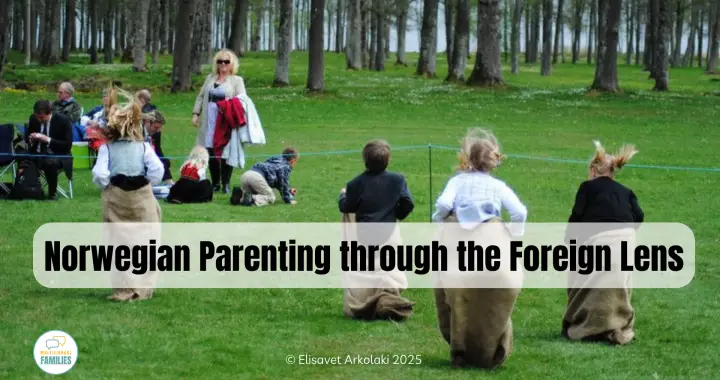
Parenting styles differ significantly across cultures, and starting a family in Norway or moving there with kids can bring unexpected adjustments. Norwegians are known for their child-centered, independent, nature-focused, and relaxed approach to discipline and parenting. Children are encouraged to explore nature, even in cold weather, and parents often trust them with more freedom than in many other countries. Schools and daycare centers prioritize play-based learning and egalitarian values, fostering a sense of autonomy from an early age. 

This approach might feel unfamiliar to newcomers, but embracing it can lead to a rewarding experience for parents and children. For instance, I was surprised to see six- and seven-year-old children walk alone to school, and I had to learn to trust our children to do the same. My husband is Norwegian, and I often ask him to confirm and reassure me whether something is considered OK here, as many beliefs concerning what is safe and age-appropriate contradict what I’ve learned and experienced in South Mediterranean cultures. 

The kids have so much freedom here; our town feels safe and child-friendly. When people ask me how I find raising kids here, I often reply that it feels like we’re back in time with stuff that matters, like kids being free, independent, and safe outside of the home. We live in the future regarding their education, how they are raised, and how the school and the family work together and take responsibility for children’s well-being and healthy upbringing. Norwegian society feels like a healthy society. 

Here, I’d like to compare Norwegian parenting with other cultural styles and provide tips for adapting.


1. The “Barnehage” Culture: Early Independence

Norwegian children can start attending barnehage (kindergarten) as early as one year old. However, it is not mandatory, and it’s up to the family to decide when to start. The focus here is on play, social skills, and outdoor activities rather than academics. This contrasts with cultures that prioritize early literacy and structured learning.

Tip: If your home culture emphasizes early academics and this is important to you, you can balance it by incorporating some learning activities at home while embracing the Norwegian play-based approach.

2. Outdoor Life: “There’s No Bad Weather…”

Norwegian parents encourage outdoor play and activities in all weather conditions (Friluftsliv mindset). For instance, it’s common practice to let babies nap outside in strollers (up to -10 C), and that also applies to daycares and kindergartens. Parents in warmer climates or cultures tend to be more cautious about weather exposure.

Tip: Invest in proper outdoor gear for your child and join other parents in local parks or nature outings.

3. Trust and Freedom: “Barn Må Få Prøve Selv” (Children must try for themselves)

Norwegian parents encourage independence from an early age; kids climb trees, use knives, and even walk to school alone. This “free-range” approach also applies to daycare and school teachers, and it fosters resilience and problem-solving skills. Parents tend to be more protective or involved in children’s daily activities in many other cultures. 

Tip: Start with small steps, like allowing your child to make decisions or handle simple responsibilities independently.

4. Work-Life Balance: Family Time Matters

Norway offers generous parental leave and flexible work schedules, in contrast with countries where long working hours may limit family time. Norwegian families prioritize hygge (cozy time together) in the evenings and weekends.

Tip: If you come from a fast-paced culture, try slowing down and embracing quality family moments over quantity of activities.

5. Discipline and Conflict Resolution: Calm and Respectful Parenting

Norwegians generally avoid yelling or harsh discipline; they use calm reasoning and positive reinforcement. There’s a focus on likestilling (equality), where children’s voices are valued in decision-making. Family decisions are often taken together with the kids and the kids have a say on matters that affect their everyday lives. This comes in contrast with cultures that may have a more authoritative or hierarchical parenting approach.

Tip: Observe and socialize with Norwegian parents and adopt techniques that work for your family.

Every culture has strengths, and adapting doesn’t mean giving up your own parenting style. The ideal scenario is that, with time, you can blend what works best for your family while respecting Norwegian norms. For me, the most challenging part was to learn how to manage my stress level and fears over the kids’ physical safety, and I’m still working on it. What helped me was to try and anchor my mind on rational thoughts like the following: since so many generations have been raised here this way, my own cultural beliefs and experiences make me think that safe experiences might be unsafe. My limiting beliefs should not be limiting my kids’ lives and journey towards independence and a fulfilling life, and that changed everything. 


Podcasts and audio material for multilingual children

Many of us are spending way more time on screen than necessary. We all would benefit from “off screen time” (funny that I share this in a post that you can only read… online).

As I am discovering more and more audio resources (audiobooks, songs, stories, podcasts), I thought I’d to share some audio resources that can help our children enjoy our languages.

Especially when we can not provide a language rich context for our children, due to complicated situations that do not allow us to meet with extended family or hire nannies or babysitters who could support our children’s language development in the target languages, we have to find alternative solutions.

Here are some suggestions about podcasts that members of my facebook group Multilingual Families kindly shared with me.

This is an ongoing list which means that I will update this post regularly.

If you would like me to include a podcast that you find particularly useful in your language, I would be very thankful if you could share your suggestions by indicating it in the comments here below:

[Podcast name]:

[language]:

[link]:

[target group (age group)]:

[where one can follow it]:

[main topics]:

[your name – if you wish to be mentioned in the post and]

Update: 12 September 2024

ARABIC

  • A post with links to Arabic Podcasts

[link]: https://www.al-fanarmedia.org/2020/07/for-kids-a-summer-of-arabic-podcasts-readings-and-online-activities/

[Ayesha Nicole]

  • Storytime with Teta

[link]: https://www.storytimewithteta.com/

Main topics: An Arabic-language podcast for children

[Ayesha Nicole]

Egyptian Arabic

  • Yuhu podcast for kids

[link]: https://www.listennotes.com/podcasts/yuhuhu-podcast-for-kids-in-egyptian-arabic-f5OrT2DcLhm/

[Ayesha Nicole]

CHINESE (MANDARIN)

  • Playful Chinese

[language]: Bilingual in English and Mandarin Chinese.

[target group]: Non-native parents and children, Chinese podcast for ABC parents and heritage speakers.

[listen on]: Apple Podcast at https://apple.co/31m1NJD

Main topics: Everyday Chinese you can use to keep Mandarin active with your children. It is in a playful story/topic format. There are occasional interview episodes with linguists, authors, and language learners.

[Amanda Hsiung Blodgett, “Miss Panda” and I am the host of the podcast and the creator of Miss Panda Chinese]

DUTCH

As I found hundreds of podcasts for children in Dutch, I share the sites where you can find them.

Here is a list of podcasts for teenagers ( please, check if the content is ok for your teenager; some are from teenagers for teenagers, others from psychologists; furthermore, there are some from Belgium, dus in het Vlaams)

ENGLISH

  • Circle Round

[link]: https://podcasts.apple.com/podcast/1246443751

[target group]: 4-10

[main topics]: “Created and produced by parents of young children, WBUR’s Circle Round adapts carefully-selected folktales from around the world into sound- and music-rich radio plays for kids ages 4 to 10. Each 10- to 20-minute episode explores important issues like kindness, persistence and generosity. And each episode ends with an activity that inspires a deeper conversation between children and grown-ups.”

[Ute Limacher-Riebold]

  • Purple Rocket Podcast

[link]: https://purplerocketpodcast.com/podcast/

[target group]: 4+

[main topics]: “Purple Rocket Podcast has a mix of content with quite a few long-running series, including “Grandpa’s Globe,” which is about twins Sawyer and Suzie, who use their grandfather’s magical globe to explore the universe. Other adventures involve everything from aliens to fairies. Mixed in with the series are occasional one-offs, some of which manage to impart little lessons for your kids. For example, “My Homework Ate Me” is a cautionary tale of procrastination.” (quote from WIRED)

[Ute Limacher-Riebold]

  • Stories Podcast

[link]: https://storiespodcast.com/

[target group]: 3+

[main topics]: Stories Podcast “performs a new story every week, drawing from a variety of sources and a variety of styles. There are retellings of classics like Snow White, some folktales, and myths from around the world, as well as original stories. Episodes range from 10 to 20 minutes, with most on the longer side. Everything here is G-rated and safe for all ages”.


GERMAN

  • Die Unsinkbaren Drei

[link]: https://kinder.wdr.de/radio/kiraka/audio/die-unsinkbaren-drei/index.html

[target group (age group)]: 4+

[main topics]: Bummkopp, Gräte und Kapitän Flitschauge sind die Bestatzung der Sturmhölle und erleben jede Menge Abenteuer zusammen. Und streiten dabei was das Zeug hält. Die unterhaltsamen Geschichten von jeweils etwa vier Minuten machen Spaß und vermitteln ganz nebenbei auch einige Fakten.

[Ute Limacher-Riebold]

  • Do Re MiKro

[link]: https://www.br.de/mediathek/podcast/do-re-mikro-die-musiksendung-fuer-kinder/517

[target group (age group)]: 6+

[main topics]: If you want your children to have access to classic music, try to listen to the podcast Do Re Mikro from the BR (Bayerischer Rundfunk)

[Ute Limacher-Riebold]

  • Geolino Podcast

[link]: https://open.spotify.com/show/0o5qbxarbs5TCegnJ3e6GA

https://podcasts.apple.com/de/podcast/geolino-spezial-der-wissenspodcast-f%C3%BCr-junge-entdeckerinnen/id1503254636

[target group (age group)]: 6+

[main topics]: Facts for young discoverers

[Ute Limacher-Riebold]

  • Mikado

[link]: https://www.ndr.de/nachrichten/info/sendungen/mikado/mikado_am_morgen/podcast4223.html

[target group (age group)]: 6+

[main topics]: Ein Thema und dazu vier Sendungen, eine täglich von Montag bis Donnerstag – das ist das Konzept von Mikado. Themen sind dabei beispielsweise das Wetter, „Drinnen Spaß“ oder Tiere im Winter.

[Ute Limacher-Riebold]

  • Radio Mikro

[link]: https://www.br.de/kinder/hoeren/radiomikro/podcast-rss-itunes-radiomikro-102.html

[target group (age group)]: 6+

[main topics]: radioMikro is a daily broadcast for children (on the radio channel Bayern 2) Monday – Saturday at 18.30 CET and on Sundays at  7.05 CET. The podcast is accessible via iTunes, the ARD Mediathek or in your browser.

[Ute Limacher-Riebold]

  • Schaulicht

[link]: https://schlaulicht.info/

[target group (age group)]: 6+

[main topics]:  All kind of topics: dragons, myths, journalism…

[Ute Limacher-Riebold]


For 6/8+ year olds and teenagers

  • SWR2 Wissen

[link]: https://open.spotify.com/show/76IHUGox6bXwXrCjDW63a1?si=497469007d4b495c

Follow our playlist for 6-12 year olds on PEaCH Spotify set up by Jessica Paolillo, content creator at Multilingual Families.


PORTUGUESE (BRAZIL)

  • Era uma vez um podcast

[link]:https://open.spotify.com/show/4q8oXx83A2mlflTmKzjTWH?si=65b06a0c1dc34914

[language]: Portuguese Brazil

[where one can follow it]: Spotify, Podcast app

[main topics]: stories

[Aline Brownjohn]

  • Histórias infantis de pai para filha

[link]: https://open.spotify.com/show/0CjRGovFGolnDgztRbVIbf?si=f5c79131ddad4d8c

[language]: Portuguese Brazil

[where one can follow it]: Spotify, Podcast app

[main topics]: stories

[Aline Brownjohn]

SPANISH

  • Eat your Spanish

https://www.eatyourspanishpodcast.com/

[language]: target language: Spanish ( lingua ponte : English)

[target age]: 3-6 years I think

[main topics] “is a podcast created Evan and Vanessa to share their deep love of music and the Spanish language with children everywhere. Their goal is to provide a constant source of warmth and comfort for all who listen and to make sure the Spanish content feels fun and easy to learn. “

[Jessica Paolillo; content creator at Multilingual Families]


On Spotify you can find PEaCH for Bilingual Children Spotify with more audio material (songs, stories, podcasts) for your children in a great and growing range of languages – have a look at our playlists! This is an initiative started and coordinated by Jessica Paolillo (content creator at Multilingual Families) (click on the picture):


4 communication styles in (multilingual) children

We all have different communication styles. And so do our children.
Parents often assume (or expect) that their children will have their same communication style, but that is not as simple. Especially in multilingual families, communication styles can be very different and children who grow up in such settings might switch back and forth between these different communication styles.

When we know what communication style our children have, we can understand them better, not only because of what they say, but also how they say it, what makes them communicate in one way or the other.

Elaine Weitzman  distinguishes 4 communication styles in children* that depend on 2 factors:

  • their ability to initiate interactions with others
  • their ability to respond when other people initiate an interaction with them. 

The way we interact with others differs from culture to culture, from language to language. Depending on the communication style that is most common in a language – which affects or influences intonations, turn takings, making (or not making) eye contact, the pace of a communication and the way adults communicate with children in general – our children will most probably follow the one of the language they are exposed to for the majority of the time. Or, in other words, the language of the person they are mostly communicating with. This can be a parent, peers, teachers etc.. 

I take Elaine Weitzman’s the 4 communication styles in children (see here below) as starting point to explain the different communication patterns that we can observe not only across cultures but across languages.

This is only a very generic explanation that I usually analyze more in detail with the multilingual and multicultural families I work with.

1) Sociable Communication Style

Children with a sociable communication style initiate interactions with others and are quick to respond to others’ initiations. Even if they only have a few words or are hard to understand, they continue to try and communicate with others. They are often considered “outgoing” or “extrovert”. Sometimes they insist communicating even if the other person can’t really understand what they mean.

If one of your child’s culture and languages is one that fosters and encourages this sociable communication style, i.e. interactions of children (or at any age) with adults and peers, chances are high that your child will have this style too.

But even if parents, and communities our children grow up in, foster this communication style, it is not a given that our children will adopt this style and feel comfortable with it. There are many factors that influence a child’s communication style (character traits, experience in different settings etc.).

2) Reluctant Communication Style

Children with a reluctant communication style are more likely to respond to others than to initiate an interaction on their own.

They can be considered “shy” and might need time to “warm up”, to become comfortable with new people and new environments. When these children are not given time to adjust and respond at their own pace, they tend to “fly under the radar” or risk to be labelled as “not fluent in the language”, although they are often much more capable than they appear!

Those who grew up in a context where children are not encouraged to interact with others (especially not adults), might need some time to adjust to a more “sociable” communication style. Especially in multilingual and multicultural contexts, it is difficult to determine if a child has this communication style because he/she is rather cautious in general, or because this is a style that is fostered by his/her parents.

Teachers who work with children coming from diverse cultural backgrounds, should be trained to understand and support the children’s different ways to relate and communicate with others.

3) Inactive Communication Style

Elaine Weitzman defines this style as passive communication style, as the passive behaviour of children with this particular style can be a sign of autism or other developmental issues.

Children with this communication style seem hard to connect with because they seem uninterested in people and objects – also toys, games etc. A developmental delay, a sickness or being on medication can lead to this more “inactive” communication style. – I prefer the term of “inactive” as I assume that these children are, in some way, receptive for their environment, i.e. that they understand and connect with their parents, teachers, siblings, friends etc. at least to some extent.

This is why I distinguish two (or more) categories of children with this communication style: those who have a developmental delay, a sickness or are on medication, which affects their way to connect with others, and those who have this more inactive communication style because they don’t understand the language (yet) or don’t know how to behave in given situations (yet)!

In fact, children who are schooled in an additional language, i.e. that is not one of their home languages and they are still in the adaptation and adjusting phase, can have this kind of communication style in specific situations only. This is very important to know because this helps us to find ways to help our children become “proactive”.

If your child has this communication style in specific societal contexts only,  it is advisable to explain this to the teachers and to invite them to find ways to interact with your children’s language, or to find ways to bridge between the home languages and the daycare/school language.

If after a few months the child still struggles with becoming confident in the new setting, despite the help from the teachers and environment (including the parents, of course), it is advisable to contact a child psychologist.


4) Own Agenda Communication Style

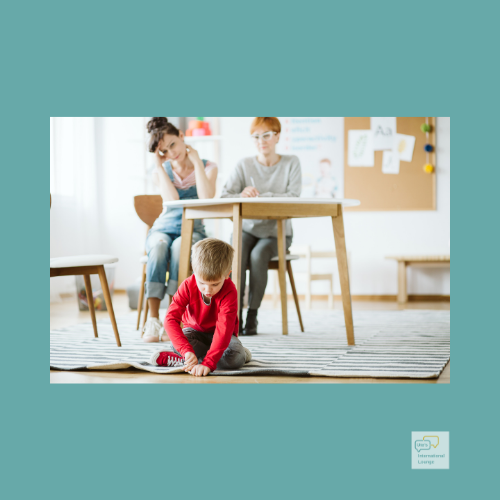
Children with this own agenda communication style, usually initiate communications with others only when they need something. They can be found playing independently and alone. It might be difficult to get a message across to these children as they seem as if they are in their own little world. They might struggle to successfully play and share with others. There are several reasons for children to have this own agenda communication style. It can be that they are the only child, that they are not used to social interactions with peers or other adults (yet), that they are used to play by themselves, or that for some reason they have problems to connect with others.  

One reason for children to have this communication style are hearing problems: they simply don’t hear when others’ speak to them, and only react when they are addressed through eye contact or touching the arm or shoulder for example. It is always advisable to check out the hearing of the child and to observe him/her in a variety of settings and situations.

If children with this communication style are schooled in an additional language that is not one of their home languages and that are still adjusting to the new language and environment, it is, once again, advisable for parents to explain the situation to teachers and to invite them to find ways to bridge between the home languages and the daycare/school language, or to find ways to interact with the child in his/her language. 
This is only a short overview and introduction about communication styles in children and some ideas on how they can apply to multilingual and multicultural children.

  • What communication style best describes your child most of the time?
  • Does your child have the same communication style in all his/her languages?
  • Does your child have the same communication style in all the societal settings, i.e. when at home with the family, at the daycare/school, with extended family and friends etc.?

If your child has an inactive, reluctant  or own agenda communication style: does she/he have the same style in all his/her languages? Does he or she have the same style in all societal settings, i.e. with adults she knows (like parents, and other adults in their daily life) and peers, in formal and informal circumstances?

If your child currently has predominantly one of the aforementioned communication styles, it can be that either your child has hearing problems (maybe has an ear infection), in which case it is advisable to let your infant’s or toddler’s hearing be checked (especially if they are prone to ear infections). If your child has one of these three communication styles but does not have an ear infection, is not ill and doesn’t take medications, and struggles with communicating, they might need some support and encouragement to get involved in interactions.

All children benefit from parent’s and other people’s efforts to make interactions more successful, interesting and engaging. If your school aged child has one of these three communication styles in specific situations only, it might be that he or she is struggling with either the language, the situation (at school or at home) or with peers/friends.

In any case, it would be helpful and beneficial for your child, if you could help him/her become more confident in sharing their thoughts, communicate effectively with you, so that you, as a parent, can understand what is going on and help or find help. 

If you want to find out how to optimize the communication with your children to support their way to communicate and connect with others in the most effective way, don’t hesitate to contact me.

And if you are looking for ways to foster understanding and speaking in a fun and entertaining way with your 0 to 15+ year old children have a look at our Toolbox for Multilingual Families, where Ana Elisa Miranda and I share 60 activities that foster understanding and speaking

Last but not least: multilinguals can have different communication styles depending on the language they speak (which doesn’t mean that they have multiple personalities…)


Some more questions: 

  • Do your children have different communication styles?
  • What communication style did you have when you were a child?
  • What style can you relate to most?
  • What style makes you feel comfortable/uncomfortable?

Please let me know in the comments here below.

*Weitzman, E. (2017) It Takes Two To Talk: A Practical guide for Parents of Children with Language Delays, Toronto, ON: The Hanen Centre.

– Finding out the communication style of your children is important to better support their language development – at home and at school. It is one aspect that you learn in my online course ENJOY Raising children with multiple languages for parents of 0-4 year olds.


All pictures © Canva.com

Code-switching, what to do, when should I worry?

This is one of the questions I get asked frequently:

When should I worry when my children do code-switching?

Code-switching

First of all, the term code-switching is widely used as an umbrella term for using different languages in the same sentence, alternating them to some extent. It is not to be confused with borrowing, where a language is integrated into the other.

Code-switching can involve a word, a phrase or a sentence and there is always a base language or matrix language. 

“Code switching is not a haphazard behavior due to some form of semilingualism but it is a well-goverend process used as a communicative stratagem to convey linguistic and social information”.  (Grosjean 2013)

The reasons for code-switching are many: using the right word or expression, filling a linguistic need, marking group identity, excluding or including someone, raising our status etc. – Please find a more detailed explanation of code-switching and code-mixing here.

Code-mixing


Code-mixing, on the other hand, is a stage of bilingual language acquisition. Bilingual children naturally mix their languages, i.e. they can use both languages in a single sentence.

It is not a sign that the child is not learning the languages properly, on the contrary, it is a sign that the child is acquiring those languages in a quite systematic way!

With mixing the languages, the child proves to naturally find interchangeable elements of the sentence.

I like to compare this code-mixing to playing with lego. When our children are exposed to multiple languages, it is like each person gives them with lego pieces of different shapes: you can imagine that each shape has a different function, like one for verbs, one for nouns, for adjectives, adverbs, prepositions, articles etc. Each language then represents a different language. Our children then end up with a box full of lego in different colors.

If the child wants or needs to to build a house – i.e. to form a sentence – they can choose to build a very colorful house, or build a house with one color only.

The house in one color stands for a monolingual sentence or conversation and the colorful house indicates a sentence or conversation where the child uses multiple languages. 

Many parents fear that by mixing the languages our children will never really learn to speak one of the languages correctly, but this usually is not true.

At what point should we worry when our child mixes the languages?

There are a few situations when we should observe our child’s code-mixing a bit closer.

  • When our child is learning the language in a formal setting for several months already, and receives formal instruction in it, i.e. support by educators and trained teachers, but keeps on code-mixing on a syntactical and morphological level in a way that the produced sentences sound “off” and can not be explained or justified by the syntax or morphological structure of the other language.
  • If our child using the syntax structure of language B while speaking in language Aconsistently, even when not tired, and when given the time to articulate at his/her own pace.

I know by experience that this kind of code-mixing can be frustrating, and it could be only a phase, so, try to find out possible reasons for the code-mixing. 

Our children can produce this kind of sentences when they are tired, or when they just switched from talking in the other language (B) and are now transitioning to talk in language A.

Whenever the communication becomes frustrating and almost impossible because its meaning is inintelligible for the participants, it is better to ask a professional to look into it. Preferably one who has knowledge of all the languages involved.

My first advice is always to find answers to the following questions:

  • What makes the child struggle to form a grammatically correct sentence?
  • Is it the situation, the topic, the person that interacts with my child?
  • How is the person communicating with my child using the language, or languages?
  • Is my child given enough time to think about what to say or respond?
  • Does my child even understand what the other person is saying?

It obviously also depends on the child’s age and stage of multilingual language acquisition, the situation (formal, non formal, at school, with people the child knows, with peers etc.), the topic (if it is a familiar topic or not), and if the child is tired or stressed for any reason etc.

First step:
Slow down the pace of the conversation.

Second step:
Give the child time to (re)formulate the sentence in a way that you or other participants of the conversation can understand it.

Third step:
Ask open questions to clarify the meaning.

Fourth step:
If the child doesn’t have the required fluency in the target language yet, bridge between the languages the child knows. There are several techniques that have proven to be effective.

Try to avoid any kind of pressure and make the child feel comfortable in expressig him/herself in any possible way. If necessary, with drawings or gestures. This has proven to be motivating for children who are emergent users of the new language – i.e. who are learning the new language as additional language.

If you have any question about this topic or if you would like to discuss a personal issue, please don’t hesitate to book a consultation with me.

I invite you to also watch my videos about Code-mixing and Code-switching, Mixing languages with your toddler and The Paradox of raising multilinguals:

Videos about code-mixing and code-switching

3 Videos

Please read also my post about Parental discourse strategies.


References:

De Houwer, Annick,Language Choice in Bilingual Interaction”, in De Houwer, A. & Ortega, L. (Eds.) The Cambridge Handbook of Bilingualism, 2019, 324-348.

De Houwer, Annick, “Why Do So Many Children Who Hear Two Language Speak Just a Single Language?” in Zeitschrift für Interkulturellen Fremdsprachenunterricht 25 (1): 7-26.

De Houwer, Annick & Nakamura, Janice, Developmental Perspectives on Parents’ Use of Discourse Strategies with Bilingual Children. in: Multilingualism Across the Lifespan, Røyneland U. & Blackwood R. (Eds.), Routledge, 2022, 31-55.

Grosjean, François, Life with Two Languages: An Introduction to Bilingualism, Cambridge, MA: Harvard University Press, 1982.

Grosjean, François and Li, Ping, The Psycholinguistics of Bilingualism, Wiley Blackwell, 2013.

Lanza, Elizabeth, Language Mixing in Infant Bilingualism. A Sociolinguistic Perspective. Oxford, OUP, 1997.

Lanza, Elizabeth, Language Mixing in Infant Bilingualism: A Sociolinguistic Perspective, Oxford, OUP, 2004.

Meisel, Jürgen, Bilingual Children. A Guide for Parents, CUP, 2019.