Before explaining how the terms of code-switching and code-mixing are used, what they mean, let’s have a look at the history of the term of code-switching.
Where does the term of code-switching come from?
The first one introducing the metaphor of a language switch, i.e. the changing from one language to another during a conversation, was Otto Poetzl, an Austrian neurologist and psychiatrist in the 1920ies, when he noticed that a patient, a Czech native speaker (who learned German at age 14) became stuck in one language and wasn’t able to get out of that language, or use it.
Poetzl’s idea was that this wasn’t damage to the language system per se, but that the patient was having difficulties with his ability to switch out of the language.
Since Poetzl this metaphor that there is some sort of a switch to turn one language on, and turn one language off, is commonly used to describe the alternate use of multiple languages.
This language switch has been studied ever since in the neural science literature with regard to bilingualism and many linguists have analyzed the mechanisms of language-switching, or, more commonly “code-switching”, the term used in linguistics. Code-switching has been used as umbrella term for all kind of contexts there two or more languages are combined in a conversation, in a turn of a discourse or one sentence.
Code-switching as alternation in a multilingual conversation
Code-switching occurs when a speaker alternates between two or more languages, or language varieties, in the context of a single conversation.
Let’s look at this conversation:
Marc: How was your day?
Carlo: Già, Laura, com’è andata oggi?
Laura: Non c’è male (looking at Carlo), it was ok (looking at Marc).
Marc: Have you managed to talk to John about the project?
(Important information: Carlo understands English to a certain extent, but doesn’t speak it, same goes for Marc’s Italian)
Laura: Si, sono riuscita a sottoporrli il progetto (looking at Carlo). He didn’t have time to read it yet though (looking at Marc).
In this situation, Laura, Marc and Carlo all speak Italian and English to different levels of fluency. Carlo speaks Italian and understands English, but doesn’t speak it. Marc speaks English and understands Italian, but doesn’t speak it.
Laura and Carlo are used to speak Italian to each other, whereas Laura and Marc usually speak English. Therefore the conversation is in both languages.
Carlo and Marc both address their questions to Laura in their respective languages, while Laura, who is fluent in both, switches between Italian and English. In this example, Marc and Carlo are not talking to each other, but only with Laura. The conversation is successful as all participants understand what the others are saying.
In this situation they could have opted for one language to communicate with each other, but everyone who shares two or more languages with family and friends, is tempted to use them all.
Also, when we are used to speak one language with a friend or family member, it is difficult to switch to another language in other societal situations.
Depending on the setting, a multilingual will always assess the situation and try to find out if everyone involved in the conversation understands all the languages that are used (more about it here).
If we share more than one language with our interlocutors, chances are high that we switch between those languages when communicating with them . Or not. If we usually speak to a person in one language, it can be difficult to switch to another language when in other societal settings with this person.
Code-switching is a conscious process of alternating the languages, with an intention and a social pragmatic consequence. “Bilinguals switch languages to accommodate the language spoken by their conversational partners” (Annick De Houwer 2019)
Code-switching is a “natural phenomenon in many multilingual societies, where speakers use multiple languages within the same interaction for stylistic reasons – to quote, interject, specify addressee and reiterate or explain a message, but also to express a variety of socio psychological affiliations” (Suzanne Quay and Simona Montanari, 2019: 548)
It can happen in a conversation where one switches from one language to the other, depending on the interlocutor, like in the example with Laura, Marc and Carlo, or involve a word, a phrase or a sentence.
The nomenclature of code-swtiching has a long history in linguistics. Einar Haugen (1956:40) defined it as “when a bilingual introuces a completely unassimilated word from another language into his speech”. Carol Myers-Scotton (1993:3) broadened the definition by saying that code-switching “is the selection by bilinguals or multilinguals of forms from an embedded variety (or varieties) in utterances … during the same conversation”. Eyamba Bokamba (1989:3) distinguishes code-switching and code-mixing: “Code-switching is the mixing of words, phrases and sentences from two distinct grammatical (sub) systems across sentence boundaries within the same speech event … [while] code-mixing is the embedding of various linguistic units such as affixes (bound morphemes), words (free morphemes), phrases and clauses from a co-operative activity where the participants, in order to infer what is intended, must reconcile what they hear with what they understand”. – The latter explanation is the one that illustrates the use and purpose of both strategies:
Code-switching is when we alternate sentences in a conversation with clear intents to highlight parts of our speech, create a special effect for several reasons:
- using the right word or expression,
- filling a linguistic need,
- marking group identity,
- excluding or including someone,
- raising our status etc.
Furthermore, code-switching involves a rule-bound use of the “other” language, as such language insertions will fit those matrix language (the main language) rules: we respect the word order of the matrix language. Example: I came to get a cappuccino caldo.
(the speaker here code-switches to mark the intention to mark group identity, including/excluding someone/raise status etc., but respects the right word order in the matrix language – English – and respects the right word order in the “other” language. English would require hot cappuccino whereas in Italian, the adjective follows the noun)

Code-mixing, on the other hand is, when a speaker mixes the codes on morphological (and phonological?) level, and – this is what makes it easier to understand the difference with code-switching – without a specific intention, if not the one to transmit the message with a certain pace, to avoid interrupting the flow of the conversation. Code-mixing happens out of linguistic requirements.
It is a stage of additional language acquisition and learning. Children who grow up with multiple languages naturally mix their languages. They use both languages in a single sentence. And multilinguals do this on a regular basis: they say use the word that first comes to mind and fits the message, no matter the language it comes from.
Code mixing is not a sign that a child or an adult for that matter, is not learning the languages properly, on the contrary, it is a sign that we are acquiring those languages in a quite systematic way (see the example here below)!
With mixing the languages, we prove to naturally find interchangeable elements of the sentence.
I like to compare this code-mixing to playing with lego. Imagine you have a box full of lego in different colors. Each color stays for another language.
If we want to build a house, we can choose to build a very colorful house, or build a house with one color only. – In other terms, either use one language only, or use more of them.
The house in one color stands for a monolingual conversation, the colorful house for a multilingual conversation where we code-mix.
What a child that is still acquiring and learning the language is finding out in this playful and intuitive way, are the rules of communication and of grammar.
Why do we mix languages?
First of all, if the other person doesn’t speak all the languages, we will choose the language that they have in common, and if the other person share more than one language with us, we have the option to use them all.
With mixing the languages we do not use the languages randomly but in a way that will make sense and be understood by the other person. In fact we demonstrate our knowledge of the functions and rules of all the elements of the phrase.
Of course, this varies depending on the age and stage of language development of the person mixing the language.
The mixing can be observed on different levels: the phonological, the morphological, the lexical and syntactic level.
Here is a very easy example for code mixing on a syntactic level.
We would not say sentences like:
*I bleu want the car
but rather:
I want the bleu car OR I want the car bleu
(I want the blue car)
putting the adjective in the grammatically right position for either an English sentence (I want the bleu car) or a French sentence (I want the car bleu = Je veux la voiture bleue).
Code mixing on a morphological level:
Ich möchte das Auto kolorieren.
(I want to color the car.)
The verb kolorieren exists in German, but this particular child had never heard that word used in German, but only ausmalen / anmalen. He used frequently the Italian verb colorare which lead him to use kolorieren in this particular context, where color- is taken from Italian colorare (Voglio colorare la macchina) and –ieren is the ending for some verbs in this German sentence (ex. probieren) and the verb is used instead of the German anmalen/ausmalen.
Code mixing on a lexical level:
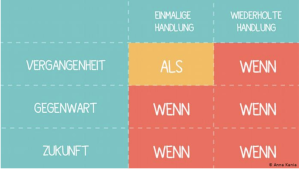
When er nach Hause kam, war er müde.
(When he came home he was tired)
When is taken from English (When he came home he was tired) instead of als in this German sentence (Als er nach Hause kam ware er müde). Many German-English bilinguals mix these two forms. German has the same form “wenn” which means “when”, but in this particular context als is necessary.
In code-mixing there is always one base language.
From a very early age, bilingual children make conceptually sensitive linguistic choices that draw on a developing knowledge of their separate language systems, switching languages according to the interlocutor. The sociolinguistic situation contributes significantly to the language use of bilingual children, indicating that language mixing requires a high degree of language awareness and competence rather than reflecting a deficiency in linguistic knowledge. (Helen Grech and Barbara Dodd, 2007: 86)
Let’s look at these examples, where the base language is French with integrations in English.
Vas chercher Marc and bribe him avec un chocolat chaud with
cream on top
(Go fetch Marc and bribe him with a hot chocolate with cream on top)
Des wild guys à cheval
(Some wild guys on horseback) (Grosjean 1982)
These examples might look like code-mixing at first, as they are insertions of another language in the context of the base language. But when considered in a context where the use of the other language is done either to emphasize the part of the message in order to raise the status of the speaker, or while addressing a person who speaks the other language, both examples illustrate cases of code-switching: they are intentional!
Last but not least, one should not confuse the terms of code-switching and code-mixing with borrowing, where a language is integrated into the other because of the lack of a corresponding word in the language:
Ça m’étonnerait qu’on ait code-switché autant que ça!
(I can’t believe we code-switched as often as that!)
“Bilinguals switch languages to accommodate the language spoken by their conversational partners” (Annick De Houwer 2019)
“One main language – called the matrix language – provides the grammatical rules that govern how something is said when there is codeswitching” (Meyers-Scotton, 2002)
“There is purpose and logic in changing languages” (Colin Baker 2011:106)
“Code-switching and code-mixing serve a variety of functions, such as building and reinforcing solidarity among speakers who share these languages.” (Zdenek Salzmann, James Stanlaw, Nobuko Adachi, 2015: 207)
Final quote from Suzanne Romaine:
Many linguists have stressed the point that switching between languages is a communicative option available to a bilingual member of a speech community on much the same basis as switching between styles or dialects is an option for the monolingual speaker. Switching in both cases serves an expressive function and has meaning. The speech functions served by switching are presumably potentially available to all speakers, whether bilingual or monolingual, although it may not be possible to attribute only one meaning to a particular switch since switches may accomplish a number of functions at the same time. Moreover, the ways in which these functions are marked linguistically or the degree to which they are accomplished successfully will depend on the resources available in any particular case. In some cases the resources may come from more than one language, while in others they may come from within what is regarded as one language. This is why many linguists use the term “codeswitching”; the term “code,” like “variety” is a neutral one and does not commit us to taking a decision as to whether the varieties or codes concerned constitute languages or dialects.
Recommended readings:
Baker, Colin, Foundations of Bilingual Education and Bilingualism, 5th Edition, Multilingual Matters, 2011.
Bokamba, Eyamba, Are there syntactic constraints on code-mixing?, World Englishes 8, 1989:277-292.
De Houwer, Annick, and Lourdes Ortega, The Cambridge Handbook of Bilingualism, 2019.
Gardner-Chloros, Penelope, Code-switching, Cambridge, CUP, 2009.
Grech, Helen and Barbara Dodd, Assessment of Speech and Language Skills in Bilingual Children: An Holistic Approach, in Stem-, Spreek- en Taalpathologie, vol, 15, Nijmegen University Press 2007.
Haugar, Einar, Bilingualism in the Americas: a bibliography and research guide, Tuscaloosa, American Dialect Society, University of Alabama, 1956.
Heller, Monica, Codeswitching: anthropological and sociolinguistic perspectives, Berlin, Mouton de Gruyter, 1988.
Muysken, Pieter, Bilingual Speech: A Typology of Code-mixing, CUP, 2000.
Muysken, Pieter, Mixed Codes, in Peter Auer and Li Wei, Handbook of Multilingualism and Multilingual Communication, Mouton de Gruyter, 2009, 315-340.
Myers-Scotton, Carol, Comparing codeswitching and borrowing, Journal of Multilingual and Multicultural Development, 1992, 13 (1&2), 19-39.
Myers-Scotton, Carol, Duelling Languages: Grammatical Structure in Codeswitching, Oxford, New York, OUP, 1993.
Myers-Scotton, Carol, Social motivations for code switching evidence from Africa, Cambridge, CUP 1993.
Myers-Scotton, Carol, Code-switching, in F. Coulmans (ed.) The Handbook fo Sociolinguistics, Oxford, Blackwell, 1997.
Myers-Scotton, Carol, Contact Linguistics, Cambridge, CUP, 2002.
Quay, Suzanne and Simona Montanari, Bilingualism and Multilingualism, Annick De Houwer and Lourdes Ortega, The Cambridge Handbook of Bilingualism, 2019, 544-560.
Romaine, Suzanne (1995). Bilingualism. Blackwell.
Saville-Troike, Muriel, Introducing second language acquisition, Cambridge, CUP, 2006.
Zdenek Salzmann, James Stanlaw, Nobuko Adachi, Language, Culture, and Society. An Introduction to Linguistic Anthropology, 6th edition, Westview Press, 2015.