
Many multilingual children experience a paradox: some may chat fluently in a new language but struggle academically, whilst others may grasp complex academic concepts yet find casual conversations about everyday topics difficult.
This is where four essential concepts – BICS (Basic Interpersonal Communicative Skills), CALP (Cognitive Academic Language Proficiency), CUP (Common Underlying Proficiency), and CALS (Core Academic Language Skills) – help us understand multilingual development and learning success.
1 – Understanding BICS, CALP and CUP
Jim Cummins (1979, 2000) introduced the distinction between BICS and CALP to explain why multilingual children may appear fluent in a language yet struggle in school.
BICS: Basic Interpersonal Communicative Skills
- BICS refers to everyday social language used in informal interactions – this is the language used on the playground, when greeting people, or the language used in casual conversations.
- This type of language develops relatively quickly (within 6 months to 2 years) once a child is exposed to a new language.
- However, conversational fluency can be misleading – just because a child speaks effortlessly in daily situations does not mean they have the language skills required for academic success. This is where the language development of children who were exposed to the target language since day one and those who start learning it at school converge: they are all language learners!
- However, multilingual children exposed to the new language only in formal settings, and learn the academic language (CALP) first, may struggle with BICS in that language and find it difficult to engage in informal conversations about everyday topics.
CALP: Cognitive Academic Language Proficiency
- CALP is the ability to understand, process, and use language in academic settings – when reading textbooks, writing essays, and solving math problems.
- Developing CALP takes significantly longer than BICS – typically 5 to 7 years, and in some cases even longer, depending on the way the academic language is transmitted and fostered over the years.
- Academic skills within CALP include critical thinking, reasoning, analyzing texts, summarizing, inferring, comparing and contrasting, and writing structured arguments.
- Multilingual children who lack CALP often struggle with schoolwork. They might appear fluent when reading (decoding), but might not fully grasp the meaning of what they are learning.
This distinction explains why some multilingual children can engage in friendly chatter but struggle with schoolwork, and why others excel academically but find informal social interactions challenging.
Most studies about multilingual learners focus on successive multilinguals, i.e. children who learn the additional language usually in formal settings and after having achieved a great level of proficiency in their first language. Children who have been exposed to multiple languages early on, i.e. simultaneous multilinguals, often have different approaches to learning additional languages, as we explain in our post about Compound, Coordinate and Subordinate Multilinguals.
CUP: The Bridge Between Languages
The Common Underlying Proficiency (CUP) model (Cummins, 1981) explains how knowledge and skills transfer across languages.
- Language learning is not isolated – once a child develops academic language in one language (in the picture here below: language orange for example), they can apply these skills in another (here below: language blue).
- This means that strong literacy and academic skills in the home/heritage language will support learning in the school language, and vice versa.
- Concepts such as problem-solving, reading comprehension, and logical reasoning exist independently of language and can be transferred across languages. Multilinguals who learn these skills in the language of instruction, need opportunities to make this transfer to the home/ heritage language(s) – ideally at school and at home.
For parents and educators, CUP highlights the importance of supporting the home/heritage language, as it strengthens overall academic success in multilingual children.

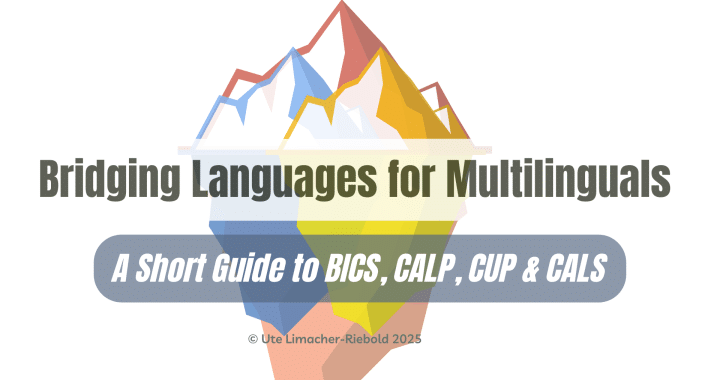
The dual Iceberg metaphor illustrates Cummins’ Developmental Interdependence Hypothesis which addresses the functional interdependence between the development of language orange and language blue skills. The tips of the iceberg above the surface of the water represent the BICS in the two separate languages, that can appear to be qualitatively distinct.
Languages often appear to have fundamentally different features when looking at them from the surface. The part of the iceberg underneath the surface of the water representing CALP (and CALS; see here below), represents Cummins’ idea that learning the two (or more) languages involves the same basic processes and skills and that learning one makes it easier to learn another (or others), thanks to the CUP .
2 – Expanding CALP for Academic Success with CALS
Core Academic Language Skills (CALS), also developed by Cummins, extends the concept of CALP. CALS focuses on the specific language skills needed for academic success in different subjects.
CALS reflect the discourse patterns and challenges of language and literacy use within he social context of schooling to a greater exent than other registers of language development (Cummins, 2021 and Barr et al., 2019).
- Academic language is not uniform – the language of math is different from the language of science, history or geography.
- CALS includes subject-specific vocabulary, complex sentence structures, and different ways of reasoning and presenting arguments.
- Students need explicit instruction in CALS to effectively navigate different academic registers and genres.
Ideally, multilingual students would learn subjects in both or several of their languages, following CLIL (Content and Language Integrated Learning), from early on.

3 – Supporting BICS, CALP, and CALS in Successive Multilinguals
As mentioned before, studies about multilingual learners focus on successive multilinguals – i.e. children who learn the additional language after the first language(s) have been consolidated, usually in formal settings, emphasising that their strongest language plays a crucial role in developing academic success. However, they may not have had the opportunity to develop BICS in the school language before they are expected to perform academically and build their CALP.
How to Support BICS in Successive Multilinguals
- Create social opportunities: Playdates, extracurricular activities, and peer interactions help children develop social fluency in the new language.
- Encourage role-playing: Practicing common phrases, small talk, and real-life scenarios boosts confidence in informal interactions.
- Use visual and contextual support: Gestures, facial expressions, and visual cues help children grasp social language in context.
- Promote bilingual peer support: Having a buddy who speaks both the home/heritage language and school language eases communication and builds confidence.
It is important to notice that once successive multilinguals have achieved a certain level of fluency, they might not benefit from continuous translating to their home/heritage language, but prefer to fully immerse into the target language.
How to Support CALP and CALS in Successive Multilinguals
The following should be practiced at school and at home:
- Encourage reading across genres: Exposing children to fiction, nonfiction, and subject-specific texts strengthens academic vocabulary.
- Discuss school topics in multiple languages: Talking about science, math, and history in the home/heritage language supports concept development and knowledge transfer.
- Develop metalinguistic awareness: Helping children recognize connections between languages enhances language learning and academic success.
- Provide structured academic language practice: Encourage debates, structured discussions, and presentations in different languages to build confidence in academic registers.
- Use scaffolding techniques: Graphic organizers, sentence starters, and guided questioning support academic language development.
How to support BICS, CALP and CALS in Simultaneous Multilinguals
It is crucial to recognize that simultaneous multilingual learners do not learn additional languages in the same way as successive multilinguals. Simultaneous multilinguals develop their languages alongside each other from early on, often without a clear dominance. When one of their early learned languages is the language of instruction, their learning will barely differ – if at all! – from the one of monolingual learners. If the language of instruction is an additional language to those they aquired from early on, their learning is likely to procede first through the mediation of the first languages (as subordinate multilinguals) and they might need some support during the early stages of language learning. However, they will very likely be reaching higher levels of proficiency faster than successive multilinguals, and they will rather learn the additional language in a coordinate way, i.e. preferring to keep their languages separated for example by topic, subject area, setting, person etc..
Their BICS may emerge naturally in all regularly used languages through play and social interaction in everyday situations, whereas CALP and CALS will require more intentional scaffolding across all contexts. Thanks to CUP, cognitive and conceptual knowledge will be transferred between their languages, and rich conceptual discussions will be nurtured in any language that the children are required to share their knowledge in. In the same way, their academic language will be strengthened across all those languages (Cummins, 2008).
Simultaneous multilingual learners benefit from the exposure to a wide range of vocabulary, genres, and registers in each language they are expected to use academically. However, for this to happen across all their languages, simultaneous multilinguals who learn an additional language at school will need exposure to the language of instruction also outside of the classroom setting.
Maintaining regular use of each language in cognitively demanding contexts – discussing books, explaining reasoning, making predictions etc. – helps deepen CALP and CALS simultaneously. Parents, teachers and other professionals should though not expect any “balanced” proficiency in all the languages. The opposite, with one or two languages being more dominant than others, is more realistic.
In our videos on Activities for Multilingual Families and The Toolbox for Multilingual Families we share ideas on how to support multilingual children’s language skills in a motivating and effective way. Crucially, support should be consistent, contextualised, and responsive to each child’s evolving language constellation (Limacher-Riebold, 2022).
Conclusion
Understanding the differences between BICS, CALP, CUP, and CALS is essential for supporting all multilingual learners. It is necessary though to tailor the support to the different kinds of multilingual learners. While conversational fluency may come quickly to some, academic proficiency takes years to develop and requires intentional support in both or all languages. Encouraging the use of the home/heritage language alongside the school language strengthens overall academic success.
– The content of this post is part of my trainings, workshops and webinars for parents, teachers and other professionals at Ute’s International Lounge.
References
- Barr, C.D., Uccelli, P. and Phillips Galloway, E. (2019) Specifying the academic language skills that support text understanding in the middle grades: The design and validation of the core academic language skills construct and instrument. Language Learning 69, 978-1021.
- Cummins, J. (1979). Cognitive/Academic Language Proficiency, Linguistic Interdependence, the Optimum Age Question, and Some Other Matters. Working Papers on Bilingualism, (19), 121-129.
- Cummins, J. (1981). Age on arrival and immigrant second language learning in Canada: A reassessment. Applied Linguistics, 2(2), 132-149.
- Cummins, J. (2000). Language, Power and Pedagogy: Bilingual Children in the Crossfire. Multilingual Matters.
- Cummins, J. (2008). Teaching for Transfer: Challenging the Two Solitudes Assumption in Bilingual Education. In J. Cummins & N. Hornberger (Eds.), Encyclopedia of Language and Education (Vol. 5). Springer.
- Cummins, J. (2021). Rethinking the Education of Multilingual Learners, Multilingual Matters, p.183.
- Limacher-Riebold, U. (2024, April 5). How to help multilingual children with homework. Multilingual-Families.com (https://multilingual-families.com/how-to-help-multilingual-children-with-homework/)
- Snow, C. E., & Uccelli, P. (2009). The challenge of academic language. In Olson, D. & Torrance, N. (Eds.), The Cambridge Handbook of Literacy, 112-133.
I invite you to watch my video about balancing multiple languages at home.