Sensible and sensitive – in French and English

Like many people who regularly use more than one language, I have some words I use in an incorrect way because the same – or similar – form of the word has a different meaning in another language I speak. Native speakers would probably not make those mistakes, but I personally consider them as an interesting side-effect of being plurilingual. 

In English, for example, I use sensible with the meaning of  sensitive.

sensible (adj.) late 14c., “capable of sensation or feeling;” also “capable of being sensed or felt, perceptible to the senses,” hence “easily understood; logical, reasonable,” from Late Latin sensibilis “having feeling: perceptible by the senses,” from sensus, past participle of sentire “perceive, feel” (see sense (n.)).

Of persons, “aware, cognizant (of something)” early 15c.; “having good sense, capable of reasoning, discerning, clever,” mid-15c. Of clothes, shoes, etc., “practical rather than fashionable” it is attested from 1855.

and

sensitive (adj.), late 14c., in reference to the body or its parts, “having the function of sensation”, also (early 15c.) “pertaining to the faculty of the soul that receives and analyzes sensory information”, from Old French sensitif “capable of feeling” (13c.) and directly from Medieval Latin sensitivus “capable of sensation”, from Latin sensus, past participle of sentire “feel perceive” (like sense (n.)). 

Meaning “easily affected” (with reference to mental feelings) first recorded in 1816; meaning “having intense physical sensation” is from 1849. Original meaning is preserved in sensitive plant (1630s.), which is “mechanically irritable in a higher degree than almost any other plant” (Century Dictionary). Meaning “involving national security” is recorded from 1953.

Other Middle English senses included “susceptible to injury or pain” (early 15c., now gone with sensitive); “worldly, temporal, outward” (c. 1400); “carnal, unspiritual” (early 15c., now gone with sensual). Related: Sensibleness.

When looking at the meanings of sensible and sensitive in English, French and Italian for example, I think it is clearer why I tend to mis-use the term in English.

In French, sensible is equivalent to the English sensitive. This is the explanation from the Larousse :

  • Qui est, qui peut être perçu par les sens : Le monde sensible.
  • Qui est apte à éprouver des perceptions, des sensations : Avoir l’oreille sensible.
  • Qui est très facilement affecté par la moindre action ou agression extérieure : Être sensible de la gorge. Une dent sensible au froid.
  • Se dit d’une partie du corps que l’on ressent, qui est plus ou moins douloureuse : La douleur est moins vive, mais la zone est toujours sensible.
  • Qui éprouve facilement des émotions, des sentiments, notamment de pitié, de compassion : Une nature sensible. Être sensible à la douleur d’autrui.
  • Qui est particulièrement accessible à certaines impressions d’ordre intellectuel, moral, esthétique ; réceptif : Être sensible aux compliments.
  • Se dit d’un appareil, d’un instrument de mesure, qui obéit à de très légères sollicitations : Une balance très sensible.
  • Se dit d’un matériel, d’un produit qui est sujet à des variations de prix dépendant de facteurs extérieurs.
  • Que l’on doit traiter avec une attention, une vigilance particulière : Dossier sensible.
  • Qui fait l’objet d’une surveillance renforcée pour des raisons de sécurité : Vol sensible.
  • Qui est facilement perçu par les sens ou par l’esprit : Une sensible différence de prix.
  • Se dit d’une émulsion photographique, d’un explosif, d’un matériel, etc., doués de sensibilité.

Whereas French sensitif means sensory or oversensitive in English. As, like Larousse says: Sensitif se dit d’un sujet doué de perception extrasensorielle

For some time I also used the term “awful” in its etymological way, i.e. “worthy of respect or fear”, and not with its actual meaning “very bad”. Especially when reacting spontaneously to an awesome situation, it happened that I said awful, not intending it in the modern way, but in the medieval way:

awful (adj.): c.1300, agheful “worthy of respect or fear”, from aghe  an earlier form of awe (n.) + ful. The Old English word was egefull. Weakened sense “very bad” is from 1809; weakened sense of “exceedingly” is by 1818.

Do you also use a word in its etymological way or with the meaning it has in another language? Please share in the comments.

Multilingualism is good for the economy

Multilingualism is not only good for our brain, our overall flexibility and open mindedness, it is also good for the economy. 

That countries like the UK with relatively “poor language skills” loses “the equivalent of 3,5% of its GDP every year” for exactly this reason whereas Switzerland, with its four national languages (German, French, Italian Rumantsch), “attributes 10% of its GDP to its multilingual heritage” is a fact.

Why is knowing other languages so important? Isn’t it enough to know English?
No, because knowing the other language is more than knowing its grammar… 

A study of small and medium-size companies in Sweden, Germany, Denmark and France found that those which invested more in languages were able to export more goods. German companies that invested heavily in multilingual staff added 10 export countries to their market. Companies that invested less said they missed out on contracts. (see: Speaking more than one language can boost economic growth)

Knowing the language of your business partner allows you to understand his/her culture, the way to approach issues, discuss – make business. In fact, it is knowing the “business language” which includes habits, beliefs, how meetings are done, what is expected from you, what you should avoid at all costs… can save you time and money.

You may object that “if everyone speaks English, we don’t need to know their language and all these details about the culture”– that’s exactly the point where many companies are wrong.

Your business partner may be fluent in English, even have no apparent accent, but he/she will still decide based on her or his cultural values, beliefs and assumptions.

Knowing the other language and some of the culture gives you the cognitive power, the understanding that is necessary to not jump onto wrong conclusions.

If I’m selling to you, I speak your language. If I’m buying, dann müssen Sie Deutsch sprechen (Willy Brandt)


In her essay Multilingual Skills provide Export Benefits and Better Access to New Emerging Markets, Ingela Bel Habib shares the results of her comparative study of small and medium-sized Swedish, Danish, French and German enterprises, and observed that:

“Swedish SME companies use mainly the English language and to some extent, German and French and therefore tend to export to neighboring markets, particularly Scandinavia. On the other hand small-and medium-sized companies in Denmark, England, Ireland, Germany, Poland, France and Portugal use up to between 8 and 12 market languages, which gives them better access to emerging markets. – In addition, the percentage of companies having a multilingual export strategy are at 27% in Sweden compared to 68% among Danish SMEs, 63% in Germany and 40% in France. This means that the percentage of firms missing export contracts due to language barriers are much higher in Sweden and are 20%, compared to 4% for Denmark, 8% for Germany and 13% for France.”

Furthermore, her study shows that “multilingualism is more complicated than the current belief that English is the only market language. Small- and medium-sized enterprises are using to an ever increasing extent the specific language of the export market to establish themselves in new emerging markets” – these languages for this study are English, Russian, German, French, Spanish, Italian, Polish and Chinese.

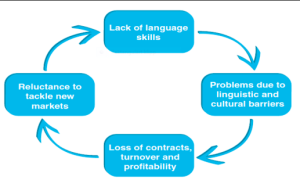
The British Chambers of Commerce and The National Centre for Languages have launched the model of  micro-economic analysis which points out the link between the lack of language skills and exports effects.


Effects of lack of language skills on export (The National Centre for Languages, 2009).


I highly recommend reading Ingela Bel Habib’s study to get all the details of variables, measurements and data that leads her to the following conclusion:

“In the short term, efforts need to be made reducing language barriers to market entry and facilitating the small-and medium-sized companies access to new emerging markets through supporting and financing professional development programs and language training.

Longer-term measures concern in particular the adaptation of education to the needs of employers through education to a greater number of languages, particularly at secondary and university levels. The languages of the migrant employees also provide a shortcut to multilingualism in order to increase small-and medium-sized companies’ exports to new emerging markets.”


In short: “multilingualism and economic competitiveness are closely linked” and measures should be taken at educational level. 

And, I may add, that in order to succeed, you don’t only need to be able to communicate in the other language, you need to know the “cultural grammar” too, the invisible rules of communication that determine the interpersonal behavior in other cultures


Quoted articles:

Ingela Bel Habib, Multilingual Skills provide Export Benefits and Better Access to New Emerging Markets, on the site Sens Public, 2011.