Babies start communicating with us from day one. The sounds they utter will become increasable intelligible: from cooing, to babbling, to monosyllable, bi-syllables up to sentences. The journey of language development in babies and infants is quick and has many facets. What many parents forget to consider is that gestures play an important role in the language development of infants.
When parents ask me how to help their children become verbal, I usually ask many questions about the non verbal communication between them and their babies. We are so focussed on verbal communication when it comes to our children’s language development, that we forget the non verbal one, which is very important and will evolve and develop alongside the verbal one across our whole lifespan.
Our infants can understand gestures very early on. They need to gain the motor skills to be able to coordinate their hands, their fingers, to imitate the movements we make.
Parents who use baby sign language, which is a more conventionalized signing where signs are closely linked with words, observe that communication with their infants seems to be more intense and effective than with their other children with whom they didn’t use baby sign language (this is the observation from parents I work with).
The importance of gestures for language acquisition
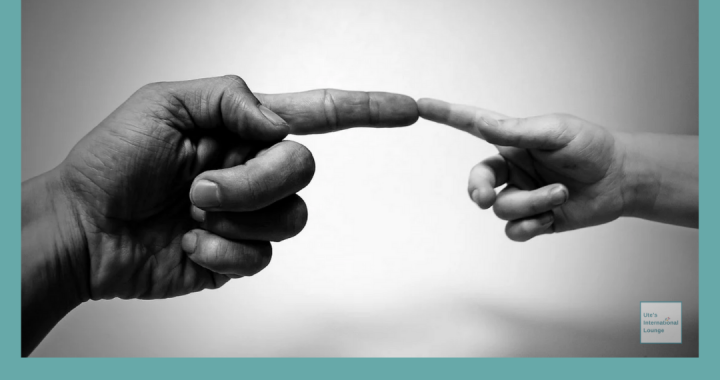
Around 10 months of age, children start using gestures in a deictic way, which means that they point fingers or use another body part to single out an object of interest.
Gestures are used by children across cultures to express their desires, share their experiences, draw attention and refer to things.
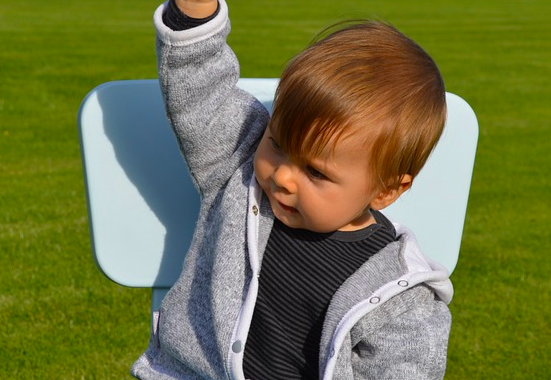
Pointing is a gesture used to communicate. The same way, other gestures and body language is used, like waving to say bye-bye, lifting arms to be carried, stamping feet when upset, clapping hands when excited etc.
Using gestures is something we intuitively teach our children and we can use gestures, explore the possibilities of using gestures to facilitate early communication.
Here you can find a list of the 11 distinct pointing development milestones from birth to two years old.
From gesture to verbal use of language
When parents ask me why their children are not speaking (yet), why they seem not to find any interest in uttering words, I usually ask them to describe a typical conversation with their children for example at the dinner table.
How are their children communicating what they want? Do they point at objects, nod or shake their heads, use facial expressions?
Parents are very good at understanding what their children want, without them needing to use words. Especially when children use a sequence of gestures and body language to communicate with us. “At eleven months of age, some children can produce a sequence of 2 gestures to convey a message (…) by twelve months of age (…) they begin to produce 3-gestures in sequence” (Ishino 2011).
Gestures play an important role in the natural development of spoken language. In hearing children, language and gesture develop in interaction with each other if they are used together. Therefore it is important that we link gestures with words.
How to help a child become verbal
If our children seem to exclusively (or mainly) communicate through gestures, we can help them increase their use of sounds and words by modeling what words we expect them to use in certain circumstances.
For example, if they point at an object, we may want to accompany their gesture with comments.
If our children point at a cup of milk on the table because they would like to drink, we would say
“Do you want to drink milk?” – they might nod, or shake the head, maybe stomp their feet.
While helping them reach the cup or giving it to them, we should make eye contact and repeat “milk” “drink” in several sentences. If we notice that the children are not responding with a smile a nod or other kind of reaction, we can get their attention by varying the intonation of our words. Sometimes a higher pitch – or a lower pitch – can do the trick. Or repeating a word in a fun way “milk, milk, milk”.
Especially when we see that our children are reluctant speakers, we can try to increase our own use of words, and gently model what we expect our children to start saying.
During this whole transition process between gestures and verbal expressions, we should stay calm and patient. Every child develops at their very own pace. We might need to repeat some words many more frequently, over a longer period of time until our children start trying to articulate them: they’ll all get there in the end!
I know that this period in language development is not an easy one for many parents. It seems like speaking with a wall, and we are very impatient to hear our children speak, to have our first conversations. If we consider gestures, body language already as a form of communication, it is easier to translate the gestures into words and to embrace this phase.
As I work with multilingual families, I find it very interesting to see how gestures change when switching from one language to the other, and how very young children can do this switch even before becoming verbal!
The most important thing in this whole process is to acknowledge the steps we make.
Enjoy all your languages when communicating with each other!
– Is your child using gestures? Are you using baby sign language with your baby or infant? How is this working for you and your multilingual family? Please let me know in the comments!
I invite you to watch the interview with Roya Caviglia:
Suggested readings:
Infant Communication Baby Sign Language with Multilingual Children
Cochet, Helene; Vauclair, Jacques (2012), “Pointing gesture in young children: Hand preference and language development”, in Colletta, Jean-Marc; Guidetti, Michele (eds.). Gesture and Multimodal Development. Amsterdam: John Benjamins Publishing Co. pp. 7–26.
Fasolo, Mirco; D’Odorico, Laura (2012), “Gesture-plus-word combinations, transitional forms, and language development”. Gesture, (12), pp. 1–15.
Gullberg, Marianne; Kees de Bot (2008), Gestures in language development, Gesture, 8(2).
Ishino, Mika; Stam, Gale (2011), Integrating Gestures : The Interdisciplinary Nature of Gesture. Amsterdam: John Benjamins Publishing Co, pp. 111–112.
Iverson, Jana M.; Goldin-Meadow, Susan (2005-05-01), “Gesture Paves the Way for Language Development”, Psychological Science, 16 (5): 367–371.
Kendon, Adam; Gullberg, Marianne; Seyfeddinipur, Mandana (2014), From Gesture In Conversation To Visible Action As Utterance: Essays In Honor Of Adam Kendon. Amsterdam: John Benjamins Publishing Company, p. 332.
Vallotton, Claire (2012), “Support or competition? Dynamic development of the relationship between manual pointing and symbolic gestures from 6 to 18 months of age”, in Colletta, Jean-Marc; Guidetti, Michele (eds.). Gesture and Multimodal Development. Amsterdam: John Benjamins Publishing Co. pp. 27–48.