Audio From Cultural Identity Model to Language Identity Model UIL
I recently translated the Third Culture Model into a Third Language Model for multilinguals, and I want to share my translation of the Cultural Identity Model from D. Pollock and R. Van Reken, into my Language Identity Model©:

(my design is inspired by the Cultural Identity Model by
Ruth van Reken and David Pollock)
There are many ways to represent or analyze acculturation, and John H. Schumann already made the link between acculturation and second language acquisition in the 80’ies, based on the social-psychology of acculturation, and I find that the bi-dimensional acculturation model based on John Berry’s research (1980) very inspiring when talking about the way internationals of any background and with all kinds of “reasons to spend time in the other country”.
It seems to me that Ruth van Reken and David Pollock were inspired by Berry’s model when they defined the cultural identity model Third Culture Kids: Growing up Among Worlds. I bridge between these models and approaches, searching for the similarities that can help to explain and understand the overall acculturation process also from a sociolinguistic perspective, that leads to what I suggest to call the a-languation process.
This process is closely related to learning and adopting the local languages, while maintaining to a certain extent, and in some cases, alas, the loss of the home languages.
I won’t bother you with a comparison and analysis of all these models that lead me to my Language Identity Model© and share only the outcome and some reflections here below.
I will start from Ruth Van Reken and David Pollock’s model (abbreviated in the following with RVR&DP), mention what Berry’s strategy would be called, and compare the different categories with the language identity stages of my model.
***
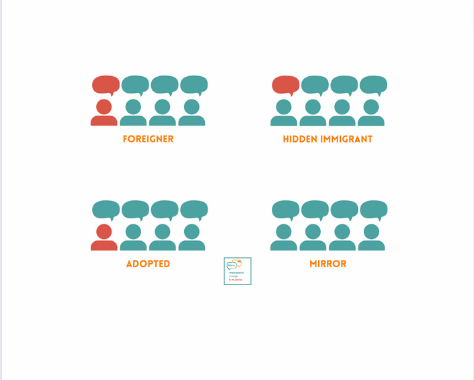
In Berry’s model, RVR&DP’s foreigner corresponds to what he describes in his separation strategy: when a person separates from the dominant culture, befriends only those with the same culture and adopts the new or dominant culture of the society.
The same way a foreigner can look different and think different from the locals in RVR&DP’s model, those who don’t speak the local language (yet!), feel excluded, separated, different. They might be recognized by locals or by those who fully integrated into the society, as standing out for what they are wearing, eating, how they do things, like, for example, not using the common means of transportation like locals in RVR&DP’s model, and also be identified as foreigners for not speaking the local language.
I have modified RVR&DP’s model by replacing the “thought bubbles” with speech bubbles to emphasize the use of the local language (and its comprehension).

Some internationals choose to stay in this stage for a long time, not wanting or finding it too difficult to integrate. They live in the so called bubble, where they function the best, feel more comfortable, find what they need and “can fill their cups”.
This is usually the first stage when one enters a new country or starts learning another language.
Hidden immigrants look very much like locals. Nevertheless, they might not share the same values and beliefs. The same applies for their language use that I highlight in my Language Identity Model©. They may use the local language, but not “sound” like locals – either because they have a foreign accent or because they use the language in a different way. It can be for example that they use the language in certain social settings only, but struggle in others, or that they don’t understand cultural references (yet), don’t laugh at the same jokes or don’t use the same metaphors when speaking.
The Adopted ones in RVR&DP’s model think like locals but look different. In my model, they correspond to many multilinguals who also look different from the outside, but who use the language like locals, know the slangs, understand jokes etc.. Locals tend to approach them by speaking either very slowly or switching to a more dominant language (like English) and be surprised that they can reply fluently in the local language. – Internationals who live in one place for a longer period tend to feel adopted as they adopt the local way to express themselves. Although they try to fit in by embracing the same habits, wearing the same clothes, adopting the same traditions etc. their features will always make locals assume that they are foreigners. Like the little Italian boy who grew up in China and learned Chinese to a high level of proficiency, perfectly blended in language-wise, but who always surprised locals by being so fluent in their language and culture!
The identity called Mirror in the Cultural Identity Model, corresponds to multilinguals who assimilated to the host language to such an extent that they sound like locals. They also look similar to locals, which, contrary to the Adopted ones, makes locals not switch to another language or slow the pace when they talk. Some internationals who fall into this category have abandoned their home languages, either in all social settings or only outside of home. There are many reasons for abandoning the home language: either for political or social reasons, or for generational reasons. We know that starting from the second generation of children / people growing up abroad, the chances of abandoning the home or heritage language grow. They fully integrate into the local society, culture and adopt the local language (or languages and dialects).
In children of mixed marriages, where one of the parents is a local and the language (and culture) of the other parent is deemed not to be important enough and ceases to be nurtured, we can observe a complete regression of this second, minoritized language, which leads to language attrition and can lead to language loss.
Some children who grow up internationally and repatriate during childhood tend to do everything not to stand out. Some even deny to even have lived in another country, and fake an accent when speaking one of their other languages, just to fit in. They tend to mirror their surroundings as much and as quickly as possible.
***
Although the different categories of cultural identity or language identity sound quite restrictive, there are mixed types of them that one can explain as follows.
As a hidden immigrant for example, or hidden multilingual, we are able to understand cultural norms in the host culture, be sounding like local speakers, while still fostering our home languages and cultures.
We can also be foreigners in one domain of life – at school for example – and a mirror at home, with the family, a hidden immigrant among people who share the same cultural background and adopted among those who share the same language.
Just to make an example. I am German and my parents instilled the German culture to me and taught me German. When I was 4, I asked my mother why our neighbors in Italy wouldn’t talk German with us when at our place. She explained to me that we were foreigners in the country, guests, and that our language at home was different from the one of our neighbors, of the majority. I had assumed that everyone would talk German at home and Italian outside home, like we did. Learning that this was not the case, and that we were “different” made me question why this had to be. I soon realized that the values and beliefs, the habits I was used to in my family, weren’t the same as those of my Italian friends. I felt like a hidden immigrant language-wise as I spoke Italian with them with no accent. I used the same anecdotes, laughed at the same jokes and read the same books.
I looked like an adopted person though, as my features are German. I learned to blend in among my friends at least through the language, I used their slang and suppressed my cultural and linguistic heritage, mirroring the local culture and language. I remember feeling embarrassed by the very loud behavior of German tourists, like my Italian friends, which lead me to avoid speaking German in public.
This attitude and feeling towards my languages has changed many times during my life and I find it highly fascinating to see, how our identity is determined by different factors in the various phases of our life.
We can unite all these identities in different contexts, at different stages, immerse or distance us from the local culture and language, whenever we consider it appropriate, safe, interesting or expected.
I think like all children who grow up abroad, I have been asked which language or culture, country I prefer, people wanted me to choose between the languages and cultures: I usually avoided to answer or, if I wanted to not discuss this any further, I answered what they expected, just not to have to deal with it.
To my children who grow up abroad too (in a different country than I or my husband), and to the families I support, I always advise to answer this kind of question with “I’m not only… but also…”, not only with regards to their cultures but also their languages, their habits, beliefs and values!
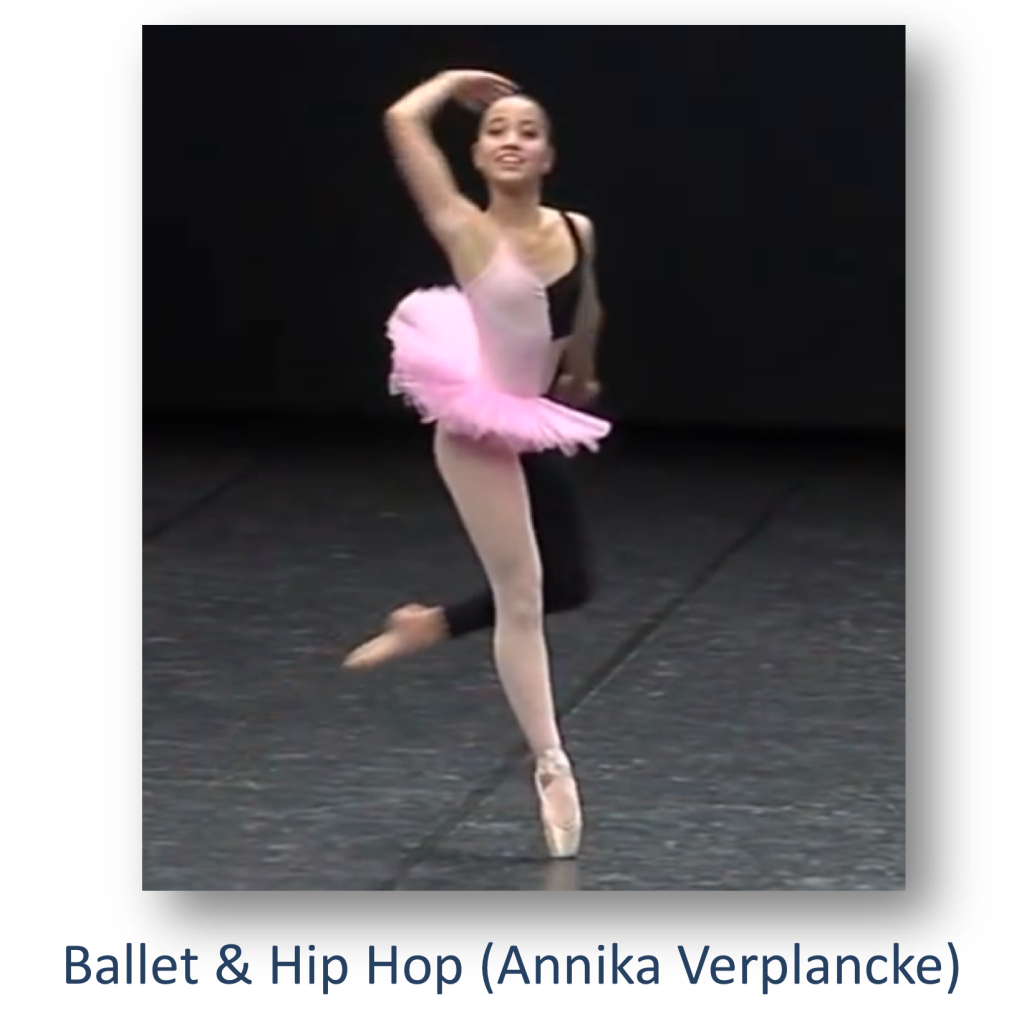
As I personally thrive whenever I can speak all my languages and embrace all my cultures without having to choose one, I like to compare this feeling with the performance by Annika Verplancke, who combines harmoniously Ballet and Hip Hop in one dance.
We and our children are both or all of the cultures and languages we embrace and learn and instead of thinking in a subtractive way, one where we need to use or be one OR the other, we should always (!) emphasize that we are both or all of them, in an additive way.
watch the video here
This is an “ongoing post”, which means, that I will work on it regularly, update it. Please share your thoughts, experiences, insights with me in the comments: I’ll be happy to mention them in the post!
John W. Berry, Acculturation as varieties of adaptation, in A.M. Padilla (ed), Acculturation: Theory, models and some new findings, p.9-25, Boulder, CO: Westview Press, 1980
I invite you to also read:
The Language Portrait
Do multilinguals have multiple personalities?
The Third Language Model
How to portray, feel and explain language use for a multilingual
Multilingual Language Timelines
The thought provoking article by Ruth Van Reken in Among Worlds about Cross Culture Kids (and the many other ways to describe children growing up abroad): How CCK came to be.