Challenges in Multilingualism – Navigating Language Dynamics in Multilingual Families


Being or becoming multilingual has numerous advantages, but it also comes with its fair share of challenges.

Understanding and addressing these challenges is essential for successful language development and maintenance in multilingual families.

Let's look at some common challenges that arise in multilingual families and discuss strategies to overcome them.


Language Dominance

When one language becomes stronger or more dominant than the other(s), we have to do with language dominance. One (or more) language(s) become more dominant when language exposure, schooling, or societal influences are supporting the target language(s) more than the others.

To address this, parents can provide a more balanced language input, i.e. make sure that there is enough exposure to the target languages in terms of qualitative high verbal interactions. Furthermore, they can encourage language use in various contexts, and seek support from language professionals if needed.


Code-Mixing and Code-Switching

Code-mixing and code-switching, where individuals switch between languages within a sentence of within a conversation, is very normal among multilinguals and usually nothing to worry about. But while this is a natural phenomenon, it can be a challenge when we struggle with having conversations in one language only. In fact, when we notice that our children can not hold a conversation in the target, i.e. the expected language in contexts where a monolingual language use is necessary, we may want to reinforce some language separation strategies, such as setting language rules for specific contexts. These strategies have proven to be very effective not only with children but also for multilingual adults!


Language Loss and Attrition

Language loss or attrition can occur when a language is not actively used or maintained. This language shift usually occurs gradually. It can become a concern when multilingual children are not exposed to the target languages consistently over a longer period of time.
To prevent language attrition and language loss, it is important to create and maintain (!) opportunities for language practice. Engaging with as many people as possible in the target language, fostering a great variety of language input – from speakers with a various interests and language use (formal, informal etc.) and of course also keeping the contact with extended family members who speak the language can help keep children motivated to use the language. If where we live we don't have enough speakers of the target languages, we can use all kind of audio and video resources to keep the language as varied and interesting as possible!

In our Toolbox for Multilingual Families we share activities and games that foster understanding, speaking, reading and writing.


Limited Language Resources

As mentioned above, access to resources in all languages spoken within the family can be limited, especially for less commonly spoken languages or languages that are not transmitted in written form (like dialects for example). However, leveraging online resources, local community networks, language exchange programs, and cultural organizations can help overcome this challenge and provide opportunities for language exposure and learning. – Make sure to join my facebook group Multilingual Families where you might find the "multilingual village" you need!


Maintaining Language Motivation

As children grow older, they may question the relevance or importance of maintaining multiple languages. Especially those they don't need with their peers or to function in social settings on a daily basis. It is crucial to foster a positive attitude towards multilingualism in general, and to highlight the advantages of having language skills in multiple languages.
In my online course for parents of 10-15+ year old children* I focus on fostering this awareness in our preteens and teens with regards to communication, cognitive development, cultural understanding, and future opportunities.

Celebrating cultural heritage and promoting meaningful language use can enhance the motivation of our chidren (and us!) to keep using the language**.


Social and Peer Pressure

As soon as children attend daycare or school, and participate in society, they are more prone to face social pressure or ridicule for speaking multiple languages or just "other" languages. Depending on where they grow up, the community will be more or less accepting towards other languages and cultures. In more monolingual settings, using other languages and coming from a more diverse cultural background can cause all kind of reactions.
As parents and caregivers, we can help our children cope with those situations by building their confidence and resilience of being "not only... but also...". educating others about the benefits of multilingualism, and fostering a supportive social network can help counteract this challenge.


Balancing Language and Academic Demands

Although more and more schools support multilingual children, i.e. their use of multiple languages, there are still some challenges our children can face. These challenges have to do with balancing language learning with academic demands. Especially when the language and overall academic expectations are not met, or not met at the expected moment, teachers and parents tend to blame the multiple languages. It has been proven that in the majority of cases academic struggles have nothing to do with the number of languages a child is exposed to. It is usually an imbalance in support for the target languages and the skills related to language learning and subject learning that cause a problem.
Whenever we observe an imbalance that lasts longer than a few months, and exceed the usual transition period (when our children changed school and maybe even school language etc.), we should work closely with educators to create a supportive environment that values and integrates multilingualism into the academic curriculum. In my over 30 years of experience with working in international settings I observed that the problem usually stems from the environment the child is exposed to, not the child. Therefore I always invite parents to find ways to create an environment where their children's needs are met and where they can develop in the most healthy way.


Conclusion

I am a defender of multilingualism as I know about the advantages about knowing multiple languages. I have acquired and learned more than 10 languages and dialects, and 5 of them to a high level of proficiency (in understanding, speaking, reading and writing). But like everything else in life, knowing multiple languages also comes with challenges. But these challenges can be overcome with awareness, proactive strategies, and support.
Embracing linguistic diversity, providing a balanced and hight quality of language exposure, fostering a positive language environment, and seeking professional guidance when needed, are essential for successful language development and maintenance in multilingual families and I'd say "across the lifespan".

By acknowledging and addressing these challenges, we can create a nurturing environment that allows multilingual individuals to thrive and embrace the richness of multiple languages and cultures.


If you are multilingual and raising multilinguals, please let me know in the comments what kind of challenges you faced or are currently facing with regards to using or fostering and learning multiple languages.


*The online course for parents of 10-15+ year old multilinguals will be available in fall 2024. If you want me to keep you informed for when the course will be ready, please leave a comment here below. No strings attached.
** I am preparing a course about Motivation for multilingual families. If you want me to keep you informed for when the course will be ready, please leave a comment here below. No strings attached.


Language shift in multilinguals

What happens when multilinguals shift language?

The process of language shift, also known as language transfer or language replacement or language assimilation, is when a community of speakers of a language shifts to speaking a completely different language, usually over an extended period of time.

From a historical perspective, this happened for example when in the now France shifted from Gaulish to Latin during the Roman Empire. The reasons for this were that Latin was perceived as to be higher status and it spread at the expense of the other language, Gaulish, that was perceived by its speakers as to be lower-status. 

In the past 150 years many countries developed a standard language, shifting from regional languages to a language that was considered more prestigious and therefore more valuable. In Italy, for example, since the times of the Renaissance, a trans-Italian language was developed in central Italy, based on the Florentine Tuscan because of its cultural prestige. This Forentine Tuscan (think about the Tre Corone: Dante, Petrarca, Boccaccio) started to be employed for formal, literary and written purposes among the literate classes from the various states of mainland Italy, Sicily and Corsica (France), sidelining the other dialects in education and formal settings. Literary speaking, Florentine established itself as the single most representative dialect of Italy long before its political unification in 1861. Thus, Tuscan has been officially adopted by the pre-unitarian states. Italian further expanded as a commonly spoken linguistic form for everyday use throughout the country after World War II.

Nowadays, we can observe a  validation of the local dialects and regional variants again, but that’s a topic for another post.

What is interesting to see is that the historical language shift can be observed also on a sociolinguistic level in multilingual people.

Those who speak multiple languages usually have (a few) languages that are more dominant for a certain period of time.

There are multiple factors that determine what language is more dominant in a given period.

Depending on the situation, the personal preference and the actual need of using the language on a regular basis influence the individual status of the language.

For example, although I was fluent in German most of my life, I spent 6 years using it only sporadically, and preferring Italian and French because I needed them daily for work and research. German became less important, less valued in the community I lived in and among my friends, which lead to a language shift and almost language loss. In fact, I had to invest considerable energy and time in reactivating my German which I perceived then as “dormant” – i.e. present in terms of I knew and understood the language but didn’t use it frequently enough to be able to have fluent communications in it anymore. The same happened to my English that I used only sporadically during the same period of time, and that I only re-activated 14 years ago and use daily since.

Language shifts happen to multilingual speakers who usually live, study and work in settings where one or two (or three) of their languages are required more than the others. Although all the languages that we acquire and learn at some point in life, are still in our language memory, those we use more often are more in the foreground and ready to be used, whereas those we use only sporadically or only in reading for example, are less “present” and ready to be activated. 

Language shift in children

When our multilingual children start attending daycare or school in another language, their language preference will shift towards the language of their education. They will need to become as fluent as possible in the school language in order to succeed academically. Many parents are advised to focus more on the school language and some are even told to drop their home language(s)!… This is completely unnecessary and actually counterproductive. In fact, skills that our children acquired and learned in their home languages can be transferred to the school language, and vice versa.

It is a fact, though that the home languages, as a consequence of more exposure in the school or community language, will become less important. If children don’t receive adequate input in their home languages that foster understanding, speaking and maybe reading and writing, the language shift from home language to school language can go so far as for children not to respond in the home languages anymore.

In order not to have a complete language shift that could lead to language loss if not taken seriously, parents, educators and the community – ideally! – would support and foster the home language too! 


Have you ever experienced language shift?

Please share in the comments!


If you have questions about language shift and language loss, don’t hesitate to contact me at info@UtesInternationalLounge.com!

Please have a look at our Toolbox for Multilingual Families to get inspired about how to foster family language skills with no or very little preparation! 


– For further readings I recommend the post about Language shift, attrition and loss 

Language scenarios for multilingual children growing up abroad

There are numerous language scenarios for multilingual children living abroad, i.e. outside of both, or one of their parents countries of provenance (or origin), since there are many different degrees of fluency for the single languages spoken at home, language preferences, and languages might be mixed within the home.

Parents might speak the community and/or school language to some extent, and other languages could be spoken at home and in certain societal situations too.

Here are some possible scenarios. La, Lb etc. indicate the different languages and are not suggesting any kind of language hierarchy; the languages indicated can be replaced with any other kind of language, dialect or sign language.

  Parent 1 Parent 2 Language at Home Language at Home CommunityLanguage Language of education
1 La (German) La (German) La (German) La (German) Lb (Italian) (Lb) Italian
2 La (German) Lb (Italian) La (German) Lb (Italian) La (German) (La) German
3 La (German) Lb (Italian) La (German) Lb (Italian) Lc (English) (Lc) English
4 La (German) Lb (Italian) Lb (Italian) Lc (English) Lc (English) (Lc) English
5 La (German) Lb (Italian) Lb (Italian) Lc (English) Ld (French) (Ld) French or (Lc) English

scenario 1: Both parents speak German with the children, their home language is German and the community and school language is Italian. – They adopt the Minority Language at Home strategy.

scenario 2: One parent speaks German, the other one Italian with the children. They both understand each others’ language and use both languages at home. The community language is German. This is one scenario of the One Person One Language strategy. 

scenario 3: One parent speaks German, the other one Italian with the children, both parents understand and speak the partner’s language and alternate them at home, when the family is all together. The community language is English, so, an additional language to the ones used at home. – This is another scenario of the One Person One Language strategy.

scenario 4: One parent speaks German, the other one Italian with the children. They speak Italian and English at home as a family, as one parent doesn’t speak German. The community language is English: so one of their family languages is the community language, and one of their family languages is a minority/home language. – This is another scenario of the One Person One Language strategy combined with the Time and Place, and the Two Persons Two Languages strategy.

scenario 5: One parent speaks German, the other one Italian, they speak Italian and English at home as a family, as one parent doesn’t speak German, and the community language is French, so, an additional language to those used at home. – This is another scenario of the One Person One Language strategy combined with Time and Place and Two Persons Two Languages strategy.


Children who live in a community that speaks one of their heritage languages (¹), will most probably be schooled in that language (example 2), whereas those who live in a community that speaks another language, are usually schooled in the community language (examples 1 and 3) or in an additional language (example 5).

For the former ones, any additional language will be introduced and taught at school, and, if necessary, additional support will be provided by teachers, speech therapists etc. in a language they also speak at home. An example would be an English-French speaking family living in France, the child attending a French school and learning English (or an other additional language) later in school.

Children whose heritage language differs from the one they need for their education, tend to learn that language in more formal setting – at daycare or school – and rely on their parents to maintain the heritage languages. They will learn the community and school language for social and academic purposes, and receive support from the school to reach the expected level of fluency necessary to participate in the lessons.

For highly mobile families, who move every few years, these scenarios will change. They may want to maintain the home and school languages if possible, to guarantee at least some kind of continuity.

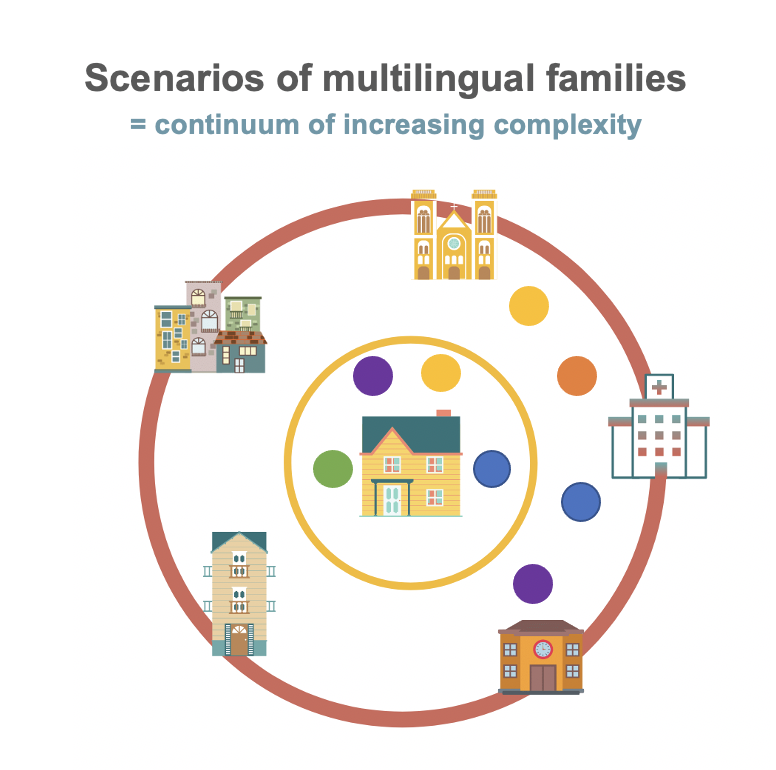
The variety of constellations in multilingual families is huge! I like to think about it as a continuum of increasing complexity. The more languages are involved, the more questions we need to find answers for to make sure to maintain the languages in the most effective and compelling way for us and our children. In the picture here below I use colors instead of labels as I prefer to avoid any kind of hierarchy when it comes to languages, dialects, sign languages etc. used in a family.

Reality check for parents raising multilingual children


Multilingual children who attend a school in another language (scenarios 1, 3, 4, 5) do not become and stay multilingual automatically. What many parents and teachers underestimate is the impact school language has on the children. In order to follow the lessons, they will need to improve their school language skills and they want to speak the same language as their friends at school.

If they are lucky, they receive education in their heritage language to some extent if it is part of the school curriculum. If the school doesn’t provide an intensive program that aims at pluriliteracy, and if their heritage language is not part of the school curriculum the chances for them to attain a native level of fluency (i.e. level C1 or C2 of the CEFR)(²) decrease and many of them won’t become or stay biliterate (or pluriliterate) if they don’t receive consistent additional support.

When parents, schools and communities don’t support the heritage languages to an extent for them to grow alongside the school language, or at least stay active, the proficiency of multilingual children in the heritage languages will most probably decrease. – This phenomenon is called subtractive bi-/multilingualism, as opposed to additive bi-/multilingualism that refers to the case in which someone learns a second language in a manner that enables him to communicate in both languages, without diminishing the skills in the other languages, and where these latter ones are considered as an asset rather than being a hindrance to the learning process.

What many parents are not aware of or underestimate is that transmitting and maintaining the heritage language when living abroad is the main responsibility of the parents: they are the ones who are the agents of multilingual education. They will either take on the task themselves or find weekend schools for their 3-12 year olds. Most weekend schools for minoritized languages offer tuition in the heritage languages up to age 12 or 13. 

Parents need to find strategies that are supportive for the heritage language throughout the whole developmental years of their children and foster reading and writing in teenage years, should pluriliteracy be the goal. But even if understanding and speaking the heritage language is their goal, consistent input is crucial for the children to maintain the language(s) throughout their childhood and beyond, when the community and education language is different.
This entails planning, time and dedication, because at some point, the requirements in the other school subjects will increase and some will consider them more important than the languages. Many families will thus abandon their former language goals concerning the heritage languages in favor of the school language and other subject areas.

What kind of language scenario do you have in your multilingual family?

How do you manage to keep all your languages alive? Please let me know in the comments.

– If you would like to find out what you can do in order to support your children with the heritage language throughout their developmental years, contact me here. Don’t wait until your child is 12 or 13…

(1) I use the term of heritage languages to define the languages spoken by non-societal groups and linguistic minorities in a society, and in given contexts. In this chapter, this term defines the languages that internationally living families speak at home, and, occasionally, outside of their homes if there are respective language communities in the area they are living. A heritage language can be one of their first languages (when they are simultaneous bilinguals) of the parents, or one that is their most dominant language (ex. adopted parents might have grown up with another language than the first one they heard). 

(2) The Common European Framework of Reference for Languages (CEFR) is a valuable reference instrument that can be used to assess language skills. It is available in 40 languages (so far) and gives a general orientation about the skills required for the different levels of fluency. It is advisable to do the assessment with professional help, as the different levels of fluency in speech, reading and writing require some explanation.