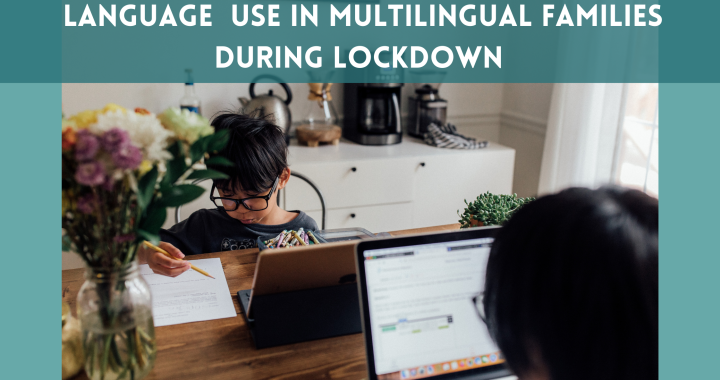
When we all went into our first lockdown due to COVID19 last year, I published a short video for multilingual families who do NOT speak the community language at home, about how to keep up with the school or community languages during lockdown. Especially for very young children who maybe just started daycare, spending more time at home with parents and being more exposed to the home languages, this lockdown maybe caused a “shift back” to the language use they had before attending daycare. Parents asked me how to support their youngest ones to keep up with their language development in the daycare/community language so that they wouldn’t “lack behind” once daycares and preschools would open again.
In my video I shared the following tips for parents:
- how to make sure that our children keep up with the home languages and the daycare/school languages
- how to signalize preschool children when you switch from one language to the other (1:10?-)
- how to make this with school aged children (2:38?-)
- how to help our school aged children improve the vocabulary they are learning in the school language (3:40?-)
- how to collaborate with the school/teachers to make the best out of this situation for your children (4:40?-)
***
A few weeks later, Prof. Ludovica Serratrice from the University of Reading, launched a survey for multilingual families about the use of home languages during the first lockdown in the UK and Ireland, together with colleagues from the Centre for Literacy and Multilingualism at the University of Reading, colleagues from UCL, Oxford, Cambridge, Mother Tongues and We Live Languages.
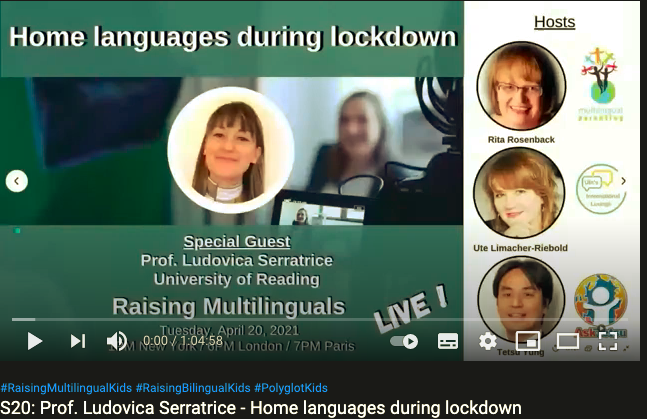
We interviewed Prof. Ludovica Serratrice for our broadcast Raising Multilinguals LIVE! on the 20th April 2021 and I am very thankful that she allowed me to share some insights about her survey.
In this survey they asked families:
– How they use their languages during the COVID19 pandemic?
– What factors* would predict changes in language practices – such as children’s age, children’s existing use of the language use? (* they looked at other predictors including parental education and self-rated proficiency too)
– About the amount of language and literacy practices in English and home languages.
– Whether there had been an increase in children’s opportunity to hear and use the language more during lockdown and to read and write more.
– Whether parents were worried about the effects of lockdown on English.
For the purposes of this project we included families with at least one child between the ages of 0 and 18 who are typically in school or childcare, and who are living together during the lockdown period and the social distancing measures during the COVID19 pandemic.
[As for the definition of who would qualify as multilingual family:]
A family is multilingual if one or more languages other than English are used among family members either on their own or together with English (Prof. Ludovica Serratrice)
They collected answers from 1000 parents, [with around 750ish families presenting valuable data], with 95 different languages whose use of languages in the family were like follows (all data is from Ludovica Serratrice):
Parents:
-
- In 46% of families the parents speak different languages, and in half of the cases it’s because one parent is a monolingual English speaker
- In 36% of families one of the parents speaks English at home.
- In 36% of families both parents speak English at home.
- In 28% of families neither parent speaks English at home.
Children:
-
- 35% only-child families
- Only 6% of children speak only the other language to their siblings
- 46% speak English and other language(s)
- 48% speak only English to their siblings
Demographics of the children: 30% were primary only, 20% preschool only, 19% primary and secondary and 16% secondary only children.
“There was A LOT of variation, more so for the non-English languages – as you would expect”, and “in absolute terms still more activities in English”, Ludovica Serratrice pointed out in the interview and the presentation with MultiLing on the 22 April 2021 (see the video here below).
- For literacy activities in the home language, children read more if they already used that language with the home language-speaking parent.
- When we asked about the increased opportunities to hear and speak the home language more, we found that this was particularly true for pre-schoolers (age effect), and for all children when they were already using the other language with the parent (language match effect).
- For reading (primary and secondary only) we found no differences. The amount was overall quite low anyway and no effect of language match. So, while there was a relationship between amount of literacy activities and language match in absolute terms, there was not a relationship in terms of change. (Ludovica Serratrice)
I personally would have liked to know what effect the lockdown had on the home languages in multilingual families where neither parent speaks English at home (mL@h). Although the effect on preschool children was what we all expected, what was the effect on school aged children? And did siblings who were used to speak the community language to each shift to the home language due to lockdown and the reduced opportunity to speak with peers on a regular basis?
In the UK, many children didn’t have school for a longer period of time – unlike here in the Netherlands, where several schools provided online learning opportunities very quickly. Assuming that they had learned to read and write before lockdown, were children in the UK and Ireland more prone (or willing) to read, maybe write in their home languages? And what about children who were just starting to read and write in the school language and who were now exposed to home languages only: would their parents take the opportunity to teach them to read and write in the home languages during lockdown? What additional support (from extended family, friends etc. via zoom/skype/facetime) did these families have during (and after!) lockdown, and how did this influence their children’s language development? What resources were particularly helpful for multilingual families not only during lockdown, but during this whole last year?
Ludovica Serratrice shared that “lockdown gave parents time and breathing space from the everyday routine, the commute, the many extra curricular activities (e.g. “because lockdown was very strict, the only pleasure that he really was getting were new books through the post”). For some families this was the opportunity to see a “home language explosion” in speaking and for some in reading. Time to read, time to learn to read together. Because online schooling was not that strict during the first lockdown [in the UK and Ireland; Ute] there was just more time in general to dedicate to non-school activities that are typically associated with English.”
It was, obviously, “not possible to measure the children’s language skills directly”, and “by the time we conducted the survey and the interviews not all of them had been back at school. However, parents in the survey were not worried about their children’s English, and children who took part in the interviews had no anxieties about their English either.” – I wonder if a similar survey among internationals in other countries would have had similar outcomes. Especially families who speak multiple languages at home and the community or school language is only spoken sporadically.
For the other languages, patterns didn’t seem to have changed dramatically, especially for speaking and hearing, “but from the interview data we saw that for some children that were already reading in the other language, lockdown was an opportunity to read more (one child read all of the Harry Potter books in German for example).”
This confirms my observations in my own children and my client’s children (all between 1,5 and 18 years old) during and after the first lockdown in the Netherlands, France, Belgium and Italy: they were all more prone to read, find alternative ways to being online (as I guess they all were experiencing some kind of online fatigue already), which had a positive effect on their home language skills – at least this was the subjective observation from their parents.
What about longer lasting effects caused by lockdown on the language development of children in the different age groups?
“The most likely longer lasting changes are with younger children. In cases in which lockdown offered the opportunity for a qualitative change in the pattern of language interaction, e.g. starting to use the other language or using it more, or learning to read, then it could be that if this qualitative shift is preserved, quantitative changes will affect children’s quantity and, potentially, quality of input (e.g. access to literacy, making new friends who are also speakers of their other language) with important consequences for the development of vocabulary and other structural aspects of language.”
What seems like a prolonged holiday effect, might fade though, as “the pull of the societal language is very strong”, and not only for children in secondary school! “Whether this effect will stand the test of time is an empirical question.”
As the pandemic is still not over and many of us have experienced a second and third lockdown, it would be interesting to see how the families are doing now, a year later. After a year of on-and-off from school, where many uncertainties have affected us all to different extent, I wonder how multilingual families who do not speak the school language at home – except for discussing school topics – managed to foster their home languages AND the school languages. Especially because extra curricular language lessons in the home language were not an option for many of us, children had even less input and in some cases were less motivated to continue with any kind of tuition. Furthermore, most children didn’t get to experience their annual full immersion into their home language due to travel restrictions…
I would also be very curious to know how many parents who speak the dominant language (societal language or the language of their children’s education) took the chance to support the minoritized* language during lockdown, knowing that the input in this language would certainly decrease. I know that some parents took this opportunity to participate in activities their partner did with their children in the minoritized language and proudly shared that they improved their language skills thanks to this lockdown situation. – What about parents from the survey who speak English at home? Did they take the opportunity to learn their partner’s language, just a little bit?
While we’re still at home (or at home again!), we can still create meaningful contexts for the use of the home language and make the best out of this situation!
I’d like to end on this final quote from a parent, Ludovica Serratrice shared with me:
“Lockdown really showed the power of necessity and opportunity to me, that you keep reading on multilingualism, necessity and opportunity. And I know I’ve been like one thousand percent consistent in me speaking Italian to her since birth, but it didn’t matter until she really was home.”
– All quotations in the text are from Prof. Ludovica Serratrice.
* I prefer using the term minoritized language instead of minority language, as it emphasizes the active part of the society to make a language “less important than…”, and because every language is dominant somewhere (no matter if on a micro, meso or macro level).
*****
– What is your experience during lockdown: did you observe a language shift in the use of languages in your family?
– How did your school support your children with the school language, and what support did you get for your home languages?
– What resources are / were particularly useful for you / your children to foster your home languages?
I’d love to know. Please let me know in the comments.
Further readings: