
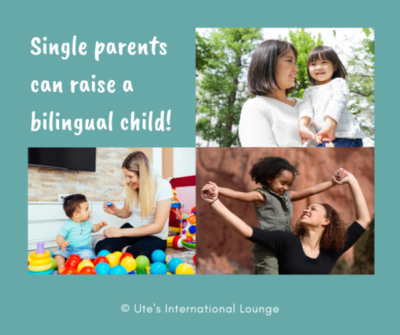
Although most of the literature about bilingual or multilingual children has a traditional family setting in mind, it is about time to focus on other kind of families.
What about patchwork families, part-time families (where one parent lives in another country and the one living with the children is in charge of all the languages), single parents where the partner is present occasionally, and single parents with no partner etc.?
In my workshops and talks I use the term of family in a very broad sense, more with the meaning of “micro-speaking community”. The members of this family don’t need to be present all the time, but they need to be in the picture somewhere, with some consistency to be part of the inner circle.
Even if the father or mother of the child is not part of the every day life of the child, they have a presence that is necessary. Even those who left forever shouldn’t be forgotten – but I won’t focus on family dynamics and all the different possible situations.
Let’s focus on situations where one parent is with the children most of the time and is responsible for all the languages.
First and foremost it is important that this parent has chosen a primary language to speak with the child. This is the language the parents speaks with the child since day one, the language that allows being most spontaneous and to speak about emotions and a very broad variety of topics. This primary language is the one we want to foster the most and that we ideally want our children to use their whole life.
I have explained this more in detail in this video:
Can a single parent raise a bilingual/multilingual child?
The answer is: yes. If we are a single parent and speak both languages, we can opt for a Time and Place (T&P; I like to use the term “time and context”) strategy. Please use this strategy only with “older” children. If our child is too young to understand the concept of time, this strategy might not get the desired results.
What our youngest children do understand very early on is that we can speak one language when we’re alone with the child and the other one in societal contexts, i.e. when speakers of the other languages are with us. Fact is that in those situations we might not always address our child in that “other” language, certainly not if the child was only exposed to this additional language passively, i.e. without people expecting a response from our child.
When the “other” language is the community language this is fairly easy to implement. If the other language is not the dominant language in the community, we need to find a group of speakers to create a “full immersion” situation for us and our child, at least from time to time (some choose Saturdays or Sundays for playgroups, coffee mornings and later on, more guided learning of the language in “weekend schools” – especially if the language is not supported by school and society).
It is a matter of language ideology: which language is more important for us and our child at that moment, and in the context we’re living. What language or languages does our child need to function every day, at home and outside home?
To make an example, if I speak Italian and Swiss-German and live in the Netherlands where I have a great community of Italian speakers, but only a few Swiss-German speakers, I would probably choose to rather speak Italian with my child. If my child needs to be able to communicate in Swiss-German with grandparents I would also try to foster Swiss-German, but the daily need for me and my child would rather be to speak Italian – and the local language, of course…
We only have a limited time per day to foster our childrens’ languages, so, I usually recommend to carefully assess the personal situation in order not to let language acquisition and learning become a burden and too much of a challenge!
A single parent can pass on also a language that he or she is not that fluent in, the same way a non-native speaking parent can raise a child with that “other” language.
One needs to be very aware of what we can achieve when we have different levels of fluency in the languages we want our children to speak – and that they need to learn (make sure to define the “need”!) – There are many other aspects to consider that would take way more space than a (already long!) post like this…
When I get asked if a single parent can raise a bilingual child I always ask questions like:
- What is the reason for you to add this language right now?
- How well do you speak this language?
- Who else, in your community (friends, extended family etc.) speaks that other language?
The answer to the first question might seem obvious as many parents want to pass on the other language as soon as possible. They want to make sure the children acquire and develop the other language, possibly to a high level of proficiency. For multilingual parents this language is also one of their heritage languages. But what about the child’s need to understand, speak, read and write the language? The way our children use and perceive various languages is different from what we experienced.
It is very important to set realistic goals and be honest about ones time and available resources, as consistency is the key. Also, it is important to set clear short and long term goals about all the languages the single parent wants to foster.
Depending on your response to this question, you can choose to either speak both languages from birth (simultaneous bilingualism) or you can start with one language first, and add the second one later (sequential bilingualism).
But first and foremost you need to know what languages your children need. Your answer also depends on the age of your child, the kind of communicator your child is and what stage of their development they are.
In the first months or year, the main focus of language is about forming connections. You use the language to sooth your baby, your little one learns to take turns, connect with you through gestures, behavior and he/she learns that her/his basic needs are met etc.. In this phase it is crucial that you use the language you are most fluent in, you feel most comfortable using as the primary language. Although research clearly states that “children don’t get confused when exposed to multiple languages early on”, these researches are all based on families, not single parents, so they all assume that each parent transmits another language, not that one parent transmits multiple languages…
Children learn that languages can be used to communicate their intentions – requests, protests, rejections etc. – and it is an important part of the childs’ sense of belonging that the language(s) used with him/her are not constantly changing.
The second question does NOT imply that if you don’t speak it at a nearly-native level you won’t succeed… – on the contrary!
Again, we are talking about additional language to transmit to our children. I have seen parents transmit a language they weren’t fluent in at the beginning (A2, B1 level) in a very successful way, as they were committed to improve their language skills whilst speaking it with their children, reading to them and learning to write it. It was a pleasure supporting them because whilst they grow their passion for the other language, they were a true inspiration for their children to do the same! – Never underestimate the power of role models!
The third question is related to the second one, and is particularly important if you want your child to become fluent in the other language and maintain it throughout their life.
If this is your goal, you need a village, a village that speaks this other language and your language, in order to foster them all in a way that is “healthy” and encouraging for your child. I always say you need a multilingual village to raise a multilingual child, therefore, find people in your community, among your friends, find peers, other adults, and maybe family members for your children who speak all the languages you want them to acquire and learn. Especially if one or both of your home languages are not the community language, you will need to find people making it necessary and pleasant for your child to use the languages!
You can speak two or more languages with your children and help them grow up bi/multilinguals, but like with everything else, they need more people to speak these languages with.
What is the role of the partner – if there is one?
If there is a partner present in your child’s life, it is important that they accept and agrees on their role as the person who is responsible for the language.
One important aspect that I can’t stress enough is, that parents – no matter if they are living together or not – need to support their partners’ language! Language can easily become the scapegoat between contending parents and the connection and communication with the child will always be affected.
Our partners should at least try to learn the basics of our language and always (!) be supportive. This behavior doesn’t only reflect positively on the children’s language learning, but it is the healthiest environment for a child to become bilingual in both parents’ languages. This is even more relevant when one or both (!) of the parents’ languages are minority languages in the community the children grow up in. – If you are having troubles of getting your partner agree on this, you are very welcome to contact me.
I have set up a Family Language Plan© for this reason, not only because every family deserves a person tailored solution, but because:
A goal without a plan is just a wish (quoting Antoine de St Exupéry)
It is always helpful to have a common goal and to design clear steps on how to achieve it. In this case it is for the benefit of our children.
Once you have found your answers to my first 3 questions, you may want to find a language strategy that works for you. I won’t list up the many different solutions there are – I mentioned two here above, just as examples, but there are more and they can be combined to support your very personal language situation. I’m always happy to help with finding the most suitable solution, so, don’t hesitate to contact me or leave a comment here below.
One last tip and hint: be prepared to talk, sing and read a lot with your child. If you are not used to talk much, you may find this difficult, but I can promise you that you won’t regret it!
– Are you a single parent raising a child with more than one language?
Then, please, leave a comment here below. I’d be happy to know more about what kind of support, advice you need and I’m very curious to know what works for you and your child.
I invite you to also watch my video about this topic.