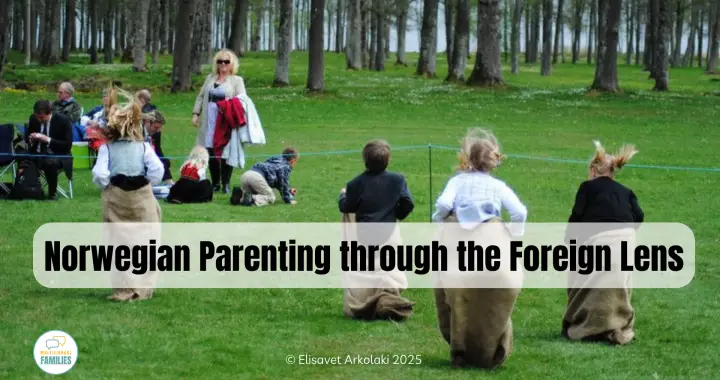
Norwegian Parenting through the Foreign Lens

Parenting styles differ significantly across cultures, and starting a family in Norway or moving there with kids can bring unexpected adjustments. Norwegians are known for their child-centered, independent, nature-focused, and relaxed approach to discipline and parenting. Children are encouraged to explore nature, even in cold weather, and parents often trust them with more freedom than in many other countries. Schools and daycare centers prioritize play-based learning and egalitarian values, fostering a sense of autonomy from an early age. 

This approach might feel unfamiliar to newcomers, but embracing it can lead to a rewarding experience for parents and children. For instance, I was surprised to see six- and seven-year-old children walk alone to school, and I had to learn to trust our children to do the same. My husband is Norwegian, and I often ask him to confirm and reassure me whether something is considered OK here, as many beliefs concerning what is safe and age-appropriate contradict what I’ve learned and experienced in South Mediterranean cultures. 

The kids have so much freedom here; our town feels safe and child-friendly. When people ask me how I find raising kids here, I often reply that it feels like we’re back in time with stuff that matters, like kids being free, independent, and safe outside of the home. We live in the future regarding their education, how they are raised, and how the school and the family work together and take responsibility for children’s well-being and healthy upbringing. Norwegian society feels like a healthy society. 

Here, I’d like to compare Norwegian parenting with other cultural styles and provide tips for adapting.


1. The “Barnehage” Culture: Early Independence

Norwegian children can start attending barnehage (kindergarten) as early as one year old. However, it is not mandatory, and it’s up to the family to decide when to start. The focus here is on play, social skills, and outdoor activities rather than academics. This contrasts with cultures that prioritize early literacy and structured learning.

Tip: If your home culture emphasizes early academics and this is important to you, you can balance it by incorporating some learning activities at home while embracing the Norwegian play-based approach.

2. Outdoor Life: “There’s No Bad Weather…”

Norwegian parents encourage outdoor play and activities in all weather conditions (Friluftsliv mindset). For instance, it’s common practice to let babies nap outside in strollers (up to -10 C), and that also applies to daycares and kindergartens. Parents in warmer climates or cultures tend to be more cautious about weather exposure.

Tip: Invest in proper outdoor gear for your child and join other parents in local parks or nature outings.

3. Trust and Freedom: “Barn Må Få Prøve Selv” (Children must try for themselves)

Norwegian parents encourage independence from an early age; kids climb trees, use knives, and even walk to school alone. This “free-range” approach also applies to daycare and school teachers, and it fosters resilience and problem-solving skills. Parents tend to be more protective or involved in children’s daily activities in many other cultures. 

Tip: Start with small steps, like allowing your child to make decisions or handle simple responsibilities independently.

4. Work-Life Balance: Family Time Matters

Norway offers generous parental leave and flexible work schedules, in contrast with countries where long working hours may limit family time. Norwegian families prioritize hygge (cozy time together) in the evenings and weekends.

Tip: If you come from a fast-paced culture, try slowing down and embracing quality family moments over quantity of activities.

5. Discipline and Conflict Resolution: Calm and Respectful Parenting

Norwegians generally avoid yelling or harsh discipline; they use calm reasoning and positive reinforcement. There’s a focus on likestilling (equality), where children’s voices are valued in decision-making. Family decisions are often taken together with the kids and the kids have a say on matters that affect their everyday lives. This comes in contrast with cultures that may have a more authoritative or hierarchical parenting approach.

Tip: Observe and socialize with Norwegian parents and adopt techniques that work for your family.

Every culture has strengths, and adapting doesn’t mean giving up your own parenting style. The ideal scenario is that, with time, you can blend what works best for your family while respecting Norwegian norms. For me, the most challenging part was to learn how to manage my stress level and fears over the kids’ physical safety, and I’m still working on it. What helped me was to try and anchor my mind on rational thoughts like the following: since so many generations have been raised here this way, my own cultural beliefs and experiences make me think that safe experiences might be unsafe. My limiting beliefs should not be limiting my kids’ lives and journey towards independence and a fulfilling life, and that changed everything. 


Yes, Neurodivergent Children Can Be Multilingual!

Neurodivergence is a widely discussed topic today, and efforts are underway to adapt social and educational environments – traditionally designed for neurotypical children – to be more inclusive. One of the key goals of inclusive education is to adjust tasks and activities so that neurodivergent children can fully participate. However, embracing neurodiversity goes beyond accommodation; it means accepting, celebrating, and supporting neurodivergent children as they are. Their differences are part of natural human variation and do not need to be fixed or changed.


Who are neurodivergent kids?

Neurodivergence refers to people who process information in a way that is not typical for their age. About 1 in 5 children have variations in their brain development. These variations include those seen in attention deficit hyperactivity disorder (ADHD), autism spectrum disorder (ASD), developmental language disorders (DLD) and learning disorders such as dyslexia, dyscalculia and dysgraphia.

Early diagnosis of neurodivergence is not always easy to make and it partly depends on the place where you live. In France, for example, dyslexia and ADHD assessments are generally carried out around the age of 7, but early signs can be seen as early as 3 years old. In Italy, autism can be roughly detected as early as 18 months old, but diagnosis is officially made from around 3-4 years old, while in the UK the average age of assessment is around the age of 5. DLD assessments are generally made around 5 years old, even though some signs of it can be recognizable before that age.

When multilingual parents suspect their child might be neurodivergent, they often worry that speaking two or more languages could negatively affect language development. While many neurodivergent profiles involve challenges with language or learning, research in recent decades has explored whether growing up with multiple languages could be harmful, and the evidence increasingly suggests it is not.

Autism spectrum disorder (ASD)

Language acquisition is generally challenging for autistic children. But recent studies show that multilingualism does not harm the development of autistic children. A recent study (Petersen et al., 2012) found that bilingual autistic children had similar English vocabulary to monolingual peers. Another study (Ohashi et al., 2012) found that multilingualism does not hinder social or pragmatic skills.

In fact, multilingualism may even provide some cognitive benefits. Autistic children growing up with two languages demonstrate better inhibition, cognitive flexibility, and perspective-taking, which are key skills for social interaction (Romero et al., 2024). For multilingual families, using the heritage language also helps maintain family connections and prevents social isolation of autistic children.

Attention Deficit Hyperactivity Disorder (ADHD)

Weaknesses in executive function have consistently been associated with Attention Deficit Hyperactivity Disorder (ADHD), whereas bilinguals have often been found to demonstrate advantages in executive functioning. Although some research has explored how bilingualism affects cognitive skills and behavior in individuals with attention deficits, the question remains far from settled.

Both bilingualism and ADHD are generally linked to weaker vocabulary knowledge. However, they tend to have opposite effects on executive control. ADHD appears to interfere more with executive functioning in bilinguals than in monolinguals, suggesting a greater cognitive burden for bilingual individuals with ADHD (Bialystok et al., 2017). Bilingualism may pose an additional challenge for adults with ADHD, potentially leading to reduced executive functioning (Mor, Yitzhaki-Amsalem, & Prior, 2015).

Recent studies have shown no clear negative effects of bilingualism on children with ADHD, though researchers acknowledge that further investigation is needed to determine which, if any, aspects of bilingualism contribute to individual variability (Sharma et al., 2022).

The limited number of available studies offers no consistent evidence that bilingualism either alleviates or worsens attention-related difficulties in adults or children with ADHD. Given the current state of research, individuals with ADHD and their families should not be concerned that learning multiple languages negatively impacts cognitive functioning or performance (Köder et al., 2022).

Development Language Disorders (DLD) & Dyslexia

A child with DLD manifests difficulties both in comprehension and in production of complex syntactic structures, with weaker phonological, morphological and lexical skills (Leonard, 2014). To date, there is no evidence that multilingualism may worsen DLD difficulties in acquiring languages. Bilinguals with DLD do not have difficulties separating languages and do not show confusion (Gutiérrez-Clellen, Simon-Cereijido, Wagner, 2008). Bilingual children with DLD show difficulties in both languages. Those difficulties are manifested in different ways depending on the language. For example, Italian DLD children have problems mastering pronouns also around the age of 5-6 (Bortolini et al., 2006). A DLD child would answer to the question “cosa fa la bambina al nonno?” (what does the girl do to the grandfather?) “bacia” (she kisses) or “bacia il nonno” (she kisses the grandfather) just to avoid the use of the pronoun “lo” (him). Instead, English DLD children do have more problems to master verb inflections. For example, they may say “she sing” instead of “she sings”.

One in ten people are dyslexic, and dyslexia is considered the most common of all neurodevelopmental disorders. For both DLD and dyslexia, more and more studies show that bilingualism doesn’t exacerbate speech and the learning disorder. On the contrary, some research suggests that bilingualism can be beneficial by promoting compensatory strategies that support language learning.


Does Bilingualism Harm Neurodivergence? NO!

Studies show that depriving a neurodivergent child of one of their languages does not negatively affect their majority language. On the contrary, the psychological consequences of depriving a child of their mother or father tongue could impact all the family harmony. Growing up with two or more languages may not only offer cognitive advantages such as improved flexibility in thinking, but also social benefits, such as stronger family and extended family bonds and cultural connections with the parent’s country of origin.

Multilingualism is not a risk factor for neurodivergent children. With appropriate support, they can thrive in multilingual environments just like neurotypical children.

Brief conclusions

  • Yes, neurodivergent children can absolutely learn two or more languages. Research over the past two decades has consistently shown that being neurodivergent does not prevent a child from becoming bilingual or multilingual.
  • Neurodivergent children may experience delays or differences in language development, but these are related to their neurodevelopmental condition, not to the number of languages they are exposed to.
  • What’s most important is consistent and rich exposure to both (or all) languages, as well as tailored support that respects the child’s learning profile.
  • Parents and educators should not feel pressured to drop a home language. Maintaining it is often crucial for family connection and emotional wellbeing.


Bibliography:

Bialystok, Ellen, et al. “Interaction of bilingualism and attention-deficit/hyperactivity disorder in young adults.” Bilingualism: Language and Cognition 20.3 (2017): 588-601.

Bortolini, Umberta, et al. “Clinical markers for specific language impairment in Italian: the contribution of clitics and non‐word repetition.” International journal of language & communication disorders 41.6 (2006): 695-712.

Gutiérrez-Clellen, Vera F., Gabriela Simon-Cereijido, and Christine Wagner. “Bilingual children with language impairment: A comparison with monolinguals and second language learners.” Applied psycholinguistics 29.1 (2008): 3-19.

Köder, Franziska, et al. “The effects of bilingualism on cognition and behaviour in individuals with attention deficits: A scoping review.” Frontiers in Psychology 13 (2022): 1057501.

Leonard, Laurence B. “Children with specific language impairment and their contribution to the study of language development.” Journal of child language 41.S1 (2014): 38-47.

Mor, Billy, Sarin Yitzhaki-Amsalem, and Anat Prior. “The joint effect of bilingualism and ADHD on executive functions.” Journal of attention disorders 19.6 (2015): 527-541.

Ohashi, J. Kaori, et al. “Comparing early language development in monolingual-and bilingual-exposed young children with autism spectrum disorders.” Research in Autism Spectrum Disorders 6.2 (2012): 890-897.

Raineri, Alessia. Un bambino multilingue. Studio longitudinale sull’acquisizione dell’italiano, del neerlandese e del francese di un bambino dislessico a contatto con più di tre lingue dalla nascita. Diss. University of Zurich, 2023.

Romero, Celia, et al. “Multilingualism impacts children’s executive function and core autism symptoms.” Autism research 17.12 (2024): 2645-2661.

Sharma, Curtis JM, Napoleon Katsos, and Jenny L. Gibson. “Associations between bilingualism and attention-deficit hyperactivity disorder (ADHD)-related behavior in a community sample of primary school children.” Applied psycholinguistics 43.3 (2022): 707-725.

Petersen, Jill M., Stefka H. Marinova-Todd, and Pat Mirenda. “Brief report: An exploratory study of lexical skills in bilingual children with autism spectrum disorder.” Journal of autism and Developmental Disorders 42 (2012): 1499-1503.

We invite you to watch the interview with Alessia Raineri PhD, about Developmental Language Disorders and Dyslexia in Multilingual Children:

The Spectrum of Multilingualism – Part 3: Is Multilingualism a Gift or a Superpower?

Multilingualism is often celebrated or emphasized as a gift or a superpower. While such descriptions emphasize the advantages of using multiple languages and are sometimes necessary when talking with people who adamantly consider multilingualism something that needs to be “fixed”, and multilinguals like people having some kind of a deficit, they can also mislead people to falsely assume and expect it to be easy. 

Multilingualism is not something bestowed upon us effortlessly; it is an achievement requiring dedication, consistency and often, strategic planning.

Multilingualism is less about innate abilities or luck and more about effort, opportunity, and commitment.


Multilingualism is a Skill – Not a Gift

The metaphor of multilingualism as a gift suggests an inherent quality, something that is either innate or that requires a talent and one receives without effort. However, research shows that language acquisition, whether for a first language (L1) or languages (L1a, L1b) or subsequent languages (L2, L3, Ln etc.), is an active process involving cognitive, emotional, and social engagement.

The Role of Effort and Strategy

Children growing up in multilingual families often acquire multiple languages simultaneously. This does not mean the process is automatic. Parents and caregivers play a crucial role by creating environments rich in linguistic diversity. Language Strategies require consistency and long-term commitment. According to Barron-Hauwaert (2011), successful multilingual families often invest considerable time and energy in maintaining language use across various contexts.

For adults, learning a new language involves even greater effort. Theories like Krashen’s Input Hypothesis (1985) highlight the importance of meaningful exposure to comprehensible input. However, exposure alone is insufficient; deliberate practice and active usage are essential components for achieving fluency.


The Myth of Multilingualism as a Superpower

While being multilingual provides cognitive and social advantages, describing it as a superpower can oversimplify the challenges involved. Multilinguals often face unique difficulties, such as:

  • Language interference: Managing different linguistic systems often leads to code-switching or code-mixing, which, though natural in the language acquisition and learning process of multilinguals, can be perceived negatively in some contexts (Poplack, 1980) and, therefore, cause frustration in parents, teachers and other professionals working with multilingual children.
    • Understanding that language interference is a common phenomenon and process that happens whenever languages are in contact, helps to focus on the important insights we can gain by observing how multiple languages intersect and interfere with each other in individual learners – the same way we can observe language interference and change when languages are in contact in societies and communities.
  • Language attrition and shift: Without consistent practice, even proficient speakers can lose fluency in a language over time.
    • Instead of considering language attrition or shift a sign of failure and an “indication for imminent language loss”, it should encourage to take action. We can always reactivate languages that have moved to the background, i.e. that we haven’t actively used for a while. By experiencing the language in a variety of contexts and in a multi-modal way, the motivation to use the language will increase and the language will shift in the foreground again (i.e. Dominant Language Constellation)

These challenges underscore the effort required to maintain multiple languages. 

Multilingualism is not a magical ability but a skill honed through practice and consistency.


Opportunities and Access Matter

Multilingualism often results from opportunities and access rather than inherent talent. For instance, children in multilingual families or communities are exposed to multiple languages from an early age, providing a natural advantage.

However, (early) exposure alone does not guarantee success! The quality and consistency of linguistic input play critical roles in language development (De Houwer, 2009). This means that children need to be involved in meaningful conversations in the target language, they need to learn the BICS and, if possible, also the CALP and CALS, to attain a high level of proficiency, should this be the goal.

We can compare this situation to monolingual individuals who choose to learn additional languages as adults: they also need to seek out opportunities – through exposure, active interactions, formal education, online resources, travel etc. – and commit to regular practice!

These efforts highlight the agency and intentionality behind becoming (and staying!) multilingual.


The Sociocultural Dimension

Multilingualism is also shaped by sociocultural factors. In some communities, speaking multiple languages is a necessity for survival or integration. For instance, migrants often learn the dominant language of their host country to navigate work, education, and social life while maintaining their heritage languages at home.

On the other hand, societal attitudes toward multilingualism can influence individual motivation. Environments that value linguistic diversity encourage individuals to maintain and develop their language skills. Conversely, societies or environments (at work or at school) that prioritize monolingualism or are geared towards the use of one – more dominant = more important (!) language – usually discourage the use of minority languages, leading to language shift, attrition or even loss (Fishman, 1991).

The Cognitive and Emotional Investment

The cognitive benefits of multilingualism – such as enhanced executive function and problem-solving skills – are well-documented (Bialystok, 2001). However, achieving and maintaining multilingual proficiency requires significant mental effort. Multilinguals constantly adapt to different linguistic and cultural contexts, exercising their brains in unique ways.

Emotionally, the journey of maintaining multiple languages can be challenging. Feelings of frustration, embarrassment, or inadequacy often accompany language learning and use, particularly in high-stakes situations. Multilinguals must navigate these emotional landscapes while persevering in their language goals.


Celebrating Multilingualism as an Achievement

Recognizing multilingualism as an achievement rather than a gift or a superpower reframes the narrative. It highlights the agency, determination, and hard work involved in acquiring and maintaining multiple languages. This perspective also validates the efforts of parents raising multilingual children, educators fostering language diversity, and individuals learning new languages.

Moreover, acknowledging multilingualism as an achievement empowers people to take ownership of their linguistic journeys. It encourages a growth mindset, emphasizing that language skills can be developed at any stage of life with the right strategies and support.

If we want to emphasize the advantages of becoming, being and staying multilingual, we can look beyond language proficiency. The cognitive and cultural skills it entails opens doors to diverse perspectives and fosters meaningful connections across cultures. Multilingualism can also be considered as an invaluable toolkit for life, which enriches our worldview and empowers us to navigate multi-faceted opportunities with confidence. Whether we call it a bridge to opportunities or a lifelong resource, being multilingual equips individuals with unique skills to adapt, connect, and thrive worldwide.


Conclusion

Describing multilingualism as a gift or superpower may inspire admiration and serve as a counterpart that balances out all the negative and deficit messages around it, but it risks downplaying the effort, planning, and perseverance involved.

Multilingualism is not an accident of birth or a natural talent that either you got gifted with or not; it is a skill nurtured through deliberate action and sustained commitment. By shifting or at least by balancing the narrative, we can celebrate the hard work behind becoming, being and staying multilinguals across the lifespan, and inspire others to embark on this same journey. However, the ability to use multiple languages can be considered a superpower for all the advantages and benefits mentioned above. 


References

  • Barron-Hauwaert, S. (2011). Bilingual Siblings: Language Use in Families. Multilingual Matters.
  • Bialystok, E. (2001). Bilingualism in Development: Language, Literacy, and Cognition. Cambridge University Press.
  • De Houwer, A. (2009). Bilingual First Language Acquisition. Multilingual Matters.
  • Fishman, J. A. (1991). Reversing Language Shift: Theoretical and Empirical Foundations of Assistance to Threatened Languages. Multilingual Matters.
  • Krashen, S. (1985). The Input Hypothesis: Issues and Implications. Longman.
  • Poplack, S. (1980). “Sometimes I’ll start a sentence in Spanish y termino en español: Toward a typology of code-switching.” Linguistics, 18(7-8), 581–618.