
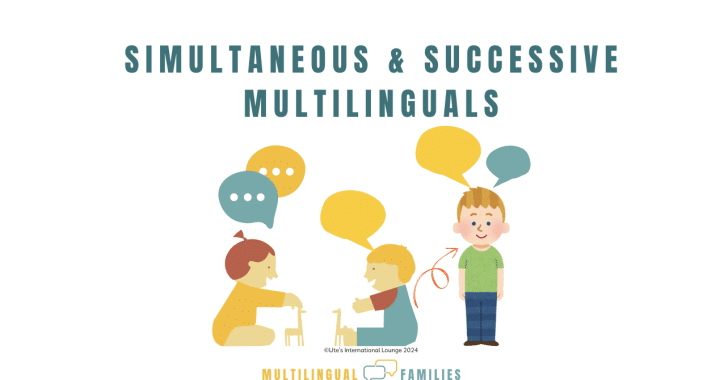
When parents speak more than one language it can be difficult to choose whether to introduce both or all of the languages from birth, or to rather wait until the children’s skills in one language have become established before introducing the second (or additional) language(s). In this post I use the terms simultaneous and successive or sequential bilinguals because research uses these terms mainly with children who are acquiring and learning two languages at an early stage. There are not comparable studies about multilinguals, i.e. children who acquire and learn more than two languages from birth (simultaneous multilinguals) or learn additional languages early on (before age 3 or 5).
Simultaneous bilinguals acquire a first and second language concurrently.
This means that two or more languages are acquired from birth or very early on. Simultaneous bilinguals will usually develop native-like proficiency in both languages in the most natural and spontaneous way, through being exposed to two (or more) languages regularly since day one, or very early on – before age 3 – and in one on one interactions or conversations, using child directed speech. The children’s early exposure helps them master subtle phonological features effortlessly.
Sequential or successive bilinguals, on the other hand, learn a second language after establishing their first, so, rather after age 3 or between age 3 and 5, when they start daycare or school in the additional language. This is also known as Early Second Language Acquisition (Annick De Houwer 2009).
Successive bilinguals benefit from a solid foundation in their first language, which helps them transfer literacy and academic skills to the new language. Furthermore, they develop metalinguistic awareness, an ability to analyse and compare language structures, leading to profound linguistic insights.
Important to know:
Most studies about school aged children are based on successive bilinguals, and practices and interventions are geared at supporting these children’s learning the school language with the support or through their home language(s), or based on the skills already acquired in their home language.
With the terms of simultaneous and successive bilinguals, the focus is mainly on the age of acquisition: which is either before the children receive formal instruction or starting from when they receive formal instruction in the additional language (generally after age 3 or between age 3 and 5, when they start daycare or school).
– Please read also the post about Compound, coordinate and subordinate multilinguals.
And watch my video about the different types of multilinguals:


Ute Limacher-Riebold
Ute Limacher-Riebold, PhD, is the founder of Multilingual-Families.com and Owner of Ute’s International Lounge & Academy.
She empowers internationals to maintain their languages and cultures effectively while embracing new ones whilst living “abroad”.
She grew up with multiple languages, holds a PhD in Romance Studies and has worked as an Assistant Professor at the University of Zurich (Department of Italian Historical Linguistics). She taught Italian historical linguistics, researched Italian dialects and minority languages, and contributed to and led various academic projects.
Driven by her passion for successful language development and maintenance, and personal experiences with language shifts, Ute supports multilingual families worldwide in nurturing their languages and cultural identities in the most effective and healthy way.
Pingback: Single parents can raise a bilingual child - Ute's International Lounge