

[updated: 26.6.2026]
How do bilingual/multilingual children develop language in the first years of life?
And when should parents be concerned and when should they simply trust the process?
Research consistently shows that bilingual and multilingual children follow the same fundamental path of language development as monolingual children. They go through similar stages: early communication, babbling, first words, word combinations and the gradual development of grammar.
At the same time, multilingual development is shaped by the child’s unique linguistic environment: the quantity and quality of language input, the emotional experiences connected to each language, the relationships in which languages are used, and the opportunities children have for meaningful interaction.
As linguist Ludovica Serratrice explains, becoming bilingual involves a complex interaction between children’s natural language-learning abilities and the social, cultural and linguistic environments in which they grow up:
“Becoming bilingual, whether from birth or soon after, or subsequently in early childhood prior to schooling, entails a complex interaction between what children bring to the learning task, that is, among others, speech segmentation skills, speed of processing, and the linguistic and cultural environments in which they grow up.”
(Serratrice, 2019)
Recent research by Annick De Houwer further confirms an important message for multilingual families:
Bilingual and multilingual children are not delayed simply because they are learning more than one language.
Their development may look different from that of monolingual children, but difference does not mean delay.
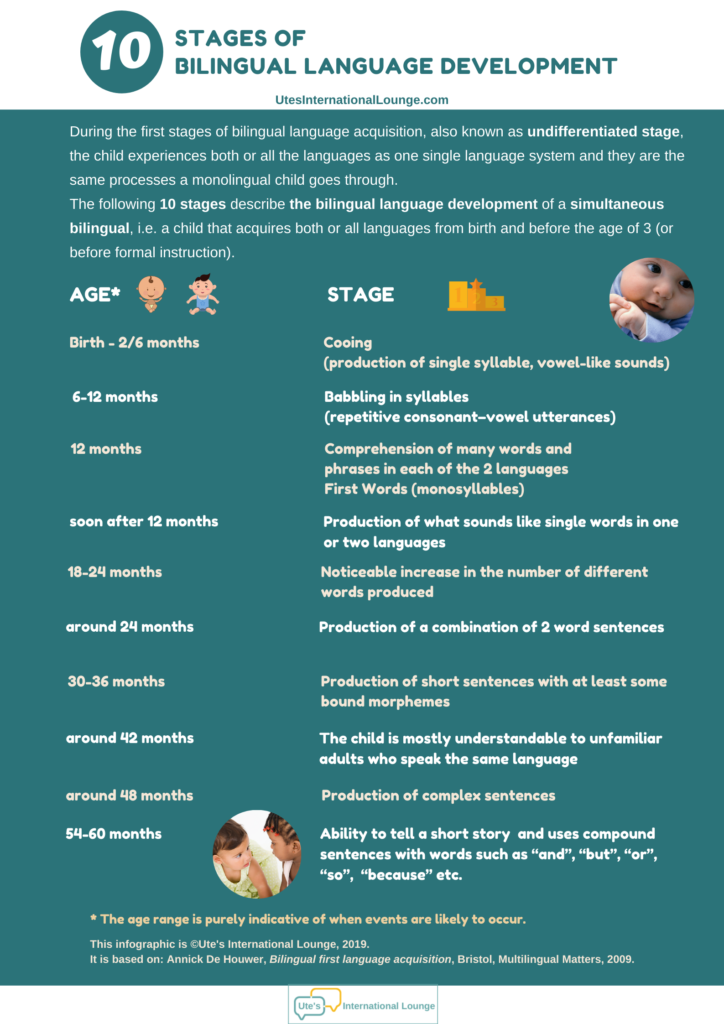
This infographic presents 10 general stages commonly observed in simultaneous bilingual and multilingual children — children who are exposed to two or more languages from birth or early childhood, before formal schooling.
These stages are not a checklist that every child follows in exactly the same way. They are a developmental guide that helps parents and professionals understand common patterns in multilingual language acquisition.
What we know about multilingual language development
Research highlights several important principles:
Children can develop more than one language system from the beginning.
Exposure to multiple languages does not confuse children. Their brains are highly capable of identifying patterns and building knowledge in different languages.
Multilingual children may distribute their vocabulary across languages.
A child who knows a word in one language and another word in a second language may have a larger total vocabulary than is visible when only one language is counted.
Development is rarely perfectly balanced.
Many multilingual children have a stronger and a weaker language at different stages of childhood. This is normal and often reflects their experiences and opportunities to use each language.
Quantity and quality of input matter.
Children need meaningful interactions, conversations, play, stories and emotional connections in their languages. Language grows through relationships.
The social value of a language influences language maintenance.
Children are more likely to continue using a language when they experience it as meaningful, valued and connected to important people in their lives.
Language mixing is part of multilingual development
Many parents worry when children mix languages.
However, using words from different languages in the same conversation is a normal part of bilingual development.
It does not mean that children are confused.
Instead, they are using their complete linguistic repertoire to communicate. Multilingual children learn not only languages, but also how to adapt their communication to different people and situations.
When should parents be concerned?
Multilingual development is not a race.
Children develop at different rhythms, and variation is a normal part of language development.
Parents should not compare a multilingual child’s one language with the total language ability of a monolingual child.
Instead, look at the whole child:
- Do they communicate their needs and ideas?
- Do they understand the languages they hear?
- Do they interact socially?
- Do they continue making progress over time?
If there are concerns, it is important that a child’s complete linguistic background is considered. Assessment of multilingual children should include all their languages whenever possible.
Trust the process — and observe with curiosity
The first babbling, first words, first jokes, first stories and first conversations in every language are important milestones worth celebrating.
Multilingual development is a journey shaped by relationships, experiences and opportunities.
This infographic is therefore intended as a guideline, not as a diagnostic tool.
Observe your child’s communication with curiosity rather than anxiety. Every multilingual child develops in their own way.
As a linguist and specialist in multilingual language development, I support families in distinguishing between normal multilingual development and signs that may require additional assessment or support.
When needed, I also recommend collaboration with speech and language therapists, audiologists, psychologists or other professionals.
Don’t hesitate to book a consultation with me.
Quantity and quality of language input are strong predictors of children’s early lexical skills, and these are closely related with emerging grammatical skills.
Further reading:
De Houwer, A. (2009). Bilingual First Language Acquisition. Multilingual Matters.
De Houwer, A. (2024). Language Development Milestones for Bilingual and Monolingual Children. Babylonia Journal of Language Education. 3. 14-17.
Serratrice, L. (2018). Becoming Bilingual in Early Childhood. in A. De Houwer and L. Ortega, The Cambridge Handbook of Bilingualism. CUP. 15-35.
Kohnert, K. (2010). Bilingual children with primary language impairment: issues, evidence, & implications for clinical actions. Journal of Communication Disorders 43. 456-473.

Ute Limacher-Riebold
Ute Limacher-Riebold, PhD, is the founder of Multilingual-Families.com and Owner of Ute’s International Lounge & Academy.
She empowers internationals to maintain their languages and cultures effectively while embracing new ones whilst living “abroad”.
She grew up with multiple languages, holds a PhD in Romance Studies and has worked as an Assistant Professor at the University of Zurich (Department of Italian Historical Linguistics). She taught Italian historical linguistics, researched Italian dialects and minority languages, and contributed to and led various academic projects.
Driven by her passion for successful language development and maintenance, and personal experiences with language shifts, Ute supports multilingual families worldwide in nurturing their languages and cultural identities in the most effective and healthy way.
Hi, I am very curious about when a child typically becomes aware of the concept of two separate languages. I cannot find much information on this, but wonder if you have experience with it being around a certain time or varying completely. ? Thanks!
Hi Abby, that is a very good question and, indeed, some children become aware of this earlier than others. I’d use the term “conscious” that Maria Montessori already used and that is also used in neuroscience. Children become more conscious about everything around them around age 2, or better: between age 2 and 4. It is not something that happens over night, it is rather an increase of consciousness that you can observe in all domains of life. They might be more cautious in moving, in talking, in reacting to things or trying new things. You probably noticed yourself that around 2-3-4 years (it really varies a lot ! ) when children start asking more questions and become more skeptic and cautious about everything. Maria Montessori distinguished between the “unconscious mind” (babies – toddlers/ around 2-3-4 years of age) and the “conscious mind” of older children. I hope this helps a bit?