For parents, especially in multilingual families, one of the biggest challenges is deciding how to support our children with homework. Should we help them in our home language, or should we stick to the school language? This is particularly tricky when it comes to STEM subjects. If you’re facing this dilemma, you’re not alone!
The Struggle is Real
When my children started school in English – a language different from those we used at home and in the community – I faced the same challenges many of you are experiencing. Maths and science concepts, new vocabulary, and reasoning were all things I had to figure out how to help them with. What I realized quickly was that bridging between school and home languages, especially in subjects like maths, is more complex than it seems. Many parents and teachers may not fully understand how to balance supporting home languages while also ensuring children succeed academically in the school language.
Why Translating Doesn’t Always Help
It can be tempting to translate everything into our home language when helping our children. I tried this approach myself but soon noticed it wasn’t as effective as I had hoped. My children often became frustrated, disengaged, and overwhelmed. Juggling two or three languages during homework sessions added unnecessary complexity.
It turns out that it’s often better for children to reason and explain things in the language they learned it in – usually the school language. This not only helps them grasp the subject matter more effectively, but it also builds confidence in the academic language they will need to use in school (Cummins, 2000).
Build a Strong Academic Foundation with the School Language First
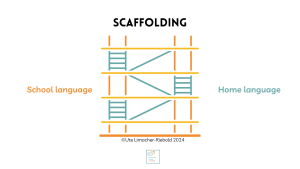
Research shows that multilingual children benefit from developing subject-specific skills, such as mathematical reasoning, in the school language. This process is called scaffolding. Imagine scaffolding as the structured support we provide while our children are building their understanding of new concepts. In this case, the school language acts as the first scaffold that allows children to problem-solve and analyze effectively (Gibbons, 2002). Once they’ve grasped the concept in the school language, we can introduce home language terms to deepen their understanding.
Why It’s Important to Follow Their Lead
One key tip is to follow our children’s lead and let them choose the topics they are most interested in. These topics are the ones they’re more likely to want to talk about in our home language. For example, if our child is working on a math problem, we allow them to reason through the problem in the school language first. They need to understand the question, analyze it, and explain their thinking. Translating everything into the home language can slow down this process and sometimes even confuse them. According to François Grosjean (2010), multilinguals don’t automatically translate everything they learn in one language into another—they store that knowledge in the language they learned it in.
The Complexities of Subject-Specific Language
It’s also important to understand that while children may be fluent in speaking their home languages, they often lack subject-specific vocabulary, especially in areas like maths and science. Once they are confident in explaining concepts in the school language, they might be ready to transfer that knowledge to the home language – but this is not a given!
The time it takes for a child to transfer understanding from the school language to the home language depends on many factors, including their comprehension level, fluency in both languages, and whether they feel the need or desire to do so (Genesee et al., 2004).
The Power of Code-Mixing
What’s likely to happen as our children become more comfortable with STEM subjects is that they’ll switch between languages and code-mix, i.e. insert words from the school language into the sentences in their home language. Code-mixing is a sign of cognitive flexibility and is perfectly normal for multilingual learners. It shows that our children are processing complex information using all the linguistic resources available to them. However, it’s also an indication that they are still learning the terms, and they’ll need to use these terms in various contexts to master them in both languages (Bialystok, 2011) with confidence.
Using Visual Aids as a Support Tool
One way to scaffold learning without relying too much on language is by using visual aids. Diagrams, charts, or hands-on models help children grasp concepts visually, making it easier for them to understand without needing everything explained in words. This is particularly helpful when it comes to explaining maths and science concepts. For example, when teaching geometry, you can use objects around the house to demonstrate shapes and angles. Visual aids work wonders for children of all ages and can be an excellent tool for multilingual learners (Gibbons, 2002).
Scaffolding: Support, Then Independence
Remember, the goal is to provide just enough support to help our children understand, then step back and allow them to work independently. Over time, our children will become more confident in explaining these concepts in both the school language and the home language – if they choose to do so. It’s crucial to follow their pace and not impose an expectation to master everything in all languages.
In Summary: Scaffolding is Key
When supporting our multilingual children with homework, especially in STEM subjects, it’s essential to start by scaffolding their learning in the school language. This ensures they build confidence in academic settings. Once they grasp the concepts, we can introduce home language terms to reinforce their understanding also in the language they use with us. If we consistently scaffold from the school language to the home language, children will develop strong, flexible thinking and language skills, which will serve them well in all areas of life.
A Flexible Approach
Finally, remember that every child is different, and there’s no one-size-fits-all approach to supporting multilingual learners. Some children may quickly transfer knowledge between languages, while others may prefer to keep their academic and home languages separate. The key is to offer support, follow their lead, and provide opportunities to practice and explore topics in multiple languages – if and when they’re ready.
Bibliography:
- Bialystok, E. (2011). Reshaping the Mind: The Benefits of Bilingualism. Canadian Journal of Experimental Psychology.
- Cummins, J. (2000). Language, Power, and Pedagogy: Bilingual Children in the Crossfire. Multilingual Matters.
- Genesee, F., Paradis, J., & Crago, M. B. (2004). Dual Language Development and Disorders: A Handbook on Bilingualism and Second Language Learning. Brookes Publishing.
- Gibbons, P. (2002). Scaffolding Language, Scaffolding Learning: Teaching Second Language Learners in the Mainstream Classroom. Heinemann.
- Grosjean, F. (2010). Bilingual: Life and Reality. Harvard University Press.
I invite you to watch my video about this topic:

Ute Limacher-Riebold
Ute Limacher-Riebold, PhD, is the founder of Multilingual-Families.com and Owner of Ute’s International Lounge & Academy.
She empowers internationals to maintain their languages and cultures effectively while embracing new ones whilst living “abroad”.
She grew up with multiple languages, holds a PhD in Romance Studies and has worked as an Assistant Professor at the University of Zurich (Department of Italian Historical Linguistics). She taught Italian historical linguistics, researched Italian dialects and minority languages, and contributed to and led various academic projects.
Driven by her passion for successful language development and maintenance, and personal experiences with language shifts, Ute supports multilingual families worldwide in nurturing their languages and cultural identities in the most effective and healthy way.