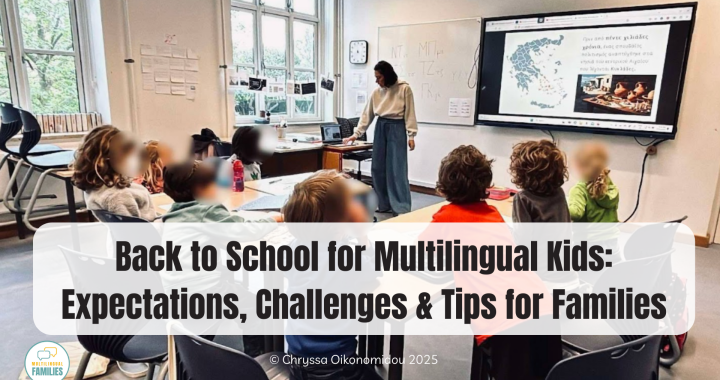
Back to School for Multilingual Kids: Expectations, Challenges & Tips for Families

September doesn’t just mean sharpened pencils and new routines, for multilingual children back to school often comes with extra layers of adjustment.

Back to School for Multilingual Kids

Starting school after the summer break is a transition for every child. For multilingual children, it may also involve:

  • Switching between languages: Some children may have spent the summer immersed in their heritage language with family, while school requires them to shift back into the majority language.


  • Navigating expectations: What’s expected in school might feel different from what’s expected at home in terms of both language and cultural practices.


  • Balancing identities & friendships: Back to school also means reconnecting with friends and making new ones. For multilingual children, this can bring both opportunities (sharing their background, building confidence) and challenges (feeling different, finding the right words in the right language).


Tips for Parents

  1. Maintain routines: Predictability helps children feel safe and grounded.


  2. Create space for stories: Invite your child to share their school experiences in any language they choose.


  3. Partner with teachers: Let them know your child’s multilingual background and how it can enrich the classroom.


  4. Celebrate progress: Small wins in any language deserve recognition!


Don’t Forget Heritage Languages

While school strengthens the majority language, heritage languages often need intentional support. Attending a heritage language school or playgroup can make a big difference: children not only maintain their language skills but also connect with peers who share their background.

👉 Explore our worldwide list of Heritage Language Playgroups & Schools to see if there’s one near you.


Final Note

Back to school is both exciting and challenging. For multilingual children, it’s an opportunity to grow in confidence, flexibility, and cultural pride. With parental support and community resources, this journey can become a source of strength for the whole family!

Would you like more detailed tips on how to support your child and family through new school routines and languages? 


You can also read Ute Limacher-Riebold’s article here: New School – New Routine – New Language

Why your child doesn’t speak all languages equally

When families live abroad and raise their children with multiple languages, their experience rarely follow a linear path. Parents often tell me “My child spoke only German at home, but after starting school in France, suddelny French took over”, or “After a summer with grandparents, my children’s Italian became much stronger again, but then it faded once school resumed”.

What these parents observe is exactly what the Dynamic Model of Multilingualism (DMM), developed by Herdina & Jessner (2002), helps us understand: multilingualism is not static, nor is it just a sum of several separate languages. Instead, it is a living, dynamic system, constantly adapting to new contexts, relationships and identities.

In this post I want to unpack the DMM, connect it with the lived reality of multilingual families abroad, and show how it can help us reframe temporary regressions, imbalances, and shifts in language dominance not as problems but as natural and expected processes.

What is the Dynamic Model of Multilingualism?

The Dynamic Model of Multilingualism (Herdina & Jessner, 2002) is a framework that explains how multiple languages coexist and interact in one person. Rather than treating each language as a separate compartment, the DMM views the multilingual mind as a single interconnected system where each language affects the others.

Key principles of the DMM:

Dynamic and non-linear: Language development is never a straight line. Languages can progress, stagnate, or regress, depending on use and context.

Holistic competence: Multilingual competence is not simply “bilingual competence plus one or more additional languages”. It is a unique form of language knowledge, where all languages interact and form a new whole.

Constant change: Internal factors – like motivation, age, identity – and external factors – like schooling, community, family practices – continually reshape the language system.

Attrition and transfer: Temporary weakening of a language (attrition) and transfer of features across languages are natural dynamics of multilingualism.

Metalinguistic awareness (MLA): Multilinguals often develop enhanced ability to reflect on and manipulate language, which supports learning additional languages.

Why is it important for families abroad?

For multilingual families, especially those living across cultures, this model resonates deeply. Parents often expect steady progress in all languages. Yet in practice, children’s languages may grow at different speeds, in different directions and at different times.

The DMM reassures us that change is part of the process. For example:

  • A child in an English-speaking school may start favouring English, but heritage languages remain part of their system and can be reactivated at any time! – Heritage language playgroups and schools can be helpful to maintain heritage languages.
  • Siblings may develop different language profiles, depending on their peer groups and individual identities.
  • A move to a new country or the change of a daycare or school language may temporarily destabilize the balance of languages, but over time the multilingual system finds a new equilibrium.

Instead of viewing unevenness or temporary regressions as failure, the DMM invites us to see them as signs of adaptation in a complex living system.


The role of identity and culture

In my work with families, I see how identity shapes the dynamic process of multilingualism. A child may resist speaking the home language because it feels “different” from peers, or conversely, they may strongly embrace it as a marker of belonging.

The DMM accounts for this: internal factors such as identity, motivation, and emotional connection to a language influence how languages develop and interact. This is especially true for families abroad, where children constantly negotiate between cultural worlds: home, school, community and transnational ties to extended family.

Here, multilingualism is not just about communication, it is about who we are and where we (feel) we belong!

Multilingual competence is unique

One of the most powerful contributions of the DMM is the recognition that mutlilingual competence is different in quality, not just in quantity. A multilingual child doesn’t have multiple “monolinguals” in one. Instead, their languages interact and form a new cognitive and linguistic system.

Grosjean’s Complementarity Principle (2010) adds an important perspective: multilinguals use their languages for different purposes, in different domains of life, with different people. No single language needs to cover all contexts or functions! this means that children may talk about their school subjects in one language, share emotions in another, and play games in yet another. Each language fulfills its role, and together they make up the child’s complete communicative repertoire.

For families, this has several implications:

  • Children will not have equal proficiency in all languages – and this is not a deficiency, but a normal reflection of the function each language serves!
  • Each language contributes in its own way – to learning, identity, relationships, and worldview. Even if one language appears “weaker”, it remains part of the child’s overall competence and cultural belonging!
  • The multilingual system works as a whole: children draw flexibly from all their languages to communicate, to learn and to express their thoughts and who they are.

This interconnected system also fosters metalinguistic awareness: multilinguals notice how languages work, compare structures, and transfer strategies from one language to another. This process can happen more or less consciously, depending on what kind of multilingual one is at a given moment of time. Parents often see this when their children play creatively with words across languages, or when the learn a new language more easily because they connect the different parts (vocabulary and underlaying grammatical rules, eg. how to form a plural or use articles) across languages.

Embracing instability: attrition and transfer

Parents abroad sometimes worry when they notice their children “losing” words in their heritage language, mixing languages, or transferring grammatical structures.

From a DMM perspective, these phenomena are not deficits but signs of a dynamic system at work!

Attrition is the temporary weakening of one language when it is not used as much. With renewed exposure it can be reactivated at any time!

Transfer is the use of elements of one language in another, eg.  code-mixing, calques, accent influence. Far from being a sign of confusion, this demonstrates that the multilingual system is integrated and flexible!

Families who understand this are better equipped to support their children with patience and confidence, instead of worrying unnecessarily about “confusion” or “delay”.

What the Dynamic Model teaches us

From my experience with my own multilingual journey, the one of my children and the multilingual families across the globe, I see the DMM as a valuable lens to interpret daily experiences. I usually combine it with the Dominant Language Constellation Model (DLC; Limacher-Riebold, 2025 [in print]) to help families:

  • Reframe “imbalances” as normal and temporary.
  • Recognize that multilingual competence is fluid and unique, not a competition of which language is “better”.
  • Value the role of identity and emootions in language maintenance.
  • Support children through transition with understanding rather than anxiety!

Most importantly, it encourages parents and educators to adopt a holistic view: multilingualism is not about perfect balance or equal proficiency, but about nurturing an adaptive system that serves communication, belonging and growth across cultures.

The DMM gives us both a scientific framework and a practical mindset. it aligns beautifully with the realities of international and multilingual families: languages shift, grow and adapt, just as families do when they evolve, move across borders and cultures – either geographically or within the multilingual family setting.

For parents, the key is to stay flexible, to support each language with meaningful use and to trust that temporary instability is not a setback but part of the journey. Multilingualism after all is not a destination: it is a dynamic lifelong process.

References:

Cenoz, J. (2013). The influence of bilingualism on third language acquisition: Focus on multilingualism. Language Teaching, 46(1), 71-86.

De Houwer, A. (2009). Bilingual First Language Acquisition. Multilingual Matters.

Grosjean, F. (2010). Bilingual: Life and Reality. HUP.

Grosjean, F. (1985). The bilingual as competent but specific speaker-hearer. Journal of Multilingual and Multicultural Development, 6(6), 467-477.

Herdina, P. & Jessner, U. (2002). A Dynamic Model of Multilingualism: Perspectives of Change in Psycholinguistics, Multilingual Matters.

Jessner, U. (2008). Teaching third languages: Findings, trends and challenges. Language Teaching, 42(1), 15-56.

Limacher-Riebold, U. (2025). The dynamic DLC’s of mobile multilingual families. In Aronin, L. and Vetter, E. (Eds.), Dominant Language Constellations for Teachers. A Practical Dimension. (in print)

About Code-Switching and Code-Mixing I invite you to watch this video:

Why parents should avoid mixing their languages with their babies and toddlers

For multilingual families it is natural for adults to blend words or phrases from multiple languages. This “mixing the languages”, or code-mixing, is very normal in multilingual communication. However, it is not advisable to use it consistently when speaking to and with young children, i.e. babies and toddlers in one-on-one situations.

1 Children Need Clear Language Models

In the early years, children are still mapping the structure, the sound system and the vocabulary of each language. When parents or adults who take care of the baby / toddler mix languages in the same sentence or conversation, it can make it harder for the child to distinguish where one language ends and another begins (De Houwer, 2009 & 2015).
This doesn’t cause confusion per se, but inconsistent input  can slow down language processing and vocabulary development, especially in children who are still building their linguistic foundation (Place & Hoff, 2011; Beyers-Heinlein et al. 2022).

2 Input Consistency Supports Stronger Language Outcomes
Children rely heavily on the quality and consistency of input to acquire and maintain multiple languages. When parents speak one language at a time, it helps children internalise grammar, syntax, phonology more effectively.

Regular and high-quality exposure to each language is crucial for successful multilingual development (De Houwer, 2009, 2015; Beyers-Heinlein et al. 2022; Unsworth, 2016)

Avoiding code-mixing gives children a clearer model to imitate, especially in the minority or heritage language, which often needs extra support to remain active.

3 Monolingual Input Encourages Active Use

It sounds like a paradox (and it is!), but children growing up with multiple languages need to understand that most social settings require the use of one language only. Unless the society or community around them constantly mixes various languages – like in many multilingual countries! – a clear, monolingual input encourages children to respond in the same language, reinforcing expressive skills and fluency.
Children tend to mirror the language patterns of their caregivers. If we mix languages frequently (consistently), they likely will too which will possibly lead to over-reliance on a mixed-language use. Again, if this is the situation in the social context they are growing up in and is expected from them to learn, because it is the norm, then it’s ok. But if the society/community around them uses languages separately, then a clearer separation of each language is going to help them become more confident and functional in each of them.

4 Strategic Separation Fosters Language Awareness

When each parent or caregiver uses one language consistently, children learn to associate each language with a specific person (OPOL), context, or routine (T&P). This helps them develop metalinguistic awareness, i.e. the ability to understand and manage more than one linguistic system (Barron-Hauwaert, 2011).

When is Mixing the Languages Acceptable?

Of course, occasional mixing is not harmful, especially when:

  • Referring to untranslatable cultural terms

  • Using emotional or identity-linked expressions

  • Clarifying meaning during a learning moment

But in general, especially with babies, toddlers, and early learners, consistency matters more than perfection and mixing the languages when communicating with them should not be the default.

Final Thought

As multilingual parents, we don’t need to be rigid, but we need to be intentional and consistent. Avoiding to mix our languages in early childhood provides children with a clear linguistic input they need to become confident, expressive, and fluent speakers/users in each of their languages.

References:

Barron-Hauwaert, S. (2011). Bilingual Siblings: Language Use in Families. Multilingual Matters.

Byers-Heinlein K, Jardak A, Fourakis E, Lew-Williams C. Effects of language mixing on bilingual children’s word learning. Biling (Camb Engl). 2022 Jan;25(1):55-69. 

De Houwer, A. (2009). Bilingual First Language Acquisition. Multilingual Matters.

De Houwer, A. (2015). Bilingual Development in Childhood, CUP.

Place, S., & Hoff, E. (2011). “Properties of dual language exposure that influence 2-year-olds’ bilingual proficiency.” Child Development, 82(6), 1834–1849.

Unsworth, S. (2016). “Quantity and quality of language input in bilingual language development.” In: Hamann, C., & Ruigendijk, E. (Eds.), Language Acquisition and Development. Cambridge Scholars Publishing.

Please also read the following posts on this website:

Limacher-Riebold, U. (2024). Code-Switching and Code-Mixing.

Limacher-Riebold, U. (2018). Code-Switching, what to do, when should I worry?

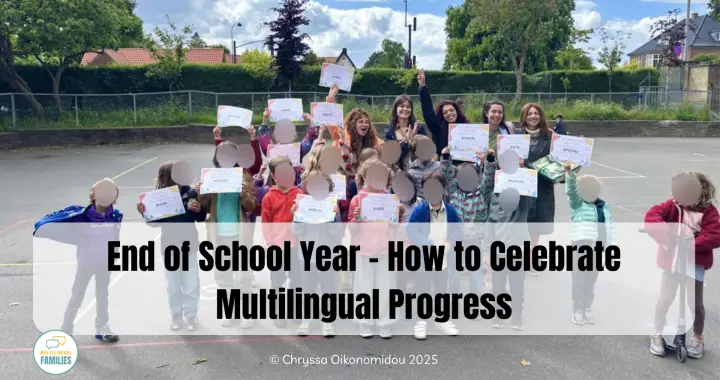
End of School Year – How to Celebrate Multilingual Progress

As the school year wraps up, many parents feel a mix of pride, relief, and exhaustion. But if you’re raising multilingual children abroad, this moment carries an extra layer, one that often goes unnoticed.  

You haven’t just helped your child through another year of school.

You’ve helped them navigate life between languages, between cultures, between identities.

And that is worth celebrating!

Why the End of the School Year Matters for Multilingual Families

For multilingual families living abroad, the end of the school year isn’t just about math, science, or history. 

It’s also about language progress across the board: whether your child dared to respond in your home language, tried to read a book in a second one, or learned how to read and write in the minority language.

It’s also about parents being able to navigate one more year in an unfamiliar educational system they keep discovering year after year.

It’s also a time of anticipation and high expectations. Many multilingual families are preparing to visit their home countries, reunite with loved ones, and soak in the increased language exposure that might give their children a boost in the heritage language. And it’s not always that simple… Some children resist. Some would rather stay close to their friends than travel “back” to mum or dad’s country. 

This season can bring joy, but also stress and mixed feelings, and that’s perfectly normal.


Multilingualism Is an Achievement Not a Given

Whatever your situation, remember: multilingualism isn’t a magical gift. Multilingualism is an achievement (Limacher-Riebold, 2025) one that takes time, consistency, patience and creativity from both children and parents.

And that’s why the end of the school year is a perfect moment to pause, reflect, breathe, and… celebrate! 


How to Celebrate Language Wins with Your Multilingual Child

Take time this month to reflect with your child, not in a formal “let’s review the year” way, but with lightness and joy.

Here are a few simple ideas to celebrate multilingual milestones:

  • Create a “We Did It!” poster with favorite words, books, or expressions learned this year in all your family’s languages.
    Don’t like posters? Just keep it as a discussion or make a list!
  • If you prefer more structured activities download our free printable worksheet “We Did It! My Multilingual Year”, a simple reflection activity for multilingual kids and parents.
  • Ask your child:

    What did you learn this year?
    How much did you improve in [language]?
    Where do you want to get better next?


  • Record a short video message or write a letter in your heritage language with some of those reflections, and send it to a family member in your home country. 
  • Draw your language journey together, like a treasure map filled with people, places, and words that left a mark.

There’s no “right” way to celebrate multilingual growth. What matters is that your child feels proud of who they are and all the languages they carry.


Don’t Forget to Celebrate Yourself, Too


Acknowledge your efforts as well.
You’ve guided your family through the challenges of school, society, and home languages.
Give yourself credit for the invisible work and remember, you are not alone.


Want to read how others are experiencing this journey?
Check out the second part of The Spectrum of Multilingualism article series: Real Stories from Multilingual Families Living Abroad


Share Your Multilingual Parenting Wins With Us!

At Multilingual Families, we see you.

We see the invisible work behind every “good morning” said in a different language.

The repeating. The reminding. The code-switching. The encouraging. The cultural bridging.

The guilt. The joy…

So, as you close this school year, we invite you to share your wins with us:

What made you smile this year? What are the highlights of your multilingual journey worth celebrating?

Add your answers to our Padlet, we’d love to hear from you!


Let’s celebrate our multilingual journeys together and cheer for one more year on this wild, wonderful ride of raising multilingual children abroad!


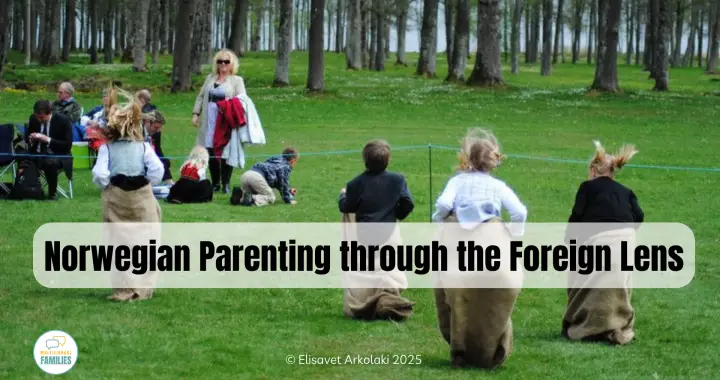
Norwegian Parenting through the Foreign Lens

Parenting styles differ significantly across cultures, and starting a family in Norway or moving there with kids can bring unexpected adjustments. Norwegians are known for their child-centered, independent, nature-focused, and relaxed approach to discipline and parenting. Children are encouraged to explore nature, even in cold weather, and parents often trust them with more freedom than in many other countries. Schools and daycare centers prioritize play-based learning and egalitarian values, fostering a sense of autonomy from an early age. 

This approach might feel unfamiliar to newcomers, but embracing it can lead to a rewarding experience for parents and children. For instance, I was surprised to see six- and seven-year-old children walk alone to school, and I had to learn to trust our children to do the same. My husband is Norwegian, and I often ask him to confirm and reassure me whether something is considered OK here, as many beliefs concerning what is safe and age-appropriate contradict what I’ve learned and experienced in South Mediterranean cultures. 

The kids have so much freedom here; our town feels safe and child-friendly. When people ask me how I find raising kids here, I often reply that it feels like we’re back in time with stuff that matters, like kids being free, independent, and safe outside of the home. We live in the future regarding their education, how they are raised, and how the school and the family work together and take responsibility for children’s well-being and healthy upbringing. Norwegian society feels like a healthy society. 

Here, I’d like to compare Norwegian parenting with other cultural styles and provide tips for adapting.


1. The “Barnehage” Culture: Early Independence

Norwegian children can start attending barnehage (kindergarten) as early as one year old. However, it is not mandatory, and it’s up to the family to decide when to start. The focus here is on play, social skills, and outdoor activities rather than academics. This contrasts with cultures that prioritize early literacy and structured learning.

Tip: If your home culture emphasizes early academics and this is important to you, you can balance it by incorporating some learning activities at home while embracing the Norwegian play-based approach.

2. Outdoor Life: “There’s No Bad Weather…”

Norwegian parents encourage outdoor play and activities in all weather conditions (Friluftsliv mindset). For instance, it’s common practice to let babies nap outside in strollers (up to -10 C), and that also applies to daycares and kindergartens. Parents in warmer climates or cultures tend to be more cautious about weather exposure.

Tip: Invest in proper outdoor gear for your child and join other parents in local parks or nature outings.

3. Trust and Freedom: “Barn Må Få Prøve Selv” (Children must try for themselves)

Norwegian parents encourage independence from an early age; kids climb trees, use knives, and even walk to school alone. This “free-range” approach also applies to daycare and school teachers, and it fosters resilience and problem-solving skills. Parents tend to be more protective or involved in children’s daily activities in many other cultures. 

Tip: Start with small steps, like allowing your child to make decisions or handle simple responsibilities independently.

4. Work-Life Balance: Family Time Matters

Norway offers generous parental leave and flexible work schedules, in contrast with countries where long working hours may limit family time. Norwegian families prioritize hygge (cozy time together) in the evenings and weekends.

Tip: If you come from a fast-paced culture, try slowing down and embracing quality family moments over quantity of activities.

5. Discipline and Conflict Resolution: Calm and Respectful Parenting

Norwegians generally avoid yelling or harsh discipline; they use calm reasoning and positive reinforcement. There’s a focus on likestilling (equality), where children’s voices are valued in decision-making. Family decisions are often taken together with the kids and the kids have a say on matters that affect their everyday lives. This comes in contrast with cultures that may have a more authoritative or hierarchical parenting approach.

Tip: Observe and socialize with Norwegian parents and adopt techniques that work for your family.

Every culture has strengths, and adapting doesn’t mean giving up your own parenting style. The ideal scenario is that, with time, you can blend what works best for your family while respecting Norwegian norms. For me, the most challenging part was to learn how to manage my stress level and fears over the kids’ physical safety, and I’m still working on it. What helped me was to try and anchor my mind on rational thoughts like the following: since so many generations have been raised here this way, my own cultural beliefs and experiences make me think that safe experiences might be unsafe. My limiting beliefs should not be limiting my kids’ lives and journey towards independence and a fulfilling life, and that changed everything. 


Yes, Neurodivergent Children Can Be Multilingual!

Neurodivergence is a widely discussed topic today, and efforts are underway to adapt social and educational environments – traditionally designed for neurotypical children – to be more inclusive. One of the key goals of inclusive education is to adjust tasks and activities so that neurodivergent children can fully participate. However, embracing neurodiversity goes beyond accommodation; it means accepting, celebrating, and supporting neurodivergent children as they are. Their differences are part of natural human variation and do not need to be fixed or changed.


Who are neurodivergent kids?

Neurodivergence refers to people who process information in a way that is not typical for their age. About 1 in 5 children have variations in their brain development. These variations include those seen in attention deficit hyperactivity disorder (ADHD), autism spectrum disorder (ASD), developmental language disorders (DLD) and learning disorders such as dyslexia, dyscalculia and dysgraphia.

Early diagnosis of neurodivergence is not always easy to make and it partly depends on the place where you live. In France, for example, dyslexia and ADHD assessments are generally carried out around the age of 7, but early signs can be seen as early as 3 years old. In Italy, autism can be roughly detected as early as 18 months old, but diagnosis is officially made from around 3-4 years old, while in the UK the average age of assessment is around the age of 5. DLD assessments are generally made around 5 years old, even though some signs of it can be recognizable before that age.

When multilingual parents suspect their child might be neurodivergent, they often worry that speaking two or more languages could negatively affect language development. While many neurodivergent profiles involve challenges with language or learning, research in recent decades has explored whether growing up with multiple languages could be harmful, and the evidence increasingly suggests it is not.

Autism spectrum disorder (ASD)

Language acquisition is generally challenging for autistic children. But recent studies show that multilingualism does not harm the development of autistic children. A recent study (Petersen et al., 2012) found that bilingual autistic children had similar English vocabulary to monolingual peers. Another study (Ohashi et al., 2012) found that multilingualism does not hinder social or pragmatic skills.

In fact, multilingualism may even provide some cognitive benefits. Autistic children growing up with two languages demonstrate better inhibition, cognitive flexibility, and perspective-taking, which are key skills for social interaction (Romero et al., 2024). For multilingual families, using the heritage language also helps maintain family connections and prevents social isolation of autistic children.

Attention Deficit Hyperactivity Disorder (ADHD)

Weaknesses in executive function have consistently been associated with Attention Deficit Hyperactivity Disorder (ADHD), whereas bilinguals have often been found to demonstrate advantages in executive functioning. Although some research has explored how bilingualism affects cognitive skills and behavior in individuals with attention deficits, the question remains far from settled.

Both bilingualism and ADHD are generally linked to weaker vocabulary knowledge. However, they tend to have opposite effects on executive control. ADHD appears to interfere more with executive functioning in bilinguals than in monolinguals, suggesting a greater cognitive burden for bilingual individuals with ADHD (Bialystok et al., 2017). Bilingualism may pose an additional challenge for adults with ADHD, potentially leading to reduced executive functioning (Mor, Yitzhaki-Amsalem, & Prior, 2015).

Recent studies have shown no clear negative effects of bilingualism on children with ADHD, though researchers acknowledge that further investigation is needed to determine which, if any, aspects of bilingualism contribute to individual variability (Sharma et al., 2022).

The limited number of available studies offers no consistent evidence that bilingualism either alleviates or worsens attention-related difficulties in adults or children with ADHD. Given the current state of research, individuals with ADHD and their families should not be concerned that learning multiple languages negatively impacts cognitive functioning or performance (Köder et al., 2022).

Development Language Disorders (DLD) & Dyslexia

A child with DLD manifests difficulties both in comprehension and in production of complex syntactic structures, with weaker phonological, morphological and lexical skills (Leonard, 2014). To date, there is no evidence that multilingualism may worsen DLD difficulties in acquiring languages. Bilinguals with DLD do not have difficulties separating languages and do not show confusion (Gutiérrez-Clellen, Simon-Cereijido, Wagner, 2008). Bilingual children with DLD show difficulties in both languages. Those difficulties are manifested in different ways depending on the language. For example, Italian DLD children have problems mastering pronouns also around the age of 5-6 (Bortolini et al., 2006). A DLD child would answer to the question “cosa fa la bambina al nonno?” (what does the girl do to the grandfather?) “bacia” (she kisses) or “bacia il nonno” (she kisses the grandfather) just to avoid the use of the pronoun “lo” (him). Instead, English DLD children do have more problems to master verb inflections. For example, they may say “she sing” instead of “she sings”.

One in ten people are dyslexic, and dyslexia is considered the most common of all neurodevelopmental disorders. For both DLD and dyslexia, more and more studies show that bilingualism doesn’t exacerbate speech and the learning disorder. On the contrary, some research suggests that bilingualism can be beneficial by promoting compensatory strategies that support language learning.


Does Bilingualism Harm Neurodivergence? NO!

Studies show that depriving a neurodivergent child of one of their languages does not negatively affect their majority language. On the contrary, the psychological consequences of depriving a child of their mother or father tongue could impact all the family harmony. Growing up with two or more languages may not only offer cognitive advantages such as improved flexibility in thinking, but also social benefits, such as stronger family and extended family bonds and cultural connections with the parent’s country of origin.

Multilingualism is not a risk factor for neurodivergent children. With appropriate support, they can thrive in multilingual environments just like neurotypical children.

Brief conclusions

  • Yes, neurodivergent children can absolutely learn two or more languages. Research over the past two decades has consistently shown that being neurodivergent does not prevent a child from becoming bilingual or multilingual.
  • Neurodivergent children may experience delays or differences in language development, but these are related to their neurodevelopmental condition, not to the number of languages they are exposed to.
  • What’s most important is consistent and rich exposure to both (or all) languages, as well as tailored support that respects the child’s learning profile.
  • Parents and educators should not feel pressured to drop a home language. Maintaining it is often crucial for family connection and emotional wellbeing.


Bibliography:

Bialystok, Ellen, et al. “Interaction of bilingualism and attention-deficit/hyperactivity disorder in young adults.” Bilingualism: Language and Cognition 20.3 (2017): 588-601.

Bortolini, Umberta, et al. “Clinical markers for specific language impairment in Italian: the contribution of clitics and non‐word repetition.” International journal of language & communication disorders 41.6 (2006): 695-712.

Gutiérrez-Clellen, Vera F., Gabriela Simon-Cereijido, and Christine Wagner. “Bilingual children with language impairment: A comparison with monolinguals and second language learners.” Applied psycholinguistics 29.1 (2008): 3-19.

Köder, Franziska, et al. “The effects of bilingualism on cognition and behaviour in individuals with attention deficits: A scoping review.” Frontiers in Psychology 13 (2022): 1057501.

Leonard, Laurence B. “Children with specific language impairment and their contribution to the study of language development.” Journal of child language 41.S1 (2014): 38-47.

Mor, Billy, Sarin Yitzhaki-Amsalem, and Anat Prior. “The joint effect of bilingualism and ADHD on executive functions.” Journal of attention disorders 19.6 (2015): 527-541.

Ohashi, J. Kaori, et al. “Comparing early language development in monolingual-and bilingual-exposed young children with autism spectrum disorders.” Research in Autism Spectrum Disorders 6.2 (2012): 890-897.

Raineri, Alessia. Un bambino multilingue. Studio longitudinale sull’acquisizione dell’italiano, del neerlandese e del francese di un bambino dislessico a contatto con più di tre lingue dalla nascita. Diss. University of Zurich, 2023.

Romero, Celia, et al. “Multilingualism impacts children’s executive function and core autism symptoms.” Autism research 17.12 (2024): 2645-2661.

Sharma, Curtis JM, Napoleon Katsos, and Jenny L. Gibson. “Associations between bilingualism and attention-deficit hyperactivity disorder (ADHD)-related behavior in a community sample of primary school children.” Applied psycholinguistics 43.3 (2022): 707-725.

Petersen, Jill M., Stefka H. Marinova-Todd, and Pat Mirenda. “Brief report: An exploratory study of lexical skills in bilingual children with autism spectrum disorder.” Journal of autism and Developmental Disorders 42 (2012): 1499-1503.

We invite you to watch the interview with Alessia Raineri PhD, about Developmental Language Disorders and Dyslexia in Multilingual Children:

The Spectrum of Multilingualism – Part 3: Is Multilingualism a Gift or a Superpower?

Multilingualism is often celebrated or emphasized as a gift or a superpower. While such descriptions emphasize the advantages of using multiple languages and are sometimes necessary when talking with people who adamantly consider multilingualism something that needs to be “fixed”, and multilinguals like people having some kind of a deficit, they can also mislead people to falsely assume and expect it to be easy. 

Multilingualism is not something bestowed upon us effortlessly; it is an achievement requiring dedication, consistency and often, strategic planning.

Multilingualism is less about innate abilities or luck and more about effort, opportunity, and commitment.


Multilingualism is a Skill – Not a Gift

The metaphor of multilingualism as a gift suggests an inherent quality, something that is either innate or that requires a talent and one receives without effort. However, research shows that language acquisition, whether for a first language (L1) or languages (L1a, L1b) or subsequent languages (L2, L3, Ln etc.), is an active process involving cognitive, emotional, and social engagement.

The Role of Effort and Strategy

Children growing up in multilingual families often acquire multiple languages simultaneously. This does not mean the process is automatic. Parents and caregivers play a crucial role by creating environments rich in linguistic diversity. Language Strategies require consistency and long-term commitment. According to Barron-Hauwaert (2011), successful multilingual families often invest considerable time and energy in maintaining language use across various contexts.

For adults, learning a new language involves even greater effort. Theories like Krashen’s Input Hypothesis (1985) highlight the importance of meaningful exposure to comprehensible input. However, exposure alone is insufficient; deliberate practice and active usage are essential components for achieving fluency.


The Myth of Multilingualism as a Superpower

While being multilingual provides cognitive and social advantages, describing it as a superpower can oversimplify the challenges involved. Multilinguals often face unique difficulties, such as:

  • Language interference: Managing different linguistic systems often leads to code-switching or code-mixing, which, though natural in the language acquisition and learning process of multilinguals, can be perceived negatively in some contexts (Poplack, 1980) and, therefore, cause frustration in parents, teachers and other professionals working with multilingual children.
    • Understanding that language interference is a common phenomenon and process that happens whenever languages are in contact, helps to focus on the important insights we can gain by observing how multiple languages intersect and interfere with each other in individual learners – the same way we can observe language interference and change when languages are in contact in societies and communities.
  • Language attrition and shift: Without consistent practice, even proficient speakers can lose fluency in a language over time.
    • Instead of considering language attrition or shift a sign of failure and an “indication for imminent language loss”, it should encourage to take action. We can always reactivate languages that have moved to the background, i.e. that we haven’t actively used for a while. By experiencing the language in a variety of contexts and in a multi-modal way, the motivation to use the language will increase and the language will shift in the foreground again (i.e. Dominant Language Constellation)

These challenges underscore the effort required to maintain multiple languages. 

Multilingualism is not a magical ability but a skill honed through practice and consistency.


Opportunities and Access Matter

Multilingualism often results from opportunities and access rather than inherent talent. For instance, children in multilingual families or communities are exposed to multiple languages from an early age, providing a natural advantage.

However, (early) exposure alone does not guarantee success! The quality and consistency of linguistic input play critical roles in language development (De Houwer, 2009). This means that children need to be involved in meaningful conversations in the target language, they need to learn the BICS and, if possible, also the CALP and CALS, to attain a high level of proficiency, should this be the goal.

We can compare this situation to monolingual individuals who choose to learn additional languages as adults: they also need to seek out opportunities – through exposure, active interactions, formal education, online resources, travel etc. – and commit to regular practice!

These efforts highlight the agency and intentionality behind becoming (and staying!) multilingual.


The Sociocultural Dimension

Multilingualism is also shaped by sociocultural factors. In some communities, speaking multiple languages is a necessity for survival or integration. For instance, migrants often learn the dominant language of their host country to navigate work, education, and social life while maintaining their heritage languages at home.

On the other hand, societal attitudes toward multilingualism can influence individual motivation. Environments that value linguistic diversity encourage individuals to maintain and develop their language skills. Conversely, societies or environments (at work or at school) that prioritize monolingualism or are geared towards the use of one – more dominant = more important (!) language – usually discourage the use of minority languages, leading to language shift, attrition or even loss (Fishman, 1991).

The Cognitive and Emotional Investment

The cognitive benefits of multilingualism – such as enhanced executive function and problem-solving skills – are well-documented (Bialystok, 2001). However, achieving and maintaining multilingual proficiency requires significant mental effort. Multilinguals constantly adapt to different linguistic and cultural contexts, exercising their brains in unique ways.

Emotionally, the journey of maintaining multiple languages can be challenging. Feelings of frustration, embarrassment, or inadequacy often accompany language learning and use, particularly in high-stakes situations. Multilinguals must navigate these emotional landscapes while persevering in their language goals.


Celebrating Multilingualism as an Achievement

Recognizing multilingualism as an achievement rather than a gift or a superpower reframes the narrative. It highlights the agency, determination, and hard work involved in acquiring and maintaining multiple languages. This perspective also validates the efforts of parents raising multilingual children, educators fostering language diversity, and individuals learning new languages.

Moreover, acknowledging multilingualism as an achievement empowers people to take ownership of their linguistic journeys. It encourages a growth mindset, emphasizing that language skills can be developed at any stage of life with the right strategies and support.

If we want to emphasize the advantages of becoming, being and staying multilingual, we can look beyond language proficiency. The cognitive and cultural skills it entails opens doors to diverse perspectives and fosters meaningful connections across cultures. Multilingualism can also be considered as an invaluable toolkit for life, which enriches our worldview and empowers us to navigate multi-faceted opportunities with confidence. Whether we call it a bridge to opportunities or a lifelong resource, being multilingual equips individuals with unique skills to adapt, connect, and thrive worldwide.


Conclusion

Describing multilingualism as a gift or superpower may inspire admiration and serve as a counterpart that balances out all the negative and deficit messages around it, but it risks downplaying the effort, planning, and perseverance involved.

Multilingualism is not an accident of birth or a natural talent that either you got gifted with or not; it is a skill nurtured through deliberate action and sustained commitment. By shifting or at least by balancing the narrative, we can celebrate the hard work behind becoming, being and staying multilinguals across the lifespan, and inspire others to embark on this same journey. However, the ability to use multiple languages can be considered a superpower for all the advantages and benefits mentioned above. 


References

  • Barron-Hauwaert, S. (2011). Bilingual Siblings: Language Use in Families. Multilingual Matters.
  • Bialystok, E. (2001). Bilingualism in Development: Language, Literacy, and Cognition. Cambridge University Press.
  • De Houwer, A. (2009). Bilingual First Language Acquisition. Multilingual Matters.
  • Fishman, J. A. (1991). Reversing Language Shift: Theoretical and Empirical Foundations of Assistance to Threatened Languages. Multilingual Matters.
  • Krashen, S. (1985). The Input Hypothesis: Issues and Implications. Longman.
  • Poplack, S. (1980). “Sometimes I’ll start a sentence in Spanish y termino en español: Toward a typology of code-switching.” Linguistics, 18(7-8), 581–618.

The Spectrum of Multilingualism – Part 2: Real Stories from Multilingual Families Living Abroad

From Theory to Lived Experience

When we talk about multilingualism, we often talk in theories: about language acquisition, critical periods, language input, or cognitive benefits.
But what does it really mean to live across languages, to raise children who call more than one language “home” – or sometimes, none at all?

This article brings together the raw, beautiful, complicated experiences of real families navigating the multilingual journey. Following up on The Spectrum of Multilingualism – Part 1, From Early Definitions to Contemporary Perspectives, here we move from abstract concepts to the emotional terrain of multilingual life through the honest words of parents raising multilingual children abroad.

The Superpower – and the Weight – of Multilingualism

Multilingualism is usually described as a “gift”, a bridge, and sometimes even as a superpower. For many children, being called a “language superhero” brings immense pride and motivation. I’ve seen it brighten their eyes, encourage their efforts, and strengthen their sense of identity.

But as my co-founder, Ute Limacher-Riebold, wisely reminded me the other day:

“When bilingualism or multilingualism is celebrated or emphasized like a gift or a superpower, people tend to falsely assume and expect it to be easy… whereas in reality it is hard work, requires dedication, consistency and support from a ‘multilingual village’.”

So in this article, I hold space for both: the lightness and the pride, the challenges and the truth.
Multilingualism is not linear, and the path is never perfect (García 2009). But, in my opinion, it is always worth walking!

What does multilingualism look like in your home? 

Pause. Reflect. Is it loud? Quiet? Joyful? Confusing?

Real Lives: Snapshots of Multilingual Families

Family 1: Eleni Prifti (Greek living in the Netherlands)

Languages spoken: Greek, Hindi, Dutch, English
Family composition: Greek mother, Indian father, living in the Netherlands
Children: 2
Language dynamics:

  • Greek with mom
  • Hindi with dad
  • English between the parents
  • Hindi between siblings
  • Dutch at school
  • English used occasionally with outsiders

-Raising multilingual children abroad: What are the first 5 words that come to your mind?

“Complex, interesting, uncomfortable, frustrating, controversial.”

Eleni’s children speak four languages – but rarely the same one at the same time. Despite being a stay-at-home mom for over seven years and consistently speaking Greek, her children surprisingly chose Hindi as their sibling language.

“No one has been able to figure out why.”

What worries her most is the emotional distance language might cause:

“Will they be able to talk to me easily in the future, if their ‘easier’ language isn’t one I speak?”
“Will language become a wall between us?”

Still, she marvels at how naturally her children absorb languages and how it shapes their cultural understanding. One moment that stayed with her:

“My son once told me: ‘I have three names. Each language pronounces it differently.’ I couldn’t even hear the differences. I felt like they had a 7th sense I didn’t.”

Her journey has taught her the art of letting go:

“If you have to choose between the language and the bond with your child, always choose the bond.”

Have you ever felt that language was creating distance – or connection – in your family? Let us know in the comments!

Family 2: Virginia (Greek living in Denmark)

Languages spoken: Greek, Turkish, Danish, English
Family composition: Greek mother, Turkish father living in Denmark
Children: 3 (ages 8, 5, and 2)
Language dynamics:

  • Turkish with dad
  • Greek with mom (unless others are present who don’t understand it)
  • Danish between siblings
  • English between the parents

-Raising multilingual children abroad: What are the first 5 words that come to your mind when you read this phrase?

“Difficulties, multiculturalism, family, nostalgia, summer.”

Virginia shares the emotional complexity of raising multilingual children in a home where four languages co-exist.

“It’s hard when family conversations don’t ‘flow.’ So many languages mix together that my brain gets tired decoding who’s saying what.”

She describes the shifting dominance of languages depending on season and context. Sometimes a language goes passive—only to re-emerge with a visit from relatives or a family trip.

“I thought it would be easier. That the kids would ‘just’ learn all the languages. But it takes effort, persistence, and compromise.”

Still, Virginia finds joy in small victories—like her kids’ curiosity about other languages or the moment in a Copenhagen playgroup when her child said proudly:

“There are others who speak many languages too!”

Family 3: Anonymous (Greek living in Denmark)

Languages spoken: Greek, English, Danish, Finnish
Family composition: Greek mother and international partner, living in Denmark, with one child and one stepchild
Children: 2 (one preschooler, one older stepchild)
Language dynamics:

  • Greek with mom
  • English with dad and child
  • Child prefers English with Danish influences
  • Stepchild speaks English at home (fluent in Danish and Finnish)
  • Danish at preschool

-Raising multilingual children abroad: What are the first 5 words that come to your mind when you read this phrase?

“Anxiety, pride, guilt, laughter, confusion.”

This parent describes the daily challenge of maintaining balance:

“One language always dominates—more cartoons, more books. It’s hard to keep the child engaged in the less dominant language.”

Despite fears that their child might never speak Greek well, moments of magic appear:

“When he uses a difficult Greek word I didn’t know he knew. Or translates for his brother without effort.”

Their hope?

“That he will have roots in all his homelands. And more freedom in his future because of it.”

Family 4: Isja (Dutch living in Denmark)

Languages spoken: Danish, Dutch, English
Family composition: Dutch mother, Danish father, living in Denmark
Children: 2 (ages 6 and 7)
Language dynamics:

  • Danish at home
  • Dutch occasionally from mom
  • Regular Dutch books
  • English from environment

-Raising multilingual children abroad: What are the first 5 words that come to your mind when you read this phrase?

“Difficult, doubt, fun, word jokes, enrichment.”

Isja’s biggest struggle? Her children’s refusal to speak Dutch:

“They get upset when I try. But they understand much more than they realize.”

She sees progress in unexpected places:

“They scored high in Danish at school. And one day, they started using Dutch without even noticing.”

“I’ve learned to trust the process. And seeing their connection with Dutch relatives grow makes it all worth it.”

Her advice:

“Just do what you can. Don’t give up because it’s not perfect.”

Family 5: Katerina (Greek living in Denmark)

Languages spoken: Greek, Danish, English
Family composition: Greek mother, Danish father, living in Denmark
Children: 2 (ages 11 and 7)
Language dynamics:

  • Greek with mom (as much as possible)
  • Danish with dad
  • English occasionally between parents
  • Danish at school

-Raising multilingual children abroad: What are the first 5 words that come to your mind?

“Home country, feelings, difficulty, consistency, pride.”

Katerina shares how challenging it has become to maintain Greek as the children grow up, especially as Danish dominates their everyday life—at school, in the community, and even in family conversations. Her youngest always responded in Danish, while her eldest began switching more recently.

“I find it harder and harder to keep being consistent about speaking Greek as the children grow up. I see that his vocabulary doesn’t grow age-appropriately in Greek. If I insist we switch to Greek, he shares less. I don’t want that. I also find it difficult to have important family conversations because my husband needs to be able to follow what we are saying, and then we end up either speaking Greek and then translating to Danish or just having the whole conversation in Danish. So as the years pass, I feel that the situation of the family forces me to speak more and more Danish to the kids.”

Still, magic moments appear:

“One of the most magical experiences is when Philip once read a Danish book to Axel, but he translated it in Greek on the spot, as he was reading. I think it is beautiful that he wants to write a Greek rap song. I find it magical when they both sing in Greek.”

A gift from Katerina’s son when he was 6 years old.

She’s learned to adjust her expectations and find new ways to connect through language:

“My experience in raising multilinguals has taught me that it is a hard job. It has taught me that things change, and as the children grow up you have to find new ways to connect and include the minority language in their life. I have also learned to adjust my ambitions.”

What keeps her going?

“I want them to understand Greek culture—the soul of it. Language is the key.”

What Keeps Us Going

Despite the doubts, the fatigue, and the ever-shifting balance between languages, one thing is clear for all these families: multilingualism is worth it.

Yes, there are hard days – when the child refuses to respond in the heritage language, when you feel you’re losing ground, or when you’re just too tired. But something always pulls these parents back in.

Sometimes it’s the small wins:

“When they surprise you with a language leap… you remember why you kept going.”
“The joy of watching them speak with their grandparents—in Greece, in Turkey. That connection matters more than anything.”

Other times it’s deeper:

“I can’t imagine them going back to Greece and not being able to speak to their cousins and uncles. I feel a deep urge to keep that bond alive.”

“It is important for me that the kids can communicate with their Greek grandparents. Also I think that language is the key to understanding the culture and the soul of a country. Learning Danish has been key for my integration and understanding of Danish people and I want my children to have the tool to understand my country, Greece and Greek people.”

For some, it’s the hope of giving their children something lasting:

“I want to give them roots. Pieces of all their homelands. So they can feel they belong anywhere.”
“I want them to grow up with choices. Language opens doors.”

Or simply the joy of shared moments:

“Reading them my childhood books in Greek—and seeing them fall in love with the stories. That’s magic.”
“Watching them be curious about how words are formed in different languages. That’s when I feel they’re truly gaining something precious.”

And sometimes, it’s just this:

“The interaction with family becomes more meaningful. That’s what keeps me going.”
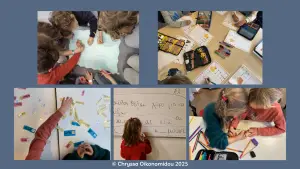
Advice from the Multilingual Village

If a friend came to these parents, unsure of how to begin raising multilingual children, here’s what they would say:

“Don’t give up, even when your child answers in another language. Language learning comes in waves. They listen, they absorb – and one day, they surprise you with full sentences.”

“Be persistent. Stick with the ‘one person, one language approach if that’s what you choose – even when it feels hard.”

“Write down the funny and touching moments. You’ll want to remember them later.”

“Just do what you can. Don’t doubt yourself too much. Don’t give up because you think you’re not doing it right.”

“Let go of control. Follow your inner voice, not the pressure of perfection.”

“If you have to choose between the language and the bond with your child, always choose the bond.”

“Ask your spouse to learn your language.”

And if multilingualism were an image?

“A ball of yarn with many ends!”

“A forest with small and big plants. Some very colorful, others not so much. Some with deep roots, others with shallow ones.” 

“A big cloud in the colours of the Danish flag, raining Greek words.”

“A multicolour garden, with two happy but tired gardeners.”

You Are Not Alone
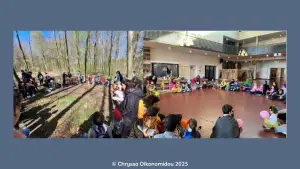
Let’s return to Eleni’s story:

“I had a tough day today.
It was tough because there were too many languages and too few words.

I spent time on the school’s app, trying to make sense of it with Google Translate.
I spent time trying to understand why the kids were arguing.
I felt defeated when a friend shut me down in conversation because I said “short-sighted view” instead of the “one-sided view” I actually meant.

Every summer, while playing with sand in Vromopousi, someone will start the language conversation:
“How lovely that your kids speak Greek so well.”
“My grandkids don’t speak it at all, and both their parents are Greek.”
“Of course it’s the mother’s fault they didn’t learn Greek.”
“Wow, four languages already? That’s amazing.”
“What a privilege.”
“Good for you!”

And every autumn, at the new school’s parent meetings, someone will start the conversation of shame:
“How many years have you been in the Netherlands?”
“Oh really…?”
“And you still don’t speak Dutch…?”

How much weight languages can carry.

The weight of expectations.
The weight of potential.
The weight of expressing what we feel.

To spend your life chasing the right word.
To think someone is rude just because they say “Yes” instead of “You’re welcome,” simply because they can’t say “alstublieft.”
To never know, almost never, where the damn accent goes in a word.
To struggle with pronunciation – French, Indian, Chinese, or from Ioannina.
To wish that AI would evolve to the point where we could all wear automatic translation headsets, always and everywhere.

And still, the weight of language remains unbearable.

Will I be able to present this talk well enough?
Will I ever feel “at home”?
Will I have to move to another country, in another language?
Will I be able to share these thoughts with Aryan and Niki fifteen years from now?
Will I understand that uncomfortable feeling in their stomach – if they try to explain it to me?
Will we speak the same language?

So many languages.
Sometimes opening doors, sometimes building walls.
Languages that carry the weight of a rapidly changing world.
Languages that sometimes signal educational privilege, and sometimes are remnants of trauma survived.

Every summer, while playing with sand in Vromopousi, the languages in our home braid together like plaits—filling us with joy, teasing, and laughter.
Every autumn, at the new school parent meetings, the languages hurt, alienate, and bring shame.
But every afternoon, at the playground next to our home, Tara will smile at me. She’ll speak broken English and say she felt the same way when she arrived, displaced from Palestine.

And suddenly, the playground fills with languages:
Greek, Dutch, English, Arabic, Spanish, Hindi, Bulgarian, and Chinese.
And only there, multilingualism becomes lighter.
Almost weightless.”
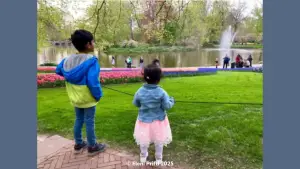
The stories shared here are unique, but the feelings – joy, doubt, guilt, pride – are shared by so many of us.
Whether you’re figuring out how to respond in your heritage language, navigating a child’s resistance, or simply trying to keep a language alive in small everyday moments, remember: you are not alone.


So, is multilingualism a superpower?

If you ask me – yes.
Multilingualism and multilingual parenting living abroad are superpowers.
But like all superpowers, they come with training, effort, setbacks, and the support of a community.
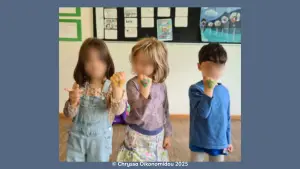
Sending positive energy to all the superhero parents out there – whether you’re monolingual, bilingual, multilingual, or even bye-lingual (as the joke goes). 


Your Story

What are your thoughts? 

We have created a shared space at Padlet: a gallery of real voices of Multilingual Families, reflecting what raising multilingual children abroad really feels like. Here, we invite you to pause, reflect, and share. You can add your thoughts, feelings, or even an image. You can write a few words, upload a photo, draw something, or leave a voice message – whatever feels true to you. Let’s create a tapestry of experiences together!

Real stories. Real people. This is multilingual life:
Difficult. Challenging. Amazing. Surprising. Beautiful.

Add your answers to Multilingual Family’s Padlet 

We look forward to reading them! 

Do you want to be one of the highlighted families like the ones presented in this article and share more?

If you would like to share your story with us, join the conversation.
Multilingual Families is listening!

Share your story here

References & Resources

Limacher-Riebold, U. (2024). 5 Stages of Additional Language Acquisition. Multilingual-Families.com. https://multilingual-families.com/5-stages-of-additional-language-acquisition/

Limacher-Riebold, U. (2024). When Learning Languages – Is Earlier Really Better? Multilingual-Families.com. https://multilingual-families.com/when-learning-languages-is-the-earlier-the-better/

Limacher-Riebold, U. (2023). Some Cognitive, Cultural and Future Benefits for Multilinguals. Multilingual-Families.com. https://multilingual-families.com/some-cognitive-cultural-and-future-benefits-for-multilinguals/

García, O. (2009). Bilingual Education in the 21st Century: A Global Perspective. Oxford: Wiley-Blackwell, 45–49.

The Spectrum of Multilingualism – Part 1: From Early Definitions to Contemporary Perspectives

Bilingualism, Multilingualism and Plurilingualism


Bilingualism has long been a subject of linguistic and cognitive inquiry, evolving from strict early definitions to more fluid and inclusive conceptualizations. It has been reflecting different research paradigms, cultural contexts and social attitudes toward language use.

Early definitions emphasized fluency and equal competence in two languages, whilst more recent approaches recognize the spectrum of abilities and functions, reflecting broader changes in our understanding of language use, cognition, and identity. 

Bilingualism, Multilingualism and Plurilingualism – in a nutshell

The term bilingualism traditionally referred to individuals using two languages, while mulitlingualism described the coexistence of multiple languages side-by-side in a society but are utilized separately. For example, in Switzerland, four national languages and numerous dialects coexist within distinct domains. More recently, multilingualism has also been applied to smaller social units, such as families, who actively use multiple languages or dialects (Hamers & Blanc, 2000).

The term plurilingualism was introduced to distinguish individual linguistic competence from societal multilingualism. While Denison (1970) initially discussed multilingual contexts involving multiple languages, the concept of plurilingualism evolved to focus on the individual as an active agent in managing and integrating their linguistic repertoire. Coste, More and Zarate (1997) further emphasized that plurilingualism represents the dynamic interplay of languages within a speaker’s communicative practices, contrasting with multilingualism’s focus on societal language coexistence. This theoretical shift underscored that languages within an individual’s repertoire are interconnected rather than compartmentalized. 

The Council of Europe (1997) formalized plurilingualism to highlight the agency of individuals in leveraging multiple languages for communication across various contexts. This term has since gained prominence, particularly in French discourse, where it is commonly used to describe individuals with diverse linguistic repertoires. 

In this post, I use bilingualism, multilingualism, plurilingualism to refer to individuals who navigate multiple languages, dialects, or sign languages, while acknowledging the distinct theoretical nuances outlined by Denison (1970), Hamers & Blanc (2000), and Coste et al. (1997).

Early Definitions: Bilingualism as Native-Like Mastery

At the beginning of the 20th century, one of the earliest and most rigid definitions came from Bloomfield (1933), who described bilingualism as “native-like control of two languages”. 

His perspective also implied that bilinguals must acquire both languages early and with “full proficiency”, mirroring monolingual competence in each language.

This narrow perspective assumes that bilingual individuals must not only acquire and learn both languages from early on (before age 3), but also exhibit equal proficiency in both languages across all domains. However, such a definition excluded many individuals who learned additional languages later, and those who actively use multiple languages in their daily lives without achieving native-like competence in all of them.

A More Inclusive Perspective: Degrees of Bilingualism

Haugen (1953) challenged Bloomfield’s view by proposing that bilingualism exists on a continuum. Instead of requiring native-like proficiency, he suggested that bilingualism begins when a speaker can produce meaningful utterances in another language. 

This view assumes that bilinguals must possess perfect (!) fluency in both languages, like “two monolinguals in one”. This rather rigid definition excluded the majority of real-life bilinguals who use their languages in a variety of contexts, for specific purposes and to various extent.
Diebold (1961) introduced the concept of incipient bilingualism, referring to the earliest stages of bilingual development (or “the initial stages of contact between two languages”). This helped frame bilingualism as a process rather than an all-or-nothing phenomenon.

Bilingualism as a Functional and Social Phenomenon

As the early definitions of bilingualism set rather unrealistic expectations, researchers began to adopt a more practical approach. 

Weinreich (1953) categorized bilinguals into “coordinate”, “compound”, and “subordinate” types, depending on how their linguistic systems interact

Mackey (1970) considered bilingualism as the “alternate use of two or more languages by the same individual”, and focused on the use of the languages rather than equal proficiency. Following the need to examine bilingualism along multiple dimensions, including proficiency, function, and stability, he argued that bilingualism is not a static state but a dynamic process shaped by social and individual factors.

Macnamara (1967) introduced the idea that even individuals with minimal proficiency in a second language should be considered bilingual if they can use it functionally. A minimal competence in only one of the four language skills – listening, speaking, reading and writing – in a language other than the mother tongue was necessary.

This perspective paved the way for recognizing partial and receptive bilinguals – those who understand but may not actively or verbally produce a second language.

Bilingualism as a Dynamic Continuum

Weinreich (1953) defined bilingualism as “the practice of alternately using two languages”, laying the foundation for later scholars like Grosjean (1982), who challenged the traditional notion of bilinguals as two monolinguals in one person. Instead, bilingualism is best understood as a fluid, context-dependent process where individuals integrate both languages into their cognitive and communicative repertoire. This holistic perspective recognizes code-switching  and code-mixing as natural and strategic bilingual behaviours, rather than signs of confusion or deficiency. 

Bilingualism in Society and Individual Identity

Romaine (2019) and Wei (2020) emphasize that bilingualism is not merely an individual trait but a societal and interactive phenomenon. Multilingual societies shape how individuals navigate their linguistic environments, influencing identity and communication.

Grosjean (1985, 2010) further dismantled the “fractional view” of bilingualism – the idea that bilinguals should mirror monolingual proficiency in each language. Instead, his complementary principle highlights that bilinguals use their languages in different domains, and for different purposes, making the notion of perfectly “balanced” bilingualism both unrealistic and unnecessary.

Contemporary Understandings of Bilingualism

Bilingualism is not merely an individual skill but is deeply embedded in education, policy, and identity (Baker, 2001; Baker & Wright, 2017). Using more than one language on a regular basis, rather than being an exception, is the global norm for over half of the world’s population. Individuals and communities navigate multiple languages seamlessly, challenging rigid distinctions between bilingual and monolingual speakers. In the digital age, concepts like translanguaging (Wei, 2020) emphasize how multilinguals dynamically draw from their full linguistic repertoire, reshaping traditional views of communication.

This dynamic interplay of languages occurs on both individual and societal levels. Societal bilingualism refers to entire communities functioning bilingually, while individual bilingualism focuses on a person’s use of multiple languages (Baker & Wright, 2017). The distinction mirrors that between bilingualism and multilingualism, with the former often describing an individual’s proficiency in two or more languages, while the latter refers to societal contexts where multiple languages coexist. Context – whether in family, education, or community  – plays a crucial role in shaping bilingual experiences.
To further categorize these settings, researchers distinguish between micro-, meso- and macro-societies. Micro-societies, such as families or close-knit communities, shape language practices through personal relationships. Meso-societies, including schools and workplaces, mediate language policies and practices between individuals and broader societal structures. Macro-societies operate at national or global levels, reflecting overarching language ideologies, policies, and sociolinguistic trends.

These layers reveal how multilingual experiences are shaped by their environments, reinforcing the need for a contextualized understanding of bilingualism. As we all use different languages depending on the setting or context, I tend to prefer the use of “multilingual” person or “multilingualism” whenever more than two languages are involved. Hence, the name of this website. 


The Use of Multiple Languages in Family and Society

In multilingual families, the use of multiple languages takes on diverse forms, shaped by strategies such as Minority Language at Home (mLAH), One Person One Language (OPOL), Time and Place, Two Persons Two Languages, or a flexible mix of approaches. The goal is not necessarily to achieve “native-like” proficiency but to foster meaningful communication, identity, and intergenerational connection. Language use in family settings is dynamic, adapting to shifting circumstances, relationships and social needs.

Defining who is bilingual or multilingual or plurilingual (whatever term you prefer) remains a challenge. As Baker (2001) notes, proficiency cannot be reduced to rigid benchmarks in listening, speaking, reading, or writing. Instead, the bilingualism/ multilingualism/ plurilingualism should be understood in terms of function – how individuals use their languages in real-life contexts. A person who understands a language but does not speak it, or who can read and write but struggles in conversation, is still engaging in bilingual practices. In languages without standardized written forms, spoken fluency alone may define competence. The complexity of multilingual abilities highlights the limitations of traditional proficiency-based definitions.

Baker (2001, 5) illustrates this fluidity:

The four basic language abilities do not exist in black and white terms. Between black and white are not only many shades of gray; there also exist a wide variety of colors. The multi-colored landscape of bilingual abilities suggests that each language ability can be more or less developed.

This “multi-colored landscape” of bi-/multilingualism reflects the variation in language skills, from basic comprehension to nuanced fluency, and from informal conversational abilities to academic or professional expertise.

Sub-skills such as pronunciation, vocabulary depth, and grammatical accuracy further complicate the picture. Importantly, formal language assessments often fail to capture the social and practical dimensions of multilingual competence, overlooking skills essential for real-world interactions.

Rather than a binary state, multilingualism is a fluid and dynamic spectrum, shaped by individual experiences, societal contexts and communicative needs. It emerges from extensive contact between languages, manifesting at national, community and personal levels. As Wei (2006) emphasizes, bilingualism lies at the core of modern linguistics, raising fundamental questions about language acquisition, use, and the human capacity for multilingual communication. Recognizing its complexity allows us to better support bilingual individuals, families, and communities in meaningful and effective ways.

Bilingualism is a product of extensive contact between people speaking different languages; it manifests both at the national and community level and at the individual level. Bilingualism as a research topic is at the heart of modern linguistics, raising fundamental theoretical issues of the human language faculty, language acquisition and language use. (Wei, 2006)

Conclusion

Our understanding of bilingualism has evolved from Bloomfield’s rigid definition to a more dynamic, socially embedded perspective. Like multilingualism and plurilingualism, it  is no longer seen as a fixed category, but recognized as a fluid and functional reality, shaped by individual experiences, societal structures, and communicative needs. Rather than measuring proficiency through rigid benchmarks, contemporary research emphasizes how languages are used in real-world contexts – whether within families, schools, workplaces, or broader societal settings.

As translanguaging (Wei, 2020) demonstrates, individuals who regularly use several languages, seamlessly draw from their full linguistic repertoire, challenging traditional distinctions between monolingual and bilingual speakers. Likewise, the recognition of micro-, meso-, and macro-societal influences (Baker & Wright, 2017) highlights the contextual nature of bilingualism, showing that language use is deeply embedded in relationships, policies, and ideologies. The “multi-colored landscape” of bilingual abilities (Baker, 2001) further reinforces that bilingualism is not a binary state but a dynamic spectrum, where different skills develop and manifest in varying ways.

As societies and communication in multilingual settings continue to evolve, so too will our understanding of bilingualism. Acknowledging its complexity allows us to normalize multilingual individuals, families and communities, whose language practices should not only be valued for their proficiency but also for their role in identity, connection and social interaction.  

Multilingualism is a dynamic spectrum where different skills develop and manifest in varying ways.

Looking Ahead: Real Stories from Multilingual Families  

While this first part focuses on the evolving definitions and theoretical understandings of bilingualism (multilingualism and plurilingualism), Part 2 will shift from theory to lived experience, bringing to light the voices behind the concepts – parents, children, and educators navigating life in more than one language.

From joyful discoveries to everyday challenges, these personal stories will reveal the many shades of what it means to grow up and raise multilingual children abroad.

Stay tuned!


References:

Baker, C. (2001). Foundations of Bilingual Education and Bilingualism. Multilingual Matters.

Baker, C., & Wright, W. E. (2017). Foundations of Bilingual Education and Bilingualism (6th ed.). Multilingual Matters.

Bloomfield, L. (1933). Language. Holt, Rinehart & Winston.

Coste, D., Moore, D., & Zarate, G. (1997). Plurilingual and Pluricultural Competence. Council of Europe.

Coste, D., Moore, D., Zarate, G. (2009). “Plurilingual and Pluricultural Competence”. Council of Europe.

Council of Europe. (1997). Modern Languages: Learning, Teaching, Assessment. A Common European Framework of Reference.

Denison, N. (1970). “Sociolinguistic Aspects of Plurilingualism”. Social Science. 45 (2): 98-101.

Diebold, A. R. (1961). “Incipient Bilingualism.” Language, 37(1), 97-112.

Grosjean, F. (1982). Life with Two Languages: An Introduction to Bilingualism, HUP.

Grosjean, F. (1985). “The bilingual as a competent but specific speaker-hearer.” Journal of Multilingual and Multicultural Development, 6(6), 467-477.

Grosjean, F. (2010). Bilingual: Life and Reality. Harvard University Press.

Haugen, E. (1953). “The Norwegian language in America: A study in bilingual behavior.” Publication of the American Institute, 1, 88-92.

Hamers, J.F., Blanc, M.H.A. (2000). Bilinguality and Bilingualism. 2nd ed., CUP.

Macnamara, J. (1967). “The bilingual’s linguistic performance – a psychological overview.” Journal of Social Issues, 23(2), 58-77.

Mackey, W.F. (1962). The Description of Bilingualism. Canadian Journal of Linguistics, 7(2), 51-85.

Romaine, S. (2019). Bilingualism. 2nd edition. Blackwell.

Wei, L. (2006). Bilingualism, Ed. Keith Brown, Encyclopedia of Language & Linguistics (Second Edition), Elsevier, 1-12.

Wei, L. (2020). Translanguaging as a Practical Theory of Language. Routledge.

Weinreich, U. (1953). Languages in Contact: Findings and Problems. Mouton.

Language Shift, Attrition and Loss

What they are, why they happen, and how to prevent them

In multilingual families, multiple languages tend to be used on a more or less regular basis. When one (or more) languages are not used or used less for a longer period of time, it can lead to language shift. This means that one or some of our languages are then likely to move to the background (Limacher-Riebold, 2023).
Language shift, language attrition and language loss are processes that can deeply affect us, particularly when our heritage languages are at stake!

What are language shifts, attrition and loss?

Language shift occurs when either a community or an individual gradually moves from using one language to another.* This is often due to external pressures. For communities these can be migration, colonization, or globalization. For individuals, the community can pressure towards the use of more dominant languages, i.e. languages that are more important to function in the society – whether it be the community, nation or even the family. Over time, the dominant language replaces the minority or heritage language in daily communication.

Language Attrition refers to the gradual decline of proficiency of a language an individual once spoke fluently. This can happen with both, the heritage and any additional language learned at any point in life.

Language Loss is the extreme outcome of attrition, where a person or community no longer effectively uses a language, either entirely or in specific domains.

These processes are often intertwined, with language shift accelerating attrition and loss.

Why and when do these processes happen?

Language shift can happen at any stage due to a change in language use (see here above) and it is rather temporary, i.e. it can be reversed at any stage with some conscious effort to use the language more frequently.
Language attrition and loss are often the result of the “use it or lose it” principle grounded in neurolinguistics (Schmid & Köpke, 2004) over a longer period of time. When a language is not used regularly, neural pathways associated with it weaken, making it harder to retrieve vocabulary, syntax and pronunciation.

Common Triggers are:

Migration or Environmental Changes: Moving to a region where a different language dominates can limit opportunities to use the heritage/other language.

Educational and Work Demands: Prioritizing the dominant societal language for studies or career advancement often sidelines minority languages.

Family Dynamics: When family members adopt the dominant language for convenience or integration, the heritage/other language loses its functional role.

Limited Domains of Use: If a language is restricted to specific contexts (e.g., only spoken with grandparents), its active vocabulary and grammar can shrink.

Signs of Language Attrition

Language attrition can manifest in multiple ways and subtly over time. Here are some common indicators:

Word retrieval difficulties: We observe that we pause frequently or struggle to recall specific words also in contexts where we usually (or in the past) would not hesitate to speak fluently.

Grammatical Errors: We start making mistakes in syntax and morphology that previously were not an issue. Sometimes it looks like we speak (or write) with the structure, the matrix of another – more dominant – language in mind. 

Code-Mixing: We start inserting words from the more dominant language when speaking, even if we are not tired, not in a rush, and when talking about familiar topics. This kind of code-mixing should not be misunderstood with the code-mixing in multilinguals during the early stages of learning another language.

Hesitation and Pauses: We make increasingly more effort in constructing sentences, formulating and expressing our thoughts and reasoning in the target language.

Accent Shift: We might sound “different” or have another accent whilst speaking the target language, which we didn’t have previously. 

These signs can emerge in adults, children and even early bi/multilinguals who stop a particular language for a longer period of time.

Strategies to Prevent Language Attrition

Languages are like muscles. When we exercise regularly, i.e. use the languages on a regular basis, they will stay strong. Proactive strategies can help preserve fluency and keep the language retrievable at any moment.

Daily Interaction

Make sure to integrate the language into daily activities. For example: 

  • Use the language during meals, family gatherings or at specific moments during the day
  • Assign specific topics or tasks to the language: storytelling, cooking, watching news and talking about them in the target language

Media Immersion

Consume authentic content in the target language.

  • Listen to music or podcasts
  • Read books, news articles, blogs, anything that motivates you in the target language
  • Watch movies, shows, series, youtube videos

Community Engagement

Find or create a community of target language speakers – online and/or offline. You are welcome to join our private facebook group Multilingual Families, a vibrant and supportive community of multilinguals around the world. Find a local community of speakers and enroll in events like cultural festivals, or start activities for other families like yours.

Language Rituals and Games

Make language use a fun and entertaining family ritual or tradition.

Formal Learning Opportunities

What about taking courses about new topics to refresh or deepen your proficiency in the target language? This is very useful for refreshing or maintaining grammar, advanced vocabulary and maintaining the confidence of using the language in a broader variety of contexts. 

The Role of Identity in Language Maintenance

Languages are deeply tied to our identities and sense of belonging (Oikonomidou, 2025; Limacher-Riebold 2018 and 2022). Losing a language can feel like losing a part of ourselves. Therefore, encouraging positive attitudes toward heritage languages is crucial to fully embrace multilingualism! Especially children benefit from understanding the cultural value of their languages through storytelling, cultural activities, and family history discussions (Garcia, 2009). These practices help to foster a strong connection between language and identity.

Several studies on language attrition highlight the importance of consistent use and emotional connection to maintain linguistic skills. Schmid & Köpke (2004) emphasize that the neural pathways weaken when the languages are not used regularly. However, they can be reactivated at any time through deliberate practice and exposure.
Fishman (1991) underscores the role of community efforts in maintaining minority languages, stressing that collective support is critical to preventing language shift, attrition and even loss. Community programs, language classes and cultural celebrations create environments where languages thrive.
For heritage language speakers, incomplete acquisition and learning, or early-stage attrition is common (Montrul, 2008). However, active engagement with the language can mitigate these effects. Revitalization efforts, both at home and in communities, can play a transformative role (Oikonomidou, 2025*). Reintroducing and fostering the use of a diminishing language involves intentional strategies, such as creating opportunities for active use in daily life and intergenerational transmission. Storytelling, traditional practices, and translanguaging approaches leverage the multilingual repertoire to bridge the gap between passive understanding (i.e. receptive language skills) and active use (García, 2009).

Language Shift, Attrition and Loss in Aging People

Aging individuals often experience changes in how they use and retain their languages. For multilingual individuals, these changes can lead to language shift, attrition and even loss, especially if certain languages are no longer actively used.

Older multilinguals may experience language attrition due to a combination of social, cognitive and environmental factors:

  • Reduced Social Interaction: Retirement, relocation, or reduced social circles can limit opportunities to use certain languages, particularly if they are heritage or minority languages.
  • Cognitive Changes: Natural age-related changes in memory and cognitive processing can make it harder to access less frequently used languages (Goral et al., 2007). Older multilinguals who maintain regular use of all their languages tend to experience less attrition and greater cognitive flexibility!
  • Health Conditions: Neurological conditions like dementia or stroke can disproportionately affect one language over others, depending on which language networks are more robustly established and actively maintained (Paradis, 2004). Age-related language loss often affects the less dominant languages first, due to weaker neural connections. However, emotional and autobiographical memories tied to a language can enhance its resilience!
  • Language Reduction in Communities: When older multilingual adults live in monolingual environments or are in touch with people who prioritize the dominant languages, they might gradually shift away from the other languages they learned.

Signs of Language Loss in Aging Individuals

  • Difficulty Retrieving Words or Switching Languages: Older adults may pause more frequently or struggle to recall specific vocabulary, especially in lesser-used languages.
  • Dominance of One Language: One language – often the more dominant, societal language – may start replacing others in daily use, even in contexts where the other languages were previously used.
  • Incomplete Sentences: Sentences in the minority or “weaker” language may become simpler or grammatically inconsistent.
  • Emotional Reactions: Frustration or withdrawal from conversations in weaker languages can signal discomfort with perceived “loss of fluency”.

Emotional connections to languages can sometimes lead to their preservation in surprising ways. For example, older multilingual adults with dementia often revert to their first language or earlier learned language, even after decades of not using it.

How to Support Aging Multilinguals

  • Foster opportunities for Language Use: Encourage them to engage with their heritage or less used languages through storytelling, community events, or conversations with family. Multilingualism in aging individuals can serve as a cognitive reserve, delaying symptoms of dementia by keeping neural pathways active (De Bot & Makoni, 2005).
  • Use Multimedia Tools: Introduce podcasts, audiobooks, or subscribed films in less-used languages to stimulate cognitive and linguistic pathways. Make sure to provide opportunities to talk about what they have listened to. 
  • Create Multilingual Routines: Establish simple habits, like dedicating specific times or activities to each language (e.g. using heritage language during family meals or outings, when talking about specific topics etc.).
  • Leverage Emotionally Meaningful Contexts: Discuss memories, traditions, or cultural practices in the heritage language in order to create positive associations and preserve fluency.
  • Bridge the Language with Fond Memories: When recalling fond memories, try to link them to the use of a target language. It is surprising to see how a specific memory can trigger the use of a language that seemed to be forgotten. In some cases, songs can ease the way back to the target language.

As our parents, grandparents and community elders navigate aging, nurturing their multilingualism can not only preserve their heritage but also support their cognitive and emotional well-being! Encourage active language use in meaningful contexts, i.e. in contexts where the use of the target language evokes positive and motivating memories. This will benefit the individuals and strengthen intergenerational ties.


Some personal experiences from members of our Facebook Group and suggestions on what to add to our list from followers on Instagram (Multilingual Families)

When we published a post about this topic on our facebook group, we also asked members to share their experience with us (in no particular order)**:

Zoe Stam: “I find my brain has a language limit. I used to speak decent Portuguese alongside English and French. When I started to learn Dutch I lost Portuguese which was the last learned language. I’d love to learn Spanish but I’m worried it will push something else out.”

Raffaella Scarpa:  “I learnt Japanese when I was 22-25, even spent one year there. Sure, it wasn’t perfect but okay conversational level. After coming back I started doing my masters, started working and after some years… it was completely gone… Then of course I lost Spanish a bit when focusing on German because we were living there… Lost a lot of German now. But with Japanese it is really impressive how I literally don’t remember a single word!” (…) “I think the main reason it happened is that I never needed it again. No one to talk with. At the same time in my life I had a lot to focus on (studying, finding a job, house…). Then I had to learn a new language fast when we moved to Germany and that was probably the final step in abandoning it completely. Even now I wouldn’t have any motivation… so I don’t even try to watch movies or anything.” 

Frances Dorrestein: “This happened to me with the smattering of Hindi I had from living in India. (…) I lived in Delhi for four years. What I have lost is fluency. I remember words but can’t make sentences. It was limited to begin with and now it’s gone. Same with comprehension. I pick out odd words but lose the overall meaning. Like regression to a baby’s first words stage!”

Agnieszka Wegner: “It happens to me, however the advice to practice daily is not practical for people who speak 5-6 languages, because they would need to practice them 5-6 hours a day. There is another possibility which I call “activation”. So when I know in advance I would need the “deactivated” language, I keep on listening to podcasts daily in this language. After a couple of weeks, it is quite ok to use it. When I was young and I had more free time to do “activation”, I would read a book to deactivate.”

J.S.: “I have varying experiences of this between the languages I have used throughout my life. My partner too, who is anxious about his lack of ability to find words in the native Limburger Dutch of his childhood with his few remaining relatives who still speak it, and his slightly fading German after being a German teacher for years.”

@leskidskalam suggested to add to the list of reasons that contribute to language shift, attrition and loss: “Lack of, or weak value associated to the language (emotional, social, cultural, etc.)”

Keep your languages alive!

Preserving and nurturing languages in multilingual families – or communities – does not happen by chance. It requires intentional and conscious effort.  Simple, consistent actions, like regular family conversations or shared activities, can create a lasting impact, ensuring these languages thrive for future generations.

As multilinguals, we have the incredible opportunity to sustain the languages that root us in our heritage, strengthen bonds with our children, and unlock new possibilities for them and ourselves.


What is your experience with language shift, attrition and loss?
What are you doing to keep your languages alive ? 
Please share with us in the comments!

*This is not code-switching, which is a similar phenomenon that occurs when we switch from one language to the other in the same conversation.
**I have the explicit consent of the facebook members to share their quotes and names or initials.

References:

De Bot, K., Makoni, S. (2006). Language and Aging in Multilingual Contexts. Clevedon: Multilingual Matters.

Fishman, J. A. (1991). Reversing Language Shift: Theoretical and Empirical Foundations of Assistance to Threatened Languages. Clevedon: Multilingual Matters.

Garcia, O. (2009). Bilingual Education in the 21st Century: A Global Perspective. Language in Society 42(03), 344-345.

Goral, M., Levy, E.S., Ober, L.K. (2007). “Languages in the Aging Brain: A Lifespan Perspective”. Annual Review of Applied Linguistics, 27, 144-162.

Limacher-Riebold, U. (12 May 2018). The Third Language Model. Multilingual-Families.com. https://multilingual-families.com/the-third-language-model/

Limacher-Riebold, U. (1 December 2022). From Cultural Identity Model to Language Identity Model. Multilingual-Families.com. https://multilingual-families.com/from-cultural-identity-model-to-language-identity-model/

Limacher-Riebold, U. (9 May 2023). The Dominant Language Constellation Model to visualize our use of multiple languages. Multilingual-Families.com. https://multilingual-families.com/the-dominant-language-constellation-model-to-visualize-our-use-of-multiple-languages/

Montrul, S. (2008). Incomplete Acquisition in Bilingualism: Re-examining the Age Factor. Studies in Bilingualism, 39.

Oikonomidou, Ch. (8 January 2025*). Dialects at Risk: Arvanitika Through the Eyes of a High School Student. https://multilingual-families.com/dialects-at-risk-arvanitika-through-the-eyes-of-a-high-school-student/

Oikonomidou, Ch. (1 April 2025). How to Help Multilingual Children Feel Proud of Their Language and Identity, Multilingual-Families.com. https://multilingual-families.com/how-to-help-multilingual-children-feel-proud-of-their-language-and-identity/

Paradis, M. (2004).  A Neurolinguistic Theory of Bilingualism. Amsterdam : John Benjamins.

Schmid, M. S., Köpke, B., Keijzer, M., Weilemar, L. (2004). First Language Attrition: Interdisciplinary Perspectives on Methodological Issues.