First signs of communication

Guest post by Artemis Pepelasi


A milestone of human development is speech. Speech is not only about the number of words an individual knows but also the effective and meaningful communication with the environment, which also includes non-verbal characteristics like eye contact and gestures. Parents tend to be very anxious about their babies' first words and get worried if their children do not speak at a specific age. However, they sometimes ignore that the preparation of speech and communication began before their children were born. 

(Pixabay.com)


Why do infants cry?

Babies cry to communicate their needs, like hunger, illness, frustration etc. Regarding their needs, infants cry in different ways. That is their very first attempt to communicate with the environment. Nevertheless, communication does not only rely on the individual's needs; communication also has social aspects. And children need to learn those aspects from their caregivers.


What can a caregiver do to teach communication?

There are several ways for caregivers to teach communication. Naturalistic context is always effective for children to learn dyadic interaction and conversation. Naturalistic context is whichever procedure has “natural” characteristics. For instance when teaching our children to play with others, we will do so on the playground. If we want to teach them how to communicate, we should try to communicate with them in the same way we communicate with verbal people.

In order to attract children’s attention, adults can talk louder and show how words are pronounced through emphasizing facial expressions. 

Another effective way to foster communication is by describing all the activities happening: describe the food preparation or that infants will have their bath. Moreover, caregivers can ask questions to infants while making eye contact and waiting for a response. In that way, infants learn that a conversation needs at least two people, everyone has time to speak, and each conversation participant pays attention to the one who is talking. We must remember that we all have learned to speak and communicate because we listened to someone talking and imitated this behavior.

What is the right time to teach an additional language? 

Communication skills can be taught regardless of the caregivers’ language and culture. Research has shown positive cognitive effects in multilingual infants. Experiments have shown that bilingual infants were more likely than monolingual infants to remain engaged to a stimulus and switch faster from one stimulus to another.
There is an excellent opportunity for children to acquire different languages early on in life and learn that different sounds and gestures can be included in communication. Nevertheless, caregivers should be careful because the same gestures may have different meanings in different cultures. It is suitable for all caregivers to come to an agreement about the gestures used with the child.


What are the psychological effects of communication? 

The interaction caregivers have with children is not only helpful in teaching languages and communication. Another essential aspect of this interaction is the children’s secure attachment to their primary caregiver. Since infancy, children communicate to fulfill their needs. However, they have to know they can turn to a specific person in distress or because of illness. This need for safety is essential for all infants. The lack of that safety combined with individual characteristics (i.e. temperament and environmental factors) can lead to later internalizing and externalizing problems, such as anxiety and maladaptive behaviors.


Talk to your infants even though they cannot speak yet. They are capable of communication and need it in order to feel safe and secure with you. Communication is the key to the emotional connection of children with their caregivers! 


  • What is your experience communicating with your infant? 
  • Please feel free to share your experience in the comments.


About the author:

Artemis Pepelasi lives in the Netherlands. She studied at the National and Kapodistrian University of Athens Philosophy, Pedagogics and Psychology.  She worked as a therapist for children with developmental disorders and decided this year to strengthen her knowledge and is attending the master program “Parenting and Child Development” in Leiden University. She is currently completing an internship at Ute’s International Lounge.


If you wish to read about naturalistic context/ education, have a look at these sites:

https://www.qualityresearchinternational.com/socialresearch/naturalistic.htm

https://cognitiveresearchjournal.springeropen.com/articles/10.1186/s41235-022-00435-0


The multilingual mindset


“A language is not just words. It’s a culture, a tradition, a unification of a community, a whole history that creates what a community is. It’s all embodied in a language.”

Noam Chomsky


We engage with the world through the vehicle of language, which is fundamental for connecting with others and for learning, whether it is oral, sign language, a series of gestures or sounds.

Our brains are wired to understand and use a variety of languages, which makes be(com)ing multilingual for everyone a natural consequence of living. I avoid adding “in today’s world”, because most of us understand or use multiple languages and variants of languages (dialects, sign language, etc.) on a regular basis.

Since people lived increasingly bigger groups and communities, moved as nomads and went places, they had to adjust to different ways of communicating, and speaking in different tongues.

We all know what a growth mindset is. In a nutshell, it is a mindset where we thrive on challenges and don’t see failure as a problem, but rather as a springboard for growth and developing our abilities. A multilingual mindset, as I define it, is very similar. It is a mindset that benefits from the knowledge of multiple languages and communication styles that allow us to focussing on what the other person is saying, not how they are saying it.

People with a multilingual mindset have multilingual listening skills, and thus focus on what people say, not how they say it. They are curious and open for what seems different. Their curiosity leads them naturally to be inclusive, accepting and non-judgmental and less biased when it comes to different worldviews, languages, ways to do and express things. People with a multilingual mindset have a multi-faceted way to process situations in a way that taking sides becomes more difficult because one naturally considers and can emphasize with different perspectives.

People with a  multilingual mindset can be open and receptive to learning and understanding different languages and cultures. They are more aware of what  languages and cultures have in common and how they are interconnected.

The ability to adapt to different verbal and non-verbal communication styles, and cultural norms when interacting with people from different linguistic and cultural backgrounds, is part of what, in my opinion, is part of a “multilingual mindset”.

A multilingual mindset goes beyond the simple use of different languages. It has to do with accepting and welcoming other languages in a non-judgmental way. It requires social skills that foster inclusion and understanding on a variety of levels that don’t focus only on language, but that use language to connect and to foster mutual understanding and effective communication. It involves connecting on a cultural level in interpersonal relations, and on cross-cultural levels.

It has to do with the “capacity of people to create opportunities to use languages or varieties of languages in very different forms and at different levels of mastery, and in a variety of settings”.  As the “experience of our languages in their cultural context expands, we discover that we do not keep these languages and cultures in strictly separated mental compartments, but rather build up a communicative multilingual competence or ability to which all our knowledge and experience of language contribute, and in which languages interrelate and interact” (Ute Limacher-Riebold, Online Course ENJOY Raising children with multiple languages for parents of 4-10 year olds).


How to develop and keep a multilingual mindset 

It all starts with learning languages, immersing oneself in the respective cultures and being open about experiencing them in a way to challenge ones own boundaries and limiting beliefs to the extent to reach a broader understanding. The multilingual mindset allows us to recognize and appreciate the richness that diversity brings to the world.

The same way the cognitive advantage of being multilingual only applies to those who regularly use their languages (see the studies by Ellen Bialystok, Li Wei, Thomas H. Bak, Arthuro Hernandez, Jean-Marc Dewaele, etc.), the multilingual mindset can be compared with a training of our mind to focus beyond the appearance and biases. It removes blindfolds and facilitates connection and communication between and amongst all forms and varieties of language. The aim of developing a multilingual mindset is to recognize stereotypes, ideological platitudes and cultural conceptions, and consequently avoid them, in order to see others as unique persons (Holliday 2011). This intercultural awareness allows to celebrate linguistic diversity and variety, and shifts away from a monolingual viewpoint towards a multilingual mindset that views identities with a high level of intercultural translatability. In this context, language plays a fundamental role as language is the medium to understanding and for learning.


Here are some of the advantages of being multilingual or using multiple languages that allow to define the multilingual mindset that I described above.

The more languages we know, the more understanding we can be towards the world around us.

Cognitive research proves that knowing more languages makes us more tolerant (Jean-Marc Dewaele and Li Wei)*.

*DEWAELE, J., & WEI, L. (2013). Is multilingualism linked to a higher tolerance of ambiguity? Bilingualism: Language and Cognition,16(1), 231-240. doi:10.1017/S1366728912000570


The more languages we know, the better we are at problem solving.

Using multiple languages helps to enhance problem-solving skills. Why? We are used to switching between languages, which makes us more flexible and allows us not only to express us in multi-faceted ways, it implicitly makes us consider situations from different perspectives. The more we switch between our languages, the more we train our flexibility to adapting to different contexts sometimes in very short time. This ability allows us to quickly assess situations and problems, skim the unnecessary and focus on the essential, problem solving aspect (see studies by Fraser Lauchlan).


The more languages we know, the easier we learn new ones.

The more languages we know, the easier we access additional languages. When we focus on similarities between the languages we know and learn, we can pick up expressions easier, including the body-language. It does not even depend on how proficient we are in our different languages. When we master some of them to a degree that we recognize underlaying patterns in their grammar, on syntactic level (SVO, SOV etc.), morphological level (ex. adding an -s transforms a singular into a plural in English, car (sg.) car-s (pl.); by adding a  -t to the verb stems, the verb becomes 3pers.sg. in German: sag-en (inf.) sag-t (3 pers. sg. pres.) etc.), phonological level (we can find the same /a/ in different languages; the sound of [x] can be found in Dutch, German, Swiss German etc.), lexical level (ex. just think about the loanwords and cognates in each language) etc.. The more facets of each language we have access to, the easier we can connect our languages to each other and use them in a more efficient and multi-competent way.


The more languages we know, the less inhibited we are, i.e. the less we fear to fail.

When we are used to switch between languages, or mix them to make ourselves understood, whenever we learn a new language we feel less inhibited. We are quicker to start talking, trying out how to say things and formulate our thoughts in the language and connect with people who use it.

By making the effort to pick up expressions in another language we are demonstrating our commitment to hearing other perspectives and showing respect for diverse cultures. This can be achieved by constructing the ‘Multilingual Mindset’: a more inclusive approach towards languages and culture.

♦This is an ongoing post. If you have any other ideas to continue the list “The more languages we know…”, please let me know in the comments. I’ll be happy to add your ideas to the list (and link back to you). 

♦Please share your thoughts about what you think a “multilingual mindset” is, or how we can define it better. 


Learning to read in multiple languages – The Reading Rope explained

There are many different approaches, theories and practices about how to start fostering reading skills, and they all differ across languages and cultures.

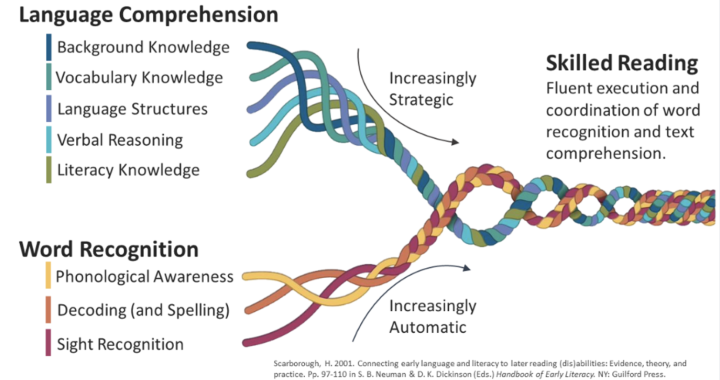
I personally find the Reading Rope by Hollis Scaraborough, a leading researcher of early language development and its connection to later literacy, very helpful to illustrate what learning to read and becoming a skilled reader entails.

Reading does not only mean to recognize letters or characters of our written language, and reading doesn’t come as naturally as understanding and speaking.

As the whole process is more complex, when our children grow up with multiple languages, and learn to read almost simultaneously in more than one language, the process is slightly different, which I’m illustrating here below.


When parents ask me when they should or could start teaching their children how to read in their home languages, I always ask them about their children’s attitude towards reading. When children are curious about learning to read they are ready. But ready to what? Parents need to understand what it means to teach reading. When children ask to learn to read, they might think about being able to decipher their name or some specific words, whereas we, parents, already see ourselves explaining complex grammar.

Therefore I usually tell them to have a look at the various skills that help our children become skilled readers illustrated by the Reading Rope, and decide which aspects of the learning process they feel comfortable supporting their children with.


© Hollis Scaraborough


Let’s start with the upper part, because it is the part that we foster in our daily life.


Language Comprehension


It is the part of the Language Comprehension strands that consist of:

  • Background Knowledge
  • Vocabulary Knowledge
  • Language Structures
  • Verbal Reasoning
  • Literacy Knowledge


Background Knowledge is what our children understand about the world, what they can relate to. Like that the apple is a fruit one can eat, that rain is water and it can be cold and warm, that there is day and night etc.

Background knowledge also includes everything related with the context of these words and terms, it involves the cultures, traditions, beliefs and values our children grow up with. If we speak several languages at home and transmit multiple cultures, way of saying and thinking, their background knowledge embraces all of them. 


Vocabulary Knowledge means not only words, but also their meaning and the variety of meanings they can have. A rich and various vocabulary is a prerequisite for our children to understand the written word, to make this connection between what they know and what they read. When our children grow up with several languages, it is important that they know the terms and concepts in their different languages in order to anchor them to the written word.

The languages our children are exposed to at school will become their most dominant ones, for obvious reasons and will make great progress in them within a relatively short time. This is what they need to do in order to function at school and succeed academically. For example, they will know what jellyfish are, they will know the story of the Gruffalo – if their school language is English – and the seasons of the year etc..

As the home language vocabulary will not expand as quickly and won’t possibly cover all the topics our children learn at school, they might not be able to understand texts in our home language to discover those terms and the “world” that would provide them with this vocabulary. They might learn how to decode the words on the paper or screen, but they might not understand it.

This is why I always advise parents to provide input about these topics at home too, especially if we want our children to also be able to understand and read texts in our home languages about these topics. 


Language Structures refers to the syntax, the way sentences are formed in the language. So, for example, in English I say “I like the dog”, in Grman “Ich mag den Hund”, “mi piace il cane” in Italian, following in all these languages the SVO structure. But when we add an adjective, we’ll say “ich mag den blauen Teppich”, and “I like the blue carpet” in German and English, but “mi piace il tappeto blu” in Italian, as the adjective follows the noun in Italian, whereas it precedes it in English and German. Language Structure also refers to the many meanings words and texts can have, the semantics, that a “group of fish” is called school, as well as the place our go to learn, and it refers to morphology, for example, that by adding -s to some words we form a plural in English. Our children who grow up with multiple languages from early on, learn to differentiate between the syntax structures of their languages by trial and error. They mix them at times, which is perfectly normal as it is an essential part of the learning process. It is a way to connect the different systems without having to relearn every language from scratch: they can build on what they already know! By reading to and with our children we expose them to a variety of different ways to say things, to different styles – formal, informal, direct speech, indirect speech etc. – which often compensates the lagging exposure to a variety of speakers of our language. This is one of the many reasons why reading with our children in our languages is even more important when we raise them abroad!  


Verbal Reasoning refers to understanding when and how words are used, when they are meant in a figurative and when they are meant in a literal way. Our children need to understand what is said, and what not, but implied, and how it is said. This can be fostered through conversations, speech, or through texts. They need to learn that there are multiple ways to express thoughts and meanings, and that we can imply, infer meanings, like if when they want to go outside to play and we say “it is going to rain” they need to understand that it’s good to wear a raincoat and maybe Wellington boots. Understanding metaphors, sayings, sarcasm or irony are also skills our children need to master. If we want our multilingual children to improve their language skills and become confident readers and writers in our languages, they need to make the experience of using these metaphors, sayings and ways to communicate. Verbal reasoning skills can be fostered also through story telling, role plays and enacting scenes. 


Literacy Knowledge refers to the different genres of texts: news, articles in newspapers, poems, riddles, fiction and non-fiction, dialogues, comics etc. The broader our children’s literacy knowledge, the better they can understand the texts, as each genre has its own rules with regards to the use of vocabulary, style etc.


The more our children learn about each of their language for all of the aspects just mentioned, the easier they will understand the texts in those languages. The language comprehension strands are strongly entangled. They feed and reinforce each other and form a complex unity that weave together with the word recognition strands.


Word Recognition

The Word Recognition strands are part of the pre- and early literacy skills our children can acquire – or the first steps one can take when learning a new language. They usually are what teachers focus on when they teach the language in formal settings.

This strand of the Reading Rope consists of single straps: 

  • Phonological Awareness
  • Decoding (and Spelling)
  • Sight Recognition


Phonological Awareness is the ability to understand that words are made of sounds. Children learn to speak without being told what is a word, where it starts and where it ends. Very young children would learn full sentences and repeat them without knowing where the different elements of the sentence start and end. They just imitate speech. For example, they would say things like “thank you very much” as “one word” or “one expression”. It is only when they are exposed to sentences where “thank you” is used with other elements of a sentence, like “thank you Anna/mom/dad/…” or “thank you for closing the door/giving me the cup…”, that they can start separating the parts and get a feeling of the underlying patterns of their languages. They need to make many mistakes before they get it right!
For multilinguals this means that they need to be exposed to their languages in multiple settings, get input in various topics and actively use the languages up to their level of proficiency. And, I would say this is a bonus: they get to make many many more mistakes than monolinguals, as they need to understand patterns of two, three, four or more languages!


Multilinguals get to make many more mistakes to understand the patterns of two, three, four or more languages!


When children learn to read they learn to recognize that the sound chains correspond to words they can see on the page. They see the spaces in between two words and will develop a sense of word or morphological structure of the word, before even knowing what these terms mean.

Children who grow up with multiple languages have a broader repertoire of phonemes, of sounds, that they need to transfer into letters or letter combinations, that they then can decode whilst reading and maybe writing what they are pronouncing.

Our children not only need to become aware of the different pronunciation of sounds, but also discriminate the individual sounds across their languages. This is a major workout, because sounds don’t correspond to the same letters or letter combinations in all languages (see fig. here below). This awareness can be built by learning that words can be broken down into different sounds and syllables.
To facilitate learning to differentiate between sounds and syllables in all their languages, rhyming, blending, segmenting and manipulating speech sounds is a great way to foster this skill! 

A playful and effective way to raise phonological awareness is by doing rhyming activities and games. Find words that rhyme, either with the first letter or sound, or the word ending. Be ware that across the languages our children know, they can retrieve many words that might seem “not matching” in the target language. But as they have all the words in their different languages at their disposal, they will try to find what works, no matter in what language!

Like for example Kuh and Schuh (cow and shoe in German) rhyme with flew and flue. Does this seem complicating the learning process? Not really. Our children will recognize that the sounds are rendered differently in words across their languages once they start reading, i.e. decoding them in texts.

In some schools, teachers take their pupil’s broad repertoire of words across multiple languages as an advantage to explore these languages in a more effective way for the children. Through translanguaging practices they allow children to explore their full linguistic repertoire. Knowing how words can be manipulated to change meaning is a great and fun activity to do! Our children can, for example, play with composita, i.e. compound words, and see how they work, how they are formed across languages – if the target language has compound words, of course!

Also knowing how to segment words, for example that the plural is formed with an additional –s at the end of a word in English, like carcars, but also by adding -ren like childchildren, can lead to a transfer of these rules to the other languages our children know. They might then apply the same rule to their other languages and say bambinos as plural of bambino singular (boy, Italian), whereas the plural in Italian is formed by changing the last vowel into –i in these kind of words, i.e. bambini.
With these examples you can see that it is important for teachers to know what other languages their pupils use. This is why I always encourage parents to inform their children’s teachers about what words they use in their home languages, what level of fluency they have attained, if they started decoding the home language already etc.. This way, teachers can help our children transfer the rules and skills they learn in the school language to their other or home languages – and vice versa!


Decoding (and Spelling) is what we do when we start reading: we sound out the letters one by one: eg. C-A-T, and focus on the smallest part of the word – the letters. Whilst blending letters, we learn about silent letters and about the complex structure of some languages, like English, where the combination of letters <ough> can be pronounced in many different ways (rough /?f/, plough /a?/, through /u:/, though /o?/, thought /??/, thorough /?/, cough /?f/, hiccough /?p/ , lough /?k/), or French ways to spell out the sound /o/ (eau, chapeau, chaud, travaux, drôle).

Our children will be proficient or fluent in decoding when they can sound out all the words that are on the page, even if they don’t know yet what every single word means.

Teaching our children how to decode words can seem easy at first, especially when we choose simple words where the correspondence between letters and sounds is easy, transparent, but when it then comes to more complex sound combinations, we need to know the rules.

If your home language is transparent, i.e. the sound and letter correspondence is clear and there are not many rules, like C_i,e (i.e. <c> before <i> or <e>) is pronounced like a /t??/ (i.e. voiceless post-alveolar sibilant affricate) (cielo, citare, cena) in Italian, but C_a,o,u (i.e. <c> before <a>, <o> or <u>) is pronounced /k/ (i.e. voiceless velar plosive) (casa, cosa, cubo).

The more transparent your home language, the easier it will be to teach it to your children.

Pic. from Transfer effects from language processing to visual attention dynamics: The impact of orthographic transparency

© 2022 The Authors. British Journal of Psychology published by John Wiley & Sons Ltd on behalf of The British Psychological Society.


Sight Recognition of words refers to the words we can recognize instantly, automatically, effortlessly, without sounding them out, or guessing them. We usually start with words that begin with a letter we know, for example A in apple, and at some point we recognize words that are used more frequently and that we don’t need to “read” anymore but “recognize” as such, like “I” or “can”. It takes time and practice to get there, and what for monolinguals seems easy can be more complicated for multilinguals! Sounding out “can” for an English speaking child who wasn’t exposed to German or Italian, is easy. But an Italian or German child might pronounce the vowel slightly differently. Depending on what our children already can read, i.e. decode, in their home languages, these “easy” or “sight words” can represent a real challenge.

This is why I always suggest to let teachers know what kind of texts and words our children already decode easily in our home languages. It will help the teachers assess our children’s skills much better. Furthermore, learning new words in the school languages that our children don’t know in our home language yet, is even more difficult for our children: they might be able to decode them, spell them right, but not know what they mean! 

We, parents, can help teachers understand the transfer our children do from one language to the other by sharing information about what texts our children know, what words they actively use and what topics they are familiar with.  

When we teach our children to read in our home language, we need to be aware that we are teaching multilingual readers, not “multiple monolinguals”! Depending on their level of fluency in their languages, and if they are simultaneous or successive bi/multilinguals, they might always have all their languages at their disposal and try to blend them in the task.

What we can do is to help them literally sort out the rules by repeating words, spelling them out and playing with the different ways we can form words across our languages.

Parents usually are not teachers and therefore should choose what skill they can and want to help their children develop.

We can easily foster the skills in the language comprehension strand by exposing them to a rich and varied language, and help them recognize some words, i.e. those they come across regularly in the texts we read with them.

One important tip here: never, ever compare your children with children who are growing up as monolinguals! That is unfair. It is like comparing apples with bananas. Also, every child develops in their own way when it comes to learning how to read and how to process multiple languages! 


My final 5 tips:

1. choose texts about topics your child is interested in, your child can relate to.

2. choose moments to read when your child is up to it, i.e. not tired, not distracted.

3. choose moments where you are relaxed, motivated and curious.

4. choose texts that are slightly above the level of your child: your child should be able to understand more than 80% of what is written on the page (no need to know exactly each word, but understanding a word thanks to the context already counts!)

5. follow the 20-80% rule: 20% of challenge, and at least 80% of fun! 


This text is an excerpt of my online course E.N.J.O.Y. raising children with multiple languages for parents of 4 to 10 year-olds


Multi-Literacy-Friendly Home Checklist

A Multi-Literacy-Friendly Home

What is a multi-literacy-friendly home? And what does multi-literacy mean?

The term of multiliteracy was coined in the mid 90ies and designs an approach to literacy theory and pedagogy which highlights linguistic diversity and multimodal forms of linguistic expression and representation ad its two key aspects. It was mainly coined because of the diverse modes of communication – internet, multimedia, digital media etc., and the growing linguistic and cultural diversity due to increased transnational migration*.

I use this term here to define the multilingual literacy in multilingual families that focuses on the linguistic landscape in multilingual families' homes, and includes also the different means of communication. The multi-literacy-friendly home is a home where every language is represented through writing in any kind of way.

When we surround our children with the different writing systems of our home languages and make reading, exploring the written language, a habit from early on, our children will be more likely to find learning to read and write easier.


Human brains are naturally wired to speak,

but they are not naturally wired to read and write.


Every child is different and the way we, parents or adults in their life, integrate reading with our children into our daily and weekly life, will support our children's multi-literacy. 


With my Multi-Literacy-Friendly Home Checklist for Parents of 0 to 6 year old children you can find out how multi-literacy-friendly your home is. Ideally, all languages – including material for sign languages and dialects – are visible in your home, tangible and/or readable, decodable.   

You can fill in the form here below to access the download. 


*Cope, Bill; Kalantzis, Mary (2009). ""Multiliteracies": New Literacies, New Learning". Pedagogies4 (3): 164–195. doi:10.1080/15544800903076044S2CID 154335505

[activecampaign form=44]

Musings about Multilinguals: Early Simultaneous Multilinguals across the Lifespan


Whenever I get asked whether I am a simultaneous or a subsequent or successive bilingual, I am tempted to say “both”, or answer with “I’m an early simultaneous multilingual and am still adding other languages to my repertoire”. I know that I am not the only one, as most of the families I work with are in exactly the same situation. Once we start with acquiring and learning languages, we don’t stop.

When trying to define the similarities or differences in language acquisition and learning in bilinguals or multilinguals, in linguistics we distinguish simultaneous from subsequent or successive bilingualism.

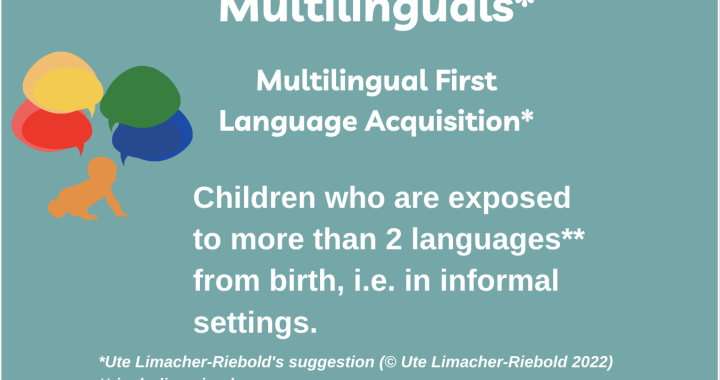
Simultaneous Bilingualism, or what Annick De Houwer defines as Bilingual First Language Acquisition is when children are exposed to two languages before the age of three, and they become verbal, or use, both languages in a comprehensive way. Some label these languages as La and L? to indicate the synchronicity with which these languages are acquired. An example would be, when one parent speaks language blue with the child and the other one language red.


There are also young children who are exposed to one language since birth and to the first additional language between age 3 and 6, so, before formal instruction. Annick De Houwer defines the way they acquire languages as Early Second Language Acquisition.


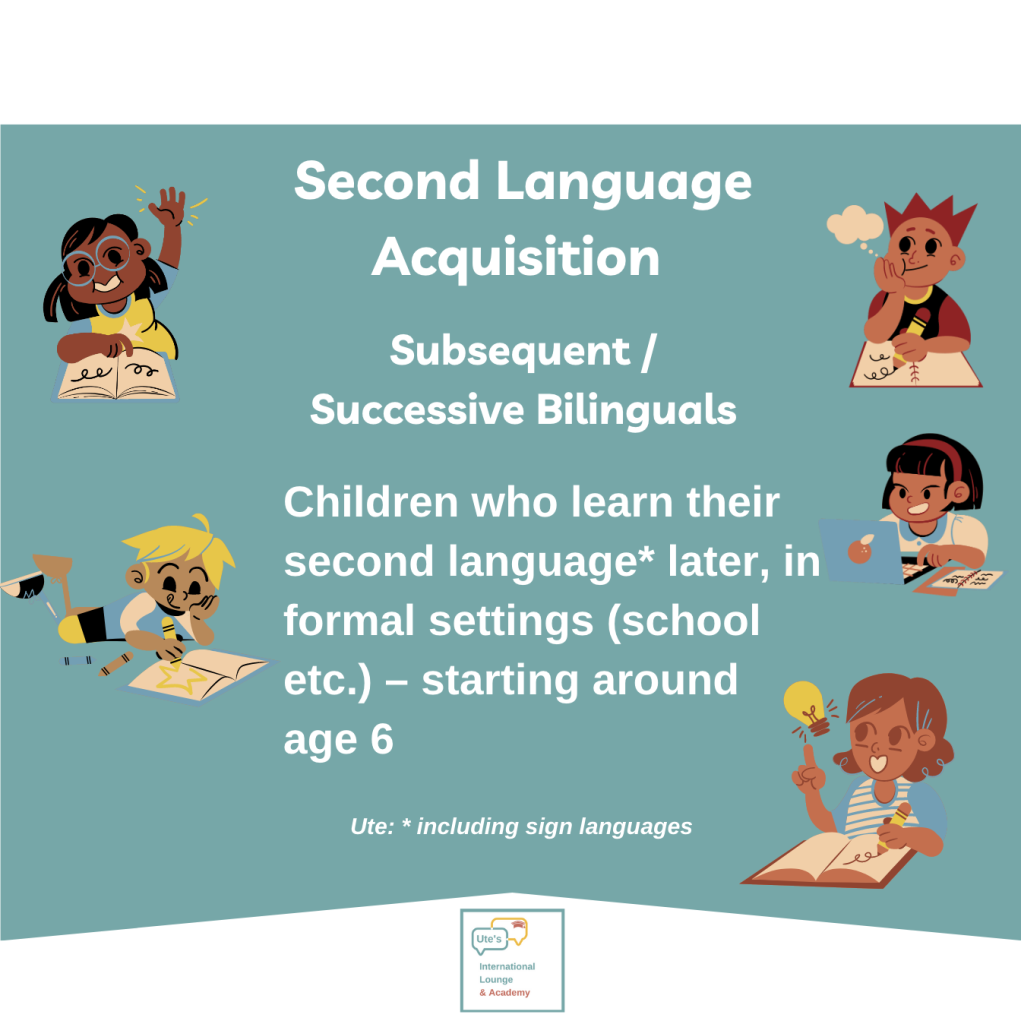
For older children, who grow up with one language and the additional language is added in formal settings, once they start school around age 6, we talk about Second Language Acquisition and Subsequent or Successive Bilinguals.


These categorizations are important for researchers to make sure to compare children who were exposed to similar situations when studying the way children use their multiple languages. Children who use several languages from very early on approach additional languages in a different way. They have a broader variety of language skills to build on than those who were exposed to one language only. 


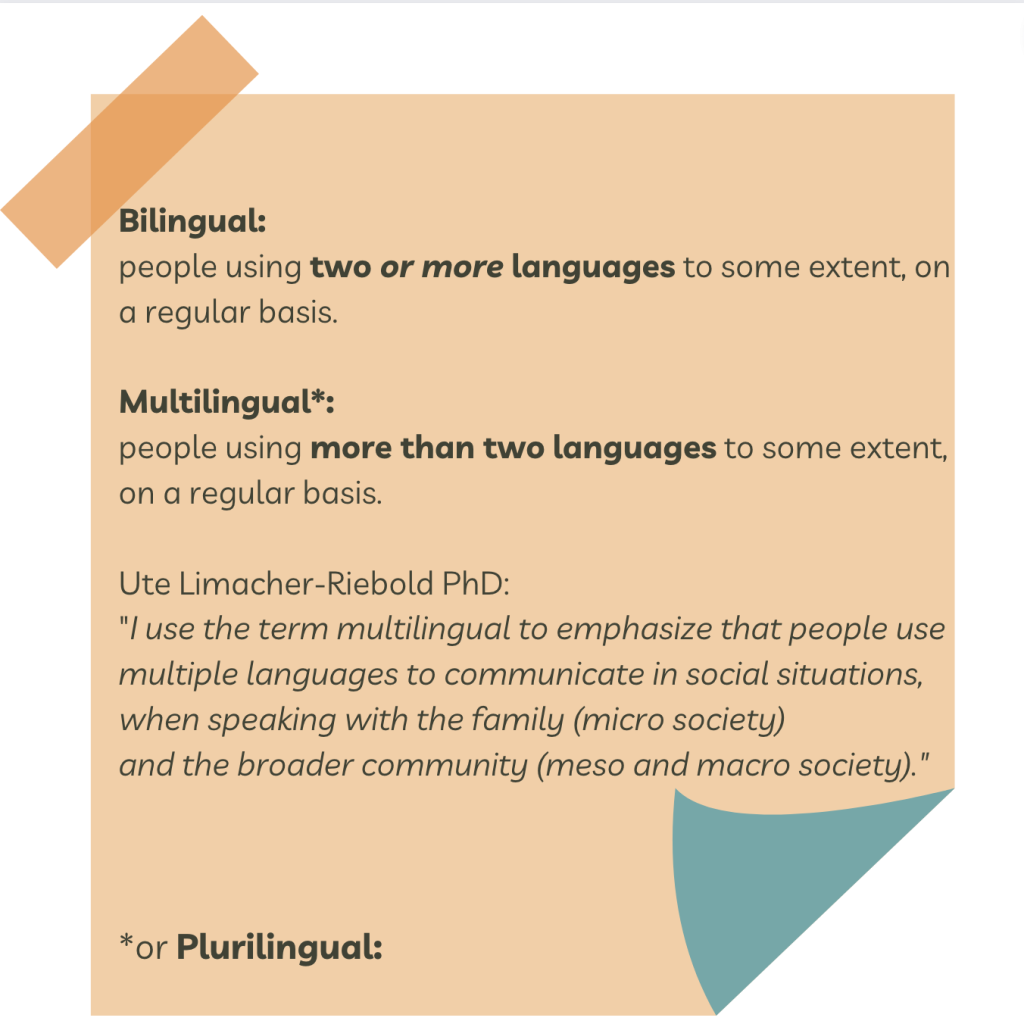
On a little side note: the term bilingual can be used for people using two or more languages to some extent, on a regular basis. I personally prefer using the term multilingual for people who use more than two languages to some extent and on a regular basis, because I emphasize that they use them to communicate in social situations, when speaking with the family (micro society) and the broader community (meso and macro society).


As a multilingual, I miss an equivalent for multilinguals like me, my children and my clients, who start with 2 or more languages very early on and add new ones across the lifespan. They could be simultaneous multilinguals as multilingual first language acquisition takes place (to transform or adapt Annick De Houwer’s term to the multilingual context). So, when considering the children, they would be Early Simultaneous Multilinguals.

You may wonder why we would need this term. I have seen how parents of early simultaneous multilinguals were asked to indicate their first two languages, their most dominant language (singular!) when applying for schools. Most of them had two or more languages that were dominant in their life and they used on a regular basis. By reducing the options to two languages for 3 to 6 year old children who start preschool and school, in my opinion and experience, we limit the possibilities of these children. When teachers do not know or do not acknowledge the full potential, the repertoire these children already have when they enter the school system, we intrinsically deprive them from improving their language skills and expect them to narrow their focus on the school language only. Furthermore, teachers need to know how multilingual children learn additional languages, how they connect them to those they already know and how they manage to transfer the skills from one language to the other!

Multilinguals who start school, have a great advantage when adding a new language as they can build on a broader foundation – think about the vocabulary in each language, the great variety of sounds they can articulate, the many ways they use intonations across their languages, and what they figured out about the patterns of the respective grammar (how words are formed (ex. how to form a plural, adjust the verb to the subject etc.) how sentences are formed etc.!


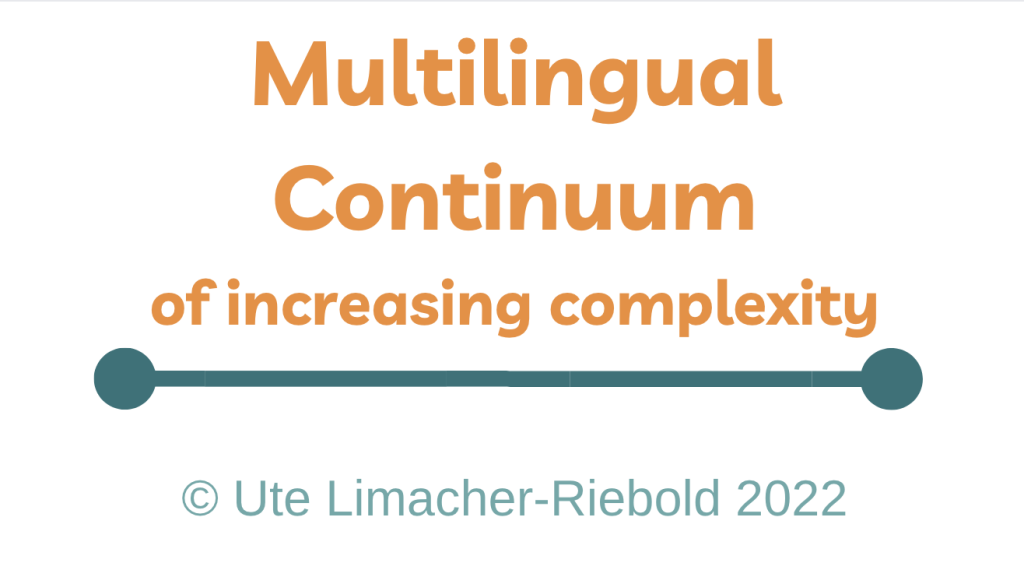
I like to consider being or becoming multilinguals – and actually also staying (!) multilinguals across the lifespan – like a multilingual continuum of increasing complexity.


In fact, multilinguals for whom using multiple languages is the norm, and who grow up in an environment that supports their languages in a healthy and nurturing way, will improve their language skills and add more languages to their repertoire. 

When trying to use similar terms for older multilinguals, using the term of “subsequent” or “successive” multilinguals doesn’t seem adequate exactly for the reasons just mentioned: we benefit from a broader foundation of languages but also because our way of learning, approaching new, additional languages is different from those who were exposed to only one language earlier. It is more natural, spontaneous, and similar to how we acquired the first languages. We intrinsically compare the new language to the ones we know, thanks to our metalinguistic awareness that we develop very early on, we compare possible patterns and proceed by trial and error. The most important reason for multilinguals to keep nurturing their languages across all phases of life is that they can benefit from the cognitive advantage, when we keep on using and learning them. As languages changes constantly, we can never finish learning a language – I personally find the German term auslernen more accurate.


As I am suggesting some new terms to use with regards to multilinguals, I am curious to know what you think. I am happy to continue the conversation in the comments.
If you are multilingual yourself: are you currently learning a new language, or what are you doing to nurture your languages throughout the years? I’d love to know!


De Houwer, Annick, 2009, Bilingual First Language Acquisition, Multilingual Matters.

You can watch my video about this topic here:


Parents’ roles when communicating with children

Have you ever noticed that you change your attitude or your "role" when talking with your children in different situations?

These roles are influenced by our personality, our idea of parenting, our own communication style, the challenge of everyday situations and our children's communication styles...

What seems easy or obvious in communicating with anyone  – not only our children! – is not! 


Elaine Weitzman (2017) emphasizes 6 typical roles of parents when communicating with children:

  • Director role
  • Tester role
  • Entertainer role
  • Helper role
  • Mover role
  • Watcher role

In the following I explain how Elaine Weitzman defines each role and explore it for any kind of communication with children of different age and skills.


We play the director role when we decide what our children wear, eat, when they do homework, go to bed etc. When we play this role we tend to do more of the talking and tell our children what to do, how to do it, when, and when not... We tend to speak to our children – not with them! When playing the director role, we are not engaging in a conversation

Typical situations when we play the director role are:

  • when we are in a hurry,
  • when our children are in a hurry,
  • when we are stressed,
  • when we are tired,
  • when things need to be done quickly/efficiently...

How to get out of the director role: 

  • let our children decide what to wear, when and how to do things.
  • let them lead the conversation, game, activity.


We play the tester role when we want our children to learn a new skill, or literally "test" them on a new skill... When our children are not developing language or any skill as expected, we tend to work even harder to help them learn. We become insistent (almost nagging). We take the role of the tester, asking lots of questions to find out what our children have learned.

Typical situations when we play the tester role are:

  • when we are insecure about our children's skills
  • when we worry about our children not meeting someone's expectations 

How to get out of the tester role:

  • observe our children whilst using the skill
  • try to enjoy the moment with our children whilst hey are using the skill 


We play the entertainer role when we have fun. We then tend to do all it takes to keep our children amused. We tend to do all the talking and playing, and sometimes take the lead...

Typical situations when we play the entertainer role:

  • during celebrations where there are other children, friends, family members present,
  • when we feel like we need to "entertain" to bridge the gap (for example the silence gap between cultures, ways to do things etc.)
  • when we feel insecure about something, and taking control reassures us

How to get out of the entertainer role:

  • "pass on the baton" to someone else, our children for example
  • change into the role of a "participant" of the game or activity 


We assume the helper role when our children have a hard time. We then tend to do everything to make life easier for our children. If our children are emergent speakers, we might tend to respond to our children's gestures instead of fostering their verbal skills. If they are older and struggling with communicating, we tend to "solve the problem" by talking on their behalf...

Typical situations when we play the helper role:

  • when our children are struggling, or seem to be struggling
  • when we are worried about our children's wellbeing
  • when we assume that our children need our help

How to get out of the helper role:

  • take a step back and see how much help, and what kind of help our children actually need
  • consider if "not helping" could be a way to help instead – not helping doesn't always mean "not caring"!


We play the mover role when we keep on determining the pace. 

Typical situations when we play the mover role:

  • when we are in a hurry,
  • when we are busy and the schedule doesn't (seem to) allow us "time" or any delay

How to get out of the mover role:

  • slow down: adjusting our pace doesn't mean to stop moving...
  • acknowledge that we are under time pressure and find out how we can avoid this


We play the watcher role when we are watching our children without interacting with them, when we don't join in when they play, read or talk. We sometimes end up only commenting from a distance.

Typical situations when we play the watcher role:

  • when we are not sure about our role in the situation (how much and what we are allowed to do)
  • when we are tired/exhausted (in need of a break)

How to get out of the watcher role:

  • ask what we can do, how we can participate (in the play, game, activity, conversation...)
  • adjust to the children's pace and level, and find a common ground to interact


If you notice that you tend to play the same role in different situations when interacting with your children, try to "get out of that role" and tune in with them. Tune into your children's interests, pace to do things and way to communicate.

Especially when we use also different languages, communication can become way more complex, and the role we play in conversations with our children can depend on the confidence we have by using the target language. The same applies to our children and every other person involved in the conversation or communication. 


If you observe that another adult – your partner, a caretaker, a teacher, a professional – plays a role with your child that doesn't seem to lead to an effective communication and healthy connection, consider sharing these tips with them.


If you want to know more about how to foster effective communication in your family, with your children, then contact me to explore ways that I can help you.


This post is inspired by Elaine Weitzman (2017) It Takes Two To TalkA Practical Guide for Parents of Children with Language Delays, Toronto ON, The Hanen Center. I have developed the tips she shares in the book and on the website, and adapted them to the communication with children in general, and multilingual children in particular.

Telling time across languages…

Image by MoteOo from Pixabay


Are you able to tell time in all your languages?

Speaking several languages doesn't mean that we feel confident in telling time in each of them. When we switch from one language to the other, we may prefer a more generic way to tell the time in order to avoid misunderstandings, when agreeing on an appointment for example.

Fact is that time can be indicated in different ways even in the same language, depending on where you are / with whom you are speaking.
In German one can say "viertel vor zwölf" or "dreiviertel zwölf" (lit. three quarter twelve) for "quarter to twelve", depending on the region.

"Viertel zwölf", literally "quarter twelve" actually means "quarter past eleven", 11:15, which is "a quarter of the 12th hour".


©dreiviertelzwölf.com


I personally find it difficult to switch between ways to tell time in German. I prefer checking twice to make sure what the person means when using "viertel" (without "vor" or "nach" – in oral speech people tend to talk fast and sometimes omit the preposition...) and "dreiviertel" to indicate the time.

If you read German, I invite you to have a look at a funny comic in the German newspaper Die Zeit, where they illustrate the difficulty of understanding the various uses of indicating time in German.

In one comment, "Norbert Z" says: "Außerdem ist drei viertel Acht genau eine halbe Stunde nach viertel Acht, und eine halbe Stunde vor viertel Neun. Außerdem darf sich jeder, der sich um viertel Neun mit anderen verabredet hat, stattdessen auch um viertel nach Acht erscheinen." / "three quarter eight is exactly half an hour after quarter past eight, and half an hour before quarter nine. Furthermore, everyone who arranges to meet at quarter nine, can also show up at quarter past eight"

The use of "half seven" in English, meaning 6:30, and "half zeven" in Dutch and "halb sieben" in German all indicate 6:30.

There are also ways to tell time more precisely, like in Swiss German: "foif voor halbi zwölfi" "five minutes before eleven thirty / half twelve" (11:25), same in German "fünf vor halb zwölf" or "fünf nach halb zwölf" (resp. 11:25 or 11:35). In Dutch we also have: "tien voor half drie" which means "ten before half three / half past two", i.e. "twenty past two" / "zwanzig nach zwei" (2:20) or also "vijf na half vier", "five after half four/half past three" (3:35) or "tien na half vier", which is "zwanzig vor vier" in German (3:40).

When learning a new language, being able to tell the time is part of the first lessons. Nevertheless, we if we usually learn the standard use of time telling, not the regional variants. When children are schooled in an additional language, teachers often assume that they learn how to tell time in their home language and the school language, and expect children to be able to use the school language spontaneously.
Not every multilingual family teaches how to tell times in all their languages as it can be quite different from language to language, and many parents find that it is more important that their children know how to tell and read the time in their school language.
I personally find that being able to tell the time in all our languages is part of the general life skills our children need to be able to do – and we, adults too! – in order to function in those languages.

When I asked if people are familiar with different ways to tell time in my facebook group, this is what some replied:

"When I talk to people from English speaking countries in German and we have an appointment at 12:30 and they say "Wir treffen uns um halb zwölf, oder?" I usually just agree. Never failed to be there in time because I know they really mean "halb eins", but the English "half twelve" interferes too much." (B.H.)

"I love Swiss German with its 'foif ab halbi zwölfi' (five past half past eleven) for 11.35 - this totally messed with my mind when I first heard it. Far too much Maths involved there for me (and I apologise for the horrendous spelling of the CH-De!)" (H.S.)

"The funny thing is, I learned "halb zwoelf" in German, before I ever heard "half twelve" in English, my native language... Just as I got used to it meaning 1130, I now had to learn it means 1230 in English!!! (because that seems to be a British thing and I'm Australian)" (F. C.)

And as time is considered in different ways across cultures – some use linear time others a more flexible one (or monochronic vs. polychronic): "When you are married to an Arab you need to check if they mean they will be back in an hour by the clock or an hour that extends as long as required" (J. OB.)


About UhrStunde in German, uur in Dutch, and why we can't say "es ist 13"...

Another interesting difference is the use of "Uhr" or "Stunde" in German, in contrast with "uur" in both contexts in Dutch. "Uhr" doesn't only define the object of the watch in German, but also the "time", Uhrzeit. It goes back to the Latin HORA "time, time of the year, time of the day, hour", for when we say "es ist fünf Uhr" (it is five o'clock). Uhr remains singular at any time it refers to (the same ways we don't say *it's five o'clocksBut in German we can also omit the word Uhr to tell when we're meeting: wir treffen uns um drei, the same way we can say it in English: we meet at three. Only when we use the 24 hours system, after the 12th hour we need to add "Uhr": wir treffen uns um dreizehn Uhr (lit. we meet at 13 hour), which applies to the time between 13:00 and 24:00. This kind of indicating hours of the day was introduced after WWI and are used in official settings. In this interesting article about this fact, they point out that the expression jetzt schlägts aber dreizehn! (lit. now it strikes thirteen) with the meaning of "now it's enough!", was in use before introducing the 24 hour countings, since the late 19 century. The reason for this expression was that, as the clock can only ring 12 times (and then starts from one again), and saying that the clock now will "strike thirteen" indicates something that goes beyond the possible or acceptable!

Do you have similar sayings in your language? 


  • I'm curious to know: can you tell the time in all your languages?
  • Can your children tell the time – also in different ways – in their languages?
  • Do teachers at your children's school teach different ways to tell times across languages?
  • What kind of telling languages do you prefer, feel more comfortable with?

 This is an ongoing post, which means that I will be adding more information, anecdotes, experiences etc. 


Further readings:
Dreiviertelzwölf

Kaenguru Comics in DIE ZEIT


From Cultural Identity Model to Language Identity Model

Audio From Cultural Identity Model to Language Identity Model UIL

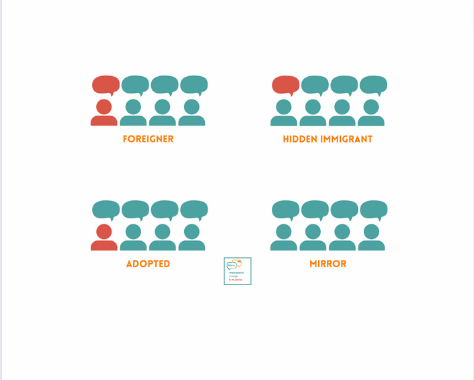
I recently translated the Third Culture Model into a Third Language Model for multilinguals, and I want to share my translation of the Cultural Identity Model from D. Pollock and R. Van Reken, into my Language Identity Model©:

(my design is inspired by the Cultural Identity Model by

Ruth van Reken and David Pollock)

There are many ways to represent or analyze acculturation, and John H. Schumann already made the link between acculturation and second language acquisition in the 80’ies, based on the social-psychology of acculturation, and I find that the bi-dimensional acculturation model based on John Berry’s research (1980) very inspiring when talking about the way internationals of any background and with all kinds of “reasons to spend time in the other country”.

It seems to me that Ruth van Reken and David Pollock were inspired by Berry’s model when they defined the cultural identity model Third Culture Kids: Growing up Among Worlds. I bridge between these models and approaches, searching for the similarities that can help to explain and understand the overall acculturation process also from a sociolinguistic perspective, that leads to what I suggest to call the a-languation process.

This process is closely related to learning and adopting the local languages, while maintaining to a certain extent, and in some cases, alas, the loss of the home languages.

I won’t bother you with a comparison and analysis of all these models that lead me to my Language Identity Model© and share only the outcome and some reflections here below.

I will start from Ruth Van Reken and David Pollock’s model (abbreviated in the following with RVR&DP), mention what Berry’s strategy would be called, and compare the different categories with the language identity stages of my model.

 ***

In Berry’s model, RVR&DP’s foreigner corresponds to what he describes in his separation strategy: when a person separates from the dominant culture, befriends only those with the same culture and adopts the new or dominant culture of the society.

The same way a foreigner can look different and think different from the locals in RVR&DP’s model, those who don’t speak the local language (yet!), feel excluded, separated, different. They might  be recognized by locals or by those who fully integrated into the society, as standing out for what they are wearing, eating, how they do things, like, for example, not using the common means of transportation like locals in RVR&DP’s model, and also be identified as foreigners for not speaking the local language.
I have modified RVR&DP’s model by replacing the “thought bubbles” with speech bubbles to emphasize the use of the local language (and its comprehension).  

Some internationals choose to stay in this stage for a long time, not wanting or finding it too difficult to integrate. They live in the so called bubble, where they function the best, feel more comfortable, find what they need and “can fill their cups”.

This is usually the first stage when one enters a new country or starts learning another language.

Hidden immigrants look very much like locals. Nevertheless, they might not share the same values and beliefs. The same applies for their language use that I highlight in my Language Identity Model©. They may use the local language, but not “sound” like locals – either because they have a foreign accent or because they use the language in a different way. It can be for example that they use the language in certain social settings only, but struggle in others, or that they don’t understand cultural references (yet), don’t laugh at the same jokes or don’t use the same metaphors when speaking. 

The Adopted ones in RVR&DP’s model think like locals but look different. In my model, they correspond to many multilinguals who also look different from the outside, but who use the language like locals, know the slangs, understand jokes etc.. Locals tend to approach them by speaking either very slowly or switching to a more dominant language (like English) and be surprised that they can reply fluently in the local language. – Internationals who live in one place for a longer period tend to feel adopted as they adopt the local way to express themselves. Although they try to fit in by embracing the same habits, wearing the same clothes, adopting the same traditions etc. their features will always make locals assume that they are foreigners. Like the little Italian boy who grew up in China and learned Chinese to a high level of proficiency, perfectly blended in language-wise, but who always surprised locals by being so fluent in their language and culture! 

The identity called Mirror in the Cultural Identity Model, corresponds to multilinguals who assimilated to the host language to such an extent that they sound like locals. They also look similar to locals, which, contrary to the Adopted ones, makes locals not switch to another language or slow the pace when they talk. Some internationals who fall into this category have abandoned their home languages, either in all social settings or only outside of home. There are many reasons for abandoning the home language: either for political or social reasons, or for generational reasons. We know that starting from the second generation of children / people growing up abroad, the chances of abandoning the home or heritage language grow. They fully integrate into the local society, culture and adopt the local language (or languages and dialects).

In children of mixed marriages, where one of the parents is a local and the language (and culture) of the other parent is deemed not to be important enough and ceases to be nurtured, we can observe a complete regression of this second, minoritized language, which leads to language attrition and can lead to language loss.

Some children who grow up internationally and repatriate during childhood tend to do everything not to stand out. Some even deny to even have lived in another country, and fake an accent when speaking one of their other languages, just to fit in. They tend to mirror their surroundings as much and as quickly as possible.

***

Although the different categories of cultural identity or language identity sound quite restrictive, there are mixed types of them that one can explain as follows.

As a hidden immigrant for example, or hidden multilingual, we are able to understand cultural norms in the host culture, be sounding like local speakers, while still fostering our home languages and cultures.

We can also be foreigners in one domain of life – at school for example – and a mirror at home, with the family, a hidden immigrant among people who share the same cultural background and adopted among those who share the same language.

Just to make an example. I am German and my parents instilled the German culture to me and taught me German. When I was 4, I asked my mother why our neighbors in Italy wouldn’t talk German with us when at our place. She explained to me that we were foreigners in the country, guests, and that our language at home was different from the one of our neighbors, of the majority. I had assumed that everyone would talk German at home and Italian outside home, like we did. Learning that this was not the case, and that we were “different” made me question why this had to be. I soon realized that the values and beliefs, the habits I was used to in my family, weren’t the same as those of my Italian friends. I felt like a hidden immigrant language-wise as I spoke Italian with them with no accent. I used the same anecdotes, laughed at the same jokes and read the same books.

I looked like an adopted person though, as my features are German. I learned to blend in among my friends at least through the language, I used their slang and suppressed my cultural and linguistic heritage, mirroring the local culture and language. I remember feeling embarrassed by the very loud behavior of German tourists, like my Italian friends, which lead me to avoid speaking German in public. 

This attitude and feeling towards my languages has changed many times during my life and I find it highly fascinating to see, how our identity is determined by different factors in the various phases of our life.

We can unite all these identities in different contexts, at different stages, immerse or distance us from the local culture and language, whenever we consider it appropriate, safe, interesting or expected.

I think like all children who grow up abroad, I have been asked which language or culture, country I prefer, people wanted me to choose between the languages and cultures: I usually avoided to answer or, if I wanted to not discuss this any further, I answered what they expected, just not to have to deal with it.

To my children who grow up abroad too (in a different country than I or my husband), and to the families I support, I always advise to answer this kind of question with “I’m not only… but also…”, not only with regards to their cultures but also their languages, their habits, beliefs and values!


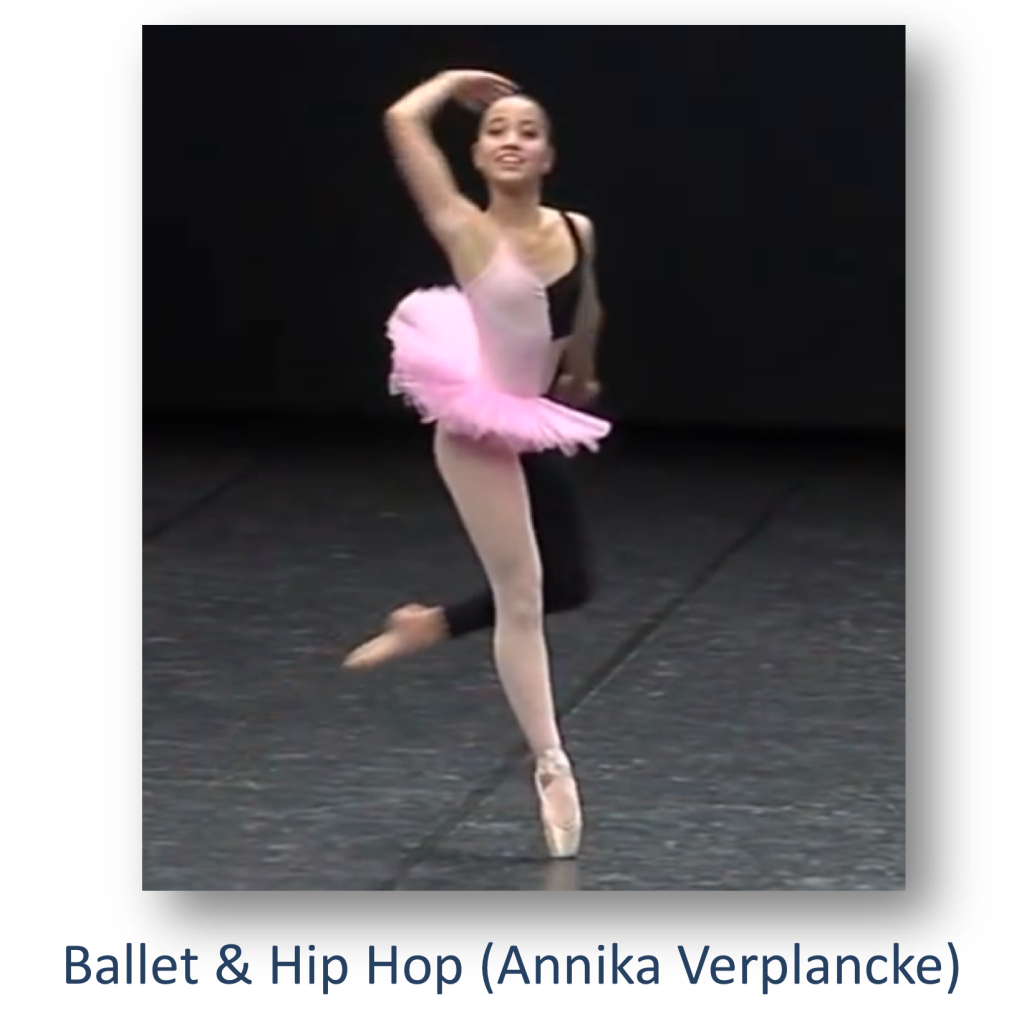
As I personally thrive whenever I can speak all my languages and embrace all my cultures without having to choose one, I like to compare this feeling with the performance by Annika Verplancke, who combines harmoniously Ballet and Hip Hop in one dance.

We and our children are both or all of the cultures and languages we embrace and learn and instead of thinking in a subtractive way, one where we need to use or be one OR the other, we should always (!) emphasize that we are both or all of them, in an additive way.

watch the video here

This is an “ongoing post”, which means, that I will work on it regularly, update it. Please share your thoughts, experiences, insights with me in the comments: I’ll be happy to mention them in the post!

John W. Berry, Acculturation as varieties of adaptation, in A.M. Padilla (ed), Acculturation: Theory, models and some new findings, p.9-25, Boulder, CO: Westview Press, 1980


I invite you to also read:
The Language Portrait

Do multilinguals have multiple personalities?

The Third Language Model

How to portray, feel and explain language use for a multilingual

Multilingual Language Timelines

The thought provoking article by Ruth Van Reken in Among Worlds about Cross Culture Kids (and the many other ways to describe children growing up abroad):  How CCK came to be.

Native Teachers or Non-Native Teachers – that’s NOT the question!

When choosing a daycare, preschool or school for our multilingual children, many of us parents tend to prefer schools with native-speaking teachers. The main reason for this is that we want our children to get the “best” exposure possible to the target language, as we might not use that language at home, which then justifies their expectation that the  teacher “should not have any bad accent”. This means that the teacher should model a way to use and pronounce the target language the closest possible to a native speaker. I completely understand this and, to be honest, I thought the same when my children started attending the British School and when I noticed the difference in speech among the 3 teachers that were teaching their year group. It is a very understandable worry of parents who are not that fluent in the language, to hope or wish for the best possible input. 

I found my reaction very interesting because on one side I was this parent who wants her children the best possible language model, because that would be the only (!) or one of the few people providing input in the target language for my children! This is a need for us multilingual families, and not everyone understands this. But I also quickly understood that my children would be interacting, communicating with a great number of other staff members, teachers, children in that target language and this on a daily basis! The other children were a great mix of English speakers, i.e. who would only speak English at home, and others, like my children, who would speak another or a set of other languages at home. This meant that they were immersed in a variety of different ways to speak the school language, which I knew was exactly what they needed!

I know that many parents fear that a non-native speaking teacher “might pass on mistakes” to their children, and I know how much one can struggle when a child says something in the school language that “sounds wrong” and we immediately fear that they picked it up wrong. This is usually not the case. When our children say funny sentences, inverse the word order or use words in a funny way, it might be that they are experimenting with the language which is a very important step for every language learner: to try out and learn by “trial and error”!

Let’s also address the “native speaker” and the myth that comes with it. What would a “true” (whatever this means) “native speaker” sound like? Like an Oxford Dictionary? I mean, an online one where one can click on the audio and get someone (who is it by the way?) articulating the word in a way that sounds “right”? – I invite you to listen to some words (that can be pronounced in the British or US way: https://www.oxfordlearnersdictionaries.com/) 

Native speakerism is overrated

A part the fact that “native-speakerism” is highly debated*, what one should focus on is rather the ability of the teacher to teach in a way that the children can understand and learn.

Being a native-speaker, doesn’t make a teacher implicitly a good or better teacher. I have seen many native speaking teachers who were not trained to teach children who use also other languages, and some others who were trained for it, but never (!) experienced learning another language themselves, and therefore proceeded “by the book” but were not able to actually comprehend what was going on with the multilingual children in their classroom, why this Dutch child would use “who” instead of “how” for example – the reason for this is simply that in Dutch “hoe” is pronounced like the English “who” and means “how”…


Floating Idiomas (FI) indicates 4 reasons why “native teachers” are not always better than “non-native teachers”


Non-native teachers:

– are accomplished language learners,

– have actively studied the grammar and vocabulary,

– focus on personality not nationality.

“Research finds that non-native teachers usually prepare their classes more precisely“.

At this point I would like to thank Floating Idiomas for the interesting discussion we had on social media about this and for inspiring me to write this post.


Native teachers are not a guarantee for quality. Not even for a high standard (whatever this means!) or standardized pronunciation because everyone has some kind of an accent, depending on the region he or she is coming from.

Non-native teachers, i.e. teachers who have acquired or learned the language as LX (X= at any point of their life as additional language), have learned (at least) another language in addition to their L1 (first language), and therefore have developed learning strategies that they can use in the classroom and emphasize more with students who learn the language as additional language. They also have a metalinguistic awareness that one can only acquire when learning languages in formal settings. You would be surprised how many teachers I have met who would not know the difference between adverbs and adjectives, or direct and indirect objects – this is, just on a side note, one of the (many!) advantages of multilinguals!


The teaching environment plays a fundamental role for the teacher and the students 

The level of proficiency seems to play an important role for the teachers’ attitude, the intrinsic motivation and many other factors that Prof. Jean-Marc Dewaele and Pearl P. Y. Leung have analyzed in their study about the feelings and self-reported behaviors in non-native EFL (English ad Foreign Language) teachers with proficiency levels between B1/B2 and C1/C2. They analyzed the teacher’s attitude toward the students and the institution, the classroom practice, the intrinsic motivation of the teacher, their introjected regulation, motivation and wellbeing.

The quintessence of their study is that the more confident teachers are in the subject they are teaching, the better the class environment for the student and the teacher, the better the outcome.


I invite you to watch this interview about “non-native English teachers” and the other one, with David Crystal, about “The Myth of the Native-Speaker”. By the way, what is said in this video about English, applies to other languages too!…


(you can listen to the whole interview here: https://anchor.fm/canguro-english/episodes/The-myth-of-the-native-speaker-with-David-Crystal-eevs87)


Interesting fact about LX teachers

Most studies on this subject are about English teachers, and it is interesting to see that not everyone is aware of what it takes to become a teacher of English compared to other languages around the world.

So, for example, not every teacher who teaches English in a classroom, has studied English language and literature. This is a detail that gets often neglected…

To teach in a state school in England, you must have a degree, and gain Qualified Teacher Status (QTS) by following a program of Initial Teacher Training (ITT).

You must have achieved minimum requirements in GCSE English, maths, and science if you wish to teach at primary-level. You can teach in independent schools, academies, and free schools in England without QTS, but it’s a definite advantage to have it. (UCAS – Teaching in England)

The “degree” mentioned here above can be in any subject area, not necessarily English Literature and or Linguistics. One can also become an English Second Language Teacher by acquiring the TEFL (Teaching English as Foreign Language) or TESOL (Teaching English to Speakers of Other Languages) certificate.

Like mentioned in this post about the requirement of teachers, “you don’t need to possess a degree in education, prior teaching experience, or even a college degree to get paid to teach English abroad. At minimum, you need a certification to teach English abroad. Private language schools abroad, online teaching companies and government programs that recruit native English speakers to teach abroad all seek to hire people who have received a certain degree of professional-level training.” 

The requirements for becoming a teacher in any language, as first or main language or additional language, differ considerably across countries, which leads to misconceptions and various expectations from parents when enrolling their children to a school where “English being taught by native speakers” is one of the assets. 

Some of the most important take aways from Dewaele and Pearl (2022) study are that besides the fact that “teachers with B1-B2 levels scored significantly lower than colleagues at C1-C2 levels (…)”, this has “important pedagogical implications (…) [as it] could be used as an argument for educational authorities to assure that teachers have sufficient proficiency and organise regular in-service training to maintain and boost that proficiency” (p.29).

Therefore, C1 as a “threshold for graduate students and for English LX users who wish to enroll in teacher training courses” is spot on. It seems to me very logical that “the more proficient we are in a language, the more confident we become“. This applies not only to teachers but to everyone, in every domain, including students. 

One very important aspect that parents, principals and policy makers tend to forget when it comes to non-native speaking teachers is that they most probably share another language with their students, which means that they have experienced first hand learning the language and can bridge between the languages when explaining concepts, words, complicated structures, semantics etc. using metalinguistic reasoning in a very spontaneous way. This, of course, also applies to those teachers who have learned additional languages to the one they are teaching – for example a British teacher teaching English but using other languages too.

What does the job market say about this?

One thing is for certain: both NESTs (Native English Speaking Teachers) and NNEST (Non-Native English Speaking Teachers) can make great teachers; it just depends on the individual [and his or her education and qualifications! (my addition)].

But NESTs have a head start in that the vast majority of jobs require native speakers. In fact, on tefl.com, a leading website for English teaching jobs, only 30% of jobs don’t require the applicant to be native. (see: Europe Language Jobs)


The fact that native speakers seem to easier “get the job” is changing. If you wish to get some insights into the language teacher market and also the differences, advantages and disadvantages of native and non-native speaking teachers, please watch the following interview. Although the target group of this interview are teachers, it is important also for parents or language students to learn about how to identify a suitable language teacher.


My tip for parents and for language learners is to get informed about the education, the qualification of the teacher, and if the teacher knows other languages too. A teacher that never has learned any language, didn’t make the experience about what it means to learn a new language from scratch, and will most likely not be able to help the student to find strategies to learn the target language, and bridge between the languages. Bridging between languages is ultimately what multilinguals do. We try to find what our languages have in common and sets them apart.

Last interesting fact shared in this video: did you know that 80% of conversations in English are among non-native speakers?

I find this even more important because when learning from a great range of speakers of the target language, we learn a broader variety of ways to use the language – different intonations, accents, terms, meanings of words etc. – which, in international settings, allows us to communicate more effectively. Instead of being distracted by the accent, and focusing too much on the “right (whatever this means) pronunciation”, we focus on what is said, the content! 


Or, to quote Jean-Marc Dewaele: “(A) fresh, more positive perspective is needed, informed by Positive Psychology. In this new perspective, progress in the new language is celebrated and encouraged and FL [Foreign Language] learners and LX [Additional Language] users are presented with a realistic goal of becoming functional, legitimate LX users rather than being pressured by an unrealistic expectation of sounding like L1 [First Language] users of the target language. This positive turn will also be a relief for teachers because they will realize that they can guide students to achieve these attainable goals in a positive classroom environment. By throwing off the shackles of the NS [Native Speaker] model, they will no longer face a classroom of anxious, discouraged and silent students, but they will be able to create enjoyable, exciting classes where students will participate, learn and thrive.”

Last but not least, I invite you to watch the our interview with Prof. Jean-Marc Dewaele at Raising Multilinguals LIVE:


****


If you are not sure about the choice of your teacher or the school for your child, please read New school. New routine. New languageFind the right school for your children

Please read also this post about The importance of developing multilingual listening skills


And if you prefer reading or listening to this topic in Italiano: posso raccomandare questo contributo (podcast) da parte di Prof. Santipolo: https://radionumberone.it/podcast/prof-santipolo-non-tutti-madrelingua-sanno-insegnare-proprio-idioma/


*Jean-Marc Dewaele, Thomas H Bak and Lourdes Ortega, Why the mythical ‘native speaker’ has mud on its face, in Nikolay Slavkov, Nadja Kerschhofer-Puhalo, Sílvia Maria Melo Pfeifer (Eds.), 2022, Changing Face of the “Native Speaker”: Perspectives from Multilingualism and Globalization, Mouton De Gruyter.


When learning languages, is the earlier the better?

Multilingual Parents are often keen to speak several languages with their children and can’t wait to introduce more languages. In the end: the sooner the better, right?

Well, not really. If we shower our children with a lot of languages from early on, without them needing them it can become a challenge to maintain them. Also, there is no window that closes “à tout jamais” / “forever” when it comes to language learning!

Research about the “Critical Period Hypothesis” first focused on monolinguals, and has since been adopted also for additional (second/third) language learning. It was originally describing a “closing window” for first language acquisition, and refers to the concept of a critical period in the biological sciences, which is a set period in which an organism must acquire a skill or ability, for the organism not being able to otherwise acquire it later in life.

Research has since fine tuned on some aspects of language acquisition like our youngest one’s understanding language and re-producing (articulating) sounds, compared to older children.

What most people seem to retain from this is that “young children acquire and learn languages “much easier” than older ones or adults”.

But the “much easier” needs to be clarified: young children acquire language in a more spontaneous, natural way, by repeating, making mistakes, finding out the patterns (aka underlying grammar) of the language, the “easier” way refers to the fact that the process is more “unconscious”. They can articulate sounds easier than adults, due to their palate being still soft – it hardens during puberty, making articulation more difficult.

Furthermore, the older the child, the more conscious every learning process becomes, and the “less easier” it is described or considered, which, if we think about the lifelong learning journey, is just not very accurate.

The “much easier” learning in early years is rather more “intuitive/natural/spontaneous”, whereas the “less easier” later is a more conscious way of learning which, on the other hand, profits from the already acquired patterns, logics and cognitive skills the person has acquired by then. In fact, older learners are better at learning the language on a morphological and syntactical level.


Brain lateralization was once seen as a possible neurological cause, but this theoretical cause has been largely discredited since lateralization does not necessarily increase with age, and there is no definite link between language learning ability and brain lateralization… The advantage of the children’s brain is “the still in development phase” of the prefrontal cortex (which takes up to 20ish years to “complete”!) which makes things “easier to learn” but also easier to forget or drop if not needed. So: it is easier for young children to “absorb a considerable quantity of data”, and this is the “advantage”.


But one needs to know that the young brain doesn’t distinguish between “good or bad”, “useful or not useful”. This unconscious or absorbent mind (Maria Montessori) has its advantages, but also disadvantages. The advantages are that it absorbs everything, “like a sponge”. This is most probably where the assumption that children “absorb everything” comes from.


The disadvantages of this “absorbing everything” is that when it is not needed, it will be pruned. In fact “use it or lose it” is a very easy way to explain how the brain works. I invite you to watch this short video about the adolescent brain and learn more about the myelination that is so important to make learning faster and more efficient!


Although children’s brains have a massive growth spurt when they are very young, by the time they are six, their brains are already about 90-95% of adult size. The early years are a critical time for brain development, however, the brain needs a lot of remodeling before it can function as an adult brain.


About the Critical Period Hypothesis, please watch our interview with Prof. Shiro Ojima and the one with Prof. Arturo Hernandez about “How children and adults learn languages” at Raising Multilinguals Live:


What is needed and used regularly (!) will be consolidated and will help with further learning. We all never stop learning – unless we stop being curious. In this interview with Dr. Thomas H Bak we talk about bilingualism and the brain,


The learning experience and the skills we hone change over time, and that is what makes people assume that “the earlier the better” because young children, who, like briefly mentioned above, have a malleable palate, i.e. that allows an easier articulation of sounds, sound like “perfect native speakers” very quickly, whereas older learners, whose palate has hardened and who therefore need more practice to “sound” native, are thought to be unable to reach high levels of fluency.

But older learners make up for this by bringing experience, acquired and learned patterns and consolidated pathways that allow them to quicker understand how the other language works and can be used. The way we learn and understand changes over time and depends on many factors, but we can learn languages – and all kinds of skills for that matter! – at any age.


Here is a short video I made about this topic:


When our children grow up with 2-4 languages already, the seeds for easier access to additional languages later in life are planted, and it will be much easier for them to learn any additional language at any stage. There are more windows of opportunities, like shown in this video about the adolescent brain by UNICEF:


Adolescence is a very intense period of significant growth and development inside the teenage brain. The main change is that connections that are not used in the thinking and processing part of the brain (i.e. the grey matter) are pruned, and those that are used are strengthened. This is the way our brain becomes more efficient and follows the “use it or lose it” principle mentioned before.

In this interview with Frances Díaz-Evans, a Latina educator, author, wife and mom to a teenager, we talked about this aspect in the context of How parents can help their teenagers in their language learning journey


So to answer the question of the title: no. The earlier is not “the better”, it’s the “easier” in terms of understanding language patterns in the most unconscious and natural way, but later language learning has its other advantages as the older learner can build on acquired and learned patterns easier. What is better or best though, is to keep stimulating our children’s brains from the beginning, through childhood and beyond, and make sure they are up to a lifelong learning journey that keep their brains healthy and their minds curious as long as possible.


This topic is highly discussed among experts and this post is an “ongoing” one, that I am happy to update with further insights and research findings. If you are a researcher, please let me know what you know and think in the comments. I’ll be more than happy to include it in the post if it helps to clarify the topic.