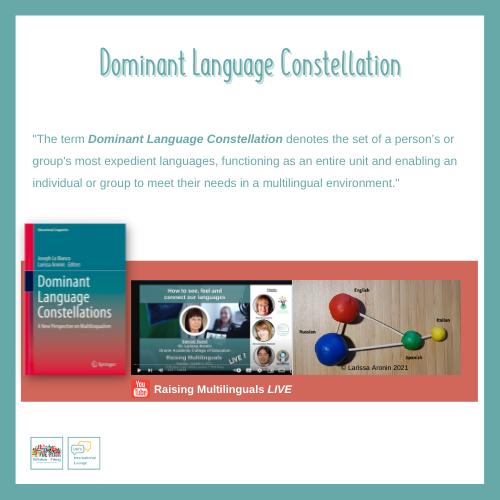
When we raise our children with multiple languages one of the most important things to consider is how we, the parents/caregivers, acquired and learned our languages. Our own experiences with acquiring and learning languages determines what we expect from our children, and our expectations can be realistic, motivating, positive or demotivating, discouraging.
If you would like your multilingual language timeline to be shared in this post, please email me at utesinternationallounge@gmail.com with the subject "My Multilingual Language Timeline".
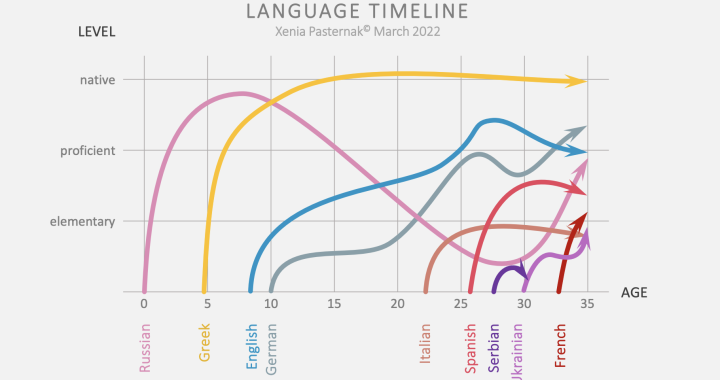
Xenia shared this multilingual language timeline with me. Born in Kyiv, she relocated to Greece at age 5 and to Germany when she was 30. Her current prevalent language is Greek – although it is not her mother tongue. In her twenties she discovered her love for languages. She worked on international projects. She learned Ukrainian as it was a prerequisite to get a job in Berlin, which she gladly welcomed as an excellent opportunity to get back to her roots. She also revived her Russian. When her daughter was born a year ago, she decided that she needed her first language, exposing her to the spectrum of Slavic languages. Following the recent events, she could not help but continue with Ukrainian.
She learned Italian when she found out that languages are fun and not so difficult as previously expected. When the universe sent her a Chilean friend as her first Spanish teacher it took her 6 months to get the Cervantes B2, 3 more to get the C1 certificate. Serbian was a short but intense relationship after she spent two weeks restoring wineries in a tiny Serbian village. She interrupted this stay to study English language and literature in Thessaloniki, while also working. When she came to Berlin, she organized two architectural competitions in Kyiv and then in Ottawa and Brussels. Fate, again, signalized that she needed to start with French. Once her daughter was born, she dropped it for Russian. Xenia's name is Greek, but she looks Ukrainian. Currently, she uses more Greek (as family language and among friends), German (as community and work language), English (at work and with friends), Russian (approx. two hours per day with her daughter and when they meet her little friends).
Julia Wilsch, a German mother of 2 children, living in the Netherlands, has shared her very diverse language journey with me. She spent the first 11 years of her life in Germany, where she attended a local primary school. During that period she grew up with German and Arabic (to a certain extent through music and the family's acquaintances), thanks to her mother who had studied Arabic. As they were always surrounded by Arabic speaking friends, it felt very natural to acquire the language later on in her teenage years and helped to develop her general language skills. When Julia was almost 12, they moved to the UK where Julia and her younger brother attended school in English. She had learned some English at the German school previous to their move, so the transition wasn’t too difficult, but thanks to some EAL lessons and lots of children's series on TV, friends and further exposure in daily life, she settled in relatively quickly. After 3 years in the UK, her family spent 6 months in Germany (she was 14) where she and her brother attended a German Gymnasium. During this very intense and short time, Julia started learning Spanish and continued learning French in school, as she had done in the UK. Her family then moved to Morocco, where Julia and her brother attended an American School, and learned Moroccan and Classical Arabic. Julia lived in Morocco from age 15 to 18. To her disappointment, no Spanish lessons were offered in High school whilst there, so she took lessons at the local Instituto Cervantes before graduating. At age 18 she then moved to the Netherlands for her gap year (FSJ), followed up by a Bachelor degree, and learned – or better, acquired – Dutch quickly, and learned to read and write in Dutch. During her studies, she also spent some time in Spain (doing a Erasmus program) and in Latin America (doing field work for her master's degree) to improve her Spanish even more. In the Netherlands she also took some more courses to improve her Arabic and to make sure to keep the language alive.
Since her children were born in 2020 and 2022, she focused more on polishing up her mother tongue, German, as her exposure to that language had been minimized during her stays abroad. She currently works as a German language coach.
Julia can speak, read and write in all the languages she has learned so far, but her oral speaking skills are the most developed.
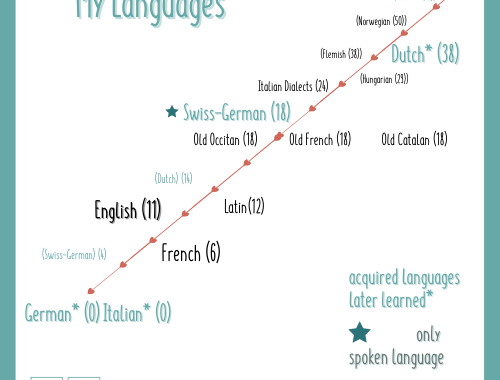
My own multilingual language timeline is as follows: I acquired Italian and German from the start, as I grew up in Italy with German parents. I started understanding Swiss-German when I was 4 years old. I never spoke it until I moved to Switzerland (Zurich) for my studies at age 18. At school I learned French at age 6, English at age 11, Latin (12) and started to understand Dutch through my friends who were in the Dutch section at school.
My mother used to sprinkle her Standard German with some expressions from the local dialect of the region she grew up in. Whenever we visited my extended family in Germany, I would carefully listen to what the "grown ups" would say in that dialect and acquired a basic fluency in understanding of it, and catch myself using some expressions with my children every now and then.
During my studies (Romance Languages and Literatures) I learned Old Occitan, Old French and Old Catalan, and I studied several Italian Dialects, like the dialect of Poschiavo and Ticino, Lombardy, Laconi (Sardegna) just to name a few.
When preparing for a conference in Budapest, I had a smattering of Hungarian (una infarinatura molto lieve).
When we moved to the Netherlands, I taught myself more Dutch. Although the two languages differ, I found Flemish very helpful when learning Dutch, as the pronunciation in TV shows was for me easier to understand. Funnily, in the Netherlands I speak way more English than anywhere else I lived before. Although living and working in international settings, the "main" languages were French and Italian, for some time also German, but only since we moved to the Netherlands, English became the most dominant language as the international community here tends to prefer English. So, after barely speaking English for decades, it became the language I use every day, where I read and write in the most now.
Thanks to some Norwegian friends and a conference that brought me to Norway, I learned some basics in Norwegian. When I discovered Korean Drama in 2019, and got "addicted to it", I decided to learn this language too. I'm not very consistent in learning it, but I enjoy listening to it.
I would love to publish your own multilingual language timeline in this post too!
Please email me at utesinternationallounge@gmail.com with the subject "My Multilingual Language Timeline".
What if we want to transmit a dialect or regional variant?
Especially families who raise their children abroad tend to prefer transmitting "standard versions of their languages", which means the standard German, not Bavarian, or regional variant from Thüringen for example. The reason for this is very natural: because the variant that allows us to interact with a broader group of people in the target language is the standard one!
And the standard language (or one of the standard languages*) is what is taught in schools and usually expected to be learnt.
What compulsory education had to do with this
Standard vs non-standard can make us think about the difference between Classic Latin and Vulgar Latin: vulgar from lat. vulgus, i.e. the "common people". Education started in ancient times and was tied to royal, religious or military organization. The more classical language was used for instructions, whereas the "vulgar" language was considered not admissible for education.
In his The Republic (c. 424-c. 348 BCE), Plato explained the concept of compulsory education: the ideal city would require ideal individuals, and ideal individuals would require an ideal education. Marsilio Ficino (1434-1499) translated Plato's work and made it accessible during the Renaissance, which culminated with the Enlightenment (or "Age of Reason", an intellectual and philosophical movement that dominated Europe in the 17th and 18th centuries).
To get a good idea of public education, I recommend reading Plato's Republic. It is not a political treatise – don't judge the book by its title! – but it is the finest, most beautiful work on education ever written, as Jean-Jacques Rousseau, says about it in Emile.
Plato argues that the first care of the rulers in his ideal State is to educate. He indicates the Hellenic model of education as the best for improved morality and religion. Education in music for the soul and gymnastics for the body, Plato argues, is the best way to educate the Guardians (the second class of citizens in his ideal city). Plato clearly indicates that the Guardians’ education is moral in nature. Their education should emphasize the acceptance of beliefs rather than critical independent thinking.
Plato asserts that education must begin in youth and continue in later years. According to his educational theory, the good man and good citizen can only coincide with a perfect State. (Daniel Heller)
In Sparta, boys between age 6 and 7 were sent to military school, and at age 18 or 20 they had to pass a test to gain citizenship and political rights. At age 60 they could retire. – This looks very familiar, right? In fact the educational system embraces the same time frame – apart from the fact that our children attend schools where other subjects than military ability or leadership skills are taught/trained.
Fast forward to the 16th century, compulsory education for boys and girls was established thanks to the Protestant Reformation. The reason for this was for parishers to be able to read the bible (Martin Luther An die Ratsherren aller Städte deutschen Landes, 1524). The compulsory education system that was compulsory for boys and girls (!) radiated from the German Dutchy Palatine Zweibrücken in 1592, later Strasbourg (1598). The same development can be observed in Scotland, where the School Establishment Act of 1616 aimed to establish schools in every parish. The US followed Luther's and other Reformers' and parents were obliged to teach their children how to read and write since 1620 (The Plymouth Colony). Around the world, education systems were implemented and modernized over the centuries, and the "compulsory school attendance based on the Prussian model gradually spread to other countries"(1): Denmark (1739 and 1814), Prussia (1763), Austria (1774) etc.
The real "boom" started in the 1800s when compulsory education was formally established in Liechtenstein (1805), Travancore (1814), Turkey (1824), Greece (1834) etc.. and compulsory school attendance spread gradually to other countries. The centralization of most European countries contributed to this, which meant that a "standard version of the nation's language" needed to be consolidated when the education became compulsory. By making education compulsory it was necessary to have a centralized system for the evaluation and as dialects and regional variants were considered "hindering" the acquisition and learning of the standard language, that was taught in schools, they were banned from schools.
About dialects, regional variants and standard languages...
A standard language is a repertoire of broadly recognizable conventions in spoken and written communication. It is developed from related dialects, "either by social action (ethnic and cultural unification) to elevate the given dialect, or by defining the norms of standard language with specific and selected linguistic features drawn from the existing dialects". (2) Standard varieties are associated with higher social prestige and greater functional importance than nonstandard dialects or regional variants. Standard usage is considered the linguistic authority, it is the codified standard. (3)
Standard language can arise informally, without formal government intervention (like in the case of Standard English), or formally, directed by prescriptive languages institutions, like in the case of French (Académie Française: Le bon français) and Spanish (Royal Spanish Academy: El buen español).
The standard language ideology implemented in schools, causes other languages – regional variants, dialects, but also other languages – to be considered "incorrect" in the given context. Language and education policies require control mechanisms – exams, assessments – to be done in an officially codified variety, which is the standard language. But the standard language ideology is a "bias toward an abstracted, idealized, non-varying spoken language that is imposed and maintained by dominant institutions". (4)
In the past 30ish years, attempts were made to introduce dialects and regional variants into the schools for several reasons.
To recognize students' language abilities and support their language development, in regions where dialects and regional variants are actively used by the community, dialects variations should be included in classrooms and curricula. Dialects show considerable differences at all linguistic levels, from pronunciation to grammar and vocabulary and for many students, using the standard language means to receive education in an additional language.
Learning is better and more successful when conducted in the variety spoken by students. In addition, it is claimed that the use of students’ variety in education enables students to use their own potential and helps them to achieve ‘deep learning’. Besides, the use of students’ native dialect in education enhances the social, cognitive, emotional and linguistic development of learners’ in and out of school. For these reasons, it is argued that students need to be educated through their own variety. (5)
Although allowing the use of a variety of languages in education can be motivating and have a positive impact on the learners, the main concern to linguists, eduationalists and researchers is that "deciding the Language of Instruction (LOI) depends on a variety of factors such as historical, economic, pedagogical, sociolinguistic, cultural, ideological, theoretical or/and political (UNESCO 2003)" (5). Considering that experts are asked to value the different dialects of a language while also preparing textbooks and National Exams, in multidialectal societies, selecting the variety to be used as the LOI is difficult and controversial. The mismatch between the varieties used at school and those used at home is not easy to solve. The "deficit hypothesis" from the 1960s and 1970s, considered the non-standard varieties as inadequate for communication, and are considered as a "handicap, socially and cognitively" because of them being "sloppy, illogical or bad grammar" (6), thus considered inappropriate for instruction (7). The "difference hypothesis", on the other hand, says that "no one linguistic system can be shown to be inherently better (...) [and therefore] using a particular dialect can be associated with having any kind of inherent deficit or advantage". In fact, non-standard dialects are not deficient, but just "a different in expressing ideas" and can, thus, be used for educational purposes.(5)
"There is general consensus, in fact, among educationalists and sociolinguistics alike, that valuing dialect in the classroom makes real difference to educational achievement of speakers." (5) (8)
What does this mean for our home dialects?
In multilingual families, where children grow up abroad, in an additional country and language, transmitting a dialect or regional variant is a challenge as they usually are not written varieties and therefore require regular exposure and can't be supported by written resources. We can find resources for some dialects** and regional variants online, and there are youtubers who are specialized in speaking their dialects and making them accessible for others, but although these resources can be used as additional support for those who use the variants on a daily or regular basis, maintaining dialects across cultures is a considerable challenge for internationals. One of the ways to preserve dialects and regional variants is to write books about them, describe them, but what our families need are audiobooks, audio material to listen to when raising a child with that dialect on the other side of the world!
As an avid defender of all home languages (i.e. languages that are necessary to communicate in the micro society, at home, with family), and user of different dialects myself, I welcome the tendency – or shift? – to not only welcome, but integrate regional variants and dialects into the classroom. It fully makes sense to me, as the local dialects and variants are what we are surrounded by. I personally enjoy exploring the different variants here in the Netherlands, as much as I liked exploring the different Swiss-German and Swiss-Italian dialects.
As the topic of the International Mother Language Day (IMLD) in 2022 is “Using technology for multilingual learning: Challenges and opportunities”, I wanted to share the challenge families like mine face when it comes to transmitting our languages and dialects to our children who grow up abroad. I wish there were more audiobooks and resources like Heidi (on Spotify) or Grimms Tales in Swiss-German. I am aware that the celebration in 2022 is about "teaching" and we usually don't teach our languages to our children, but when it comes to home languages, most parents do teach their children how to read and write, or, in case of dialects, how to speak and further explore their language.
Why we should transmit our dialects and regional variants
Dialects and regional variants preserve the unique cultural elements of a given place and region. Knowing a dialect or regional variant means that we know more of the roots, the history, the "soul" of a region, a local society. Some assume that individual dialects divide people, but when approached in a way that instead of separating them, tries to find unities instead, we can discover the unique qualities of a region expressed through the dialect. Each dialect has a unique pronunciation and helps give a local culture an identity. What some people find difficult is when we can't translate terms into the standard variant of the language or if there are no equivalents in other dialects. Every translator knows that languages can not be translated one-on-one, there is no perfect equivalent for each word across languages. I consider every dialect like a language – no hierarchy involved or negative/positive judgment about what dialect is "better" or "more prestigious". The mere fact that people speak the particular dialect is reason enough to respect and appreciate it, and understanding is only a natural consequence of wanting to get to know the person or the group. When learning languages, we can experience deeper understanding when we explore its dialects and regional variants. Knowing that in Northern Germany, the term "moin" is used to greet each other at any time, not only in the morning (moin = "morning"), is important for us when we live in that region, but also when our new colleague in Singapore comes from that region and we want to make him feel a bit more welcome.
Uniqueness of dialects provides them a sense of independence and when we speak a certain dialect we can take pride in it, we enjoy defending and explaining our particular way of pronouncing or phrasing to others. Differences enhance cultural diversity and increase independence, and without diversity, our world would not progress. Therefore, our world needs dialects and individual expression to keep cultures alive for future generations.
When transmitting our dialects to our children we transmit the feeling of belonging, or uniqueness and pride. I know that my children feel proud to be able to speak and understand different variants of Swiss-German dialect.
***
Last but not least, I want to share this poem by George The Poet (George Mpanga) with you:
Mother Tongue
My parents never spoke to me in the language of my home city.
They tried to attempt it but the doctor advised against it.
Said it was too much to distinguish as a “word sandwich”.
So I grew up with English as a first language.
So my parents never spoke to me in the language it was supposed to be.
They said: “He'll pick it up when he's older. Hopefully...”
And the culture, that's something that they both really know to keep.
I think of (it) all day and dream about (it) when I go to sleep.
So the irony is... it's when he turned... finally, this 19 year old goes back to Uganda.
But I'm loving it. I'm happy. But more time you're finding me pissed
That I can't communicate the way I really wish.
Hearing my people talking my language, it's like smiling from prison.
It's funny when you miss what you know you never had: my bilingualism.
You might think it's insignificant but I think it isn't.
It's one thing trying to talk it and trying to listen but trying to fit in and fight and resistance makes you feel so far away even after flying in a distance.
See, my parents never spoke to me in the language it was supposed to be.
My Nikes, I'm treading them over these clover leaves.
Why, I'm just one of them nobody's overseas,
disconnected from everybody that I hope to please.
Maybe it’s paranoia, maybe it’s distress but to me the word “diaspora” sounds a lot like desperate, dispersed and dispossessed.
I suspect that this verse puts myths to rest because it's possible to have the rest of both worlds and still miss the best.
*with "a standard version of a language" I mean that for example when the school language is English, we can find schools that transmit Australian English, American English (from any different regions!), Irish English, British English, Scottish English etc.
** This is a page with resources for songs in Swiss-German (and Romantsch) for example.
(1) Soysal, Yasemin Nuhoglu; Strang, David, Construction of the First Mass Education Systems in Nineteenth-Century Europe, Sociology of Education, 1998, 62 (4), p.277–288. doi:10.2307/2112831. JSTOR2112831
(2) McArthur, Tom; McArthur, Feri, The Oxford Companion to the English Language, 1992. ISBN9780192141835.
Milroy, James, The Ideology of the Standard Language, in Llamas, Carmen; Mullany, Louise; Stockwell, Peter (eds.). The Routledge Companion to Sociolinguistics. London: Routledge, 2007, p. 133–13. ISBN978-0203441497. OCLC76969042
(4) Lippi-Green, R., Language Ideology and Language Prejudice, in E. Finegan & J.R. Rickford (Eds.), Language in the USA Cambridge: Cambridge University Press, 2006, p. 289-304.
(6) Kangas, T., Education of minorities, in Fishman, J., Handbook of language and ethnic identity, OUP, 1999, p.42-59.
(7) Romaine, Suzanne, Language in society: An introduction to Sociolinguistics (2nd edition), OUP, 2000.
(8) Cheshire, J., Dialect and education: Responses from sociolinguistics, in Papapavou, A., and Pavlos, P. (Eds), Sociolinguistics and pedagogical dimensions of dialect in education , Newcastle; Cambridge Scholars Publishing, 2007, p.14-33..
When our children grow up abroad, outside of the country where our home languages are spoken, many of us tend to focus on standard language. We want our children to learn the most standardized version of our language. This has several reasons: we want our children to be able to understand and be understood by a vast majority of speakers of that language. So, for example, if the language is German, we want them to be able to communicate with people in the different regions of Germany, Austria, Switzerland, Liechtenstein etc..
Many parents make an extra effort to not pass on their regional accent.
But why shouldn’t our children learn regional variants too?
Would this really be too much or would this rather help them connect even more with extended family, or the places we visit?
Knowing regional variants does not mean that our children won’t be able to speak the standard version.
Every language and dialect counts!
I’d like to share my take on languages and dialects. My husband and I transmitting to our children my husband’s Swiss-German, which is a mix of the local dialect of Luzern and Zurich, and as I am a strong defendant of maintaining any language and dialect that is important for us, parents, and our extended family, I find it important that Swiss-German has exactly the same value as German and Italian – the other two languages I am transmitting to my children.
Avoiding any hierarchy in our family languages is fundamental when we transmit several languages to our children. Our own experience, our doubts, our way of acquiring and learning languages and what we think about our languages and our partner’s language, influences not only our relationship with our partner, but also the one with our children.
To connect with our children we need language and when this language is linked with linguistic bias, fear, guilt or shame, it will affect the attitude of our children towards it, and also our connection with our children. The way our children perceive our language has an impact on their motivation to acquire and learn it.
For this reason, all our languages should be on exactly the same level or “importance” for us. If our languages are equally important and supported by the society is another aspect, and we usually don’t have much influence on that. But at home, in our family, our micro-society, we can create a healthy and harmonious environment that fosters all languages and values them at the same level.
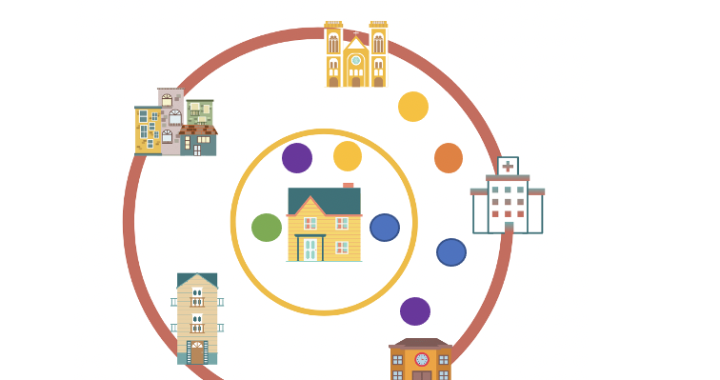
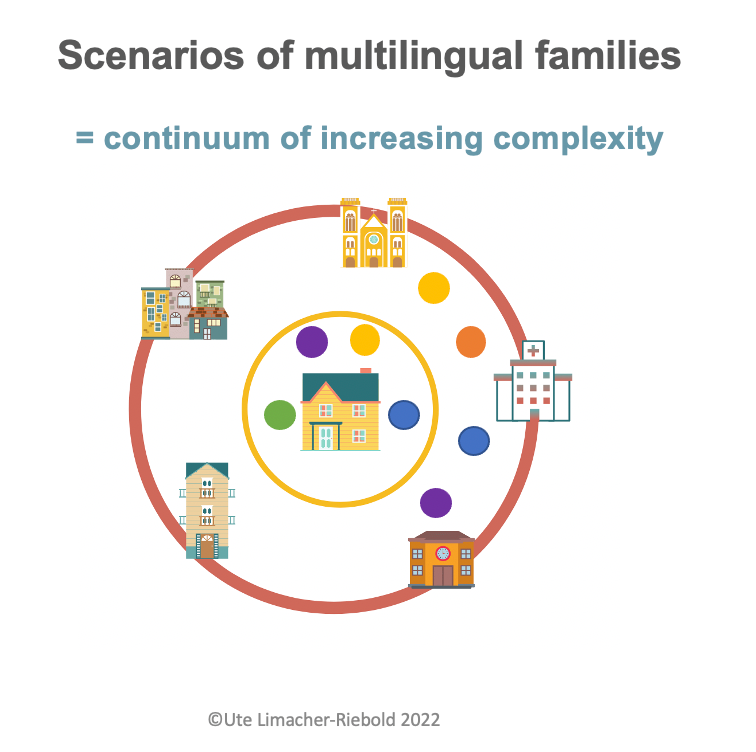
This is why when speaking about all our languages at home, I use colors and not labels like L1, language alpha, mother tongue – or father tongue, to be fair (see the image here below, which I use in my workshops and trainings).
Why I am so adamant about this…
I’d like to share my own “story” about being exposed to both: the standard language and regional variants.
Whilst growing up in Italy, my parents mainly spoke German with me and my sister. They chose the standard version, which was tinted with some regional expressions from Hessen, the region they came from. We were lucky to have the opportunity to attend school in our home language, which surely contributed to consolidate and further motivate us to use that language in different contexts on a daily basis. Also, this allowed us to hear our peers speak German with a variety of intonations and accents from different regions of Germany, but as some of my classmates spoke German as additional language, the environment in our class at school was what I’d define a more “international German” one.
As my mother knew that she had to do something to not loose contact with Germany and the language, she made it a habit to listen to the Deutsche Welle – a radio station that was and still is globally broadcasted. This way she was always up to date about news, politics, culture and also some “slang” that was used in some shows.
My parents grew up speaking the local variant, Hessisch, of their region, which my mother spoke with her family when we visited once or twice per year. I remember that she didn’t explicitly teach us words, sayings or sentences, but I picked up a lot while just listening to her and her family. I guess I was just too curious to know what the adults were talking about. But what made me like the Hessisch even more was the fact that I could see that my mother was enjoying speaking it! She felt so confident and comfortable in using her Hessisch, that I wanted to know more about it. I sometimes would repeat some sentences or expressions I picked up and we had fun playing with the language, comparing expressions and inserting Hessisch into our more standardized German every now and then.
For me, this particular bond that using the regional variant is something that made me like German more than anything else. Knowing some of the expressions also helped me to understand locals, to bond with my extended family, and feel “included”.
To get an idea about what Hessisch can sound like – there are different regional variants – have a look at this video:
As for other dialects spoken in Germany – hier ist ein Video, das eine Übersicht verschafft, über den Gebrauch von regionalen Sprachen in Deutschland heute:
Und hier eine schnelle Übersicht von 8 unterschiedlichen deutschen Dialekten in einer Minute:
The same applies to regional variants or dialects of the region I grew up in in Italy, Lombardia:
For me, the only way to maintain a language, also a dialect, is to speak it, like the person in this video says: “l’ünica manera per tenir viva una lengua, l’és parlar-la” – e mi la parli.
To maintain it a bit also when we live abroad. The cultural value of the language, the dialect, is what I find very important to transmit to our children.
This is a video about the dialect that I heard in families of my peers when growing up:
What language should we transmit to our children?
My answer to this question is: the one you speak in the most spontaneous way, the one that you feel closer to your heart. For multilingual parents like me it is not possible to opt for one language or variant only. For this reason Swiss-German, German – with some regional variants – and Italian – also with some variants –, are the three languages that my husband and I are transmitting to our children. The reason for me to also include variants and dialects is simply because we can’t avoid regional expressions when transmitting a standardized version of our language. Also, I have an emotional bond with some of them and I insert some expressions in my German and Italian that one would recognize as coming from Hessen or Lombardia (or Tuscany, where I lived several years).
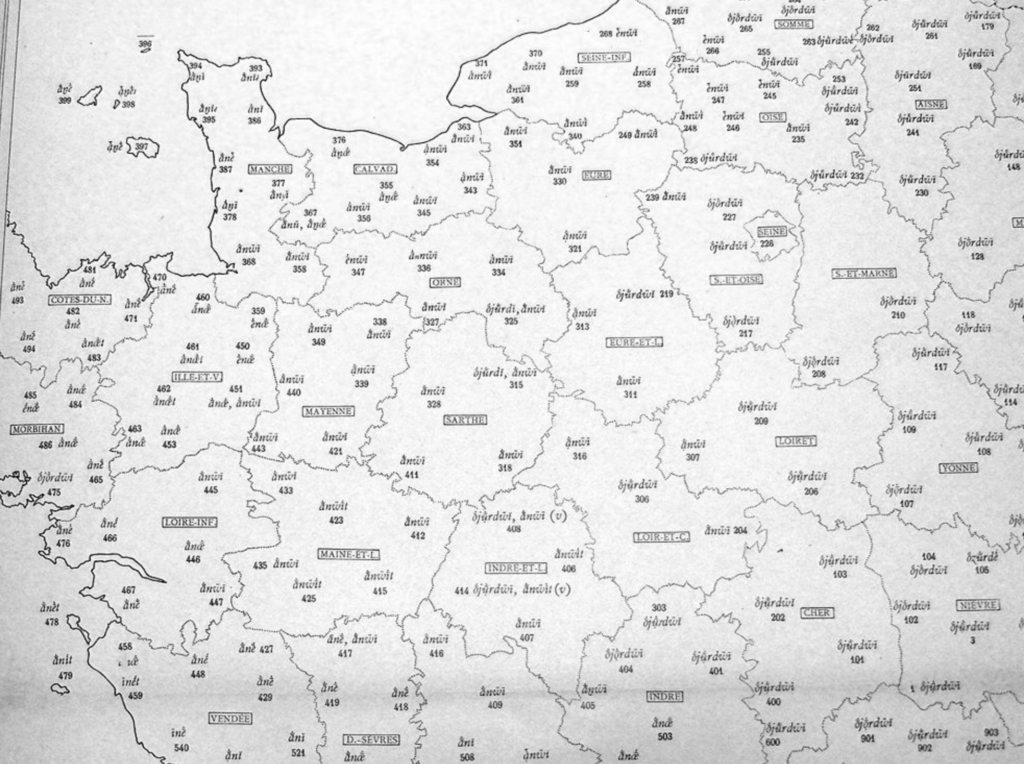
If we look closer, all languages, all standard versions of our languages have expressions that derive from regional variants. If you look at the Linguistic Atlas of your own language(s), you will find how for everyday objects, tasks etc. you find different expressions. Which one to choose is up to us. I personally find it important to find our very own combination of languages and our very own multilingual repertoire that makes our multilingual family unique and, what I particularly like, what makes us feel home in our languages. I still remember the moments spent with my mother exploring her Hessisch, when I hear others speak it, and the same goes with listening to people speaking Lombardo.
How can we maintain our languages “alive” when living abroad?
I asked this question in my facebook group Multilingual Familiesand the responses inspired me to write this post.
One mother said that she didn’t want her children to learn the “new French” as she preferred them not to get used to speak her language in a way that she compared with people using “like” all the time in English for example. This is indeed what I observe in many families who live abroad, and what I have mentioned above: that we want our children to be able to use a more standardized version of the language.
Another mother who is living in Korea, shared that in order to “keep (her) German alive and fresh”, she watches “news, and political talk shows and discussions and documentaries”, she also bought a “German dictionary with synonyms”. I like this idea of having a dictionary with synonyms as we sometimes run out of them when explaining things in new contexts. I personally like to explore synonyms with my children, as I find it very important that they know the shifting meanings words can have, depending on the contexts.
Watching “television or Netflix, listening to podcasts and reading books, trying to keep up the communication with other native speakers” is what another mother said helps her to get a various input in her language whilst living abroad.
“Keeping in contact with family and friends” is as important for another mother, who points out that “keeping culture alive” is more difficult. In fact “last hits, slangs, jokes, phrases” are what is difficult to keep up with when living abroad. These are the things we try to catch up on when we get the chance to visit the countries our languages are spoken.
When our language is one that is used by many internationals, like English, living abroad can also mean to get used to speak your own language in a more international way, i.e. without the own local touch, that we need when speaking with our family and friends when visiting. So, even if our language is supported and used by the community we live in abroad, and we get a more varied input in it than those whose languages are spoken only by a minority or nobody else, maintaining our languages abroad always feels like “maintaining something static”, that doesn’t change and “live” as much as if we were living in the country where it is the majority language.
What I do to keep my languages “alive” and to update my knowledge of new terms and expressions is to listen to podcasts, radio, watch TV – not only news that are usually using the more standardized version of the language, but also shows, documentaries and reality shows. Fact is that by listening to it doesn’t automatically make me use them. Even if I understand them, it takes a while for them to get into my active vocabulary.
I have observed though that when my children watch compelling shows or movies, they almost immediately use certain phrases or expressions.
When, a few years ago, my daughters watched a reality show about teenagers spending holidays in other countries, they not only could relate more to what their German peers were sharing, but they immediately looked up the cultural references (music, books, stories that were mentioned), and they learned about how their German peers communicate with each other.
Some years earlier, I used to watch a show with my daughters, where participants had to find an outfit for a certain theme, within a short amount of time. The funny result of watching that show was not only that whenever we had to shop new clothes, my daughters were very quick at deciding and very good at opting for what was needed and what not, they also used expressions like “dieses Teil ist nicht meins”, meaning that the particular item didn’t suit them, they didn’t like it, adopting the “jargon” of the show. I do the same when watching movies and shows in my languages. I only watch what I find interesting and the vocabulary, new expressions seem to be much easier for me to use in conversations.
Maintaining dialects and regional variants is more difficult though. It means to provide my children with exposure either through audiobooks, podcasts, and videos about them, or to visit the places. There are only few books written in a more “intuitive” version of the dialects, or about topics that are not always compelling for my children. The downside of these text is also that we stumble through the texts, our pace slows down, which results in most cases that we avoid reading them. I have a whole series of Asterix & Obelix in different variants – even in Latin – and I enjoy reading them, but it’s my very personal way taste.
Another way to maintain and fuel the interest for Italian and Lombardo is to spend our summer holidays in the Southern part of Switzerland – Ticino – where our children were exposed to the dialect of Ticino (from the Lucomagno region). They were also exposed to several Swiss-German dialects, which they all understood naturally, without us having to explain them.
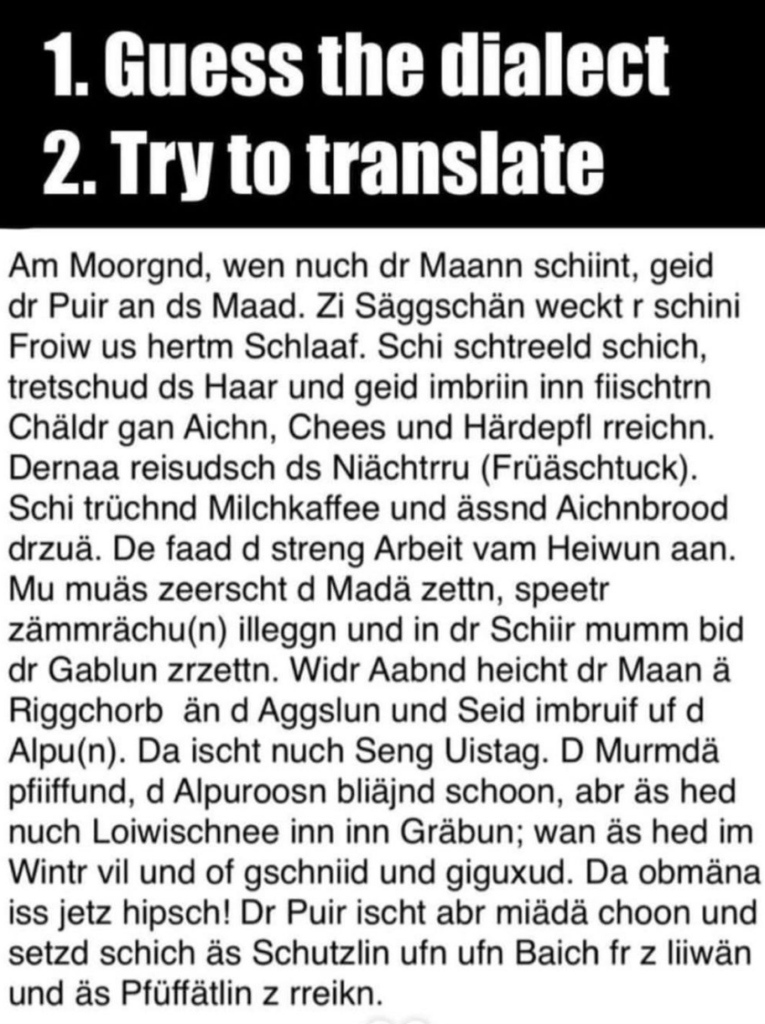
When someone shared a post on facebook lately, about a text that people didn’t seem to recognize, I talked about it with my family, and when we read it out loud, my daughters immediately said that it sounded like the dialect they heard during our last holidays in Switzerland. We only spent 3 weeks in that region in 2019, but this was enough for them to remember the sound of the local dialect, and to recognize it 3 years later.
In fact, it turns our that the dialect of the text was, indeed, the dialect from the Lötschental in Wallis/Valais!
What part of your language do you pass on to your children?
What do you do to make it compelling for them?
And how do you manage to maintain your language “alive” while living abroad?
Children love cartoons, movies, games and we all know that the villains, the “bad guys” are not only characterized by features that make them unpleasant, but also by foreign accents.
Sociolinguist Calvin Gidney started to study language patterns in animated kid’s entertainment after noticing that Mufasa had an American accent, whereas Scar, the lion of the dark side, roars in British English in The Lion King. He analyzed 30 shows and 1,500 characters, and is still working on this project. Together with Julie Dobrow, a senior lecturer at Tufts who specializes in issues of children and media, they observed that
“the use of German, Eastern European, and Russian accents for animated villains is likely reflective of America’s hostility toward those countries during World War II and the Cold War. They have continued to find these same accent trends through the past few decades, even as the political and social climate changes and the nation’s zeitgeist is marked by different ethnic and global tensions.”
It seems that still today, Slavic and German accents are still the voices of choice for “bad” characters in US and UK.
It seems that this is related with the age and training of the show-runners who “make the decision on the basis of what was popular and successful in the shows they grew up watching” (Rosina Lippi-Green, author of English with an accent).
Stereotyped use of language seems not to be an industry-wide norm, “accent signaling is a more subtle form of ethnic stereotyping” and we all observe this not only in cartoons, movies, video games, but also in TV shows, and in some online forums and social media in general etc.
I grew up in Italy and I noticed from a very early age, that not only villains and odd professors had the typical tscherman accent, but Germans were constantly ridiculed in shows, movies etc. People would make fun of their accent, of their “not fluent Italian” and of other clichés related to German–ness.
I didn’t take it very well to see my friends make fun of how Germans were portrayed in TV shows, movies, cartoons, TV commercials etc.. I remember that when show masters stereotyped German actors and actresses, I used to cringe.
I suppose that like many other children growing up abroad I don’t like stereotypes related to my cultures and languages. For a long time I thought that I am the only one feeling odd when it comes to this topic, but the study mentioned above confirms that “language tropes can have far-reaching consequences, both for kids’ perceptions of those around them and their understandings of themselves.”
If in the 90’ies children “used TV as a key source of information about other ethnic groups, as well as about their own ethnic and racial identities”, nowadays the internet and the countless social media platforms.
When it comes to language fluency, people tend to “make judgements about their peers’ intelligence and education levels based on language characteristics”. Those using standard language are generally considered as being smarter than others, and they are treated better. Certain accents are “better” than others, more “prestigious” than others and it exists a non-written hierarchy of languages and accents that are a clear distinctive feature.
We should not underestimate the impact on children whose home language is stereotyped by the host society and media, because they “see the correlation between evil and foreignness, between evil and low socioeconomic status” and they will be more prone to internalize negative perceptions of themselves or other groups!
Lippi-Green suggests to take entertainment as a “spoonful of sugar with a sour aftertaste for in-the-know adults —TV and movies “take [bias] and pour concrete over it.” Children learn through repetition : “You show them a pattern, you keep showing them that pattern … of course they’re going to assimilate that”, is amplified by the variety of platforms and medias our children are exposed to daily.
We can’t shield our children – and ourselves – from cultural biases, but we can learn to be(come) media-literate viewers.
Dobrow suggests “if a parent or sibling or caregiver is there with a child watching television or a film, this … can make anything into an educational experience”.
I personally find that there is a relation between this kind of stereotyping of accents and languages in the media, and the anxiety of speakers of that language, especially if these speakers use the language in international settings or outside of the country where the language is spoken.
In our interview with Dr. Yesim Sevinç at Raising Multilinguals LIVE, we talked about Heritage Language Anxiety, which is way more common than many think! Feeling insufficient in one’s language contributes to language anxiety. When our language is then linked to a certain accent, a stereotype and a linguistic bias, it becomes even more difficult to feel the connection and even develop a sense of pride towards our heritage language.
Watching these movies, videos and reading the comments with our children is one step, but transmitting a strong sense of pride and ownership of the language is not that easy for us who raise our children abroad.
I appreciate and value accents, they are like fingerprints of our language, but I find that they shouldn’t be used to make fun, ridicule or stereotype a person. Not in movies and not in “real life”.
Please let me know what you think about this topic in the comments.
An earlier version of this post was published on my “other” blog Expat-Since-Birth.
Children love cartoons, movies, games and we all know that the villains, the “bad guys” are not only characterized by features that make them unpleasant, but also by foreign accents.
Sociolinguist Calvin Gidney started to study language patterns in animated kid’s entertainment after noticing that Mufasa had an American accent, whereas Scar, the lion of the dark side, roars in British English in The Lion King. He analyzed 30 shows and 1,500 characters, and is still working on this project. Together with Julie Dobrow, a senior lecturer at Tufts who specializes in issues of children and media, they observed that
“the use of German, Eastern European, and Russian accents for animated villains is likely reflective of America’s hostility toward those countries during World War II and the Cold War. They have continued to find these same accent trends through the past few decades, even as the political and social climate changes and the nation’s zeitgeist is marked by different ethnic and global tensions.”
It seems that still today, Slavic and German accents are still the voices of choice for “bad” characters in US and UK.
It seems that this is related with the age and training of the show-runners who “make the decision on the basis of what was popular and successful in the shows they grew up watching” (Rosina Lippi-Green, author of English with an accent).
Stereotyped use of language seems not to be an industry-wide norm, “accent signaling is a more subtle form of ethnic stereotyping” and we all observe this not only in cartoons, movies, video games, but also in TV shows, and in some online forums and social media in general etc.
I grew up in Italy and I noticed from a very early age, that not only villains and odd professors had the typical tscherman accent, but Germans were constantly ridiculed in shows, movies etc. People would make fun of their accent, of their “not fluent Italian” and of other clichés related to German–ness.
I didn’t take it very well to see my friends make fun of how Germans were portrayed in TV shows, movies, cartoons, TV commercials etc.. I remember that when show masters stereotyped German actors and actresses, I used to cringe.
I suppose that like many other children growing up abroad I don’t like stereotypes related to my cultures and languages. For a long time I thought that I am the only one feeling odd when it comes to this topic, but the study mentioned above confirms that “language tropes can have far-reaching consequences, both for kids’ perceptions of those around them and their understandings of themselves.”
If in the 90’ies children “used TV as a key source of information about other ethnic groups, as well as about their own ethnic and racial identities”, nowadays the internet and the countless social media platforms.
When it comes to language fluency, people tend to “make judgements about their peers’ intelligence and education levels based on language characteristics”. Those using standard language are generally considered as being smarter than others, and they are treated better. Certain accents are “better” than others, more “prestigious” than others and it exists a non-written hierarchy of languages and accents that are a clear distinctive feature.
We should not underestimate the impact on children whose home language is stereotyped by the host society and media, because they “see the correlation between evil and foreignness, between evil and low socioeconomic status” and they will be more prone to internalize negative perceptions of themselves or other groups!
Lippi-Green suggests to take entertainment as a “spoonful of sugar with a sour aftertaste for in-the-know adults —TV and movies “take [bias] and pour concrete over it.” Children learn through repetition : “You show them a pattern, you keep showing them that pattern … of course they’re going to assimilate that”, is amplified by the variety of platforms and medias our children are exposed to daily.
We can’t shield our children – and ourselves – from cultural biases, but we can learn to be(come) media-literate viewers.
Dobrow suggests “if a parent or sibling or caregiver is there with a child watching television or a film, this … can make anything into an educational experience”.
I personally find that there is a relation between this kind of stereotyping of accents and languages in the media, and the anxiety of speakers of that language, especially if these speakers use the language in international settings or outside of the country where the language is spoken.
In our interview with Dr. Yesim Sevinç at Raising Multilinguals LIVE, we talked about Heritage Language Anxiety, which is way more common than many think! Feeling insufficient in one’s language contributes to language anxiety. When our language is then linked to a certain accent, a stereotype and a linguistic bias, it becomes even more difficult to feel the connection and even develop a sense of pride towards our heritage language.
Watching these movies, videos and reading the comments with our children is one step, but transmitting a strong sense of pride and ownership of the language is not that easy for us who raise our children abroad.
I appreciate and value accents, they are like fingerprints of our language, but I find that they shouldn’t be used to make fun, ridicule or stereotype a person. Not in movies and not in “real life”.
Please let me know what you think about this topic in the comments.
The category game, known as Stadt–Land-Fluß in German, in Italiano si chiama nome, cose città en français c’est le jeu du baccalauréat, ou jeu du bac, ou petit bac – En español es el juego tutti frutti o también conocido como Stop, Alto el Lápiz, Chanton, Pare carrito, Autopencil, Bachillerato y Basta – y em portugues significa Adedonha.
When playing games in multilingual families, we either decide for one language or we can play them across languages – assuming that all players understand them.
If you also wonder how to involve young children or grandparents in the category game, and want to know how to play it online I have some tips for you.
The Rules of the Game
Categories is a word game where the players have to find words that fit into particular categories that are defined by the players, all starting with the same letter.
The letters can be chosen by asking one player recite the alphabet in his or her head and another player stopping him at any time by saying stop (or basta).
As soon as the player says the letter where he/she stopped out loud, the game starts and players need to fill in the words of each category in one row of the table as quickly as possible.
Goal is that all players find words in each category that start with the chosen letter as quickly as possible.
The first player to fill in all the categories shouts stop / basta and everyone else has to put down their pencil.
At the end of each round, points are awarded for the words: for example, 10 points for words that were chosen only by one player of the group, 5 points for words that were chosen by two or more players and 0 points for words that don’t exist or when a player didn’t find a word in that category.
After each round, everyone counts the points and the winner can choose the next letter, or you can decide to proceed clock- or anti-clockwise.
The game ends when the players decide.
The player with the most points wins.
How to play the game across age groups, with players with different language competencies and across languages
Letters and sounds
If you play this game with preschool children, you can ask them to find objects or pictures of objects that start with a particular sound. For example, if the rest of the group is trying to find words for the different categories that starts with “A”, you can ask the little ones to find objects that start with “A” and gather them on a pile (or whatever works for you). This way you would also add some movement to the game as the child will be allowed to move around the room or place.
You can also ask them to draw things that start with A, while the other players complete their task.
If you play this game with children of the same age, you can adapt the rules to their language fluency: if they can’t write yet, you rather focus on the sounds, if they are emergent readers, you can help them, by writing the first letter etc.
You can also add some more dimensions to the game, by inviting players to “find everything that starts with an A and is soft/hard/small/big/round/green…/“.
If participants are emergent writers in the target language and have a better understanding of sounds, you may want to focus on sounds instead of letters and not penalize if they choose a word that starts with K instead of C (or vice versa, depending on the language of the game).
Adjust the pace to the slowest player
When playing the game across age groups and with players with different language fluencies, you may want to slow down the pace of the game.
One option is also to let everyone finish to complete the task instead of the first player who finishes, stopping the game. This allows those who need a bit more time to think and write to not feel pressured or penalized because of it. – The main aim of the game is to enjoy time together, explore your languages and cultures!
Playing the game across languages
You can play this game across languages by inserting words from different languages in the chosen categories, for example, let’s assume the chosen letter is “C”, one can choose “cat” as animal, “Cello”(German) for musical instrument, “cetriolo” (Italian) for vegetables for example.
When mixing alphabets, make sure that people who are not able to write in the alphabet (yet) can write in one they are more confident in. For example, if a player knows Greek or Arabic or Chinese etc. but can’t write it (yet), allow him/her to write the word in the alphabet of his/her choice.
Make sure to include all the letters/sounds of the language
If the language you play this game in has “additional sounds/letters”, like Ä, Ö, Ü in German for example, make sure they can be chosen too.
Other alternatives to play the game
Another alternative way to play the game is to let players find words where the chosen letter or sound is either in the middle of the word or at the end of the word.
You can also change the rules from round to round to make it more interesting and motivating for the players.
Vary the point system
If for example a child needs to practice the 3/6/9 time table, you can choose to assign 3-6-9 points to the different responses, or 0/6/9, or, to practice the 7 time table 0/7/14.
On the Toolbox for Multilingual Familiespage you can find a pdf file with a list of categories (in English) and pages to print out or fill in online to play this game on your device.
You can also choose to play the game online with friends and family by choosing categories on this website: https://scattergoriesonline.net/
If you need help with words in the target language, you can search for “word games” / “category game” in the target language.
Many of us are spending way more time on screen than necessary. We all would benefit from “off screen time” (funny that I share this in a post that you can only read… online).
As I am discovering more and more audio resources (audiobooks, songs, stories, podcasts), I thought I’d to share some audio resources that can help our children enjoy our languages.
Especially when we can not provide a language rich context for our children, due to complicated situations that do not allow us to meet with extended family or hire nannies or babysitters who could support our children’s language development in the target languages, we have to find alternative solutions.
Here are some suggestions about podcasts that members of my facebook group Multilingual Families kindly shared with me.
This is an ongoing list which means that I will update this post regularly.
If you would like me to include a podcast that you find particularly useful in your language, I would be very thankful if you could share your suggestions by indicating it in the comments here below:
[Podcast name]:
[language]:
[link]:
[target group (age group)]:
[where one can follow it]:
[main topics]:
[your name – if you wish to be mentioned in the post and]
Main topics: Everyday Chinese you can use to keep Mandarin active with your children. It is in a playful story/topic format. There are occasional interview episodes with linguists, authors, and language learners.
Here is a list of podcasts for teenagers ( please, check if the content is ok for your teenager; some are from teenagers for teenagers, others from psychologists; furthermore, there are some from Belgium, dus in het Vlaams)
Onbespeekbaar: het gaat over mentale gezondheid, kwetsbaarheid, sociale media en zelfacceptatie (Apple en Spotify)
[main topics]: “Created and produced by parents of young children, WBUR’s Circle Round adapts carefully-selected folktales from around the world into sound- and music-rich radio plays for kids ages 4 to 10. Each 10- to 20-minute episode explores important issues like kindness, persistence and generosity. And each episode ends with an activity that inspires a deeper conversation between children and grown-ups.”
[main topics]: “Purple Rocket Podcast has a mix of content with quite a few long-running series, including “Grandpa’s Globe,” which is about twins Sawyer and Suzie, who use their grandfather’s magical globe to explore the universe. Other adventures involve everything from aliens to fairies. Mixed in with the series are occasional one-offs, some of which manage to impart little lessons for your kids. For example, “My Homework Ate Me” is a cautionary tale of procrastination.” (quote from WIRED)
[main topics]: Stories Podcast “performs a new story every week, drawing from a variety of sources and a variety of styles. There are retellings of classics like Snow White, some folktales, and myths from around the world, as well as original stories. Episodes range from 10 to 20 minutes, with most on the longer side. Everything here is G-rated and safe for all ages”.
[main topics]: Bummkopp, Gräte und Kapitän Flitschauge sind die Bestatzung der Sturmhölle und erleben jede Menge Abenteuer zusammen. Und streiten dabei was das Zeug hält. Die unterhaltsamen Geschichten von jeweils etwa vier Minuten machen Spaß und vermitteln ganz nebenbei auch einige Fakten.
[main topics]: Ein Thema und dazu vier Sendungen, eine täglich von Montag bis Donnerstag – das ist das Konzept von Mikado. Themen sind dabei beispielsweise das Wetter, „Drinnen Spaß“ oder Tiere im Winter.
[main topics]: radioMikro is a daily broadcast for children (on the radio channel Bayern 2) Monday – Saturday at 18.30 CET and on Sundays at 7.05 CET. The podcast is accessible via iTunes, the ARD Mediathek or in your browser.
[language]: target language: Spanish ( lingua ponte : English)
[target age]: 3-6 years I think
[main topics] “is a podcast created Evan and Vanessa to share their deep love of music and the Spanish language with children everywhere. Their goal is to provide a constant source of warmth and comfort for all who listen and to make sure the Spanish content feels fun and easy to learn. “
On Spotify you can find PEaCH for Bilingual Children Spotify with more audio material (songs, stories, podcasts) for your children in a great and growing range of languages – have a look at our playlists! This is an initiative started and coordinated by Jessica Paolillo (content creator at Multilingual Families) (click on the picture):
What has being a multilingual family to do with how to travel light? Have you ever packed a backpack in the wrong way? Made it too heavy, causing you back pain; brought the wrong or unnecessary things, making it difficult to reach what you actually needed, quickly enough?
Or have you ever been on a hike where the pace was much faster than yours, so that you ended up exhausted, frustrated and didn’t enjoy the journey?
If we carry too much, the wrong items or walk too fast, we can get out of breath, frustrated and are more prone to giving up, as we don’t enjoy the journey.
Raising children with multiple languages is a journey that starts before the children are born and never ends.
Here are 3 tips on how to “travel light” on your multilingual journey:
Define the journey
As parents of multilingual children, we are on some kind of international journey. We either live abroad in our partner’s country, or our partner is a foreigner in our country, or we live in a country where both of us are foreigners.
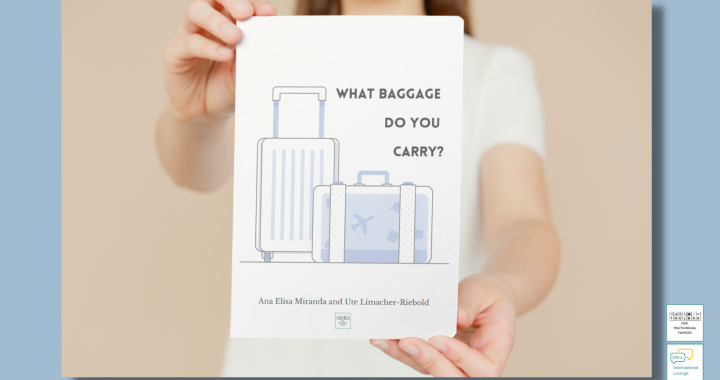
Each parent brings his or her very own baggage. This is our cultural background, our attitudes, preferences, habits, patterns, ideas and expectations, our personal experiences, values, beliefs, assumptions, convictions, our way of doing things, as well as our way of communicating, our languages, our memories and more. Our baggage is determined by what we consider important, essential and “good to carry with us” on our life-journey.
When on a journey together, following the same goal and carrying what is necessary to reach it, makes the journey easier. You are less likely to become overwhelmed and to experience attrition. You should have enough energy to focus on what is really important.
Have you agreed and defined the multilingual journey of your family?
What are the short and long term goals for you, your partner, your children?
Pack your baggage wisely
The art of packing a backpack is to think carefully about what we really need, to make sure to travel as light as possible. Translated to our multilingual journey, this means:
Decide if judgments or expectations (of others as well as our own) are important for us or not. Do they support our short and long term goals?
We all have our very own assumptions, experiences and expectations. Some are relics from our childhood or earlier phases of our life, and we carry them like a safety blanket to give us comfort.
Are your expectations aligned with your common goal or are they rather hindering you, your partner or your child?
Are the expectations you have realistic and achievable?
If our assumptions and expectations are realistic, we keep them, if some are not helpful right now, we can put them aside (in a mental drawer). What can help us to “travel light”?
Have a survival kit. Items we must always bring on a hike are a water bottle, food, a first aid kit and our IDs (and with young children, everything we need to take care of them).
On our multilingual journey, these would be resources that “feed” our languages: books, music, games, podcasts, audiobooks, lessons, playgroups; websites and discussion groups that can give us the necessary support; a guide for parents of multilingual children, or our Toolbox for Multilingual Families, where you can find activities and games to foster your languages and enjoy communicating with your children.
Do you know how to keep transmitting your language, in an engaging and motivating way for the whole family?
Adjust the pace
For a hike to be successful and enjoyable for every family member, it is important to distribute the weights wisely. We adults carry the heavier items, and our children carry the lighter ones. Our older children can also take over some tasks and roles, depending on their abilities and strengths.
During our journey, the pace of our walk should allow us to proceed and progress steadily. This means keeping the pace of the weakest or youngest person in the group, stopping when the youngest or weakest member is tired, because a group – or team – is only as strong and effective as its weakest member. This also means that the group will do their best to support each other to achieve the common goal.
One of our goals on our multilingual journey is to reach the milestones safely and with enough energy left to enjoy the landscape and celebrate the small steps.
Have you paused to consider the pace you are going?
Is every member of the family feeling supported and enjoying the journey?
We have created a journal prompt to help you reflect on your cultural baggage and on how to make sure you travel light as a multilingual family.
You can access it by fillingin this form that also will give you direct access to my Membership Site of TheToolbox for Multilingual Families, and to other prompts, infographics etc.
You can start with answering the questions in this post – and, please, let me know your answers and continue the conversation in the comments!
Well, the answer is: no! People who speak multiple languages do not havemultiple personalities. Having multiple personalities is a disorder, being multilingual is not!
True is, that a person who speaks more than one language, feels part of the different cultures and “acts” in different ways.
For example, when I talk Italian with Italians, I gesticulate like Italians – but not in the presence of non-Italians. I adjust my way of communicating to the situation and the language I speak.
Anyway, the cultural influences coming from other languages do not mean that one will develop multiple personality disorder! It is surely not pathological!
Multilinguals have a multiple cultural reference system. That’s all. Our personality and identity is made of many elements “in a world where more and more people grow up and live with various cultural references – even more so after the expansion of the internet – it is meaningless to stick to the monistic concept of identity. Identity can be multiple, it can be plural” (Tokuhama-Espinosa, T. (2003), The multilingual mind: Issues discussed by, for, and about people living with many languages, Westport, Conneticut: Praeger Publishers, p.185).
Multilinguals do not necessarily have an identity crisis because they are a part of many cultures. If they have a sort of “identity crisis”, then it’s because other people ask themto choose one (and only one!) of their cultures.
If we assume with Charlotte Burck that identity can always be “actively constructed and renegotiated” (Multilingual living: Explorations of language and subjectivity, New York, Palgrave Macmillan, 2005), well, then identity and personality are something that flows as we grow. It evolves and develops throughout our lives.
When we speak different languages, we also express different kinds and aspects of ourselves. This depends from our audience, the situation etc. In every language we speak, we create different kinds of self-expressions and experiences for ourselves.
Our different languages allow us to express several facets of ourselves, the way we perceive and experience the world, but never change our personality! (Ute Limacher-Riebold)
Multilinguals often feel “different” when they are switching between their different languages. But the difference is felt during this shifting, because the culture, the frame of reference changes with the language too. François Grosjean describes it like this: “what is seen as a change in personality is most probably simply a shift in attitudes and behaviours that correspond to a shift in situation or context, independent of language” (François Grosjean, Life as a Bilingual: the reality of living with two or more languages, Psychology Today, 2011) – I would add: but triggered by the change of language.
Let’s make an example. I usually talk German to my children, but sometimes, I switch to Italian. Usually this happens, when I’m tired or I have to tell them something quickly (for example in situations of imminent danger: “step back from that road!”). When this happens, I feel different. My expression changes, words come out much faster and I start gesticulating. But when I talk Italian in a more formal context, I slow down and do not gesticulate that much. Therefore, in my opinion, the “personality shift” has a bit to do with the language, but not only. I would say it is like wearing another mask or glove.
During role plays with my children, I changed language or imitated a strong accent (Italian, German, Swiss-German, French, English or Dutch) in order to “feel” and accentuate the difference of the character. There was no “personality shift”, it was rather the opportunity to explore the multiple facets of the characters or roles we were playing. – For those who think this only happens when switching from one language to another: monolinguals experience this “shift” too when they switch from a formal to an informal register, when they shift from speaking to young children to speaking with adults or colleagues in formal settings ! We all use different registers when we are in formal meetings than when we talk to our children or friends. Bilinguals (or multilinguals) just have a broader framework to work with.
Usually, multilinguals have two to four dominant languages, but this dominance can vary over one’s lifetime. All our languages are always present to some extent and form our very own multi-competent multilingual identity.
It’s like having multiple tools to express ourselves: an incredibly powerful asset!
What are your thoughts about this?
What is your experience as a multilingual – or parent of bi- or multilingual children?
We all have different communication styles. And so do our children. Parents often assume (or expect) that their children will have their same communication style, but that is not as simple. Especially in multilingual families, communication styles can be very different and children who grow up in such settings might switch back and forth between these different communication styles.
When we know what communication style our children have, we can understand them better, not only because of what they say, but also how they say it, what makes them communicate in one way or the other.
Elaine Weitzman distinguishes 4 communication styles in children* that depend on 2 factors:
their ability to initiate interactions with others
their ability to respond when other people initiate an interaction with them.
The way we interact with others differs from culture to culture, from language to language. Depending on the communication style that is most common in a language – which affects or influences intonations, turn takings, making (or not making) eye contact, the pace of a communication and the way adults communicate with children in general – our children will most probably follow the one of the language they are exposed to for the majority of the time. Or, in other words, the language of the person they are mostly communicating with. This can be a parent, peers, teachers etc..
I take Elaine Weitzman’s the 4 communication styles in children (see here below) as starting point to explain the different communication patterns that we can observe not only across cultures but across languages.
This is only a very generic explanation that I usually analyze more in detail with the multilingual and multicultural families I work with.
1) Sociable Communication Style
Children with a sociable communication style initiate interactions with others and are quick to respond to others’ initiations. Even if they only have a few words or are hard to understand, they continue to try and communicate with others. They are often considered “outgoing” or “extrovert”. Sometimes they insist communicating even if the other person can’t really understand what they mean.
If one of your child’s culture and languages is one that fosters and encourages this sociable communication style, i.e. interactions of children (or at any age) with adults and peers, chances are high that your child will have this style too.
But even if parents, and communities our children grow up in, foster this communication style, it is not a given that our children will adopt this style and feel comfortable with it. There are many factors that influence a child’s communication style (character traits, experience in different settings etc.).
2) Reluctant Communication Style
Children with a reluctant communication style are more likely to respond to others than to initiate an interaction on their own.
They can be considered “shy” and might need time to “warm up”, to become comfortable with new people and new environments. When these children are not given time to adjust and respond at their own pace, they tend to “fly under the radar” or risk to be labelled as “not fluent in the language”, although they are often much more capable than they appear!
Those who grew up in a context where children are not encouraged to interact with others (especially not adults), might need some time to adjust to a more “sociable” communication style. Especially in multilingual and multicultural contexts, it is difficult to determine if a child has this communication style because he/she is rather cautious in general, or because this is a style that is fostered by his/her parents.
Teachers who work with children coming from diverse cultural backgrounds, should be trained to understand and support the children’s different ways to relate and communicate with others.
3) Inactive Communication Style
Elaine Weitzman defines this style as passive communication style, as the passive behaviour of children with this particular style can be a sign of autism or other developmental issues.
Children with this communication style seem hard to connect with because they seem uninterested in people and objects – also toys, games etc. A developmental delay, a sickness or being on medication can lead to this more “inactive” communication style. – I prefer the term of “inactive” as I assume that these children are, in some way, receptive for their environment, i.e. that they understand and connect with their parents, teachers, siblings, friends etc. at least to some extent.
This is why I distinguish two (or more) categories of children with this communication style: those who have a developmental delay, a sickness or are on medication, which affects their way to connect with others, and those who have this more inactive communication style because they don’t understand the language (yet) or don’t know how to behave in given situations (yet)!
In fact, children who are schooled in an additional language, i.e. that is not one of their home languages and they are still in the adaptation and adjusting phase, can have this kind of communication style in specific situations only. This is very important to know because this helps us to find ways to help our children become “proactive”.
If your child has this communication style in specific societal contexts only, it is advisable to explain this to the teachers and to invite them to find ways to interact with your children’s language, or to find ways to bridge between the home languages and the daycare/school language.
If after a few months the child still struggles with becoming confident in the new setting, despite the help from the teachers and environment (including the parents, of course), it is advisable to contact a child psychologist.
4) Own Agenda Communication Style
Children with this own agenda communication style, usually initiate communications with others only when they need something. They can be found playing independently and alone. It might be difficult to get a message across to these children as they seem as if they are in their own little world. They might struggle to successfully play and share with others. There are several reasons for children to have this own agenda communication style. It can be that they are the only child, that they are not used to social interactions with peers or other adults (yet), that they are used to play by themselves, or that for some reason they have problems to connect with others.
One reason for children to have this communication style are hearing problems: they simply don’t hear when others’ speak to them, and only react when they are addressed through eye contact or touching the arm or shoulder for example. It is always advisable to check out the hearing of the child and to observe him/her in a variety of settings and situations.
If children with this communication style are schooled in an additional language that is not one of their home languages and that are still adjusting to the new language and environment, it is, once again, advisable for parents to explain the situation to teachers and to invite them to find ways to bridge between the home languages and the daycare/school language, or to find ways to interact with the child in his/her language.
This is only a short overview and introduction about communication styles in children and some ideas on how they can apply to multilingual and multicultural children.
What communication style best describes your child most of the time?
Does your child have the same communication style in all his/her languages?
Does your child have the same communication style in all the societal settings, i.e. when at home with the family, at the daycare/school, with extended family and friends etc.?
If your child has an inactive, reluctant or own agenda communication style: does she/he have the same style in all his/her languages? Does he or she have the same style in all societal settings, i.e. with adults she knows (like parents, and other adults in their daily life) and peers, in formal and informal circumstances?
If your child currently has predominantly one of the aforementioned communication styles, it can be that either your child has hearing problems (maybe has an ear infection), in which case it is advisable to let your infant’s or toddler’s hearing be checked (especially if they are prone to ear infections). If your child has one of these three communication styles but does not have an ear infection, is not ill and doesn’t take medications, and struggles with communicating, they might need some support and encouragement to get involved in interactions.
All children benefit from parent’s and other people’s efforts to make interactions more successful, interesting and engaging. If your school aged child has one of these three communication styles in specific situations only, it might be that he or she is struggling with either the language, the situation (at school or at home) or with peers/friends.
In any case, it would be helpful and beneficial for your child, if you could help him/her become more confident in sharing their thoughts, communicate effectively with you, so that you, as a parent, can understand what is going on and help or find help.
If you want to find out how to optimize the communication with your children to support their way to communicate and connect with others in the most effective way, don’t hesitate to contact me.
And if you are looking for ways to foster understanding and speaking in a fun and entertaining way with your 0 to 15+ year old children have a look at our Toolbox for Multilingual Families, where Ana Elisa Miranda and I share 60 activities that foster understanding and speaking.
Last but not least: multilinguals can have different communication styles depending on the language they speak (which doesn’t mean that they have multiple personalities…)
Some more questions:
Do your children have different communication styles?
What communication style did you have when you were a child?
What style can you relate to most?
What style makes you feel comfortable/uncomfortable?
Please let me know in the comments here below.
*Weitzman, E. (2017) It Takes Two To Talk: A Practical guide for Parents of Children with Language Delays, Toronto, ON: The Hanen Centre.
When we use more languages either on a daily or regular basis, or across our lifespan, we might not be aware that the languages who “stand in the foreground” can shift into the background at some point.
When we grow up surrounded by languageyellow, blueandgreen[1] in the first 3-5 years, once we start attending daycare and school, an additional language or languages can be added to our repertoire.
Language acquisition and learning is a journey that spans across our lifetime – at least for most of us. We never stop learning new words, expressions, terms, as language is like a living organism and one can never stop learning it.
Nevertheless, we tend to define milestones, determine steps we take next, to somehow assess, quantify and classify our language competences.
[1] I prefer using colors instead of L1/L2, LA/La/LB/Lb etc. to avoid any kind of categorization and hierarchy.
What about our actual, individual use of our languages?
I observe that as multilingual adults we are not necessarily aware of all the languages we are in contact or have been in contact at some point, and that we can understand to some extent. There are those who say that they “are fluent” in a language they can only understand and can utter some words or short sentences, whereas others consider themselves not “competent” in a language they speak daily and even read and write, because they are “not perfect”* and “not native” in it, i.e. didn’t acquire and learn it from a very early age. On a side-note: there is no such thing as being “perfect” in a language; there is only “being confident enough to function in certain circumstances where the language is necessary”.
The language learning process being one that is subjected to many external and internal factors, we should consider our it as a “work in progress” along a continuum that is open ended.
So, how can we become more aware of how we use our languages?
The Language Portrait
One way to portray our language use is the Language Portrait. It is a graphic visualization of the linguistic repertoire, using the outline of a body silhouette. This kind of exercise has been used in schools and other educational institutions since about 20 years, “to initiate processes of language reflection and to promote sensitivity in dealing with multilingualism” (Brigitta Busch, The language portrait in multilingualism research: Theoretical and methodological considerations, Working Papers in Urban Language & Literacies, 2018) The “visualization of lived experience has been used in various disciplines for a considerable time as a means of stimulating processes of reflection”. In her article, Brigitta Busch points out that visualizations with the help of body silhouettes was mentioned the first time “at the beginning of the 1990s under the title “I speak many languages” (Grundschulzeitschrift) in their Ideenkiste (ideas box)”, and students were given the task of filling in the silhouettes with coloured pencils to emphasize the different languages they speak, associating also their feelings towards each language.
These Language Portraits are ever since used as an instrument for language awareness in schools, demonstrating also the important link between language-learning and emotions, sense of belonging and biographical experience. Needless to say that it is a very powerful tool in settings where the individual has had traumatic experiences due to a language or a culture related to it. Through this method language is related to the body through the use of the silhouette and the linguistic repertoire interacts with the “body image” that we have of ourselves and which is reflected to us by others. It reminds me of what the sociologist Erving Goffman called “social portraiture” (see his studies about portraits in advertisements).
The power of this model consists in self-distancing that gives us a more objective perspective. It allows us to consider ourselves as the centre of the here-and-now and the external perspective at the same time. This shift between the two perspectives leads us to connect the personal experience with the languages and our own linguistic dispositions with the external view on languages “as objects and on linguistic-discursive patterns which one perceives as being part of one’s own linguistic practices” (Brigitta Busch).
With this portrait we can use spatial metaphors like internal/external for familiar/unfamiliar, above/below for current/more remote, large/small for important/less important.
In order to not misinterpret ones’ Language Portrait, it is advisable to ask the person to explain “what makes them put a language in their feet” for example, like in the portrait here below, as it does not necessarily mean that the language is less important only because it is placed further away from the heart or head. I would be careful to assume everyone would place the most important skills on the center of the body: our hands and feet can be considered as important as any other part of the body!
The reason for the 16 year old who designed the portrait here below, to put Italian to his feet in the picture here below, was because he plays football (calcio) like his Italian father and brother, and the reason he places Korean (Hangul) in his hands is because he is learning to write the language at the moment – he received his education in German and Dutch, so he is biliterate in both languages already, but didn’t consider it important to add this detail in his portrait at the moment. As he loves Koran food, he placed this language and culture on his stomach, and his heart is Dutch because he has a Dutch girlfriend…
The next Language Portrait (see below) is about my languages. I shared it on my Instagram account in February 2021, explaining why I place my languages in different parts: I place German in my head together with Italian, because my way of thinking, organizing things etc. feels like a mix of German and Italian: one could define it – using stereotypes! – organized-flexible. Italian is the language of my heart, my emotions. It’s the language I use most spontaneously. Furthermore I love Italian food – but only the one “fatto in casa”! As for Swiss-German, I placed it on my wrist because it feels like my “watch”: I learned being punctual the hard way when I moved to Switzerland at age 18 for my studies. French is the language I feel most connected with on an emotional level, like Italian. I learned French at age 6 and never stoped. I wrote most of my scientific work incl. my PhD in French and Italian, and love reading French books. As for Spanish, I read Spanish (so I point at my eyes) better than I speak it (so far) – I’m working on it so I hope I will soon be able to point that arrow to my mouth too. I am learning Korean by listening at the moment. I recently started speaking it but it is pretty much the listening and understanding part that I’m focusing on most. In the past 10 years, English has become the language I speak on a daily basis and write in the most. I placed Dutch and Spanish to my legs because I love to dance (Latin), cycle (which I associate to my Dutch life) and walk (idem).
What I could not add in this portrait is the historical, diachronic perspective of my languages. Although I now write mainly in English (like this post…) I used to write mainly in Italian, French and German. I am constantly working on my writing skills in all these languages, so I place them all on my right hand. The fact that Italiano, Français an Deutsch are written in smaller characters, indicates that I am not using them as often (as I would wish!). Furthermore, I did not indicate all the languages I have been in contact with and learned to a certain extent. Using the portrait somehow made me focus on the languages I use here-and-now or that I still “feel” present.
For a history of the Language Portrait see: Ingrid Gogolin, Die Karriere einer Kontur – Sprachenportraits, in Inci Dirim et al (eds.), Impulse für die Migrationsgesellschaft. Bildung ,Politik und Religion, Münster, New York, Wasmann, 2015, 294-304.
Erving Goffman, Geschlecht und Werbung, Frankfurt / Main, Suhrkamp, 1981.
The Dominant Language Constellation
Another way to portray the languages we use or feel are important for us is the Dominant Language Constellation Model. Although we can use multiple languages regularly, there are always some languages – on average 3 (but it can be also 2 or 4…) – that are “in the foreground”, that we use more frequently and to a greater extent than the others. I tend to indicate it with my hand: if I have 5 languages – no matter the level of competence in each, there will always be two-three who are predominant, which does not mean that the other one, two or more, are absent. We know that all our languages are always present somehow and retrievable anytime. For those who are more in the background we might need to make more effort to activate them, to feel comfortable using them again if we hadn’t done so for a while, but they are still “there”.
You can watch my video on Language Shift here below.
Thanks to the model of Dominant Language Constellation we can indicate this language shift, what languages are more important, more dominant for us and which are not, by simply rotating the 3D model.
The model allows us to indicate our very personal view on our languages: we choose the color and the size of each “planet”.
Although the sum of our linguistic skills in all our languages can be defined as our language repertoire, the Dominant Language Constellation is the active part of the language repertoire:
“The concepts of language repertoire and Dominant Language Constellation concur, differ, and mutually complement each other. While a language repertoire relates to the totality of linguistic skills in all the languages possessed by an individual or by a community, a Dominant Language Constellation embraces only several languages (typically but not always three) that are deemed to be of prime importance. In other words, DLC is the active part of one’s language repertoire. One may say that a language repertoire is about the linguistic assets and a DLC refers to active usage of languages. Within the unit of DLC, languages play different roles and various linguistic and cognitive skills in several languages serve to carry out the necessary functions of a human language.” (Larissa Aronin, 2021:20)
I invite you to watch the interview we had with Prof. Larissa Aronin at Raising Multilinguals LIVE, the broadcast I organize with my partners-in-multilingualism, Rita Rosenback and Tetsu Yung.
Another way to indicate our language use and fluency is through a grid that François Grosjean developed for this purpose. This grid allows us to categorize our languages based on these two criteria in a specific moment.
François Grosjean suggests to regularly repeat this exercise to get a clearer picture about our language use and fluency throughout a longer period of time (or our lifespan).
It is thanks to this kind of consideration that we become aware of what can cause a language shift or a change in motivation to use (speak, read, write) a given language.
François Grosjean, Bicultural Bilinguals, in International Journal of Bilingualism, 2015, vol. 19(5), 572-586. He mentions this grid in other studies
Language Timeline
When asked about what languages we use (speak, read or write), we normally think synchronically, we take snapshots of a particular moment of our life – now or in the past – where we use or used the languages in question. Like in a Language Portrait, the language grid or the Dominant Language Constellation model, we indicate our language use, preference and fluency at a given time.
The 3D model of the Dominant Language Constellation comes very close to a more diachronic perspective on our language use and development. When someone asked me lately how many languages I had acquired and learned so far, I had to draw a timeline and define the moments where I was exposed to certain languages but didn’t speak them (yet), and the moments where I started speaking them. In this following picture I have indicated all the languages that I have acquired (in green with (*) – I must add that I later also learned German and Italian! –, and those that are only “spoken” languages, like Swiss-German and that I couldn’t possibly “learn” in a formal setting (although there are some online lessons available now, but we still miss books written in at least one of the many variants of Swiss-German!). Furthermore there are those languages I learned for a short period of time (between 1-6 months) and that I still understand a bit (Hungarian and Norwegian), and some “dead” languages that I learned through reading and writing, and where the “speaking” consisted only in reading aloud – these are Latin, Old Occitan, Old French and Old Catalan. Flemish is a language that I acquired together with Dutch when we moved to the Netherlands: I understood some Dutch already, but in the beginning I found it easier to follow the news and some shows on TV on a Flemish TV channel, which lead me to also acquire Flemish. Korean is a language I tried to acquire for more than a year now, but I recently started to occasionally follow classes online. I will need to set a clearer goal to become more confident and competent in it.
When I did a similar exercise with some clients recently, they noticed that they are in contact with many more languages than they thought and that they understand them to a certain extent, even if they never “learned” them consciously, intentionally.
When I showed this timeline to the group of parents, they asked me where the Australian, New Zealand, U.S. and Irish English is on my list, and what about Scottish – that were the variants they were talking during the workshop and I understood them all. Fact is that they all talked the standard version of their language which makes mutual understanding among us all easier. What I found most important in that session was the fact that everyone became more aware of their personal use of language and languages.
Language and language use are constantly changing, like organisms. Therefore, every attempt to capture our language use, preference, dominance is only a snap-shot. If we want to get an idea about our language use, preference, dominance and shifts across a longer period of time, we should put these snap-shots on a timeline and enjoy what we see (and experience)!
Have you ever done a Language Portrait, or a Dominant Language Constellation model, or have you tried to compete a grid like the one above, or put your languages on a timeline? Please let me know in the comments.
Based on the Dynamic Model of Multilingualism by Jessner & Herdina (2002), I also design Language Timelinesfor my clients and participants of my workshops and trainings with the aim to raise the awareness of ones individual language learning experience and language use throughout time.
Jessner, U. & Herdina, Ph. (2002). A Dynamic Model of Multilingualism. Perspectives of Change in Psycholinguistics. Multilingual Matters.
Manage Consent
To provide the best experiences, we use technologies like cookies to store and/or access device information. Consenting to these technologies will allow us to process data such as browsing behavior or unique IDs on this site. Not consenting or withdrawing consent, may adversely affect certain features and functions.
Functional
Always active
The technical storage or access is strictly necessary for the legitimate purpose of enabling the use of a specific service explicitly requested by the subscriber or user, or for the sole purpose of carrying out the transmission of a communication over an electronic communications network.
Preferences
The technical storage or access is necessary for the legitimate purpose of storing preferences that are not requested by the subscriber or user.
Statistics
The technical storage or access that is used exclusively for statistical purposes.The technical storage or access that is used exclusively for anonymous statistical purposes. Without a subpoena, voluntary compliance on the part of your Internet Service Provider, or additional records from a third party, information stored or retrieved for this purpose alone cannot usually be used to identify you.
Marketing
The technical storage or access is required to create user profiles to send advertising, or to track the user on a website or across several websites for similar marketing purposes.