Internationals struggle to pass on their home languages

Families who live internationally, i.e. who spend several of their children’s developmental years in another country, and whose home languages are different from the communities they live in, usually struggle to pass on their home languages. Especially if these are not English. – This is not an assumption, this is a fact.

I observed this in my friend’s families when I grew up in Italy with German parents, I experienced it first hand when I refused to speak my home language at home as a teenager, and I experience it now with my own children who are the second generation living abroad, growing up with home languages that are not supported by the community we live in.

This also happens with my friends and clients who are in a similar situation: they speak languages at home that are not spoken in the community they live in, and that don’t receive the expected support from schools. Although more and more schools are becoming language friendly and include children’s home languages into the daily activities at school, most families don’t get the necessary support for their children to maintain their home languages to the desired extent.

One of the main reasons parents decide to move abroad is to offer their children the opportunity to experience life in another country, get to know another culture and understand that “things can be done differently and can have other meanings than the one we think” and that “the other language is worth to be learnt”. The latter one is, unfortunately only true for so called “prestigious” languages, such as English, French, German, Spanish, Chinese.

One could assume that if you are a family who speaks one of these languages at home and lives abroad, chances are high that your children will grow up as “perfect bi-/multilinguals”. – I would rather say they might be “more likely to become bi-/multilinguals and even multiliterate” (i.e. speak, read and write in all their languages), but there are many aspects that one needs to consider. These are the main two ones:

– Is the community you live in supporting the home languages in a way that you are allowed to speak your home languages in social settings?

– Does the school support and encourage your child to use the home languages in school – throughout the whole school curriculum (from day one until graduation)?

This all sounds very idealistic. If you live in a community where you can say yes and give examples to the two questions above, please share in the comment area.

Maintaining home languages becomes increasingly difficult if the home languages are ex. Polish-Finnish in Germany, Hindi-Spanish in France, Greek-German in the United States, Farsi-Norwegian in Austria etc.

Children are not like sponges. Not at every age and surely not if the language input provided to them is poor and inconsistent!

Many families tend to talk about the same kind of topics at home, limiting their children to what is called “kitchen language”. And every person transmit their own idiolect*, i.e. their individual’s unique use of language, including speech. This unique and personal use encompasses vocabulary, grammar and pronunciation. 

Parents usually want only the best for their children and many internationals start on the multilingual journey by following the best advice they can get from the internet, from friends etc., and they have a stellar start.

When I read comments like “my 3 yo child is perfectly fluent in 3 languages”, “my 8 yo child reads in 3 languages”, or “my 10 yo child speaks 5 languages, writes and reads perfectly in 2” I can not but wonder: do you really think that at that young age a child can already be “perfectly (fluent)” ? A 3 yo can not be “perfectly fluent” in 3 languages because this child is still acquiring the languages, and on average it takes 8 years (!) to become nearly natively fluent, if one is consistently exposed to the target languages. All children can reach the expected level of fluency at that given moment, and usually it’s the parents in these chat rooms who determine what is expected, desired and needed for their children.

What about the same children a few years later, when they are schooled in another language and the parents – who still have the best of the children’s interests in mind – shift their focus on the school language because they need to function academically?

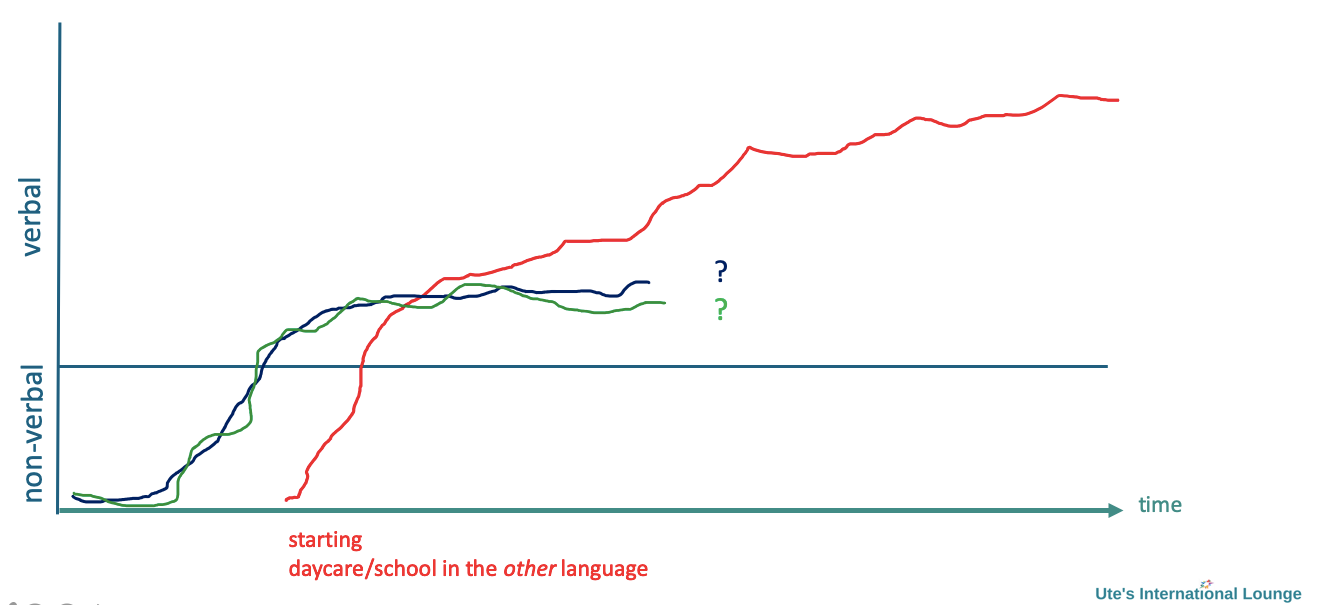
What I observe is this:
© Ute Limacher-Riebold 2019

This chart shows an average development of a multilingual child. After the non-verbal phase, when the child is acquiring the home languages (in this case indicated in blue and green lines), the child becomes verbal in both languages, if the exposure to both languages is consistent.

At some point, this child will attend daycare or school in another language (read line) and will be required to acquire and learn the school language as quickly as possible – see the exponential development in the school language.

Once our children start attending school in a language that is not one of our home languages, the exposure to the home languages decreases and in most families, the main focus shifts on the school language. This is a very natural and, for many years, expected shift to take place in international/expat/immigrant families.

In the past, governments discouraged immigrant families from keeping their languages, as to help them assimilate as quickly as possible to the host society by learning the local language. The main objective being for immigrants to fit into the society and adapt to the local life, culture and language. – But assimilation often goes hand in hand with abandonment of the previous language and culture, which will has a negative impact on the identity and sense of belonging of the children and young adults.

In recent years, research has emphasized the importance of maintaining the home languages and contributed to a major shift in education, which leads to more language inclusive schools that, for example, adopt translanguaging pedagogies, are allowing children to speak their languages within the school premisses and use resources in their home languages to prepare school subjects etc.

Home languages play a major role in the overall wellbeing of international children*: they are necessary to bond between generations – children and their parents, and extended family – and connect with heritage cultures. Furthermore, the fact that home language skills can be transferred to school, which had been emphasized by Prof. Jim Cummins in 1979 (!) already, has proven to be more successful and important than focusing on the school language only for foreign children, especially, when home languages are consistently fostered throughout childhood.
* international children= I mean all children who are growing up outside of their parents countries of origin, independently of the reason for this upbringing. These can be refugees, immigrants, expats etc.

Thankfully, more and more parents are aware of the importance to maintain their home languages, independently of the “prestige” their languages are attributed to either by society or the parents themselves.

Especially the burden put on international parents who are in charge of providing not only the necessary input for their children to become verbal in their home languages, but also the teaching for them to become bi-/pluriliterate, can become an immense burden, especially when this all leads to rejection.

In my practice and in my personal experience, I have observed that this rejection of the home language can lead to attrition and, in the worst case, to language loss.

Based on my own experience with my rejection of my home language as a teenager and my children’s personal choice of languages, I completely agree with Dr. Sabine Little, a German linguist at the University of Sheffield, who recommends to “let children forge their own emotional connection to the language”.

Like her son, I gave up on German for several years, before returning to it. Like Sabine Little, my mother let me determine when I would speak it together with my German family and friends (with whom I share other languages too). 

The measures Sabine Little took with her son won’t work with my children – his time on YouTube is restricted, but he is allowed more if he watches in German: this is something my teenage children would not do consistently – but, like I say to my clients, there is no one solution that fits all and every multilingual family deserves her personalized solution!

Our languages are an intimate part of our identity. For us parents it is wrenching to try and fail to pass them on to our children**.

But, once again, I advise to carefully define our success: for some it is enough that our children can speak our languages with extended family, for others it is important that they can also read and write to a certain extent, and then there are those who want their children to return to their countries of origin for study or work, and therefore have higher expectations concerning their level of literacy.
Success has many facets and it is interesting to see how what we would define as such when our children are toddlers can change over time and still be our personal success when they are young adults.

I always invite international parents to
• define the language goals for their children,
• divide them into small achievable steps and
• re-assess their situation every now and then (once a year is a good average),

to make sure to keep goals realistic, celebrate the small achievements and make sure to remain consistent in the long term goals.

If you have any questions related to this topic, contact me at info@UtesInternationalLounge.com (or find more about my services as Family Language Consultant here)

Please find more of my articles and posts about raising children with multiple languages here and join my facebook group “Multilingual Families“.

(*) The term idiolect is etymologically related to the Greek prefix idio- (meaning “own, personal, private, peculiar, separate, distinct”) and -lect, abstracted from dialect, and ultimately from Ancient Greek ????lég?, ‘I speak’.

(**) I got inspired to write this post when I read this article on the economist.com site.
https://www.youtube.com/live/LE1PBCx7lMQ?feature=share

First multilingual non-verbal communication milestones

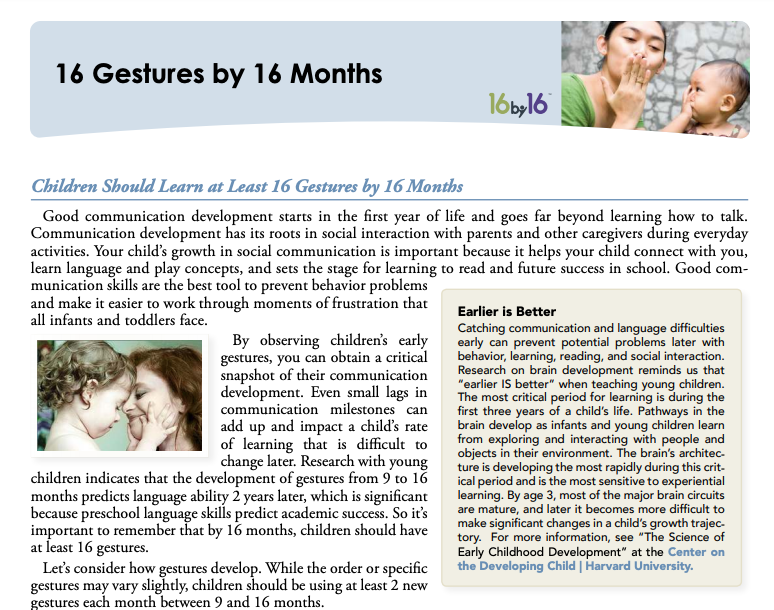
When children grow up with multiple languages they not only acquire words from different languages, they also learn different gestures.

A healthy communication development starts in the first year of life and consists not only in becoming verbal – i.e. articulating sounds and acquiring that sound-chains can have a meaning and connect with objects, people and concepts in the world around us – but also in using gestures and facial expressions.  It has its roots in social interaction with parents and other caregivers during everyday activities.

For multilingual families this means that we have to make sure to communicate with our children in the different home languages with a certain consistency so that our children can copy the sounds we make and the gestures we use. 

By observing our children’s acquisition and use of gestures, we can get an impression of what their overall communication development looks and might look like in the future.

Research with young children indicates that the development of gestures from 9 to 16 months predicts language ability two years later, which is significant because preschool language skills predict academic success. So it’s important to remember that by 16 months, children should have at least 16 gestures. – On the Reading Rockets website you can find an interesting pdf file with 16 Gestures by 16 months.

I am always cautious when it comes to advice like the one that by 16 months, children should have at least 16 gestures. Every child is different and family situations are unique. Furthermore, languages and cultures differ in communication styles, also with regard to gestures. Some gestures are used in different languages and seem to be universal, but they can slightly or highly differ in their meaning.

The typical American sign of “thumbs up” for example, or the “hand up” sign for “wait” seem to be perfectly acceptable in some Western cultures, but they are not in Eastern countries and languages or Greece (for the wait sign). Sings vary across cultures and it is advisable to get informed about the signs our partner uses with our children and agree on what we want and can introduce and what not.

Families who raise children with multiple languages, focus on multiple communication verbal and non-verbal styles. 

In this context it would be interesting to study the use of baby-sign language and the effect it has on the infant and toddler’s acquisition of gestures and verbal language.* 

If your child happens to be between 9 and 16 months old when you read this, it would be interesting if you could take pictures or write a log-book about the signs he or she makes. – I’d be very interested in knowing about these milestones as it is something I missed taking notes about when my children where that age.

I recall one particular milestone of son at age 2,8 years, that I mention in my intercultural communication classes when I talk about non-verbal communication: we just moved from Italy to the Netherlands and my son was used to hear and speak more Italian and used some Italian gestures already. Among these, the sign stai attento / guarda…! = sei nei guai (be careful / = you are in trouble) was one of his favourite. It was impressive to notice that within a few weeks in a Dutch daycare, he switched from the Italian hand gesture to the Dutch one lekker lekker, to signify yummy, yummy.


When a parent asked me what to watch out for about her daughter’s language development in this pre-verbal phase, while acquiring Arabic and Italian. I suggested her to decide with her husband what gestures are important for both languages and won’t lead to misunderstandings or embarrassing situations, to observe her daughter and not to worry as long as the daughter is making some kind of progress.

What should us make reach out for help is, when there is a long stagnation in the development or a noticeable regression, and there is no apparent reason for it, eg. a transition or change, like the birth of a sibling, a move, but also changes that for us seem minor but can mean a world to our little ones. Whenever parents start to worry, it is advisable to ask an expert and find out what might be the cause. 


Good communication skills are the best tool to prevent behavior problems and make it easier to work through moments of frustration that all infants and toddlers face.


* Please have a look at Roya Caviglia’s Infant Communication Baby Sign Language Courses 


Further readings

This is an article in Italian that explains the meaning of baby’s body-language 


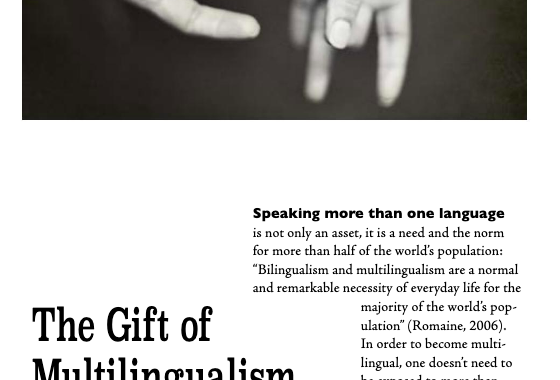
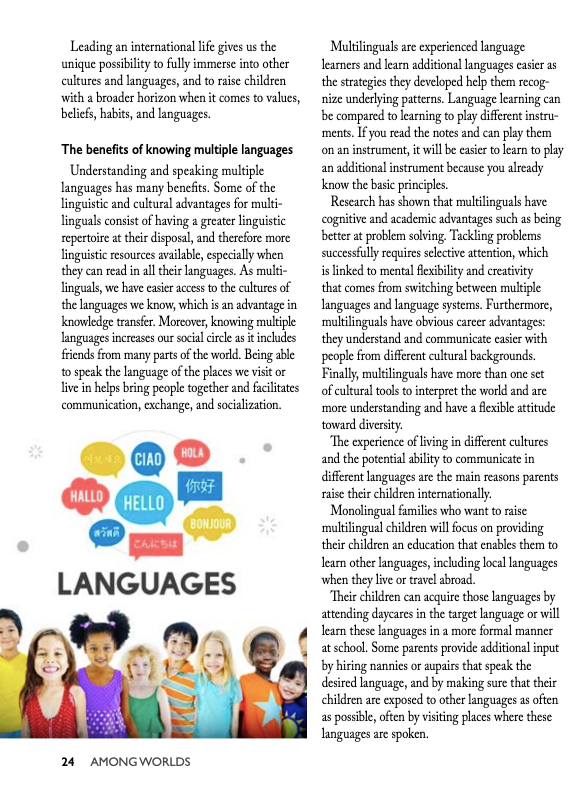
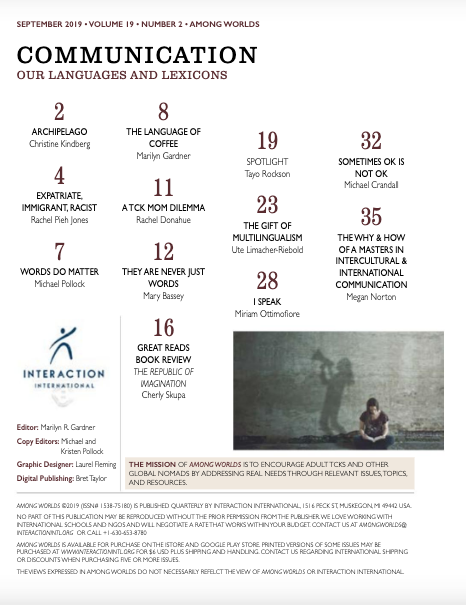
The gift of multilingualism (article in Among Worlds)

When Marilyn Gardner asked me to write an article for the September 2019 issue of Among Worlds, Communication: our languages and lexicons I couldn’t resist writing about the gift of multilingualism.

I am very honored to see my article published in this magazine dedicated to so many important topics for internationals!

– Thank you, Marilyn 😉


Marilyn Gardner, editor of this magazine and author of Between worlds, Worlds Apart, and the blog Communicating across boundaries, gave me the permission to publish my article here (if you click on the images, you access the issue of the magazine):

I kindly invite you to read the whole magazine.

Here is the index of the September 2019 issue:

How we learn and memorize new words

Everyone has a very personal way to learn a language. Some of us just learn by repeating what they hear, others need to learn the structure, the grammar in order to consolidate the new language.

Every new word that we hear does make a long way to land eventually in our long term memory. When we read or hear it for the first time, the word lands in our very-short-term-memory (i.e. sensory register or sensory memory) and usually disappears from there, unless we focus our attention on it and concentrate and transfer it to the short term memory. Here, the new words spend approximately 20 minutes (some say even shorter). During this time we should repeat the new words, otherwise they’ll get “erased”. The way from the short term memory to the long term memory takes approximately 6 hours.

How does this work? It is like our brain would push the save button and the data, like on our computer, is saved on the hard disk. But even if the new words are memorized and fixed in the long term memory, they can’t rest.

They have to be repeated in regular intervals, otherwise they’ll go into the (passive) storage room of our long-term memory, i.e. in our receptive vocabulary, the vocabulary we comprehend, but don’t use. We could recall and maybe use them later on, if we want or need them.

This can happen with languages we don’t use regularly but want to reactivate at some point. – We don’t have to re-learn them from scratch, we just have to reactivate them by stimulating our knowledge by reading, listening, speaking or writing, and use them again. It’s interesting to see that this doesn’t only apply to language we used orally, but also language we used mainly in writing. If for some time we stop writing in them and want to reactivate that skill, our way to re-access the language, its words, expressions etc. can also happen through writing!

Let’s go back to how we memorize words.

It seems complicated, but through constantly stimulating our new inputs we really can memorize up to 200 new words per day in our long-term memory.

The single steps a new word takes, make it clear why we need a certain time to master a new language and become proficient, aka fluent enough to feel confident speaking it.

The way the storage of words and their networking with other words we already know works, depends on the type of learner we are.

The visual learner memorizes new words when he sees them written, i.e. when he reads them. The haptictactile  or kinesthetic learner needs to write the words in order to memorize them, the auditory learner needs to hear them. – I personally believe that most of us are a combination of them all, only that in each individual, these types are combined in a very unique way and one type or more, can be more prominent than others.

Some people prefer approaching a new language by understanding its grammatical rules. These are called cognitive learners, who really need a systematic textbook. Whereas imitative learners seem to memorize the best by listening and repeating.

Independently from what kind of learner we are, we need to practice, speak, if possible, read and write the new language whenever we can in order to improve our skills.

Adding the creative aspect to the learning process, the learning languages is never complete. We all learn language in the domains of life, with the vocabulary, registers etc. we need them. We can not learn all the expressions, nuances, registers in all regional variants and dialects of a language, in its sociolects etc.!

We will never reach a complete knowledge of a language, not even if we are a native language speaker! (Li Wei)

Dr. Diane Larsen-Freeman held a very interesting speech about Empowering the Language Learner (very long!) where she used a combination of lecture “and experimental exercises (…) and traced the evolution of language teaching methods over the past 60 years, discussing how each evolutionary phase has contributed to a more “whole-person” view of language learners. Larsen-Freeman suggests that when educators treat language as a closed, static system, they create a critical barrier to student empowerment. When language is instead seen as the complex, dynamic system, teachers are able to help their students transform their linguistic world, not merely conform to it. Larsen-Freeman illustrates how this shift in understanding has implications for what and how teachers teach.”

It is not easy to decide what kind of learner we are. It also changes depending on the phase we are in during our learning process.

For example, I am definitely an imitative learner in the first phases of learning a new language. I imitate sounds, sound chains, intonations of even whole sentences. But during these first phases I also need to read and hear the words I’m learning, in order to understand their spelling and some basic orthographic rules of the new language.

I then expand this to the grammar: the morphology, the syntax, the vocabulary, semantics and pragmatics. During the whole process I constantly compare the new language to those I already know, more ore less consciously. It is like integrating the new into a network that already exists, creating new pathways and connections.

The dynamics Dr. Diane Larsen-Freeman mentions about the system of a language and what it implies for teachers who teach a language, is also recognizable in the learner himself who is going through different stages of comprehension that involve all the senses.

If you want to find out learner you are, you can find it out here  or here.

Further readings:
Ways to expand vocabulary

(cfr. ©”Wie landet das Wort im Kopf”, P.M. 7/04)

Language shift in multilinguals

What happens when multilinguals shift language?

The process of language shift, also known as language transfer or language replacement or language assimilation, is when a community of speakers of a language shifts to speaking a completely different language, usually over an extended period of time.

From a historical perspective, this happened for example when in the now France shifted from Gaulish to Latin during the Roman Empire. The reasons for this were that Latin was perceived as to be higher status and it spread at the expense of the other language, Gaulish, that was perceived by its speakers as to be lower-status. 

In the past 150 years many countries developed a standard language, shifting from regional languages to a language that was considered more prestigious and therefore more valuable. In Italy, for example, since the times of the Renaissance, a trans-Italian language was developed in central Italy, based on the Florentine Tuscan because of its cultural prestige. This Forentine Tuscan (think about the Tre Corone: Dante, Petrarca, Boccaccio) started to be employed for formal, literary and written purposes among the literate classes from the various states of mainland Italy, Sicily and Corsica (France), sidelining the other dialects in education and formal settings. Literary speaking, Florentine established itself as the single most representative dialect of Italy long before its political unification in 1861. Thus, Tuscan has been officially adopted by the pre-unitarian states. Italian further expanded as a commonly spoken linguistic form for everyday use throughout the country after World War II.

Nowadays, we can observe a  validation of the local dialects and regional variants again, but that’s a topic for another post.

What is interesting to see is that the historical language shift can be observed also on a sociolinguistic level in multilingual people.

Those who speak multiple languages usually have (a few) languages that are more dominant for a certain period of time.

There are multiple factors that determine what language is more dominant in a given period.

Depending on the situation, the personal preference and the actual need of using the language on a regular basis influence the individual status of the language.

For example, although I was fluent in German most of my life, I spent 6 years using it only sporadically, and preferring Italian and French because I needed them daily for work and research. German became less important, less valued in the community I lived in and among my friends, which lead to a language shift and almost language loss. In fact, I had to invest considerable energy and time in reactivating my German which I perceived then as “dormant” – i.e. present in terms of I knew and understood the language but didn’t use it frequently enough to be able to have fluent communications in it anymore. The same happened to my English that I used only sporadically during the same period of time, and that I only re-activated 14 years ago and use daily since.

Language shifts happen to multilingual speakers who usually live, study and work in settings where one or two (or three) of their languages are required more than the others. Although all the languages that we acquire and learn at some point in life, are still in our language memory, those we use more often are more in the foreground and ready to be used, whereas those we use only sporadically or only in reading for example, are less “present” and ready to be activated. 

Language shift in children

When our multilingual children start attending daycare or school in another language, their language preference will shift towards the language of their education. They will need to become as fluent as possible in the school language in order to succeed academically. Many parents are advised to focus more on the school language and some are even told to drop their home language(s)!… This is completely unnecessary and actually counterproductive. In fact, skills that our children acquired and learned in their home languages can be transferred to the school language, and vice versa.

It is a fact, though that the home languages, as a consequence of more exposure in the school or community language, will become less important. If children don’t receive adequate input in their home languages that foster understanding, speaking and maybe reading and writing, the language shift from home language to school language can go so far as for children not to respond in the home languages anymore.

In order not to have a complete language shift that could lead to language loss if not taken seriously, parents, educators and the community – ideally! – would support and foster the home language too! 


Have you ever experienced language shift?

Please share in the comments!


If you have questions about language shift and language loss, don’t hesitate to contact me at info@UtesInternationalLounge.com!

Please have a look at our Toolbox for Multilingual Families to get inspired about how to foster family language skills with no or very little preparation! 


– For further readings I recommend the post about Language shift, attrition and loss 

Language scenarios for multilingual children growing up abroad

There are numerous language scenarios for multilingual children living abroad, i.e. outside of both, or one of their parents countries of provenance (or origin), since there are many different degrees of fluency for the single languages spoken at home, language preferences, and languages might be mixed within the home.

Parents might speak the community and/or school language to some extent, and other languages could be spoken at home and in certain societal situations too.

Here are some possible scenarios. La, Lb etc. indicate the different languages and are not suggesting any kind of language hierarchy; the languages indicated can be replaced with any other kind of language, dialect or sign language.

  Parent 1 Parent 2 Language at Home Language at Home CommunityLanguage Language of education
1 La (German) La (German) La (German) La (German) Lb (Italian) (Lb) Italian
2 La (German) Lb (Italian) La (German) Lb (Italian) La (German) (La) German
3 La (German) Lb (Italian) La (German) Lb (Italian) Lc (English) (Lc) English
4 La (German) Lb (Italian) Lb (Italian) Lc (English) Lc (English) (Lc) English
5 La (German) Lb (Italian) Lb (Italian) Lc (English) Ld (French) (Ld) French or (Lc) English

scenario 1: Both parents speak German with the children, their home language is German and the community and school language is Italian. – They adopt the Minority Language at Home strategy.

scenario 2: One parent speaks German, the other one Italian with the children. They both understand each others’ language and use both languages at home. The community language is German. This is one scenario of the One Person One Language strategy. 

scenario 3: One parent speaks German, the other one Italian with the children, both parents understand and speak the partner’s language and alternate them at home, when the family is all together. The community language is English, so, an additional language to the ones used at home. – This is another scenario of the One Person One Language strategy.

scenario 4: One parent speaks German, the other one Italian with the children. They speak Italian and English at home as a family, as one parent doesn’t speak German. The community language is English: so one of their family languages is the community language, and one of their family languages is a minority/home language. – This is another scenario of the One Person One Language strategy combined with the Time and Place, and the Two Persons Two Languages strategy.

scenario 5: One parent speaks German, the other one Italian, they speak Italian and English at home as a family, as one parent doesn’t speak German, and the community language is French, so, an additional language to those used at home. – This is another scenario of the One Person One Language strategy combined with Time and Place and Two Persons Two Languages strategy.


Children who live in a community that speaks one of their heritage languages (¹), will most probably be schooled in that language (example 2), whereas those who live in a community that speaks another language, are usually schooled in the community language (examples 1 and 3) or in an additional language (example 5).

For the former ones, any additional language will be introduced and taught at school, and, if necessary, additional support will be provided by teachers, speech therapists etc. in a language they also speak at home. An example would be an English-French speaking family living in France, the child attending a French school and learning English (or an other additional language) later in school.

Children whose heritage language differs from the one they need for their education, tend to learn that language in more formal setting – at daycare or school – and rely on their parents to maintain the heritage languages. They will learn the community and school language for social and academic purposes, and receive support from the school to reach the expected level of fluency necessary to participate in the lessons.

For highly mobile families, who move every few years, these scenarios will change. They may want to maintain the home and school languages if possible, to guarantee at least some kind of continuity.

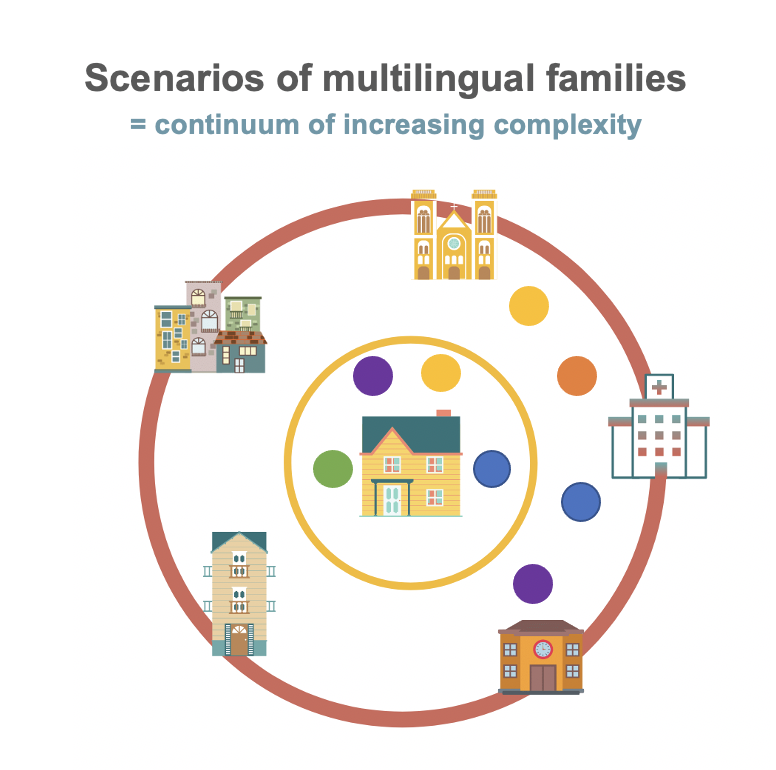
The variety of constellations in multilingual families is huge! I like to think about it as a continuum of increasing complexity. The more languages are involved, the more questions we need to find answers for to make sure to maintain the languages in the most effective and compelling way for us and our children. In the picture here below I use colors instead of labels as I prefer to avoid any kind of hierarchy when it comes to languages, dialects, sign languages etc. used in a family.

Reality check for parents raising multilingual children


Multilingual children who attend a school in another language (scenarios 1, 3, 4, 5) do not become and stay multilingual automatically. What many parents and teachers underestimate is the impact school language has on the children. In order to follow the lessons, they will need to improve their school language skills and they want to speak the same language as their friends at school.

If they are lucky, they receive education in their heritage language to some extent if it is part of the school curriculum. If the school doesn’t provide an intensive program that aims at pluriliteracy, and if their heritage language is not part of the school curriculum the chances for them to attain a native level of fluency (i.e. level C1 or C2 of the CEFR)(²) decrease and many of them won’t become or stay biliterate (or pluriliterate) if they don’t receive consistent additional support.

When parents, schools and communities don’t support the heritage languages to an extent for them to grow alongside the school language, or at least stay active, the proficiency of multilingual children in the heritage languages will most probably decrease. – This phenomenon is called subtractive bi-/multilingualism, as opposed to additive bi-/multilingualism that refers to the case in which someone learns a second language in a manner that enables him to communicate in both languages, without diminishing the skills in the other languages, and where these latter ones are considered as an asset rather than being a hindrance to the learning process.

What many parents are not aware of or underestimate is that transmitting and maintaining the heritage language when living abroad is the main responsibility of the parents: they are the ones who are the agents of multilingual education. They will either take on the task themselves or find weekend schools for their 3-12 year olds. Most weekend schools for minoritized languages offer tuition in the heritage languages up to age 12 or 13. 

Parents need to find strategies that are supportive for the heritage language throughout the whole developmental years of their children and foster reading and writing in teenage years, should pluriliteracy be the goal. But even if understanding and speaking the heritage language is their goal, consistent input is crucial for the children to maintain the language(s) throughout their childhood and beyond, when the community and education language is different.
This entails planning, time and dedication, because at some point, the requirements in the other school subjects will increase and some will consider them more important than the languages. Many families will thus abandon their former language goals concerning the heritage languages in favor of the school language and other subject areas.

What kind of language scenario do you have in your multilingual family?

How do you manage to keep all your languages alive? Please let me know in the comments.

– If you would like to find out what you can do in order to support your children with the heritage language throughout their developmental years, contact me here. Don’t wait until your child is 12 or 13…

(1) I use the term of heritage languages to define the languages spoken by non-societal groups and linguistic minorities in a society, and in given contexts. In this chapter, this term defines the languages that internationally living families speak at home, and, occasionally, outside of their homes if there are respective language communities in the area they are living. A heritage language can be one of their first languages (when they are simultaneous bilinguals) of the parents, or one that is their most dominant language (ex. adopted parents might have grown up with another language than the first one they heard). 

(2) The Common European Framework of Reference for Languages (CEFR) is a valuable reference instrument that can be used to assess language skills. It is available in 40 languages (so far) and gives a general orientation about the skills required for the different levels of fluency. It is advisable to do the assessment with professional help, as the different levels of fluency in speech, reading and writing require some explanation.

Research Projects about Bi- and Multilingualism

Research projects (past and present)

Here you can find a list of projects around plurilingual (or multilingual) living.
I will update it regularly. If you want me to add your project or a project you consider important, please mail me at info@UtesInternationalLounge.com or leave a comment with the name and link to the project site in the comments.

EU Projects

Erasmus+ PEaCH project

Up2Europe

MultilingualMind

Belgium

Groupe de recherche sur le plurilinguisme de Namur

Germany

DAIMLER BENZ STIFTUNG

Sprachstandsermittlung bei Kindern mit Migrationshintergrund

DUISBURG/ESSEN

DuEPublico

UNI ERFURT

Language Acquisition and Multilingualism

KONSTANZ

Zentrum für Mehrsprachigkeit

Italy

BOLZANO

EURAC (Istituto di Linguistica Applicata)

CATANIA

Il Centro di Ricerca Interuniversitario POLYPHONIE – Ricerche su plurilinguismo, creatività e scrittura

UNIVERSITA DEGLI STUDI DI TRENTO

Bilinguismo Conta

UDINE

Centro Internazionale sul Plurilinguismo

Luxembourg

UNIVERSITÉ DE LUXEMBOURG

Mehrsprachigkeitsforschung

Netherlands

UNIVERSITY OF GRONINGEN

The Effects of Multilingualism

UNIVERSITY OF LEIDEN

AThEMEAdvancing the European Multilingual Experience 

UNIVERSITY OF NIJMEGEN

Cognitive and Developmental Aspects of Multilingualism

UNIVERSITY OF UTRECHT

Faculty of Social and Behavioural Sciences

Meertalig.nl

Norway

UNIVERSITETET I TROMSØ OG NTNU I TRONDHEIM

FLERE SPRÅK TIL FLERE

THE CENTER FOR MULTILINGUALISM IN SOCIETY ACROSS THE LIFESPAN (MULTILING) IS A RESEARCH CENTER FINANCED BY THE RESEARCH COUNCIL OF NORWAY AS A CENTER OF EXCELLENCE

MULTIFAM: FAMILY LANGUAGE POLICY IN MULTILINGUAL TRANSCULTURAL FAMILIES

LANGUAGE, CULTURE AND IDENTITY IN MIGRANT NARRATIVES (SKI) (COMPLETED)

Switzerland

PLURILINGUISMO IN SVIZZERA

UNIVERSITÄT BASEL

Sprachlernmechanismen bei ein- und mehrsprachigen Kindern

Spracherwerb: Erwerbssequenzen und Mechanismen des Erstsprachenerwerbs und der frühen Mehrsprachigkeit

Urbane Mehrsprachigkeit in der Schweiz: Kommunikative Praktiken und Spracheinstellungen

BERN

Schweizerische Eidgenossenschaft

UNIVERSITÉ FRIBOURG / UNIVERSITÄT FREIBURG 

Departement für Mehrsprachigkeitsforschung und Fremdsprachendidaktik

Institut für Mehrsprachigkeit

Mandats de Recherche

Portail Plurilingue (de l’Université de Fribourg)

Publications CSP

Recherche du centre scientifique de compétence sur le plurilinguisme

PÄDAGOGISCHE HOCHSCHULE ZÜRICH

Datenbank Mehrsprachigkeit

United Kingdom

UNIVERSITY OF BANGOR

Centre of Research on Bilingualism

UNIVERSITY OF ESSEX

Center for Research in Language Development throughout the Lifespan

UNIVERSITY OF EDINBURGH

Bilingualism Matters

UNIVERSITY OF READING

Centre of Literacy and Multilingualism

ESRC PROJECT

Family Language Policies

USA

PENN STATE UNIVERSITY

The Center for Language Science

5 Stages of Additional Language Acquisition

When children learn another language after having acquired their first language or languages, they go through different stages that can vary from child to child and depend of how similar the additional language is to those the children already know. 

This infographic shows 5 stages that 3 to 8 year olds can go through when learning an additional language in informal settings, i.e. not at daycare or school, without formal instruction.
This is why we use the term of language acquisition and not learning, although for the last 3 stages reading and writing skills are also considered. Reading and writing are both skills that need formal instruction.

After our children have already acquired their first language(s), everything they will acquire and learn about the additional language will be put in relation to their existing knowledge of the other languages. And if our children have already started reading and writing in those other languages, these skills are transferrable to the additional language (see Jim Cummins’ Common Underlying Proficiency). 

Please consider this infographic as a general guideline. Every child is different and deserves personalized attention and assessment if necessary.

I invite you to observe your child’s language development and to support your child by praising the progress (not the mistakes!) and to enjoy all the steps!

If you are not sure if your child is making progress, try to write down the words he/she understands (receptive language) and uses (active language) for 3-4 weeks.

The infographic explained

1) The first stage, called pre-production stage (some used to call it the silent stage) which I prefer calling the receptive stage can last between zero to six months.

In this stage, children have very few if any oral skills in the additional language and begin learning vocabulary. They may only respond to someone speaking the additional language in a non verbal way such as pointing, gesturing or drawing for example.
But they start understanding simple sentences and words, and therefore they are receptive for the new language since they start being exposed to it.

As this stage is very controversial among language educators because it is very unlikely that a child that acquires an additional language will “stay silent” in this first stage, I prefer the term of receptive stage, in analogy to the receptive pre-verbal phase of very young children. Furthermore, speech is so fundamental in language acquisition and when speaking about additional language acquisition, we talk about children who are verbal in another language or other languages (plural) already, so they have means to express themselves.

Children can improve very quickly in their additional language if they directly get to apply what they are acquiring: by repeating simple words, phrases, anything they understand, that is useful for them (see: comprehensible input (and output) by Stephen D. Krashen)

2) As soon as children begin to practice articulating new words starts the early production stage that can last between six months to a year.

The child starts having a greater understanding while listening to the additional language and can produce a limited number of words, phrases and simple sentences like “thankyou” “please” “Ineedthat” “Iwant”. In this stage, children might not distinguish words in the new languages morphologically and consider “thankyou” as one word, until they understand that one can also say “thank her / him / us… Anna…“.

3) The third stage is known as speech emergence and can last between one and three years depending on the frequency of exposure to the additional language.

The child gains even greater comprehension in the additional language, starts stringing words together into phrases, sentences and questions, and we can notice that the accuracy from a grammatical point of you and with regards to the pronunciation increases.

The child might be starting to read and write in the additional language if taught how to do so in another language. Remember, this is an infographic about language acquisition, i.e. when the child is exposed to the additional language on a regular basis but without formal instruction.

If the child starts being exposed to the additional language starting from age 3, this stage would correspond to the child starting school, and receives formal instruction in the school language, i.e. learns also how to read and write.

4) The fourth stage is the one of intermediate fluency which can last for 3-5 years.

Children will continue developing vocabulary and start thinking in the additional language. This thinking in the target language will help them gain a higher proficiency when speaking the language!

There is a considerable increase in communicating via writing: children will use more complex sentences – with subordinates for example – and we’ll notice a greater accuracy and correctness in the use of grammar and pronunciation.

Furthermore, children might start auto-correcting themselves.
At this stage, children have learned how to read and write in their other language, and are able to transfer those skills to the additional language – at least to some extent.

They’re able to express their thoughts and feelings in the additional language, be more spontaneous, start conversations and hold conversations about familiar topics. Depending on the language, they might be able to use simple forms of negative questions “You don’t like the movie?”, “Don’t you like the movie?”.

If children started with the additional language at age 3, they would be approximately 8 years old at this stage. Their fluency in the additional language will depend from their exposure to the other language (usually the one they are schooled / educated in) and the way they manage to transfer the learned skills to the additional language.

5) The last stage is called advanced fluency or continued language development which can take for 5 to 7 or 8 years, depending on the circumstances.

The children develop the vocabulary of the content area, i.e. the domain and circumstances they acquire the additional language. Their improvement in the additional language depends from the exposure of a greater variety of contexts, i.e. different content areas, or more in depth vocabulary in the areas of interest.

With the increase of vocabulary and overall confidence in using more complex sentence structures across the domains of interest (and need), children will be considered as nearly native users of the additional language, even with regards to idiomatic expressions, metaphors etc.

By attaining nearly native fluency, children will be confident at using more complex negative questions  like “I hope you don’t mind…” and irony.


If you would like to have tips about how to start such a journal or are wondering if your bi- or multilingual children’s language development is healthy, don’t hesitate to contact me for a free consultation .

FYI:
I’m a linguist and I have studied language acquisition, language variation etc. and I can help you find out if your child needs a speech therapist, audiologist, child psychologist… or not. 

10 Stages of Bilingual Language Development

“Becoming bilingual, whether from birth of soon after, or subsequently in early childhood prior to schooling, entails a complex interaction between what children bring to the learning task, that is, among others, speech segmentation skills, speed of processing, and the linguistic and cultural environments in which they grow up” (Ludovica Serratrice, Becoming Bilingual in Early Childhood, in A. De Houwer and L. Ortega, The Cambridge Handbook of Bilingualism, CUP, 2019, p.35)

Parents, teachers, educators and health practitioners should always consider that quantity and quality of input are strong predictors of children’s early lexical skills, and these are closely related with emerging grammatical skills.

Also, the societal status of the language – its prestige in the community – plays an important role in the development and maintenance of the skills children acquire in these languages.

Please consider this infographic as a general guideline!

Every child is different and deserves personalized attention and assessment if necessary!

I invite you to observe but not hover over your child’s language development and to enjoy all the steps!

If you are wondering if your bi- or multilingual child’s language development is healthy, don’t hesitate to contact me for a free consultation at info@UtesInternationalLounge.com.

As a linguist with extensive experience with multilingual language acquisition and learning, and language and speech specialist, I am able to recognize the signs that require help from a a speech and language therapist, audiologist or a child psychologist and always recommend other professionals when necessary.

Further readings:

Kohnert, K. (2010) Bilingual children with primary language impairment: issues, evidence, &  implications for clinical actions. Journal of Communication Disorders 43: 456-473.

Simultaneous and Sequential Bilingualism

When parents speak more than one language it can be difficult to choose whether to introduce both or all of the languages from birth, or to rather wait until the children’s skills in one language have become established before introducing the second (or additional) language(s). In this post I use the terms simultaneous and successive or sequential bilinguals because research uses these terms mainly with children who are acquiring and learning two languages at an early stage. There are not comparable studies about multilinguals, i.e. children who acquire and learn more than two languages from birth (simultaneous multilinguals) or learn additional languages early on (before age 3 or 5).

Simultaneous bilinguals acquire a first and second language concurrently.

This means that two or more languages are acquired from birth or very early on. Simultaneous bilinguals will usually develop native-like proficiency in both languages in the most natural and spontaneous way, through being exposed to two (or more) languages regularly since day one, or very early on – before age 3 – and in one on one interactions or conversations, using child directed speech. The children’s early exposure helps them master subtle phonological features effortlessly.

Sequential or successive bilinguals, on the other hand, learn a second language after establishing their first, so, rather after age 3 or between age 3 and 5, when they start daycare or school in the additional language. This is also known as Early Second Language Acquisition (Annick De Houwer 2009).

Successive bilinguals benefit from a solid foundation in their first language, which helps them transfer literacy and academic skills to the new language. Furthermore, they develop metalinguistic awareness, an ability to analyse and compare language structures, leading to profound linguistic insights.


Important to know:

Most studies about school aged children are based on successive bilinguals, and practices and interventions are geared at supporting these children’s learning the school language with the support or through their home language(s), or based on the skills already acquired in their home language.
With the terms of simultaneous and successive bilinguals, the focus is mainly on the age of acquisition: which is either before the children receive formal instruction or starting from when they receive formal instruction in the additional language (generally after age 3 or between age 3 and 5, when they start daycare or school).

– Please read also the post about Compound, coordinate and subordinate multilinguals.

And watch my video about the different types of multilinguals: