Category: Professional Development for Educators of Multilinguals

The Writing Rope and Multilingual Writers

Writing Development in Simultaneous and Successive Bilingual Learners Writing is one of the most demanding skills children acquire because it requires thinking, language knowledge, motor skills, and cultural awareness to work together. For multilingual learners, this complexity increases further, as writing develops across languages with different structures, scripts, and conventions. Joan Sedita’s Writing Rope offers

Read More

Bridging Languages and Learning: A Short Guide to BICS, CALP, CUP & CALS for Multilinguals

Many multilingual children experience a paradox: some may chat fluently in a new language but struggle academically, whilst others may grasp complex academic concepts yet find casual conversations about everyday topics difficult.

This is where four essential concepts – BICS (Basic Interpersonal Communicative Skills), CALP (Cognitive Academic Language Proficiency), CUP (Common Underlying Proficiency), and CALS (Core Academic Language Skills) – help us understand multilingual development and learning success.

Read More

How to Read Bilingual Books: for Teenagers and Adults

How to Read Bilingual Books: for Teenagers and Adults Bilingual books offer a unique opportunity for language learners, both teenagers and adults, to enhance their language skills, gain deeper cultural insights, and maintain their heritage language while acquiring a new one. However, reading bilingual books effectively requires more than just skimming through the text. It

Read More

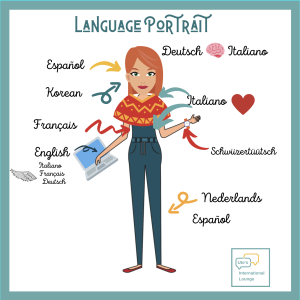
Language Portrait

  Originally developed as a language awareness exercise in education, the Language Portrait is now increasingly used as a research tool investigating how speakers themselves experience and interpret their heteroglossic practices and repertoires (Busch 2018). It allows a multimodal approach as it combines discursive and presentational forms of symbolization (Langer 1948). By providing a body

Read More

Multilingualism is good for the economy

Multilingualism is not only good for our brain, our overall flexibility and open mindedness, it is also good for the economy.  That countries like the UK with relatively “poor language skills” loses “the equivalent of 3,5% of its GDP every year” for exactly this reason whereas Switzerland, with its four national languages (German, French, Italian

Read More

Multilingual Assessment in the Netherlands

Some international families send their children to international schools, especially if they move frequently  this seems to be the best option as the curriculum of international schools is expected to be similar all over the world. Unfortunately this is not the case. There are sometimes major differences even within the same kind of “international” school

Read More