


Norwegian Parenting through the Foreign Lens
Parenting styles differ significantly across cultures, and starting a family in Norway or moving there with kids can bring unexpected adjustments. Norwegians are known for their child-centered, independent, nature-focused, and relaxed approach to discipline and parenting.

How to Help Multilingual Children Feel Proud of Their Language and Identity
Discover how language, love, and community help children grow proud of their multilingual identity. Insights from psychiatrist Dimitris Karagiorgas.

Preparing Multilingual Teens for Home Country Visits
Are you visiting your heritage country with your teenagers? When our teenagers grow up abroad and we are the only ones or one of the few they get to speak our language with, meeting family, friends and peers who are immersed into that language is not easy. When my children were preteens, I observed
How to maintain our languages whilst living abroad
Whilst living abroad we can learn and immerse ourselves in a new culture and language, but how can we maintain our other languages?

From Cultural Identity Model to Language Identity Model
Audio From Cultural Identity Model to Language Identity Model UIL I recently translated the Third Culture Model into a Third Language Model for multilinguals, and I want to share my translation of the Cultural Identity Model from D. Pollock and R. Van Reken, into my Language Identity Model©: (my design is inspired by the Cultural Identity
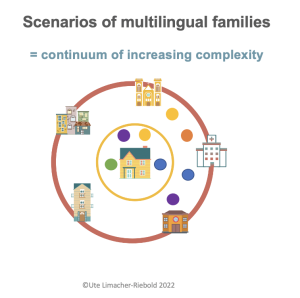
What part of our language are we passing on to our children when living abroad?
When our children grow up abroad, outside of the country where our home languages are spoken, many of us tend to focus on standard language. We want our children to learn the most standardized version of our language. This has several reasons: we want our children to be able to understand and be
Internationals struggle to pass on their home languages
Families who live internationally, i.e. who spend several of their children’s developmental years in another country, and whose home languages are different from the communities they live in, usually struggle to pass on their home languages. Especially if these are not English. – This is not an assumption, this is a fact. I observed this

The gift of multilingualism (article in Among Worlds)
When Marilyn Gardner asked me to write an article for the September 2019 issue of Among Worlds, Communication: our languages and lexicons I couldn’t resist writing about the gift of multilingualism. I am very honored to see my article published in this magazine dedicated to so many important topics for internationals! – Thank you, Marilyn

Home Language Maintenance with Teenagers
[update May 2023] If you have teenagers whose school language is not one of the home languages it might be difficult to make them read, write and “immerse” into the home languages. If they don’t get any formal education in those languages it is very difficult to maintain them at home. The switching to the