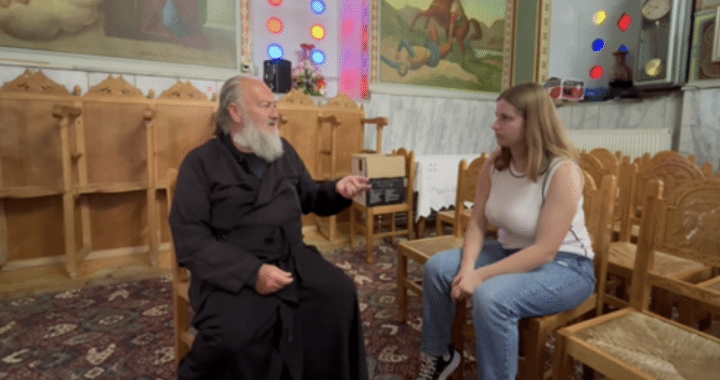
A few weeks ago, a social media post caught my attention. It referred to a documentary made by a young student, Lambrini Papachristodoulou, about a disappearing language, Arvanitika. Initially, my interest was piqued by the fact that a young high school student had created a documentary, so I looked into it further, watched the documentary, and browsed the website Lambrini created. I wanted to learn more about how her interest in such a topic arose. In my search, I came across her words:
“Language is the core of culture. When we lose our language, we lose a part of our cultural wealth. Songs, fairy tales, poems, and customs are inextricably linked to the language, and when it disappears, they fade away. It’s like erasing a chapter from a book that will never be rewritten.”
With Lambrini’s words echoing in my mind, I decided to contact her and ask her to share her story with us.
Lambrini and her Documentary
—Can you tell us a bit about yourself?
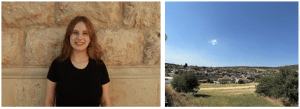
My name is Lambrini Papachristodoulou and I was born and raised in Athens, Greece. I was raised in a multicultural environment; my father is Greek-American while my mother is from a village in Peloponnesus called Limnes. In Limnes other than Greek a second language is spoken: Arvanitika, a dialect of Albanian.
—How did your interest in the Arvanitika dialect begin? What inspired you to create a documentary about this dying dialect?
Growing up I realized that while my maternal grandparents spoke Greek with me, when referring to each other they would switch in an unfamiliar, secretive tongue. In my early years I didn’t pay much attention to it, thinking that this was a common experience amongst children. Yet, year after year the peculiarity of the situation became more apparent to me. I remember when I started asking about Arvanitika I was discouraged by my mother to seek further information but my spark for exploration and discovery was too strong and nothing could hold my curiosity.
I have always been a fan of documentaries, so creating one myself seemed the best way to go. I wanted to educate people on this minority language since few Greeks even know of its existence. Furthermore, it proved to be a good way to collect samples of the language being spoken by its native speakers and a good way to record elements of its oral tradition, like fables and folktales, Arvanitic songs and idioms.
—What challenges did you encounter while researching and documenting the Arvanitika dialect?
The number of its native speakers is rapidly declining and with their loss an important part of the Arvanitic identity is threatened to be forever lost in time. A significant number of traditional music and folk stories disappear since the people who carry that knowledge have nowhere to transfer it. For cultural reclamation and linguistic revitalization, efforts need to be established and further research needs to be conducted.
—How do the speakers of Arvanitika feel about the language’s decline? Is there a sense of urgency or resistance to change?
The last fluent speakers are very proud of their identity and are always willing to aid anyone who shows interest in their heritage and experiences. There is much generational shame within generation X, the ones that are passive speakers and didn’t allow their children to learn the language. However, I believe the latest generations show a significant interest in potential revitalization efforts and are proud of their identity.

—What impact do you hope your documentary will have on the younger generation and the future of Arvanitika?
I would be grateful if even one young person would reflect on the documentary and understand the benefits of diversity and uniqueness of Arvanitic and endangered languages in general.
The Arvanitika Dialect
—Could you briefly explain what Arvanitika is and how it has evolved over the centuries?
Arvanites are the speakers of Arvanitika, one of the primary dialects of Albanian. In the late 12th century to early 13th a population from North Epirus migrated to Central Greece, Peloponnesus and to the Peloponnesian islands. There they created independent communities that stayed isolated for 8 centuries, allowing the language to stay true to its original, ancient form and the distinct culture of the Arvanites to thrive.
—Why is Arvanitika considered an endangered dialect, and what are the main reasons for its decline?
Arvanitika has been categorized by UNESCO as a “critically endangered” dialect. This can be attributed to its rapid decline in the past sixty years. Following the Great War the isolated communities of the Arvanites started to come in contact with other solely Greek speaking populations. For the first time marriages between speakers and non-speakers of Arvanitika formed and the number of households using it as the primary language started declining. Later on the schools that opened in these villages greatly restricted its use in daily life and using Arvanitika in an academic setting was highly discouraged. More on the topic can be found in my documentary.
—What do you think the future holds for Arvanitika? Are there any ongoing efforts to revitalize or protect the dialect?
Efforts to revive and protect the dialect exist mainly through promoting Arvanitic traditions, customs, dances and songs. The cultural center of the village successfully organizes events, exhibitions and activities to promote the use and the teaching of the language and educate people about the Arvanites. Many children from local villages know and regularly sing songs in Arvanitika and dance its dances. As a next step, the publication of an Arvanitika-Greek dictionary and the installation of a language course would help provide a chance for new Arvanitika families to raise an Arvanitika speaking family.
—How can we encourage the younger generations to engage with and learn their ancestral languages, especially those that are endangered?
We can encourage younger generations through the cultural actions I mentioned and via promoting sociability, diversity and respect for individuality. Linguistic diversity enriches the communities in which we live. I would further recommend anyone interested to download the free study guide I offer on my website https://arvanitika.eu.
Lessons & Takeaways for Multilingual Families
—Based on your work, what advice would you give to multilingual families trying to maintain and pass on their language while living abroad or even a dialect at risk of disappearing?
To emphasize the importance of preserving their diversity, to take pride in their roots, and to strive to transmit their language to younger generations alongside the language of the country they live in. The host country’s language will naturally be learned, but their own language will only be preserved if they actively use and transmit it.
—What role do you think community efforts and local initiatives play in language preservation?
Communities and local initiatives play a primary role in language preservation as knowledge starts and is passed on from there.
Epilogue
The Greek name “Lambrini” means “bright” or “radiant.” It refers to someone who shines or emits light. Lambrini Papachristodoulou is such a radiant Lambrini, whose light shone so brightly that it reached me even from afar — even if I am based in Denmark and her in Greece. Thank you, Lambrini. Thank you for delving into something you found interesting and for sharing your experience and thoughts with us.
The language we speak at home is our treasure. No one should ever feel ashamed of this treasure.
Watch the documentary here:

Chryssa Oikonomidou
Chryssa Oikonomidou is the Co-Founder of Multilingual-Families.com and Founder of Paidokipos, a creative Greek teacher, storyteller, and animator of interactive educational theater events. With a background as Senior Executive, she leverages over a decade of experience across various sectors to enhance her work in education, bolstered by her studies in education and multilingualism. Having not enjoyed school as a child and inspired by her two bilingual children, she is determined to make her lessons engaging and enjoyable for her students. She combines her diverse skills in didactics and project management to foster a rich educational landscape for young learners.