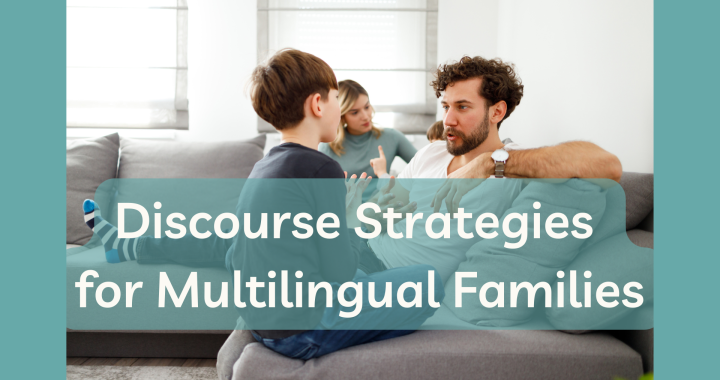
As a multilingual family navigating the complexities of raising children in a linguistically rich environment, one common challenge is encouraging children to respond in the target language.
To foster a balanced and effective multilingual development, employing specific conversational strategies can be particularly beneficial.
5 parental discourse strategies
Elizabeth Lanza (1997, 2004) identifies 5 parental discourse strategies:
- minimal grasp
- expressed guess
- adult repetition
- move on
- adult code-switch
These strategies are on a monolingual–multilingual continuum, meaning, that on the monolingual end of the continuum, the parent speaks only one language with the child and aims to create a monolingual context, whereas on the bilingual end of the continuum, the parent uses both languages the child is learning, allowing for a bilingual context to be established.
1 The Minimal Grasp Strategy
The minimal grasp strategy involves the adult pretending not to understand the child when they respond in a language other than the target language.
Minimal grasp does not mean that we ignore what the child is saying! With this strategy we want to prompt the children to switch to the desired language in order to ensure that our children are understood.
Example:
Parent: “Was hast du heute in der Schule gelernt?” (What did you learn at school today?)
Child: “I learned about space.”
Parent: “Entschuldigung, ich verstehe nicht. Es ist so laut hier” (Sorry, I don’t understand. It’s so loud here…)
Child: “Wir haben über das Weltall gelernt.” (We learned about space.)
With older children who are more aware of their language use and with whom you have negotiated the use of the target language (in this example, German) with you or in given settings (at home for example), you can also say “Kannst du das bitte nochmal sagen? Auf Deutsch?” (Can you please say this again? In German?).
The minimal grasp strategy leverages the child’s natural desire to be understood and communicates that the target language is necessary for (better) comprehension.
Denying that we understand what our child is saying can stop the communication and affect the relationship. “Pretending not to understand the other language is not an option I would recommend. In fact, it is not a discourse strategy that can serve the purpose of maintaining temporarily a monolingual situation. It rather creates a permanently monolingual setting. If a parent really does not speak the child’s other language, this is obviously the only option.” (Meisel 2019, 121) However, if the parent does understand and use the other language, the child will not understand why the parent insists on one language only.
With minimal grasp, Elizabeth Lanza means that during the conversation we hold on a second, say something like “what did you say?” or “what do you mean?”. We shortly interrupt the conversation with a questioning “hm?” which can function as a trigger for the child to switch to the expected language. I personally used this strategy with my children and it works very well.
2 The Expressed Guess Strategy
The expressed guess strategy involves the adult making an educated guess about what the child is saying in the non-target language and then asking the child to confirm or correct the guess in the target language. This not only demonstrates understanding but also encourages the child to respond in the desired language.
This is an effective strategy as it involves active hearing and true commitment to understand what the child is saying. It also gives the children to find other words, paraphrase what they are saying, and keeps the conversation flowing.
Example:
Parent: “Qu’est-ce que tu veux manger pour le dîner aujourd’hui?” (What do you want to eat for dinner?)
Child: “Ehm… lasagna, o una pizza…, o spaghetti al pesto!”
Parent: “Ah, tu veux dire que tu voudrais manger de une lasagna ou bien une pizza, ou des spaghettis au pesto, n’est-ce pas?” (Ah, you mean you would like to eat lasagna or pizza, or spaghetti al pesto, right?)
Child: “Oui, je ne sais pas encore… j’ai envie de manger une lasagna. On a eu une pizza samedi, alors…” (Yes, I don’t know yet… I would like to eat lasagna. We had pizza on Saturday, so…)
In this scenario, the parent shows understanding of the child’s preference but nudges them to articulate it in French.
The expressed guess strategy combines comprehension with correction, facilitating language learning in a supportive manner.
3 The Adult Repetition Strategy
The adult repetition strategy involves the adult repeating what the child has said in the non-target language in the target language and then pausing to allow the child to repeat or continue in the target language. This strategy serves as a model for the correct linguistic form and encourages the child to follow suit.
Example:
Parent: “Wat wil je doen vanmiddag?” (What do you want to do this afternoon?)
Child: “I want to go to the playground with my friends.”
Parent: “Je wilt met je vrienden naar de speeltuin.” (You want to go to the playground with your friends.)
Child: “Ja, ik wil buiten spelen.” (Yes, I want to play outside.)
Here, the parent models the correct response in Dutch and pauses, giving the child the opportunity to repeat or elaborate in the target language. This strategy reinforces correct language usage through repetition and gentle prompting.
Applying These Strategies in Everyday Contexts
Implementing these strategies consistently can significantly impact a child’s language development. Each strategy has its own unique benefits and can be applied in various contexts depending on the child’s proficiency level and the linguistic environment.
Practical Tips:
- Consistency is Key: Regular application of these strategies helps children understand the expectations and increases their comfort and proficiency in the target language.
- Positive Reinforcement: Praise and encouragement when the child responds in the target language can boost their confidence and motivation.
- Patience and Persistence: Language learning is a gradual process. Be patient and persistent in using these strategies, even if progress seems slow at times.
Research Insights
Janice Nakamura’s research highlights the effectiveness of these strategies in promoting language use among multilingual children. Nakamura emphasizes that such strategies create a supportive linguistic environment that encourages active use and practice of the target language (Nakamura, 2020).
Her studies show that the minimal grasp strategy, in particular, can significantly increase the likelihood of children switching to the target language as they strive to be understood by their caregivers. It is important to note that the minimal grasp strategy never consists in ignoring what the child is saying!
Similarly, the expressed guess and adult repetition strategies not only provide linguistic input but also validate the child’s attempts at communication, thereby fostering a positive and effective language learning experience.
4 The Move On and Adult Code-Switching
The move on and the adult code-switching strategies are not efficient strategies to encourage the child to respond in the desired language.
When moving on, the parent ignores the child’s use of the other language and a dual-lingual conversation takes place:
Parent: “Wie war dein Tag heute?” (How was your day?)
Child: “It was ok”
Parent: “Was habt ihr heute in Englisch schönes gelernt?” (What did you learn in the English lesson?)
Child: “We talked about “To kill a Mockingbird””
Parent: “Worum geht es da?”
Child: “It’s a novel about about a girl named Scout. Scout and Jem Finch, and their father Atticus, a lawyer, who defends a Black man who is falsely accused…”
The adult code-switching strategy consists in the adult using the language the child has introduced which leads the conversation continuing in the language chosen by the child.
Parent: “Cos’hai imparato di bello a scuola oggi?” (What did you do at school today?)
Child: “I learned about the Lorenz force.”
Parent: “Oh, that was in Physics then. What did you learn?”
Child: “Yes, we looked at the charged force on particles when moving”
Parent: “Oh, ok. You looked at the electric and magnetic fields…”
Child: “Yes, it’s interesting to see how the charged particles move and we learned the basic formula”
Parent: “Oh that sounds interesting, maybe you can explain it to me?”
These last two strategies are more common among parents and older multilingual children who choose the language that is best suited for the children to communicate about particular topics.
We can use a mix of all these strategies and see which one works best for us, our child, our family, and the situation we are in. With our youngest ones we may want to use a combination of the first three ones, as they are all focusing on our children changing to the target language – usually the minority language or the language we want to help them improve their language skills.
The first three strategies interrupt the conversation flow, therefore it is advisable to make sure that this doesn’t lead to a stop of the conversation! Connecting with our children, speaking with them should always be first priority!
If you start applying these strategies from early on, your children will get used to them and respond in the desired way and you do not have to negotiate or explain them every time.
- Which strategy do you prefer?
- Which strategies work best with your children?
Please let us know in the comments.
I invite you to watch the following videos:
– about this post,
– of an interview we did with Prof. Elizabeth Lanza
– of an interview we did with Prof. Janice Nakamura
– a video we did at Activities for Multilingual Families