Raising multilingual children is a rewarding yet complex journey. Parents play a pivotal role in shaping their children’s linguistic development, and one of the most effective ways to support this process is through parental discourse strategies (read also our post about 4 parental discourse strategies).
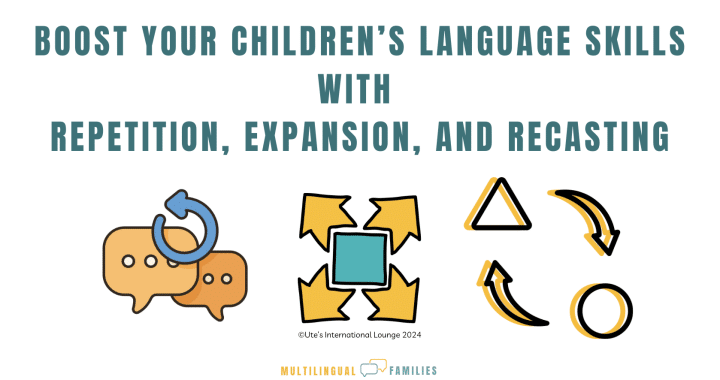
Techniques such as repetition, expansion, and recasting create a rich linguistic environment, providing children with the tools they need to navigate and master multiple languages. In this post, we’ll explore these strategies, why they are effective, and how they can be implemented in everyday interactions.
Understanding Parental Discourse Strategies
Parental discourse strategies refer to the techniques parents use during conversations to support their children’s language learning. These strategies are not only tools for communication but also mechanisms for scaffolding linguistic development. They serve to model correct language usage, expand vocabulary, and reinforce grammatical structures.
Research highlights the importance of these strategies, particularly for multilingual families. Studies, such as those conducted by Annick De Houwer (2007), show that children’s proficiency in multiple languages is significantly influenced by the quantity and quality of parental input. By using targeted discourse strategies, parents can maximize the effectiveness of their input.
Key Strategies for Multilingual Families
1. Repetition
Repetition is a foundational strategy for reinforcing language structures and vocabulary. By repeating what children say, parents confirm the message and provide a model for correct pronunciation and grammar. For example, if a child says, “Apple,” the parent can respond, “Yes, that’s an apple.”
Why it works: Repetition creates a sense of familiarity, making it easier for children to internalise language patterns. It also signals to the children that their attempts to communicate are valued and understood.
How to implement:
During mealtimes, name and repeat the items on the table. For instance, “This is bread. Bread is delicious!”
When reading a story, emphasize repeated phrases or key vocabulary, such as, “The cat is on the mat. The cat is very happy.”
- Repetition is very effective at each stage of language development. School aged children and even adults who are learning an additional language benefit from hearing and using new terms and sentences multiple times and in a variety of contexts.
2. Expansion
Expansion involves taking the children’s utterance and adding complexity to it. This strategy helps children learn how to construct more sophisticated sentences and introduces new vocabulary in context. For example, if a child says, “Dog running,” a parent might respond, “Yes, the dog is running fast in the park!”
Why it works: Expansion enriches children’s linguistic input, encouraging them to pay attention to how sentences are constructed. It also provides a natural way to introduce new words and grammar structures.
How to implement:
During play, expand on your children’s observations. For instance, “Car!” can become, “That’s a red car. It’s moving very quickly.”
While describing daily routines, add details to their statements. For example, “Eat cookie” can be expanded to, “You’re eating a chocolate cookie. I like chocolate cookies too.”
- For older children expansion allows to explore broader contexts and become more confident in forming longer and more detailed sentences. For instance, we can explore synonyms of adjectives, verbs, adverbs and nouns. Or, if learning an additional language like German, support the use of articles, or cases like Genitive, Dative etc..
3. Recasting
Recasting involves rephrasing a child’s incorrect or incomplete sentence into a grammatically correct one. This strategy gently corrects mistakes without discouraging children from attempting to communicate. For example, if a child says, “I goed to park,” a parent might respond, “Oh, you went to the park? That sounds fun!”
Why it works: Recasting provides implicit feedback, allowing children to learn from their mistakes in a supportive environment. It fosters confidence while simultaneously reinforcing correct language forms.
How to implement:
During conversations, focus on the content of what your children are saying while modeling the correct form. For example, “Him is playing” can be recast as, “Yes, he is playing.”
Avoid over-correcting every error to maintain a positive and encouraging atmosphere. Instead, prioritize errors that impact comprehension or are critical for language development.
- Recasting can help older learners correct themselves in a more motivating way.
The Benefits of Parental Discourse Strategies
Using these strategies consistently has a profound impact on children’s language development, especially in multilingual settings. Here are some key benefits:
Enhanced Vocabulary Development: By exposing children to a wide range of words and phrases, these strategies help expand their lexicon across languages.
Improved Grammar Skills: Techniques like expansion and recasting model correct sentence structures, enabling children to grasp complex grammatical rules.
Increased Confidence: Positive reinforcement through repetition and recasting helps children feel supported and motivated to use multiple languages.
Stronger Parent-Child Bond: Engaging in meaningful conversations fosters emotional connections and builds trust.
Facilitation of Code-Switching Skills: These strategies help children navigate between languages more fluidly, an essential skill for multilingual communication.
Tips for Success
To maximize the effectiveness of parental discourse strategies, consider the following tips:
Be Consistent – but Mindful: Use these strategies regularly during daily interactions, such as mealtimes, play, and bedtime. But be mindful of the moments you use them. If your children are tired, stressed or busy, or you are not in a calm and understanding mood, prioritize communication over correct language use!
Focus on the Positive: Enjoy that your children make efforts to communicate, regardless of errors.
Adapt to Your Children’s Needs: Tailor your approach based on your children’s age, language proficiency, and individual learning style.
Mix It Up: Incorporate a variety of activities, such as storytelling, role playing, singing, and games, to keep interactions engaging.
Be Patient: Language development is a gradual and very long process. Provide consistent support and give your children the time they need to progress.
Overcoming Challenges
While these strategies are highly effective, parents may encounter challenges, particularly in multilingual contexts. Common concerns include:
Balancing Multiple Languages: The goal to an equal exposure to all languages is not realistic. Consider creating routines that incorporate each language, such as designating specific times or activities for each one. Fostering each language on a regular basis and to the extent the children’s need it in that given phase of their life will be enough!
Managing Code-Mixing: Code-mixing is a natural part of multilingual development. Rather than discouraging it, use recasting to guide your children toward distinguishing between languages should this be necessary for mutual comprehension. If all interlocutors share the languages mixed in the conversation: enjoy the flow!
Finding Time: Busy schedules can make it challenging to prioritize language interactions. Integrate these strategies into everyday tasks, such as cooking or commuting, to make the most of available time. A conversation of 5 minutes is better than being exposed to languages in a passive way, i.e. without interaction.
Conclusion
Parental discourse strategies – repetition, expansion, and recasting – are powerful tools for supporting multilingual children’s language development. By creating a rich and responsive linguistic environment, parents can help their children build strong communication skills in multiple languages. Remember, consistency, patience, and a positive attitude are key. Every interaction is an opportunity to nurture your children’s multilingual journey.
For further reading, consider Annick De Houwer’s study on parental input patterns and their impact on children’s bilingual use (Applied Psycholinguistics, 28(3), 411-424).
Let us know:
How do you incorporate these strategies into your daily routine?
Share your experiences in the comments below!

Ute Limacher-Riebold
Ute Limacher-Riebold, PhD, is the founder of Multilingual-Families.com and Owner of Ute’s International Lounge & Academy.
She empowers internationals to maintain their languages and cultures effectively while embracing new ones whilst living “abroad”.
She grew up with multiple languages, holds a PhD in Romance Studies and has worked as an Assistant Professor at the University of Zurich (Department of Italian Historical Linguistics). She taught Italian historical linguistics, researched Italian dialects and minority languages, and contributed to and led various academic projects.
Driven by her passion for successful language development and maintenance, and personal experiences with language shifts, Ute supports multilingual families worldwide in nurturing their languages and cultural identities in the most effective and healthy way.