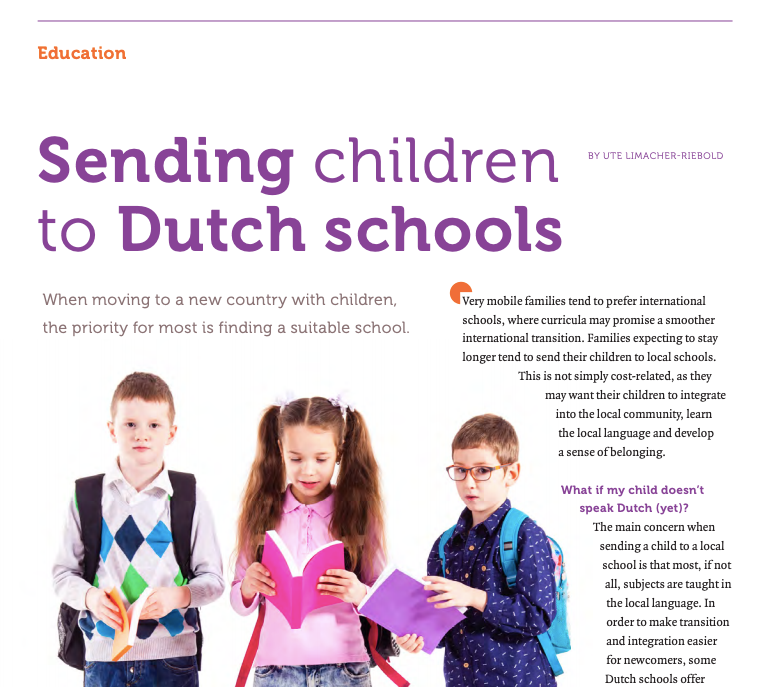
When moving to the Netherlands with family, one of the first things internationals want to find is a school for their children. Although very mobile families tend to prefer international schools, but more and more choose to send their children to local schools.
In this article for ACCESS magazine (issue Spring 2019) I shared some aspects to consider and check before the move.
I want to add one important aspect to what I mentioned in the article: if you have a child in secondary school that needs special support, and you plan to stay in the Netherlands only for a few years you may want to reconsider your decision.
Although some international schools offer some kind of support for children who are already at their school, many internationals experience a different treatment when they apply for one of the schools and indicate what need their child needs support with.
It seems that schools tend to turn down children who have been assessed before coming to the Netherlands and the only option for them is to enroll in a Dutch school. This means, of course, that you have to consider the time it takes for your child to become sufficiently fluent in the Dutch language to be able to join peers. I know that many families with SEN children in secondary school decide against the move for exactly this reason.
For more information about this, please contact me at info@UtesInternationalLounge.com or visit the site inclusion4all.com.

Ute Limacher-Riebold
Ute Limacher-Riebold, PhD, is the founder of Multilingual-Families.com and Owner of Ute’s International Lounge & Academy.
She empowers internationals to maintain their languages and cultures effectively while embracing new ones whilst living “abroad”.
She grew up with multiple languages, holds a PhD in Romance Studies and has worked as an Assistant Professor at the University of Zurich (Department of Italian Historical Linguistics). She taught Italian historical linguistics, researched Italian dialects and minority languages, and contributed to and led various academic projects.
Driven by her passion for successful language development and maintenance, and personal experiences with language shifts, Ute supports multilingual families worldwide in nurturing their languages and cultural identities in the most effective and healthy way.