The Spectrum of Multilingualism – Part 1: From Early Definitions to Contemporary Perspectives

Bilingualism, Multilingualism and Plurilingualism


Bilingualism has long been a subject of linguistic and cognitive inquiry, evolving from strict early definitions to more fluid and inclusive conceptualizations. It has been reflecting different research paradigms, cultural contexts and social attitudes toward language use.

Early definitions emphasized fluency and equal competence in two languages, whilst more recent approaches recognize the spectrum of abilities and functions, reflecting broader changes in our understanding of language use, cognition, and identity. 

Bilingualism, Multilingualism and Plurilingualism – in a nutshell

The term bilingualism traditionally referred to individuals using two languages, while mulitlingualism described the coexistence of multiple languages side-by-side in a society but are utilized separately. For example, in Switzerland, four national languages and numerous dialects coexist within distinct domains. More recently, multilingualism has also been applied to smaller social units, such as families, who actively use multiple languages or dialects (Hamers & Blanc, 2000).

The term plurilingualism was introduced to distinguish individual linguistic competence from societal multilingualism. While Denison (1970) initially discussed multilingual contexts involving multiple languages, the concept of plurilingualism evolved to focus on the individual as an active agent in managing and integrating their linguistic repertoire. Coste, More and Zarate (1997) further emphasized that plurilingualism represents the dynamic interplay of languages within a speaker’s communicative practices, contrasting with multilingualism’s focus on societal language coexistence. This theoretical shift underscored that languages within an individual’s repertoire are interconnected rather than compartmentalized. 

The Council of Europe (1997) formalized plurilingualism to highlight the agency of individuals in leveraging multiple languages for communication across various contexts. This term has since gained prominence, particularly in French discourse, where it is commonly used to describe individuals with diverse linguistic repertoires. 

In this post, I use bilingualism, multilingualism, plurilingualism to refer to individuals who navigate multiple languages, dialects, or sign languages, while acknowledging the distinct theoretical nuances outlined by Denison (1970), Hamers & Blanc (2000), and Coste et al. (1997).

Early Definitions: Bilingualism as Native-Like Mastery

At the beginning of the 20th century, one of the earliest and most rigid definitions came from Bloomfield (1933), who described bilingualism as “native-like control of two languages”. 

His perspective also implied that bilinguals must acquire both languages early and with “full proficiency”, mirroring monolingual competence in each language.

This narrow perspective assumes that bilingual individuals must not only acquire and learn both languages from early on (before age 3), but also exhibit equal proficiency in both languages across all domains. However, such a definition excluded many individuals who learned additional languages later, and those who actively use multiple languages in their daily lives without achieving native-like competence in all of them.

A More Inclusive Perspective: Degrees of Bilingualism

Haugen (1953) challenged Bloomfield’s view by proposing that bilingualism exists on a continuum. Instead of requiring native-like proficiency, he suggested that bilingualism begins when a speaker can produce meaningful utterances in another language. 

This view assumes that bilinguals must possess perfect (!) fluency in both languages, like “two monolinguals in one”. This rather rigid definition excluded the majority of real-life bilinguals who use their languages in a variety of contexts, for specific purposes and to various extent.
Diebold (1961) introduced the concept of incipient bilingualism, referring to the earliest stages of bilingual development (or “the initial stages of contact between two languages”). This helped frame bilingualism as a process rather than an all-or-nothing phenomenon.

Bilingualism as a Functional and Social Phenomenon

As the early definitions of bilingualism set rather unrealistic expectations, researchers began to adopt a more practical approach. 

Weinreich (1953) categorized bilinguals into “coordinate”, “compound”, and “subordinate” types, depending on how their linguistic systems interact

Mackey (1970) considered bilingualism as the “alternate use of two or more languages by the same individual”, and focused on the use of the languages rather than equal proficiency. Following the need to examine bilingualism along multiple dimensions, including proficiency, function, and stability, he argued that bilingualism is not a static state but a dynamic process shaped by social and individual factors.

Macnamara (1967) introduced the idea that even individuals with minimal proficiency in a second language should be considered bilingual if they can use it functionally. A minimal competence in only one of the four language skills – listening, speaking, reading and writing – in a language other than the mother tongue was necessary.

This perspective paved the way for recognizing partial and receptive bilinguals – those who understand but may not actively or verbally produce a second language.

Bilingualism as a Dynamic Continuum

Weinreich (1953) defined bilingualism as “the practice of alternately using two languages”, laying the foundation for later scholars like Grosjean (1982), who challenged the traditional notion of bilinguals as two monolinguals in one person. Instead, bilingualism is best understood as a fluid, context-dependent process where individuals integrate both languages into their cognitive and communicative repertoire. This holistic perspective recognizes code-switching  and code-mixing as natural and strategic bilingual behaviours, rather than signs of confusion or deficiency. 

Bilingualism in Society and Individual Identity

Romaine (2019) and Wei (2020) emphasize that bilingualism is not merely an individual trait but a societal and interactive phenomenon. Multilingual societies shape how individuals navigate their linguistic environments, influencing identity and communication.

Grosjean (1985, 2010) further dismantled the “fractional view” of bilingualism – the idea that bilinguals should mirror monolingual proficiency in each language. Instead, his complementary principle highlights that bilinguals use their languages in different domains, and for different purposes, making the notion of perfectly “balanced” bilingualism both unrealistic and unnecessary.

Contemporary Understandings of Bilingualism

Bilingualism is not merely an individual skill but is deeply embedded in education, policy, and identity (Baker, 2001; Baker & Wright, 2017). Using more than one language on a regular basis, rather than being an exception, is the global norm for over half of the world’s population. Individuals and communities navigate multiple languages seamlessly, challenging rigid distinctions between bilingual and monolingual speakers. In the digital age, concepts like translanguaging (Wei, 2020) emphasize how multilinguals dynamically draw from their full linguistic repertoire, reshaping traditional views of communication.

This dynamic interplay of languages occurs on both individual and societal levels. Societal bilingualism refers to entire communities functioning bilingually, while individual bilingualism focuses on a person’s use of multiple languages (Baker & Wright, 2017). The distinction mirrors that between bilingualism and multilingualism, with the former often describing an individual’s proficiency in two or more languages, while the latter refers to societal contexts where multiple languages coexist. Context – whether in family, education, or community  – plays a crucial role in shaping bilingual experiences.
To further categorize these settings, researchers distinguish between micro-, meso- and macro-societies. Micro-societies, such as families or close-knit communities, shape language practices through personal relationships. Meso-societies, including schools and workplaces, mediate language policies and practices between individuals and broader societal structures. Macro-societies operate at national or global levels, reflecting overarching language ideologies, policies, and sociolinguistic trends.

These layers reveal how multilingual experiences are shaped by their environments, reinforcing the need for a contextualized understanding of bilingualism. As we all use different languages depending on the setting or context, I tend to prefer the use of “multilingual” person or “multilingualism” whenever more than two languages are involved. Hence, the name of this website. 


The Use of Multiple Languages in Family and Society

In multilingual families, the use of multiple languages takes on diverse forms, shaped by strategies such as Minority Language at Home (mLAH), One Person One Language (OPOL), Time and Place, Two Persons Two Languages, or a flexible mix of approaches. The goal is not necessarily to achieve “native-like” proficiency but to foster meaningful communication, identity, and intergenerational connection. Language use in family settings is dynamic, adapting to shifting circumstances, relationships and social needs.

Defining who is bilingual or multilingual or plurilingual (whatever term you prefer) remains a challenge. As Baker (2001) notes, proficiency cannot be reduced to rigid benchmarks in listening, speaking, reading, or writing. Instead, the bilingualism/ multilingualism/ plurilingualism should be understood in terms of function – how individuals use their languages in real-life contexts. A person who understands a language but does not speak it, or who can read and write but struggles in conversation, is still engaging in bilingual practices. In languages without standardized written forms, spoken fluency alone may define competence. The complexity of multilingual abilities highlights the limitations of traditional proficiency-based definitions.

Baker (2001, 5) illustrates this fluidity:

The four basic language abilities do not exist in black and white terms. Between black and white are not only many shades of gray; there also exist a wide variety of colors. The multi-colored landscape of bilingual abilities suggests that each language ability can be more or less developed.

This “multi-colored landscape” of bi-/multilingualism reflects the variation in language skills, from basic comprehension to nuanced fluency, and from informal conversational abilities to academic or professional expertise.

Sub-skills such as pronunciation, vocabulary depth, and grammatical accuracy further complicate the picture. Importantly, formal language assessments often fail to capture the social and practical dimensions of multilingual competence, overlooking skills essential for real-world interactions.

Rather than a binary state, multilingualism is a fluid and dynamic spectrum, shaped by individual experiences, societal contexts and communicative needs. It emerges from extensive contact between languages, manifesting at national, community and personal levels. As Wei (2006) emphasizes, bilingualism lies at the core of modern linguistics, raising fundamental questions about language acquisition, use, and the human capacity for multilingual communication. Recognizing its complexity allows us to better support bilingual individuals, families, and communities in meaningful and effective ways.

Bilingualism is a product of extensive contact between people speaking different languages; it manifests both at the national and community level and at the individual level. Bilingualism as a research topic is at the heart of modern linguistics, raising fundamental theoretical issues of the human language faculty, language acquisition and language use. (Wei, 2006)

Conclusion

Our understanding of bilingualism has evolved from Bloomfield’s rigid definition to a more dynamic, socially embedded perspective. Like multilingualism and plurilingualism, it  is no longer seen as a fixed category, but recognized as a fluid and functional reality, shaped by individual experiences, societal structures, and communicative needs. Rather than measuring proficiency through rigid benchmarks, contemporary research emphasizes how languages are used in real-world contexts – whether within families, schools, workplaces, or broader societal settings.

As translanguaging (Wei, 2020) demonstrates, individuals who regularly use several languages, seamlessly draw from their full linguistic repertoire, challenging traditional distinctions between monolingual and bilingual speakers. Likewise, the recognition of micro-, meso-, and macro-societal influences (Baker & Wright, 2017) highlights the contextual nature of bilingualism, showing that language use is deeply embedded in relationships, policies, and ideologies. The “multi-colored landscape” of bilingual abilities (Baker, 2001) further reinforces that bilingualism is not a binary state but a dynamic spectrum, where different skills develop and manifest in varying ways.

As societies and communication in multilingual settings continue to evolve, so too will our understanding of bilingualism. Acknowledging its complexity allows us to normalize multilingual individuals, families and communities, whose language practices should not only be valued for their proficiency but also for their role in identity, connection and social interaction.  

Multilingualism is a dynamic spectrum where different skills develop and manifest in varying ways.

Looking Ahead: Real Stories from Multilingual Families  

While this first part focuses on the evolving definitions and theoretical understandings of bilingualism (multilingualism and plurilingualism), Part 2 will shift from theory to lived experience, bringing to light the voices behind the concepts – parents, children, and educators navigating life in more than one language.

From joyful discoveries to everyday challenges, these personal stories will reveal the many shades of what it means to grow up and raise multilingual children abroad.

Stay tuned!


References:

Baker, C. (2001). Foundations of Bilingual Education and Bilingualism. Multilingual Matters.

Baker, C., & Wright, W. E. (2017). Foundations of Bilingual Education and Bilingualism (6th ed.). Multilingual Matters.

Bloomfield, L. (1933). Language. Holt, Rinehart & Winston.

Coste, D., Moore, D., & Zarate, G. (1997). Plurilingual and Pluricultural Competence. Council of Europe.

Coste, D., Moore, D., Zarate, G. (2009). “Plurilingual and Pluricultural Competence”. Council of Europe.

Council of Europe. (1997). Modern Languages: Learning, Teaching, Assessment. A Common European Framework of Reference.

Denison, N. (1970). “Sociolinguistic Aspects of Plurilingualism”. Social Science. 45 (2): 98-101.

Diebold, A. R. (1961). “Incipient Bilingualism.” Language, 37(1), 97-112.

Grosjean, F. (1982). Life with Two Languages: An Introduction to Bilingualism, HUP.

Grosjean, F. (1985). “The bilingual as a competent but specific speaker-hearer.” Journal of Multilingual and Multicultural Development, 6(6), 467-477.

Grosjean, F. (2010). Bilingual: Life and Reality. Harvard University Press.

Haugen, E. (1953). “The Norwegian language in America: A study in bilingual behavior.” Publication of the American Institute, 1, 88-92.

Hamers, J.F., Blanc, M.H.A. (2000). Bilinguality and Bilingualism. 2nd ed., CUP.

Macnamara, J. (1967). “The bilingual’s linguistic performance – a psychological overview.” Journal of Social Issues, 23(2), 58-77.

Mackey, W.F. (1962). The Description of Bilingualism. Canadian Journal of Linguistics, 7(2), 51-85.

Romaine, S. (2019). Bilingualism. 2nd edition. Blackwell.

Wei, L. (2006). Bilingualism, Ed. Keith Brown, Encyclopedia of Language & Linguistics (Second Edition), Elsevier, 1-12.

Wei, L. (2020). Translanguaging as a Practical Theory of Language. Routledge.

Weinreich, U. (1953). Languages in Contact: Findings and Problems. Mouton.

Challenges in Multilingualism – Navigating Language Dynamics in Multilingual Families


Being or becoming multilingual has numerous advantages, but it also comes with its fair share of challenges.

Understanding and addressing these challenges is essential for successful language development and maintenance in multilingual families.

Let's look at some common challenges that arise in multilingual families and discuss strategies to overcome them.


Language Dominance

When one language becomes stronger or more dominant than the other(s), we have to do with language dominance. One (or more) language(s) become more dominant when language exposure, schooling, or societal influences are supporting the target language(s) more than the others.

To address this, parents can provide a more balanced language input, i.e. make sure that there is enough exposure to the target languages in terms of qualitative high verbal interactions. Furthermore, they can encourage language use in various contexts, and seek support from language professionals if needed.


Code-Mixing and Code-Switching

Code-mixing and code-switching, where individuals switch between languages within a sentence of within a conversation, is very normal among multilinguals and usually nothing to worry about. But while this is a natural phenomenon, it can be a challenge when we struggle with having conversations in one language only. In fact, when we notice that our children can not hold a conversation in the target, i.e. the expected language in contexts where a monolingual language use is necessary, we may want to reinforce some language separation strategies, such as setting language rules for specific contexts. These strategies have proven to be very effective not only with children but also for multilingual adults!


Language Loss and Attrition

Language loss or attrition can occur when a language is not actively used or maintained. This language shift usually occurs gradually. It can become a concern when multilingual children are not exposed to the target languages consistently over a longer period of time.
To prevent language attrition and language loss, it is important to create and maintain (!) opportunities for language practice. Engaging with as many people as possible in the target language, fostering a great variety of language input – from speakers with a various interests and language use (formal, informal etc.) and of course also keeping the contact with extended family members who speak the language can help keep children motivated to use the language. If where we live we don't have enough speakers of the target languages, we can use all kind of audio and video resources to keep the language as varied and interesting as possible!

In our Toolbox for Multilingual Families we share activities and games that foster understanding, speaking, reading and writing.


Limited Language Resources

As mentioned above, access to resources in all languages spoken within the family can be limited, especially for less commonly spoken languages or languages that are not transmitted in written form (like dialects for example). However, leveraging online resources, local community networks, language exchange programs, and cultural organizations can help overcome this challenge and provide opportunities for language exposure and learning. – Make sure to join my facebook group Multilingual Families where you might find the "multilingual village" you need!


Maintaining Language Motivation

As children grow older, they may question the relevance or importance of maintaining multiple languages. Especially those they don't need with their peers or to function in social settings on a daily basis. It is crucial to foster a positive attitude towards multilingualism in general, and to highlight the advantages of having language skills in multiple languages.
In my online course for parents of 10-15+ year old children* I focus on fostering this awareness in our preteens and teens with regards to communication, cognitive development, cultural understanding, and future opportunities.

Celebrating cultural heritage and promoting meaningful language use can enhance the motivation of our chidren (and us!) to keep using the language**.


Social and Peer Pressure

As soon as children attend daycare or school, and participate in society, they are more prone to face social pressure or ridicule for speaking multiple languages or just "other" languages. Depending on where they grow up, the community will be more or less accepting towards other languages and cultures. In more monolingual settings, using other languages and coming from a more diverse cultural background can cause all kind of reactions.
As parents and caregivers, we can help our children cope with those situations by building their confidence and resilience of being "not only... but also...". educating others about the benefits of multilingualism, and fostering a supportive social network can help counteract this challenge.


Balancing Language and Academic Demands

Although more and more schools support multilingual children, i.e. their use of multiple languages, there are still some challenges our children can face. These challenges have to do with balancing language learning with academic demands. Especially when the language and overall academic expectations are not met, or not met at the expected moment, teachers and parents tend to blame the multiple languages. It has been proven that in the majority of cases academic struggles have nothing to do with the number of languages a child is exposed to. It is usually an imbalance in support for the target languages and the skills related to language learning and subject learning that cause a problem.
Whenever we observe an imbalance that lasts longer than a few months, and exceed the usual transition period (when our children changed school and maybe even school language etc.), we should work closely with educators to create a supportive environment that values and integrates multilingualism into the academic curriculum. In my over 30 years of experience with working in international settings I observed that the problem usually stems from the environment the child is exposed to, not the child. Therefore I always invite parents to find ways to create an environment where their children's needs are met and where they can develop in the most healthy way.


Conclusion

I am a defender of multilingualism as I know about the advantages about knowing multiple languages. I have acquired and learned more than 10 languages and dialects, and 5 of them to a high level of proficiency (in understanding, speaking, reading and writing). But like everything else in life, knowing multiple languages also comes with challenges. But these challenges can be overcome with awareness, proactive strategies, and support.
Embracing linguistic diversity, providing a balanced and hight quality of language exposure, fostering a positive language environment, and seeking professional guidance when needed, are essential for successful language development and maintenance in multilingual families and I'd say "across the lifespan".

By acknowledging and addressing these challenges, we can create a nurturing environment that allows multilingual individuals to thrive and embrace the richness of multiple languages and cultures.


If you are multilingual and raising multilinguals, please let me know in the comments what kind of challenges you faced or are currently facing with regards to using or fostering and learning multiple languages.


*The online course for parents of 10-15+ year old multilinguals will be available in fall 2024. If you want me to keep you informed for when the course will be ready, please leave a comment here below. No strings attached.
** I am preparing a course about Motivation for multilingual families. If you want me to keep you informed for when the course will be ready, please leave a comment here below. No strings attached.


Language acquisition versus language learning


What is the difference between language acquisition and language learning.


Some people use the term of language acquisition for all the phases that lead to language fluency, including learning to read and write. Others use the term of language learning even for babies and very young, pre-school children. – But there is a fundamental difference between these two terms.


Children acquire language through a natural, subconscious process during which they are unaware of grammatical rules. This happens especially when they acquire their first language(s). They repeat what is said to them and get a feel for what is and what is not correct.
In order to acquire a language, they need a source of natural communication, which is usually the mother, the father, or the caregiver. Children who grow up with multiple languages, will acquire these languages in the most natural way. They will repeat what they hear, try out sound chains until they make sense (i.e. others will understand their meaning), and they will use them purposefully in their communication. – Some distinguish infant language acquisition – as defining the process of acquiring the first language(s) – from second language acquisition, which takes place "later" and in addition to speech, includes also reading and writing.

As many parents tend to think that they need to teach their language to their children, it is important to make sure the whole concept is clear!

We do not teach our children the first language(s)! We transmit our languages through verbal and non-verbal communication. We do not need to explain all the objects around us. We don't need to show our child what an apple is and say "this is an apple", or a cup "this is a cup". We simply need to use our language like we always do and our children will acquire it by simple and regular exposure. We need though to involve them in conversations with us – also non-verbal ones count! – and encourage them to use our language.

In German we distinguish between Spracherwerb and Sprachenlernen, in Italian between acquisizione di una lingua and apprendimento di una lingua, in French acquisition du language and apprentissage d'une langue.


Language learning, on the other hand, is the result of direct instruction in the rules of language. Language learning is not an age-appropriate activity for very young children as learning presupposes that learners have a conscious knowledge of the new language and can talk about that knowledge.

Language learners usually have a basic knowledge of the grammar of their first languages they acquired. They know the differences in intonation, the sound of words, what a grammatically correct word order is in a sentence in the language, that words can have multiple meanings etc..

When we learn a new language we have a deductive approach to the intonations, phonology, morphology, syntax of the target language. This happens when we start being schooled in this language, when we learn to read and write.
Reading and writing are not skills that come naturally. They are not intuitive. We need to learn that signs (letters and letter combinations) represent a sound, that by combining them we form words that have a meaning, which we can use to convey our thoughts. We learn that there are rules for each language, concerning the position of the words in a sentence, that intonation can vary and change the meaning of a word and a sentence, that one word can have many different meanings, depending on the context. For example, in "I like the green apple", depending on the intonation and accentuation of one word, we can convey different meanings:

I like the green apple = It's not Tom who likes it!
I like the green apple = Really, I'm honest!
I like the green apple = Not the red one!
I like the green apple = Not the kiwi!


©Fernandes Arung 2016 (see below)


From a neurolinguistic point of view, language acquisition and language learning are processed in two different ways in the brain.

There are many areas of the brain involved in language acquisition and learning, and in the understanding and articulation of languages.

The two main areas are the Broca’s area, which is situated in the left frontal cortex, and is the word production center of the brain, i.e. responsible to the production of the patterns in vocal and sign language.
The Wernicke’s area, in the left temporal cortex, is the word recognition center, which is primarily involved in language comprehension.

Roughly said, the Broca’s area is the one actively involved in language acquisition processes, whereas the Wernicke’s area is active in the language learning process – where the understanding speech takes place.

During speech processing and language learning, these two areas collaborate with multiple other areas of the brain, like the Angular Gyrus – where the assembling of information takes place, and where understanding of words and concepts happens –, the Supramarginal Gyrus, which is involved with language perception and processing, and the Primary Auditory Cortex, where auditory signals are recognised, memorised and may result in a response...


To learn more about how this works, have a look at the video with Kenneth Pugh (Haskins Laboratories/Yale University) and Arturo E. Hernandez (University of Houston):


About Co-Evolution of Language and the Brain: https://blogs.ntu.edu.sg/hss-language-evolution/wiki/chapter-16/


Acquisition:

  • unconscious process

  • does not presuppose teaching

  • the child controls the pace

Learning:

  • intentional process

  • presupposes teaching

  • the teacher controls the pace

Some articles:

Ambridge, B., & Lieven, E.V.M. (2011), Language Acquisition: Contrasting theoretical approaches. Cambridge: Cambridge University Press.

Arung, Fernandes, (2016), Language Acquisition and Learning on Children, Journal of English Education, Vol. 1, No. 1, March 2016, 1-9. 

Brooks, Patricia & Vera Kempe (eds.), Encyclopedia of language development, Thousand Oaks, Sage. 

Chomsky, N. (1965), Aspects of the Theory of Syntax, MIT Press.

De Houwer, A., (in press 2019) Uninstructed language acquisition in multiple language learners in Jeroen Darquennes, Joseph Salmons & Wim Vendenbussche, Language Contact. An International Handbook, Berlin, Germany, Mouton de Gruyter, 183-196.

Pecchi, Jean Stillwell, 1994, Child Language, London, Routedge.

Pine, J.M., Conti-Ramsden, G., Joseph, K.L., Lieven, E.V.M., & Serratrice, L. (2008). Tense over time: testing the Agreement/Tense Omission Model as an account of the pattern of tense-marking provision in early child English, Journal of Child Language, 35(1), 55-75.

Pinker, S. (1994), The Language instinct, New York, W.W.Morrow.

Pinker, S. (1995), The New Science of Language and Mind, Penguin.

Rowland, C. F., & Noble, C. L. (2010), The role of syntactic structure in children’s sentence comprehension: Evidence from the dative, Language Learning and Development, 7(1), 55-75.

Skinner, B.F. (1957). Verbal Behavior, Acton, MA, Copley Publishing Group.

Smith, N. (1989). The Twitter Machine: Reflections on Language, Oxford, Blackwell.

Theakston, A.L., & Lieven, E.V.M. (2005), The acquisition of auxiliaries BE and HAVE: an elicitation study, Journal of Child Language, 32(2), 587-616.

Tomasello, M. (2005), Constructing A Language: A Usage-Based Theory of Language Acquisition. Harvard University Press.

You can find more articles about Language Acquisition here.

"Playing the Language Game." Program Two: Acquiring the Human Language. The Human Language Series. Videocassette. New York: Equinox Films, 1995.

How it works: Video

Research about Language Acquisition:

Utrecht Institute of Linguistics

Radboud University Nijmegen

MIT Language Acquisition Lab

And please watch this very inspiring video which shows the way I acquired most of my languages!

When the home language is not the dominant language

If you are a multilingual, is your home language your most dominant language?

Something that surprises me when I read about language policies in schools and elsewhere is, that it is always assumed that people – children and adults – are most proficient, i.e. most fluent, in their home language. This might be correct for those who learned other languages later in life and were first schooled in their home language, but reality is very different for multilinguals who are schooled in other languages!

If you are a simultaneous bilingual and you have the chance to maintain those first languages at school (because the school teaches several subjects in both or all the languages!), all your languages might be more or less at the same level – usually one or two are more dominant than the others, depending on many factors. You may be bi- or pluriliterate.

If you acquired and learned several languages, simultaneously and successively, lived in different places, were schooled in one of the languages, or maybe not..., worked using one of these languages – it might be that your most dominant language is not the first language you acquired or learned.

If our children are schooled in another language chances are high that their most dominant language is the school language...


The reason for this is very simple: we don't (or can't) foster all the vocabulary they learn and use at school also in their home language, because it would mean that they hear the same lessons twice once at school in the school language, once from us at home. 

Recently many schools – not only the international ones! – are opting for a more inclusive policy when it comes to home languages, which I fully support. It is proven that integrating home languages in the practice at school, helps new students, i.e. those who were schooled in their home language earlier, to adapt and integrate easier.

But what about those multilinguals who are schooled in languages that are not their home language(s) since day one? Who maybe had to learn two (or more!) school languages in addition to their home languages due to their moves?

I see a problem in the overall approach, because these latter children are often lacking behind their peers in their countries of origin language wise. They need a whole other support!

Many multilingual families bridge the school and the home languages by discussing about school topics, by providing the necessary input, fostering the right vocabulary. This is hard work! And it requires collaboration and transparency from the teachers and the school in general, and not only on primary school level, but throughout the whole school curriculum!

We parents – even those who are teachers – can't provide all the input that our children receive at school in their school language. We have to make compromises. For my family it means that I focus on the topics my children like the most. I must confess that I find it sad that my children don't count in German or Italian, that they prefer English when it comes to explaining complex subjects, but I know that with patience and our many conversations, they will acquire as much as they can.

I honestly hope that there will be more studies about multilingual families whose children are schooled in another language and who do everything possible for their children to become fluent also in their home languages. I am looking for testimonials from other multilingual families whose children are schooled in another language.

I want to hear from you, how you foster your home language(s) and how it is going, what support you get, what support you would need.

Please share your experience with me, by leaving a comment here below. 

I will gather all the information I can get to write an article, present it at conferences and hopefully we will get more help from governments, schools, teachers, the community we live in.


Keeping our languages alive when living abroad – FIGT presentation

At my kitchen table conversation– session I held at the 20th FIGT conference this year in The Hague I focused on the languages we collect during our life, and how we can keep them alive while living abroad, in different countries.

Why kitchen table conversation?

Because that’s where all began 20 years ago at Ruth van Reken’s kitchen table. I wanted to honor the format where all began, because I, myself, have the most significant conversations and discussions at my own kitchen table. Of course, the one at the venue of the conference was not a real “kitchen table”, but we had a great discussion about “my” topic.

Ruth van Reken at FIGT 2018 in The Hague

How can we keep our languages alive?

Many international families struggle to maintain their home languages if they are not among the most dominant ones, i.e. if they are not English and sometimes Spanish, French and German, depending on the country they live in. What seems an easy task for the first years of a child can become a real challenge once the children attend daycares and schools who don’t provide sufficient support in the other language.

I see this every day with my clients and friends: our children are tired from school and rarely find the after school classes in their home languages pleasant, fun. Many families send their children to weekend schools, where, once again, they will sit down and “learn” a language that, in other circumstances and settings would just “come natural to them”: they would be fully immersed, literally showered by it.

For all these families, maintaining their language can become a great issue. If they don’t find a community that speaks this language, or they don’t connect with this community for different reasons, parents find themselves as being the only ones of providing linguistic input for their children.

Moreover, speaking a language in a restricted group, i.e. among family members, doesn’t allow the language to “breathe”: we tend to use the same kind of vocabulary because we tend to speak about the same topics, our language “shrinks”, like a plant would shrink and wither, if we don’t nurture it.

For our children it is even more important to have regular and diverse input in our home language as they are still building their vocabulary, they are still becoming “natively fluent” in the language, which, as we know, takes up to 8 years of constant, daily (!) practice.

What if:

  • our children don’t speak their language with peers?
  • the daycare or school doesn’t support our home language?
  • weekend lessons are not enough to foster the language or are not an option?
  • our partner or extended family can not support our language?

Then this language will stagnate or die.

I have seen this many times when I was a child, and throughout my work with multilingual families: languages are abandoned because it is too much to ask to one person or a small group of persons to work on it, and if it is about more than one or two languages within the same family it becomes almost impossible to maintain them.

This is why I recommend to be very clear about the following points: 

– what language is important for our family – because extended family, friends speak it? 

who talks this language on a daily/weekly basis with our children and us?

– what are the short and long term goals for all our languages qua fluency?

Are these language goals and expectations S.M.A.R.T.?

Many multilingual families struggle with agreeing on the languages they want to prioritize. Should we keep Swissgerman or prefer German or Italian instead? Should I learn my partners’ language? What if we move to a country where none of our languages are spoken, where there is no community in that language? – I help families maintain their languages on the move, make short and longterm plans

Language lives, changes over time, adapts to new circumstances and needs to be nurtured if we want to keep it alive.

How can we make sure that we keep our languages alive? 

  • By speaking them on a regular basis – daily would be perfect, but weekly needs to be enough sometimes.
  • By not listening to the no-sayers, those who tell us that it is too difficult to keep up with all those languages, and by following those who, like us, want to enjoy our languages and see them grow.
  • By thinking out of the box: if we can’t immerse into the language by traveling to places where it’s spoken, form our micro-world in our home.
  • By finding other speakers on- and offline, and talking about topics that challenge us to learn new words, new concepts. Our vocabulary will grow by repeating new words in different contexts, learning new registers of the language, jokes, metaphores, how to do maths in all our languages.

With our languages it is like with our cultures: we shouldn’t have to choose one or two of them to call “our own”, we have the right to choose them all.

Our languages shouldn’t be minoritized and marginalized. They all have a right to be spoken and heard.

***

Some thoughts & quotes about languages:

Knowing another language is like possessing another soul (Charlemagne)

The limits of my languages are the limits of my worlds ( adapted from Ludwig Wittgenstein)

I am all the languages I know, some I only understand, others I speak, read and write. (Ute Limacher-Riebold)

Languages are the vehicle of our thoughts, they open the door to the other culture, its values, beliefs, habits and so much more. (Ute Limacher-Riebold)

The development of language is part of the development of the personality, for words are the natural means of expressing thoughts and establishing understanding between people. (Maria Montessori)

Poetry is not a matter of feelings, it is a matter of language. It is language which creates feelings. (Umberto Eco)

– What about you?

– What are the languages you are nurturing and keeping alive?

– What are the obstacles you encountered while trying to keep your languages alive?

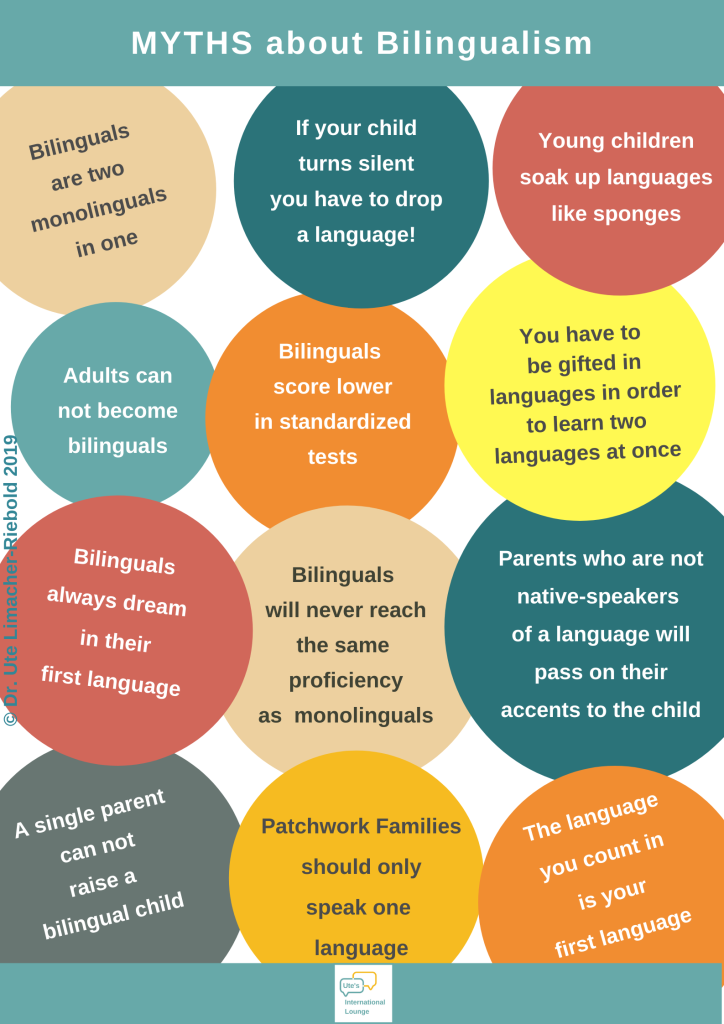
Myths about Bilingualism/Multilingualism

This is a short (!) overview of some common myths about bilingualism/multilingualism – I will be updating this list in May/June 2024, so, if you came across any myths you want me to include, please let me know in the comments.

They are all assumptions based on old theories about bilingualism and bilinguals (and multilingualism), but have all been proven wrong.

If you would like to know more about how to raise bilingual children and how to become and stay bilingual when you’re adult, then don’t miss my Free Online Webinars.


English

Deutsch


Myths about Bilingualism

Mythen über die Zweisprachigkeit


This is a short overview of some of the most common myths about bilingualism.

Dies ist ein kurzer Überblick über einige der häufigsten Mythen zur Zweisprachigkeit.


They are all assumptions based on old theories about bilingualism and bilinguals (and multilingualism), but have all been proven wrong.

Dies sind alles Annahmen, die auf überholten Theorien über Zweisprachigkeit und Mehrsprachigkeit beruhen, sich aber inzwischen als falsch erwiesen haben.


If you would like to know more about how to raise bilingual children and how to become and stay bilingual when you’re adult, then join my free online live webinars.

Falls du mehr über zweisprachige Kindererziehung und vor allem darüber erfahren möchtest, wie das langfristig erfolgreich möglich ist, dann versäume nicht meine free online live webinars.


  • Bilinguals have equal and perfect knowledge of their languages
  • Zweisprachige beherrschen beide/alle Sprachen in gleichem Maße


  • Mixing languages is a sign of laziness in bilinguals
  • Das Mixen von Sprachen ist ein Zeichen von Faulheit


  • OPOL is the best approach parents should use if they want their children to grow up bilingual
  • OPOL ist die beste Strategie, die Eltern anwenden sollten, wenn sie ihre Kinder zweisprachig erziehen wollen


  • Bilinguals are born translators
  • Zweisprachige sind geborene Übersetzer


  • Bilinguals acquire all their languages in childhood
  • Zweisprachige erwerben ihre Sprachen während ihrer Kindheit


  • Bilinguals have no accent in different languages
  • Zweisprachige haben keinen Akzent in ihren jeweiligen Sprachen


  • Bilingualism is a rare phenomenon
  • Zweisprachigkeit ist ein seltenes Phänomen


  • Bilinguals express their emotions in their first language
  • Zweisprachige drücken ihre Emotionen in ihrer ersten Sprache aus


  • All bilinguals are bicultural
  • Zweisprachige sind auch bikulturell


  • Bilingual children speak later than monolinguals
  • Zweisprachige Kinder sprechen später als Einsprachige


  • Bilinguals have a double or split personality
  • Zweisprachige haben eine doppelte oder gespaltene Persönlichkeit


  • The home language has a negative effect on the acquisition of the school language
  • Die Familiensprache wirkt sich negativ auf den Erwerb der Schulsprache aus


  • A child with learning difficulties can not be/become bilingual
  • Ein Kind mit Lernschwierigkeiten kann nicht zweisprachig sein/werden


  • Children raised bilingual will always mix their languages
  • Kinder die zweisprachig aufwachsen, mischen immer ihre Sprachen


  • Bilinguals are two monolinguals in one
  • Zweisprachige sind zwei Einsprachige in einem


  • If your child turns silent you have to drop a language!
  • Wenn euer Kind nicht spricht (oder aufhört eine Sprache zu sprechen), müsst ihr eine Sprache fallen lassen!


  • Young children soak up languages like sponges
  • Kleine Kinder saugen Sprachen auf wie Schwämme


  • Adults can not become bilinguals
  • Erwachsene können nicht zweisprachig werden


  • Bilinguals score lower in standardized tests
  • Zweisprachige schneiden in standardisierten Tests schlechter ab


  • You have be gifted in languages in order to learn two languages at once
  • Man muss sprachbegabt sein, um zwei Sprachen auf einmal zu lernen


  • Bilinguals always dream in their first language
  • Zweisprachige träumen immer in ihrer ersten Sprache


  • Bilinguals will never reach the same proficiency as monolinguals
  • Zweisprachige werden nie dasselbe Sprachniveau erreichen wie Einsprachige


  • Parents who are not native-speakers of a language will pass on their accents to the child
  • Eltern, die nicht ihre Muttersprache mit ihren Kinder sprechen, geben ihre Akzente an die Kinder weiter


  • A single parent can not raise a bilingual child
  • Ein Alleinerziehender kann kein zweisprachiges Kind großziehen


  • Patchwork Families should only speak one language
  • Patchwork-Familien sollten nur eine Sprache sprechen


  • The language you count in is your first language
  • Die Sprache in der man zählt, ist die erste Sprache


Nederlands

Français

Italiano

Mythen over meertaligheid

Mythes sur le bilinguisme

Miti sul bilinguismo

Dit is een kort overzicht van enkele van de meest voorkomende mythes over twee/meertaligheid.

Voici un bref aperçu de certains des mythes les plus courants sur le bilinguisme.

Questo è un breve panorama dei miti più comuni sul bilinguismo.

Het zijn allemaal aannames gebaseerd op oude theorieën over tweetaligheid en tweetalige  (en meertalige), maar zijn allemaal als fout bewezen.

Ce sont toutes des hypothèses basées sur de vieilles théories sur le bilinguisme et les bilingues (et multi/plurilingues), mais elles se sont toutes révélées fausses,

Sono tutti presupposti basati su teorie antiquate sul bilinguismo e sui bilingui (e multilingui), che sono tutti stati smentiti.

Als je meer wilt weten over het opvoeden van tweetalige kinderen en hoe je tweetalig kunt worden en blijven als je volwassen bent, mis dan niet mijn gratis online webinars.

Si vous souhaitez en savoir plus sur comment élever des enfants bilingues et comment devenir et rester bilingue à l’âge adulte, ne manquez pas mes ateliers gratuites en ligne.

Se desideri saperne di più su come crescere figli bilingui e su come diventare e rimanere bilingui anche in età adulta, assicurati di non perderti i miei webinar gratuiti online.

  • Tweetaligen hebben een gelijke en perfecte kennis van hun talen
  • Les bilingues ont une connaissance égale et parfaite de toutes leurs langues
  • Bilingui hanno una perfetta  e pari conoscenza in tutte le loro lingue
  • Het mengen van talen is een teken van luiheid bij tweetaligen
  • Mélanger les langues est un signe de paresse chez les bilingues
  • Mischiare le lingue è un segno di pigrizia
  • OPOL is de beste benadering die ouders zouden gebruiken als ze willen dat hun kinderen tweetalig worden/opgroeien
  • OPOL est le meilleur approche que les parents devraient utiliser s’ils veulent que leurs enfants deviennent bilingues
  • OPOL è l’approccio migliore se genitori vogliono che i loro figli crescano bilingui
  • Tweetaligen zijn geboren vertalers
  • Les bilingues sont nés traducteurs
  • Bilingui sono traduttori nati
  • Tweetaligen verwerven al hun talen in hun kinderjaren
  • Les bilingues acquièrent toutes leurs langues pendant leur enfance
  • Bilingui acquisiscono tutte le loro lingue durante l’infanzia
  • Tweetaligen hebben geen accent in hun verschillende talen
  • Les bilingues n’ont pas d’accent dans leurs différentes langues
  • Bilingui non hanno accenti nelle loro diverse lingue
  • Tweetaligheid is een zeldzaam fenomeen
  • Le bilinguisme est un phénomène rare
  • Il bilinguismo è un fenomeno raro
  • Tweetaligen uiten hun emoties in hun moedertaal/ eerste taal
  • Les bilingues expriment leurs émotions dans leur langue maternelle / première langue
  • Bilingui esprimono le loro emozioni nella loro lingua materna / prima lingua
  • Alle tweetaligen zijn bicultureel
  • Tous les bilingues sont biculturels
  • Tutti i bilingui sono anche biculturali
  • Tweetalige kinderen spreken later dan eentaligen
  • Les enfants bilingues parlent plus tard que les enfants monolingues
  • Bambini bilingui parlano più tardi dei bambini monolingui
  • Tweetaligen hebben een dubbele of gespleten persoonlijkheid
  • Les bilingues ont une double personnalité
  • Bilingui hanno una doppia personalità
  • De thuistaal heeft een negatief effect op de verwerving van de schooltaal
  • La langue parlée à la maison a un effet négatif sur l’acquisition de la langue scolaire
  • La lingua madre / di famiglia ha un effetto negativo sull’acquisizione della lingua scolastica
  • Een kind met leermoeilijkheden kan niet tweetalig zijn/worden
  • Un enfant ayant des difficultés d’apprentissage ne peut pas être bilingue
  • Un bambino con difficoltà di apprendimento non può diventare/essere bilingue
  • Kinderen die tweetalig zijn opgevoed, zullen altijd hun talen mengen
  • Les enfants élevés bilingues mélangeront toujours leurs langues
  • Bambini bilingui mescoleranno sempre le loro lingue
  • Tweetaligen zijn tween eentaligen in één
  • Les bilingues sont deux monolingues en un
  • Bilingui sono due monolingui in uno
  • Als je kind niet spreekt, moet je een taal laten vallen
  • Si votre enfant ne parle pas, vous devez abandonner une langue
  • Se bambini che crescono con più lingue non parlano, bisogna abbandonare una lingua!
  • Jonge kinderen nemen talen op als sponzen
  • Les jeunes enfants s’imprègnent des langues comme des éponges
  • Bambini assorbono le lingue come spugne
  • Volwassenen kunnen niet tweetalig worden
  • Les adultes ne peuvent pas devenir bilingues
  • Adulti non possono diventare bilingui
  • Tweetaligen scoren lager op gestandardiseerde toetsen
  • Les bilingues obtiennent des notes inférieures aux tests strandardisés
  • Bilingui ottengono punteggi inferiori nei test standardizzati
  • U moet begaafd zijn in talen om twee talen tegelijk te leren
  • Il faut être doué en langues pour apprendre deux langues à la fois
  • Devi essere dotato per le lingue per imparare due lingue contemporaneamente
  • Tweetaligen dromen altijd in hun moedertaal/eerste taal
  • Les bilingues rêvent toujours dans leur langue maternelle
  • Bilingui sognano sempre nella loro prima lingua / lingua madre
  • Tweetaligen zullen nooit dezelfde taalvaardigheid bereiken als eentaligen
  • Les bilingues n’atteindront jamais les mêmes compétences que les monolingues
  • Bilingui non raggiungeranno mai la stessa competenza linguistica dei monolingui
  • Ouders die geen moedertaalspreker zijn, zullen hun accenten aan het kind doorgeven
  • Les parents qui ne sont pas natifs d’une langue, transmettront leurs accents à l’enfant
  • Genitori che non sono madrelingua trasmetteranno i loro accenti ai bambini
  • Een alleenstaande ouder kan geen tweetalig kind opvoeden
  • Un seul parent ne peut pas élever un enfant bilingue
  • Un genitore single non può crescere bambini bilingui
  • Nieuw-samengesteld gezinnen mogen maar één taal spreken
  • Les familles recomposées/mixtes ne doivent parler qu’une seule langue
  • Le famiglie miste dovrebbero parlare solo una lingua
  • De taal waarin je meetelt, is je eerste taal
  • La langue dans laquelle vous comptez est votre langue maternelle
  • La lingua in cui conti è la tua prima lingua /lingua principale (più importante/dominante)


Language Assessments for Bilingual and Multilingual Children

Parents of multilingual children worry the most if their children will be able to keep up with all the languages and have a sufficient knowledge, proficiency, academically speaking, once they go to school.

Schools do regular language and literacy assessments and even international schools tend to assess the school language only or at least also the dominant language – for example, for a German child living in the Netherlands and attending an English speaking school, the assessment would be focusing on Dutch and English.

As there isn't one test that can be applied to all languages and teachers who evaluate these tests should at least have a basic knowledge of the other languages involved, I always advise parents of multilingual children to make sure their children are not only tested on one or two – usually the most dominant languages – but also on their family languages. In fact, as stated in the article mentioned here below, "SLPs have acknowledged competence in the assessment of monolingual children's speech but must consider additional aspects when assessing the speech of children who speak non-dominant languages and dialects."

If you are a parent of multilingual children and you have the impression that your school is not updated on the latest findings about language and literacy assessments, you may find an assessment in this list to submit to your school.

You want to make sure that during the speech assessment they will identify the presence or absence of SSD* and include referral, case history, assessment of speech production, additional areas of assessment (intelligibility, acceptability, stimulability, speech perception, phonological processing, language, hearing, oral structure and function, nonverbal intelligence, and participation), analysis, diagnosis, and goal setting.

Here is a scientific article about Speech Assessment for Multilingual Children who don't speak the same language(s) as the Speech-Language Pathologist

If you need support on this matter, I offer mediation with schools to make sure your child gets the right assessment and support he / she deserves! – Contact me at info@UtesInternationalLounge.com

*SSD= Speech Sound Disorders (cfr. from the article mentioned above “Children with speech sound disorders can have any combination of difficulties with perception, articulation/motor production, and/or phonological representation of speech segments (consonants and vowels), phonotactics (syllable and word shapes), and prosody (lexical and grammatical tones, rhythm, stress, and intonation) that may impact speech intelligibility and acceptability” (International Expert Panel on Multilingual Children's Speech, 2012, p. 1).)


Bilingual children can be easily misdiagnosed as having a language disorder. Language tests for bilingual children that are based on English [or another language] assessments are flawed not only because bilingual children may acquire certain language structures differently from monolinguals but because the sequence and rate of acquisition of specific language components varies between different languages. (Helen Grech, Barbara Dodd, Assessment of Speech and Language Skills in Bilingual Children: A holistic approach, Stem-, Spraak- en Taalpathologie, vol15, 2007, No.2, p.87)


What I recommend to do:

Fact is that there are many different tests for assessments that are done with the children.
I would recommend to ask about the testing:

  • What kind of test is used?
  • What exactly is tested – the comprehension of single words, in word chains or without context etc. 
  • It is a very complex set of data that they evaluate and we parents often only are informed about the results.
  • We don't see them... unless we ask. And it is actually our right to see the tests in total. For example, if the teacher says that my child can't pronounce a sound "correctly" this can have many reasons. Either because my child is still acquiring the language and needs more time, or because my child can't hear the difference between a sound and another one he/she knows from another language. 


It can also be that my child mixes similar words in the languages.

For example, "Wie gaat naar school?" (wie= who) in Dutch vs. *Wie geht zur Schule?  in German, but correct German would be Wer geht zur Schule?

The child/person uses "wie" in the "wrong way", because wie also exists in German and means "how", i.e. producing an incorrect question : *How goes to school? (i.e. *Wie geht zur Schule?)

It always depends on what teachers/schools or health practitioners are testing and why.

 
Always ask questions about:

  • the type of test
  • the reason for the testing
  • the way the test was performed (i.e. did the child really understand what they asked him/her?, was the child given enough time to perform the task?)
  • did they take into account that the child also speaks or understands other languages and what these other languages are?,
  • what is the outcome of the test and the consequences of it,
  • will the test be repeated, and if so, when etc.
  • what will be the next steps the school or health practitioner will take if help is needed?
  • what can we, parents, do to help?
  • what are the consequences for my child?...

One important advice: please make sure that language or literacy tests are not done during transition time! They give false results as the children are still adapting. It is like if someone would test us adults during our first week taking classes in a new language and tell us "you can't work for the company because you're not at the right level"...


Thank you Alison T. for suggesting to add this practical advice!


Please read also my other post about Speech and Language Therapists and Multilinguals

Can SEN children become bilingual?

One of the biggest myths when it comes to bilingualism is that it causes language delay in children. I understand that if a child is a “late speaker” or has some speech issues, teachers and parents often think that the reason for this is because the child is overwhelmed by all the languages. The first thought is, of course to drop a language… Acquiring and learning a language is not an easy task, but no matter how old the child is, the languages are usually not the reason for the problems a child has to be in the norm.


Nowadays we know that this norm encompasses a broad range of possibilities: a bilingual can start talking (articulating meaningful and recognizable sound chains) at 10 months (or earlier) or 36 months… If there are no other factors influencing a childs’ language delay, this is perfectly normal. Every child is different and processes things around him/her in his or her very personal way: even language.

What about children who are on the SEN spectrum?

Prof. Elizabeth Kay-Raining Bird of Dalhousie University in Canada is an expert in this field and she conducted a research on this matter, focussing on “children with Specific (or Primary) Language Impairment (SLI), Down syndrome (DS), or Autism Spectrum Disorder (ASD)”:


Exposing a child with developmental disabilities to two languages, the argument goes, might result in no language being learned well. This is a myth and it has been debunked through studies of typically developing children and children from our three groups. Children with developmental disabilities, regardless of diagnosis, can and do become bilingual but, unfortunately, many professionals and families are not aware of these resear
ch findings. (Interview of Elizabeth Kay-Raining Bird by Prof. François Grosjean, Supporting Bilingual Children With Special Educational Needs)

Please read the full interview here and an article about children with hearing loss and bilingualism here.

The key take aways from this research are:

  • those involved with children with developmental disabilities need to know that these children can and do become bilingual
  • their families should be encouraged to enroll them in bilingual programs and services available to other children
  • special education and bilingual education programs and services should be integrated
  • staff who work with them should be provided with training and supports etc.

Read also: François Grosjean’s blog Life as a Bilingual

For children who have a developmental language disorder (DLD), we should always “carefully consider, during the assessment procedure, the role of environmental (e.g., age of first exposure to the languages, degree of exposure, etc.) and cognitive (e.g., phonological short-term memory) factors and their potential repercussions on language development and processing. Finally, they support the usefulness of multilevel procedures of narrative analysis that significantly contribute to draw a comprehensive linguistic profile that will be pivotal to rehabilitation ()”

(please read the full study “Linguistic Skills in Bilingual Children With Developmental Language Disorders: A Pilot Study” (2019) by Andrea MariniPaola SperindèIsabella RutaChristian Savegnago, and Francesco Avanzini, here)

An international team led by UNIGE (Geneva) demonstrates “that the characteristics of bilingualism allow autistic children to compensate for certain fundamental deficits”. Like Stéphanie Durrleman concludes, “as this neurodevelopmental disorder often affects language acquisition, bilingual families tend to give up the use of one of the two languages, so as not to exacerbate the learning process. However, it is now clear that far from putting autistic children in difficulty bilingualism can, on the contrary, help these children to overcome several aspects of their disorder, serving as a kind of natural therapy”. (Please read the full article here)

  • As for the transfer of language skills from L1 to L2, this study showed that “children’s formal linguistic skills in L1 and L2 tend to be related and that their level of L1 proficiency may help to develop linguistic skills in L2.” (Linguistic transfer in bilingual children with specific language impairment, by Verhoeven LSteenge Jvan Balkom H, 2012 Mar-Apr, 47(2):176-83) 
  • As for the significance of multilingualism for children with diverse needs and benefits in inclusive education have a look at this qualitative study by Dr. Neena Dush.

    Find some more resources on the Growing Up Bilingual site.

When you end up talking another language with your child…


Many internationals end up talking another language with their child than the one they chose at the beginning.


There are different reasons for this:


– They live in a country where their mother tongue is not recognized as an important (= prestigious enough...) language, i.e. it is not supported by the school and society, and there is not a linguistic community which could help to support these families to keep on talking this language – at least in private.

– They don't consider their family language important enough to pass it on to their children – because they don't have family and friends who share this language, and are second or third generation speakers themselves.

– Doctors and teachers told them to drop their family language in order to help their children integrate easier into the local school and perform better.

This last reason is, alas, the most common one. In many countries, schools and societies are getting more and more aware of the importance to maintain the heritage languages, since research clearly proves the benefits of it on the childrens' academical  performances on the long run.


But what about the other two? – When a language is considered "not important enough" by a society (and, consequently, by schools, teachers, doctors, locals...), and there are no resources available for these families to foster the language in a spontaneous and natural way – communities, libraries, language learning opportunities etc. – it is almost impossible for parents to maintain a language "alive" in their family.

If they manage despite these difficult circumstances, the language becomes tendentially "artificial". In order to keep a language "alive", it needs to be practiced on different levels: to become fluent and confident in a language one needs to be able to distinguish between several registers, understand slang for example and a broader range of meanings.

This situation becomes even more complex for bilingual parents: Which language should they choose to talk with their children? Do they need to choose or can they pass on both or all of their languages?

Linguists usually recommend to speak the “mother-tongue(s)” (i.e. the parents' language(s), the family language(s)) to our children. But which is the mother-tongue if you are a balanced bilingual and if your extended family talks both or even more languages? – When it comes to agreeing on the languages to speak to our children when we, parents, are already bilinguals (= understand /talk /read /write two or more languages), there is not one-size-fits-all solution. 


My personal experience...

I am a multilingual parent and grew up with 2 languages myself (Italian and German). We were living in Italy when our son was born and as Italian is one of my dominant languages and actually the one I'm most spontaneous in, it was natural for me to speak Italian to him from the beginning.

Our home languages were Italian (me and my son), Swiss German (my husband and my son) and German (my husband and I) and we knew that he would pick up German automatically too.

When we moved to the Netherlands our son was 2,5 years old. Two months after he started attending a Dutch daycare, he stoped responding in Italian to me. 

My husband was still speaking Swiss German to him and I noticed that my son preferred to answer me in Swiss German or even Dutch. Nevertheless, I kept on speaking Italian, assuming that this was just a phase.

When children are exposed to another language in a "full immersion" way, like it was at the daycare for my son, they tend to prefer that language to the other languages (cfr. the "home-" or "family-languages")  and once they feel more comfortable in both (or more languages), and the input in all languages is still enough and there is a proper need for them to speak all the languages, they get back at speaking them all. – So I persisted with Italian, knowing that he would at least gain a passive competence in this language.

Unfortunately in this period we didn’t find Italian families with children of his age and I was the only person he would speak Italian with. Also, he realized that I understand and talk the other languages too: I learned Dutch with him and perfectly speak Swiss German and German too.

So, all he was doing was following the economic principle in languages: he didn't see why he should keep on speaking Italian with me, there was no real need for him to do so.

The concept of economy – a tenet or tendency shared by all living organisms – may be referred to as "the principle of least effort", which consists in tending towards the minimum amount of effort that is necessary to achieve the maximum result, so that nothing is wasted. Besides being a biological principle, this principle operates in linguistic behaviour as well, at the very core of linguistic evolution. In modern times it was given a first consistent definition by André Martinet, who studied and analysed the principle of economy in linguistics, testing its manifold applications in both phonology and syntax.(Alessandra Vicentini, The Economy Principle in Language, 2003)

I still kept speaking Italian to my son and to my twin daughters who were born a year after we arrived to the Netherlands, confident that when they would start speaking Italian, my son would follow them and everything would be fine.

In fact, all three spoke Italian to me for almost four months when my daughters were 11-15 months old : my daughters started forming monosyllables around month 10/11 in Swiss German, Italian and Dutch).

When plans change...

But then, my daughters started to communicate in an autonomous language that had nothing in common – neither phonetically, nor morphologically – with the languages they were exposed to.

This secret language became a problem in our family because nobody could understand what they were saying. It was mainly because our son was suffering from this situation – he couldn't understand his sisters and we weren't able to "translate" the meaning of the words they used either – that we decided to choose German as our family language. I was fully aware of the problems that could arise – confusion, subtractive bilingualism, language refusal from all children, loss of emotional bond if my husband and I would cease speaking Swiss German, respectively Italian with our children, only to name a few... –  and this would surely not be something I'd advise parents to do! But to avoid that my son would feel excluded and that his level of anxiety would worsen, and for the sake of a healthy linguistic atmosphere in our multilingual home, we decided to give it a try. It was very important for me to include our son in the decision making process! I am a firm believer, and research confirms this, that children's agency, their active involvement in this kind of situations is of great importance!  

Cummins draws the distinction between additive bilingualism in which the first language continues to be developed and the first culture to be valued while the second language is added; and subtractive bilingualism in which the second language is added at the expense of the first language and culture, which diminish as a consequence. Cummins (1994) quotes research which suggests students working in an additive bilingual environment succeed to a greater extent than those whose first language and culture are devalued by their schools and by the wider society.

We did not completely stop speaking Swiss German and Italian at home. We shifted the focus on German, but maintained the other two languages in one on one settings and when reading and singing with our children, and, of course, when speaking with our Swiss German and Italian speaking members of the family. I was constantly monitoring my children's reaction and behaviour.

Luckily our children responded very well to this change: after two months our daughters completely stopped speaking the secret language and started speaking German and our son showed a very positive reaction to us speaking German all together. They increasingly searched to communicate with us in German and would also enjoy listening to the other languages. We agreed that their Italian and Swiss German would, for the moment, rather be passive (receptive multilingualism), knowing that understanding our languages would make it easier later on to activate the languages and become verbal.
It is important to add that our daughters started going to a Dutch daycare 1, later 2, then 3 days a week, starting from 7 months. They were in separate groups with the possibility to meet over the day and play together if they wanted. The reason for this early socialization was that I observed them assuming a clear behaviour of giver and taker, which I first tried to balance with playdates. Arranging regular gatherings with other parents of infants was not possible and I saw that it didn't work as my daughters would rather prefer playing with each other than with other children. My intent was to make them experience play and interaction with other children of the same age, to learn socialise with others and find their very own way of being and interacting. I know that many twins can't stay apart, or suffer when they don't see or hear their twin. My daughters were different from the beginning. They would search physical contact when napping or during the night, but not so during the day. They enjoyed discovering the world each in her very own specific way. – The development of this autonomous language, also known as cryptophasia, came "out of the blue" and both were already verbal in our languages. I know that some twins or siblings develop this secret language at different times in life, but what I didn't know was how long it would take until this phase is over. I didn't want to risk the health of my son and the bond we have as a family, that was compromised by this isolating language...

More than 10 years later...

More than 10 years later, my children speak English, Dutch and German on a daily basis, they also speak French and Spanish on a basic level, and our son is learning Chinese. They all understand and speak Italian on a A1/A2 level, and Swiss German. In order to support Swiss German and Italian we used to spend our summer holidays in Switzerland, meeting family and friends who would provide the necessary input during our stay. We stoped with these language immersion holidays three years ago, because we decided all together to focus on the languages we need in our daily life: German, Dutch and English.
I observe that all three have very different preferences when it comes to languages, and I am happy to see that they don't refuse any of them. They have attained different levels of fluency, and that is enough for what they need right now. Should they ever need to improve any of their less dominant languages at some point, I know we have planted the seeds. We have watered the plants regularly, some more than others, but that's how it goes. We can't expect to be perfectly balanced in all our languages, that isa huge myth many parents want to make true. What I'm sure though is that they all are aware of the gift of languages they have, they are proud of it and they know what to do should they want to improve their language skills in any of them!

How we did it

For multilingual parents maintaining one or more minority languages* requires a considerable effort and is a greater commitment and challenge. Some families follow the Time and Place strategy, ie. they have fix situations and times where they talk one or the other language. – I usually recommend this strategy  with older children who have already a sense of time and understand why a parent would switch to another language. In our family we have agreed on times when we speak English or Dutch at home: during the week, after school and when we have guests who don't speak German. 

When my son was born we thought he would become fluent in Italian and German – attending a school in Italy –  but when we moved to the Netherlands we had to reassess our language situation. He went to a Dutch daycare and we thought he would attend a Dutch school later; so Dutch became the dominant language for a year. When we decided to send him to an English speaking school, this changed again: English, Dutch and at that time German, became his most dominant languages.
For our daughters, who started speaking Swiss German and Italian, Dutch and German were the most dominant languages until age 3 and English replaced the Dutch when they started attending the same school as their brother.

We never had long term language goals as we knew that all can change and would change, due to international moves and our children being schooled in their fifth language (chronologically speaking), and growing up in a highly multinational and multilingual community.

When my son asked me explicitly to restart speaking Italian with him more regularly because he noticed that when I was talking Italian with friends, I would remind him of earlier and he wanted to connect through this language with me, we agreed on a plan to speak Italian to each other during our one on one time. 

Unfortunately our school doesn't provide sufficient language tuition and I gave my children language lessons in German for 2 years. Only 2 years because I noticed that it didn't work to be mum and teacher with my children. We agreed that they would watch German TV, listen to German podcasts and audiobooks, and read books in German.


In 2017, this was our situation:
"my daughters recently (May 2017) asked me to teach them Italian and I now dedicate 2 hours per week to "teaching" them Italian in a natural way – we read texts, do role plays, listen to music. As all three children have an analytical approach to Italian I introduce grammar (how you form plurals, according adjectives etc.) to them in a context based way, i.e. when we listen to a song or read a text I will focus on one aspect, for example the form and agreement of adjectives in Italian. 

At the moment I dedicate 6 hours per week to teach my children German, Italian and French. – The goal that we have agreed on is for them to become nearly native in German (C2 level) and confident enough in Italian and French (both B2 or C1). "

In 2020, the situation is very different. I don't teach any language to my children anymore. They have made the commitment and took the responsibility to work on their language skills independently. Reading in German or Italian is not what they do spontaneously, or at least, it is not their first choice. Two of my children are book worms and I fully welcome this no matter the language. German is a language they find too difficult to read ("the sentences are so long... and so boring..."), so they tend to opt for shorter texts – posts, online articles, and whenever possible, prefer videos... 

In 2024, all my children are adults and they have a native and nearly-native level in English, Dutch and German. They understand, speak, read and write Italian, Spanish and French to different levels of proficiency, and understand and speak also Swiss German. In the past 4 years my son has started learning Mandarin Chinese and Japanese independently, and keeps improving his French. One of my daughters is learning Russian, the other one Thai and Mandarin Chinese. 

Never give up!

Many of my clients struggle with accepting that their children don't speak their language, that they don't respond in the family language. Not sharing their language with their children deeply affects them and many surrender.

One of my clients managed to talk Italian to his daughter for 10 years, not getting any response in Italian, only in Dutch or English. His daughter was perfectly able to understand Italian and would also speak basic Italian with extended family, but knowing that her father was fluent in English and Dutch. Growing up in a highly international environment where English and Dutch are the dominant languages, made her prefer these two languages even when speaking with her Italian father. 

We all identify with the languages we know, with the cultures they represent and everything that we associate with the language. Not speaking a language we feel very connected with with our loved ones feels like missing out the opportunity to share the most spontaneous thoughts and emotions with them.

Speaking German with my children feels like speaking through a filter, whereas when I speak Italian, I speak from my soul: this is why I never gave up on Italian!

I always ask my clients: if you could fast forward 10 years, would you be happy not to speak your language with your child?

What about when you become grandparent? If you feel that you have to silence part of you by not speaking your language, that you don't feel comfortable with it in some way, then don't stop talking your language to your child, no matter how your child responds.*

The daughter of my client did the same as my son and my daughters: after several years she started talking Italian again. She had listened to his Italian for years and built a passive/receptive vocabulary, and knew exactly how to form sentences and is now (at age 18) nearly native!

* I must add that there are some extreme situations where I would not advise to keep talking your language to your child, but these are very extreme (for more information about this you can contact me anytime) 

When the dominant language wins... again

Many internationals whose mother tongue or L1 is a minority language know how it feels like when their children prefer a more dominant language even at home. When they almost forget their family language(s) or consider it "not worth to be learned". – For parents this equals with a personal rejection from their children – although this is usually not the children's intention!  

With my clients who are in this situation I do regular assessments to analyze their language situation, the way their children cope with it.

I consider this very important as we all, our situations and our language preferences change over time, and we should let all members of the family know what our expectations are and try to adjust and agree on which languages to maintain. (Ute)

As I mentioned before, we never had unrealistic language goals with our children, and I made sure that our children always had a say when it came to language choices! 

We always have to look at the bigger picture and follow the long term goal which, for my family, is to keep on learning languages, stay flexible, and adjust to the different situations and needs. ~Ute's International Lounge @UtesIntLounge


Parents of bilingual children have to make choices that may not be the ones they wanted in the beginning, but that are necessary for their children to adapt to the situation they find themselves in.


I sometimes wonder: if the situation with my daughters wouldn’t have happened, my children would still speak Italian and Swiss German at home, and be less fluent in German. My children wouldn't be in the German native-speaker class at school – but among the Italian native-speakers. To be honest, it doesn't make a big difference for me, as German and Italian are my first languages, my two L1's. As for Swiss German: it is an oral language only, and therefore it was not difficult to accept that our children would learn it "on the side" – they understand everything today, and can also distinguish and understand different Swiss German dialects, which is, in my opinion, a fantastic achievement, considering that they spend on average 1 week in Switzerland per year!

When my son told me that he would like to speak Spanish and French at home too, I first got anxious because my children spend most of their time at school, have after school activities and homework to do, so the time to practice on those languages is not enough to foster these languages too. But it wasn't about reaching nearly native fluency! My son only wanted to exercise these languages with me, speak them and analyze them with me. 

We agreed on the fluency he wants to achieve in all the languages he is learning and improving, and so far I am very pleased to see that he takes this with the right spirit: he enjoys speaking the languages he chose and make the best out of it. He has published a guidebook for students preparing for their GCSE and is currently learning Chinese and Japanese.  


Heute we speak quasi ogni giorno alle taalen, pero no es importante qu'on les parle parfaitement: it's more important, Spaß dabei zu haben en ze alle heelemaal te genieten!


*minority language: a minority language is a language that is different from the official language(s) of a state and usually spoken by less than 50% of the population of a society/ community.

The term "bilingual" is here used to define people who understand and speak two or more language to a certain extent.


If you would like to know more about this and are interested in an assessment of your family language situation, contact me at info@UtesInternationalLounge.com – and have a look at my services here.


© Ute Limacher-Riebold, 2024 


Related articles

Can monolingual parents raise bilingual children?


Bildschirmfoto 2015-02-26 um 16.25.06


The answer is “yes”, but…

Many parents wonder if they can succeed in raising their children bilingually. Most of the studies of the ’60-’80 about bilingualism were about monolingual parents who wanted their children to become bilingual. Some parents would share the same home language and the community language would be L2, in some other studies only one of the parents would share the community language etc..

I think that defining a monolingual parent becomes more and more difficult because talking “only” one language, i.e. being monolingual, nowadays is almost impossible – at least for all those who don’t have English as home language. Everyone studies another language at some point, and will acquire some kind of knowledge in it. Therefore, being exclusively monolingual parents, living in a continuously monolingual context is almost impossible. Especially if we count dialects as languages. – If we agree with François Grosjean‘s definition of a bilingual:

“Bilinguals are those who use two or more languages (or dialects) in their everyday lives”

we can define accordingly a monolingual:

“Monolinguals are those who use only one language (or dialect) in their everyday lives”.


***

Every family raising bilingual children need a language plan. There are several strategies that can work for monolingual families or monolingual parents. In a (almost) monolingual situation, the strategy would look like this:

                            Parent 1                    Parent 2                    Community

 Strategy 1          Language A              Language A               Language A

Parents would speak their native language and the child would associate the second language (not indicated in this figure) with a certain place or certain person, such as special classes or trips to visit relatives or friends. With an environment not providing a regular input to the child, the parents would need to make more effort in providing exposure to the second language (cfr. playgroups in the other language, language lessons, care givers who talk the other language – and DVDs, CDs, audiobooks, books etc.).

Monolingual parents who want to raise their children bilingually but are not able to support this at home, need to reach out for help and provide a regular input from someone else. With the help of technology this is surely possible and I know many families who succeeded, but in the long run, either one parent (or both) would learn the other language and the parents would need to offer regular full immersion programs to their children – during holidays etc. – to foster the learning.

If one of the parents has the knowledge of another language, but the family lives in a Language A community, one of the parents would always address the child in his or her non-native, second language.

                            Parent 1                    Parent 2                    Community

Strategy 2      Language A               Language A                 Language A

                           Language B

These first two strategies require a special effort and commitment from the parents to provide regular input in Language B, with the advantage that in Strategy 2, one parent would be the regular dialogue partner for the child. On the long run, the child (and the parent) may need more people to share this language with. Playgroups, peers, collaborative teachers and family who either share the same language or at least support the bilingual upbringing can be very beneficial.

***

If both parents have the same home language but live abroad, the scenario can look like this:

                            Parent 1                    Parent 2                    Community

Strategy 3          Language A              Language A             Language B

Both parents would talk Language A to the child and leave the second language (B) to the environment and school. Usually, parents in this situation would learn language B at some point and would probably also be able to understand and support their child during his learning process.

When one of the parents has some knowledge of the community language, this could be the scenario:

                            Parent 1                    Parent 2                    Community

Strategy 4          Language A              Language A                Language B

                           Language B

One parent would always talk the community language (B) with the child, while the other parent would be consistent talking the other one. Language A being the minority language in this case, parents would need to support the child by offering other opportunities to speak language A (with peers, playgroups etc.).

For all the scenarios listed here above, it would be beneficial for the bilingual child if parents would agree on a language planning, be confident, creative, committed and consistent – and flexible, if the language situation within the family changes due to a move abroad or else.

***

My parents adopted strategy 3 in raising my sister and me bilingually: with German as home language and Italian as the local language. Both my parents spoke also Italian and other languages (English, French and local German dialects).
I can say that they succeeded: my sister and I are both bilinguals talking up to 6 languages and raising our children with multiple languages too.


Sign in Switzerland's four official languages

Sign in Switzerland’s four official languages (Photo credit: Wikipedia)

 (this post has been published (in another version) on my “other” blog expatsincebirth)