Preparing Multilingual Teens for Home Country Visits


Are you visiting your heritage country with your teenagers?
When our teenagers grow up abroad and we are the only ones or one of the few they get to speak our language with, meeting family, friends and peers who are immersed into that language is not easy.

When my children were preteens, I observed a shift in their confidence to use our language with extended family, friends and peers when we visited for holidays. They were much more conscious about the words, the formal and informal language used and expected from them.
In order to feel more confident, I tried to lower the threshold by sharing about the people they would meet, the situation, the expectations (when it was a not so familiar place or situation), but also how we approach people we don’t know and want information or help from.


I share some practical tips and prompts here below, and in a video on our youtube channel Activities for Multilingual Families

Especially if the time we spend immersed in a language is limited, we may want to make the most out of the experience.

I always found it helpful to get prepared for all kinds of situations, especially the awkward ones...

As teenagers we all don't want to stand out. We want to blend in. This mainly means to look like the others and sound like them, talk like them.

We can prepare our teenagers to have conversations in their home language when visiting their country of heritage. With a bit of preparation, they can feel confident and ready to engage with locals. Here are three practical prompts to help them get started.

Role-Playing Real-Life Scenarios

One of the most effective ways to help teens become comfortable with their home language is through role-playing real-life scenarios. This method is both fun and practical, allowing teens to practice specific vocabulary and cultural nuances.


Scenario: Visiting a Local Market

Let's encourage our teen to imagine they are at a local market. Practice asking vendors about prices, quality, and origins of products. For example:

  • "How much does this cost?"
  • "Is this fresh?"
  • "Where is this from?"

Role-playing these scenarios helps teens learn the necessary phrases and vocabulary, while also giving them a feel for the cultural interactions typical in such settings. According to research, role-playing can significantly improve language proficiency and confidence (Dörnyei, 2014).


Preparing for Family and Social Gatherings

Family and social gatherings are excellent opportunities for teens to practice speaking their home language in a supportive environment. Preparing for these events can help reduce anxiety and increase confidence.

Practice Introductions and Conversations

Have your teen practice introducing themselves and sharing details about their life. They might say:

  • "Hi, I'm [Name]. I live in [Country], and I love [Hobby]."
  • "What’s new in your life?"
  • "Can you tell me more about our family history?"

By rehearsing these introductions and questions, teens can enter family gatherings ready to engage in meaningful conversations. This preparation is crucial for building conversational skills and comfort in social settings (Pavlenko & Blackledge, 2004).


Engaging in Social Activities

Engaging in social activities with local peers can be a fun and effective way for our teens to practice their home language. These interactions often revolve around shared interests, making the practice feel more natural and enjoyable.

Find Common Interests

Let's encourage our teens to think about common interests and prepare open-ended questions such as:

  • "What do you like to do for fun?"
  • "Have you seen any good movies lately?"
  • "What are your favorite local spots?"

Talking about shared interests helps keep conversations flowing naturally and builds confidence in using the home language in a relaxed setting. This approach aligns with the communicative language teaching (CLT) method, which emphasizes interaction as both the means and the ultimate goal of learning a language (Richards, 2006).


Conclusion

There you have it – three practical prompts to help multilingual teens prepare for conversations in their home language when visiting their country.

Role-playing real-life scenarios, preparing for family gatherings, and engaging in social activities can make all the difference!


References

  • Dörnyei, Z. (2014). Motivational Strategies in the Language Classroom. Cambridge University Press.
  • Pavlenko, A., & Blackledge, A. (2004). Negotiation of Identities in Multilingual Contexts. Multilingual Matters.
  • Richards, J. C. (2006). Communicative Language Teaching Today. Cambridge University Press.


By integrating these strategies into your preparation, you can help your teens navigate their home country visits with greater ease and confidence.


Happy travels!


Speech and Language Therapists and Multilinguals

In my practice as Language Consultant for Multilingual Families I sometimes refer families to speech and language therapists (SLT's) when I think that the children need some professional support with their speech or language development.
I can't stress this enough, but SLT's who work with multilingual children should have a solid understanding of the typical patterns of language development in multilingual children. It is not enough to know how a typical and atypical development in one target language would look like, as each language presents unique challenges and opportunities.
Not knowing how the other language(s) function, their patterns, i.e. phonetics, phonology, morphology, syntax, as well as other cultural aspects one needs to consider when working with multilinguals and multilculturals can lead to misunderstandings and inaccuracies in assessments.


We can not expect that SLT's are proficient (i.e. understand, speak, read and write) all our languages, but they should be able to access and make assessments in the needed languages.


Speech and Language Therapists working with multilinguals should know that:

  1. Multilingual children's language development is not necessarily delayed or disordered. Multilingual children may reach language milestones at different rates. Furthermore, a delay is not a sign of a language disorder.
  2. Code-switching and code-mixing is a natural part of language development in multilinguals. Children may mix words or use different grammatical structures when switching between languages. This is a natural part of using multiple languages and is not a sign of a language disorder.
  3. Context and exposure are key. Children need sufficient exposure to rich language in each of their languages in order to develop proficiency in them. Furthermore, it is not realistic to assume or even aim for equal language proficiency in all languages. Multilingual children acquire and learn their languages in different contexts, for different purposes and through different persons. Therefore their language skills will vary across their languages. Consequently, the context in which each language is used affects the respective language development.
  4. Speech and language therapists should consider the child's entire linguistic repertoire. When evaluating multilingual children, speech and language therapists should consider all the languages used by the children, not just the dominant language. And they shouldn't only assess the children's oral skills, but also their non-verbal communication skills. As non-verbal communication skills can differ across languages (think about the way gestures are used in different languages), it is advisable that the speech and language therapist is familiar with the non-verbal communication in the target languages.
  5. Speech and language therapists should involve parents and caregivers in therapy. Parents and caregivers play a crucial role in supporting their children's language development, and should be involved in therapy whenever possible. 
  6. Cultural factors can impact language development. Speech and language therapists should be aware of cultural factors that may affect language use and development, and should work to understand the cultural context in which the children are growing up in. For example: how are children expected to interact with adults in their home cultures? Are they expected to address adults in a formal way only, or are they allowed to speak informally? Are they allowed to make eye contact with adults?
  7. Speech and language therapists should be familiar with assessment tools for multilingual children. Standardized assessment tools may not always be appropriate for evaluating multilingual children. Speech therapists should be familiar with alternative approaches and tools for assessing language skills in multilingual children.

Overall, speech and language therapists who work with multilingual children should approach language development from a culturally and linguistically responsive perspective, taking into account the unique needs and experiences of each child and their family.

Speech and Language Therapists should work with Teachers

What we also may need to ask is how the speech and language therapist who works with our children collaborates with our children's teachers. There should be a close collaboration between the speech and language therapist and the teachers, as the SLT will need to know how to help our children progress in the school language. Furthermore, our children's teachers need to know what our children are working on so that they can take this into account when assessing our children's language at school. 


Some schools have in-house SLT's, who are a great help as they are familiar with the curriculum and can keep teachers informed about our children's progress. Moreover, as SLT's tend to have long waiting lists, schools offering SLT's in-house services allow quicker intervention.


I recommend the following books on this topic:

Dual Language Development and Disorders, A Handbook of Bilingualism and Second Language Learning, by Johanne Paradis, Fred Genesee, Martha Cargo. 

Taalstoornissen bij meertalige kinderen, by Manuela Julien

Multilingual Children, by Dr. Mary-Pat O'Malley

Difference or Disorder: Understanding Speech and Language Patterns in Culturally and Linguistically Diverse Students, by Ellen Stubbe Kester


Language Assessments for Bilingual and Multilingual Children


The multilingual mindset


“A language is not just words. It’s a culture, a tradition, a unification of a community, a whole history that creates what a community is. It’s all embodied in a language.”

Noam Chomsky


We engage with the world through the vehicle of language, which is fundamental for connecting with others and for learning, whether it is oral, sign language, a series of gestures or sounds.

Our brains are wired to understand and use a variety of languages, which makes be(com)ing multilingual for everyone a natural consequence of living. I avoid adding “in today’s world”, because most of us understand or use multiple languages and variants of languages (dialects, sign language, etc.) on a regular basis.

Since people lived increasingly bigger groups and communities, moved as nomads and went places, they had to adjust to different ways of communicating, and speaking in different tongues.

We all know what a growth mindset is. In a nutshell, it is a mindset where we thrive on challenges and don’t see failure as a problem, but rather as a springboard for growth and developing our abilities. A multilingual mindset, as I define it, is very similar. It is a mindset that benefits from the knowledge of multiple languages and communication styles that allow us to focussing on what the other person is saying, not how they are saying it.

People with a multilingual mindset have multilingual listening skills, and thus focus on what people say, not how they say it. They are curious and open for what seems different. Their curiosity leads them naturally to be inclusive, accepting and non-judgmental and less biased when it comes to different worldviews, languages, ways to do and express things. People with a multilingual mindset have a multi-faceted way to process situations in a way that taking sides becomes more difficult because one naturally considers and can emphasize with different perspectives.

People with a  multilingual mindset can be open and receptive to learning and understanding different languages and cultures. They are more aware of what  languages and cultures have in common and how they are interconnected.

The ability to adapt to different verbal and non-verbal communication styles, and cultural norms when interacting with people from different linguistic and cultural backgrounds, is part of what, in my opinion, is part of a “multilingual mindset”.

A multilingual mindset goes beyond the simple use of different languages. It has to do with accepting and welcoming other languages in a non-judgmental way. It requires social skills that foster inclusion and understanding on a variety of levels that don’t focus only on language, but that use language to connect and to foster mutual understanding and effective communication. It involves connecting on a cultural level in interpersonal relations, and on cross-cultural levels.

It has to do with the “capacity of people to create opportunities to use languages or varieties of languages in very different forms and at different levels of mastery, and in a variety of settings”.  As the “experience of our languages in their cultural context expands, we discover that we do not keep these languages and cultures in strictly separated mental compartments, but rather build up a communicative multilingual competence or ability to which all our knowledge and experience of language contribute, and in which languages interrelate and interact” (Ute Limacher-Riebold, Online Course ENJOY Raising children with multiple languages for parents of 4-10 year olds).


How to develop and keep a multilingual mindset 

It all starts with learning languages, immersing oneself in the respective cultures and being open about experiencing them in a way to challenge ones own boundaries and limiting beliefs to the extent to reach a broader understanding. The multilingual mindset allows us to recognize and appreciate the richness that diversity brings to the world.

The same way the cognitive advantage of being multilingual only applies to those who regularly use their languages (see the studies by Ellen Bialystok, Li Wei, Thomas H. Bak, Arthuro Hernandez, Jean-Marc Dewaele, etc.), the multilingual mindset can be compared with a training of our mind to focus beyond the appearance and biases. It removes blindfolds and facilitates connection and communication between and amongst all forms and varieties of language. The aim of developing a multilingual mindset is to recognize stereotypes, ideological platitudes and cultural conceptions, and consequently avoid them, in order to see others as unique persons (Holliday 2011). This intercultural awareness allows to celebrate linguistic diversity and variety, and shifts away from a monolingual viewpoint towards a multilingual mindset that views identities with a high level of intercultural translatability. In this context, language plays a fundamental role as language is the medium to understanding and for learning.


Here are some of the advantages of being multilingual or using multiple languages that allow to define the multilingual mindset that I described above.

The more languages we know, the more understanding we can be towards the world around us.

Cognitive research proves that knowing more languages makes us more tolerant (Jean-Marc Dewaele and Li Wei)*.

*DEWAELE, J., & WEI, L. (2013). Is multilingualism linked to a higher tolerance of ambiguity? Bilingualism: Language and Cognition,16(1), 231-240. doi:10.1017/S1366728912000570


The more languages we know, the better we are at problem solving.

Using multiple languages helps to enhance problem-solving skills. Why? We are used to switching between languages, which makes us more flexible and allows us not only to express us in multi-faceted ways, it implicitly makes us consider situations from different perspectives. The more we switch between our languages, the more we train our flexibility to adapting to different contexts sometimes in very short time. This ability allows us to quickly assess situations and problems, skim the unnecessary and focus on the essential, problem solving aspect (see studies by Fraser Lauchlan).


The more languages we know, the easier we learn new ones.

The more languages we know, the easier we access additional languages. When we focus on similarities between the languages we know and learn, we can pick up expressions easier, including the body-language. It does not even depend on how proficient we are in our different languages. When we master some of them to a degree that we recognize underlaying patterns in their grammar, on syntactic level (SVO, SOV etc.), morphological level (ex. adding an -s transforms a singular into a plural in English, car (sg.) car-s (pl.); by adding a  -t to the verb stems, the verb becomes 3pers.sg. in German: sag-en (inf.) sag-t (3 pers. sg. pres.) etc.), phonological level (we can find the same /a/ in different languages; the sound of [x] can be found in Dutch, German, Swiss German etc.), lexical level (ex. just think about the loanwords and cognates in each language) etc.. The more facets of each language we have access to, the easier we can connect our languages to each other and use them in a more efficient and multi-competent way.


The more languages we know, the less inhibited we are, i.e. the less we fear to fail.

When we are used to switch between languages, or mix them to make ourselves understood, whenever we learn a new language we feel less inhibited. We are quicker to start talking, trying out how to say things and formulate our thoughts in the language and connect with people who use it.

By making the effort to pick up expressions in another language we are demonstrating our commitment to hearing other perspectives and showing respect for diverse cultures. This can be achieved by constructing the ‘Multilingual Mindset’: a more inclusive approach towards languages and culture.

♦This is an ongoing post. If you have any other ideas to continue the list “The more languages we know…”, please let me know in the comments. I’ll be happy to add your ideas to the list (and link back to you). 

♦Please share your thoughts about what you think a “multilingual mindset” is, or how we can define it better. 


Multilingual Language Timelines


[updated 12 December 2023]

When I shared my post on How to portray, feel and explain language use for a multilingual, in my facebook group Multilingual Families, several parents shared their multilingual journey with me. 

When we raise our children with multiple languages one of the most important things to consider is how we, the parents/caregivers, acquired and learned our languages.
Our own experiences with acquiring and learning languages determines what we expect from our children, and our expectations can be realistic, motivating, positive or demotivating, discouraging.

During my Language Consultations for multilingual families I encourage parents to describe their own multilingual language journey with the help of the Multilingual Language Timeline© that I have designed especially for parents, caregivers and educators.
This exercise allows us to realize how many languages we actually know or knew, how many we understand, and also how those languages have shaped and still shape our everyday life.

If you would like your multilingual language timeline to be shared in this post, please email me at utesinternationallounge@gmail.com with the subject "My Multilingual Language Timeline".


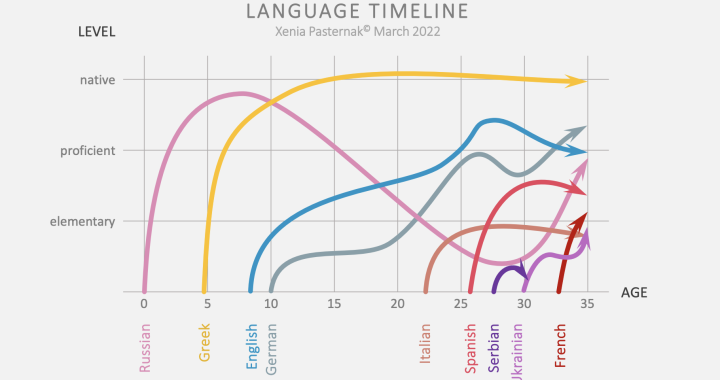
Xenia shared this multilingual language timeline with me. Born in Kyiv, she relocated to Greece at age 5 and to Germany when she was 30. Her current prevalent language is Greek – although it is not her mother tongue. In her twenties she discovered her love for languages. She worked on international projects. She learned Ukrainian as it was a prerequisite to get a job in Berlin, which she gladly welcomed as an excellent opportunity to get back to her roots. She also revived her Russian. When her daughter was born a year ago, she decided that she needed her first language, exposing her to the spectrum of Slavic languages.  Following the recent events, she could not help but continue with Ukrainian.

She learned Italian when she found out that languages are fun and not so difficult as previously expected. When the universe sent her a Chilean friend as her first Spanish teacher it took her 6 months to get the Cervantes B2, 3 more to get the C1 certificate. Serbian was a short but intense relationship after she spent two weeks restoring wineries in a tiny Serbian village. She interrupted this stay to study English language and literature in Thessaloniki, while also working. When she came to Berlin, she organized two architectural competitions in Kyiv and then in Ottawa and Brussels. Fate, again, signalized that she needed to start with French. Once her daughter was born, she dropped it for Russian. Xenia's name is Greek, but she looks Ukrainian. Currently, she uses more Greek (as family language and among friends), German (as community and work language), English (at work and with friends), Russian (approx. two hours per day with her daughter and when they meet her little friends).


Roya Caviglia, creator of the Infant Communication Baby Sign Language and owner of The English Voice Academy, shared her language journey in a short video on IG:


Julia Wilsch's Language Timeline


Julia Wilsch, a German mother of 2 children, living in the Netherlands, has shared her very diverse language journey with me. She spent the first 11 years of her life in Germany, where she attended a local primary school. During that period she grew up with German and Arabic (to a certain extent through music and the family's acquaintances), thanks to her mother who had studied Arabic. As they were always surrounded by Arabic speaking friends, it felt very natural to acquire the language later on in her teenage years and helped to develop her general language skills. When Julia was almost 12, they moved to the UK where Julia and her younger brother attended school in English. She had learned some English at the German school previous to their move, so the transition wasn’t too difficult, but thanks to some EAL lessons and lots of children's series on TV, friends and further exposure in daily life, she settled in relatively quickly. After 3 years in the UK, her family spent 6 months in Germany (she was 14) where she and her brother attended a German Gymnasium. During this very intense and short time, Julia started learning Spanish and continued learning French in school, as she had done in the UK. Her family then moved to Morocco, where Julia and her brother attended an American School, and learned Moroccan and Classical Arabic. Julia lived in Morocco from age 15 to 18. To her disappointment, no Spanish lessons were offered in High school whilst there, so she took lessons at the local Instituto Cervantes before graduating. At age 18 she then moved to the Netherlands for her  gap year (FSJ), followed up by a Bachelor degree, and learned – or better, acquired – Dutch quickly, and learned to read and write in Dutch. During her studies, she also spent some time in Spain (doing a Erasmus program) and in Latin America (doing field work for her master's degree) to improve her Spanish even more. In the Netherlands she also took some more courses to improve her Arabic and to make sure to keep the language alive. 

Since her children were born in 2020 and 2022, she focused more on polishing up her mother tongue, German, as her exposure to that language had been minimized during her stays abroad. She currently works as a German language coach.

Julia can speak, read and write in all the languages she has learned so far, but her oral speaking skills are the most developed.


My own multilingual language timeline is as follows: I acquired Italian and German from the start, as I grew up in Italy with German parents. I started understanding Swiss-German when I was 4 years old. I never spoke it until I moved to Switzerland (Zurich) for my studies at age 18. At school I learned French at age 6, English at age 11, Latin (12) and started to understand Dutch through my friends who were in the Dutch section at school.

My mother used to sprinkle her Standard German with some expressions from the local dialect of the region she grew up in. Whenever we visited my extended family in Germany, I would carefully listen to what the "grown ups" would say in that dialect and acquired a basic fluency in understanding of it, and catch myself using some expressions with my children every now and then. 

During my studies (Romance Languages and Literatures) I learned Old Occitan, Old French and Old Catalan, and I studied several Italian Dialects, like the dialect of Poschiavo and Ticino, Lombardy, Laconi (Sardegna) just to name a few.
When preparing for a conference in Budapest, I had a smattering of Hungarian (una infarinatura molto lieve).

When we moved to the Netherlands, I taught myself more Dutch. Although the two languages differ, I found Flemish very helpful when learning Dutch, as the pronunciation in TV shows was for me easier to understand. Funnily, in the Netherlands I speak way more English than anywhere else I lived before. Although living and working in international settings, the "main" languages were French and Italian, for some time also German, but only since we moved to the Netherlands, English became the most dominant language as the international community here tends to prefer English. So, after barely speaking English for decades, it became the language I use every day, where I read and write in the most now.

Thanks to some Norwegian friends and a conference that brought me to Norway, I learned some basics in Norwegian. When I discovered Korean Drama in 2019, and got "addicted to it", I decided to learn this language too. I'm not very consistent in learning it, but I enjoy listening to it.


I would love to publish your own multilingual language timeline in this post too!
Please email me at utesinternationallounge@gmail.com with the subject "My Multilingual Language Timeline".


Do multilinguals have multiple personalities?

Well, the answer is: no! People who speak multiple languages do not have multiple personalities. Having multiple personalities is a disorder, being multilingual is not!

True is, that a person who speaks more than one language, feels part of the different cultures and “acts” in different ways.

For example, when I talk Italian with Italians, I gesticulate like Italians – but not in the presence of non-Italians. I adjust my way of communicating to the situation and the language I speak.

Anyway, the cultural influences coming from other languages do not mean that one will develop multiple personality disorder! It is surely not pathological!

Multilinguals have a multiple cultural reference system. That’s all. Our personality and identity is made of many elements “in a world where more and more people grow up and live with various cultural references – even more so after the expansion of the internet – it is meaningless to stick to the monistic concept of identity. Identity can be multiple, it can be plural” (Tokuhama-Espinosa, T. (2003), The multilingual mind: Issues discussed by, for, and about people living with many languages, Westport, Conneticut: Praeger Publishers, p.185).

Multilinguals do not necessarily have an identity crisis because they are a part of many cultures. If they have a sort of “identity crisis”, then it’s because other people ask them to choose one (and only one!) of their cultures.

If we assume with Charlotte Burck that identity can always be “actively constructed and renegotiated” (Multilingual living: Explorations of language and subjectivity, New York, Palgrave Macmillan, 2005), well, then identity and personality are something that flows as we grow. It evolves and develops throughout our lives.

When we speak different languages, we also express different kinds and aspects of ourselves. This depends from our audience, the situation etc. In every language we speak, we create different kinds of self-expressions and experiences for ourselves. 

Our different languages allow us to express several facets of ourselves, the way we perceive and experience the world, but never change our personality! (Ute Limacher-Riebold)

Multilinguals often feel “different” when they are switching between their different languages. But the difference is felt during this shifting, because the culture, the frame of reference changes with the language too. François Grosjean describes it like this: “what is seen as a change in personality is most probably simply a shift in attitudes and behaviours that correspond to a shift in situation or context, independent of language” (François Grosjean, Life as a Bilingual: the reality of living with two or more languages, Psychology Today, 2011) – I would add: but triggered by the change of language.

Let’s make an example. I usually talk German to my children, but sometimes, I switch to Italian. Usually this happens, when I’m tired or I have to tell them something quickly (for example in situations of imminent danger: “step back from that road!”). When this happens, I feel different. My expression changes, words come out much faster and I start gesticulating. But when I talk Italian in a more formal context, I slow down and do not gesticulate that much. Therefore, in my opinion, the “personality shift” has a bit to do with the language, but not only. I would say it is like wearing another mask or glove.

During role plays with my children, I changed language or imitated a strong accent (Italian, German, Swiss-German, French, English or Dutch) in order to “feel” and accentuate the difference of the character. There was no “personality shift”, it was rather the opportunity to explore the multiple facets of the characters or roles we were playing. – For those who think this only happens when switching from one language to another: monolinguals experience this “shift” too when they switch from a formal to an informal register, when they shift from speaking to young children to speaking with adults or colleagues in formal settings !
We all use different registers when we are in formal meetings than when we talk to our children or friends. Bilinguals (or multilinguals) just have a broader framework to work with.

Usually, multilinguals have two to four dominant languages, but this dominance can vary over one’s lifetime. All our languages are always present to some extent and form our very own multi-competent multilingual identity.

It’s like having multiple tools to express ourselves: an incredibly powerful asset!

Bildschirmfoto 2015-01-18 um 19.31.02


What are your thoughts about this?

What is your experience as a multilingual – or parent of bi- or multilingual children?


When the home language is not the dominant language

If you are a multilingual, is your home language your most dominant language?

Something that surprises me when I read about language policies in schools and elsewhere is, that it is always assumed that people – children and adults – are most proficient, i.e. most fluent, in their home language. This might be correct for those who learned other languages later in life and were first schooled in their home language, but reality is very different for multilinguals who are schooled in other languages!

If you are a simultaneous bilingual and you have the chance to maintain those first languages at school (because the school teaches several subjects in both or all the languages!), all your languages might be more or less at the same level – usually one or two are more dominant than the others, depending on many factors. You may be bi- or pluriliterate.

If you acquired and learned several languages, simultaneously and successively, lived in different places, were schooled in one of the languages, or maybe not..., worked using one of these languages – it might be that your most dominant language is not the first language you acquired or learned.

If our children are schooled in another language chances are high that their most dominant language is the school language...


The reason for this is very simple: we don't (or can't) foster all the vocabulary they learn and use at school also in their home language, because it would mean that they hear the same lessons twice once at school in the school language, once from us at home. 

Recently many schools – not only the international ones! – are opting for a more inclusive policy when it comes to home languages, which I fully support. It is proven that integrating home languages in the practice at school, helps new students, i.e. those who were schooled in their home language earlier, to adapt and integrate easier.

But what about those multilinguals who are schooled in languages that are not their home language(s) since day one? Who maybe had to learn two (or more!) school languages in addition to their home languages due to their moves?

I see a problem in the overall approach, because these latter children are often lacking behind their peers in their countries of origin language wise. They need a whole other support!

Many multilingual families bridge the school and the home languages by discussing about school topics, by providing the necessary input, fostering the right vocabulary. This is hard work! And it requires collaboration and transparency from the teachers and the school in general, and not only on primary school level, but throughout the whole school curriculum!

We parents – even those who are teachers – can't provide all the input that our children receive at school in their school language. We have to make compromises. For my family it means that I focus on the topics my children like the most. I must confess that I find it sad that my children don't count in German or Italian, that they prefer English when it comes to explaining complex subjects, but I know that with patience and our many conversations, they will acquire as much as they can.

I honestly hope that there will be more studies about multilingual families whose children are schooled in another language and who do everything possible for their children to become fluent also in their home languages. I am looking for testimonials from other multilingual families whose children are schooled in another language.

I want to hear from you, how you foster your home language(s) and how it is going, what support you get, what support you would need.

Please share your experience with me, by leaving a comment here below. 

I will gather all the information I can get to write an article, present it at conferences and hopefully we will get more help from governments, schools, teachers, the community we live in.


The Third Language Model

Audio The Third Language Model

How do multilinguals preceive, experience their languages? How do their languages influence the way they perceive themselves, their identity and sense of belonging? We know that multilinguals are not a combination of multiple monolinguals in one, but a unique combination and sum of their languages that they have acquired and learned to different levels of competence, for different purposes and in various domains of life.

When it comes to identity and language, or identity and culture, I find that we can not separate them, and the same way multilinguals are a unique symphony of all their languages, multiculturals are a unique symphony of all their cultures (and all that comes with them). As cultures are transmitted through languages, and languages translate cultures, they are both inseparable.

With their Third Culture Model, David Pollock and Ruth van Reken explain how cultures are involved when children grow up in different cultures or adults live in different cultures. I propose a Third Language Model that aims to explain how  multilinguals experience their languages.

More than half of the world’s population is multilingual, i.e. uses more than one language on a regular basis. No matter when they acquired or learned the languages, and no matter to what extent and level of competence, and what skill (understanding, speaking, reading, writing). This rather broad definition of multilinguals reflects the reality of the very diverse, complex and always changing panorama of “living with multiple languages”. 

No matter for what reason we live in another country than the one of our origin or passport, there are always three cultures – or three social contexts – we switch between: the home culture – the one of the core family –, the host culture or cultures, and the one of the community we tend to thrive, which would be the one that shares our same experience of living abroad, far away from extended family, speaking other languages etc. 

The Third Culture Model, therefore, applies to every international – refugee, immigrant, expat etc. however we want to label ourselves (or are labeled by others!…)

(see description in David Pollock, Ruth Van Reken and Michael Pollock’s “Third Culture Kids: Growing up among worlds” (2017, 3rd edition))

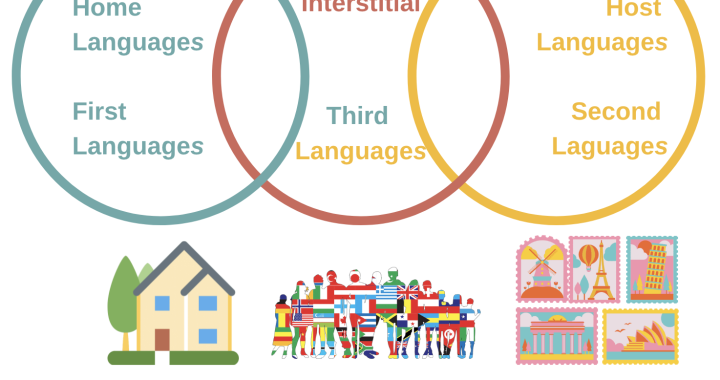
As one very important aspect of each culture is its language, or its languages, I like to translate this model into the Third Language Model for multilinguals, where the Home Language(s) are those spoken at home – or in the micro-society – which are the first languages a person acquires (chronologically speaking) – and in multilingual families it can be more than 2 (hence languages).

The Host Languages are those spoken by the community and/or at school (or at work), and represent the “second” layer of languages, those spoken in the meso- and macro-society. 

The Interstitial languages, or “Third Languages”, are those we share with our community of people who we share the same interests, that we meet at school, work etc.. 

The Third Language doesn’t mean that one speaks only three languages, the same way as Third Culture doesn’t mean the third culture in a chronological sense (as in opposition of second, fourth etc.).

It means that there is a third dimension which is the one multilinguals thrive: the interstitial dimension where the home languages and all those we are or have been in contact and acquired or learned to different extent coalesce. Multilinguals thrive in contexts where they can use all their languages unconditionally, without any bias or judgment, where they don’t have to explain or justify the use of one language or the other, or all of them for that matter.

The same way a TCK builds relationships to all the cultures, while not having full – and I prefer to add “exclusive” – ownership in any, a multilingual child (or person), can communicate to some extent in all his/her languages, while not necessarily needing to be fully fluent (up to CALP = Cognitive Academic Language Proficiency level; see studies by Prof. Jim Cummins) in all of them.

I always had a problem with defining “full ownership” in the description of a TCK and I prefer avoiding its definition as it differs considerably from person to person. I rather prefer the other formulation in my Third Language Model because, in fact, we can be fully fluent in one, two or three of our languages, which means that we can fully function for the situations and purposes we need, and be multili-terate! There is not one kind of being multilingual but a continuum of increasing complex ways of being multilingual. 

Multilinguals will always thrive in international settings, with people who share their multilingual experience. It is not necessary that they share the same languages, the same way TCKs will always thrive in international settings no matter where the other TCKs have lived before. In fact, knowing several languages allows us also to understand languages that we didn’t learn yet, simply because we can access them with a broader variety of forms or tools, i.e. the variety of the languages we already understand and use.

I once said that “I am all the languages I speak” and that “my home are my languages“, and this is very true for many multilinguals!

With all the languages we speak we have a great repertoire of words and expressions that we would love to be able to use as often as we can. The ideal would be if we could use all our languages in one conversation and fully exploit all facets of our languages. It is the multlingual advantage and privilege

If you are speaking (reading and writing) multiple languages, I hope you can relate to this Third Language Model.

Please let me know your thoughts in the comments’ section!

Pollock, David C. and Van Reken, Ruth E., Third culture kids: growing up among worlds, London, Nicholas Brealey, 2009.

Pollock, David C.,  Ruth E.Van Reken, Michael Pollock, Third culture kids: growing up among worlds, 2017, 3rd edition.

Definition of a Third Culture Kid in Pollock, David C.,  Ruth E.Van Reken, Micheal Pollock, Third culture kids: growing up among worlds, 2017 3rd edition. p. 27: “A traditional TCK is a person who spends a significant part of his or her first eighteen years of life accompanying parent(s) into a country that is different from at least one parent’s passport country(ies) due to a parent’s choice of work or advanced training”

For a multilingual approach to the use of multiple languages, read: A Multilingual Perspective on Translanguaging by Jeff Mac Swan 

TinyEYE online speech therapy from your home or school

In my practice as Language Consultant I sometimes work as mediator between parents and schools when there are some misunderstandings concerning the speech and language development of the child.

Speech therapists usually help the child either during school hours or after school with the school language. They usually work closely with the teachers in order to provide the best support to the child.

What many parents of bi- or multilingual children don't know is that their children should get this support it in all the languages they speak!

As not every parent is a linguist or a speech therapist, who can provide this support themselves or at least bridge between the languages.

Also, finding a speech therapist who is expert in the school and the home languages is very difficult.

The online service offered by TinyEYE can be a solution for some.

I'm very thankful that Mila Rozema, TinyEYE British-Dutch speech and language pathologist, agreed on answering a few questions about the services TinyEYE can offer to bi- or multilingual families.


  • What age group are you targeting with TinyEYE?

TinyEYE is an online speech therapy company that has been helping clients of all ages for many years now. From children with speech and language disorders to teenagers who stutter and adults who have had a stroke.


  • How does this work?

To be able to know whether a person needs speech therapy, one of our TinyEYE speech therapists plans in an intake interview with you. During this interview you can elaborate on the problem and the speech therapist will ask questions about the medical history. The speech therapist will then give advice and discuss starting up speech therapy or not.


  • What kind of information do you need from parents and schools in order to know if you can help the child (or adult)?

Our TinyEYE speech therapists find it important to get in contact with others involved in the client’s daily life. Think of teachers or doctors.


  • Is the speech therapy you're offering at TinyEYE covered by the health insurance?

Our online speech therapy is fully covered by the Dutch health insurances.


  • What about multilingual children: can your speech therapists provide the service in more than one language?

Our speech therapists are also specialized in working with multilingualism and different cultures. We can test and treat in different languages.


  • What are the languages do your speech therapists cover at the moment?

The languages we provide are: Turkish, Dutch, British, German, French and Malayalam.


  • Is this service available worldwide or do you only serve specific time-zones?

Our services are world wide. Flexible hours, so time difference isn’t an issue at TinyEYE!


  • Can parents assist the online sessions together with their children?

The good thing about online speech therapy, is it can take place from the client’s home environment. This means parents can be present during the speech therapy of their child for example. We also work with international schools. In some cases the equipment is set up at a school and we see children online, during school time.


  • Do you use online games when working with the children or do you also give homework they can do offline?

When working with children, we use our TinyEYE speech and language games. We then place these games, with personal instructional video’s in their homework so they can practice whenever they please. When working with adults, we use a large screen, writing or photo material. All therapy materiaal is integrated in our software programme.


  • How long does a session last?

The duration of a TinyEYE session is 20 minutes. Short but effective. We tend to plan in two or three sessions a week.


  • Some families who live in remote areas where they don't have the appropriate speech therapy for their children, also struggle with internet connection problems. What system do you use when working with the clients online and is it safe for children to use?

We use our own TinyEYE software programme for the live audio-visual sessions. Client and speech therapist login via the website. This programma doesn’t need a strong internet connection so families living in remote areas or in the mountains can also receive online help.


To see a brief introduction of the bilingual speech therapists, please click on the following link: https://tinyeye.eu/en/about/ and https://tinyeye.eu/wie-zijn-wij/


Please don't hesitate to contact TinyEYE if you are interested in online speech therapy for yourself or someone you know.


Mila Rozema, British-Dutch speech and language pathologist at TinyEYE


When you end up talking another language with your child…


Many internationals end up talking another language with their child than the one they chose at the beginning.


There are different reasons for this:


– They live in a country where their mother tongue is not recognized as an important (= prestigious enough...) language, i.e. it is not supported by the school and society, and there is not a linguistic community which could help to support these families to keep on talking this language – at least in private.

– They don't consider their family language important enough to pass it on to their children – because they don't have family and friends who share this language, and are second or third generation speakers themselves.

– Doctors and teachers told them to drop their family language in order to help their children integrate easier into the local school and perform better.

This last reason is, alas, the most common one. In many countries, schools and societies are getting more and more aware of the importance to maintain the heritage languages, since research clearly proves the benefits of it on the childrens' academical  performances on the long run.


But what about the other two? – When a language is considered "not important enough" by a society (and, consequently, by schools, teachers, doctors, locals...), and there are no resources available for these families to foster the language in a spontaneous and natural way – communities, libraries, language learning opportunities etc. – it is almost impossible for parents to maintain a language "alive" in their family.

If they manage despite these difficult circumstances, the language becomes tendentially "artificial". In order to keep a language "alive", it needs to be practiced on different levels: to become fluent and confident in a language one needs to be able to distinguish between several registers, understand slang for example and a broader range of meanings.

This situation becomes even more complex for bilingual parents: Which language should they choose to talk with their children? Do they need to choose or can they pass on both or all of their languages?

Linguists usually recommend to speak the “mother-tongue(s)” (i.e. the parents' language(s), the family language(s)) to our children. But which is the mother-tongue if you are a balanced bilingual and if your extended family talks both or even more languages? – When it comes to agreeing on the languages to speak to our children when we, parents, are already bilinguals (= understand /talk /read /write two or more languages), there is not one-size-fits-all solution. 


My personal experience...

I am a multilingual parent and grew up with 2 languages myself (Italian and German). We were living in Italy when our son was born and as Italian is one of my dominant languages and actually the one I'm most spontaneous in, it was natural for me to speak Italian to him from the beginning.

Our home languages were Italian (me and my son), Swiss German (my husband and my son) and German (my husband and I) and we knew that he would pick up German automatically too.

When we moved to the Netherlands our son was 2,5 years old. Two months after he started attending a Dutch daycare, he stoped responding in Italian to me. 

My husband was still speaking Swiss German to him and I noticed that my son preferred to answer me in Swiss German or even Dutch. Nevertheless, I kept on speaking Italian, assuming that this was just a phase.

When children are exposed to another language in a "full immersion" way, like it was at the daycare for my son, they tend to prefer that language to the other languages (cfr. the "home-" or "family-languages")  and once they feel more comfortable in both (or more languages), and the input in all languages is still enough and there is a proper need for them to speak all the languages, they get back at speaking them all. – So I persisted with Italian, knowing that he would at least gain a passive competence in this language.

Unfortunately in this period we didn’t find Italian families with children of his age and I was the only person he would speak Italian with. Also, he realized that I understand and talk the other languages too: I learned Dutch with him and perfectly speak Swiss German and German too.

So, all he was doing was following the economic principle in languages: he didn't see why he should keep on speaking Italian with me, there was no real need for him to do so.

The concept of economy – a tenet or tendency shared by all living organisms – may be referred to as "the principle of least effort", which consists in tending towards the minimum amount of effort that is necessary to achieve the maximum result, so that nothing is wasted. Besides being a biological principle, this principle operates in linguistic behaviour as well, at the very core of linguistic evolution. In modern times it was given a first consistent definition by André Martinet, who studied and analysed the principle of economy in linguistics, testing its manifold applications in both phonology and syntax.(Alessandra Vicentini, The Economy Principle in Language, 2003)

I still kept speaking Italian to my son and to my twin daughters who were born a year after we arrived to the Netherlands, confident that when they would start speaking Italian, my son would follow them and everything would be fine.

In fact, all three spoke Italian to me for almost four months when my daughters were 11-15 months old : my daughters started forming monosyllables around month 10/11 in Swiss German, Italian and Dutch).

When plans change...

But then, my daughters started to communicate in an autonomous language that had nothing in common – neither phonetically, nor morphologically – with the languages they were exposed to.

This secret language became a problem in our family because nobody could understand what they were saying. It was mainly because our son was suffering from this situation – he couldn't understand his sisters and we weren't able to "translate" the meaning of the words they used either – that we decided to choose German as our family language. I was fully aware of the problems that could arise – confusion, subtractive bilingualism, language refusal from all children, loss of emotional bond if my husband and I would cease speaking Swiss German, respectively Italian with our children, only to name a few... –  and this would surely not be something I'd advise parents to do! But to avoid that my son would feel excluded and that his level of anxiety would worsen, and for the sake of a healthy linguistic atmosphere in our multilingual home, we decided to give it a try. It was very important for me to include our son in the decision making process! I am a firm believer, and research confirms this, that children's agency, their active involvement in this kind of situations is of great importance!  

Cummins draws the distinction between additive bilingualism in which the first language continues to be developed and the first culture to be valued while the second language is added; and subtractive bilingualism in which the second language is added at the expense of the first language and culture, which diminish as a consequence. Cummins (1994) quotes research which suggests students working in an additive bilingual environment succeed to a greater extent than those whose first language and culture are devalued by their schools and by the wider society.

We did not completely stop speaking Swiss German and Italian at home. We shifted the focus on German, but maintained the other two languages in one on one settings and when reading and singing with our children, and, of course, when speaking with our Swiss German and Italian speaking members of the family. I was constantly monitoring my children's reaction and behaviour.

Luckily our children responded very well to this change: after two months our daughters completely stopped speaking the secret language and started speaking German and our son showed a very positive reaction to us speaking German all together. They increasingly searched to communicate with us in German and would also enjoy listening to the other languages. We agreed that their Italian and Swiss German would, for the moment, rather be passive (receptive multilingualism), knowing that understanding our languages would make it easier later on to activate the languages and become verbal.
It is important to add that our daughters started going to a Dutch daycare 1, later 2, then 3 days a week, starting from 7 months. They were in separate groups with the possibility to meet over the day and play together if they wanted. The reason for this early socialization was that I observed them assuming a clear behaviour of giver and taker, which I first tried to balance with playdates. Arranging regular gatherings with other parents of infants was not possible and I saw that it didn't work as my daughters would rather prefer playing with each other than with other children. My intent was to make them experience play and interaction with other children of the same age, to learn socialise with others and find their very own way of being and interacting. I know that many twins can't stay apart, or suffer when they don't see or hear their twin. My daughters were different from the beginning. They would search physical contact when napping or during the night, but not so during the day. They enjoyed discovering the world each in her very own specific way. – The development of this autonomous language, also known as cryptophasia, came "out of the blue" and both were already verbal in our languages. I know that some twins or siblings develop this secret language at different times in life, but what I didn't know was how long it would take until this phase is over. I didn't want to risk the health of my son and the bond we have as a family, that was compromised by this isolating language...

More than 10 years later...

More than 10 years later, my children speak English, Dutch and German on a daily basis, they also speak French and Spanish on a basic level, and our son is learning Chinese. They all understand and speak Italian on a A1/A2 level, and Swiss German. In order to support Swiss German and Italian we used to spend our summer holidays in Switzerland, meeting family and friends who would provide the necessary input during our stay. We stoped with these language immersion holidays three years ago, because we decided all together to focus on the languages we need in our daily life: German, Dutch and English.
I observe that all three have very different preferences when it comes to languages, and I am happy to see that they don't refuse any of them. They have attained different levels of fluency, and that is enough for what they need right now. Should they ever need to improve any of their less dominant languages at some point, I know we have planted the seeds. We have watered the plants regularly, some more than others, but that's how it goes. We can't expect to be perfectly balanced in all our languages, that isa huge myth many parents want to make true. What I'm sure though is that they all are aware of the gift of languages they have, they are proud of it and they know what to do should they want to improve their language skills in any of them!

How we did it

For multilingual parents maintaining one or more minority languages* requires a considerable effort and is a greater commitment and challenge. Some families follow the Time and Place strategy, ie. they have fix situations and times where they talk one or the other language. – I usually recommend this strategy  with older children who have already a sense of time and understand why a parent would switch to another language. In our family we have agreed on times when we speak English or Dutch at home: during the week, after school and when we have guests who don't speak German. 

When my son was born we thought he would become fluent in Italian and German – attending a school in Italy –  but when we moved to the Netherlands we had to reassess our language situation. He went to a Dutch daycare and we thought he would attend a Dutch school later; so Dutch became the dominant language for a year. When we decided to send him to an English speaking school, this changed again: English, Dutch and at that time German, became his most dominant languages.
For our daughters, who started speaking Swiss German and Italian, Dutch and German were the most dominant languages until age 3 and English replaced the Dutch when they started attending the same school as their brother.

We never had long term language goals as we knew that all can change and would change, due to international moves and our children being schooled in their fifth language (chronologically speaking), and growing up in a highly multinational and multilingual community.

When my son asked me explicitly to restart speaking Italian with him more regularly because he noticed that when I was talking Italian with friends, I would remind him of earlier and he wanted to connect through this language with me, we agreed on a plan to speak Italian to each other during our one on one time. 

Unfortunately our school doesn't provide sufficient language tuition and I gave my children language lessons in German for 2 years. Only 2 years because I noticed that it didn't work to be mum and teacher with my children. We agreed that they would watch German TV, listen to German podcasts and audiobooks, and read books in German.


In 2017, this was our situation:
"my daughters recently (May 2017) asked me to teach them Italian and I now dedicate 2 hours per week to "teaching" them Italian in a natural way – we read texts, do role plays, listen to music. As all three children have an analytical approach to Italian I introduce grammar (how you form plurals, according adjectives etc.) to them in a context based way, i.e. when we listen to a song or read a text I will focus on one aspect, for example the form and agreement of adjectives in Italian. 

At the moment I dedicate 6 hours per week to teach my children German, Italian and French. – The goal that we have agreed on is for them to become nearly native in German (C2 level) and confident enough in Italian and French (both B2 or C1). "

In 2020, the situation is very different. I don't teach any language to my children anymore. They have made the commitment and took the responsibility to work on their language skills independently. Reading in German or Italian is not what they do spontaneously, or at least, it is not their first choice. Two of my children are book worms and I fully welcome this no matter the language. German is a language they find too difficult to read ("the sentences are so long... and so boring..."), so they tend to opt for shorter texts – posts, online articles, and whenever possible, prefer videos... 

In 2024, all my children are adults and they have a native and nearly-native level in English, Dutch and German. They understand, speak, read and write Italian, Spanish and French to different levels of proficiency, and understand and speak also Swiss German. In the past 4 years my son has started learning Mandarin Chinese and Japanese independently, and keeps improving his French. One of my daughters is learning Russian, the other one Thai and Mandarin Chinese. 

Never give up!

Many of my clients struggle with accepting that their children don't speak their language, that they don't respond in the family language. Not sharing their language with their children deeply affects them and many surrender.

One of my clients managed to talk Italian to his daughter for 10 years, not getting any response in Italian, only in Dutch or English. His daughter was perfectly able to understand Italian and would also speak basic Italian with extended family, but knowing that her father was fluent in English and Dutch. Growing up in a highly international environment where English and Dutch are the dominant languages, made her prefer these two languages even when speaking with her Italian father. 

We all identify with the languages we know, with the cultures they represent and everything that we associate with the language. Not speaking a language we feel very connected with with our loved ones feels like missing out the opportunity to share the most spontaneous thoughts and emotions with them.

Speaking German with my children feels like speaking through a filter, whereas when I speak Italian, I speak from my soul: this is why I never gave up on Italian!

I always ask my clients: if you could fast forward 10 years, would you be happy not to speak your language with your child?

What about when you become grandparent? If you feel that you have to silence part of you by not speaking your language, that you don't feel comfortable with it in some way, then don't stop talking your language to your child, no matter how your child responds.*

The daughter of my client did the same as my son and my daughters: after several years she started talking Italian again. She had listened to his Italian for years and built a passive/receptive vocabulary, and knew exactly how to form sentences and is now (at age 18) nearly native!

* I must add that there are some extreme situations where I would not advise to keep talking your language to your child, but these are very extreme (for more information about this you can contact me anytime) 

When the dominant language wins... again

Many internationals whose mother tongue or L1 is a minority language know how it feels like when their children prefer a more dominant language even at home. When they almost forget their family language(s) or consider it "not worth to be learned". – For parents this equals with a personal rejection from their children – although this is usually not the children's intention!  

With my clients who are in this situation I do regular assessments to analyze their language situation, the way their children cope with it.

I consider this very important as we all, our situations and our language preferences change over time, and we should let all members of the family know what our expectations are and try to adjust and agree on which languages to maintain. (Ute)

As I mentioned before, we never had unrealistic language goals with our children, and I made sure that our children always had a say when it came to language choices! 

We always have to look at the bigger picture and follow the long term goal which, for my family, is to keep on learning languages, stay flexible, and adjust to the different situations and needs. ~Ute's International Lounge @UtesIntLounge


Parents of bilingual children have to make choices that may not be the ones they wanted in the beginning, but that are necessary for their children to adapt to the situation they find themselves in.


I sometimes wonder: if the situation with my daughters wouldn’t have happened, my children would still speak Italian and Swiss German at home, and be less fluent in German. My children wouldn't be in the German native-speaker class at school – but among the Italian native-speakers. To be honest, it doesn't make a big difference for me, as German and Italian are my first languages, my two L1's. As for Swiss German: it is an oral language only, and therefore it was not difficult to accept that our children would learn it "on the side" – they understand everything today, and can also distinguish and understand different Swiss German dialects, which is, in my opinion, a fantastic achievement, considering that they spend on average 1 week in Switzerland per year!

When my son told me that he would like to speak Spanish and French at home too, I first got anxious because my children spend most of their time at school, have after school activities and homework to do, so the time to practice on those languages is not enough to foster these languages too. But it wasn't about reaching nearly native fluency! My son only wanted to exercise these languages with me, speak them and analyze them with me. 

We agreed on the fluency he wants to achieve in all the languages he is learning and improving, and so far I am very pleased to see that he takes this with the right spirit: he enjoys speaking the languages he chose and make the best out of it. He has published a guidebook for students preparing for their GCSE and is currently learning Chinese and Japanese.  


Heute we speak quasi ogni giorno alle taalen, pero no es importante qu'on les parle parfaitement: it's more important, Spaß dabei zu haben en ze alle heelemaal te genieten!


*minority language: a minority language is a language that is different from the official language(s) of a state and usually spoken by less than 50% of the population of a society/ community.

The term "bilingual" is here used to define people who understand and speak two or more language to a certain extent.


If you would like to know more about this and are interested in an assessment of your family language situation, contact me at info@UtesInternationalLounge.com – and have a look at my services here.


© Ute Limacher-Riebold, 2024 


Related articles