From Theory to Lived Experience
When we talk about multilingualism, we often talk in theories: about language acquisition, critical periods, language input, or cognitive benefits.
But what does it really mean to live across languages, to raise children who call more than one language “home” – or sometimes, none at all?
This article brings together the raw, beautiful, complicated experiences of real families navigating the multilingual journey. Following up on The Spectrum of Multilingualism – Part 1, From Early Definitions to Contemporary Perspectives, here we move from abstract concepts to the emotional terrain of multilingual life through the honest words of parents raising multilingual children abroad.
The Superpower – and the Weight – of Multilingualism
Multilingualism is usually described as a “gift”, a bridge, and sometimes even as a superpower. For many children, being called a “language superhero” brings immense pride and motivation. I’ve seen it brighten their eyes, encourage their efforts, and strengthen their sense of identity.
But as my co-founder, Ute Limacher-Riebold, wisely reminded me the other day:
“When bilingualism or multilingualism is celebrated or emphasized like a gift or a superpower, people tend to falsely assume and expect it to be easy… whereas in reality it is hard work, requires dedication, consistency and support from a ‘multilingual village’.”
So in this article, I hold space for both: the lightness and the pride, the challenges and the truth.
Multilingualism is not linear, and the path is never perfect (García 2009). But, in my opinion, it is always worth walking!
What does multilingualism look like in your home?
Pause. Reflect. Is it loud? Quiet? Joyful? Confusing?
Real Lives: Snapshots of Multilingual Families
Family 1: Eleni Prifti (Greek living in the Netherlands)
Languages spoken: Greek, Hindi, Dutch, English
Family composition: Greek mother, Indian father, living in the Netherlands
Children: 2
Language dynamics:
- Greek with mom
- Hindi with dad
- English between the parents
- Hindi between siblings
- Dutch at school
- English used occasionally with outsiders
-Raising multilingual children abroad: What are the first 5 words that come to your mind?
“Complex, interesting, uncomfortable, frustrating, controversial.”
Eleni’s children speak four languages – but rarely the same one at the same time. Despite being a stay-at-home mom for over seven years and consistently speaking Greek, her children surprisingly chose Hindi as their sibling language.
“No one has been able to figure out why.”
What worries her most is the emotional distance language might cause:
“Will they be able to talk to me easily in the future, if their ‘easier’ language isn’t one I speak?”
“Will language become a wall between us?”
Still, she marvels at how naturally her children absorb languages and how it shapes their cultural understanding. One moment that stayed with her:
“My son once told me: ‘I have three names. Each language pronounces it differently.’ I couldn’t even hear the differences. I felt like they had a 7th sense I didn’t.”
Her journey has taught her the art of letting go:
“If you have to choose between the language and the bond with your child, always choose the bond.”
Have you ever felt that language was creating distance – or connection – in your family? Let us know in the comments!
Family 2: Virginia (Greek living in Denmark)
Languages spoken: Greek, Turkish, Danish, English
Family composition: Greek mother, Turkish father living in Denmark
Children: 3 (ages 8, 5, and 2)
Language dynamics:
- Turkish with dad
- Greek with mom (unless others are present who don’t understand it)
- Danish between siblings
- English between the parents
-Raising multilingual children abroad: What are the first 5 words that come to your mind when you read this phrase?
“Difficulties, multiculturalism, family, nostalgia, summer.”
Virginia shares the emotional complexity of raising multilingual children in a home where four languages co-exist.
“It’s hard when family conversations don’t ‘flow.’ So many languages mix together that my brain gets tired decoding who’s saying what.”
She describes the shifting dominance of languages depending on season and context. Sometimes a language goes passive—only to re-emerge with a visit from relatives or a family trip.
“I thought it would be easier. That the kids would ‘just’ learn all the languages. But it takes effort, persistence, and compromise.”
Still, Virginia finds joy in small victories—like her kids’ curiosity about other languages or the moment in a Copenhagen playgroup when her child said proudly:
“There are others who speak many languages too!”
Family 3: Anonymous (Greek living in Denmark)
Languages spoken: Greek, English, Danish, Finnish
Family composition: Greek mother and international partner, living in Denmark, with one child and one stepchild
Children: 2 (one preschooler, one older stepchild)
Language dynamics:
- Greek with mom
- English with dad and child
- Child prefers English with Danish influences
- Stepchild speaks English at home (fluent in Danish and Finnish)
- Danish at preschool
-Raising multilingual children abroad: What are the first 5 words that come to your mind when you read this phrase?
“Anxiety, pride, guilt, laughter, confusion.”
This parent describes the daily challenge of maintaining balance:
“One language always dominates—more cartoons, more books. It’s hard to keep the child engaged in the less dominant language.”
Despite fears that their child might never speak Greek well, moments of magic appear:
“When he uses a difficult Greek word I didn’t know he knew. Or translates for his brother without effort.”
Their hope?
“That he will have roots in all his homelands. And more freedom in his future because of it.”
Family 4: Isja (Dutch living in Denmark)
Languages spoken: Danish, Dutch, English
Family composition: Dutch mother, Danish father, living in Denmark
Children: 2 (ages 6 and 7)
Language dynamics:
- Danish at home
- Dutch occasionally from mom
- Regular Dutch books
- English from environment
-Raising multilingual children abroad: What are the first 5 words that come to your mind when you read this phrase?
“Difficult, doubt, fun, word jokes, enrichment.”
Isja’s biggest struggle? Her children’s refusal to speak Dutch:
“They get upset when I try. But they understand much more than they realize.”
She sees progress in unexpected places:
“They scored high in Danish at school. And one day, they started using Dutch without even noticing.”
“I’ve learned to trust the process. And seeing their connection with Dutch relatives grow makes it all worth it.”
Her advice:
“Just do what you can. Don’t give up because it’s not perfect.”
Family 5: Katerina (Greek living in Denmark)
Languages spoken: Greek, Danish, English
Family composition: Greek mother, Danish father, living in Denmark
Children: 2 (ages 11 and 7)
Language dynamics:
- Greek with mom (as much as possible)
- Danish with dad
- English occasionally between parents
- Danish at school
-Raising multilingual children abroad: What are the first 5 words that come to your mind?
“Home country, feelings, difficulty, consistency, pride.”
Katerina shares how challenging it has become to maintain Greek as the children grow up, especially as Danish dominates their everyday life—at school, in the community, and even in family conversations. Her youngest always responded in Danish, while her eldest began switching more recently.
“I find it harder and harder to keep being consistent about speaking Greek as the children grow up. I see that his vocabulary doesn’t grow age-appropriately in Greek. If I insist we switch to Greek, he shares less. I don’t want that. I also find it difficult to have important family conversations because my husband needs to be able to follow what we are saying, and then we end up either speaking Greek and then translating to Danish or just having the whole conversation in Danish. So as the years pass, I feel that the situation of the family forces me to speak more and more Danish to the kids.”
Still, magic moments appear:
“One of the most magical experiences is when Philip once read a Danish book to Axel, but he translated it in Greek on the spot, as he was reading. I think it is beautiful that he wants to write a Greek rap song. I find it magical when they both sing in Greek.”
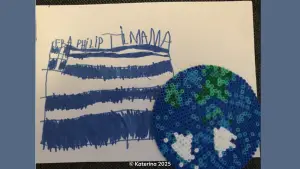
A gift from Katerina’s son when he was 6 years old.
She’s learned to adjust her expectations and find new ways to connect through language:
“My experience in raising multilinguals has taught me that it is a hard job. It has taught me that things change, and as the children grow up you have to find new ways to connect and include the minority language in their life. I have also learned to adjust my ambitions.”
What keeps her going?
“I want them to understand Greek culture—the soul of it. Language is the key.”
What Keeps Us Going
Despite the doubts, the fatigue, and the ever-shifting balance between languages, one thing is clear for all these families: multilingualism is worth it.
Yes, there are hard days – when the child refuses to respond in the heritage language, when you feel you’re losing ground, or when you’re just too tired. But something always pulls these parents back in.
Sometimes it’s the small wins:
“When they surprise you with a language leap… you remember why you kept going.”
“The joy of watching them speak with their grandparents—in Greece, in Turkey. That connection matters more than anything.”
Other times it’s deeper:
“I can’t imagine them going back to Greece and not being able to speak to their cousins and uncles. I feel a deep urge to keep that bond alive.”
“It is important for me that the kids can communicate with their Greek grandparents. Also I think that language is the key to understanding the culture and the soul of a country. Learning Danish has been key for my integration and understanding of Danish people and I want my children to have the tool to understand my country, Greece and Greek people.”
For some, it’s the hope of giving their children something lasting:
“I want to give them roots. Pieces of all their homelands. So they can feel they belong anywhere.”
“I want them to grow up with choices. Language opens doors.”
Or simply the joy of shared moments:
“Reading them my childhood books in Greek—and seeing them fall in love with the stories. That’s magic.”
“Watching them be curious about how words are formed in different languages. That’s when I feel they’re truly gaining something precious.”
And sometimes, it’s just this:
“The interaction with family becomes more meaningful. That’s what keeps me going.”
Advice from the Multilingual Village
If a friend came to these parents, unsure of how to begin raising multilingual children, here’s what they would say:
“Don’t give up, even when your child answers in another language. Language learning comes in waves. They listen, they absorb – and one day, they surprise you with full sentences.”
“Be persistent. Stick with the ‘one person, one language’ approach if that’s what you choose – even when it feels hard.”
“Write down the funny and touching moments. You’ll want to remember them later.”
“Just do what you can. Don’t doubt yourself too much. Don’t give up because you think you’re not doing it right.”
“Let go of control. Follow your inner voice, not the pressure of perfection.”
“If you have to choose between the language and the bond with your child, always choose the bond.”
“Ask your spouse to learn your language.”
And if multilingualism were an image?
“A ball of yarn with many ends!”
“A forest with small and big plants. Some very colorful, others not so much. Some with deep roots, others with shallow ones.”
“A big cloud in the colours of the Danish flag, raining Greek words.”
“A multicolour garden, with two happy but tired gardeners.”
You Are Not Alone
Let’s return to Eleni’s story:
“I had a tough day today.
It was tough because there were too many languages and too few words.
I spent time on the school’s app, trying to make sense of it with Google Translate.
I spent time trying to understand why the kids were arguing.
I felt defeated when a friend shut me down in conversation because I said “short-sighted view” instead of the “one-sided view” I actually meant.
Every summer, while playing with sand in Vromopousi, someone will start the language conversation:
“How lovely that your kids speak Greek so well.”
“My grandkids don’t speak it at all, and both their parents are Greek.”
“Of course it’s the mother’s fault they didn’t learn Greek.”
“Wow, four languages already? That’s amazing.”
“What a privilege.”
“Good for you!”
And every autumn, at the new school’s parent meetings, someone will start the conversation of shame:
“How many years have you been in the Netherlands?”
“Oh really…?”
“And you still don’t speak Dutch…?”
How much weight languages can carry.
The weight of expectations.
The weight of potential.
The weight of expressing what we feel.
To spend your life chasing the right word.
To think someone is rude just because they say “Yes” instead of “You’re welcome,” simply because they can’t say “alstublieft.”
To never know, almost never, where the damn accent goes in a word.
To struggle with pronunciation – French, Indian, Chinese, or from Ioannina.
To wish that AI would evolve to the point where we could all wear automatic translation headsets, always and everywhere.
And still, the weight of language remains unbearable.
Will I be able to present this talk well enough?
Will I ever feel “at home”?
Will I have to move to another country, in another language?
Will I be able to share these thoughts with Aryan and Niki fifteen years from now?
Will I understand that uncomfortable feeling in their stomach – if they try to explain it to me?
Will we speak the same language?
So many languages.
Sometimes opening doors, sometimes building walls.
Languages that carry the weight of a rapidly changing world.
Languages that sometimes signal educational privilege, and sometimes are remnants of trauma survived.
…
Every summer, while playing with sand in Vromopousi, the languages in our home braid together like plaits—filling us with joy, teasing, and laughter.
Every autumn, at the new school parent meetings, the languages hurt, alienate, and bring shame.
But every afternoon, at the playground next to our home, Tara will smile at me. She’ll speak broken English and say she felt the same way when she arrived, displaced from Palestine.
And suddenly, the playground fills with languages:
Greek, Dutch, English, Arabic, Spanish, Hindi, Bulgarian, and Chinese.
And only there, multilingualism becomes lighter.
Almost weightless.”
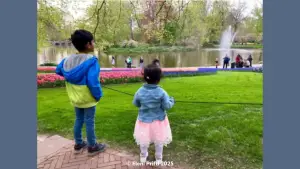
The stories shared here are unique, but the feelings – joy, doubt, guilt, pride – are shared by so many of us.
Whether you’re figuring out how to respond in your heritage language, navigating a child’s resistance, or simply trying to keep a language alive in small everyday moments, remember: you are not alone.
So, is multilingualism a superpower?
If you ask me – yes.
Multilingualism and multilingual parenting living abroad are superpowers.
But like all superpowers, they come with training, effort, setbacks, and the support of a community.
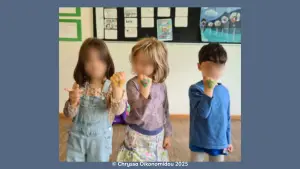
Sending positive energy to all the superhero parents out there – whether you’re monolingual, bilingual, multilingual, or even bye-lingual (as the joke goes).
Your Story
What are your thoughts?
We have created a shared space at Padlet: a gallery of real voices of Multilingual Families, reflecting what raising multilingual children abroad really feels like. Here, we invite you to pause, reflect, and share. You can add your thoughts, feelings, or even an image. You can write a few words, upload a photo, draw something, or leave a voice message – whatever feels true to you. Let’s create a tapestry of experiences together!
Real stories. Real people. This is multilingual life:
Difficult. Challenging. Amazing. Surprising. Beautiful.
Add your answers to Multilingual Family’s Padlet
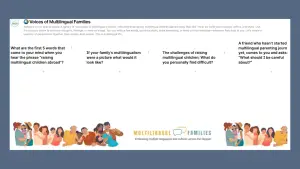
We look forward to reading them!
Do you want to be one of the highlighted families like the ones presented in this article and share more?
If you would like to share your story with us, join the conversation.
Multilingual Families is listening!
Share your story here
References & Resources
Limacher-Riebold, U. (2024). 5 Stages of Additional Language Acquisition. Multilingual-Families.com. https://multilingual-families.com/5-stages-of-additional-language-acquisition/
Limacher-Riebold, U. (2024). When Learning Languages – Is Earlier Really Better? Multilingual-Families.com. https://multilingual-families.com/when-learning-languages-is-the-earlier-the-better/
Limacher-Riebold, U. (2023). Some Cognitive, Cultural and Future Benefits for Multilinguals. Multilingual-Families.com. https://multilingual-families.com/some-cognitive-cultural-and-future-benefits-for-multilinguals/
García, O. (2009). Bilingual Education in the 21st Century: A Global Perspective. Oxford: Wiley-Blackwell, 45–49.

Chryssa Oikonomidou
Chryssa Oikonomidou is the Co-Founder of Multilingual-Families.com and Founder of Paidokipos, a creative Greek teacher, storyteller, and animator of interactive educational theater events. With a background as Senior Executive, she leverages over a decade of experience across various sectors to enhance her work in education, bolstered by her studies in education and multilingualism. Having not enjoyed school as a child and inspired by her two bilingual children, she is determined to make her lessons engaging and enjoyable for her students. She combines her diverse skills in didactics and project management to foster a rich educational landscape for young learners.