When you raise your children away from your homeland, you quickly realize that the task is not only to keep a language alive. For many of us, it is about passing on a whole world of feelings and identity. Think about the sound of music that gives you goosebumps, the stories you read as a child, the films you want to share with your kids one day. The language we speak is much more than words or grammar, it is part of who we are.
My Journey Towards Creating A Heritage Children’s Center
I am Greek, living in Denmark. From the very beginning, I could not imagine raising children who would not, at some level, understand this inner world of mine. I wanted them to feel familiar with it, to recognize where I come from, and to carry a piece of it inside themselves.
That is why Paidokipos was born. At first, it was nothing more than a casual parents’ group with babies. Once a month we would meet at a spacious café: a cup of coffee for the adults, the little ones playing around us. Nothing structured in the beginning. But as our babies grew, I realized that the group also needed to grow and change.
New questions began to emerge:
- How will they one day learn to read and write in Greek?
- Will this limited exposure be enough?
- How will they come to know the country I love: its geography and history, its writers and poets, its traditional dances, its music and culture?
- How will they relate, connect, and love the way their grandparents and family in Greece live if they only ever see it “from abroad,” like tourists?
That last question hit me the hardest. I wanted my kids to really see me. To understand me and our family back home. I wanted them to see Greece as I do and not just the touristic version of “opa, tzatziki, Zorbas, Santorini”. I wanted them to really know and feel their DNA. And at the same time, I wanted them to embrace the Danish roots we are building here, to evolve, and to create their own identity, one that includes me and my heritage too.
Does that sound egoistic? Maybe. I believe that deciding to have children is, in a way, the ultimate act of egoism, but parenting itself quickly becomes the daily practice of canceling your ego, every minute, in order to let them fly higher and higher. That’s what I wanted for my children: to fly and evolve, as long as they know what they are made of.
These questions pushed me to move beyond casual meetings and to start shaping something more intentional, more structured. Over time, with patience and persistence, that small playgroup, slowly transformed into what is today Paidokipos: a Children’s Center for Language and Culture for Greek-heritage kids in Denmark, now bringing together more than 200 members.
I know very well what it feels like not to know where to start, to wonder how to make things work and to doubt if it will ever be enough. That is why I want to share some of the lessons we learned along the way, so that you too, can take the first steps in creating your own heritage language playgroup.
How to Start Your Own Heritage Language Playgroup and grow it into a dedicated and committed community
Stage 1: The very beginning
- Keep it simple and start small: Most playgroups are born out of a personal need. Don’t wait for the “perfect” program, start small. Gather a few families who share the same goal and begin meeting regularly. Even simple activities in the heritage language can make a big difference.
- Focus on joy and exposure: songs, stories, simple games… the goal is to make the language fun.
- Learn from others: You don’t have to reinvent the wheel. Reach out to other heritage schools or playgroups. Consult educators and teachers in your network or search and find facebook groups like this one: Home & Minority Language Teachers Abroad to connect, ask questions and share good practices. Don’t forget we have a list of Heritage Language Playgroups and Schools Abroad at Multilingual Families site you can consult and maybe add also yours in the near future.
- Talk to the other parents: Ask parents directly about their needs. Simple surveys can be very helpful.
Stage 2: Growing into a community
- Program: Clarify what you want to offer. Start with one focus (e.g., playtime, interactive storytelling, outdoor play, crafts) and expand gradually.
- Space: Look for affordable venues. In many countries, forming a volunteer association or non-profit gives you access to community spaces at reduced cost.
- Legal/organizational setup: Decide whether you will be an informal group, an association, or another structure. This affects how you collect contributions and organize finances.
- Be ready to share or even let go of the steering wheel: if your group becomes a formal association, it will likely have a board of directors, elections, and shared leadership. This can feel unsettling and one may think “I started this, and now it’s no longer mine?”, but it is an essential part of building a real community. Ask yourself: what is my true motivation? If your goal is genuinely to create a community, then accepting that the group will eventually live beyond you – and sometimes without you at the center – is not only okay, it is healthy and often necessary.
- Stay connected to the local context: one reason many efforts fail is that they isolate themselves from the mentality of the host country. Don’t close the door on the child’s full identity. Explore what they learn at their local schools and find ways to bridge it with the heritage language. This makes the playgroup more relevant and natural.
- Be transparent with the other parents: communicate clearly about costs, plans, and decisions.
- Give parents small tasks: Don’t be shy to ask for help and don’t expect them to fully understand what is needed or invent ideas. Instead ask help when and where you can, share the workload, delegate clear and manageable tasks, i.e.: bring food for a shared buffet, set up chairs, organize a game.
- Open calls for support: invite animators, storytellers, or volunteers from your wider network to lead an activity once a month. This brings new energy and keeps the workload manageable.
- Remember: whatever you build is part of the solution, not the whole solution: communicate openly with parents that a heritage language playgroup or school or community is only part of the answer and they play a vital role for each success. Children need consistent exposure at home and in everyday life. The playgroup works best when families actively reinforce the language in their routines and use the group as a social catalyst: swap numbers, set up smaller social circles and rotating playdates, meet at the park on Saturdays… The more friendships and micro-encounters you seed, the more natural need there is for the language to ask, negotiate, joke, and tell stories beyond the monthly meeting. In our case, at Paidokipos, we try to encourage this from the very beginning. For example, in our welcome email we explain that Paidokipos is not a commercial service but a volunteer-based community, and that participation means sharing our values and supporting the collective effort. In our first school-year message we even write: “we encourage you to get to know each other if you don’t already. Children’s friendships help a lot, so please support them and do meet outside the class” These small signals remind families that they are part of a community, not just users of a service.
Stage 3: When the group gets bigger
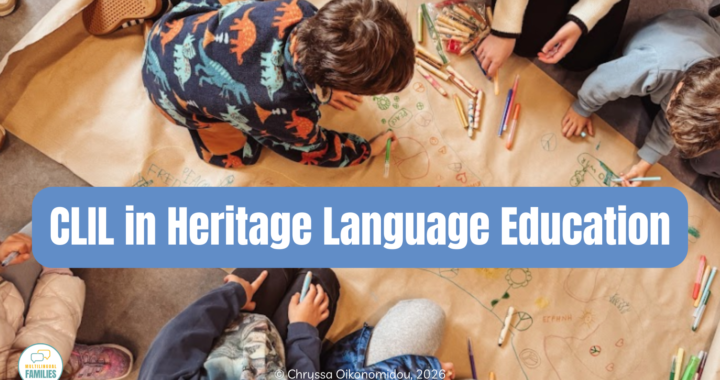
- Expand your program: introduce literacy, cultural workshops, or more advanced activities as children grow. For example, explore playful literacy methods like CLIL (Content and Language Integrated Learning), an educational approach that blends subject matter instruction with language learning. CLIL has been shown to improve both language skills and motivation for language acquisition (Coyle, Hood & Marsh, 2010).
- Collaborate with institutions: partner with municipalities, schools, cultural centers, or associations for long-term sustainability.
- Think long-term: how can the group continue beyond your own family’s needs? This mindset helps the community last.
Final thoughts
Creating a heritage language playgroup takes time, energy, and patience. Expect challenges and don’t give up! There will be moments of doubt, but the long-term rewards are worth it: children grow their language skills, parents find community, and cultural identity is strengthened.
And remember: you don’t have to make it perfect or large to make an impact. All it takes is a few committed families, a clear purpose, and the willingness to grow together. From a birthday party conversation, our very own Paidokipos has grown into a thriving community. Yours can too.
Practical Tips Recap
- Start small: begin with simple, fun activities — one step at a time.
- Test, learn and adapt: don’t reinvent the wheel. Study what others do and what research suggests, test it in reality, take feedback from families and children, and adjust accordingly.
- Share & involve: be transparent, delegate tasks, and let go of control as the group grows.
- Connect: link your efforts with the local context and encourage friendships among families.
- Grow with vision: invite support, secure spaces, and design the group to last beyond your own family’s needs.
References:
Coyle, Hood & Marsh (2010). CLIL: Content and Language Integrated Learning. Cambridge University Press.

Chryssa Oikonomidou
Chryssa Oikonomidou is the Co-Founder of Multilingual-Families.com and Founder of Paidokipos, a creative Greek teacher, storyteller, and animator of interactive educational theater events. With a background as Senior Executive, she leverages over a decade of experience across various sectors to enhance her work in education, bolstered by her studies in education and multilingualism. Having not enjoyed school as a child and inspired by her two bilingual children, she is determined to make her lessons engaging and enjoyable for her students. She combines her diverse skills in didactics and project management to foster a rich educational landscape for young learners.