How to Read Bilingual Books with Emergent Readers: A Guide for Simultaneous and Successive Bilinguals

How to Read Bilingual Books with Emergent Readers: A Guide for Simultaneous and Successive Bilinguals

We can support early literacy and bilingual language development of emergent readers by using bilingual books.
However, it is important to tailor reading strategies to the child’s bilingual background. Children acquiring two languages simultaneously (simultaneous bilinguals) have a different language experience compared to those who learn a second language after establishing a foundation in one language (successive bilinguals).

Both groups can benefit from bilingual books, but their needs and approaches may vary.

Bilingual books are sometimes referred to as “Dual Language Books” or “Side-by-Side-Books”, i.e. with two different languages on the same page, with the one language being the translation of the other. 

With emergent reader we define a person who is interested in books but can’t yet read them independently, or may be able to read some words but requires continued support to make meaning from print.

“Emergent readers are working on lots of goals: they’re learning more letters of the alphabet, expanding their perspectives through new books, and taking big steps toward writing. To support an emergent reader, literacy experts suggest (…) reading strategies to help them advance toward reading fluency.”

(I invite you to read the full article Developing Readers vs Emergent Readers on:  readingteacher.com)

In this short guide, I share how to effectively use bilingual books with emergent readers, and I distinguish between simultaneous and successive bilinguals. Simultaneous or successive multilingual emergent readers require a more tailored support that I will focus on in a separate post.
Here I focus on simultaneous bilingual emergent readers who have acquired both languages from birth (within their first few years) in a natural, spontaneous way, and where the school language or the language they learn to read in a formal setting, is also one of their home languages. They may have a balanced exposure to both languages at home and the community, but this is not a given and is difficult to measure or assess.

First of all, reading is a skill that is not acquired spontaneously like speaking. One does not learn how to read by constantly being read to. We need to “crack the code” of reading, which means that we need to learn how to give meaning to the signs on the page (or screen).
When exposed to reading books to and with them from early on, children will understand what decoding means. They will understand that the characters on the page have a meaning (in another post I explain how emergent readers become skilled readers with the help of the Reading Rope).

Bilingual books are not the only way to foster reading skills in more than one language, but they can be used to foster the same kind of vocabulary in both languages.

1. Choose the Right Bilingual Book

For both simultaneous and successive bilinguals, selecting an age-appropriate and engaging bilingual book is essential. Books with rich illustrations, repetitive patterns, and familiar themes provide the necessary scaffolding for language learning.

However, the linguistic demands of the book should match the child’s language experience.

  • For Simultaneous Bilinguals, books that integrate both their languages naturally and seamlessly are ideal. Look for books where both languages are presented with equal prominence to foster a balanced exposure.

  • Successive Bilinguals are introduced to a second (or additional) language after the foundation of their first language(s), typically after age three. This introduction usually happens in formal settings (at school). They benefit from bilingual books where the stronger language is used to support the acquisition of the weaker language. Books that gradually introduce the second/weaker language, perhaps with more text in their more dominant language and keywords or phrases in the new language, can make the transition smoother.

Tip:

For successive bilingual emergent readers, choose books that start with more content in their dominant language and slowly introduce the target language to ease the learning process.

For simultaneous bilinguals emergent readers, who already know and use both languages, look for books where both languages are given equal weight and representation.

2. Engaging with Both Languages

The way you use both languages during reading sessions should vary based on the children’s bilingual status.

  • Simultaneous Bilinguals are accustomed to switching between languages naturally. However, although they can alternate between the two languages more fluidly when speaking, when it comes to reading, avoid alternating the languages in one setting, i.e. do not read one section in one language, and the next in the other. You can do this in a second step. Once the children can decode (i.e. read) in both languages you can invite them to compare the vocabulary and structure (if they are interested). This metalinguistic approach can help to reinforce both languages in a more balanced way, i.e. they can learn new vocabulary in both their languages. It is crucial to follow the children’s lead: simultaneous bilinguals do not translate or compare their languages! 

Simultaneous bilinguals might be relatively “balanced” in their languages when it comes to speaking, but this does in no way equal their fluency skills when it comes to decoding, i.e. reading! (Ute Limacher-Riebold PhD)

  • Successive Bilinguals who are emergent readers are still gaining proficiency in the second language. This means that they are still learning new words in the second language and need a lot of opportunities to be exposed to both in order to find ways to link new words to the terms they know – and those they are still learning (!) – in their first or more dominant (i.e. “stronger”) language!
    For successive bilinguals it is helpful to first explain or read the text in their more dominant language to ensure comprehension. Afterward, read the same section in the weaker language with them, focusing on key vocabulary or phrases.

This kind of approach from the more dominant to the new language is where children need help with. Language Friendly Schools can support the children by creating opportunities to discover the “new” (school) language through translanguaging activities that involve reading (and writing).

Bilingual books in the home language and the school language are ideal for successive bilinguals and/or newcomers! Children can read them in their home language with their parents first, and then, in class, in the school language. This way they already know what the text is about and can easier transmit their knowledge to the (weaker) school language and, with help of the teachers, easier decode the new language.

The primary goal is to build confidence in the second language without overwhelming the child.

Tip:

For successive bilingual emergent readers you can use the “sandwich technique” which consists in reading a sentence or passage in the dominant language, then in the second language, and again in the dominant language. Emergent readers might manage to decode the script quickly, but you may want to make sure that they also understand what they are reading/decoding!

With simultaneous bilingual emergent readers, try to foster each language at a time, not both together in the same setting. This separation seems a paradox, but simultaneous bilinguals do not constantly compare their languages, and are very good at separating their different languages in speech and when reading!

3. Using Visual Cues for Language Support

Emergent readers who are developing bilingual skills, rely heavily on visual cues to aid comprehension. Bilingual books with vivid illustrations that correspond closely to the text are highly effective for both simultaneous and successive bilinguals.

  • Simultaneous Bilinguals can process both languages concurrently and use the illustrations to bridge understanding between the two languages. Point to the images while reading and encourage the children to describe what they see in the language you are focusing on. Do the same, in another setting, with the other language. This helps them link the two linguistic systems in an effective way.

Never assume that terms and concepts are equally distributed and known in both languages! 

Simultaneous bilinguals learn their languages from different persons, for different purposes, in different domains of life and to various extent.

(Ute Limacher-Riebold; extended version of Grosjean, 2012)

  • For Successive Bilinguals, visuals are particularly important as they provide contextual support when the second language is less developed. Encourage the child to use the illustrations as clues to decode the meaning of unfamiliar words in the second language.

Tip:

For both types of emergent bilingual readers, use the pictures as a way to elicit language production. Ask the child to describe the pictures in the target language or use key vocabulary from the text.


4. Balancing Repetition and Predictability

Repetition is key to language learning, and bilingual books often use predictable patterns and repetitive structures that support language development. However, how repetition is used may vary between simultaneous and successive bilingual emergent readers!

  • Simultaneous Bilinguals benefit from hearing the same story in both languages, as it reinforces linguistic patterns across their two languages. Repetition in both languages helps them recognize equivalent or different structures and vocabulary, strengthening their overall bilingualism. 

  • Successive Bilinguals need more repetition in their dominant language to ensure comprehension before being exposed to the second language. Once they are familiar with the story in the dominant language, repeating it in the second language allows them to focus on understanding without the cognitive load of learning the narrative itself.

Tip:

Read the same book multiple times in both languages, by alternating the languages in two separated sessions with simultaneous bilingual emergent readers. The focus here is to learn how to read in each language.

For successive bilingual emergent readers, ensure they are fully comfortable with the story in the dominant language before introducing more of the second language.

5. Creating a Positive, Interactive Environment

Creating a positive reading environment is critical for both simultaneous and successive bilinguals. Children thrive when they feel that reading is fun and interactive and not a task or lesson.

  • Simultaneous Bilinguals are used to navigating two (or more) languages. Make the reading experience as interactive as possible by using gestures, facial expressions, and even games to help them connect the two languages. (In The Toolbox for Multilingual Families you can find many activities and games that foster reading (and writing) for multilinguals!)

  • With Successive Bilinguals, ensure that the second language does not feel like a burden. Engage the children with interactive reading techniques—such as acting out scenes, using props, or encouraging them to guess what happens next—to make the process enjoyable.

Tip:

Celebrate small wins in both languages. Acknowledge the children’s progress and foster their confidence in both languages! 


Conclusion

Reading bilingual books with emergent readers is an invaluable way to support their bilingual development, but it’s important to tailor your approach to whether the children are simultaneous or successive bilinguals.

Simultaneous bilinguals usually benefit from a more balanced and integrated exposure to both languages when it comes to speaking. With regards to reading though, they are usually faster in the school or more dominant language, i.e. the language they have learned to read first.

Some bilingual children learn to read in multiple languages at the same time, i.e. simultaneously, for example in some CLIL schools. This is, alas, still the exception as it requires schools to offer tuition in both languages from very early on.

Successive bilinguals need additional support in their second language, with a focus on building confidence gradually.

By selecting the right books, using both languages strategically, incorporating visual cues, and fostering a positive reading environment, you can nurture the children’s bilingual abilities and foster a lifelong love of reading.

Simultaneous bilinguals who are exposed to three or more languages from birth and are learning to read in an additional language at school, benefit from reading in both, their home languages and the school language on a daily basis.

In my trainings and consultations I help families find the strategy that best works for them (parents and children!) when it comes to fostering reading skills in two, three or more languages. 

References:

  • Cummins, J. (2021). Rethinking the Education of Multilingual Learners: A Critical Analysis of Theoretical Concepts, Multilingual Matters.
  • De Houwer, A. (2009). Bilingual First Language Acquisition. Multilingual Matters.
  • Genesee, F. (2002). Portrait of the Bilingual Child. Language, Speech, and Hearing Services in Schools.
  • Grosjean, F. (2012). Bilingualism: A short introduction. In F. Grosjean & P. Li (Eds.), The psycholinguistics of bilingualism (pp. 5–25). Hoboken, NJ: John Wiley & Sons.
  • Baker, C. (2011). Foundations of Bilingual Education and Bilingualism. Multilingual Matters.
  • Tabors, P. O. (2008). One Child, Two Languages: A Guide for Early Childhood Educators of Children Learning English as a Second Language. Paul H. Brookes Publishing Co.
  • Gort, M. (2012). Codeswitching Patterns in Bilingual Kindergarteners’ Literacy Practices. Early Childhood Education Journal.

When parents should NOT speak their L1 with their children

Against the common advice, backed up by countless research that states that parents should speak their L1 – first language – with their children, it is time to explain why this is not always the best solution for multilingual parents. I think there is an important misunderstanding leading to many parents doubting about the decisions they are making. But let’s start with explaining what is meant by L1 and how this differs for multilinguals.

L1 is, chronologically speaking, the language we acquired/learned first. It is the language some still call mother-tongue, and which can also be our native language – if our level of fluency is (nearly)native.

For multilinguals, their first language or L1 is not always the one they feel most comfortable speaking, reading, writing in. Not everyone who grows up with multiple languages will obtain and maintain the highest level of fluency in their L1. 

This is very obvious in the case of those who were adopted at a very early age. Adoptees can loose their L1 if it is not supported and fostered by their new parents. Depending on their age when they were adopted, and on their language development stage in their L1 at that time, they might only have a receptive (some call it “passive”) knowledge of the language, i.e. they might have understood it, but weren’t verbal yet, or were about to speak.

Fact is that the level of fluency in L1 for those who grew up with more than one home language, and live and work in another language, can fluctuate, and this can also happen to simultaneous and sequential (and a combination of both, considering the amount of languages they have learned) bi-/multilinguals too.

Let’s make an example*:

Laura who grew up with Italian and German in Germany, learns French at age 6, English at age 11 and later Spanish, Portuguese and Greek. After studying in Italy, she moved to Spain where she works in a Spanish company. Her partner, Davide, is Portuguese and British, and they speak Italian, Spanish, English and Portuguese together. They then move to the Netherlands, where they both speak English every day at work and in the international community. Of course, they learn Dutch too. – Do you find this unusual? Well, this scenario is not that uncommon! I work with many internationals who have such a scenario; they grew up with two or more languages and added several more during their life, studies and work in different countries. 

I mentioned that language fluency and dominance changes over time. In fact, we tend to invest more time and energy in the language we need for social contacts, school and work, especially when this language is not our L1 (chronologically speaking). If we grew up with multiple languages we may prefer another language than L1 to speak with our partner and colleagues. 

In the example above, Laura has experienced three language shifts.

  1. German was her most dominant language while living in Germany as a child
  2. Italian was her most dominant language when she studied in Italy
  3. Spanish was the language she was using on a daily basis at work and in the community for several years
  4. Now that she lives in the Netherlands, English is the language she speaks, reads and writes on a daily basis

These language shifts have an important impact on multilinguals and their families.

The most common question I get asked from multilingual parents is: what language should I speak with my child? 

Let’s go back to Laura: while living in the Netherlands, she gives birth to a son. Laura and Davide are not sure what languages to speak with their son: should Laura speak German (her mothers’ language) or Italian (her fathers’ language) with him; and Davide, should he speak Portuguese (his father’s language) or English (his mothers’ language) with their son? And what about Spanish? Spanish is the language Laura and Davide worked in for a long time and it is the language that is most spontaneous for both and they are very competent in it…

Considering the most common interpretation of research on this matter, Laura and Davide should both speak their L1 or native language with their son.

For Laura this would be German and/or Italian, for Davide Portuguese and/or English, as these were the languages both parents acquired during their first years of life and these are the languages of their extended families.

  • But are these the languages Laura and Davide feel more comfortable with?
  • Are these the languages they are, at that moment of their life, the most competent or proficient in?

Laura told me that Spanish is the language she likes the most. It’s the language she spontaneously spoke with her son when he was born. Should she switch to German and Italian though? And Davide? He hesitates between Spanish and Portuguese.

What needs to be very clear not only when choosing the language to speak with our children, but also when filling in application forms in daycares and schools: make sure to clearly state what language is the most dominant for you, as a person/parent, at this moment and phase of your life, and what language you are most competent and confident in: this would be your L1.

***

Research says that one should speak the native language to children also because of the emotional bond that is apparently stronger in our native language than in any other language.

This is where we need to further investigate the research on the matter. The research in question was conducted with people using foreign languages in a given situation and compared with the way native speakers would react.

But what was their level of fluency in those languages, how confident were they when they used that “other” language? Was this other language a language they just learned as additional language to one or more other languages they knew before?  What was the emotional and cultural bond they had with those languages? Were they using the “other” language with their partners too? – There are so many parameters that were not explained and taken into consideration in that study (or at least it was not shared overtly), who could have given another outcome than the one we now consider important when choosing the language to speak with our children. – Please don’t get me wrong: we should choose the language we feel most comfortable expressing our feelings in; but this is not necessarily the chronologically speaking “first language” or L1, “native language” in the common use of the term!

Couples who communicate in their 3rd or 4th language with each other and who made that language their emotional language, following this study, could not have a strong emotional bond with their partner because they speak in another language than their native language or L1.

Again, we have to define L1 as the language we are most confident and competent in, the one we have gained a nearly-native fluency; this can be also another language than the language we acquired first, chronologically speaking! 

Therefore I suggest multilingual parents who attained a high level of fluency in a language and feel comfortable expressing their feelings and emotions in it, and can be spontaneous in it, maybe even know nursery rhymes and lullabies in that language – or are willing to learn them! – to consider that as the language to speak with their children. As the language we speak with our children from day one is the one that we build an emotional bond with them, it is extremely important to think about possible scenarios in the future: will we always (!) feel comfortable to speak that language as the primary language with our children? 

But what if we speak one language with our partner and would like to speak another one with our children?
That is a very common situation in multilingual couples. It is the base for the OPOL (One Person One Language) and the 2P2L (Two Persons Two Languages) strategies.

When I work with multilingual couples who wonder what language to speak with their children, I start with assessing their language situation, the past, the present and the foreseeable future, and I ask them a (long!) series of questions. We usually have several sessions over a longer period of time to make sure that they take long term oriented decisions. Furthermore, they get to experience different strategies and asses themselves before taking a decision. 

Here are some standard questions I start with:

  • What is the language you would choose to speak spontaneously with your child?
  • What makes you doubt that this language might NOT be the right one to choose?
  • What language would your child need to be speaking with your parents & extended family?
  • Is it possible that your parents & extended family would speak another language with your child?  Which one?
  • How comfortable do you feel (from 0 to 10) speaking this language with your child? 
  • Do you know some nursery rhymes etc. in that language(s)?

Most multilingual parents want their children to grow up with as many languages as possible. Their first priority is for their children to “have more chances later in life”, and opt for more prestigious languages like English, French, Spanish, German etc. if these are in their repertoire, especially when one of the parents’ languages is a minoritized one. For example, instead of speaking Farsi with their children, they would opt for English, instead of Swiss German, they would prefer German etc. 

 Some further questions I ask are:

  • What languages they speak, read and write on a regular – preferably daily (!) – basis
  • If there will be any changes in their language use in the next 5 years
  • What short and longterm goals look like with regards of living in that country, working for that company, using that language on a daily basis etc.
  • What their short and longterm goals are with regards to their children’s language fluency (understanding, speaking, reading, writing) in all their languages

My main focus is on what languages parents are more comfortable speaking with their children as it is preferably** the language they will be sharing with them throughout their whole life.

If parents can not or do not want to reactivate a language they have not spoken on a daily basis for a long time – and this can be their first language chronologically speaking – it might be less dominant than their L2/3/4 etc. and, as a consequence, they won’t feel comfortable using it on a daily basis with their child. Asking them to speak it with their children would feel like a burden and they would need to put extra effort into it. The attempt to re-animate a “dormant” language can be successful, but only if there is a real need for the parent to do so. If for example the family is living or is going to move to a country where this language is the community language, or if the parent works in that language.
The time and effort the parent puts into re-activating a language can be too overwhelming if the situation and context are not supportive, and eventually lead to frustration, self-doubt and guilt and possibly failure.

****

When we become parents we tend to question which language would be most important for our children to learn.

We think about the importance for our children to understand their grand parents and our extended family, to succeed in the society and community we live in, and later academically. – Generally speaking, if a language becomes less important in our life and it would not be a spontaneous and natural choice to use that language with our children, we should consider alternative solutions.

Please don’t get me wrong: I am a convinced and avid defender of heritage/home language maintenance – but not at every cost!


The reason I do what I do as an Independent Language Consultant is that every family language situation is different and every family deserves a personalized solution, and that is the advice and support they get from me.

When it comes to decide what language to speak to our children we should decide consciously, considering the pros and cons about what is best and most natural for us.

I work with many multilingual parents who face this kind of situation and who very often find themselves discussing about the importance of their heritage languages and the importance for their family to find one, maybe two, languages to speak with their children and to each other. 

Why two, or only two languages?

Because in the long run, many multilingual families – I might say “most multilingual families” – will find it too much to keep up with 4 languages at home, especially when their children are schooled in an additional 5th or even 6th language! Like a parent said to me, juggling 6 languages in one family feels like “having a UN situation at home”. It might sound interesting and exciting at first, but it is very difficult to maintain.   

Laura and Davide both speak each others’ languages, which is not always the case in multilingual couples. They have the imbarazzo della scelta: they can choose whatever language combination they want. The most important aspect for them to consider is what their son will need to be able to speak and to what level of fluency in the setting they are right now and in the next 10ish years.

Did Laura’s and David’s language situation seem complicated to you? It really is not. It is a typical situation for so many cross-cultural couples who live internationally.

The most complex situation I had to work with was the one of a family that had 8 family languages, 6 children, 6 parents – yes, a patchwork family – with 2 community languages, and the parents/couples living in three different countries. 

But let’s go back to Laura and Davide’s family. So, Laura and Davide speak Spanish with each other when their first child is born. Laura speaks mainly Italian with the child, but speaks also Spanish when they are all together as a family, while Davide speaks Portuguese with him and Spanish, like Laura. Instead of OPOL (One Person One Language) they use the 2P2L (Two Persons Two Languages) strategy combined with T&P (Time and Place), which allows them to focus on one language in one-on-one situations and add the other one at specific occasions at home (and outside home).

When their son starts attending daycare in Dutch they also welcome Dutch at home, for specific situations. – When 3 years later a daughter is born, they decide to maintain the same languages at home, until they realize two years later, that their children prefer speaking Dutch with each other, the language of the community and that they speak with their peers. And, just to complicate it a bit more: the whole family is about to move to Germany…

You can imagine that Laura and Davide wonder what to do next. How can they make sure their children will maintain their home languages – Spanish, Italian and Portuguese – and what will happen to Dutch when they move to Germany?
Laura doubts if her first decision was the right one or not, because maybe choosing to speak German with her son from the beginning would have been the “better” option.
Fact is that they couldn’t foresee what would happen and all the decisions they took were right for them, at those moments.
Laura and Davide have set a very clear base of languages in their family and they will continue building on that. Changing the foundation of a house that we are building is never advisable, and neither it is to change the family or home language!
The advantage of this young multilingual family is that their extended family speaks German with their children and this will surely help them adjust to their new life in Germany. 

Life with multiple languages is never straight forward, it is never easy and clear from the beginning. It is a journey. And like for every kind of journey, Laura and Davide will need to readjust the sails. And they do!

If you are a multilingual parent, what language did you choose to speak with your children?
Have you maintained the same language throughout the years or did you change it, or add another one? If so, I would love to know when and what made you change.

Please let me know in the comments!

If you would rather prefer talking about this in person, book a consultation with me.

Related posts
Language Shift in Multilinguals

Language scenarios for multilingual children growing up abroad

The Third Language Model

Internationals struggle passing on their home languages 

* I have changed the names of the parents.

**I say “preferably” because, like in all multilingual families, it can happen that the home language or the language one parent speaks with the children will change. It is not very healthy for the connection between parent and child, but it can happen, usually because of outer circumstances. 

© Ute Limacher-Riebold 2020


5 Stages of additional Language Acquisition


If your child is acquiring Chinese as an additional language, you may find this infographic useful.

Thanks to Yu Xun, a young intern at Ute’s International Lounge,  and Amanda, owner and founder of Miss Panda, my infographic 5 Stages of Additional Language Acquisition got translated into Chinese. 


Following an interesting discussion with some clients and members of my facebook group Multilingual Families who are raising their children with multiple languages, and Chinese is one of them, I realized that the information parents get for Chinese language development is slightly different from what I am used to share.
What is important to know is that children around the world go through the same stages of language acquisition and their first words are all /papa/, /tata/ – an occlusive (in the study here below “non-pulmonic”) sound /p t k/ in combination with the most open vowel sound /a/.

For the consonants, the study by Sharynne McLeod and Kathryn Crowe, Children’s Consonant Acquisition in 27 Languages: A Cross-Linguistic Review, offers an interesting overview about the order young children tend to be able to produce consonants.

This is a chart about English, Japanese, Korean and Spanish consonant sounds.

I find important for parents to know  that “children’s consonant acquisition is a key feature of children’s overall development, enabling them to perceive and produce intelligible speech and interact with members of society. “. Furthermore, “children master some categories of phonemes (manner/place) using a similar pattern of acquisition across languages” and we can observe a “wide range and large standard deviations in the acquisition of some individual phonemes”. 
I usually advise parents to observe their children’s language development, their understanding, speech production, perception and overall cognition skills, their interaction capacities, in all kind of societal contexts (at home, outside of home).

You can find more detailed information about Chinese language development (in Chinese) on this website (https://kknews.cc/baby/8znglgl.html)


The illusion of sound and its meaning in language acquisition and learning

Sound is the most important medium we use when communicating – unless, of course, we use sign language.

Most of us assume that the auditory signal is enough for others to understand us. Some people increase the volume to make sure they are “heard”. Most of my clients are surprised to learn that sound is not enough to communicate effectively and that other cues affect our perception and understanding.


Whenever we talk with someone whom we can also see, we automatically watch the movements of the other person. We look at the lips, the articulatory movements, the gestures.


When listening comprehension becomes difficult, for example when there is background noise, or if we speak with someone in a language we – and/or he/she – are not that fluent in, we may struggle to understand what is said.


Especially when what we hear and what we see (or seem to see) does not match. We are easily irritated when for example we watch a movie and the audio and the image on the screen are not in sync. (cfr. Albert Costa, The Bilingual Brain: And what it tells us about the Science of Language, 2020)

A very interesting effect called the McGurk Effect, shows what can happen. It is an audiovisual illusion that shows clearly that sounds can be perceived very differently. For example the pronunciation of /ba/ and /va/ can sound exactly the same.

The accurate perception of information can involve the participation of more than one sensory system, in this case, vision with sound, which is called multi-modal perception. Senses, in fact, did not evolve in isolation from each other, but work together to help us perceive our world.When multiple senses are stimulated simultaneously, the brain begins to experience and information rich learning experience! (1:00-1:45 of the following video)

Try to analyze the sounds you see and hear in this video:

What this means for bilingual language acquisition in babies

When babies acquire languages they try to build their sound inventory by connecting visual and auditory cues to discriminate between languages.

Babies between four and six month old are able to differentiate between French and English only by watching videos of people speaking in those languages without sound! (Albert Costa, Chapter 1 Bilingual Cradles)

Costa focuses on babies who are between four and six months old because during that time babies fix their gaze on the mouth of a person.

I can confirm that this ability to differentiate between languages by only focussing on the articulatory movements of the lips can be maintained and fostered throughout life.

I recently did this experiment myself by switching of the volume and only looking at the movements of lips. After a few words I managed to recognize the languages: Italian, German, French and English.

It might be that my personal history has to do with this capacity. When I was 4 years old, I was hearing impaired for almost a year. I suffered from chronic ear infections since birth, but when I was about 4 years old, these infections became very severe. My ear drums bursted about 23 times during those years, causing regular hearing impairment. My parents were not aware about the severity of my hearing impairment because I automatically learned to read their lips. I remember hearing sounds – like when we swim under water – but could only understand what people were saying when I could see their lips movements.
I acquired German and Italian during those years and this impairment did not affect my languages in any way. In fact, my parents and the medical doctors were surprised and shocked when they realized how little I was actually hearing. Fortunately, at 5 years a simple tonsillectomy made these ear infections decrease and eventually stop, and I could finally hear without any impairment. People would even say that my hearing was intensified. At school I could understand what people would whisper and I heard sounds others couldn’t hear – my mother used to say that I would hear the sound of bats (which wasn’t really true).

What this means for language acquisition and learning

When we learn a new language, but also when babies acquire languages, we need to learn to distinguish sounds that are present in that language: phonemes.
Phonemes are the smallest units that differentiate words. In English, batcatmat, fat only differ by one phoneme (/b/-/k/-/m/-/f/) that are contrastive, i.e. the alternation of these phonemes results in different words, with different meanings. When we struggle with acquiring contrastive phonemes, we make mistakes.
Children whose first language is Chinese, will struggle with hearing the difference of sound in l and r – unless they are exposed to a language where these are two distinctive phonemes, like in English (rack, lack), German (Latte, Ratte), Italian (lutto, rutto) etc. Studies show that babies who are exposed to contrastive phonemes will be able to differentiate between the language, but apparently, when not exposed to these languages before they reach 12 months of age, they won’t be able to :

after just twelve months of exposure to a language in which the contrast between the two sounds in question was not relevant, the ability to differentiate those sounds was lost (or at least significantly reduced). This shows that the passage of time is critical in terms of our ability to distinguish sounds (Costa, p.18)

This loss of sensitivity seems to be accompanied by an increase of sensitivity to detect subtle differences between the phonemes of the language to which the baby is exposed.
I personally doubt that this sensibility will be completely lost. I rather assume that the focus simply shifts to the most important languages for the child at that developmental stage.
In fact, I observe and experience that even later in life we are still able to distinguish between contrastive sounds in other languages. What I would agree with is that it will be more difficult to distinguish sounds that are very different from those we have in our inventory, but it is not impossible. The approach to distinguishing these sounds may not be as intuitive and natural as in babies, but the same way we can learn new languages also later in life, we can learn about the contrastive phonemes of that language. Costa mentions that the loss of this capacity explains why non-babies or everyone who learns another language beyond childhood would have an accent, but there are enough people in the world who learned languages later in life and had very little or no accent, and who would not make the expected “mistakes” that one would expect.

I do agree though that it requires training to hear the difference of pronunciation and intonation of sounds in tonal languages if ones languages in are all non-tonal languages, the same way an adult Chinese native speaker would struggle with differentiating between /l/ and /r/.

What is your experience with acquiring and learning sounds in a new language?
Have you experienced the McGurk Effect?
Please share in the comments here below.

5 Stages of Additional Language Acquisition

When children learn another language after having acquired their first language or languages, they go through different stages that can vary from child to child and depend of how similar the additional language is to those the children already know. 

This infographic shows 5 stages that 3 to 8 year olds can go through when learning an additional language in informal settings, i.e. not at daycare or school, without formal instruction.
This is why we use the term of language acquisition and not learning, although for the last 3 stages reading and writing skills are also considered. Reading and writing are both skills that need formal instruction.

After our children have already acquired their first language(s), everything they will acquire and learn about the additional language will be put in relation to their existing knowledge of the other languages. And if our children have already started reading and writing in those other languages, these skills are transferrable to the additional language (see Jim Cummins’ Common Underlying Proficiency). 

Please consider this infographic as a general guideline. Every child is different and deserves personalized attention and assessment if necessary.

I invite you to observe your child’s language development and to support your child by praising the progress (not the mistakes!) and to enjoy all the steps!

If you are not sure if your child is making progress, try to write down the words he/she understands (receptive language) and uses (active language) for 3-4 weeks.

The infographic explained

1) The first stage, called pre-production stage (some used to call it the silent stage) which I prefer calling the receptive stage can last between zero to six months.

In this stage, children have very few if any oral skills in the additional language and begin learning vocabulary. They may only respond to someone speaking the additional language in a non verbal way such as pointing, gesturing or drawing for example.
But they start understanding simple sentences and words, and therefore they are receptive for the new language since they start being exposed to it.

As this stage is very controversial among language educators because it is very unlikely that a child that acquires an additional language will “stay silent” in this first stage, I prefer the term of receptive stage, in analogy to the receptive pre-verbal phase of very young children. Furthermore, speech is so fundamental in language acquisition and when speaking about additional language acquisition, we talk about children who are verbal in another language or other languages (plural) already, so they have means to express themselves.

Children can improve very quickly in their additional language if they directly get to apply what they are acquiring: by repeating simple words, phrases, anything they understand, that is useful for them (see: comprehensible input (and output) by Stephen D. Krashen)

2) As soon as children begin to practice articulating new words starts the early production stage that can last between six months to a year.

The child starts having a greater understanding while listening to the additional language and can produce a limited number of words, phrases and simple sentences like “thankyou” “please” “Ineedthat” “Iwant”. In this stage, children might not distinguish words in the new languages morphologically and consider “thankyou” as one word, until they understand that one can also say “thank her / him / us… Anna…“.

3) The third stage is known as speech emergence and can last between one and three years depending on the frequency of exposure to the additional language.

The child gains even greater comprehension in the additional language, starts stringing words together into phrases, sentences and questions, and we can notice that the accuracy from a grammatical point of you and with regards to the pronunciation increases.

The child might be starting to read and write in the additional language if taught how to do so in another language. Remember, this is an infographic about language acquisition, i.e. when the child is exposed to the additional language on a regular basis but without formal instruction.

If the child starts being exposed to the additional language starting from age 3, this stage would correspond to the child starting school, and receives formal instruction in the school language, i.e. learns also how to read and write.

4) The fourth stage is the one of intermediate fluency which can last for 3-5 years.

Children will continue developing vocabulary and start thinking in the additional language. This thinking in the target language will help them gain a higher proficiency when speaking the language!

There is a considerable increase in communicating via writing: children will use more complex sentences – with subordinates for example – and we’ll notice a greater accuracy and correctness in the use of grammar and pronunciation.

Furthermore, children might start auto-correcting themselves.
At this stage, children have learned how to read and write in their other language, and are able to transfer those skills to the additional language – at least to some extent.

They’re able to express their thoughts and feelings in the additional language, be more spontaneous, start conversations and hold conversations about familiar topics. Depending on the language, they might be able to use simple forms of negative questions “You don’t like the movie?”, “Don’t you like the movie?”.

If children started with the additional language at age 3, they would be approximately 8 years old at this stage. Their fluency in the additional language will depend from their exposure to the other language (usually the one they are schooled / educated in) and the way they manage to transfer the learned skills to the additional language.

5) The last stage is called advanced fluency or continued language development which can take for 5 to 7 or 8 years, depending on the circumstances.

The children develop the vocabulary of the content area, i.e. the domain and circumstances they acquire the additional language. Their improvement in the additional language depends from the exposure of a greater variety of contexts, i.e. different content areas, or more in depth vocabulary in the areas of interest.

With the increase of vocabulary and overall confidence in using more complex sentence structures across the domains of interest (and need), children will be considered as nearly native users of the additional language, even with regards to idiomatic expressions, metaphors etc.

By attaining nearly native fluency, children will be confident at using more complex negative questions  like “I hope you don’t mind…” and irony.


If you would like to have tips about how to start such a journal or are wondering if your bi- or multilingual children’s language development is healthy, don’t hesitate to contact me for a free consultation .

FYI:
I’m a linguist and I have studied language acquisition, language variation etc. and I can help you find out if your child needs a speech therapist, audiologist, child psychologist… or not. 

10 Stages of Bilingual Language Development

“Becoming bilingual, whether from birth of soon after, or subsequently in early childhood prior to schooling, entails a complex interaction between what children bring to the learning task, that is, among others, speech segmentation skills, speed of processing, and the linguistic and cultural environments in which they grow up” (Ludovica Serratrice, Becoming Bilingual in Early Childhood, in A. De Houwer and L. Ortega, The Cambridge Handbook of Bilingualism, CUP, 2019, p.35)

Parents, teachers, educators and health practitioners should always consider that quantity and quality of input are strong predictors of children’s early lexical skills, and these are closely related with emerging grammatical skills.

Also, the societal status of the language – its prestige in the community – plays an important role in the development and maintenance of the skills children acquire in these languages.

Please consider this infographic as a general guideline!

Every child is different and deserves personalized attention and assessment if necessary!

I invite you to observe but not hover over your child’s language development and to enjoy all the steps!

If you are wondering if your bi- or multilingual child’s language development is healthy, don’t hesitate to contact me for a free consultation at info@UtesInternationalLounge.com.

As a linguist with extensive experience with multilingual language acquisition and learning, and language and speech specialist, I am able to recognize the signs that require help from a a speech and language therapist, audiologist or a child psychologist and always recommend other professionals when necessary.

Further readings:

Kohnert, K. (2010) Bilingual children with primary language impairment: issues, evidence, &  implications for clinical actions. Journal of Communication Disorders 43: 456-473.

Signs of Communication Disorders

One of the reasons parents approach me as Language Consultant is that they wonder if their children who are exposed to multiple languages at home and in the community, aren’t having some kind of communication disorders.

Especially when we’re given the advice to either talk only one language at home or to even only talk the community language with our children, we wonder if “all those languages don’t cause not only a delay but a general confusion of our children” (I quote a parent who attended one of my workshops on Raising bilingual children).

I usually ask parents what makes them worry, what signs they observe in their children and in what contexts they observe them.

I am not a speech pathologist, but I know what signs one should worry about and when to reach out to other professionals for further assessments and intervention.

On the ASHA site (American Speech Language Hearing Association), you can find an overview of the signs of communication disorders that you can easily assess at home. 

Abby Gilbert Aubin, speech pathologist at Communicate without borders, suggests “the European organization for SLPs, CPLOL. It is mainly aimed at professionals rather than parents”, “also RADLD, a site from the UK has useful information for the general public about language disorders (…) and Talkingpoint has a lot of resources for parents and professionals in regards to speech, language and communication needs, as well as The Communication Trust.” 

As for the children’s acquisition of consonant sounds, this article shows when to expect our children to be able to produce these sounds: you may need to be trained in phonetics and phonology in order to fully understand the content of the article.

(these are only a few of the languages mentioned in the article)

Although some of these sites are mainly aimed at professionals, parents tend to become semi-professionals when it comes to anything related to their children’s health and wellbeing. Therefore I prefer sharing informative sites that require more study so that you can get the best possible information before you ask a professional for help. If you have any further question about this topic, please don’t hesitate to book a consultation with me

Language acquisition versus language learning


What is the difference between language acquisition and language learning.


Some people use the term of language acquisition for all the phases that lead to language fluency, including learning to read and write. Others use the term of language learning even for babies and very young, pre-school children. – But there is a fundamental difference between these two terms.


Children acquire language through a natural, subconscious process during which they are unaware of grammatical rules. This happens especially when they acquire their first language(s). They repeat what is said to them and get a feel for what is and what is not correct.
In order to acquire a language, they need a source of natural communication, which is usually the mother, the father, or the caregiver. Children who grow up with multiple languages, will acquire these languages in the most natural way. They will repeat what they hear, try out sound chains until they make sense (i.e. others will understand their meaning), and they will use them purposefully in their communication. – Some distinguish infant language acquisition – as defining the process of acquiring the first language(s) – from second language acquisition, which takes place "later" and in addition to speech, includes also reading and writing.

As many parents tend to think that they need to teach their language to their children, it is important to make sure the whole concept is clear!

We do not teach our children the first language(s)! We transmit our languages through verbal and non-verbal communication. We do not need to explain all the objects around us. We don't need to show our child what an apple is and say "this is an apple", or a cup "this is a cup". We simply need to use our language like we always do and our children will acquire it by simple and regular exposure. We need though to involve them in conversations with us – also non-verbal ones count! – and encourage them to use our language.

In German we distinguish between Spracherwerb and Sprachenlernen, in Italian between acquisizione di una lingua and apprendimento di una lingua, in French acquisition du language and apprentissage d'une langue.


Language learning, on the other hand, is the result of direct instruction in the rules of language. Language learning is not an age-appropriate activity for very young children as learning presupposes that learners have a conscious knowledge of the new language and can talk about that knowledge.

Language learners usually have a basic knowledge of the grammar of their first languages they acquired. They know the differences in intonation, the sound of words, what a grammatically correct word order is in a sentence in the language, that words can have multiple meanings etc..

When we learn a new language we have a deductive approach to the intonations, phonology, morphology, syntax of the target language. This happens when we start being schooled in this language, when we learn to read and write.
Reading and writing are not skills that come naturally. They are not intuitive. We need to learn that signs (letters and letter combinations) represent a sound, that by combining them we form words that have a meaning, which we can use to convey our thoughts. We learn that there are rules for each language, concerning the position of the words in a sentence, that intonation can vary and change the meaning of a word and a sentence, that one word can have many different meanings, depending on the context. For example, in "I like the green apple", depending on the intonation and accentuation of one word, we can convey different meanings:

I like the green apple = It's not Tom who likes it!
I like the green apple = Really, I'm honest!
I like the green apple = Not the red one!
I like the green apple = Not the kiwi!


©Fernandes Arung 2016 (see below)


From a neurolinguistic point of view, language acquisition and language learning are processed in two different ways in the brain.

There are many areas of the brain involved in language acquisition and learning, and in the understanding and articulation of languages.

The two main areas are the Broca’s area, which is situated in the left frontal cortex, and is the word production center of the brain, i.e. responsible to the production of the patterns in vocal and sign language.
The Wernicke’s area, in the left temporal cortex, is the word recognition center, which is primarily involved in language comprehension.

Roughly said, the Broca’s area is the one actively involved in language acquisition processes, whereas the Wernicke’s area is active in the language learning process – where the understanding speech takes place.

During speech processing and language learning, these two areas collaborate with multiple other areas of the brain, like the Angular Gyrus – where the assembling of information takes place, and where understanding of words and concepts happens –, the Supramarginal Gyrus, which is involved with language perception and processing, and the Primary Auditory Cortex, where auditory signals are recognised, memorised and may result in a response...


To learn more about how this works, have a look at the video with Kenneth Pugh (Haskins Laboratories/Yale University) and Arturo E. Hernandez (University of Houston):


About Co-Evolution of Language and the Brain: https://blogs.ntu.edu.sg/hss-language-evolution/wiki/chapter-16/


Acquisition:

  • unconscious process

  • does not presuppose teaching

  • the child controls the pace

Learning:

  • intentional process

  • presupposes teaching

  • the teacher controls the pace

Some articles:

Ambridge, B., & Lieven, E.V.M. (2011), Language Acquisition: Contrasting theoretical approaches. Cambridge: Cambridge University Press.

Arung, Fernandes, (2016), Language Acquisition and Learning on Children, Journal of English Education, Vol. 1, No. 1, March 2016, 1-9. 

Brooks, Patricia & Vera Kempe (eds.), Encyclopedia of language development, Thousand Oaks, Sage. 

Chomsky, N. (1965), Aspects of the Theory of Syntax, MIT Press.

De Houwer, A., (in press 2019) Uninstructed language acquisition in multiple language learners in Jeroen Darquennes, Joseph Salmons & Wim Vendenbussche, Language Contact. An International Handbook, Berlin, Germany, Mouton de Gruyter, 183-196.

Pecchi, Jean Stillwell, 1994, Child Language, London, Routedge.

Pine, J.M., Conti-Ramsden, G., Joseph, K.L., Lieven, E.V.M., & Serratrice, L. (2008). Tense over time: testing the Agreement/Tense Omission Model as an account of the pattern of tense-marking provision in early child English, Journal of Child Language, 35(1), 55-75.

Pinker, S. (1994), The Language instinct, New York, W.W.Morrow.

Pinker, S. (1995), The New Science of Language and Mind, Penguin.

Rowland, C. F., & Noble, C. L. (2010), The role of syntactic structure in children’s sentence comprehension: Evidence from the dative, Language Learning and Development, 7(1), 55-75.

Skinner, B.F. (1957). Verbal Behavior, Acton, MA, Copley Publishing Group.

Smith, N. (1989). The Twitter Machine: Reflections on Language, Oxford, Blackwell.

Theakston, A.L., & Lieven, E.V.M. (2005), The acquisition of auxiliaries BE and HAVE: an elicitation study, Journal of Child Language, 32(2), 587-616.

Tomasello, M. (2005), Constructing A Language: A Usage-Based Theory of Language Acquisition. Harvard University Press.

You can find more articles about Language Acquisition here.

"Playing the Language Game." Program Two: Acquiring the Human Language. The Human Language Series. Videocassette. New York: Equinox Films, 1995.

How it works: Video

Research about Language Acquisition:

Utrecht Institute of Linguistics

Radboud University Nijmegen

MIT Language Acquisition Lab

And please watch this very inspiring video which shows the way I acquired most of my languages!

Code-switching, what to do, when should I worry?

This is one of the questions I get asked frequently:

When should I worry when my children do code-switching?

Code-switching

First of all, the term code-switching is widely used as an umbrella term for using different languages in the same sentence, alternating them to some extent. It is not to be confused with borrowing, where a language is integrated into the other.

Code-switching can involve a word, a phrase or a sentence and there is always a base language or matrix language. 

“Code switching is not a haphazard behavior due to some form of semilingualism but it is a well-goverend process used as a communicative stratagem to convey linguistic and social information”.  (Grosjean 2013)

The reasons for code-switching are many: using the right word or expression, filling a linguistic need, marking group identity, excluding or including someone, raising our status etc. – Please find a more detailed explanation of code-switching and code-mixing here.

Code-mixing


Code-mixing, on the other hand, is a stage of bilingual language acquisition. Bilingual children naturally mix their languages, i.e. they can use both languages in a single sentence.

It is not a sign that the child is not learning the languages properly, on the contrary, it is a sign that the child is acquiring those languages in a quite systematic way!

With mixing the languages, the child proves to naturally find interchangeable elements of the sentence.

I like to compare this code-mixing to playing with lego. When our children are exposed to multiple languages, it is like each person gives them with lego pieces of different shapes: you can imagine that each shape has a different function, like one for verbs, one for nouns, for adjectives, adverbs, prepositions, articles etc. Each language then represents a different language. Our children then end up with a box full of lego in different colors.

If the child wants or needs to to build a house – i.e. to form a sentence – they can choose to build a very colorful house, or build a house with one color only.

The house in one color stands for a monolingual sentence or conversation and the colorful house indicates a sentence or conversation where the child uses multiple languages. 

Many parents fear that by mixing the languages our children will never really learn to speak one of the languages correctly, but this usually is not true.

At what point should we worry when our child mixes the languages?

There are a few situations when we should observe our child’s code-mixing a bit closer.

  • When our child is learning the language in a formal setting for several months already, and receives formal instruction in it, i.e. support by educators and trained teachers, but keeps on code-mixing on a syntactical and morphological level in a way that the produced sentences sound “off” and can not be explained or justified by the syntax or morphological structure of the other language.
  • If our child using the syntax structure of language B while speaking in language Aconsistently, even when not tired, and when given the time to articulate at his/her own pace.

I know by experience that this kind of code-mixing can be frustrating, and it could be only a phase, so, try to find out possible reasons for the code-mixing. 

Our children can produce this kind of sentences when they are tired, or when they just switched from talking in the other language (B) and are now transitioning to talk in language A.

Whenever the communication becomes frustrating and almost impossible because its meaning is inintelligible for the participants, it is better to ask a professional to look into it. Preferably one who has knowledge of all the languages involved.

My first advice is always to find answers to the following questions:

  • What makes the child struggle to form a grammatically correct sentence?
  • Is it the situation, the topic, the person that interacts with my child?
  • How is the person communicating with my child using the language, or languages?
  • Is my child given enough time to think about what to say or respond?
  • Does my child even understand what the other person is saying?

It obviously also depends on the child’s age and stage of multilingual language acquisition, the situation (formal, non formal, at school, with people the child knows, with peers etc.), the topic (if it is a familiar topic or not), and if the child is tired or stressed for any reason etc.

First step:
Slow down the pace of the conversation.

Second step:
Give the child time to (re)formulate the sentence in a way that you or other participants of the conversation can understand it.

Third step:
Ask open questions to clarify the meaning.

Fourth step:
If the child doesn’t have the required fluency in the target language yet, bridge between the languages the child knows. There are several techniques that have proven to be effective.

Try to avoid any kind of pressure and make the child feel comfortable in expressig him/herself in any possible way. If necessary, with drawings or gestures. This has proven to be motivating for children who are emergent users of the new language – i.e. who are learning the new language as additional language.

If you have any question about this topic or if you would like to discuss a personal issue, please don’t hesitate to book a consultation with me.

I invite you to also watch my videos about Code-mixing and Code-switching, Mixing languages with your toddler and The Paradox of raising multilinguals:

Videos about code-mixing and code-switching

3 Videos

Please read also my post about Parental discourse strategies.


References:

De Houwer, Annick,Language Choice in Bilingual Interaction”, in De Houwer, A. & Ortega, L. (Eds.) The Cambridge Handbook of Bilingualism, 2019, 324-348.

De Houwer, Annick, “Why Do So Many Children Who Hear Two Language Speak Just a Single Language?” in Zeitschrift für Interkulturellen Fremdsprachenunterricht 25 (1): 7-26.

De Houwer, Annick & Nakamura, Janice, Developmental Perspectives on Parents’ Use of Discourse Strategies with Bilingual Children. in: Multilingualism Across the Lifespan, Røyneland U. & Blackwood R. (Eds.), Routledge, 2022, 31-55.

Grosjean, François, Life with Two Languages: An Introduction to Bilingualism, Cambridge, MA: Harvard University Press, 1982.

Grosjean, François and Li, Ping, The Psycholinguistics of Bilingualism, Wiley Blackwell, 2013.

Lanza, Elizabeth, Language Mixing in Infant Bilingualism. A Sociolinguistic Perspective. Oxford, OUP, 1997.

Lanza, Elizabeth, Language Mixing in Infant Bilingualism: A Sociolinguistic Perspective, Oxford, OUP, 2004.

Meisel, Jürgen, Bilingual Children. A Guide for Parents, CUP, 2019.

Myths about Bilingualism/Multilingualism

This is a short (!) overview of some common myths about bilingualism/multilingualism – I will be updating this list in May/June 2024, so, if you came across any myths you want me to include, please let me know in the comments.

They are all assumptions based on old theories about bilingualism and bilinguals (and multilingualism), but have all been proven wrong.

If you would like to know more about how to raise bilingual children and how to become and stay bilingual when you’re adult, then don’t miss my Free Online Webinars.


English

Deutsch


Myths about Bilingualism

Mythen über die Zweisprachigkeit


This is a short overview of some of the most common myths about bilingualism.

Dies ist ein kurzer Überblick über einige der häufigsten Mythen zur Zweisprachigkeit.


They are all assumptions based on old theories about bilingualism and bilinguals (and multilingualism), but have all been proven wrong.

Dies sind alles Annahmen, die auf überholten Theorien über Zweisprachigkeit und Mehrsprachigkeit beruhen, sich aber inzwischen als falsch erwiesen haben.


If you would like to know more about how to raise bilingual children and how to become and stay bilingual when you’re adult, then join my free online live webinars.

Falls du mehr über zweisprachige Kindererziehung und vor allem darüber erfahren möchtest, wie das langfristig erfolgreich möglich ist, dann versäume nicht meine free online live webinars.


  • Bilinguals have equal and perfect knowledge of their languages
  • Zweisprachige beherrschen beide/alle Sprachen in gleichem Maße


  • Mixing languages is a sign of laziness in bilinguals
  • Das Mixen von Sprachen ist ein Zeichen von Faulheit


  • OPOL is the best approach parents should use if they want their children to grow up bilingual
  • OPOL ist die beste Strategie, die Eltern anwenden sollten, wenn sie ihre Kinder zweisprachig erziehen wollen


  • Bilinguals are born translators
  • Zweisprachige sind geborene Übersetzer


  • Bilinguals acquire all their languages in childhood
  • Zweisprachige erwerben ihre Sprachen während ihrer Kindheit


  • Bilinguals have no accent in different languages
  • Zweisprachige haben keinen Akzent in ihren jeweiligen Sprachen


  • Bilingualism is a rare phenomenon
  • Zweisprachigkeit ist ein seltenes Phänomen


  • Bilinguals express their emotions in their first language
  • Zweisprachige drücken ihre Emotionen in ihrer ersten Sprache aus


  • All bilinguals are bicultural
  • Zweisprachige sind auch bikulturell


  • Bilingual children speak later than monolinguals
  • Zweisprachige Kinder sprechen später als Einsprachige


  • Bilinguals have a double or split personality
  • Zweisprachige haben eine doppelte oder gespaltene Persönlichkeit


  • The home language has a negative effect on the acquisition of the school language
  • Die Familiensprache wirkt sich negativ auf den Erwerb der Schulsprache aus


  • A child with learning difficulties can not be/become bilingual
  • Ein Kind mit Lernschwierigkeiten kann nicht zweisprachig sein/werden


  • Children raised bilingual will always mix their languages
  • Kinder die zweisprachig aufwachsen, mischen immer ihre Sprachen


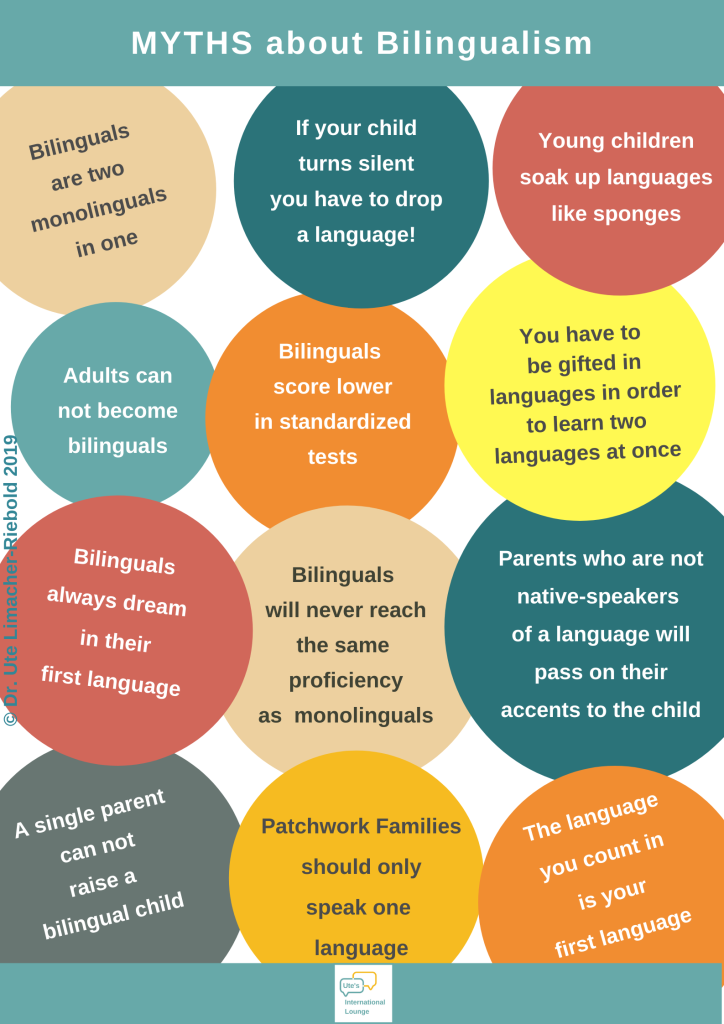
  • Bilinguals are two monolinguals in one
  • Zweisprachige sind zwei Einsprachige in einem


  • If your child turns silent you have to drop a language!
  • Wenn euer Kind nicht spricht (oder aufhört eine Sprache zu sprechen), müsst ihr eine Sprache fallen lassen!


  • Young children soak up languages like sponges
  • Kleine Kinder saugen Sprachen auf wie Schwämme


  • Adults can not become bilinguals
  • Erwachsene können nicht zweisprachig werden


  • Bilinguals score lower in standardized tests
  • Zweisprachige schneiden in standardisierten Tests schlechter ab


  • You have be gifted in languages in order to learn two languages at once
  • Man muss sprachbegabt sein, um zwei Sprachen auf einmal zu lernen


  • Bilinguals always dream in their first language
  • Zweisprachige träumen immer in ihrer ersten Sprache


  • Bilinguals will never reach the same proficiency as monolinguals
  • Zweisprachige werden nie dasselbe Sprachniveau erreichen wie Einsprachige


  • Parents who are not native-speakers of a language will pass on their accents to the child
  • Eltern, die nicht ihre Muttersprache mit ihren Kinder sprechen, geben ihre Akzente an die Kinder weiter


  • A single parent can not raise a bilingual child
  • Ein Alleinerziehender kann kein zweisprachiges Kind großziehen


  • Patchwork Families should only speak one language
  • Patchwork-Familien sollten nur eine Sprache sprechen


  • The language you count in is your first language
  • Die Sprache in der man zählt, ist die erste Sprache


Nederlands

Français

Italiano

Mythen over meertaligheid

Mythes sur le bilinguisme

Miti sul bilinguismo

Dit is een kort overzicht van enkele van de meest voorkomende mythes over twee/meertaligheid.

Voici un bref aperçu de certains des mythes les plus courants sur le bilinguisme.

Questo è un breve panorama dei miti più comuni sul bilinguismo.

Het zijn allemaal aannames gebaseerd op oude theorieën over tweetaligheid en tweetalige  (en meertalige), maar zijn allemaal als fout bewezen.

Ce sont toutes des hypothèses basées sur de vieilles théories sur le bilinguisme et les bilingues (et multi/plurilingues), mais elles se sont toutes révélées fausses,

Sono tutti presupposti basati su teorie antiquate sul bilinguismo e sui bilingui (e multilingui), che sono tutti stati smentiti.

Als je meer wilt weten over het opvoeden van tweetalige kinderen en hoe je tweetalig kunt worden en blijven als je volwassen bent, mis dan niet mijn gratis online webinars.

Si vous souhaitez en savoir plus sur comment élever des enfants bilingues et comment devenir et rester bilingue à l’âge adulte, ne manquez pas mes ateliers gratuites en ligne.

Se desideri saperne di più su come crescere figli bilingui e su come diventare e rimanere bilingui anche in età adulta, assicurati di non perderti i miei webinar gratuiti online.

  • Tweetaligen hebben een gelijke en perfecte kennis van hun talen
  • Les bilingues ont une connaissance égale et parfaite de toutes leurs langues
  • Bilingui hanno una perfetta  e pari conoscenza in tutte le loro lingue
  • Het mengen van talen is een teken van luiheid bij tweetaligen
  • Mélanger les langues est un signe de paresse chez les bilingues
  • Mischiare le lingue è un segno di pigrizia
  • OPOL is de beste benadering die ouders zouden gebruiken als ze willen dat hun kinderen tweetalig worden/opgroeien
  • OPOL est le meilleur approche que les parents devraient utiliser s’ils veulent que leurs enfants deviennent bilingues
  • OPOL è l’approccio migliore se genitori vogliono che i loro figli crescano bilingui
  • Tweetaligen zijn geboren vertalers
  • Les bilingues sont nés traducteurs
  • Bilingui sono traduttori nati
  • Tweetaligen verwerven al hun talen in hun kinderjaren
  • Les bilingues acquièrent toutes leurs langues pendant leur enfance
  • Bilingui acquisiscono tutte le loro lingue durante l’infanzia
  • Tweetaligen hebben geen accent in hun verschillende talen
  • Les bilingues n’ont pas d’accent dans leurs différentes langues
  • Bilingui non hanno accenti nelle loro diverse lingue
  • Tweetaligheid is een zeldzaam fenomeen
  • Le bilinguisme est un phénomène rare
  • Il bilinguismo è un fenomeno raro
  • Tweetaligen uiten hun emoties in hun moedertaal/ eerste taal
  • Les bilingues expriment leurs émotions dans leur langue maternelle / première langue
  • Bilingui esprimono le loro emozioni nella loro lingua materna / prima lingua
  • Alle tweetaligen zijn bicultureel
  • Tous les bilingues sont biculturels
  • Tutti i bilingui sono anche biculturali
  • Tweetalige kinderen spreken later dan eentaligen
  • Les enfants bilingues parlent plus tard que les enfants monolingues
  • Bambini bilingui parlano più tardi dei bambini monolingui
  • Tweetaligen hebben een dubbele of gespleten persoonlijkheid
  • Les bilingues ont une double personnalité
  • Bilingui hanno una doppia personalità
  • De thuistaal heeft een negatief effect op de verwerving van de schooltaal
  • La langue parlée à la maison a un effet négatif sur l’acquisition de la langue scolaire
  • La lingua madre / di famiglia ha un effetto negativo sull’acquisizione della lingua scolastica
  • Een kind met leermoeilijkheden kan niet tweetalig zijn/worden
  • Un enfant ayant des difficultés d’apprentissage ne peut pas être bilingue
  • Un bambino con difficoltà di apprendimento non può diventare/essere bilingue
  • Kinderen die tweetalig zijn opgevoed, zullen altijd hun talen mengen
  • Les enfants élevés bilingues mélangeront toujours leurs langues
  • Bambini bilingui mescoleranno sempre le loro lingue
  • Tweetaligen zijn tween eentaligen in één
  • Les bilingues sont deux monolingues en un
  • Bilingui sono due monolingui in uno
  • Als je kind niet spreekt, moet je een taal laten vallen
  • Si votre enfant ne parle pas, vous devez abandonner une langue
  • Se bambini che crescono con più lingue non parlano, bisogna abbandonare una lingua!
  • Jonge kinderen nemen talen op als sponzen
  • Les jeunes enfants s’imprègnent des langues comme des éponges
  • Bambini assorbono le lingue come spugne
  • Volwassenen kunnen niet tweetalig worden
  • Les adultes ne peuvent pas devenir bilingues
  • Adulti non possono diventare bilingui
  • Tweetaligen scoren lager op gestandardiseerde toetsen
  • Les bilingues obtiennent des notes inférieures aux tests strandardisés
  • Bilingui ottengono punteggi inferiori nei test standardizzati
  • U moet begaafd zijn in talen om twee talen tegelijk te leren
  • Il faut être doué en langues pour apprendre deux langues à la fois
  • Devi essere dotato per le lingue per imparare due lingue contemporaneamente
  • Tweetaligen dromen altijd in hun moedertaal/eerste taal
  • Les bilingues rêvent toujours dans leur langue maternelle
  • Bilingui sognano sempre nella loro prima lingua / lingua madre
  • Tweetaligen zullen nooit dezelfde taalvaardigheid bereiken als eentaligen
  • Les bilingues n’atteindront jamais les mêmes compétences que les monolingues
  • Bilingui non raggiungeranno mai la stessa competenza linguistica dei monolingui
  • Ouders die geen moedertaalspreker zijn, zullen hun accenten aan het kind doorgeven
  • Les parents qui ne sont pas natifs d’une langue, transmettront leurs accents à l’enfant
  • Genitori che non sono madrelingua trasmetteranno i loro accenti ai bambini
  • Een alleenstaande ouder kan geen tweetalig kind opvoeden
  • Un seul parent ne peut pas élever un enfant bilingue
  • Un genitore single non può crescere bambini bilingui
  • Nieuw-samengesteld gezinnen mogen maar één taal spreken
  • Les familles recomposées/mixtes ne doivent parler qu’une seule langue
  • Le famiglie miste dovrebbero parlare solo una lingua
  • De taal waarin je meetelt, is je eerste taal
  • La langue dans laquelle vous comptez est votre langue maternelle
  • La lingua in cui conti è la tua prima lingua /lingua principale (più importante/dominante)