Multilingual Societies

Multilingual societies are a testament to the vibrancy and complexity of human culture, where multiple languages coexist and evolve within a shared social framework. These societies are not simply collections of diverse linguistic groups but intricate networks of communication that weave together histories, cultural identities, and social dynamics. The interplay between various languages and dialects in multilingual communities creates rich tapestries that reflect the diverse experiences and traditions of their members.

Defining Multilingual Societies

A multilingual society is one in which multiple languages and dialects are actively used across different domains – be it in the home, at school, in the workplace, or in public life.

The coexistence of these languages is not only a matter of daily communication but also a reflection of the community’s diverse histories and the continuous interaction of various social, cultural, and political forces.

The ability to speak and navigate between multiple languages provides individuals in these societies with a deeper understanding of their own identities while promoting understanding and collaboration between different groups.

In such societies, the use of language can be fluid, shifting depending on the context, purpose, and the participants involved in the interaction. This dynamic nature of multilingualism is what makes multilingual societies particularly interesting – they are always in flux, adapting to changing social realities while preserving the unique cultural heritage of each language.

Key Characteristics of Multilingual Societies

1. Diglossia and the Role of Varieties

One of the defining characteristics of many multilingual societies is the phenomenon of diglossia, where two or more varieties of the same language coexist, each having a distinct role in society. This concept, first introduced by sociolinguist Charles Ferguson in the 1950s, is particularly evident in societies like those in the Arab world. For example, Modern Standard Arabic (MSA) is typically used in formal contexts, such as in the media, literature, and religious settings. On the other hand, local dialects, such as Egyptian Arabic, are used in everyday interactions and casual conversations. This distinction between high and low varieties of a language serves as a way to maintain both cultural and social order, allowing for functional diversity within the same linguistic system.

Diglossia exists not only in the Arabic-speaking world but also in many other multilingual societies. In Switzerland, for example, German, French, and Italian are spoken in distinct regions, and these languages are used in formal and governmental settings. Meanwhile, regional dialects play an important role in social interactions, demonstrating how different linguistic varieties have their place in different domains of life.

2. The Richness of Dialects

Another fascinating aspect of multilingual societies is the presence of dialects, which add depth and texture to the linguistic landscape. Dialects are variations of a language that are often regionally or socially distinct. While Standard Italian is the official language of Italy, it coexists with a variety of regional dialects, such as Neapolitan, Venetian, or Sicilian. These dialects are not simply colloquial forms of the language but have their own unique lexicons, grammar, and cultural histories.

The presence of dialects within a multilingual society enriches cultural identity by reflecting the historical and geographical diversity of the community. Dialects are more than just ways of speaking; they are repositories of local traditions, folklore, and ways of life. For example, a speaker of Venetian might use words and expressions that reflect the history of the region, its unique interactions with other cultures, and its role in maritime trade.

While there is often a tension between the prestige of a standard language and the value of dialects, multilingual societies offer the potential for dialects to be celebrated and preserved. In places like Italy, the revival of interest in regional dialects is part of a larger cultural movement to maintain connections with local traditions and histories, even as the country embraces globalization and modernity.

3. Code-Switching and Language Shifts

Individuals in multilingual societies often shift between languages or dialects depending on the context in which they are communicating. This code-switching is a common phenomenon in these societies, where speakers fluidly alternate between languages or varieties of language within a conversation.

India provides a rich example of code-switching in action. In many urban areas, it is not uncommon for individuals to mix Hindi and English within a single sentence, especially in workspaces or social settings. This practice – often referred to as Hinglish – reflects the intersection of India’s rich linguistic diversity with the global influence of English. In multilingual societies, code-switching serves as a pragmatic tool for communication, allowing speakers to express themselves more effectively by drawing from a wider range of linguistic resources.

Code-switching can also serve as a marker of social identity and group membership. In multilingual societies, speakers often shift between languages to signal their affiliation with a particular group, region, or social class. For instance, a person in Spain might alternate between Catalan and Spanish depending on whether they are speaking with family, friends, or colleagues. These language shifts are not just about communication but about positioning oneself within a social context, reinforcing shared experiences, and maintaining a sense of belonging.

4. The Cognitive Benefits of Multilingualism

Living in a multilingual society also has cognitive advantages. Research has shown that multilingual individuals often exhibit enhanced mental agility and adaptability. Exposure to different languages and dialects helps improve cognitive flexibility, as individuals constantly switch between different linguistic systems. This ability to switch between languages fosters better problem-solving skills, increased creativity, and an enhanced capacity for multitasking.

Moreover, multilingualism is linked to improved executive functions, such as working memory, attention control, and the ability to focus. In a multilingual society, individuals who are constantly interacting with different languages and linguistic varieties develop stronger mental skills that can be transferred to other areas of life, including academic achievement, professional success, and interpersonal relationships.

The Role of Multilingual Societies in Fostering Communication

Multilingual societies are more than just linguistic landscapes; they are spaces of cross-cultural exchange and communication. In such societies, languages serve as bridges that connect diverse communities, fostering collaboration, mutual understanding, and social cohesion. Through language, individuals from different linguistic backgrounds can share ideas, build relationships, and negotiate shared meanings.

The use of multiple languages in a society also supports the preservation of diverse traditions and histories.

Languages are not static: they evolve and adapt to the needs of the communities that use them. In multilingual societies, this linguistic dynamism allows for the ongoing revitalization of cultural practices, as speakers continue to innovate and adapt their languages to new social realities.

Challenges of Multilingual Societies

While multilingual societies offer a wealth of opportunities, they also present challenges. One of the most significant challenges is the unequal prestige of languages. In many multilingual societies, certain languages are seen as more prestigious or valuable than others. For example, in Switzerland, while German, French, and Italian enjoy official status, the Romansh language has been marginalized, despite being one of the country’s national languages. Similarly, in many post-colonial countries, the dominance of colonial languages like English or French can overshadow indigenous languages, leading to their gradual decline.

The challenge of linguistic inequality is further compounded by globalization and the increasing prominence of English as a global lingua franca. As English becomes the dominant language of business, science, and technology, languages that are considered less prestigious on a global scale are at risk of disappearing, especially in societies where language shift is already occurring.

Ensuring linguistic equity is therefore a key challenge for multilingual societies. Governments, educational systems, and social institutions must work together to promote the value of all languages, ensuring that minoritised languages are not left behind. This requires policies that actively promote the use of these languages in public life, education, and media, and that support the teaching of these languages alongside more widely spoken ones.

Conclusion: Embracing Linguistic Creativity and Resilience

Despite the challenges, multilingual societies are a living proof of linguistic creativity and resilience. When languages and dialects are celebrated and nurtured, they enrich the cultural and social fabric of a society, making it more inclusive, dynamic, and adaptable.

Multilingual societies are spaces of constant linguistic innovation, where languages evolve and adapt to the needs of the people who speak them.

As we look towards the future, it is important to remember that multilingualism is not a challenge to be overcome but a resource to be cherished. In a world that is increasingly interconnected, multilingual societies offer valuable lessons in how to live together in linguistic harmony while celebrating the diversity that makes us unique.


References

  • Fishman, J. A. (1967). Bilingualism with and Without Diglossia; Diglossia with and Without Bilingualism. Journal of Social Issues, 23(2), 29-38.
  • Edwards, J. (2012). Multilingualism: Understanding Linguistic Diversity. Continuum.
  • Aronin, L., & Singleton, D. (2012). Multilingualism. Oxford University Press.

Foreign Language Education in Dutch Schools: What Multilingual Families Should Know

When relocating to the Netherlands, navigating the education system can be challenging, especially for multilingual families. A key aspect often overlooked is how foreign languages are integrated into the curriculum, supporting children in maintaining and developing their multilingual skills.

Primary Education: Early Foreign Language Learning (vvto)

Dutch primary schools are increasingly offering Early Foreign Language Teaching (Vroeg Vreemdetalenonderwijs – vvto), focusing on English, German, or French. English is a mandatory subject starting from grade 7, but many schools introduce it earlier, from grade 5 or even lower. According to Dutch law, schools can allocate up to 15% of their teaching time to a foreign language.

The benefits of early multilingual learning are well-established:

  • Young children absorb languages more easily through play.
  • Pronunciation and new sounds are more naturally adopted at a young age.
  • Cognitive skills are enhanced through multilingual learning.
  • Multilingualism fosters cultural tolerance and acceptance.

However, the success of vvto largely depends on the teacher’s proficiency in the foreign language. Schools must ensure a structured and continuous learning approach, often guided by the European Framework of Reference for Languages (ECFR). Several schools in the Netherlands offer vvto. The highest concentration can be found in the Randstad.

Secondary Education: Expanding Language Choices

In secondary education, foreign language learning becomes more diversified. Students must study one or two additional languages alongside English.

For havo and vwo students (college preparatory tracks), both French and German are mandatory. In some cases, these can be replaced by languages like Spanish, Russian, Italian, Arabic, Turkish, or Chinese (for vwo only). At schools with ‘Gymnasium’, Latin and Greek are also required.

For vmbo students (vocational track), one foreign language, usually French or German, is mandatory, with similar alternatives available.

Frisian as a Compulsory Language

In Friesland, Frisian is a mandatory subject in junior secondary education, though some exemptions exist depending on the region.

Upper Secondary Education: Language Specialization

At the upper levels of havo and vwo, English is compulsory for final exams, with the option to choose additional modern foreign languages, depending on the school’s offerings. Students in the culture and society track of havo must take a second foreign language.

Bilingual Education (TTO)

For families seeking deeper integration of foreign languages, bilingual education (Tweetalig Onderwijs – TTO) is available. TTO involves partial instruction in a foreign language, typically English. In the lower grades, at least 50% of the curriculum is taught in the foreign language for havo and vwo, and 30% for vmbo. However, final exams are conducted in Dutch.

TTO schools also offer international activities like language trips and exchanges, and students receive a certificate attesting to their extra language skills upon graduation.

The 2 most important characteristics of bilingual education are:

  • The teachers have had special tto training
  • Teaching in a foreign language must not be at the expense of Dutch language development

“It is important to note that bilingual education in Dutch schools focuses on children with Dutch as native language who want to learn another (often English) language.” 


Explore in-depth: The full, detailed article on Dutch for Children

If you’d like to explore this topic in more depth, you can read the full, detailed article on our website here. You can also read this article in Dutch, and find more information on the Dutch education system and how it supports multilingual families.


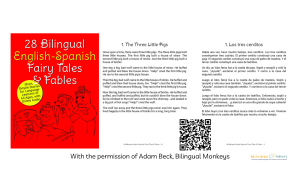
How to Read Bilingual Books: for Teenagers and Adults

How to Read Bilingual Books: for Teenagers and Adults

Bilingual books offer a unique opportunity for language learners, both teenagers and adults, to enhance their language skills, gain deeper cultural insights, and maintain their heritage language while acquiring a new one.

However, reading bilingual books effectively requires more than just skimming through the text. It involves strategic approaches that maximize language acquisition and comprehension. With our youngest, early simultaneous multilinguals, we want to follow other strategies than with older children, and focus on one language per setting; I explain this more in detail in my post How to Read Bilingual Books with Babies and Toddlers .

Teenagers and adults can use bilingual books to learn an additional language independently:

Understand the Structure of Bilingual Books

Bilingual books typically present the text in two languages side by side, either on the same page or on facing pages. This format allows readers to compare the languages directly. For teenagers and adults, this can be particularly helpful as they can easily reference the translation when encountering unfamiliar vocabulary or complex structures. Understanding this format is essential as it helps in developing a routine that enhances comprehension and retention.

Tip: Start by reading a paragraph or a section in your stronger language to grasp the context. Then, read the same section in your target language to notice differences in expression, vocabulary, and syntax.


Engage with the Text Actively

Active reading is crucial when working with bilingual books. This involves not just reading the text but also engaging with it through annotation, summarization, and reflection. For instance, after reading a passage, try summarizing it in the target language. This reinforces comprehension and helps in internalizing new vocabulary and grammar structures.

Tip: Use a notebook to jot down unfamiliar words or phrases and their translations. This practice aids memory retention and provides a quick reference for future reading sessions.

Leverage Cultural Contexts

Bilingual books often include cultural references that are unique to each language. For example, a word or phrase in one language might carry cultural connotations that do not directly translate into another language. Paying attention to these nuances not only improves language proficiency but also deepens cultural understanding.

Tip: When you encounter a culturally specific term or concept, take the time to research its background. Understanding the cultural context enhances your appreciation of the text and provides a richer learning experience.

Set Clear Goals

Whether you are reading for fluency, vocabulary acquisition, or cultural understanding, setting clear goals can make your reading sessions more productive. For teenagers and adults, this could mean focusing on particular aspects of language, such as idiomatic expressions or specific grammar structures.

Tip: Before starting a new bilingual book, define what you want to achieve. For instance, you might decide to focus on mastering verb tenses or expanding your vocabulary related to a particular theme.

Use Complementary Resources

Bilingual books are most effective when supplemented with other language-learning resources. This could include dictionaries, language apps, or even discussion groups where you can practice and discuss what you’ve read. For teenagers and adults, engaging with language communities can provide additional support and motivation.

Tip: Consider joining a book club or online forum focused on bilingual books. Discussing the text with others can provide new insights and help you see the language from different perspectives.

Conclusion

Bilingual books are a powerful tool for independent language learning, especially for teenagers and adults who are skilled readers and already have a foundational understanding of both languages.

By understanding the structure of these books, engaging actively with the text, leveraging cultural contexts, setting clear goals, and using complementary resources, readers can significantly enhance their language proficiency and cultural awareness.

References:

  • Baker, C. (2011). Foundations of Bilingual Education and Bilingualism. Multilingual Matters.
  • Cummins, J. (2000). Language, Power, and Pedagogy: Bilingual Children in the Crossfire. Multilingual Matters.
  • García, O. (2009). Bilingual Education in the 21st Century: A Global Perspective. Wiley-Blackwell.
  • Grosjean, F. (2010). Bilingual: Life and Reality. Harvard University Press.

This approach, integrating strategic reading techniques with cultural and linguistic insights, supports effective bi- and multilingualism and enriches the reader’s language learning journey.

Further readings:

How to Read Bilingual Books with Babies and Toddlers

How to Read Bilingual Books with Emergent Readers: A Guide for Simultaneous and Successive Bilinguals

I invite you to watch our video Reading Bilingual Books, or Not Reading Bilingual Books:

Children are NOT translators or interpreters!

Children are NOT translators or interpreters!

The Complex Role of Children: Why They Aren’t Translators or Interpreters for Immigrant Parents

In many immigrant families, children often find themselves in the position of translators or interpreters for their parents, bridging the gap between their parents’ native language and the language of their new country.
While this may seem like a practical solution to communication barriers, the role of children as translators and interpreters can have profound implications on their development, family dynamics, and emotional well-being.

Children are not professional translators or interpreters, and expecting them to fulfill this role can place undue pressure and responsibility on their shoulders.

Here are several reasons why children should not be relied upon as translators for their immigrant parents:

Developmental Limitations:

  • Children may not have fully developed language skills, especially in complex or technical matters. Translating or interpreting nuanced concepts accurately requires a deep understanding of both languages, which children may not possess. 

Emotional Burden:

  • Acting as translators or interpreters can place immense emotional strain on children, who may feel burdened by the responsibility of conveying sensitive or difficult information between their parents and the outside world. They may also feel the weight of responsibility for accurately transmitting important messages.

Role Reversal:

  • When children assume the role of translators or interperters, traditional parent-child dynamics can become blurred. Children may feel a sense of role reversal, where they are compelled to take on adult responsibilities, potentially undermining their sense of identity and autonomy.

Educational Interference:

  • Serving as translators or interpreters can interfere with children’s education and personal development. Time spent translating detracts from opportunities for children to focus on their academic studies, and age appropriate activities and experiences, extracurricular activities, and social interactions critical for their growth and well-being.

Confidentiality and Privacy:

  • Children may inadvertently become privy to private or sensitive information shared between their parents and third parties during translation sessions, compromising their sense of privacy and security within the family unit.

Inaccuracy and Miscommunication:

  • Children may lack the language proficiency and cultural understanding necessary to accurately convey the intended message. Misinterpretations or mistranslations can lead to misunderstandings, conflicts, and potentially harmful consequences.

Impacts on Family Dynamics:

  • Relying on children as translators or interpreters can disrupt the natural flow of communication within the family. It may discourage parents from actively seeking language support or accessing professional translation services, ultimately hindering their integration and autonomy.

In conclusion, while children may possess language skills that make them convenient intermediaries for their immigrant parents, it is essential to recognize the limitations and potential consequences of this role. 

Instead of burdening children with translation and interpretation duties, immigrant families should prioritize accessing professional translation services, language classes, and community resources to facilitate effective communication and support the holistic development of their children.


By doing so, families can nurture healthy family dynamics, preserve children’s emotional well-being, and foster a supportive environment conducive to cultural integration and mutual understanding.


This campaign in the Netherlands in 2021 sat one step towards the child protection with regards to their role in the immigration and integration process of families.

  • Are children translating for their immigrant parents in the country you are living?
  • What is your experience and/or opinion about this?

I invite you to also read the following articles about this topic:
How Translating for My Parents Affected Me
Teenage Translators…
Immigrant children as translators

And please watch this video:

Musings about Multilinguals: Early Simultaneous Multilinguals across the Lifespan


Whenever I get asked whether I am a simultaneous or a subsequent or successive bilingual, I am tempted to say “both”, or answer with “I’m an early simultaneous multilingual and am still adding other languages to my repertoire”. I know that I am not the only one, as most of the families I work with are in exactly the same situation. Once we start with acquiring and learning languages, we don’t stop.

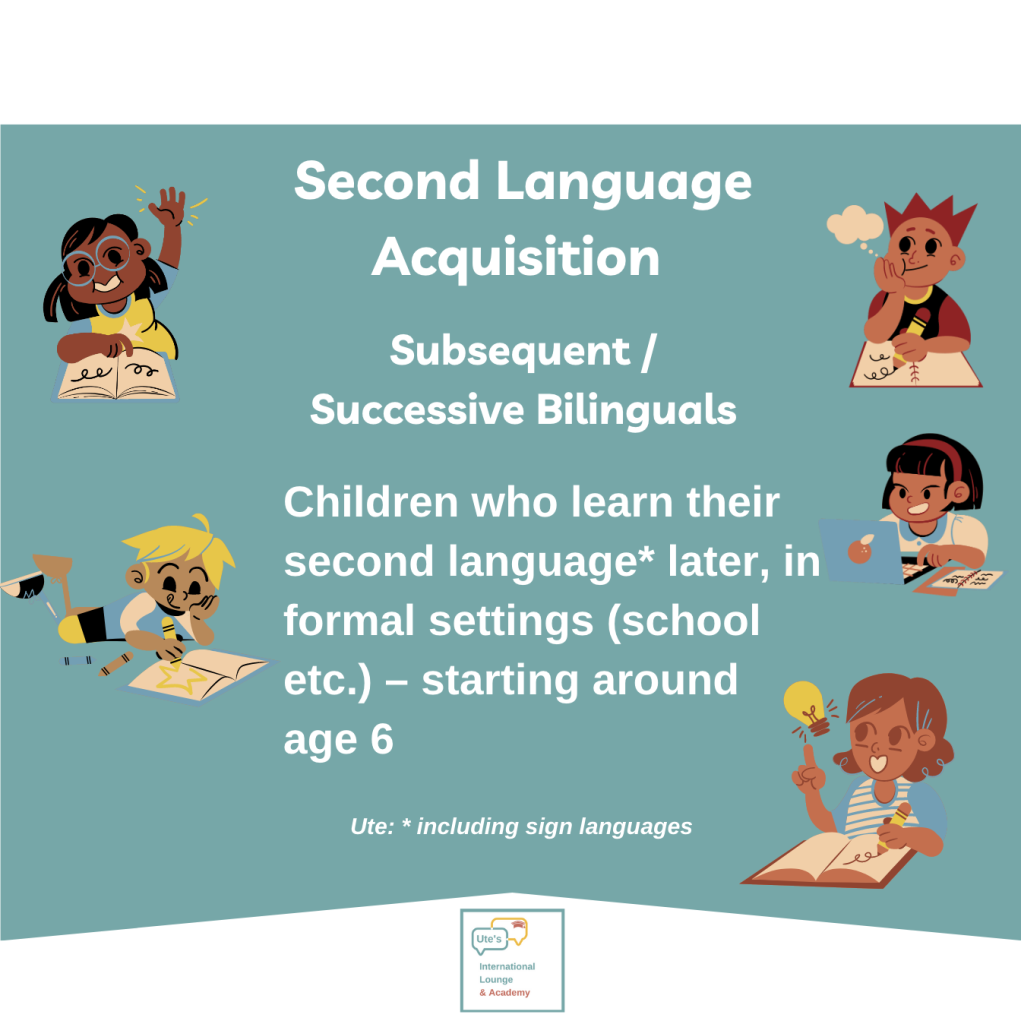
When trying to define the similarities or differences in language acquisition and learning in bilinguals or multilinguals, in linguistics we distinguish simultaneous from subsequent or successive bilingualism.

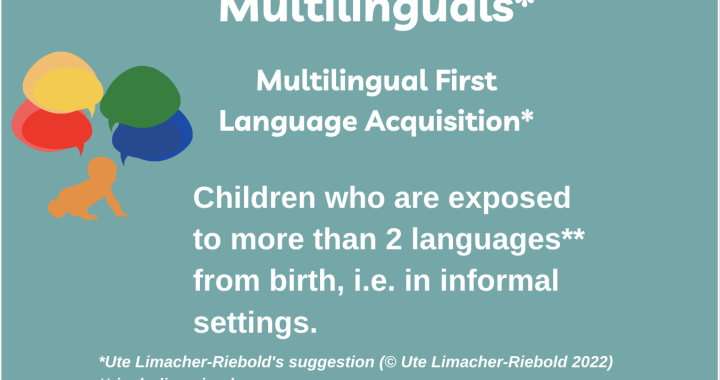
Simultaneous Bilingualism, or what Annick De Houwer defines as Bilingual First Language Acquisition is when children are exposed to two languages before the age of three, and they become verbal, or use, both languages in a comprehensive way. Some label these languages as La and L? to indicate the synchronicity with which these languages are acquired. An example would be, when one parent speaks language blue with the child and the other one language red.


There are also young children who are exposed to one language since birth and to the first additional language between age 3 and 6, so, before formal instruction. Annick De Houwer defines the way they acquire languages as Early Second Language Acquisition.


For older children, who grow up with one language and the additional language is added in formal settings, once they start school around age 6, we talk about Second Language Acquisition and Subsequent or Successive Bilinguals.


These categorizations are important for researchers to make sure to compare children who were exposed to similar situations when studying the way children use their multiple languages. Children who use several languages from very early on approach additional languages in a different way. They have a broader variety of language skills to build on than those who were exposed to one language only. 


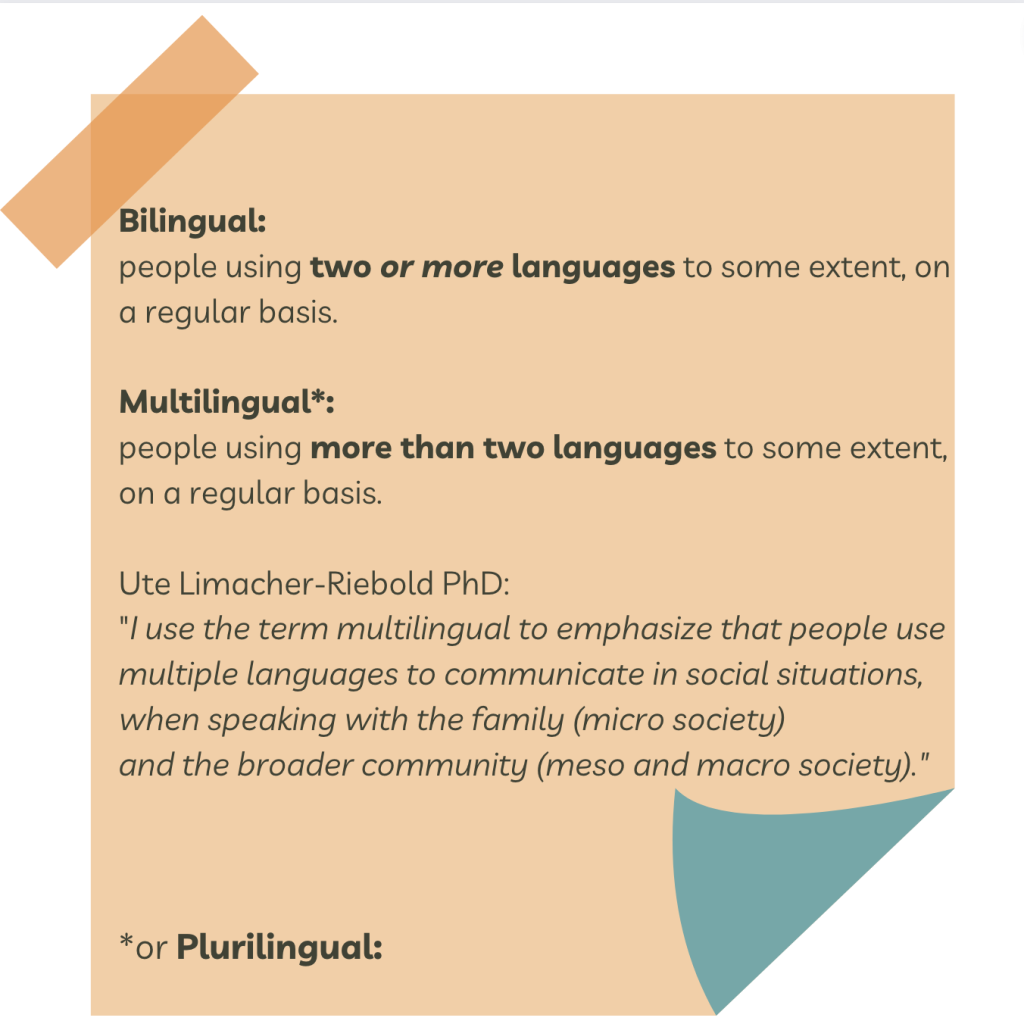
On a little side note: the term bilingual can be used for people using two or more languages to some extent, on a regular basis. I personally prefer using the term multilingual for people who use more than two languages to some extent and on a regular basis, because I emphasize that they use them to communicate in social situations, when speaking with the family (micro society) and the broader community (meso and macro society).


As a multilingual, I miss an equivalent for multilinguals like me, my children and my clients, who start with 2 or more languages very early on and add new ones across the lifespan. They could be simultaneous multilinguals as multilingual first language acquisition takes place (to transform or adapt Annick De Houwer’s term to the multilingual context). So, when considering the children, they would be Early Simultaneous Multilinguals.

You may wonder why we would need this term. I have seen how parents of early simultaneous multilinguals were asked to indicate their first two languages, their most dominant language (singular!) when applying for schools. Most of them had two or more languages that were dominant in their life and they used on a regular basis. By reducing the options to two languages for 3 to 6 year old children who start preschool and school, in my opinion and experience, we limit the possibilities of these children. When teachers do not know or do not acknowledge the full potential, the repertoire these children already have when they enter the school system, we intrinsically deprive them from improving their language skills and expect them to narrow their focus on the school language only. Furthermore, teachers need to know how multilingual children learn additional languages, how they connect them to those they already know and how they manage to transfer the skills from one language to the other!

Multilinguals who start school, have a great advantage when adding a new language as they can build on a broader foundation – think about the vocabulary in each language, the great variety of sounds they can articulate, the many ways they use intonations across their languages, and what they figured out about the patterns of the respective grammar (how words are formed (ex. how to form a plural, adjust the verb to the subject etc.) how sentences are formed etc.!


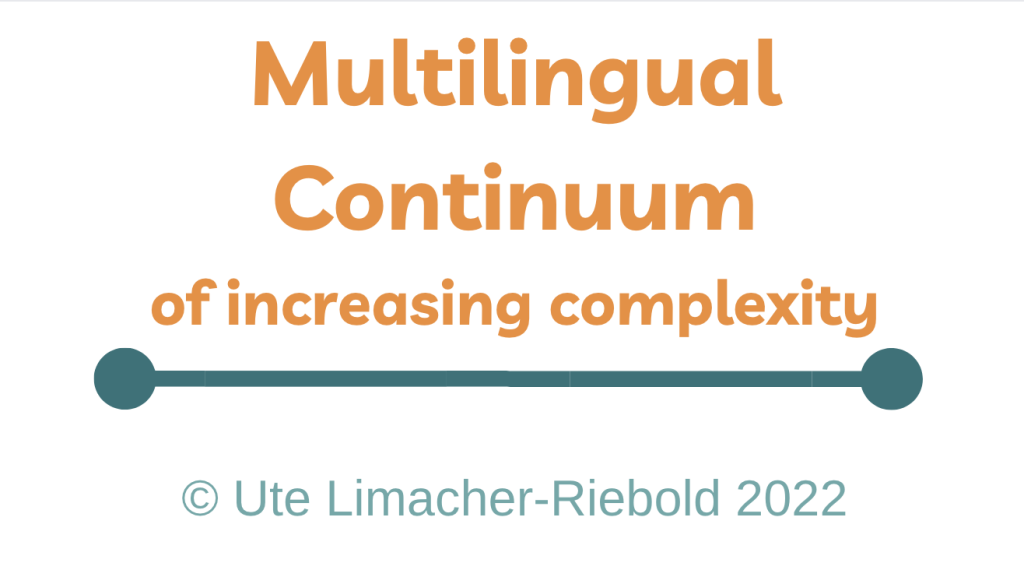
I like to consider being or becoming multilinguals – and actually also staying (!) multilinguals across the lifespan – like a multilingual continuum of increasing complexity.


In fact, multilinguals for whom using multiple languages is the norm, and who grow up in an environment that supports their languages in a healthy and nurturing way, will improve their language skills and add more languages to their repertoire. 

When trying to use similar terms for older multilinguals, using the term of “subsequent” or “successive” multilinguals doesn’t seem adequate exactly for the reasons just mentioned: we benefit from a broader foundation of languages but also because our way of learning, approaching new, additional languages is different from those who were exposed to only one language earlier. It is more natural, spontaneous, and similar to how we acquired the first languages. We intrinsically compare the new language to the ones we know, thanks to our metalinguistic awareness that we develop very early on, we compare possible patterns and proceed by trial and error. The most important reason for multilinguals to keep nurturing their languages across all phases of life is that they can benefit from the cognitive advantage, when we keep on using and learning them. As languages changes constantly, we can never finish learning a language – I personally find the German term auslernen more accurate.


As I am suggesting some new terms to use with regards to multilinguals, I am curious to know what you think. I am happy to continue the conversation in the comments.
If you are multilingual yourself: are you currently learning a new language, or what are you doing to nurture your languages throughout the years? I’d love to know!


De Houwer, Annick, 2009, Bilingual First Language Acquisition, Multilingual Matters.

You can watch my video about this topic here:


Language use in multilingual families during lockdown

When we all went into our first lockdown due to COVID19 last year, I published a short video for multilingual families who do NOT speak the community language at home, about how to keep up with the school or community languages during lockdown. Especially for very young children who maybe just started daycare, spending more time at home with parents and being more exposed to the home languages, this lockdown maybe caused a “shift back” to the language use they had before attending daycare.  Parents asked me how to support their youngest ones to keep up with their language development in the daycare/community language so that they wouldn’t “lack behind” once daycares and preschools would open again.

In my video I shared the following tips for parents:

  • how to make sure that our children keep up with the home languages and the daycare/school languages
  • how to signalize preschool children when you switch from one language to the other (1:10?-)
  • how to make this with school aged children (2:38?-)
  • how to help our school aged children improve the vocabulary they are learning in the school language (3:40?-)
  • how to collaborate with the school/teachers to make the best out of this situation for your children (4:40?-)

***

A few weeks later, Prof. Ludovica Serratrice from the University of Reading, launched a survey for multilingual families about the use of home languages during the first lockdown in the UK and Ireland, together with colleagues from the Centre for Literacy and Multilingualism at the University of Reading, colleagues from UCL, Oxford, Cambridge, Mother Tongues and We Live Languages.

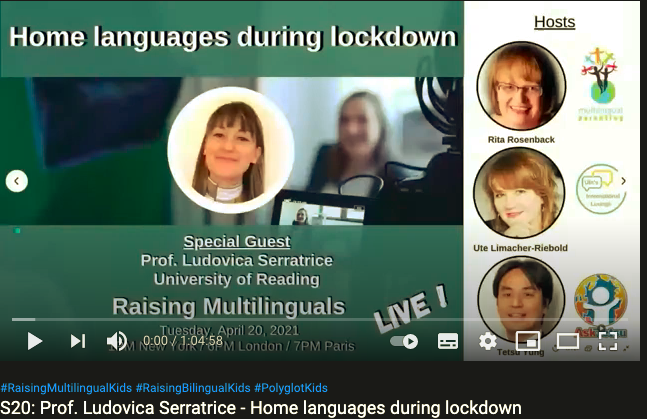
We interviewed Prof. Ludovica Serratrice for our broadcast Raising Multilinguals LIVE! on the 20th April 2021 and I am very thankful that she allowed me to share some insights about her survey. 

In this survey they asked families:

– How they use their languages during the COVID19 pandemic?

– What factors* would predict changes in language practices – such as children’s age, children’s existing use of the language use? (* they looked at other predictors including parental education and self-rated proficiency too)

– About the amount of language and literacy practices in English and home languages.

– Whether there had been an increase in children’s opportunity to hear and use the language more during lockdown and to read and write more. 

– Whether parents were worried about the effects of lockdown on English.

For the purposes of this project we included families with at least one child between the ages of 0 and 18 who are typically in school or childcare, and who are living together during the lockdown period and the social distancing measures during the COVID19 pandemic.

[As for the definition of who would qualify as multilingual family:]

A family is multilingual if one or more languages other than English are used among family members either on their own or together with English (Prof. Ludovica Serratrice)

They collected answers from 1000 parents, [with around 750ish families presenting valuable data], with 95 different languages whose use of languages in the family were like follows (all data is from Ludovica Serratrice):

Parents:

    • In 46% of families the parents speak different languages, and in half of the cases it’s because one parent is a monolingual English speaker
    • In 36% of families one of the parents speaks English at home.
    • In 36% of families both parents speak English at home.
    • In 28% of families neither parent speaks English at home. 

Children:

    • 35% only-child families
    • Only 6% of children speak only the other language to their siblings
    • 46% speak English and other language(s)
    • 48% speak only English to their siblings

Demographics of the children: 30% were primary only, 20% preschool only, 19% primary and secondary and 16% secondary only children.

“There was A LOT of variation, more so for the non-English languages – as you would expect”, and “in absolute terms still more activities in English”, Ludovica Serratrice pointed out in the interview and the presentation  with MultiLing on the 22 April 2021 (see the video here below).

  • For literacy activities in the home language, children read more if they already used that language with the home language-speaking parent.
  • When we asked about the increased opportunities to hear and speak the home language more, we found that this was particularly true for pre-schoolers (age effect), and for all children when they were already using the other language with the parent (language match effect).
  • For reading (primary and secondary only) we found no differences. The amount was overall quite low anyway and no effect of language match. So, while there was a relationship between amount of literacy activities and language match in absolute terms, there was not a relationship in terms of change. (Ludovica Serratrice)

I personally would have liked to know what effect the lockdown had on the home languages in  multilingual families where neither parent speaks English at home (mL@h). Although the effect on preschool children was what we all expected, what was the effect on school aged children? And did siblings who were used to speak the community language to each shift to the home language due to lockdown and the reduced opportunity to speak with peers on a regular basis?

In the UK, many children didn’t have school for a longer period of time – unlike here in the Netherlands, where several schools provided online learning opportunities very quickly. Assuming that they had learned to read and write before lockdown, were children in the UK and Ireland more prone (or willing) to read, maybe write in their home languages? And what about children who were just starting to read and write in the school language and who were now exposed to home languages only: would their parents take the opportunity to teach them to read and write in the home languages during lockdown? What additional support (from extended family, friends etc. via zoom/skype/facetime) did these families have during (and after!) lockdown, and how did this influence their children’s language development? What resources were particularly helpful for multilingual families not only during lockdown, but during this whole last year? 

Ludovica Serratrice shared that “lockdown gave parents time and breathing space from the everyday routine, the commute, the many extra curricular activities (e.g. “because lockdown was very strict, the only pleasure that he really was getting were new books through the post”). For some families this was the opportunity to see a “home language explosion” in speaking and for some in reading. Time to read, time to learn to read together. Because online schooling was not that strict during the first lockdown [in the UK and Ireland; Ute] there was just more time in general to dedicate to non-school activities that are typically associated with English.”

It was, obviously, “not possible to measure the children’s language skills directly”, and “by the time we conducted the survey and the interviews not all of them had been back at school. However, parents in the survey were not worried about their children’s English, and children who took part in the interviews had no anxieties about their English either.” – I wonder if a similar survey among internationals in other countries would have had similar outcomes. Especially families who speak multiple languages at home and the community or school language is only spoken sporadically.

For the other languages, patterns didn’t seem to have changed dramatically, especially for speaking and hearing, “but from the interview data we saw that for some children that were already reading in the other language, lockdown was an opportunity to read more (one child read all of the Harry Potter books in German for example).” 

This confirms my observations in my own children and my client’s children (all between 1,5 and 18 years old) during and after the first lockdown in the Netherlands, France, Belgium and Italy: they were all more prone to read, find alternative ways to being online (as I guess they all were experiencing some kind of online fatigue already), which had a positive effect on their home language skills – at least this was the subjective observation from their parents. 

What about longer lasting effects caused by lockdown on the language development of children in the different age groups?

“The most likely longer lasting changes are with younger children. In cases in which lockdown offered the opportunity for a qualitative change in the pattern of language interaction, e.g. starting to use the other language or using it more, or learning to read, then it could be that if this qualitative shift is preserved, quantitative changes will affect children’s quantity and, potentially, quality of input (e.g. access to literacy, making new friends who are also speakers of their other language) with important consequences for the development of vocabulary and other structural aspects of language.”

What seems like a prolonged holiday effect, might fade though, as “the pull of the societal language is very strong”, and not only for children in secondary school! “Whether this effect will stand the test of time is an empirical question.”

As the pandemic is still not over and many of us have experienced a second and third lockdown, it would be interesting to see how the families are doing now, a year later. After a year of on-and-off from school, where many uncertainties have affected us all to different extent, I wonder how multilingual families who do not speak the school language at home – except for discussing school topics – managed to foster their home languages AND the school languages. Especially because extra curricular language lessons in the home language were not an option for many of us, children had even less input and in some cases were less motivated to continue with any kind of tuition. Furthermore, most children didn’t get to experience their annual full immersion into their home language due to travel restrictions…

I would also be very curious to know how many parents who speak the dominant language (societal language or the language of their children’s education) took the chance to support the minoritized* language during lockdown, knowing that the input in this language would certainly decrease. I know that some parents took this opportunity to participate in activities their partner did with their children in the minoritized language and proudly shared that they improved their language skills thanks to this lockdown situation. – What about parents from the survey who speak English at home? Did they take the opportunity to learn their partner’s language, just a little bit?

While we’re still at home (or at home again!), we can still create meaningful contexts for the use of the home language and make the best out of this situation!

I’d like to end on this  final quote from a parent, Ludovica Serratrice shared with me:
“Lockdown really showed the power of necessity and opportunity to me, that you keep reading on multilingualism, necessity and opportunity. And I know I’ve been like one thousand percent consistent in me speaking Italian to her since birth, but it didn’t matter until she really was home.”

– All quotations in the text are from Prof. Ludovica Serratrice. 

* I prefer using the term minoritized language instead of minority language, as it emphasizes the active part of the society to make a language “less important than…”, and because every language is dominant somewhere (no matter if on a micro, meso or macro level).

*****

– What is your experience during lockdown: did you observe a language shift in the use of languages in your family?

– How did your school support your children with the school language, and what support did you get for your home languages?

– What resources are / were particularly useful for you / your children to foster your home languages?

I’d love to know. Please let me know in the comments.

Further readings: 

Infant Communication Baby Sign Language with Multilingual Children

When I first heard about baby sign language, my children were already verbal. Here in Europe it seems not as common to teach babies and infants signs if they are not deaf growing up with deaf parents. I have since read about this and met families who have taught their babies how to sign words in order to communicate before they become verbal.
I was particularly interested in how to use baby sign language to bridge between languages in multilingual families as I believe that it is a great tool to facilitate communication between all family members: the baby, the parents who might speak two different languages and not be fluent in the partner’s language (yet), and siblings, not to mention extended family and caregivers!

I met Roya Caviglia who offers Infant Communication Baby Sign Language courses online and in the Delft area (Netherlands)  and interviewed her on my youtube channel about this topic.

If you have ever wondered how baby sign language can help you communicate earlier with your baby/infant, before they even become verbal, and how it can bridge communication in all your home languages, find out in the interview with Roya.

These are some of the questions we discuss about:
4:23 How does the Infant Communication Baby Sign Language (ICBSL) differ from the official Sign Languages?
8:42 When can we start with learning the ICBSL, and when can we expect our children to respond by using the signs?
12:52 And if my child is already 2,5 years old and verbal: is it too late to start with ICBL, will it hinder my child becoming more verbal?
18:42 Is it not too much for multilingual families to add ICBSL to their other home languages?
25:05 How ICBSL can help daycare and preschool teachers communicate with children who are not verbal (yet) in the required language.
27:57 What happens when my child gets older? How will this ICBSL evolve?

  • Do you use baby sign language with your baby or infant?
  • What is your experience with it?
  • What did you find particularly helpful, and what would you advise new parents about baby sign language?
  • Please let me/ us know in the comments here below!

About Roya:
Roya Caviglia has spent many years teaching people how to improve their communication in English while moving from one European country to another. Now she runs a language school in South Holland looking after international professionals and their families. One day she had kids and started out on the crazy wonderful journey of parenting. It was a shock to find out how challenging and physically demanding being a parent can be. But she also made the wonderful discovery of how much babies have to tell us. Now she is passionate about helping families bond through clear communication before their babies can even speak.

Find out more about Roya’s Infant Communication Baby Sign Language course and the video with babies signing


Further readings on this topic: 
Enhancing early communication through infant sign training “Sign training might facilitate rather than hinder the development of vocal language”! 


When parents should NOT speak their L1 with their children

Against the common advice, backed up by countless research that states that parents should speak their L1 – first language – with their children, it is time to explain why this is not always the best solution for multilingual parents. I think there is an important misunderstanding leading to many parents doubting about the decisions they are making. But let’s start with explaining what is meant by L1 and how this differs for multilinguals.

L1 is, chronologically speaking, the language we acquired/learned first. It is the language some still call mother-tongue, and which can also be our native language – if our level of fluency is (nearly)native.

For multilinguals, their first language or L1 is not always the one they feel most comfortable speaking, reading, writing in. Not everyone who grows up with multiple languages will obtain and maintain the highest level of fluency in their L1. 

This is very obvious in the case of those who were adopted at a very early age. Adoptees can loose their L1 if it is not supported and fostered by their new parents. Depending on their age when they were adopted, and on their language development stage in their L1 at that time, they might only have a receptive (some call it “passive”) knowledge of the language, i.e. they might have understood it, but weren’t verbal yet, or were about to speak.

Fact is that the level of fluency in L1 for those who grew up with more than one home language, and live and work in another language, can fluctuate, and this can also happen to simultaneous and sequential (and a combination of both, considering the amount of languages they have learned) bi-/multilinguals too.

Let’s make an example*:

Laura who grew up with Italian and German in Germany, learns French at age 6, English at age 11 and later Spanish, Portuguese and Greek. After studying in Italy, she moved to Spain where she works in a Spanish company. Her partner, Davide, is Portuguese and British, and they speak Italian, Spanish, English and Portuguese together. They then move to the Netherlands, where they both speak English every day at work and in the international community. Of course, they learn Dutch too. – Do you find this unusual? Well, this scenario is not that uncommon! I work with many internationals who have such a scenario; they grew up with two or more languages and added several more during their life, studies and work in different countries. 

I mentioned that language fluency and dominance changes over time. In fact, we tend to invest more time and energy in the language we need for social contacts, school and work, especially when this language is not our L1 (chronologically speaking). If we grew up with multiple languages we may prefer another language than L1 to speak with our partner and colleagues. 

In the example above, Laura has experienced three language shifts.

  1. German was her most dominant language while living in Germany as a child
  2. Italian was her most dominant language when she studied in Italy
  3. Spanish was the language she was using on a daily basis at work and in the community for several years
  4. Now that she lives in the Netherlands, English is the language she speaks, reads and writes on a daily basis

These language shifts have an important impact on multilinguals and their families.

The most common question I get asked from multilingual parents is: what language should I speak with my child? 

Let’s go back to Laura: while living in the Netherlands, she gives birth to a son. Laura and Davide are not sure what languages to speak with their son: should Laura speak German (her mothers’ language) or Italian (her fathers’ language) with him; and Davide, should he speak Portuguese (his father’s language) or English (his mothers’ language) with their son? And what about Spanish? Spanish is the language Laura and Davide worked in for a long time and it is the language that is most spontaneous for both and they are very competent in it…

Considering the most common interpretation of research on this matter, Laura and Davide should both speak their L1 or native language with their son.

For Laura this would be German and/or Italian, for Davide Portuguese and/or English, as these were the languages both parents acquired during their first years of life and these are the languages of their extended families.

  • But are these the languages Laura and Davide feel more comfortable with?
  • Are these the languages they are, at that moment of their life, the most competent or proficient in?

Laura told me that Spanish is the language she likes the most. It’s the language she spontaneously spoke with her son when he was born. Should she switch to German and Italian though? And Davide? He hesitates between Spanish and Portuguese.

What needs to be very clear not only when choosing the language to speak with our children, but also when filling in application forms in daycares and schools: make sure to clearly state what language is the most dominant for you, as a person/parent, at this moment and phase of your life, and what language you are most competent and confident in: this would be your L1.

***

Research says that one should speak the native language to children also because of the emotional bond that is apparently stronger in our native language than in any other language.

This is where we need to further investigate the research on the matter. The research in question was conducted with people using foreign languages in a given situation and compared with the way native speakers would react.

But what was their level of fluency in those languages, how confident were they when they used that “other” language? Was this other language a language they just learned as additional language to one or more other languages they knew before?  What was the emotional and cultural bond they had with those languages? Were they using the “other” language with their partners too? – There are so many parameters that were not explained and taken into consideration in that study (or at least it was not shared overtly), who could have given another outcome than the one we now consider important when choosing the language to speak with our children. – Please don’t get me wrong: we should choose the language we feel most comfortable expressing our feelings in; but this is not necessarily the chronologically speaking “first language” or L1, “native language” in the common use of the term!

Couples who communicate in their 3rd or 4th language with each other and who made that language their emotional language, following this study, could not have a strong emotional bond with their partner because they speak in another language than their native language or L1.

Again, we have to define L1 as the language we are most confident and competent in, the one we have gained a nearly-native fluency; this can be also another language than the language we acquired first, chronologically speaking! 

Therefore I suggest multilingual parents who attained a high level of fluency in a language and feel comfortable expressing their feelings and emotions in it, and can be spontaneous in it, maybe even know nursery rhymes and lullabies in that language – or are willing to learn them! – to consider that as the language to speak with their children. As the language we speak with our children from day one is the one that we build an emotional bond with them, it is extremely important to think about possible scenarios in the future: will we always (!) feel comfortable to speak that language as the primary language with our children? 

But what if we speak one language with our partner and would like to speak another one with our children?
That is a very common situation in multilingual couples. It is the base for the OPOL (One Person One Language) and the 2P2L (Two Persons Two Languages) strategies.

When I work with multilingual couples who wonder what language to speak with their children, I start with assessing their language situation, the past, the present and the foreseeable future, and I ask them a (long!) series of questions. We usually have several sessions over a longer period of time to make sure that they take long term oriented decisions. Furthermore, they get to experience different strategies and asses themselves before taking a decision. 

Here are some standard questions I start with:

  • What is the language you would choose to speak spontaneously with your child?
  • What makes you doubt that this language might NOT be the right one to choose?
  • What language would your child need to be speaking with your parents & extended family?
  • Is it possible that your parents & extended family would speak another language with your child?  Which one?
  • How comfortable do you feel (from 0 to 10) speaking this language with your child? 
  • Do you know some nursery rhymes etc. in that language(s)?

Most multilingual parents want their children to grow up with as many languages as possible. Their first priority is for their children to “have more chances later in life”, and opt for more prestigious languages like English, French, Spanish, German etc. if these are in their repertoire, especially when one of the parents’ languages is a minoritized one. For example, instead of speaking Farsi with their children, they would opt for English, instead of Swiss German, they would prefer German etc. 

 Some further questions I ask are:

  • What languages they speak, read and write on a regular – preferably daily (!) – basis
  • If there will be any changes in their language use in the next 5 years
  • What short and longterm goals look like with regards of living in that country, working for that company, using that language on a daily basis etc.
  • What their short and longterm goals are with regards to their children’s language fluency (understanding, speaking, reading, writing) in all their languages

My main focus is on what languages parents are more comfortable speaking with their children as it is preferably** the language they will be sharing with them throughout their whole life.

If parents can not or do not want to reactivate a language they have not spoken on a daily basis for a long time – and this can be their first language chronologically speaking – it might be less dominant than their L2/3/4 etc. and, as a consequence, they won’t feel comfortable using it on a daily basis with their child. Asking them to speak it with their children would feel like a burden and they would need to put extra effort into it. The attempt to re-animate a “dormant” language can be successful, but only if there is a real need for the parent to do so. If for example the family is living or is going to move to a country where this language is the community language, or if the parent works in that language.
The time and effort the parent puts into re-activating a language can be too overwhelming if the situation and context are not supportive, and eventually lead to frustration, self-doubt and guilt and possibly failure.

****

When we become parents we tend to question which language would be most important for our children to learn.

We think about the importance for our children to understand their grand parents and our extended family, to succeed in the society and community we live in, and later academically. – Generally speaking, if a language becomes less important in our life and it would not be a spontaneous and natural choice to use that language with our children, we should consider alternative solutions.

Please don’t get me wrong: I am a convinced and avid defender of heritage/home language maintenance – but not at every cost!


The reason I do what I do as an Independent Language Consultant is that every family language situation is different and every family deserves a personalized solution, and that is the advice and support they get from me.

When it comes to decide what language to speak to our children we should decide consciously, considering the pros and cons about what is best and most natural for us.

I work with many multilingual parents who face this kind of situation and who very often find themselves discussing about the importance of their heritage languages and the importance for their family to find one, maybe two, languages to speak with their children and to each other. 

Why two, or only two languages?

Because in the long run, many multilingual families – I might say “most multilingual families” – will find it too much to keep up with 4 languages at home, especially when their children are schooled in an additional 5th or even 6th language! Like a parent said to me, juggling 6 languages in one family feels like “having a UN situation at home”. It might sound interesting and exciting at first, but it is very difficult to maintain.   

Laura and Davide both speak each others’ languages, which is not always the case in multilingual couples. They have the imbarazzo della scelta: they can choose whatever language combination they want. The most important aspect for them to consider is what their son will need to be able to speak and to what level of fluency in the setting they are right now and in the next 10ish years.

Did Laura’s and David’s language situation seem complicated to you? It really is not. It is a typical situation for so many cross-cultural couples who live internationally.

The most complex situation I had to work with was the one of a family that had 8 family languages, 6 children, 6 parents – yes, a patchwork family – with 2 community languages, and the parents/couples living in three different countries. 

But let’s go back to Laura and Davide’s family. So, Laura and Davide speak Spanish with each other when their first child is born. Laura speaks mainly Italian with the child, but speaks also Spanish when they are all together as a family, while Davide speaks Portuguese with him and Spanish, like Laura. Instead of OPOL (One Person One Language) they use the 2P2L (Two Persons Two Languages) strategy combined with T&P (Time and Place), which allows them to focus on one language in one-on-one situations and add the other one at specific occasions at home (and outside home).

When their son starts attending daycare in Dutch they also welcome Dutch at home, for specific situations. – When 3 years later a daughter is born, they decide to maintain the same languages at home, until they realize two years later, that their children prefer speaking Dutch with each other, the language of the community and that they speak with their peers. And, just to complicate it a bit more: the whole family is about to move to Germany…

You can imagine that Laura and Davide wonder what to do next. How can they make sure their children will maintain their home languages – Spanish, Italian and Portuguese – and what will happen to Dutch when they move to Germany?
Laura doubts if her first decision was the right one or not, because maybe choosing to speak German with her son from the beginning would have been the “better” option.
Fact is that they couldn’t foresee what would happen and all the decisions they took were right for them, at those moments.
Laura and Davide have set a very clear base of languages in their family and they will continue building on that. Changing the foundation of a house that we are building is never advisable, and neither it is to change the family or home language!
The advantage of this young multilingual family is that their extended family speaks German with their children and this will surely help them adjust to their new life in Germany. 

Life with multiple languages is never straight forward, it is never easy and clear from the beginning. It is a journey. And like for every kind of journey, Laura and Davide will need to readjust the sails. And they do!

If you are a multilingual parent, what language did you choose to speak with your children?
Have you maintained the same language throughout the years or did you change it, or add another one? If so, I would love to know when and what made you change.

Please let me know in the comments!

If you would rather prefer talking about this in person, book a consultation with me.

Related posts
Language Shift in Multilinguals

Language scenarios for multilingual children growing up abroad

The Third Language Model

Internationals struggle passing on their home languages 

* I have changed the names of the parents.

**I say “preferably” because, like in all multilingual families, it can happen that the home language or the language one parent speaks with the children will change. It is not very healthy for the connection between parent and child, but it can happen, usually because of outer circumstances. 

© Ute Limacher-Riebold 2020


Internationals struggle to pass on their home languages

Families who live internationally, i.e. who spend several of their children’s developmental years in another country, and whose home languages are different from the communities they live in, usually struggle to pass on their home languages. Especially if these are not English. – This is not an assumption, this is a fact.

I observed this in my friend’s families when I grew up in Italy with German parents, I experienced it first hand when I refused to speak my home language at home as a teenager, and I experience it now with my own children who are the second generation living abroad, growing up with home languages that are not supported by the community we live in.

This also happens with my friends and clients who are in a similar situation: they speak languages at home that are not spoken in the community they live in, and that don’t receive the expected support from schools. Although more and more schools are becoming language friendly and include children’s home languages into the daily activities at school, most families don’t get the necessary support for their children to maintain their home languages to the desired extent.

One of the main reasons parents decide to move abroad is to offer their children the opportunity to experience life in another country, get to know another culture and understand that “things can be done differently and can have other meanings than the one we think” and that “the other language is worth to be learnt”. The latter one is, unfortunately only true for so called “prestigious” languages, such as English, French, German, Spanish, Chinese.

One could assume that if you are a family who speaks one of these languages at home and lives abroad, chances are high that your children will grow up as “perfect bi-/multilinguals”. – I would rather say they might be “more likely to become bi-/multilinguals and even multiliterate” (i.e. speak, read and write in all their languages), but there are many aspects that one needs to consider. These are the main two ones:

– Is the community you live in supporting the home languages in a way that you are allowed to speak your home languages in social settings?

– Does the school support and encourage your child to use the home languages in school – throughout the whole school curriculum (from day one until graduation)?

This all sounds very idealistic. If you live in a community where you can say yes and give examples to the two questions above, please share in the comment area.

Maintaining home languages becomes increasingly difficult if the home languages are ex. Polish-Finnish in Germany, Hindi-Spanish in France, Greek-German in the United States, Farsi-Norwegian in Austria etc.

Children are not like sponges. Not at every age and surely not if the language input provided to them is poor and inconsistent!

Many families tend to talk about the same kind of topics at home, limiting their children to what is called “kitchen language”. And every person transmit their own idiolect*, i.e. their individual’s unique use of language, including speech. This unique and personal use encompasses vocabulary, grammar and pronunciation. 

Parents usually want only the best for their children and many internationals start on the multilingual journey by following the best advice they can get from the internet, from friends etc., and they have a stellar start.

When I read comments like “my 3 yo child is perfectly fluent in 3 languages”, “my 8 yo child reads in 3 languages”, or “my 10 yo child speaks 5 languages, writes and reads perfectly in 2” I can not but wonder: do you really think that at that young age a child can already be “perfectly (fluent)” ? A 3 yo can not be “perfectly fluent” in 3 languages because this child is still acquiring the languages, and on average it takes 8 years (!) to become nearly natively fluent, if one is consistently exposed to the target languages. All children can reach the expected level of fluency at that given moment, and usually it’s the parents in these chat rooms who determine what is expected, desired and needed for their children.

What about the same children a few years later, when they are schooled in another language and the parents – who still have the best of the children’s interests in mind – shift their focus on the school language because they need to function academically?

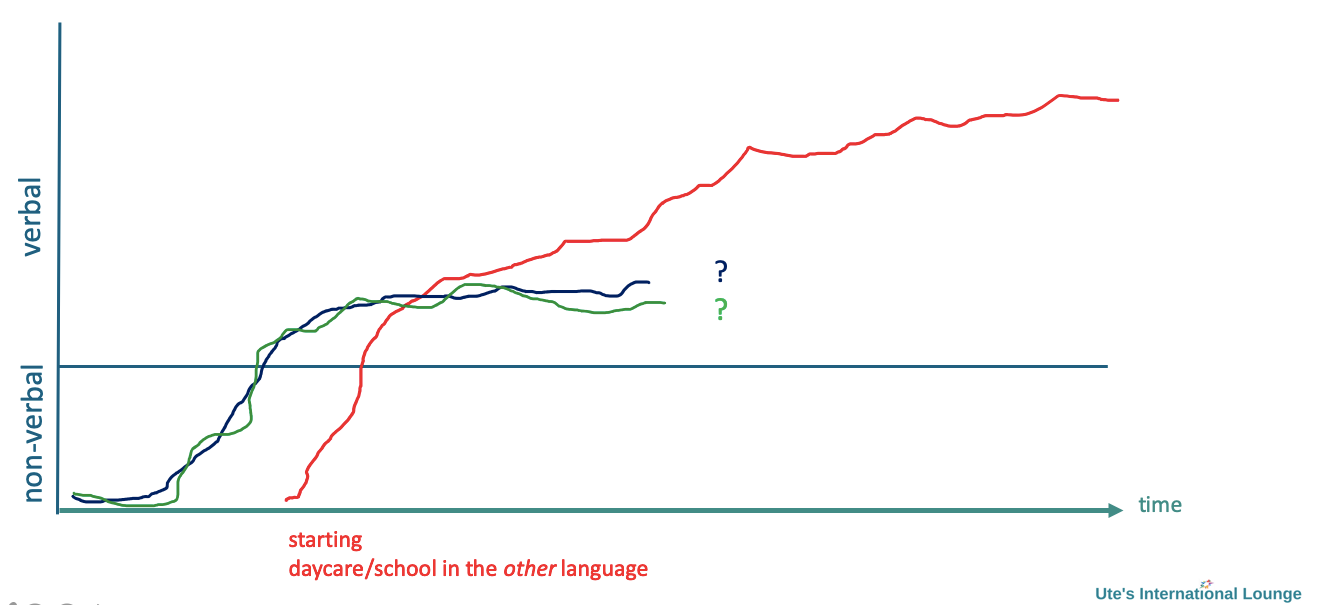
What I observe is this:

© Ute Limacher-Riebold 2019

This chart shows an average development of a multilingual child. After the non-verbal phase, when the child is acquiring the home languages (in this case indicated in blue and green lines), the child becomes verbal in both languages, if the exposure to both languages is consistent.

At some point, this child will attend daycare or school in another language (read line) and will be required to acquire and learn the school language as quickly as possible – see the exponential development in the school language.

Once our children start attending school in a language that is not one of our home languages, the exposure to the home languages decreases and in most families, the main focus shifts on the school language. This is a very natural and, for many years, expected shift to take place in international/expat/immigrant families.

In the past, governments discouraged immigrant families from keeping their languages, as to help them assimilate as quickly as possible to the host society by learning the local language. The main objective being for immigrants to fit into the society and adapt to the local life, culture and language. – But assimilation often goes hand in hand with abandonment of the previous language and culture, which will has a negative impact on the identity and sense of belonging of the children and young adults.

In recent years, research has emphasized the importance of maintaining the home languages and contributed to a major shift in education, which leads to more language inclusive schools that, for example, adopt translanguaging pedagogies, are allowing children to speak their languages within the school premisses and use resources in their home languages to prepare school subjects etc.

Home languages play a major role in the overall wellbeing of international children*: they are necessary to bond between generations – children and their parents, and extended family – and connect with heritage cultures. Furthermore, the fact that home language skills can be transferred to school, which had been emphasized by Prof. Jim Cummins in 1979 (!) already, has proven to be more successful and important than focusing on the school language only for foreign children, especially, when home languages are consistently fostered throughout childhood.
* international children= I mean all children who are growing up outside of their parents countries of origin, independently of the reason for this upbringing. These can be refugees, immigrants, expats etc.

Thankfully, more and more parents are aware of the importance to maintain their home languages, independently of the “prestige” their languages are attributed to either by society or the parents themselves.

Especially the burden put on international parents who are in charge of providing not only the necessary input for their children to become verbal in their home languages, but also the teaching for them to become bi-/pluriliterate, can become an immense burden, especially when this all leads to rejection.

In my practice and in my personal experience, I have observed that this rejection of the home language can lead to attrition and, in the worst case, to language loss.

Based on my own experience with my rejection of my home language as a teenager and my children’s personal choice of languages, I completely agree with Dr. Sabine Little, a German linguist at the University of Sheffield, who recommends to “let children forge their own emotional connection to the language”.

Like her son, I gave up on German for several years, before returning to it. Like Sabine Little, my mother let me determine when I would speak it together with my German family and friends (with whom I share other languages too). 

The measures Sabine Little took with her son won’t work with my children – his time on YouTube is restricted, but he is allowed more if he watches in German: this is something my teenage children would not do consistently – but, like I say to my clients, there is no one solution that fits all and every multilingual family deserves her personalized solution!

Our languages are an intimate part of our identity. For us parents it is wrenching to try and fail to pass them on to our children**.

But, once again, I advise to carefully define our success: for some it is enough that our children can speak our languages with extended family, for others it is important that they can also read and write to a certain extent, and then there are those who want their children to return to their countries of origin for study or work, and therefore have higher expectations concerning their level of literacy.
Success has many facets and it is interesting to see how what we would define as such when our children are toddlers can change over time and still be our personal success when they are young adults.

I always invite international parents to
• define the language goals for their children,
• divide them into small achievable steps and
• re-assess their situation every now and then (once a year is a good average),

to make sure to keep goals realistic, celebrate the small achievements and make sure to remain consistent in the long term goals.

If you have any questions related to this topic, contact me at info@UtesInternationalLounge.com (or find more about my services as Family Language Consultant here)

Please find more of my articles and posts about raising children with multiple languages here and join my facebook group “Multilingual Families“.

(*) The term idiolect is etymologically related to the Greek prefix idio- (meaning “own, personal, private, peculiar, separate, distinct”) and -lect, abstracted from dialect, and ultimately from Ancient Greek ????lég?, ‘I speak’.

(**) I got inspired to write this post when I read this article on the economist.com site.

https://www.youtube.com/live/LE1PBCx7lMQ?feature=share