When the home language is not the dominant language

If you are a multilingual, is your home language your most dominant language?

Something that surprises me when I read about language policies in schools and elsewhere is, that it is always assumed that people – children and adults – are most proficient, i.e. most fluent, in their home language. This might be correct for those who learned other languages later in life and were first schooled in their home language, but reality is very different for multilinguals who are schooled in other languages!

If you are a simultaneous bilingual and you have the chance to maintain those first languages at school (because the school teaches several subjects in both or all the languages!), all your languages might be more or less at the same level – usually one or two are more dominant than the others, depending on many factors. You may be bi- or pluriliterate.

If you acquired and learned several languages, simultaneously and successively, lived in different places, were schooled in one of the languages, or maybe not..., worked using one of these languages – it might be that your most dominant language is not the first language you acquired or learned.

If our children are schooled in another language chances are high that their most dominant language is the school language...


The reason for this is very simple: we don't (or can't) foster all the vocabulary they learn and use at school also in their home language, because it would mean that they hear the same lessons twice once at school in the school language, once from us at home. 

Recently many schools – not only the international ones! – are opting for a more inclusive policy when it comes to home languages, which I fully support. It is proven that integrating home languages in the practice at school, helps new students, i.e. those who were schooled in their home language earlier, to adapt and integrate easier.

But what about those multilinguals who are schooled in languages that are not their home language(s) since day one? Who maybe had to learn two (or more!) school languages in addition to their home languages due to their moves?

I see a problem in the overall approach, because these latter children are often lacking behind their peers in their countries of origin language wise. They need a whole other support!

Many multilingual families bridge the school and the home languages by discussing about school topics, by providing the necessary input, fostering the right vocabulary. This is hard work! And it requires collaboration and transparency from the teachers and the school in general, and not only on primary school level, but throughout the whole school curriculum!

We parents – even those who are teachers – can't provide all the input that our children receive at school in their school language. We have to make compromises. For my family it means that I focus on the topics my children like the most. I must confess that I find it sad that my children don't count in German or Italian, that they prefer English when it comes to explaining complex subjects, but I know that with patience and our many conversations, they will acquire as much as they can.

I honestly hope that there will be more studies about multilingual families whose children are schooled in another language and who do everything possible for their children to become fluent also in their home languages. I am looking for testimonials from other multilingual families whose children are schooled in another language.

I want to hear from you, how you foster your home language(s) and how it is going, what support you get, what support you would need.

Please share your experience with me, by leaving a comment here below. 

I will gather all the information I can get to write an article, present it at conferences and hopefully we will get more help from governments, schools, teachers, the community we live in.


Keeping our languages alive when living abroad – FIGT presentation

At my kitchen table conversation– session I held at the 20th FIGT conference this year in The Hague I focused on the languages we collect during our life, and how we can keep them alive while living abroad, in different countries.

Why kitchen table conversation?

Because that’s where all began 20 years ago at Ruth van Reken’s kitchen table. I wanted to honor the format where all began, because I, myself, have the most significant conversations and discussions at my own kitchen table. Of course, the one at the venue of the conference was not a real “kitchen table”, but we had a great discussion about “my” topic.

Ruth van Reken at FIGT 2018 in The Hague

How can we keep our languages alive?

Many international families struggle to maintain their home languages if they are not among the most dominant ones, i.e. if they are not English and sometimes Spanish, French and German, depending on the country they live in. What seems an easy task for the first years of a child can become a real challenge once the children attend daycares and schools who don’t provide sufficient support in the other language.

I see this every day with my clients and friends: our children are tired from school and rarely find the after school classes in their home languages pleasant, fun. Many families send their children to weekend schools, where, once again, they will sit down and “learn” a language that, in other circumstances and settings would just “come natural to them”: they would be fully immersed, literally showered by it.

For all these families, maintaining their language can become a great issue. If they don’t find a community that speaks this language, or they don’t connect with this community for different reasons, parents find themselves as being the only ones of providing linguistic input for their children.

Moreover, speaking a language in a restricted group, i.e. among family members, doesn’t allow the language to “breathe”: we tend to use the same kind of vocabulary because we tend to speak about the same topics, our language “shrinks”, like a plant would shrink and wither, if we don’t nurture it.

For our children it is even more important to have regular and diverse input in our home language as they are still building their vocabulary, they are still becoming “natively fluent” in the language, which, as we know, takes up to 8 years of constant, daily (!) practice.

What if:

  • our children don’t speak their language with peers?
  • the daycare or school doesn’t support our home language?
  • weekend lessons are not enough to foster the language or are not an option?
  • our partner or extended family can not support our language?

Then this language will stagnate or die.

I have seen this many times when I was a child, and throughout my work with multilingual families: languages are abandoned because it is too much to ask to one person or a small group of persons to work on it, and if it is about more than one or two languages within the same family it becomes almost impossible to maintain them.

This is why I recommend to be very clear about the following points: 

– what language is important for our family – because extended family, friends speak it? 

who talks this language on a daily/weekly basis with our children and us?

– what are the short and long term goals for all our languages qua fluency?

Are these language goals and expectations S.M.A.R.T.?

Many multilingual families struggle with agreeing on the languages they want to prioritize. Should we keep Swissgerman or prefer German or Italian instead? Should I learn my partners’ language? What if we move to a country where none of our languages are spoken, where there is no community in that language? – I help families maintain their languages on the move, make short and longterm plans

Language lives, changes over time, adapts to new circumstances and needs to be nurtured if we want to keep it alive.

How can we make sure that we keep our languages alive? 

  • By speaking them on a regular basis – daily would be perfect, but weekly needs to be enough sometimes.
  • By not listening to the no-sayers, those who tell us that it is too difficult to keep up with all those languages, and by following those who, like us, want to enjoy our languages and see them grow.
  • By thinking out of the box: if we can’t immerse into the language by traveling to places where it’s spoken, form our micro-world in our home.
  • By finding other speakers on- and offline, and talking about topics that challenge us to learn new words, new concepts. Our vocabulary will grow by repeating new words in different contexts, learning new registers of the language, jokes, metaphores, how to do maths in all our languages.

With our languages it is like with our cultures: we shouldn’t have to choose one or two of them to call “our own”, we have the right to choose them all.

Our languages shouldn’t be minoritized and marginalized. They all have a right to be spoken and heard.

***

Some thoughts & quotes about languages:

Knowing another language is like possessing another soul (Charlemagne)

The limits of my languages are the limits of my worlds ( adapted from Ludwig Wittgenstein)

I am all the languages I know, some I only understand, others I speak, read and write. (Ute Limacher-Riebold)

Languages are the vehicle of our thoughts, they open the door to the other culture, its values, beliefs, habits and so much more. (Ute Limacher-Riebold)

The development of language is part of the development of the personality, for words are the natural means of expressing thoughts and establishing understanding between people. (Maria Montessori)

Poetry is not a matter of feelings, it is a matter of language. It is language which creates feelings. (Umberto Eco)

– What about you?

– What are the languages you are nurturing and keeping alive?

– What are the obstacles you encountered while trying to keep your languages alive?

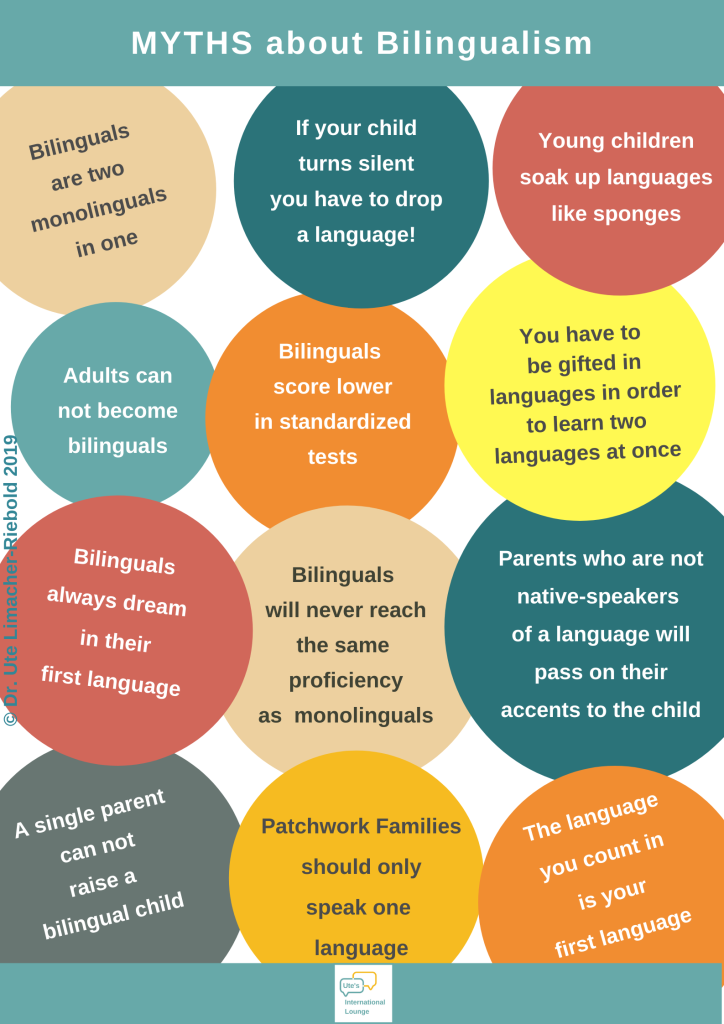
Myths about Bilingualism/Multilingualism

This is a short (!) overview of some common myths about bilingualism/multilingualism – I will be updating this list in May/June 2024, so, if you came across any myths you want me to include, please let me know in the comments.

They are all assumptions based on old theories about bilingualism and bilinguals (and multilingualism), but have all been proven wrong.

If you would like to know more about how to raise bilingual children and how to become and stay bilingual when you’re adult, then don’t miss my Free Online Webinars.


English

Deutsch


Myths about Bilingualism

Mythen über die Zweisprachigkeit


This is a short overview of some of the most common myths about bilingualism.

Dies ist ein kurzer Überblick über einige der häufigsten Mythen zur Zweisprachigkeit.


They are all assumptions based on old theories about bilingualism and bilinguals (and multilingualism), but have all been proven wrong.

Dies sind alles Annahmen, die auf überholten Theorien über Zweisprachigkeit und Mehrsprachigkeit beruhen, sich aber inzwischen als falsch erwiesen haben.


If you would like to know more about how to raise bilingual children and how to become and stay bilingual when you’re adult, then join my free online live webinars.

Falls du mehr über zweisprachige Kindererziehung und vor allem darüber erfahren möchtest, wie das langfristig erfolgreich möglich ist, dann versäume nicht meine free online live webinars.


  • Bilinguals have equal and perfect knowledge of their languages
  • Zweisprachige beherrschen beide/alle Sprachen in gleichem Maße


  • Mixing languages is a sign of laziness in bilinguals
  • Das Mixen von Sprachen ist ein Zeichen von Faulheit


  • OPOL is the best approach parents should use if they want their children to grow up bilingual
  • OPOL ist die beste Strategie, die Eltern anwenden sollten, wenn sie ihre Kinder zweisprachig erziehen wollen


  • Bilinguals are born translators
  • Zweisprachige sind geborene Übersetzer


  • Bilinguals acquire all their languages in childhood
  • Zweisprachige erwerben ihre Sprachen während ihrer Kindheit


  • Bilinguals have no accent in different languages
  • Zweisprachige haben keinen Akzent in ihren jeweiligen Sprachen


  • Bilingualism is a rare phenomenon
  • Zweisprachigkeit ist ein seltenes Phänomen


  • Bilinguals express their emotions in their first language
  • Zweisprachige drücken ihre Emotionen in ihrer ersten Sprache aus


  • All bilinguals are bicultural
  • Zweisprachige sind auch bikulturell


  • Bilingual children speak later than monolinguals
  • Zweisprachige Kinder sprechen später als Einsprachige


  • Bilinguals have a double or split personality
  • Zweisprachige haben eine doppelte oder gespaltene Persönlichkeit


  • The home language has a negative effect on the acquisition of the school language
  • Die Familiensprache wirkt sich negativ auf den Erwerb der Schulsprache aus


  • A child with learning difficulties can not be/become bilingual
  • Ein Kind mit Lernschwierigkeiten kann nicht zweisprachig sein/werden


  • Children raised bilingual will always mix their languages
  • Kinder die zweisprachig aufwachsen, mischen immer ihre Sprachen


  • Bilinguals are two monolinguals in one
  • Zweisprachige sind zwei Einsprachige in einem


  • If your child turns silent you have to drop a language!
  • Wenn euer Kind nicht spricht (oder aufhört eine Sprache zu sprechen), müsst ihr eine Sprache fallen lassen!


  • Young children soak up languages like sponges
  • Kleine Kinder saugen Sprachen auf wie Schwämme


  • Adults can not become bilinguals
  • Erwachsene können nicht zweisprachig werden


  • Bilinguals score lower in standardized tests
  • Zweisprachige schneiden in standardisierten Tests schlechter ab


  • You have be gifted in languages in order to learn two languages at once
  • Man muss sprachbegabt sein, um zwei Sprachen auf einmal zu lernen


  • Bilinguals always dream in their first language
  • Zweisprachige träumen immer in ihrer ersten Sprache


  • Bilinguals will never reach the same proficiency as monolinguals
  • Zweisprachige werden nie dasselbe Sprachniveau erreichen wie Einsprachige


  • Parents who are not native-speakers of a language will pass on their accents to the child
  • Eltern, die nicht ihre Muttersprache mit ihren Kinder sprechen, geben ihre Akzente an die Kinder weiter


  • A single parent can not raise a bilingual child
  • Ein Alleinerziehender kann kein zweisprachiges Kind großziehen


  • Patchwork Families should only speak one language
  • Patchwork-Familien sollten nur eine Sprache sprechen


  • The language you count in is your first language
  • Die Sprache in der man zählt, ist die erste Sprache


Nederlands

Français

Italiano

Mythen over meertaligheid

Mythes sur le bilinguisme

Miti sul bilinguismo

Dit is een kort overzicht van enkele van de meest voorkomende mythes over twee/meertaligheid.

Voici un bref aperçu de certains des mythes les plus courants sur le bilinguisme.

Questo è un breve panorama dei miti più comuni sul bilinguismo.

Het zijn allemaal aannames gebaseerd op oude theorieën over tweetaligheid en tweetalige  (en meertalige), maar zijn allemaal als fout bewezen.

Ce sont toutes des hypothèses basées sur de vieilles théories sur le bilinguisme et les bilingues (et multi/plurilingues), mais elles se sont toutes révélées fausses,

Sono tutti presupposti basati su teorie antiquate sul bilinguismo e sui bilingui (e multilingui), che sono tutti stati smentiti.

Als je meer wilt weten over het opvoeden van tweetalige kinderen en hoe je tweetalig kunt worden en blijven als je volwassen bent, mis dan niet mijn gratis online webinars.

Si vous souhaitez en savoir plus sur comment élever des enfants bilingues et comment devenir et rester bilingue à l’âge adulte, ne manquez pas mes ateliers gratuites en ligne.

Se desideri saperne di più su come crescere figli bilingui e su come diventare e rimanere bilingui anche in età adulta, assicurati di non perderti i miei webinar gratuiti online.

  • Tweetaligen hebben een gelijke en perfecte kennis van hun talen
  • Les bilingues ont une connaissance égale et parfaite de toutes leurs langues
  • Bilingui hanno una perfetta  e pari conoscenza in tutte le loro lingue
  • Het mengen van talen is een teken van luiheid bij tweetaligen
  • Mélanger les langues est un signe de paresse chez les bilingues
  • Mischiare le lingue è un segno di pigrizia
  • OPOL is de beste benadering die ouders zouden gebruiken als ze willen dat hun kinderen tweetalig worden/opgroeien
  • OPOL est le meilleur approche que les parents devraient utiliser s’ils veulent que leurs enfants deviennent bilingues
  • OPOL è l’approccio migliore se genitori vogliono che i loro figli crescano bilingui
  • Tweetaligen zijn geboren vertalers
  • Les bilingues sont nés traducteurs
  • Bilingui sono traduttori nati
  • Tweetaligen verwerven al hun talen in hun kinderjaren
  • Les bilingues acquièrent toutes leurs langues pendant leur enfance
  • Bilingui acquisiscono tutte le loro lingue durante l’infanzia
  • Tweetaligen hebben geen accent in hun verschillende talen
  • Les bilingues n’ont pas d’accent dans leurs différentes langues
  • Bilingui non hanno accenti nelle loro diverse lingue
  • Tweetaligheid is een zeldzaam fenomeen
  • Le bilinguisme est un phénomène rare
  • Il bilinguismo è un fenomeno raro
  • Tweetaligen uiten hun emoties in hun moedertaal/ eerste taal
  • Les bilingues expriment leurs émotions dans leur langue maternelle / première langue
  • Bilingui esprimono le loro emozioni nella loro lingua materna / prima lingua
  • Alle tweetaligen zijn bicultureel
  • Tous les bilingues sont biculturels
  • Tutti i bilingui sono anche biculturali
  • Tweetalige kinderen spreken later dan eentaligen
  • Les enfants bilingues parlent plus tard que les enfants monolingues
  • Bambini bilingui parlano più tardi dei bambini monolingui
  • Tweetaligen hebben een dubbele of gespleten persoonlijkheid
  • Les bilingues ont une double personnalité
  • Bilingui hanno una doppia personalità
  • De thuistaal heeft een negatief effect op de verwerving van de schooltaal
  • La langue parlée à la maison a un effet négatif sur l’acquisition de la langue scolaire
  • La lingua madre / di famiglia ha un effetto negativo sull’acquisizione della lingua scolastica
  • Een kind met leermoeilijkheden kan niet tweetalig zijn/worden
  • Un enfant ayant des difficultés d’apprentissage ne peut pas être bilingue
  • Un bambino con difficoltà di apprendimento non può diventare/essere bilingue
  • Kinderen die tweetalig zijn opgevoed, zullen altijd hun talen mengen
  • Les enfants élevés bilingues mélangeront toujours leurs langues
  • Bambini bilingui mescoleranno sempre le loro lingue
  • Tweetaligen zijn tween eentaligen in één
  • Les bilingues sont deux monolingues en un
  • Bilingui sono due monolingui in uno
  • Als je kind niet spreekt, moet je een taal laten vallen
  • Si votre enfant ne parle pas, vous devez abandonner une langue
  • Se bambini che crescono con più lingue non parlano, bisogna abbandonare una lingua!
  • Jonge kinderen nemen talen op als sponzen
  • Les jeunes enfants s’imprègnent des langues comme des éponges
  • Bambini assorbono le lingue come spugne
  • Volwassenen kunnen niet tweetalig worden
  • Les adultes ne peuvent pas devenir bilingues
  • Adulti non possono diventare bilingui
  • Tweetaligen scoren lager op gestandardiseerde toetsen
  • Les bilingues obtiennent des notes inférieures aux tests strandardisés
  • Bilingui ottengono punteggi inferiori nei test standardizzati
  • U moet begaafd zijn in talen om twee talen tegelijk te leren
  • Il faut être doué en langues pour apprendre deux langues à la fois
  • Devi essere dotato per le lingue per imparare due lingue contemporaneamente
  • Tweetaligen dromen altijd in hun moedertaal/eerste taal
  • Les bilingues rêvent toujours dans leur langue maternelle
  • Bilingui sognano sempre nella loro prima lingua / lingua madre
  • Tweetaligen zullen nooit dezelfde taalvaardigheid bereiken als eentaligen
  • Les bilingues n’atteindront jamais les mêmes compétences que les monolingues
  • Bilingui non raggiungeranno mai la stessa competenza linguistica dei monolingui
  • Ouders die geen moedertaalspreker zijn, zullen hun accenten aan het kind doorgeven
  • Les parents qui ne sont pas natifs d’une langue, transmettront leurs accents à l’enfant
  • Genitori che non sono madrelingua trasmetteranno i loro accenti ai bambini
  • Een alleenstaande ouder kan geen tweetalig kind opvoeden
  • Un seul parent ne peut pas élever un enfant bilingue
  • Un genitore single non può crescere bambini bilingui
  • Nieuw-samengesteld gezinnen mogen maar één taal spreken
  • Les familles recomposées/mixtes ne doivent parler qu’une seule langue
  • Le famiglie miste dovrebbero parlare solo una lingua
  • De taal waarin je meetelt, is je eerste taal
  • La langue dans laquelle vous comptez est votre langue maternelle
  • La lingua in cui conti è la tua prima lingua /lingua principale (più importante/dominante)


Language Assessments for Bilingual and Multilingual Children

Parents of multilingual children worry the most if their children will be able to keep up with all the languages and have a sufficient knowledge, proficiency, academically speaking, once they go to school.

Schools do regular language and literacy assessments and even international schools tend to assess the school language only or at least also the dominant language – for example, for a German child living in the Netherlands and attending an English speaking school, the assessment would be focusing on Dutch and English.

As there isn't one test that can be applied to all languages and teachers who evaluate these tests should at least have a basic knowledge of the other languages involved, I always advise parents of multilingual children to make sure their children are not only tested on one or two – usually the most dominant languages – but also on their family languages. In fact, as stated in the article mentioned here below, "SLPs have acknowledged competence in the assessment of monolingual children's speech but must consider additional aspects when assessing the speech of children who speak non-dominant languages and dialects."

If you are a parent of multilingual children and you have the impression that your school is not updated on the latest findings about language and literacy assessments, you may find an assessment in this list to submit to your school.

You want to make sure that during the speech assessment they will identify the presence or absence of SSD* and include referral, case history, assessment of speech production, additional areas of assessment (intelligibility, acceptability, stimulability, speech perception, phonological processing, language, hearing, oral structure and function, nonverbal intelligence, and participation), analysis, diagnosis, and goal setting.

Here is a scientific article about Speech Assessment for Multilingual Children who don't speak the same language(s) as the Speech-Language Pathologist

If you need support on this matter, I offer mediation with schools to make sure your child gets the right assessment and support he / she deserves! – Contact me at info@UtesInternationalLounge.com

*SSD= Speech Sound Disorders (cfr. from the article mentioned above “Children with speech sound disorders can have any combination of difficulties with perception, articulation/motor production, and/or phonological representation of speech segments (consonants and vowels), phonotactics (syllable and word shapes), and prosody (lexical and grammatical tones, rhythm, stress, and intonation) that may impact speech intelligibility and acceptability” (International Expert Panel on Multilingual Children's Speech, 2012, p. 1).)


Bilingual children can be easily misdiagnosed as having a language disorder. Language tests for bilingual children that are based on English [or another language] assessments are flawed not only because bilingual children may acquire certain language structures differently from monolinguals but because the sequence and rate of acquisition of specific language components varies between different languages. (Helen Grech, Barbara Dodd, Assessment of Speech and Language Skills in Bilingual Children: A holistic approach, Stem-, Spraak- en Taalpathologie, vol15, 2007, No.2, p.87)


What I recommend to do:

Fact is that there are many different tests for assessments that are done with the children.
I would recommend to ask about the testing:

  • What kind of test is used?
  • What exactly is tested – the comprehension of single words, in word chains or without context etc. 
  • It is a very complex set of data that they evaluate and we parents often only are informed about the results.
  • We don't see them... unless we ask. And it is actually our right to see the tests in total. For example, if the teacher says that my child can't pronounce a sound "correctly" this can have many reasons. Either because my child is still acquiring the language and needs more time, or because my child can't hear the difference between a sound and another one he/she knows from another language. 


It can also be that my child mixes similar words in the languages.

For example, "Wie gaat naar school?" (wie= who) in Dutch vs. *Wie geht zur Schule?  in German, but correct German would be Wer geht zur Schule?

The child/person uses "wie" in the "wrong way", because wie also exists in German and means "how", i.e. producing an incorrect question : *How goes to school? (i.e. *Wie geht zur Schule?)

It always depends on what teachers/schools or health practitioners are testing and why.

 
Always ask questions about:

  • the type of test
  • the reason for the testing
  • the way the test was performed (i.e. did the child really understand what they asked him/her?, was the child given enough time to perform the task?)
  • did they take into account that the child also speaks or understands other languages and what these other languages are?,
  • what is the outcome of the test and the consequences of it,
  • will the test be repeated, and if so, when etc.
  • what will be the next steps the school or health practitioner will take if help is needed?
  • what can we, parents, do to help?
  • what are the consequences for my child?...

One important advice: please make sure that language or literacy tests are not done during transition time! They give false results as the children are still adapting. It is like if someone would test us adults during our first week taking classes in a new language and tell us "you can't work for the company because you're not at the right level"...


Thank you Alison T. for suggesting to add this practical advice!


Please read also my other post about Speech and Language Therapists and Multilinguals

Can monolingual parents raise bilingual children?


Bildschirmfoto 2015-02-26 um 16.25.06


The answer is “yes”, but…

Many parents wonder if they can succeed in raising their children bilingually. Most of the studies of the ’60-’80 about bilingualism were about monolingual parents who wanted their children to become bilingual. Some parents would share the same home language and the community language would be L2, in some other studies only one of the parents would share the community language etc..

I think that defining a monolingual parent becomes more and more difficult because talking “only” one language, i.e. being monolingual, nowadays is almost impossible – at least for all those who don’t have English as home language. Everyone studies another language at some point, and will acquire some kind of knowledge in it. Therefore, being exclusively monolingual parents, living in a continuously monolingual context is almost impossible. Especially if we count dialects as languages. – If we agree with François Grosjean‘s definition of a bilingual:

“Bilinguals are those who use two or more languages (or dialects) in their everyday lives”

we can define accordingly a monolingual:

“Monolinguals are those who use only one language (or dialect) in their everyday lives”.


***

Every family raising bilingual children need a language plan. There are several strategies that can work for monolingual families or monolingual parents. In a (almost) monolingual situation, the strategy would look like this:

                            Parent 1                    Parent 2                    Community

 Strategy 1          Language A              Language A               Language A

Parents would speak their native language and the child would associate the second language (not indicated in this figure) with a certain place or certain person, such as special classes or trips to visit relatives or friends. With an environment not providing a regular input to the child, the parents would need to make more effort in providing exposure to the second language (cfr. playgroups in the other language, language lessons, care givers who talk the other language – and DVDs, CDs, audiobooks, books etc.).

Monolingual parents who want to raise their children bilingually but are not able to support this at home, need to reach out for help and provide a regular input from someone else. With the help of technology this is surely possible and I know many families who succeeded, but in the long run, either one parent (or both) would learn the other language and the parents would need to offer regular full immersion programs to their children – during holidays etc. – to foster the learning.

If one of the parents has the knowledge of another language, but the family lives in a Language A community, one of the parents would always address the child in his or her non-native, second language.

                            Parent 1                    Parent 2                    Community

Strategy 2      Language A               Language A                 Language A

                           Language B

These first two strategies require a special effort and commitment from the parents to provide regular input in Language B, with the advantage that in Strategy 2, one parent would be the regular dialogue partner for the child. On the long run, the child (and the parent) may need more people to share this language with. Playgroups, peers, collaborative teachers and family who either share the same language or at least support the bilingual upbringing can be very beneficial.

***

If both parents have the same home language but live abroad, the scenario can look like this:

                            Parent 1                    Parent 2                    Community

Strategy 3          Language A              Language A             Language B

Both parents would talk Language A to the child and leave the second language (B) to the environment and school. Usually, parents in this situation would learn language B at some point and would probably also be able to understand and support their child during his learning process.

When one of the parents has some knowledge of the community language, this could be the scenario:

                            Parent 1                    Parent 2                    Community

Strategy 4          Language A              Language A                Language B

                           Language B

One parent would always talk the community language (B) with the child, while the other parent would be consistent talking the other one. Language A being the minority language in this case, parents would need to support the child by offering other opportunities to speak language A (with peers, playgroups etc.).

For all the scenarios listed here above, it would be beneficial for the bilingual child if parents would agree on a language planning, be confident, creative, committed and consistent – and flexible, if the language situation within the family changes due to a move abroad or else.

***

My parents adopted strategy 3 in raising my sister and me bilingually: with German as home language and Italian as the local language. Both my parents spoke also Italian and other languages (English, French and local German dialects).
I can say that they succeeded: my sister and I are both bilinguals talking up to 6 languages and raising our children with multiple languages too.


Sign in Switzerland's four official languages

Sign in Switzerland’s four official languages (Photo credit: Wikipedia)

 (this post has been published (in another version) on my “other” blog expatsincebirth)