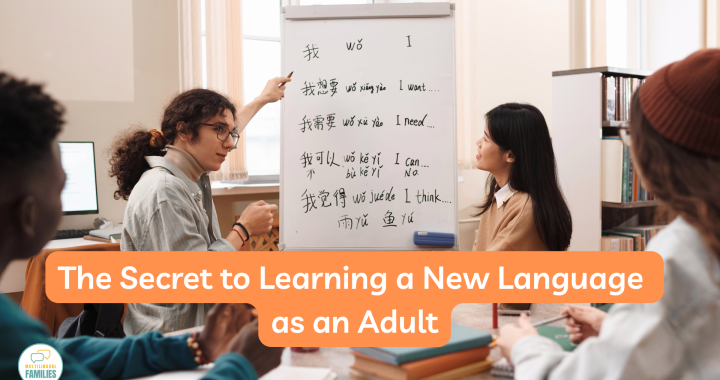
A persistent myth about bilingualism is that adults cannot properly learn new languages. On the contrary, research shows that adults are capable of achieving fluency, even when starting later in life (Garraffa, Sorace & Vender, 2020). What differentiates adults from children is not exactly their capacity to learn, but the mechanisms and emotional attitudes involved in the process.
Cognitive and neural perspectives
Neuroscience demonstrates that children’s brains display greater neural plasticity, allowing them to build new networks as they acquire language. Adults, instead, must reorganize existing ones, which demands more cognitive effort (Li Wei, 2023). This structural difference partly explains why language learning may appear slower in adulthood. Nevertheless, adults’ developed metacognitive skills – such as self-monitoring and reflection – can compensate for reduced plasticity and support efficient language learning strategies.
Beyond traditional instruction
Language courses with teachers and textbooks remain useful, as they offer structure, interaction, and expert feedback. Yet, linguistic progress depends primarily on self-directed engagement. Many adult learners expect proficiency to emerge from formal instruction alone, often overlooking the importance of active, autonomous exposure to the target language in natural contexts.
Self-learning and immersion
Studies on polyglots (Machova, 2019) reveal that successful adult learners rely on continuous, self-guided exposure: reading, listening, watching audiovisual materials, and interacting socially in the target language. The key is to reproduce the conditions of first language acquisition – rich input, meaningful communication, and emotional involvement. When learning becomes enjoyable and intrinsically motivating, attention and memory are naturally enhanced.
Emotional and motivational factors
Children approach language learning playfully, without fear of error or judgment. Adults, conversely, often experience frustration, embarrassment, or a sense of inadequacy, which can inhibit spontaneous communication (Dewaele 2010). Overcoming these affective barriers is crucial. Adopting a “child-like” stance – curiosity, patience, and acceptance of imperfection – facilitates sustained motivation and cognitive flexibility.
Conclusion
Ultimately, adults learn most effectively when they replicate the fundamental conditions of early language acquisition: abundant exposure, meaningful use, emotional engagement, and persistence. The adult learner’s challenge is therefore not primarily neurological, but attitudinal. To learn like a child is to recover the curiosity, playfulness, and openness that make language learning a natural, lifelong process.
References:
Dewaele, J.-M. (2013). Emotions in Multiple Languages (2nd ed.; 1st ed. 2010). Basingstoke: Palgrave Macmillan.
Garraffa, M., Sorace, A., & Vender, M. (2020). Il cervello bilingue. Carrocci Editore.
Wei, L. (2023) Why being bilingual is good for your brain?. BBC Ideas.
Machová, L. (2019, February). The secrets of learning a new language. TEDx Talks.