Writing Development in Simultaneous and Successive Bilingual Learners
Writing is one of the most demanding skills children acquire because it requires thinking, language knowledge, motor skills, and cultural awareness to work together. For multilingual learners, this complexity increases further, as writing develops across languages with different structures, scripts, and conventions.
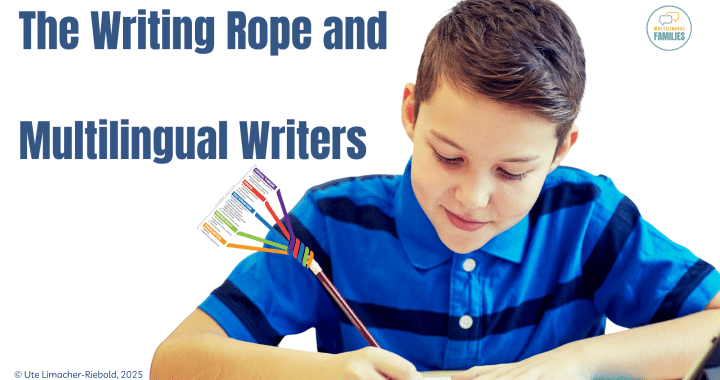
Joan Sedita’s Writing Rope offers a particularly helpful framework for understanding multilingual writing development. Similarly to the Reading Rope from Hollis Scaraborough, it shows writing as a set of interwoven strands that must be strengthened and coordinated over time. Importantly, the model helps explain why multilingual writers may show asynchronous development: strong abilities in one strand or one language, and emerging skills in another.
This applies to both
- simultaneous bilinguals, who grow up with two or more languages from early childhood, and
- successive bilinguals, who acquire additional languages later, often through schooling.

Multilingual Writing Is Distributed Across Languages
A key insight from multilingual research is that writing skills are not duplicated across languages. Some competencies transfer easily whereas others must be rebuilt for each language. The Writing Rope helps us see where this transfer happens and where it does not.
1. Ideas and Thinking: Rich Cognition, Uneven Expression
What this strand involves
- generating ideas
- planning and revising
- drawing on background knowledge
- considering purpose and audience
Multilingual example
A child who speaks Arabic at home and writes in German at school may have deep knowledge about a topic (e.g. family traditions or science concepts) but produce a short, simple German text. The limitation lies not in thinking, but in linguistic access to expression.
Some multilingual learners might move flexibly between languages when planning ideas, while others prefer thinking primarily in their stronger languages, depending on the subject. In both cases, allowing oral discussion, brainstorming, or planning in multiple languages strengthens this strand.
2. Sentence Structure: Where Transfer Is Limited
What this strand involves
- word order
- agreement
- sentence complexity
- clause linking
Multilingual example
A Spanish–English bilingual child may write “The boy has 10 years” a structure that mirrors Spanish syntax. This reflects cross-linguistic influence, not lack of understanding.
Sentence structure is one of the least transferable strands. Each language requires explicit learning. Simultaneous bilinguals may alternate patterns; successive learners often rely heavily on first-language structures when writing in a new language.
Targeted, contrastive instruction helps learners become aware of differences rather than suppressing them.
3. Text Organization: A Strong Site of Transfer
What this strand involves
- narrative structure
- logical sequencing
- paragraphing
- genre knowledge
Multilingual example
A child who can write a well-structured story in Turkish often understands narrative logic when writing in German or English as well, but may struggle with connectors, paragraph markers, or genre-specific expectations.
Text organization is frequently a strength in multilingual writers, especially successive learners who already have literacy in another language. Explicit teaching of genre conventions in each school language supports successful transfer.
4. Spelling and Handwriting: High Cognitive Load
What this strand involves
- spelling accuracy
- handwriting or typing fluency
- orthographic knowledge
Multilingual example
A child who writes fluently in Italian may find English spelling highly demanding due to its opaque orthography. Similarly, children learning to write in a second script (e.g. Arabic vs Latin) must invest substantial effort at the transcription level.
If spelling and handwriting are not automatised, writing becomes slow and exhausting, reducing attention available for ideas and structure. This strand is entirely language-specific and often the last to stabilise.
5. Writing Style and Voice: Identity Across Languages
What this strand involves
- word choice
- tone and register
- audience awareness
- personal voice
Multilingual example
A child may sound confident and expressive when writing stories in their home language, but distant or formulaic in the school language. This does not indicate a lack of voice, it reflects developing linguistic identity, i.e. the preference of one language over the other, depending on the topic and situation due to a different use of the various languages.
Simultaneous bilinguals often develop multiple voices early, while successive learners may need years before their written voice in a new language feels authentic. Style emerges only when all other strands are sufficiently strong.
What the Writing Rope Reveals About Multilingual Writing
The Writing Rope makes clear that multilingual writing development is:
- non-linear
- language-specific in parts
- deeply influenced by transfer and interaction
Difficulties in writing rarely signal a general deficit. More often, they indicate that specific strands in a specific language require support.
Effective support means:
- diagnosing strengths and needs strand by strand
- valuing skills developed in all languages
- allowing time for integration
Conclusion
Seen through the lens of the Writing Rope, multilingual writing is not fragmented, it is layered. Each strand grows at its own pace, shaped by linguistic experience, instruction, and opportunity.
For families, educators, and professionals, this model offers clarity and reassurance: strong writing in more than one language is built deliberately, patiently, and with respect for the learner’s full linguistic repertoire.
Bibliographical References
Cummins, J. (2000). Language, Power and Pedagogy: Bilingual Children in the Crossfire. Multilingual Matters.
Bialystok, E. (2001). Bilingualism in Development: Language, Literacy, and Cognition. Cambridge University Press.
García, O., & Wei, L. (2014). Translanguaging: Language, Bilingualism and Education. Palgrave Macmillan.
Koda, K. (2008). Cross-linguistic Transfer in Second Language Reading. Routledge.
Limacher-Riebold, U. (2025). Multilingual Teens and Literacy: Embracing Asynchronous Growth https://utesinternationallounge.com/multilingual-teens-and-literacy-embracing-asynchronous-growth/
Limacher-Riebold, U. (2020). Learning to Read in Multiple Languages – The Reading Rope explained https://multilingual-families.com/learning-to-read-in-multiple-languages-the-reading-rope-explained/
You can watch the explanation of what the Writing Rope entails by the author herself.
I invite you to also read my post about the Reading Rope.

Ute Limacher-Riebold
Ute Limacher-Riebold, PhD, is the founder of Multilingual-Families.com and Owner of Ute’s International Lounge & Academy.
She empowers internationals to maintain their languages and cultures effectively while embracing new ones whilst living “abroad”.
She grew up with multiple languages, holds a PhD in Romance Studies and has worked as an Assistant Professor at the University of Zurich (Department of Italian Historical Linguistics). She taught Italian historical linguistics, researched Italian dialects and minority languages, and contributed to and led various academic projects.
Driven by her passion for successful language development and maintenance, and personal experiences with language shifts, Ute supports multilingual families worldwide in nurturing their languages and cultural identities in the most effective and healthy way.