Why this Research Matters
Across the world, multilingual families are navigating rapidly changing linguistic landscapes. Children grow up in multicultural societies, in homes where several languages coexist, and in classrooms that reflect a global mosaic.
Within these shifting realities, Greek-speaking families share many of the same questions and challenges faced by multilingual families everywhere.
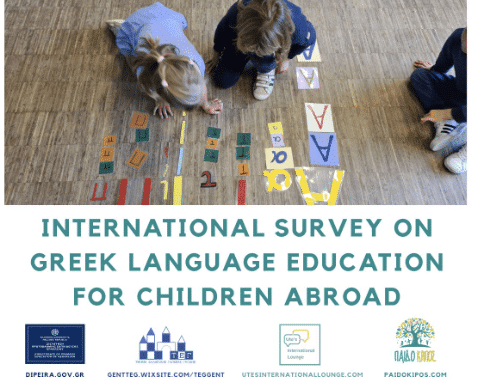
To better understand these experiences, Paidokipos Børneklub together with the Heraklion Directorate of Primary Education (Greece), Ute’s International Lounge (Netherlands), and the Greek Language Department of Ghent (Belgium) carried out an international survey focusing on young Greek-heritage children (0–10 years old) growing up abroad.
Our goal was simple yet essential:
What do multilingual Greek-heritage families and their educators truly need today?
While this survey focused on Greek-heritage families, it offers insights that are highly relevant to heritage-language communities around the world.
About The Survey
The survey ran from 15 January to 17 February 2025 and included two online questionnaires: one for parents and one for educators.
Its aims were to:
- document the difficulties faced by children, parents, and educators in Greek language education abroad,
- identify gaps in teaching materials, structures, and professional development,
- gather concrete proposals from within the diaspora community.
Participants
- 154 parents of Greek-heritage children aged 0–10 living in 54 countries
- 44 Greek heritage-language educators teaching in 32 countries
This geographical diversity gives the findings a strong comparative dimension, reflecting multilingual childhoods across different educational and cultural systems.
The questionnaires combined both quantitative data (percentages, structured responses) and qualitative insights (open comments), allowing a nuanced understanding of multilingual family experiences.
The findings paint a clear picture:
Greek heritage-language education abroad is facing significant gaps and there is a tremendous need for change, modernization, and structured support.
Findings: Parents’ Perspective
Parents describe a multilingual reality where Greek is not the dominant language of the environment yet remains emotionally central to family life.
Why parents value the heritage language
While in many multilingual contexts parents focus on academic benefits, Greek-heritage families highlight something deeper:
- 80% see Greek as a core part of cultural and personal identity.
- 75% mention maintaining family bonds as their primary motivation.
For these families, the heritage language is a bridge across generations, a way to remain connected despite geographical distance.
This mirrors what we see across multilingual communities globally: heritage languages carry emotional meaning, belonging, and cultural continuity.
Key challenges at home
Parents are highly motivated yet often feel unsupported.
Top challenges include:
- 70% lack modern, age-appropriate bilingual learning materials.
- 60% struggle with limited time and busy extracurricular schedules.
- 55% say Greek classes don’t align with host-country school structures.
Parents also express frustration about inconsistent staffing at Greek language schools abroad and the difficulty of supporting the language at home without accessible resources.
What parents are asking for
Parents consistently request:
- bilingual, developmentally appropriate materials (85%)
- digital resources for home use (65%)
- practical guidance on supporting bilingualism at home (50%)
Their message is clear:
they want structured support, not occasional solutions.
Findings: Educators’ Perspective
Educators teaching Greek as a heritage language abroad come from highly diverse contexts: community schools, cultural organisations, weekend programs, and online classes.
Despite this diversity, their challenges are remarkably similar.
The biggest barriers teachers face
- Lack of appropriate, modern materials (78%)
Most existing resources target monolingual learners and do not reflect multilingual children’s profiles, needs, or linguistic trajectories.
- Mixed-age and mixed-proficiency groups (72%)
Heritage language classrooms often include children:
- with different levels of exposure,
- who speak different dominant languages,
- who have different school backgrounds.
Differentiation in such settings is demanding for teachers, and 73% identify it as one of their major challenges.
- Limited institutional support (68%)
Educators report working with:
- minimal training,
- few resources,
- limited funding,
- little structural support.
They often juggle multiple roles: creating materials, organising cultural activities, communicating with parents, and adapting lessons to students with varied linguistic profiles.
- Need for professional development (55%)
Teachers request continuous training in:
- multilingualism,
- heritage-language pedagogy,
- child-centred approaches for diaspora settings.
- Need for networking and collaboration (60%)
Many educators describe themselves as “islands” working alone, without opportunities to exchange ideas, share practices, or build professional communities.
What educators want
Across countries and contexts, teachers express four clear priorities:
- 93% want child-centred materials designed specifically for bilingual/heritage learners.
- 80% want stronger support from the Greek state or diaspora organisations.
- 75% request systematic training in teaching Greek as a second or heritage language, with approaches designed for the linguistic profiles and learning needs of diaspora children.
- 60% emphasise the need for international networks and professional communities.
What the Findings Reveal
Taken together, parents and educators describe an educational landscape that is multilingual, diverse, full of motivation, but lacking support, tools, and recognition.
The heritage-language needs of young children abroad are clear. Multilingual families want an education that is meaningful, modern, and aligned with real life.
Four priorities emerge consistently
- Modern, engaging, research-based materials tailored to bilingual children.
- Continuous professional development for teachers of Greek as a second/heritage language.
- Guidance for families on supporting bilingualism at home in realistic ways.
- Better integration of Greek education within host-country systems through recognition, collaboration, and networks.
From Research to Action: What These Findings Mean for Multilingual Families Worldwide
Are these challenges unique to Greek-heritage education, or do they reflect a broader global reality for heritage-language communities?
The data suggest the latter.
Although this study focuses on Greek-heritage children, its findings resonate far beyond a single linguistic community. Across multilingual families worldwide, the same themes reappear: children balancing multiple languages, parents searching for meaningful support, and educators working with dedication but limited tools.
The experiences captured in this survey echo what we see among many diaspora groups:
a need for child-centred materials, teacher training in multilingual development, home–school collaboration, and recognition of heritage languages as valuable parts of children’s identities.
What needs to happen next
Based on the findings, several priorities emerge not only for Greek communities, but for heritage-language education more broadly:
- Invest in modern, research-informed materials that reflect the linguistic profiles of bilingual children.
- Strengthen professional development for educators working in multilingual contexts.
- Support parents with practical, accessible guidance on raising bilingual and multilingual children.
- Build networks and partnerships that connect communities, educators, and institutions across borders.
- Advocate for policies that recognise heritage-language education as a matter of linguistic rights and equity.
A shared responsibility
Heritage-language education cannot, and should not, rely on the effort of individual families or isolated educators. It requires coordinated action from communities, organisations, researchers, and institutions who understand the importance of multilingual development in childhood.
Your Voice Matters
At Multilingual Families, we believe that real progress begins with listening to the people who live these realities every day.
If you would like to share your story with us, join the conversation.
Multilingual Families is listening!

© Kathimerini, 2025
The findings of this study have also drawn wider attention. A summary of the results was featured in Kathimerini, one of Greece’s major newspapers. Read the article in Greek here.
For readers who would like to explore the original Greek publication of the study, the full article is available here (in Greek): Voices of the Diaspora – Research Findings in Greek

Interview with Chyssa Oikonomidou at Mega Cosmos – 21.12.2025

Chryssa Oikonomidou
Chryssa Oikonomidou is the Co-Founder of Multilingual-Families.com and Founder of Paidokipos, a creative Greek teacher, storyteller, and animator of interactive educational theater events. With a background as Senior Executive, she leverages over a decade of experience across various sectors to enhance her work in education, bolstered by her studies in education and multilingualism. Having not enjoyed school as a child and inspired by her two bilingual children, she is determined to make her lessons engaging and enjoyable for her students. She combines her diverse skills in didactics and project management to foster a rich educational landscape for young learners.