How to Read Bilingual Books: for Teenagers and Adults

How to Read Bilingual Books: for Teenagers and Adults

Bilingual books offer a unique opportunity for language learners, both teenagers and adults, to enhance their language skills, gain deeper cultural insights, and maintain their heritage language while acquiring a new one.

However, reading bilingual books effectively requires more than just skimming through the text. It involves strategic approaches that maximize language acquisition and comprehension. With our youngest, early simultaneous multilinguals, we want to follow other strategies than with older children, and focus on one language per setting; I explain this more in detail in my post How to Read Bilingual Books with Babies and Toddlers .

Teenagers and adults can use bilingual books to learn an additional language independently:

Understand the Structure of Bilingual Books

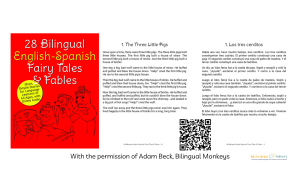
Bilingual books typically present the text in two languages side by side, either on the same page or on facing pages. This format allows readers to compare the languages directly. For teenagers and adults, this can be particularly helpful as they can easily reference the translation when encountering unfamiliar vocabulary or complex structures. Understanding this format is essential as it helps in developing a routine that enhances comprehension and retention.

Tip: Start by reading a paragraph or a section in your stronger language to grasp the context. Then, read the same section in your target language to notice differences in expression, vocabulary, and syntax.
 

Engage with the Text Actively

Active reading is crucial when working with bilingual books. This involves not just reading the text but also engaging with it through annotation, summarization, and reflection. For instance, after reading a passage, try summarizing it in the target language. This reinforces comprehension and helps in internalizing new vocabulary and grammar structures.

Tip: Use a notebook to jot down unfamiliar words or phrases and their translations. This practice aids memory retention and provides a quick reference for future reading sessions.

Leverage Cultural Contexts

Bilingual books often include cultural references that are unique to each language. For example, a word or phrase in one language might carry cultural connotations that do not directly translate into another language. Paying attention to these nuances not only improves language proficiency but also deepens cultural understanding.

Tip: When you encounter a culturally specific term or concept, take the time to research its background. Understanding the cultural context enhances your appreciation of the text and provides a richer learning experience.

Set Clear Goals

Whether you are reading for fluency, vocabulary acquisition, or cultural understanding, setting clear goals can make your reading sessions more productive. For teenagers and adults, this could mean focusing on particular aspects of language, such as idiomatic expressions or specific grammar structures.

Tip: Before starting a new bilingual book, define what you want to achieve. For instance, you might decide to focus on mastering verb tenses or expanding your vocabulary related to a particular theme.

Use Complementary Resources

Bilingual books are most effective when supplemented with other language-learning resources. This could include dictionaries, language apps, or even discussion groups where you can practice and discuss what you’ve read. For teenagers and adults, engaging with language communities can provide additional support and motivation.

Tip: Consider joining a book club or online forum focused on bilingual books. Discussing the text with others can provide new insights and help you see the language from different perspectives.

Conclusion

Bilingual books are a powerful tool for independent language learning, especially for teenagers and adults who are skilled readers and already have a foundational understanding of both languages.

By understanding the structure of these books, engaging actively with the text, leveraging cultural contexts, setting clear goals, and using complementary resources, readers can significantly enhance their language proficiency and cultural awareness.

References:

  • Baker, C. (2011). Foundations of Bilingual Education and Bilingualism. Multilingual Matters.
  • Cummins, J. (2000). Language, Power, and Pedagogy: Bilingual Children in the Crossfire. Multilingual Matters.
  • García, O. (2009). Bilingual Education in the 21st Century: A Global Perspective. Wiley-Blackwell.
  • Grosjean, F. (2010). Bilingual: Life and Reality. Harvard University Press.

This approach, integrating strategic reading techniques with cultural and linguistic insights, supports effective bi- and multilingualism and enriches the reader’s language learning journey.

Further readings:

How to Read Bilingual Books with Babies and Toddlers

How to Read Bilingual Books with Emergent Readers: A Guide for Simultaneous and Successive Bilinguals

I invite you to watch our video Reading Bilingual Books, or Not Reading Bilingual Books:

How to Read Bilingual Books with Babies and Toddlers

Reading bilingual books can be a powerful tool in fostering multilingualism, maintaining heritage languages and learning new ones. However, it is crucial to approach this activity strategically to maximize the benefits and avoid potential pitfalls. We read these books in a different way depending on the age and proficiency of the reader (or listener). 

Bilingual books are sometimes referred to as “Dual Language Books” or “Side-by-Side-Books”, i.e. with two different languages on the same page, with the second (!) language being the translation of the first. 

Although advanced readers, i.e. who already read at least in one of the languages or who are learning one of the two languages of the book, can compare vocabulary, language style, grammar and scripts, with babies and toddlers we should read bilingual books in a different way.

How to read bilingual books with babies and toddlers

I have noticed that in some videos on youtube, instagram and TikTok, people read the books by alternating the languages in one setting, eg. reading the text in language blue and right after that, the text in language red, before turning the page.

With babies, toddlers and preschool children it is advisable to not follow this strategy, but to rather read the book in one language per setting and person (i.e. by following the One Person One Language Strategy like mentioned here below).   

Here are some key strategies for effectively reading bilingual books with our youngest children.

Keep Languages Separate

One of the most important principles when reading bilingual books with our youngest ones, is to avoid mixing the two languages within a single reading session. This approach helps children clearly distinguish between the languages, preventing confusion and promoting better cognitive organization of each language system. Studies have shown that maintaining clear boundaries between languages can enhance bilingual children’s language development and proficiency (Genesee, 2001; De Houwer, 2009).

When we mix languages too freely – in each sentence or in each reading setting in a way that the sentence is first read in language blue and then in language red –  it can lead to children mixing languages within sentences or even words. While code-switching and code-mixing is  a very natural phase in bilingual and multilingual language acquisition, it is important for young learners to have consistent exposure to each language independently, particularly during the early stages of language acquisition (Muysken, 2000).

One Person One Language (OPOL) Strategy

For younger children, following the One Person One Language (OPOL) strategy is highly effective when reading bilingual books. This method entails each parent or caregiver consistently speaking and reading to the child in a specific language. For example, one parent might always read the English text, while the other reads the same story in Spanish.
This strategy reinforces language consistency and helps children build strong language associations with each parent or caregiver (Barron-Hauwaert, 2004).

Practical Tips for Reading Bilingual Books

  1. Select High-Quality Bilingual Books: Choose books that offer clear and well-translated texts in both languages. The content should be engaging and relevant to maintain the child’s interest and provide a meaningful context for language learning. Texts that with strong cultural references for one culture and language could have an alienating effect in the other language (eg. when for example in one book young children walk to school by themselves and this is not common in places the other language is used).  

  2. Establish a Routine: Create a consistent reading routine where you designate specific times for each language. For instance, read with your child in one language during the morning and let someone else read in the other language in the evening (this can be the other parent, a caregiver, an older sibling of the child etc.) 

  3. Use Visual Aids: Utilize the illustrations in the book to support comprehension. Point to pictures and discuss them in the target language to reinforce vocabulary and context. If each parent or caregiver reads the same book with the child but in their target language, the child will be able to link the picture (the character, animal, object etc.) to the respective language, which enhances the children’s metalinguistic competence. They will know that “the blue car” is “la macchina blu” or “das blaue Auto” in Italian, respectively in German.

  4. Interactive Reading: Engage your child by asking questions about the story, encouraging them to predict what happens next, or having them retell parts of the story in their own words. Again, make sure that in one setting you focus on one language, in the next setting, your partner or another caregiver focuses on the other language.

  5. Cultural Context: Provide cultural context for each language. Discuss the cultural significance of certain words, phrases, or story elements, which can enhance the child’s understanding and appreciation of both languages and cultures. 

  6. Be Patient and Consistent: Language learning is a gradual process. Consistency and patience are key. Celebrate small milestones and progress in the target language, but avoid comparisons of the different levels of comprehension and use across the different languages your child is acquiring and learning! Learning multiple languages should never be a power struggle or a competition!

By following these strategies with your youngest, emergent multilinguals, you can create effective learning opportunities in the target language.

Remember, the goal is to make language learning an enjoyable and enriching experience, fostering a lifelong love for both languages and cultures.

What if your child doesn’t like the bilingual book?

Not everyone likes bilingual books. When my children were young, they didn’t exist in our languages, so I translated their favourite books on the spot or stuck the translations on post-it notes on every page. The reason I ended up writing it all down was that my son would expect me to use exactly the same words and sentences – children are very smart!…
Needless to say that this was not the best solution: at some point the books were way too many for me and my husband to translate into our respective languages and our son developed a clear preference for specific books and storylines, so he would pick the book with the story he liked the most.

I have proofread and even provided translations of many bilingual books and must say that not all of them were equally appealing and convincing in both or all the languages. Although I understand that bilingual books can be a great option for some, I personally prefer books in their original language. My children are the same. If possible, they preferred and still prefer reading the books in their original language.

  • What is your take on bilingual books?
  • What bilingual books do you have?
  • Do you prefer having books in various languages instead?
  • Which ones do you use with your children?
  • Which ones do your children prefer?
  • Please share your thoughts and experience in the comments here below!

References

  • Barron-Hauwaert, S. (2004). Language Strategies for Bilingual Families: The One-Parent-One-Language Approach. Clevedon: Multilingual Matters.
  • De Houwer, A. (2009). Bilingual First Language Acquisition. Bristol: Multilingual Matters.
  • Genesee, Fred. (2001). Bilingual first language acquisition: Exploring the limits of the language faculty. Annual Review of Applied Linguistics. 21. 153 – 168.
  • Muysken, P. (2000). Bilingual Speech: A Typology of Code-Mixing. Cambridge: Cambridge University Press.

Further readings:

Using Bilingual Stories to “Teach un poquito de Español”

How to Read Bilingual Books: for Teenagers and Adults

How to Read Bilingual Books with Emergent Readers: A Guide for Simultaneous and Successive Bilinguals

Children are NOT translators or interpreters!

Children are NOT translators or interpreters!

The Complex Role of Children: Why They Aren’t Translators or Interpreters for Immigrant Parents

In many immigrant families, children often find themselves in the position of translators or interpreters for their parents, bridging the gap between their parents’ native language and the language of their new country.
While this may seem like a practical solution to communication barriers, the role of children as translators and interpreters can have profound implications on their development, family dynamics, and emotional well-being.

Children are not professional translators or interpreters, and expecting them to fulfill this role can place undue pressure and responsibility on their shoulders.

Here are several reasons why children should not be relied upon as translators for their immigrant parents:

Developmental Limitations:

  • Children may not have fully developed language skills, especially in complex or technical matters. Translating or interpreting nuanced concepts accurately requires a deep understanding of both languages, which children may not possess. 

Emotional Burden:

  • Acting as translators or interpreters can place immense emotional strain on children, who may feel burdened by the responsibility of conveying sensitive or difficult information between their parents and the outside world. They may also feel the weight of responsibility for accurately transmitting important messages.

Role Reversal:

  • When children assume the role of translators or interperters, traditional parent-child dynamics can become blurred. Children may feel a sense of role reversal, where they are compelled to take on adult responsibilities, potentially undermining their sense of identity and autonomy.

Educational Interference:

  • Serving as translators or interpreters can interfere with children’s education and personal development. Time spent translating detracts from opportunities for children to focus on their academic studies, and age appropriate activities and experiences, extracurricular activities, and social interactions critical for their growth and well-being.

Confidentiality and Privacy:

  • Children may inadvertently become privy to private or sensitive information shared between their parents and third parties during translation sessions, compromising their sense of privacy and security within the family unit.

Inaccuracy and Miscommunication:

  • Children may lack the language proficiency and cultural understanding necessary to accurately convey the intended message. Misinterpretations or mistranslations can lead to misunderstandings, conflicts, and potentially harmful consequences.

Impacts on Family Dynamics:

  • Relying on children as translators or interpreters can disrupt the natural flow of communication within the family. It may discourage parents from actively seeking language support or accessing professional translation services, ultimately hindering their integration and autonomy.

In conclusion, while children may possess language skills that make them convenient intermediaries for their immigrant parents, it is essential to recognize the limitations and potential consequences of this role. 

Instead of burdening children with translation and interpretation duties, immigrant families should prioritize accessing professional translation services, language classes, and community resources to facilitate effective communication and support the holistic development of their children.


By doing so, families can nurture healthy family dynamics, preserve children’s emotional well-being, and foster a supportive environment conducive to cultural integration and mutual understanding.


This campaign in the Netherlands in 2021 sat one step towards the child protection with regards to their role in the immigration and integration process of families.

  • Are children translating for their immigrant parents in the country you are living?
  • What is your experience and/or opinion about this?

I invite you to also read the following articles about this topic:
How Translating for My Parents Affected Me
Teenage Translators…
Immigrant children as translators

And please watch this video:

10 Habits to quit when raising children with multiple languages

Raising multilingual children is a rewarding yet complex task that requires thoughtful strategies and a supportive environment.

Every family needs to find what works best in the many (!) different stages of the children’s (and parent’s!) language development and learning.

We often worry when others make remarks or seem to know better what is good for us or our children. Especially when these are authorities or professionals, we can start doubting if what we do is “right” or if we are maybe “doing something wrong”.
Please always put your family, your children first: observe what works for you, what you can and want to handle, and then consider adjusting or changing something.

Based on my now lifelong experience of being multilingual and more than 20 years of raising multilinguals and supporting multilingual families,  I share ten habits you should quit to foster a successful multilingual upbringing:

1 Expecting Immediate Results:

Language development takes time. Avoid putting pressure on your children to “speak perfectly” or “switch languages instantly” (Paradis, Genesee, & Crago, 2011). 

2 Being Inconsistent:

Consistency is crucial. Especially in the early years! Switching strategies or languages frequently and abruptly (i.e. without a need for it or without your children understanding the reason for it) can confuse children. Stick to your chosen approach, whether it’s One Person One Language (OPOL) or Minority Language at Home (MLAH) (Barron-Hauwaert, 2004), or, later, Time and Place (T&P) or a combination of them.

I invite you to watch my video about code-switching and code-mixing and Family Language Strategies, as well as different kinds of multilingual families.

3 Correcting Every Mistake:

Constant correction can discourage children. Focus on communication rather than perfection. Natural exposure and use will gradually refine their skills (Lightbown & Spada, 2013; Lanza, 1997 & 2004; Meisel, 2019; Nakamura, 2020).

I share some effective discourse strategies for multilingual families in this video.

4 Overloading with Languages:

Introducing too many languages at once can overwhelm our youngest children. Especially if they are transmitted by the same person and there is no apparent need for the children to learn them. Prioritize and gradually introduce additional languages based on their capacity and context (De Houwer, 2009, 2019, 2021).

I invite you to watch my videos about what language to speak first with your child, why it is never to late to add your language later, and whether “earlier is better”

5 Ignoring the Community Language:

Balancing heritage and community languages is essential. Ensure your children are proficient in the dominant language of your environment to facilitate social integration and academic success (Cummins, 2000). It is very motivating for our children to see us parents also improve our language skills in the community language. 

In this video I share some tips about how to embrace the community language also at home.

6 Relying Solely on Formal Education:

Language learning is enhanced through everyday interactions, play, and cultural experiences. Creating a rich linguistic environment beyond the classroom (Grosjean, 2010) is essential for families who don’t use the community or school language at home. This means: provide opportunities where your children can use and improve their language skills with other children of different age groups, adults, about a wide range of topics. Motivation is key, and our children are even more motivated to improve their language skills in the school language when they experience us using it as well. When we share our learning experience, and what it means to improve language skills (or any skill for that matter!), our children will find it very natural to do the same.

7 Limiting Language Use to Specific Contexts:

Encourage the use of all languages in various settings. This flexibility enhances proficiency and confidence (Bialystok, 2011). We all learn languages from different people, for different purposes and to different extent. If we want our children to improve their language skills in a specific target language, we need to create opportunities to do so.
Same goes for using all their languages if they want to! I call this the paradox of raising multilingual children
In this video I talk about this paradox (mainly referring to our youngest children).

Once our children are older we can easily switch between all the languages we share. I do so with my now adult children, and, of course, my multilingual friends.

8 Comparing Your Children to Others:

Every child’s language journey is unique. Comparisons can create undue stress and demotivate them (Döpke, 1992). Whenever you feel that other children are “better” in using the target language, try to take a step back and focus on your children and their individual development.
Is there any sign of stagnation that can’t be explained or justified by a major change (move, change of daycare or school, transition period, change in the family etc.)?
Take notes of your child’s developmental stages (no need to do this daily, once per week or occasionally is ok and will help also explain your child’s development during  medical visits) and have a look at the big(ger) picture. 

Should you still worry, you are always welcome to schedule a consultation with me, ask a question in my private facebook group Multilingual Families, or take one of my self paced online courses where you can find out what you can do. 

9 Underestimating the Power of Play:

Play is a natural and effective way to learn languages. Engage in games, storytelling, and songs to make learning enjoyable (Toth, 2010). This not only applies to the early years!

Please have a look at my Toolbox for Multilingual Families and the youtube channel Activities for Multilingual Families  where we share activities and games that foster understanding, speaking, reading and writing in 0 to 15+ children.

10 Neglecting Your Language:

Maintain your proficiency in your heritage language and improve your knowledge by staying up to date with how your language evolves and changes. Children need strong role models and consistent input from fluent speakers (Yamamoto, 2001).

You are always welcome to join my monthly free online meetings where we also share how we, parents, can keep our languages “alive and thriving” whilst living abroad!

Avoiding these habits can create a supportive environment for your children, fostering effective multilingualism and intercultural competence.

References:

  • Barron-Hauwaert, S. (2004). Language Strategies for Bilingual Families: The One-Parent-One-Language Approach. Multilingual Matters.
  • Bialystok, E. (2011). Bilingualism in Development: Language, Literacy, and Cognition. Cambridge University Press.
  • Cummins, J. (2000). Language, Power, and Pedagogy: Bilingual Children in the Crossfire. Multilingual Matters.
  • De Houwer, A. (2009). Bilingual First Language Acquisition. Multilingual Matters.
  • De Houwer, A. (2019). Input, context and early child bilingualism: implications for clinical practice. 
  • De Houwer, A. (2021). Bilingual development in childhood. Cambridge: Cambridge University Press.
  • Döpke, S. (1992). One Parent, One Language: An Interactional Approach. John Benjamins Publishing.
  • Grosjean, F. (2010). Bilingual: Life and Reality. Harvard University Press.
  • Lanza, Elizabeth, Language Mixing in Infant Bilingualism. A Sociolinguistic Perspective. Oxford, OUP, 1997.
  • Lanza, Elizabeth, Language Mixing in Infant Bilingualism: A Sociolinguistic Perspective, Oxford, OUP, 2004.
  • Lightbown, P. M., & Spada, N. (2013). How Languages are Learned. Oxford University Press.
  • Meisel, Jürgen, Bilingual Children. A Guide for Parents, CUP, 2019.
  • Nakamura, J. (2020). Multilingualism in Children: Strategies for Effective Communication. Journal of Multilingual and Multicultural Development, 41(3), 256-272.
  • Paradis, J., Genesee, F., & Crago, M. B. (2011). Dual Language Development & Disorders: A Handbook on Bilingualism and Second Language Learning. Brookes Publishing.
  • Toth, P. D. (2010). The Impact of Extended Instruction and Interactive Discourse on the Second Language Acquisition of Grammatical Structures. Language Teaching Research.
  • Yamamoto, M. (2001). Language Use in Interlingual Families: A Japanese-English Sociolinguistic Study. Multilingual Matters.

Parental Discourse Strategies

As a multilingual family navigating the complexities of raising children in a linguistically rich environment, one common challenge is encouraging children to respond in the target language. 

To foster a balanced and effective multilingual development, employing specific conversational strategies can be particularly beneficial. 

5 parental discourse strategies

Elizabeth Lanza (1997, 2004) identifies 5 parental discourse strategies:

  • minimal grasp
  • expressed guess
  • adult repetition
  • move on
  • adult code-switch

These strategies are on a monolingual–multilingual continuum, meaning, that on the monolingual end of the continuum, the parent speaks only one language with the child and aims to create a monolingual context, whereas on the bilingual end of the continuum, the parent uses both languages the child is learning, allowing for a bilingual context to be established.

1 The Minimal Grasp Strategy

The minimal grasp strategy involves the adult pretending not to understand the child when they respond in a language other than the target language.

Minimal grasp does not mean that we ignore what the child is saying! With this strategy we want to prompt the children to switch to the desired language in order to ensure that our children are understood.

Example:

Parent: “Was hast du heute in der Schule gelernt?” (What did you learn at school today?) 

Child: “I learned about space.” 

Parent: “Entschuldigung, ich verstehe nicht. Es ist so laut hier” (Sorry, I don’t understand. It’s so loud here…) 

Child: “Wir haben über das Weltall gelernt.” (We learned about space.)

With older children who are more aware of their language use and with whom you have negotiated the use of the target language (in this example, German) with you or in given settings (at home for example), you can also say “Kannst du das bitte nochmal sagen? Auf Deutsch?” (Can you please say this again? In German?).

The minimal grasp strategy leverages the child’s natural desire to be understood and communicates that the target language is necessary for (better) comprehension.

Denying that we understand what our child is saying can stop the communication and affect the relationship. “Pretending not to understand the other language is not an option I would recommend. In fact, it is not a discourse strategy that can serve the purpose of maintaining temporarily a monolingual situation. It rather creates a permanently monolingual setting. If a parent really does not speak the child’s other language, this is obviously the only option.” (Meisel 2019, 121) However, if the parent does understand and use the other language, the child will not understand why the parent insists on one language only.

With minimal grasp, Elizabeth Lanza means that during the conversation we hold on a second, say something like “what did you say?” or “what do you mean?”. We shortly interrupt the conversation with a questioning “hm?” which can function as a trigger for the child to switch to the expected language. I personally used this strategy with my children and it works very well.

2 The Expressed Guess Strategy

The expressed guess strategy involves the adult making an educated guess about what the child is saying in the non-target language and then asking the child to confirm or correct the guess in the target language. This not only demonstrates understanding but also encourages the child to respond in the desired language.

This is an effective strategy as it involves active hearing and true commitment to understand what the child is saying. It also gives the children to find other words, paraphrase what they are saying, and keeps the conversation flowing.

Example:

Parent: “Qu’est-ce que tu veux manger pour le dîner aujourd’hui?” (What do you want to eat for dinner?) 

Child: “Ehm… lasagna, o una pizza…, o spaghetti al pesto!”

Parent: “Ah, tu veux dire que tu voudrais manger de une lasagna ou bien une pizza, ou des spaghettis au pesto, n’est-ce pas?” (Ah, you mean you would like to eat lasagna or pizza, or spaghetti al pesto, right?) 

Child: “Oui, je ne sais pas encore… j’ai envie de manger une lasagna. On a eu une pizza samedi, alors…” (Yes, I don’t know yet… I would like to eat lasagna. We had pizza on Saturday, so…)

In this scenario, the parent shows understanding of the child’s preference but nudges them to articulate it in French. 

The expressed guess strategy combines comprehension with correction, facilitating language learning in a supportive manner.

3 The Adult Repetition Strategy

The adult repetition strategy involves the adult repeating what the child has said in the non-target language in the target language and then pausing to allow the child to repeat or continue in the target language. This strategy serves as a model for the correct linguistic form and encourages the child to follow suit.

Example:

Parent: “Wat wil je doen vanmiddag?” (What do you want to do this afternoon?) 

Child: “I want to go to the playground with my friends.” 

Parent: “Je wilt met je vrienden naar de speeltuin.” (You want to go to the playground with your friends.) 

Child: “Ja, ik wil buiten spelen.” (Yes, I want to play outside.)

Here, the parent models the correct response in Dutch and pauses, giving the child the opportunity to repeat or elaborate in the target language. This strategy reinforces correct language usage through repetition and gentle prompting.

Applying These Strategies in Everyday Contexts

Implementing these strategies consistently can significantly impact a child’s language development. Each strategy has its own unique benefits and can be applied in various contexts depending on the child’s proficiency level and the linguistic environment.

Practical Tips:

  • Consistency is Key: Regular application of these strategies helps children understand the expectations and increases their comfort and proficiency in the target language.
  • Positive Reinforcement: Praise and encouragement when the child responds in the target language can boost their confidence and motivation.
  • Patience and Persistence: Language learning is a gradual process. Be patient and persistent in using these strategies, even if progress seems slow at times.

Research Insights

Janice Nakamura’s research highlights the effectiveness of these strategies in promoting language use among multilingual children. Nakamura emphasizes that such strategies create a supportive linguistic environment that encourages active use and practice of the target language (Nakamura, 2020).

Her studies show that the minimal grasp strategy, in particular, can significantly increase the likelihood of children switching to the target language as they strive to be understood by their caregivers. It is important to note that the minimal grasp strategy never consists in ignoring what the child is saying! 

Similarly, the expressed guess and adult repetition strategies not only provide linguistic input but also validate the child’s attempts at communication, thereby fostering a positive and effective language learning experience.

4 The Move On and Adult Code-Switching

The move on and the adult code-switching strategies are not efficient strategies to encourage the child to respond in the desired language.

When moving on, the parent ignores the child’s use of the other language and a dual-lingual conversation takes place:

Parent: “Wie war dein Tag heute?” (How was your day?)
Child: “It was ok”
Parent: “Was habt ihr heute in Englisch schönes gelernt?” (What did you learn in the English lesson?)
Child: “We talked about “To kill a Mockingbird””
Parent: “Worum geht es da?”
Child: “It’s a novel about about a girl named Scout. Scout and Jem Finch, and their father Atticus, a lawyer, who defends a Black man who is falsely accused…” 

The adult code-switching strategy consists in the adult using the language the child has introduced which leads the conversation continuing in the language chosen by the child. 

Parent: “Cos’hai imparato di bello a scuola oggi?” (What did you do at school today?)

Child: “I learned about the Lorenz force.”

Parent: “Oh, that was in Physics then. What did you learn?”

Child: “Yes, we looked at the charged force on particles when moving”

Parent: “Oh, ok. You looked at the electric and magnetic fields…”

Child: “Yes, it’s interesting to see how the charged particles move and we learned the basic formula”

Parent: “Oh that sounds interesting, maybe you can explain it to me?”

These last two strategies are more common among parents and older multilingual children who choose the language that is best suited for the children to communicate about particular topics.

We can use a mix of all these strategies and see which one works best for us, our child, our family, and the situation we are in. With our youngest ones we may want to use a combination of the first three ones, as they are all focusing on our children changing to the target language – usually the minority language or the language we want to help them improve their language skills.

The first three strategies interrupt the conversation flow, therefore it is advisable to make sure that this doesn’t lead to a stop of the conversation! Connecting with our children, speaking with them should always be first priority!
If you start applying these strategies from early on, your children will get used to them and respond in the desired way and you do not have to negotiate or explain them every time.  

  • Which strategy do you prefer?
  • Which strategies work best with your children?

Please let us know in the comments.

I invite you to watch the following videos: 
about this post,
– of an interview we did with Prof. Elizabeth Lanza
– of an interview we did with Prof. Janice Nakamura
– a video we did at Activities for Multilingual Families 

Discourse Strategies

4 Videos

References:

De Houwer, Annick,Language Choice in Bilingual Interaction”, in De Houwer, A. & Ortega, L. (Eds.) The Cambridge Handbook of Bilingualism, 2019, 324-348.

De Houwer, Annick, “Why Do So Many Children Who Hear Two Language Speak Just a Single Language?” in Zeitschrift für Interkulturellen Fremdsprachenunterricht 25 (1): 7-26.

De Houwer, Annick & Nakamura, Janice, Developmental Perspectives on Parents’ Use of Discourse Strategies with Bilingual Children. in: Multilingualism Across the Lifespan, Røyneland U. & Blackwood R. (Eds.), Routledge, 2022, 31-55.

Lanza, Elizabeth, Language Mixing in Infant Bilingualism. A Sociolinguistic Perspective. Oxford, OUP, 1997.

Lanza, Elizabeth, Language Mixing in Infant Bilingualism: A Sociolinguistic Perspective, Oxford, OUP, 2004.

Meisel, Jürgen, Bilingual Children. A Guide for Parents, CUP, 2019.

Nakamura, J. (2020). Multilingualism in Children: Strategies for Effective Communication. Journal of Multilingual and Multicultural Development, 41(3), 256-272.

Risorse per l’italiano

Il ricorso a risorse online è spesso l'unico modo per provvedere l'input linguistico necessario per i nostri figli che crescono all'estero. 

Quando le scuole non danno il supporto desiderato e adeguato all'insegnamento dell'italiano e le risorse in loco non sono sufficienti, la maggior parte delle famiglie non vede altra soluzione che la TV, DVD o l'internet.

Ma trovare siti con materiale didattico e letture adeguate all'età dei nostri figli, che sia anche interessante ed educativo, è un'impresa spesso ardua.

Ecco perché ho deciso di dedicare questo spazio alla raccolta di siti online non soltanto per l'insegnamento dell'italiano, ma anche per l'apprendimento naturale e gioioso (e giocoso!) dell'italiano per le famiglie che vivono all'estero.

Questa è una lista di risorse che aggiornerò regolarmente. 

Se conosci un sito che ritieni utile e importante per aiutare i nostri figli ad apprendere e imparare l'italiano, ti prego di o lasciare un commento qui di seguito o di mandarmi un mail a info@UtesInternationalLounge.com. ~ Grazie mille!

Filastrocche, racconti, giochi, canzoni, fiabe, indovinelli, ninne nanne... per i più piccoli:

Siti con attività interattive (bambini dai 5 anni in poi; o assistiti da genitori):

  • Su RaiPlaySound.it puoi trovare varie playlist (tra l'altro di Gianni Rodari) Ad alta voce audiolibri sul sito della Rai Play Radio per bambini Favole al telefono di Gianni Rodari (letto da Manuela Mandracchia)  
  • The Italian Experiment è un sito che raccoglie filastrocche (Il Polletto Carletto, Il Gabbiano e la Balena, I Tre Porcellini, Riccioli d'oro e i tre orsi, Cappuccetto Rosso etc.) con materiale audio e video.
  • Fabulinis è un sito che raccoglie storie, rime e scioglilingua in Italiano. Le storie sono accessibili anche come audiofiles.
  • Date anche un'occhiata a Spotify. Potete trovarci varie risorse che abbiamo raccolto nel quadro di un progetto Erasmus+ PEaCH for bilingual children – e se i vostri figli sono alla ricerca di racconti non-fiction, Raccontascienza potrebbe essere una soluzione.
  • Lunii, un sito sul quale trovi tante risorse, tra cui anche un app gratuito per il computer, Il Luniistore, "dove potrai gestire la tua biblioteca audio, acquistare nuovi audiolibri interattivi e trasferirli nella tua Fabbrica delle Storie".

Siti italiani con risorse interessanti per i nostri figli:

Sul sito Progetto Ipazia potete trovare testi per classi di terza, quarta e quinta della primaria, con risorse didattiche storie di donne (scienziate ecc.). 

La Zanichelli offre una vasta gamma di risorse, tra cui anche siti per la scuola, e trovi video educativi sul canale youtube della Zanichelli.

Gallucci Editore offre una vasta gamma di libri per bambini di tutte le età. Di tanto in tanto ci puoi trovare anche libri gratuiti da scaricare direttamente!

Per i ragazzi più grandi (11 anni in su), l'Arcipelago Educativo offre risorse di vario genere.

Giunti Scuola

Il Castoro

Uovonero

Siti educativi su youtube

Editoriale Scienza

Per gli adulti...:
E per i genitori che amano i audiobooks, guarda sul sito della Rai.

Se conosci un ulteriore sito con risorse in Italiano per bambini, adolescenti o adulti, fammi sapere inviandomi un messaggio a info@UtesInternationalLounge.com.

Preparing Multilingual Teens for Home Country Visits


Are you visiting your heritage country with your teenagers?
When our teenagers grow up abroad and we are the only ones or one of the few they get to speak our language with, meeting family, friends and peers who are immersed into that language is not easy.

When my children were preteens, I observed a shift in their confidence to use our language with extended family, friends and peers when we visited for holidays. They were much more conscious about the words, the formal and informal language used and expected from them.
In order to feel more confident, I tried to lower the threshold by sharing about the people they would meet, the situation, the expectations (when it was a not so familiar place or situation), but also how we approach people we don’t know and want information or help from.


I share some practical tips and prompts here below, and in a video on our youtube channel Activities for Multilingual Families

Especially if the time we spend immersed in a language is limited, we may want to make the most out of the experience.

I always found it helpful to get prepared for all kinds of situations, especially the awkward ones...

As teenagers we all don't want to stand out. We want to blend in. This mainly means to look like the others and sound like them, talk like them.

We can prepare our teenagers to have conversations in their home language when visiting their country of heritage. With a bit of preparation, they can feel confident and ready to engage with locals. Here are three practical prompts to help them get started.

Role-Playing Real-Life Scenarios

One of the most effective ways to help teens become comfortable with their home language is through role-playing real-life scenarios. This method is both fun and practical, allowing teens to practice specific vocabulary and cultural nuances.


Scenario: Visiting a Local Market

Let's encourage our teen to imagine they are at a local market. Practice asking vendors about prices, quality, and origins of products. For example:

  • "How much does this cost?"
  • "Is this fresh?"
  • "Where is this from?"

Role-playing these scenarios helps teens learn the necessary phrases and vocabulary, while also giving them a feel for the cultural interactions typical in such settings. According to research, role-playing can significantly improve language proficiency and confidence (Dörnyei, 2014).


Preparing for Family and Social Gatherings

Family and social gatherings are excellent opportunities for teens to practice speaking their home language in a supportive environment. Preparing for these events can help reduce anxiety and increase confidence.

Practice Introductions and Conversations

Have your teen practice introducing themselves and sharing details about their life. They might say:

  • "Hi, I'm [Name]. I live in [Country], and I love [Hobby]."
  • "What’s new in your life?"
  • "Can you tell me more about our family history?"

By rehearsing these introductions and questions, teens can enter family gatherings ready to engage in meaningful conversations. This preparation is crucial for building conversational skills and comfort in social settings (Pavlenko & Blackledge, 2004).


Engaging in Social Activities

Engaging in social activities with local peers can be a fun and effective way for our teens to practice their home language. These interactions often revolve around shared interests, making the practice feel more natural and enjoyable.

Find Common Interests

Let's encourage our teens to think about common interests and prepare open-ended questions such as:

  • "What do you like to do for fun?"
  • "Have you seen any good movies lately?"
  • "What are your favorite local spots?"

Talking about shared interests helps keep conversations flowing naturally and builds confidence in using the home language in a relaxed setting. This approach aligns with the communicative language teaching (CLT) method, which emphasizes interaction as both the means and the ultimate goal of learning a language (Richards, 2006).


Conclusion

There you have it – three practical prompts to help multilingual teens prepare for conversations in their home language when visiting their country.

Role-playing real-life scenarios, preparing for family gatherings, and engaging in social activities can make all the difference!


References

  • Dörnyei, Z. (2014). Motivational Strategies in the Language Classroom. Cambridge University Press.
  • Pavlenko, A., & Blackledge, A. (2004). Negotiation of Identities in Multilingual Contexts. Multilingual Matters.
  • Richards, J. C. (2006). Communicative Language Teaching Today. Cambridge University Press.


By integrating these strategies into your preparation, you can help your teens navigate their home country visits with greater ease and confidence.


Happy travels!


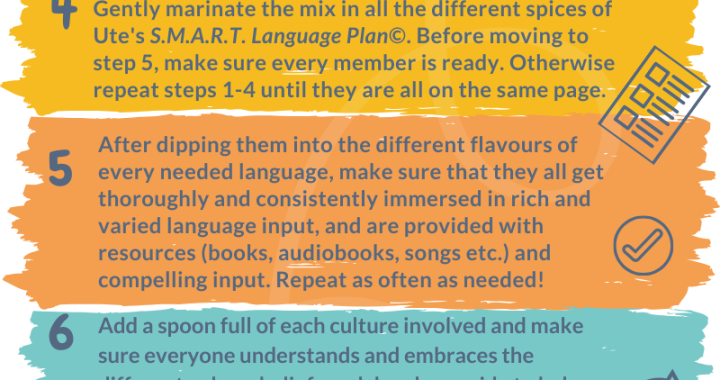
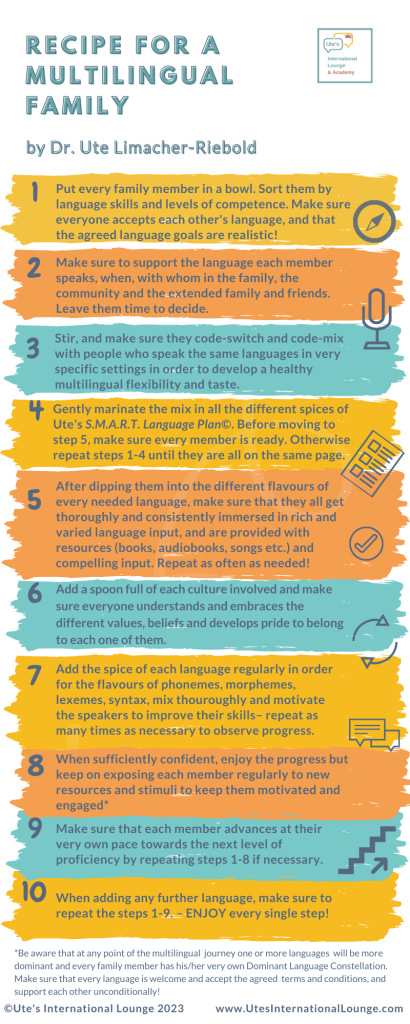
Recipe for a multilingual family


This is the recipe for a multilingual family that I share with some parents I work with. It is a fun way to explain the hard work we are doing!


Embrace every single step and enjoy the process!


  • At what step are you at the moment?
  • What are you finding particularly difficult or exciting?


Please let me know in the comments.

If you want to know how to successfully raise your children with multiple languages, have a look at my self paced online course for parents of 0 to 4, or 4 to 10 year old children.


Quizzes and Games about Multilingualism

You can find several quizzes and games about Multilingualism online. In this post I share some I found particularly interesting:


If you know a game or quiz that should be added to this list, please let me know in the comments here below! 

Effective strategies to support Additional Language Learners

Supporting Additional Language Learners (ALL) students in a multilingual classroom requires tailored approaches that acknowledge their unique linguistic needs and challenges. Additional Language Learners are all those for whom the school language represents an additional language to those they learned or acquired before. Many studies focus on EAL students, i.e. those who have English as Additional Language, but what I am sharing in this post can be applied to students of all languages, i.e. German/Dutch/Romanian/Italian etc. as Additional Language (AL).

By implementing effective strategies, educators can create an inclusive learning environment where AL students thrive alongside their peers.

Here are some proven methods to enhance support for AL learners:


1  Utilize Visual Learning:

Incorporate visual aids such as labeled images, videos, and gestures to supplement verbal instruction. Visual cues aid comprehension and facilitate understanding of new concepts for AL students, while benefiting all learners by providing multiple modalities for learning.

Important:

When it comes to using gestures and body language, it is important to know what gestures are used by the students in their respective home languages.


2  Strategic Seating Arrangements:

Seat AL students near the front of the classroom to improve visibility and audibility. Pairing them with proficient speakers can serve as language models and foster peer support.

Important:

Make sure that the students know why they are seated in front, and that they can choose their seats and have a say when it comes to peers or language buddies sitting next to them.


3  Promote Group Work:

Encourage collaborative activities to boost engagement and provide opportunities for AL students to practice speaking in a supportive environment. Select peers who exhibit patience and serve as positive language role models for effective group interactions.

Important:

Make sure to form a supportive and encouraging group around the AL students, and allow each student to communicate in their very own way – by using their other language, gestures, actions instead of words, should they not be ready to speak yet. For students who struggle with communicating with peers, engaging them in an activity that you, the educator, initiates, can be more motivating. Smaller groups will be less intimidating.


4  Adapt Teaching Style:

Adjust your pace of speech, enunciation, and instructional approach to accommodate AL students. Allow additional processing time, repeat instructions. Try to avoid or provide very clear explanations of idiomatic expressions and culturally specific terms.

Important:

Know what pace in speech and intonations the students are used to in their other languages: if they are used to turn takings with clear gaps or rather overlapping ones, they will feel more comfortable with a similar style in the school language. Pacing down doesn't always mean to choose a simplified vocabulary. Depending on the student's level of proficiency, a clearer enunciation – i.e. sounding out all syllables of the word – might be more helpful.


5  Embrace Other Language Use:

Recognize the value of students' other languages as a foundation for language acquisition and learning. Allowing the use of their other languages in group discussions and translation aids like dictionaries can foster confidence and deeper understanding.

Important:

Not all AL students are literate in their first languages, others have been schooled in another additional language first.
Some can speak, but not read or write, some can read, but not write, and others can speak, read and write to various level of proficiency. Be aware of the students' individual capacities to avoid making them feel guilty not to be able to do the task in their other languages. 


6  Preparation Prior to Lessons:

Provide learning materials in advance to AL students to facilitate pre-learning and comprehension. Advance access to articles, videos, or key vocabulary enhances readiness and boosts confidence.

Important:

It is advisable to involve parents whenever possible, to facilitate access to the learning materials, and invite them to discuss the topic with the students before the lesson in order to set the context of the topic.


7  Respect Silent Periods:

Understand that language acquisition involves stages, including a silent period where students may hesitate to speak. Avoid pressure to verbalize prematurely and allow AL learners to express themselves at their own pace.

Important:

Should the silent period persist more than 6 months despite you using various strategies mentioned in this post, I advice to search the help of a Speech and Language Therapist or a Child Psychologist.


8 Cultural Sensitivity:

Learn about the students' names, backgrounds, and cultural norms to create a welcoming atmosphere. Respect cultural differences in communication styles and non-verbal cues to foster inclusivity.

Important:

Knowing how to pronounce the names of your students should be a priority: it shows them that you care, that you see them and that you make the effort to call them by their name. On the Nameshouts site you can look up ways to pronounce names for example. Have also a look at the video on our youtube channel about how to say my name


9 Effective Feedback:

Offer constructive feedback that reinforces positive efforts and gently corrects language errors. Employ techniques such as modeling correct structures and praising attempts at challenging language tasks.

Important:

Avoid correcting mistakes every time, instead, repeat and expand what the students say, or reformulate the student's mixed utterance by way of an expressed guess or question.


10 Address Challenging Behavior with Empathy:

Recognize that frustration with language barriers may manifest as challenging behavior. Respond with empathy, understanding, and appropriate behavior management techniques to support AL students emotionally.

Important:

Learning a new language means to be allowed to make many mistakes, to struggle and be frustrated at times. Create an encouraging environment for the students and, whenever necessary, remind them what they are capable of, what they already have achieved.


11 Support independent Learning:

Guide students to resources like bilingual dictionaries, simplified texts, and online language learning platforms to facilitate independent study and skill development.

Important:

Use scaffolding techniques to provide students the support they need as well as the autonomy and independence to continue learning at their own pace and in their very own way.


12 Engage Parents:

Foster effective communication with parents by offering translated materials, encouraging involvement in school activities, and providing updates on curriculum topics and resources for home support. You can create informative word maps on the website of your school, or for the year group you are teaching for parents to consult whenever possible.*

Important:

No matter the age of the students: when they are still learning the school language, the support and help from parents is beneficial for academic success and a more balanced and healthy approach to the whole learning experience and outcome. 


13  Continuous Professional Development:

Invest in ongoing AL training for educators to enhance your own understanding of effective teaching strategies and stay abreast of best practices in language acquisition and learning.

Important:

If you haven't done so yet, learn a new language. When we learn new languages we can better understand what our students are going through and can be more supportive of their learning.


14 Utilize Assessment Frameworks:

Implement assessment frameworks tailored to AL students' needs to gauge proficiency levels and inform targeted support strategies and resource allocation.

Important:

Make sure that the assessment frameworks are up to date and take into account the diverse language and cultural background of the individual student.

By implementing these strategies, educators can create a supportive and inclusive learning environment where AL students can thrive academically and linguistically.
Effective support for AL learners not only promotes language acquisition but also fosters their overall academic success and socio-emotional well-being.


* Create opportunities for parents to share their cultures and languages, ex. during International Day, by celebrating particular festivities, International Day of Languages etc. You can invite parents to talk about their country, let them share about subject areas (ex. if you talk about volcanos in Iceland, a parent who is geologist can share their expertise). Anything that fosters inclusion, diversity and community will make the whole family feel welcome, seen and appreciated with their diverse cultural and linguistic backgrounds. Schools are the second home for international parents.  As educators you can collaborate with the parents to ensure the best context for the children to develop in a healthy way.


Language Consultancy for Daycares and Schools