Dutch education explained

Every country has its own education system. The Netherlands is no exception to that.


Primary school


In the Netherlands, primary school starts with kindergarten at age four. From age five it is compulsory to attend school fulltime. There are hardly any private schools in the Netherlands.  Schools can have a certain religious orientation such as Protestant, Catholic, Islamic, Hindu, any other religion or no religion at all.  In addition, schools can follow a certain educational philosophy such as Montessori, Jenaplan, Dalton or Vrije School (internationally also known as Waldorf).  Children with special educational needs will find offerings more frequently in primary than in secondary schools.

All primary schools teach English, at least in groups seven and eight (ages 11-12). Between 2014 and 2023 took place an experiment with bilingual primary education, in which teachers spoke English during 30-50% of the time: “The research shows that the TPO schools score at least as well on Dutch language skills and arithmetic and that their English language skills are significantly higher. These research results have led to a continuation of bilingual primary education in the Netherlands”. [Please find more detailed information on the NUFFIC website

At the age of 12 (in group eight of primary school) children get advice which kind or secondary education is a best fit. This advice is based on the results of an independent national test and information the school has gathered during the child’s eight years of primary school. Schools have a system in which they register each child’s progress in all subjects. A child may be good at arithmetic in general but not good in multiplying or it takes a lot of time to understand it; another child may have problems with spelling and grammar.

It is often said in the Netherlands that children have to choose a secondary education level at a very young age. This may be true, but the level chosen does not necessarily have to be the final level. When you have finished secondary school at a certain level and your grades are good enough, you can continue at a higher level.

Secondary school

There are four options for secondary school:

  • Practical education (praktijkonderwijs): This takes five years. It is for children for whom VMBO (see below) is too difficult. Every child follows an individual package of subjects. Most children may start working when they have finished this school, while some go on to medium level vocational education (middelbaar beroepsonderwijs, MBO)
  • Preparatory secondary vocational education (voorbereidend middelbaar beroepsonderwijs, VMBO): Within VMBO there are four levels. They all take four years. Depending on the level, children focus on practical training, theoretical training or a combination of both. VMBO prepares children for medium level vocational education (middelbaar beroepsonderwijs, MBO)
  • Senior general secondary education (hoger algemeen vormend onderwijs, HAVO): This takes five years and prepares students for universities of applied science (hoger beroepsonderwijs, HBO) During the third year, the student chooses one out of four streams (so-called profielen). In the last two years, the student follows subjects for the stream he/she has chosen; some subjects are compulsory for everyone and at least one subject is of the student’s choice (depending on what the school offers). Streams available are: culture and society, economy and society, nature and technique, nature and health.  The student takes exams in seven subjects.
  • Pre-university education (voorbereidend wetenschappelijk onderwijs, VWO): This takes six years and prepares students for research universities. During the third year, the student chooses one out of four streams (so called profielen) . Streams available are: culture and society, economy and society, nature and technique, nature and health. In the last three years the student follows subjects for the stream he/she has chosen; some subjects are compulsory for everyone and at least one subject is of the student’s choice (depending on what the school offers). The students take exams in eight subjects. Some VWO schools also offer Latin and ancient Greek from the first year on. Such a VWO school is called   In these schools it is compulsory to take the exam in either Latin or ancient Greek.

There are secondary schools for HAVO/VWO that offer a so-called Technasium.  This kind of secondary education emphasises research and development and it is compulsory to take the exam in this subject.

Some secondary schools (VMBO, HAVO and VWO) offer bilingual education. In the first few years, some lessons are in English. As the national, central exams are in Dutch, the lessons in the higher classes are mainly in Dutch. The subjects that are not part of the national, central exam are usually taught in English.

Many bilingual schools offer the possibility to take the IB (International Baccalaureate) English B Higher Level Exam (if the student is following HAVO) or the IB English A Language and Literature Higher Level Exam (if the student is following VWO).  This means that the student’s English is at the level of a near-native speaker. It offers good preparation for tertiary study that is partly or completely taught in English. – Bilingual education is aimed for children who have Dutch as a native language and want to improve their English.

For more detailed information about Dutch secondary education, please look at the website of the Ministry of Education.

Tertiary education


After secondary school there are several options:

  • Medium level professional education (middelbaar beroepsonderwijs, MBO) for those who have finished VMBO. Like VMBO this has four levels.
  • University of Applied Science (hoger beroepsonderwijs, HBO) for those who have finished HAVO (or MBO at the highest level)
  • Research University (universiteit) for those who have finished VWO ( or first year -called propedeuse – at HBO)

When a student finishes at a University of Applied Science, a bachelor’s degree is conferred. If a student wants to obtain a master’s degree he/she can attend a Research University. For some studies at Universities of Applied Science there is also the possibility to obtain a master’s degree. If the student wants to pursue a career as a researcher, a PhD can be an option. Usually a student does a research master’s to prepare for this.

For students who have finished MBO and don’t want to commit to a full HBO study, there is an opportunity to do a two-year study and obtain an associate’s degree. The level is in between the highest level of MBO and the HBO bachelor’s.  After obtaining an associate’s degree the student can either start working or continue studying for a bachelor’s degree.

Special education

In the Netherlands children go to a regular school and get extra support there if necessary. However, sometimes a child needs more support than a regular school can offer.

In such situations a child can be referred to special education. Find some more details about this here.

There are two kinds of special education:

  • Special primary education (or Special Basisonderwijs (SBO)) The difference with a regular primary school is that the classes are smaller and there are more people who can offer support. The children take the same national test at the end of primary school. 

This type of education especially caters for children who have more serious learning difficulties, a low IQ, or behavioral problems. (Xpat)

  • Special education for primary school or secondary school (VSO). This is special needs education. These schools are aimed for:
    • Cluster 1: children who are blind or are visually impaired
    • Cluster 2: children who have serious communication problems (are deaf, have severe hearing problems, speech disorders etc.)
    • Cluster 3: children who have cognitive or physical disabilities or a chronic illness that makes going to school difficult
    • Cluster 4: children with psychiatric or serious behavioral issues (autism, ADHD, PDD-NOS, ODD, CD, etc.). (please find more details about this on the Xpat site)

All schools for special education have to make a development plan for every child. Such a plan is made together with the parents. It contains the goal to be achieved and the way it will be achieved. Goals can be: obtaining a diploma, finding a job or finding a place in an organisation that offers meaningful activities during the day.

In the Netherlands there is one international school that focusses only on special education: Lighthouse Special Education in The Hague. There is also an international preschool for children aged three to four years with special facilities for those who have special needs: https://threelittleships.nl. It was founded in 2006 by Lighthouse Special Education. However, there are several international schools who either have a special education department or include children with special needs in their regular classes. – There are several support groups for expat parents who have children with special needs. You can find these groups on http://eseng.nl/.

Learning Dutch for newly-arrived children


If you want your child to attend a Dutch school, you may wonder how he/she can cope with the rest of the class as he/she doesn’t know any Dutch. – For this purpose there are special classes:

  • For primary school there are several options: schools with special courses to learn Dutch for children aged six to eleven. These can be a school which only teaches newly-arrived children often called opvangschool (reception school), regular basisscholen (primary schools) with one or more special classes for newcomers, often called opvangklas (reception class) or schools that integrate newcomers in regular classes.  In all schools there is a lot of attention for learning Dutch, but they also teach other subjects such as arithmetic, history, geography, science, biology, crafts and arts. Your child may still need extra support for Dutch once the initial Dutch lessons are finished.
  • For children from 12-18 years there is an Internationale Schakelklas – ISK (bridging class). Here they are taught Dutch as well as other subjects offered at secondary school. When the level of Dutch is good enough, a child goes to a regular Dutch secondary school.  He/she may need extra support for Dutch for some time to get a similar level as the other pupils.
  • Tertiary education in the Netherlands is partly offered in Dutch and partly in English. If you want to do a study in Dutch but don’t have (much) knowledge of the Dutch language you can attend a special course: Dutch as a second language (Nederlands als tweede taal, NT2).

There are two programmes: programme one is suitable if you want to do practical work or study at MBO-level; programme two is suitable if you want to work or study at the level of higher education. You can directly choose the programme that fits your needs. If you want to work or study at the level of higher education, you don’t need to do programme one first; you can start immediately with programme two.

If you feel overwhelmed by all the options of Dutch education, the figure below may help.

If you have any further questions, please look at www.access-nl.org  or contact ACCESS at helpdesk@access-nl.org.

For updated information in English, please visit the ACCESS website.

Foreign Language Education in Dutch Schools: What Multilingual Families Should Know

When relocating to the Netherlands, navigating the education system can be challenging, especially for multilingual families. A key aspect often overlooked is how foreign languages are integrated into the curriculum, supporting children in maintaining and developing their multilingual skills.

Primary Education: Early Foreign Language Learning (vvto)

Dutch primary schools are increasingly offering Early Foreign Language Teaching (Vroeg Vreemdetalenonderwijs – vvto), focusing on English, German, or French. English is a mandatory subject starting from grade 7, but many schools introduce it earlier, from grade 5 or even lower. According to Dutch law, schools can allocate up to 15% of their teaching time to a foreign language.

The benefits of early multilingual learning are well-established:

  • Young children absorb languages more easily through play.
  • Pronunciation and new sounds are more naturally adopted at a young age.
  • Cognitive skills are enhanced through multilingual learning.
  • Multilingualism fosters cultural tolerance and acceptance.

However, the success of vvto largely depends on the teacher’s proficiency in the foreign language. Schools must ensure a structured and continuous learning approach, often guided by the European Framework of Reference for Languages (ECFR). Several schools in the Netherlands offer vvto. The highest concentration can be found in the Randstad.

Secondary Education: Expanding Language Choices

In secondary education, foreign language learning becomes more diversified. Students must study one or two additional languages alongside English.

For havo and vwo students (college preparatory tracks), both French and German are mandatory. In some cases, these can be replaced by languages like Spanish, Russian, Italian, Arabic, Turkish, or Chinese (for vwo only). At schools with ‘Gymnasium’, Latin and Greek are also required.

For vmbo students (vocational track), one foreign language, usually French or German, is mandatory, with similar alternatives available.

Frisian as a Compulsory Language

In Friesland, Frisian is a mandatory subject in junior secondary education, though some exemptions exist depending on the region.

Upper Secondary Education: Language Specialization

At the upper levels of havo and vwo, English is compulsory for final exams, with the option to choose additional modern foreign languages, depending on the school’s offerings. Students in the culture and society track of havo must take a second foreign language.

Bilingual Education (TTO)

For families seeking deeper integration of foreign languages, bilingual education (Tweetalig Onderwijs – TTO) is available. TTO involves partial instruction in a foreign language, typically English. In the lower grades, at least 50% of the curriculum is taught in the foreign language for havo and vwo, and 30% for vmbo. However, final exams are conducted in Dutch.

TTO schools also offer international activities like language trips and exchanges, and students receive a certificate attesting to their extra language skills upon graduation.

The 2 most important characteristics of bilingual education are:

  • The teachers have had special tto training
  • Teaching in a foreign language must not be at the expense of Dutch language development

“It is important to note that bilingual education in Dutch schools focuses on children with Dutch as native language who want to learn another (often English) language.” 


Explore in-depth: The full, detailed article on Dutch for Children

If you’d like to explore this topic in more depth, you can read the full, detailed article on our website here. You can also read this article in Dutch, and find more information on the Dutch education system and how it supports multilingual families.


How to Read Bilingual Books with Emergent Readers: A Guide for Simultaneous and Successive Bilinguals

How to Read Bilingual Books with Emergent Readers: A Guide for Simultaneous and Successive Bilinguals

We can support early literacy and bilingual language development of emergent readers by using bilingual books.
However, it is important to tailor reading strategies to the child’s bilingual background. Children acquiring two languages simultaneously (simultaneous bilinguals) have a different language experience compared to those who learn a second language after establishing a foundation in one language (successive bilinguals).

Both groups can benefit from bilingual books, but their needs and approaches may vary.

Bilingual books are sometimes referred to as “Dual Language Books” or “Side-by-Side-Books”, i.e. with two different languages on the same page, with the one language being the translation of the other. 

With emergent reader we define a person who is interested in books but can’t yet read them independently, or may be able to read some words but requires continued support to make meaning from print.

“Emergent readers are working on lots of goals: they’re learning more letters of the alphabet, expanding their perspectives through new books, and taking big steps toward writing. To support an emergent reader, literacy experts suggest (…) reading strategies to help them advance toward reading fluency.”

(I invite you to read the full article Developing Readers vs Emergent Readers on:  readingteacher.com)

In this short guide, I share how to effectively use bilingual books with emergent readers, and I distinguish between simultaneous and successive bilinguals. Simultaneous or successive multilingual emergent readers require a more tailored support that I will focus on in a separate post.
Here I focus on simultaneous bilingual emergent readers who have acquired both languages from birth (within their first few years) in a natural, spontaneous way, and where the school language or the language they learn to read in a formal setting, is also one of their home languages. They may have a balanced exposure to both languages at home and the community, but this is not a given and is difficult to measure or assess.

First of all, reading is a skill that is not acquired spontaneously like speaking. One does not learn how to read by constantly being read to. We need to “crack the code” of reading, which means that we need to learn how to give meaning to the signs on the page (or screen).
When exposed to reading books to and with them from early on, children will understand what decoding means. They will understand that the characters on the page have a meaning (in another post I explain how emergent readers become skilled readers with the help of the Reading Rope).

Bilingual books are not the only way to foster reading skills in more than one language, but they can be used to foster the same kind of vocabulary in both languages.

1. Choose the Right Bilingual Book

For both simultaneous and successive bilinguals, selecting an age-appropriate and engaging bilingual book is essential. Books with rich illustrations, repetitive patterns, and familiar themes provide the necessary scaffolding for language learning.

However, the linguistic demands of the book should match the child’s language experience.

  • For Simultaneous Bilinguals, books that integrate both their languages naturally and seamlessly are ideal. Look for books where both languages are presented with equal prominence to foster a balanced exposure.

  • Successive Bilinguals are introduced to a second (or additional) language after the foundation of their first language(s), typically after age three. This introduction usually happens in formal settings (at school). They benefit from bilingual books where the stronger language is used to support the acquisition of the weaker language. Books that gradually introduce the second/weaker language, perhaps with more text in their more dominant language and keywords or phrases in the new language, can make the transition smoother.

Tip:

For successive bilingual emergent readers, choose books that start with more content in their dominant language and slowly introduce the target language to ease the learning process.

For simultaneous bilinguals emergent readers, who already know and use both languages, look for books where both languages are given equal weight and representation.

2. Engaging with Both Languages

The way you use both languages during reading sessions should vary based on the children’s bilingual status.

  • Simultaneous Bilinguals are accustomed to switching between languages naturally. However, although they can alternate between the two languages more fluidly when speaking, when it comes to reading, avoid alternating the languages in one setting, i.e. do not read one section in one language, and the next in the other. You can do this in a second step. Once the children can decode (i.e. read) in both languages you can invite them to compare the vocabulary and structure (if they are interested). This metalinguistic approach can help to reinforce both languages in a more balanced way, i.e. they can learn new vocabulary in both their languages. It is crucial to follow the children’s lead: simultaneous bilinguals do not translate or compare their languages! 

Simultaneous bilinguals might be relatively “balanced” in their languages when it comes to speaking, but this does in no way equal their fluency skills when it comes to decoding, i.e. reading! (Ute Limacher-Riebold PhD)

  • Successive Bilinguals who are emergent readers are still gaining proficiency in the second language. This means that they are still learning new words in the second language and need a lot of opportunities to be exposed to both in order to find ways to link new words to the terms they know – and those they are still learning (!) – in their first or more dominant (i.e. “stronger”) language!
    For successive bilinguals it is helpful to first explain or read the text in their more dominant language to ensure comprehension. Afterward, read the same section in the weaker language with them, focusing on key vocabulary or phrases.

This kind of approach from the more dominant to the new language is where children need help with. Language Friendly Schools can support the children by creating opportunities to discover the “new” (school) language through translanguaging activities that involve reading (and writing).

Bilingual books in the home language and the school language are ideal for successive bilinguals and/or newcomers! Children can read them in their home language with their parents first, and then, in class, in the school language. This way they already know what the text is about and can easier transmit their knowledge to the (weaker) school language and, with help of the teachers, easier decode the new language.

The primary goal is to build confidence in the second language without overwhelming the child.

Tip:

For successive bilingual emergent readers you can use the “sandwich technique” which consists in reading a sentence or passage in the dominant language, then in the second language, and again in the dominant language. Emergent readers might manage to decode the script quickly, but you may want to make sure that they also understand what they are reading/decoding!

With simultaneous bilingual emergent readers, try to foster each language at a time, not both together in the same setting. This separation seems a paradox, but simultaneous bilinguals do not constantly compare their languages, and are very good at separating their different languages in speech and when reading!

3. Using Visual Cues for Language Support

Emergent readers who are developing bilingual skills, rely heavily on visual cues to aid comprehension. Bilingual books with vivid illustrations that correspond closely to the text are highly effective for both simultaneous and successive bilinguals.

  • Simultaneous Bilinguals can process both languages concurrently and use the illustrations to bridge understanding between the two languages. Point to the images while reading and encourage the children to describe what they see in the language you are focusing on. Do the same, in another setting, with the other language. This helps them link the two linguistic systems in an effective way.

Never assume that terms and concepts are equally distributed and known in both languages! 

Simultaneous bilinguals learn their languages from different persons, for different purposes, in different domains of life and to various extent.

(Ute Limacher-Riebold; extended version of Grosjean, 2012)

  • For Successive Bilinguals, visuals are particularly important as they provide contextual support when the second language is less developed. Encourage the child to use the illustrations as clues to decode the meaning of unfamiliar words in the second language.

Tip:

For both types of emergent bilingual readers, use the pictures as a way to elicit language production. Ask the child to describe the pictures in the target language or use key vocabulary from the text.


4. Balancing Repetition and Predictability

Repetition is key to language learning, and bilingual books often use predictable patterns and repetitive structures that support language development. However, how repetition is used may vary between simultaneous and successive bilingual emergent readers!

  • Simultaneous Bilinguals benefit from hearing the same story in both languages, as it reinforces linguistic patterns across their two languages. Repetition in both languages helps them recognize equivalent or different structures and vocabulary, strengthening their overall bilingualism. 

  • Successive Bilinguals need more repetition in their dominant language to ensure comprehension before being exposed to the second language. Once they are familiar with the story in the dominant language, repeating it in the second language allows them to focus on understanding without the cognitive load of learning the narrative itself.

Tip:

Read the same book multiple times in both languages, by alternating the languages in two separated sessions with simultaneous bilingual emergent readers. The focus here is to learn how to read in each language.

For successive bilingual emergent readers, ensure they are fully comfortable with the story in the dominant language before introducing more of the second language.

5. Creating a Positive, Interactive Environment

Creating a positive reading environment is critical for both simultaneous and successive bilinguals. Children thrive when they feel that reading is fun and interactive and not a task or lesson.

  • Simultaneous Bilinguals are used to navigating two (or more) languages. Make the reading experience as interactive as possible by using gestures, facial expressions, and even games to help them connect the two languages. (In The Toolbox for Multilingual Families you can find many activities and games that foster reading (and writing) for multilinguals!)

  • With Successive Bilinguals, ensure that the second language does not feel like a burden. Engage the children with interactive reading techniques—such as acting out scenes, using props, or encouraging them to guess what happens next—to make the process enjoyable.

Tip:

Celebrate small wins in both languages. Acknowledge the children’s progress and foster their confidence in both languages! 


Conclusion

Reading bilingual books with emergent readers is an invaluable way to support their bilingual development, but it’s important to tailor your approach to whether the children are simultaneous or successive bilinguals.

Simultaneous bilinguals usually benefit from a more balanced and integrated exposure to both languages when it comes to speaking. With regards to reading though, they are usually faster in the school or more dominant language, i.e. the language they have learned to read first.

Some bilingual children learn to read in multiple languages at the same time, i.e. simultaneously, for example in some CLIL schools. This is, alas, still the exception as it requires schools to offer tuition in both languages from very early on.

Successive bilinguals need additional support in their second language, with a focus on building confidence gradually.

By selecting the right books, using both languages strategically, incorporating visual cues, and fostering a positive reading environment, you can nurture the children’s bilingual abilities and foster a lifelong love of reading.

Simultaneous bilinguals who are exposed to three or more languages from birth and are learning to read in an additional language at school, benefit from reading in both, their home languages and the school language on a daily basis.

In my trainings and consultations I help families find the strategy that best works for them (parents and children!) when it comes to fostering reading skills in two, three or more languages. 

References:

  • Cummins, J. (2021). Rethinking the Education of Multilingual Learners: A Critical Analysis of Theoretical Concepts, Multilingual Matters.
  • De Houwer, A. (2009). Bilingual First Language Acquisition. Multilingual Matters.
  • Genesee, F. (2002). Portrait of the Bilingual Child. Language, Speech, and Hearing Services in Schools.
  • Grosjean, F. (2012). Bilingualism: A short introduction. In F. Grosjean & P. Li (Eds.), The psycholinguistics of bilingualism (pp. 5–25). Hoboken, NJ: John Wiley & Sons.
  • Baker, C. (2011). Foundations of Bilingual Education and Bilingualism. Multilingual Matters.
  • Tabors, P. O. (2008). One Child, Two Languages: A Guide for Early Childhood Educators of Children Learning English as a Second Language. Paul H. Brookes Publishing Co.
  • Gort, M. (2012). Codeswitching Patterns in Bilingual Kindergarteners’ Literacy Practices. Early Childhood Education Journal.

How to Read Bilingual Books: for Teenagers and Adults

How to Read Bilingual Books: for Teenagers and Adults

Bilingual books offer a unique opportunity for language learners, both teenagers and adults, to enhance their language skills, gain deeper cultural insights, and maintain their heritage language while acquiring a new one.

However, reading bilingual books effectively requires more than just skimming through the text. It involves strategic approaches that maximize language acquisition and comprehension. With our youngest, early simultaneous multilinguals, we want to follow other strategies than with older children, and focus on one language per setting; I explain this more in detail in my post How to Read Bilingual Books with Babies and Toddlers .

Teenagers and adults can use bilingual books to learn an additional language independently:

Understand the Structure of Bilingual Books

Bilingual books typically present the text in two languages side by side, either on the same page or on facing pages. This format allows readers to compare the languages directly. For teenagers and adults, this can be particularly helpful as they can easily reference the translation when encountering unfamiliar vocabulary or complex structures. Understanding this format is essential as it helps in developing a routine that enhances comprehension and retention.

Tip: Start by reading a paragraph or a section in your stronger language to grasp the context. Then, read the same section in your target language to notice differences in expression, vocabulary, and syntax.


Engage with the Text Actively

Active reading is crucial when working with bilingual books. This involves not just reading the text but also engaging with it through annotation, summarization, and reflection. For instance, after reading a passage, try summarizing it in the target language. This reinforces comprehension and helps in internalizing new vocabulary and grammar structures.

Tip: Use a notebook to jot down unfamiliar words or phrases and their translations. This practice aids memory retention and provides a quick reference for future reading sessions.

Leverage Cultural Contexts

Bilingual books often include cultural references that are unique to each language. For example, a word or phrase in one language might carry cultural connotations that do not directly translate into another language. Paying attention to these nuances not only improves language proficiency but also deepens cultural understanding.

Tip: When you encounter a culturally specific term or concept, take the time to research its background. Understanding the cultural context enhances your appreciation of the text and provides a richer learning experience.

Set Clear Goals

Whether you are reading for fluency, vocabulary acquisition, or cultural understanding, setting clear goals can make your reading sessions more productive. For teenagers and adults, this could mean focusing on particular aspects of language, such as idiomatic expressions or specific grammar structures.

Tip: Before starting a new bilingual book, define what you want to achieve. For instance, you might decide to focus on mastering verb tenses or expanding your vocabulary related to a particular theme.

Use Complementary Resources

Bilingual books are most effective when supplemented with other language-learning resources. This could include dictionaries, language apps, or even discussion groups where you can practice and discuss what you’ve read. For teenagers and adults, engaging with language communities can provide additional support and motivation.

Tip: Consider joining a book club or online forum focused on bilingual books. Discussing the text with others can provide new insights and help you see the language from different perspectives.

Conclusion

Bilingual books are a powerful tool for independent language learning, especially for teenagers and adults who are skilled readers and already have a foundational understanding of both languages.

By understanding the structure of these books, engaging actively with the text, leveraging cultural contexts, setting clear goals, and using complementary resources, readers can significantly enhance their language proficiency and cultural awareness.

References:

  • Baker, C. (2011). Foundations of Bilingual Education and Bilingualism. Multilingual Matters.
  • Cummins, J. (2000). Language, Power, and Pedagogy: Bilingual Children in the Crossfire. Multilingual Matters.
  • García, O. (2009). Bilingual Education in the 21st Century: A Global Perspective. Wiley-Blackwell.
  • Grosjean, F. (2010). Bilingual: Life and Reality. Harvard University Press.

This approach, integrating strategic reading techniques with cultural and linguistic insights, supports effective bi- and multilingualism and enriches the reader’s language learning journey.

Further readings:

How to Read Bilingual Books with Babies and Toddlers

How to Read Bilingual Books with Emergent Readers: A Guide for Simultaneous and Successive Bilinguals

I invite you to watch our video Reading Bilingual Books, or Not Reading Bilingual Books:

Effective strategies to support Additional Language Learners

Supporting Additional Language Learners (ALL) students in a multilingual classroom requires tailored approaches that acknowledge their unique linguistic needs and challenges. Additional Language Learners are all those for whom the school language represents an additional language to those they learned or acquired before. Many studies focus on EAL students, i.e. those who have English as Additional Language, but what I am sharing in this post can be applied to students of all languages, i.e. German/Dutch/Romanian/Italian etc. as Additional Language (AL).

By implementing effective strategies, educators can create an inclusive learning environment where AL students thrive alongside their peers.

Here are some proven methods to enhance support for AL learners:


1  Utilize Visual Learning:

Incorporate visual aids such as labeled images, videos, and gestures to supplement verbal instruction. Visual cues aid comprehension and facilitate understanding of new concepts for AL students, while benefiting all learners by providing multiple modalities for learning.

Important:

When it comes to using gestures and body language, it is important to know what gestures are used by the students in their respective home languages.


2  Strategic Seating Arrangements:

Seat AL students near the front of the classroom to improve visibility and audibility. Pairing them with proficient speakers can serve as language models and foster peer support.

Important:

Make sure that the students know why they are seated in front, and that they can choose their seats and have a say when it comes to peers or language buddies sitting next to them.


3  Promote Group Work:

Encourage collaborative activities to boost engagement and provide opportunities for AL students to practice speaking in a supportive environment. Select peers who exhibit patience and serve as positive language role models for effective group interactions.

Important:

Make sure to form a supportive and encouraging group around the AL students, and allow each student to communicate in their very own way – by using their other language, gestures, actions instead of words, should they not be ready to speak yet. For students who struggle with communicating with peers, engaging them in an activity that you, the educator, initiates, can be more motivating. Smaller groups will be less intimidating.


4  Adapt Teaching Style:

Adjust your pace of speech, enunciation, and instructional approach to accommodate AL students. Allow additional processing time, repeat instructions. Try to avoid or provide very clear explanations of idiomatic expressions and culturally specific terms.

Important:

Know what pace in speech and intonations the students are used to in their other languages: if they are used to turn takings with clear gaps or rather overlapping ones, they will feel more comfortable with a similar style in the school language. Pacing down doesn't always mean to choose a simplified vocabulary. Depending on the student's level of proficiency, a clearer enunciation – i.e. sounding out all syllables of the word – might be more helpful.


5  Embrace Other Language Use:

Recognize the value of students' other languages as a foundation for language acquisition and learning. Allowing the use of their other languages in group discussions and translation aids like dictionaries can foster confidence and deeper understanding.

Important:

Not all AL students are literate in their first languages, others have been schooled in another additional language first.
Some can speak, but not read or write, some can read, but not write, and others can speak, read and write to various level of proficiency. Be aware of the students' individual capacities to avoid making them feel guilty not to be able to do the task in their other languages. 


6  Preparation Prior to Lessons:

Provide learning materials in advance to AL students to facilitate pre-learning and comprehension. Advance access to articles, videos, or key vocabulary enhances readiness and boosts confidence.

Important:

It is advisable to involve parents whenever possible, to facilitate access to the learning materials, and invite them to discuss the topic with the students before the lesson in order to set the context of the topic.


7  Respect Silent Periods:

Understand that language acquisition involves stages, including a silent period where students may hesitate to speak. Avoid pressure to verbalize prematurely and allow AL learners to express themselves at their own pace.

Important:

Should the silent period persist more than 6 months despite you using various strategies mentioned in this post, I advice to search the help of a Speech and Language Therapist or a Child Psychologist.


8 Cultural Sensitivity:

Learn about the students' names, backgrounds, and cultural norms to create a welcoming atmosphere. Respect cultural differences in communication styles and non-verbal cues to foster inclusivity.

Important:

Knowing how to pronounce the names of your students should be a priority: it shows them that you care, that you see them and that you make the effort to call them by their name. On the Nameshouts site you can look up ways to pronounce names for example. Have also a look at the video on our youtube channel about how to say my name


9 Effective Feedback:

Offer constructive feedback that reinforces positive efforts and gently corrects language errors. Employ techniques such as modeling correct structures and praising attempts at challenging language tasks.

Important:

Avoid correcting mistakes every time, instead, repeat and expand what the students say, or reformulate the student's mixed utterance by way of an expressed guess or question.


10 Address Challenging Behavior with Empathy:

Recognize that frustration with language barriers may manifest as challenging behavior. Respond with empathy, understanding, and appropriate behavior management techniques to support AL students emotionally.

Important:

Learning a new language means to be allowed to make many mistakes, to struggle and be frustrated at times. Create an encouraging environment for the students and, whenever necessary, remind them what they are capable of, what they already have achieved.


11 Support independent Learning:

Guide students to resources like bilingual dictionaries, simplified texts, and online language learning platforms to facilitate independent study and skill development.

Important:

Use scaffolding techniques to provide students the support they need as well as the autonomy and independence to continue learning at their own pace and in their very own way.


12 Engage Parents:

Foster effective communication with parents by offering translated materials, encouraging involvement in school activities, and providing updates on curriculum topics and resources for home support. You can create informative word maps on the website of your school, or for the year group you are teaching for parents to consult whenever possible.*

Important:

No matter the age of the students: when they are still learning the school language, the support and help from parents is beneficial for academic success and a more balanced and healthy approach to the whole learning experience and outcome. 


13  Continuous Professional Development:

Invest in ongoing AL training for educators to enhance your own understanding of effective teaching strategies and stay abreast of best practices in language acquisition and learning.

Important:

If you haven't done so yet, learn a new language. When we learn new languages we can better understand what our students are going through and can be more supportive of their learning.


14 Utilize Assessment Frameworks:

Implement assessment frameworks tailored to AL students' needs to gauge proficiency levels and inform targeted support strategies and resource allocation.

Important:

Make sure that the assessment frameworks are up to date and take into account the diverse language and cultural background of the individual student.

By implementing these strategies, educators can create a supportive and inclusive learning environment where AL students can thrive academically and linguistically.
Effective support for AL learners not only promotes language acquisition but also fosters their overall academic success and socio-emotional well-being.


* Create opportunities for parents to share their cultures and languages, ex. during International Day, by celebrating particular festivities, International Day of Languages etc. You can invite parents to talk about their country, let them share about subject areas (ex. if you talk about volcanos in Iceland, a parent who is geologist can share their expertise). Anything that fosters inclusion, diversity and community will make the whole family feel welcome, seen and appreciated with their diverse cultural and linguistic backgrounds. Schools are the second home for international parents.  As educators you can collaborate with the parents to ensure the best context for the children to develop in a healthy way.


Language Consultancy for Daycares and Schools


Literacy skills and music: how our children learn to think in words or sentences

When parents ask me how to help their not verbal children start speaking I usually suggest techniques that involve music. The same goes with literacy skills. Musical notes and a free style of representing music and the spoken word can help our children understand how language works. How language can be “translated” into sounds, and these sounds represented with signs.
This way to represent Johann Strauß Jr.’s Tritsch Tratsch Polka is a great representation of what I consider very helpful to break down the steps between oral language, sounds, and some kind of representation.

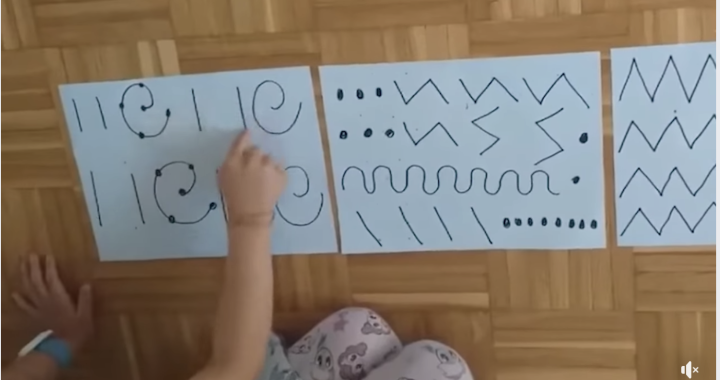
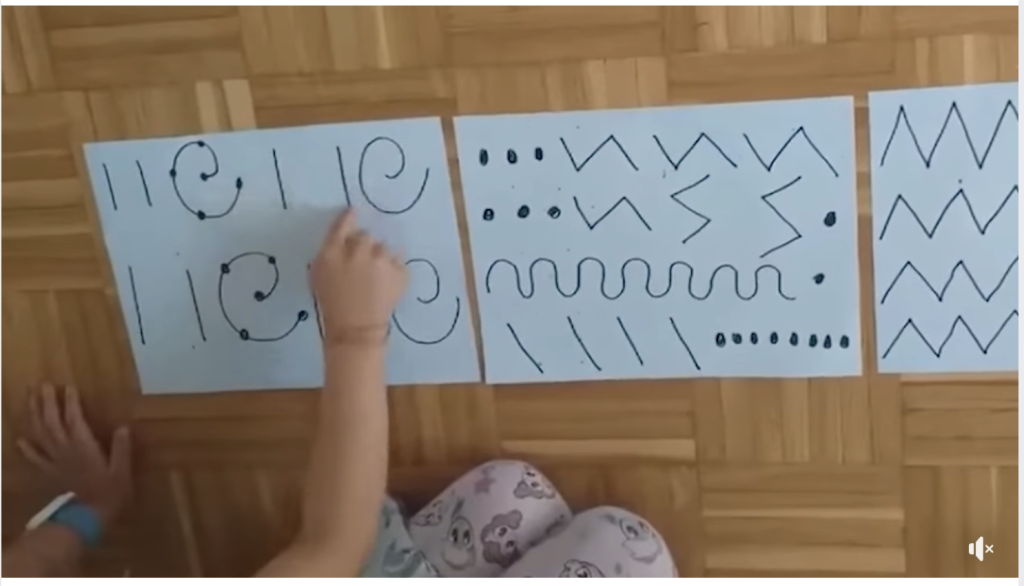
Children can find their very own way to represent music and sounds: through art. They can draw something or design lines like in this example (it is from the Psicomúsica page on facebook; 3 July 2020 – click on the image to access the video):

If you compare this “representation” with the conventional one in the video here below, you can observe the similarity in structure that we, adults, need to help our children with understanding, or better, towards which we can guide your children.

Acquiring fluency in reading requires children to transform symbolic information provided by print into mental representations based on their prior language experience. This literacy acquisition relies heavily on the process of phonological awareness

Every child likes music, likes singing. In fact, singing songs is a great help to foster language acquisition and learning – also at a later stage!
This example is not a song one can sing along as it seems wordless as actual words are not added to the Tritsch Tratsch Polka, but it has clear musical notes.
These are the conventional ones (here below) but one can choose to represent them in all kinds of ways to help children follow the music like in the way it is represented here above, that makes it easier for very young children to “follow with the finger”.


Try to do the same with songs you sing with your child and let your child guide you with shapes, zigzag lines, colors… anything that works for them to represent words or melodies, will help them distinguish words, articulate them, find the rhythm of the language they are learning!

You can transfer this kind of representation illustrated here to words in texts. I got this idea when one of my children wrote a text at age 2, in what I thought were scribbles. When I asked him to tell me what was written there, he traced the lines with his finger and read the text to me. I understood that what were scribbles to me were words to him. So I decided to try to understand how his system worked, not the other way around! My son is now almost 18 and we moved twice since and his first writing attempts unfortunately got lost during the past two moves. But parents can ask their young children to write down what they want to say or words from songs in their own way. I find it mind blowing to see how they structure words and sentences from a very early age!

If you want to take the same signs like in the first video here above, you can for example represent “car” as a dot, “mo-ther” with two dots or a line etc. This method can help older children separating words into syllables, or understand sentences:  “the blue car” can be represented for example as a triangle.

According to Education.com:

Music activities provide an excellent means for increasing children’s listening skills. Four- and five-year-olds can develop listening skills that will help them sing in tune, create melodies, accompany themselves on instruments, and move to music. They can be taught to listen to the expressive elements of music, such as melody, rhythm, and dynamics. In one way or another, music at all levels is focused on listening. The purposes and outcomes of listening may vary with the age of the listener and the musical setting, but there is perhaps no other music behavior so widely valued as good listening.

A way to “translate” this exercise in sentence and syllable awareness  is by focusing on the sequence of words, and repeating them in the way this teacher from InfantEd does, or syllables:

Please let me know what you think about using music to teach language in the comments here below.

Further readings about enhancing literacy skills and music:
https://www.luther.edu/oneota-reading-journal/archive/2012/learning-literacy-through-music/

https://www.researchgate.net/publication/234615237_Developing_Literacy_through_Music

https://www.researchgate.net/publication/229682968_The_Relationship_Between_Musical_Ability_and_Literacy_Skills

https://stateofopportunity.michiganradio.org/post/five-things-know-about-music-and-early-literacy

https://www.frontiersin.org/articles/10.3389/fpsyg.2015.01777/full

Culatta, R. (2012). Social development theory (L. Vygotsky). In Instructional Design. Retrieved September 1, 2012.

Gee, J.P. (1989). What is literacy?. Journal of Education, 171(1), 18-25.

Hansen, D., Bernstorf, E., & Stuber, G.M. (2004). The music and literacy connection. Reston, Virginia: MENC: The National Association for Music Education.

Kimball, K., & O’Connor, L. (2010). Engaging auditory modalities through the use of music in information literacy instruction. Reference & User Services Quarterly, 49(4), 316-319.

McEwing, H.E. (2011). Music, movement, and early literacy: A best practices primer for “Gotta move!”. Children & Libraries: The Journal Of The Association For Library Service To Children, 9(2), 29-35.

Wiggins, D.G. (2007). Pre-k music and the emergent reader: promoting literacy in a music-enhanced environment. Early Childhood Education Journal, 35(1), 55-64.

When parents should NOT speak their L1 with their children

Against the common advice, backed up by countless research that states that parents should speak their L1 – first language – with their children, it is time to explain why this is not always the best solution for multilingual parents. I think there is an important misunderstanding leading to many parents doubting about the decisions they are making. But let’s start with explaining what is meant by L1 and how this differs for multilinguals.

L1 is, chronologically speaking, the language we acquired/learned first. It is the language some still call mother-tongue, and which can also be our native language – if our level of fluency is (nearly)native.

For multilinguals, their first language or L1 is not always the one they feel most comfortable speaking, reading, writing in. Not everyone who grows up with multiple languages will obtain and maintain the highest level of fluency in their L1. 

This is very obvious in the case of those who were adopted at a very early age. Adoptees can loose their L1 if it is not supported and fostered by their new parents. Depending on their age when they were adopted, and on their language development stage in their L1 at that time, they might only have a receptive (some call it “passive”) knowledge of the language, i.e. they might have understood it, but weren’t verbal yet, or were about to speak.

Fact is that the level of fluency in L1 for those who grew up with more than one home language, and live and work in another language, can fluctuate, and this can also happen to simultaneous and sequential (and a combination of both, considering the amount of languages they have learned) bi-/multilinguals too.

Let’s make an example*:

Laura who grew up with Italian and German in Germany, learns French at age 6, English at age 11 and later Spanish, Portuguese and Greek. After studying in Italy, she moved to Spain where she works in a Spanish company. Her partner, Davide, is Portuguese and British, and they speak Italian, Spanish, English and Portuguese together. They then move to the Netherlands, where they both speak English every day at work and in the international community. Of course, they learn Dutch too. – Do you find this unusual? Well, this scenario is not that uncommon! I work with many internationals who have such a scenario; they grew up with two or more languages and added several more during their life, studies and work in different countries. 

I mentioned that language fluency and dominance changes over time. In fact, we tend to invest more time and energy in the language we need for social contacts, school and work, especially when this language is not our L1 (chronologically speaking). If we grew up with multiple languages we may prefer another language than L1 to speak with our partner and colleagues. 

In the example above, Laura has experienced three language shifts.

  1. German was her most dominant language while living in Germany as a child
  2. Italian was her most dominant language when she studied in Italy
  3. Spanish was the language she was using on a daily basis at work and in the community for several years
  4. Now that she lives in the Netherlands, English is the language she speaks, reads and writes on a daily basis

These language shifts have an important impact on multilinguals and their families.

The most common question I get asked from multilingual parents is: what language should I speak with my child? 

Let’s go back to Laura: while living in the Netherlands, she gives birth to a son. Laura and Davide are not sure what languages to speak with their son: should Laura speak German (her mothers’ language) or Italian (her fathers’ language) with him; and Davide, should he speak Portuguese (his father’s language) or English (his mothers’ language) with their son? And what about Spanish? Spanish is the language Laura and Davide worked in for a long time and it is the language that is most spontaneous for both and they are very competent in it…

Considering the most common interpretation of research on this matter, Laura and Davide should both speak their L1 or native language with their son.

For Laura this would be German and/or Italian, for Davide Portuguese and/or English, as these were the languages both parents acquired during their first years of life and these are the languages of their extended families.

  • But are these the languages Laura and Davide feel more comfortable with?
  • Are these the languages they are, at that moment of their life, the most competent or proficient in?

Laura told me that Spanish is the language she likes the most. It’s the language she spontaneously spoke with her son when he was born. Should she switch to German and Italian though? And Davide? He hesitates between Spanish and Portuguese.

What needs to be very clear not only when choosing the language to speak with our children, but also when filling in application forms in daycares and schools: make sure to clearly state what language is the most dominant for you, as a person/parent, at this moment and phase of your life, and what language you are most competent and confident in: this would be your L1.

***

Research says that one should speak the native language to children also because of the emotional bond that is apparently stronger in our native language than in any other language.

This is where we need to further investigate the research on the matter. The research in question was conducted with people using foreign languages in a given situation and compared with the way native speakers would react.

But what was their level of fluency in those languages, how confident were they when they used that “other” language? Was this other language a language they just learned as additional language to one or more other languages they knew before?  What was the emotional and cultural bond they had with those languages? Were they using the “other” language with their partners too? – There are so many parameters that were not explained and taken into consideration in that study (or at least it was not shared overtly), who could have given another outcome than the one we now consider important when choosing the language to speak with our children. – Please don’t get me wrong: we should choose the language we feel most comfortable expressing our feelings in; but this is not necessarily the chronologically speaking “first language” or L1, “native language” in the common use of the term!

Couples who communicate in their 3rd or 4th language with each other and who made that language their emotional language, following this study, could not have a strong emotional bond with their partner because they speak in another language than their native language or L1.

Again, we have to define L1 as the language we are most confident and competent in, the one we have gained a nearly-native fluency; this can be also another language than the language we acquired first, chronologically speaking! 

Therefore I suggest multilingual parents who attained a high level of fluency in a language and feel comfortable expressing their feelings and emotions in it, and can be spontaneous in it, maybe even know nursery rhymes and lullabies in that language – or are willing to learn them! – to consider that as the language to speak with their children. As the language we speak with our children from day one is the one that we build an emotional bond with them, it is extremely important to think about possible scenarios in the future: will we always (!) feel comfortable to speak that language as the primary language with our children? 

But what if we speak one language with our partner and would like to speak another one with our children?
That is a very common situation in multilingual couples. It is the base for the OPOL (One Person One Language) and the 2P2L (Two Persons Two Languages) strategies.

When I work with multilingual couples who wonder what language to speak with their children, I start with assessing their language situation, the past, the present and the foreseeable future, and I ask them a (long!) series of questions. We usually have several sessions over a longer period of time to make sure that they take long term oriented decisions. Furthermore, they get to experience different strategies and asses themselves before taking a decision. 

Here are some standard questions I start with:

  • What is the language you would choose to speak spontaneously with your child?
  • What makes you doubt that this language might NOT be the right one to choose?
  • What language would your child need to be speaking with your parents & extended family?
  • Is it possible that your parents & extended family would speak another language with your child?  Which one?
  • How comfortable do you feel (from 0 to 10) speaking this language with your child? 
  • Do you know some nursery rhymes etc. in that language(s)?

Most multilingual parents want their children to grow up with as many languages as possible. Their first priority is for their children to “have more chances later in life”, and opt for more prestigious languages like English, French, Spanish, German etc. if these are in their repertoire, especially when one of the parents’ languages is a minoritized one. For example, instead of speaking Farsi with their children, they would opt for English, instead of Swiss German, they would prefer German etc. 

 Some further questions I ask are:

  • What languages they speak, read and write on a regular – preferably daily (!) – basis
  • If there will be any changes in their language use in the next 5 years
  • What short and longterm goals look like with regards of living in that country, working for that company, using that language on a daily basis etc.
  • What their short and longterm goals are with regards to their children’s language fluency (understanding, speaking, reading, writing) in all their languages

My main focus is on what languages parents are more comfortable speaking with their children as it is preferably** the language they will be sharing with them throughout their whole life.

If parents can not or do not want to reactivate a language they have not spoken on a daily basis for a long time – and this can be their first language chronologically speaking – it might be less dominant than their L2/3/4 etc. and, as a consequence, they won’t feel comfortable using it on a daily basis with their child. Asking them to speak it with their children would feel like a burden and they would need to put extra effort into it. The attempt to re-animate a “dormant” language can be successful, but only if there is a real need for the parent to do so. If for example the family is living or is going to move to a country where this language is the community language, or if the parent works in that language.
The time and effort the parent puts into re-activating a language can be too overwhelming if the situation and context are not supportive, and eventually lead to frustration, self-doubt and guilt and possibly failure.

****

When we become parents we tend to question which language would be most important for our children to learn.

We think about the importance for our children to understand their grand parents and our extended family, to succeed in the society and community we live in, and later academically. – Generally speaking, if a language becomes less important in our life and it would not be a spontaneous and natural choice to use that language with our children, we should consider alternative solutions.

Please don’t get me wrong: I am a convinced and avid defender of heritage/home language maintenance – but not at every cost!


The reason I do what I do as an Independent Language Consultant is that every family language situation is different and every family deserves a personalized solution, and that is the advice and support they get from me.

When it comes to decide what language to speak to our children we should decide consciously, considering the pros and cons about what is best and most natural for us.

I work with many multilingual parents who face this kind of situation and who very often find themselves discussing about the importance of their heritage languages and the importance for their family to find one, maybe two, languages to speak with their children and to each other. 

Why two, or only two languages?

Because in the long run, many multilingual families – I might say “most multilingual families” – will find it too much to keep up with 4 languages at home, especially when their children are schooled in an additional 5th or even 6th language! Like a parent said to me, juggling 6 languages in one family feels like “having a UN situation at home”. It might sound interesting and exciting at first, but it is very difficult to maintain.   

Laura and Davide both speak each others’ languages, which is not always the case in multilingual couples. They have the imbarazzo della scelta: they can choose whatever language combination they want. The most important aspect for them to consider is what their son will need to be able to speak and to what level of fluency in the setting they are right now and in the next 10ish years.

Did Laura’s and David’s language situation seem complicated to you? It really is not. It is a typical situation for so many cross-cultural couples who live internationally.

The most complex situation I had to work with was the one of a family that had 8 family languages, 6 children, 6 parents – yes, a patchwork family – with 2 community languages, and the parents/couples living in three different countries. 

But let’s go back to Laura and Davide’s family. So, Laura and Davide speak Spanish with each other when their first child is born. Laura speaks mainly Italian with the child, but speaks also Spanish when they are all together as a family, while Davide speaks Portuguese with him and Spanish, like Laura. Instead of OPOL (One Person One Language) they use the 2P2L (Two Persons Two Languages) strategy combined with T&P (Time and Place), which allows them to focus on one language in one-on-one situations and add the other one at specific occasions at home (and outside home).

When their son starts attending daycare in Dutch they also welcome Dutch at home, for specific situations. – When 3 years later a daughter is born, they decide to maintain the same languages at home, until they realize two years later, that their children prefer speaking Dutch with each other, the language of the community and that they speak with their peers. And, just to complicate it a bit more: the whole family is about to move to Germany…

You can imagine that Laura and Davide wonder what to do next. How can they make sure their children will maintain their home languages – Spanish, Italian and Portuguese – and what will happen to Dutch when they move to Germany?
Laura doubts if her first decision was the right one or not, because maybe choosing to speak German with her son from the beginning would have been the “better” option.
Fact is that they couldn’t foresee what would happen and all the decisions they took were right for them, at those moments.
Laura and Davide have set a very clear base of languages in their family and they will continue building on that. Changing the foundation of a house that we are building is never advisable, and neither it is to change the family or home language!
The advantage of this young multilingual family is that their extended family speaks German with their children and this will surely help them adjust to their new life in Germany. 

Life with multiple languages is never straight forward, it is never easy and clear from the beginning. It is a journey. And like for every kind of journey, Laura and Davide will need to readjust the sails. And they do!

If you are a multilingual parent, what language did you choose to speak with your children?
Have you maintained the same language throughout the years or did you change it, or add another one? If so, I would love to know when and what made you change.

Please let me know in the comments!

If you would rather prefer talking about this in person, book a consultation with me.

Related posts
Language Shift in Multilinguals

Language scenarios for multilingual children growing up abroad

The Third Language Model

Internationals struggle passing on their home languages 

* I have changed the names of the parents.

**I say “preferably” because, like in all multilingual families, it can happen that the home language or the language one parent speaks with the children will change. It is not very healthy for the connection between parent and child, but it can happen, usually because of outer circumstances. 

© Ute Limacher-Riebold 2020


The illusion of sound and its meaning in language acquisition and learning

Sound is the most important medium we use when communicating – unless, of course, we use sign language.

Most of us assume that the auditory signal is enough for others to understand us. Some people increase the volume to make sure they are “heard”. Most of my clients are surprised to learn that sound is not enough to communicate effectively and that other cues affect our perception and understanding.


Whenever we talk with someone whom we can also see, we automatically watch the movements of the other person. We look at the lips, the articulatory movements, the gestures.


When listening comprehension becomes difficult, for example when there is background noise, or if we speak with someone in a language we – and/or he/she – are not that fluent in, we may struggle to understand what is said.


Especially when what we hear and what we see (or seem to see) does not match. We are easily irritated when for example we watch a movie and the audio and the image on the screen are not in sync. (cfr. Albert Costa, The Bilingual Brain: And what it tells us about the Science of Language, 2020)

A very interesting effect called the McGurk Effect, shows what can happen. It is an audiovisual illusion that shows clearly that sounds can be perceived very differently. For example the pronunciation of /ba/ and /va/ can sound exactly the same.

The accurate perception of information can involve the participation of more than one sensory system, in this case, vision with sound, which is called multi-modal perception. Senses, in fact, did not evolve in isolation from each other, but work together to help us perceive our world.When multiple senses are stimulated simultaneously, the brain begins to experience and information rich learning experience! (1:00-1:45 of the following video)

Try to analyze the sounds you see and hear in this video:

What this means for bilingual language acquisition in babies

When babies acquire languages they try to build their sound inventory by connecting visual and auditory cues to discriminate between languages.

Babies between four and six month old are able to differentiate between French and English only by watching videos of people speaking in those languages without sound! (Albert Costa, Chapter 1 Bilingual Cradles)

Costa focuses on babies who are between four and six months old because during that time babies fix their gaze on the mouth of a person.

I can confirm that this ability to differentiate between languages by only focussing on the articulatory movements of the lips can be maintained and fostered throughout life.

I recently did this experiment myself by switching of the volume and only looking at the movements of lips. After a few words I managed to recognize the languages: Italian, German, French and English.

It might be that my personal history has to do with this capacity. When I was 4 years old, I was hearing impaired for almost a year. I suffered from chronic ear infections since birth, but when I was about 4 years old, these infections became very severe. My ear drums bursted about 23 times during those years, causing regular hearing impairment. My parents were not aware about the severity of my hearing impairment because I automatically learned to read their lips. I remember hearing sounds – like when we swim under water – but could only understand what people were saying when I could see their lips movements.
I acquired German and Italian during those years and this impairment did not affect my languages in any way. In fact, my parents and the medical doctors were surprised and shocked when they realized how little I was actually hearing. Fortunately, at 5 years a simple tonsillectomy made these ear infections decrease and eventually stop, and I could finally hear without any impairment. People would even say that my hearing was intensified. At school I could understand what people would whisper and I heard sounds others couldn’t hear – my mother used to say that I would hear the sound of bats (which wasn’t really true).

What this means for language acquisition and learning

When we learn a new language, but also when babies acquire languages, we need to learn to distinguish sounds that are present in that language: phonemes.
Phonemes are the smallest units that differentiate words. In English, batcatmat, fat only differ by one phoneme (/b/-/k/-/m/-/f/) that are contrastive, i.e. the alternation of these phonemes results in different words, with different meanings. When we struggle with acquiring contrastive phonemes, we make mistakes.
Children whose first language is Chinese, will struggle with hearing the difference of sound in l and r – unless they are exposed to a language where these are two distinctive phonemes, like in English (rack, lack), German (Latte, Ratte), Italian (lutto, rutto) etc. Studies show that babies who are exposed to contrastive phonemes will be able to differentiate between the language, but apparently, when not exposed to these languages before they reach 12 months of age, they won’t be able to :

after just twelve months of exposure to a language in which the contrast between the two sounds in question was not relevant, the ability to differentiate those sounds was lost (or at least significantly reduced). This shows that the passage of time is critical in terms of our ability to distinguish sounds (Costa, p.18)

This loss of sensitivity seems to be accompanied by an increase of sensitivity to detect subtle differences between the phonemes of the language to which the baby is exposed.
I personally doubt that this sensibility will be completely lost. I rather assume that the focus simply shifts to the most important languages for the child at that developmental stage.
In fact, I observe and experience that even later in life we are still able to distinguish between contrastive sounds in other languages. What I would agree with is that it will be more difficult to distinguish sounds that are very different from those we have in our inventory, but it is not impossible. The approach to distinguishing these sounds may not be as intuitive and natural as in babies, but the same way we can learn new languages also later in life, we can learn about the contrastive phonemes of that language. Costa mentions that the loss of this capacity explains why non-babies or everyone who learns another language beyond childhood would have an accent, but there are enough people in the world who learned languages later in life and had very little or no accent, and who would not make the expected “mistakes” that one would expect.

I do agree though that it requires training to hear the difference of pronunciation and intonation of sounds in tonal languages if ones languages in are all non-tonal languages, the same way an adult Chinese native speaker would struggle with differentiating between /l/ and /r/.

What is your experience with acquiring and learning sounds in a new language?
Have you experienced the McGurk Effect?
Please share in the comments here below.

5 Stages of Additional Language Acquisition

When children learn another language after having acquired their first language or languages, they go through different stages that can vary from child to child and depend of how similar the additional language is to those the children already know. 

This infographic shows 5 stages that 3 to 8 year olds can go through when learning an additional language in informal settings, i.e. not at daycare or school, without formal instruction.
This is why we use the term of language acquisition and not learning, although for the last 3 stages reading and writing skills are also considered. Reading and writing are both skills that need formal instruction.

After our children have already acquired their first language(s), everything they will acquire and learn about the additional language will be put in relation to their existing knowledge of the other languages. And if our children have already started reading and writing in those other languages, these skills are transferrable to the additional language (see Jim Cummins’ Common Underlying Proficiency). 

Please consider this infographic as a general guideline. Every child is different and deserves personalized attention and assessment if necessary.

I invite you to observe your child’s language development and to support your child by praising the progress (not the mistakes!) and to enjoy all the steps!

If you are not sure if your child is making progress, try to write down the words he/she understands (receptive language) and uses (active language) for 3-4 weeks.

The infographic explained

1) The first stage, called pre-production stage (some used to call it the silent stage) which I prefer calling the receptive stage can last between zero to six months.

In this stage, children have very few if any oral skills in the additional language and begin learning vocabulary. They may only respond to someone speaking the additional language in a non verbal way such as pointing, gesturing or drawing for example.
But they start understanding simple sentences and words, and therefore they are receptive for the new language since they start being exposed to it.

As this stage is very controversial among language educators because it is very unlikely that a child that acquires an additional language will “stay silent” in this first stage, I prefer the term of receptive stage, in analogy to the receptive pre-verbal phase of very young children. Furthermore, speech is so fundamental in language acquisition and when speaking about additional language acquisition, we talk about children who are verbal in another language or other languages (plural) already, so they have means to express themselves.

Children can improve very quickly in their additional language if they directly get to apply what they are acquiring: by repeating simple words, phrases, anything they understand, that is useful for them (see: comprehensible input (and output) by Stephen D. Krashen)

2) As soon as children begin to practice articulating new words starts the early production stage that can last between six months to a year.

The child starts having a greater understanding while listening to the additional language and can produce a limited number of words, phrases and simple sentences like “thankyou” “please” “Ineedthat” “Iwant”. In this stage, children might not distinguish words in the new languages morphologically and consider “thankyou” as one word, until they understand that one can also say “thank her / him / us… Anna…“.

3) The third stage is known as speech emergence and can last between one and three years depending on the frequency of exposure to the additional language.

The child gains even greater comprehension in the additional language, starts stringing words together into phrases, sentences and questions, and we can notice that the accuracy from a grammatical point of you and with regards to the pronunciation increases.

The child might be starting to read and write in the additional language if taught how to do so in another language. Remember, this is an infographic about language acquisition, i.e. when the child is exposed to the additional language on a regular basis but without formal instruction.

If the child starts being exposed to the additional language starting from age 3, this stage would correspond to the child starting school, and receives formal instruction in the school language, i.e. learns also how to read and write.

4) The fourth stage is the one of intermediate fluency which can last for 3-5 years.

Children will continue developing vocabulary and start thinking in the additional language. This thinking in the target language will help them gain a higher proficiency when speaking the language!

There is a considerable increase in communicating via writing: children will use more complex sentences – with subordinates for example – and we’ll notice a greater accuracy and correctness in the use of grammar and pronunciation.

Furthermore, children might start auto-correcting themselves.
At this stage, children have learned how to read and write in their other language, and are able to transfer those skills to the additional language – at least to some extent.

They’re able to express their thoughts and feelings in the additional language, be more spontaneous, start conversations and hold conversations about familiar topics. Depending on the language, they might be able to use simple forms of negative questions “You don’t like the movie?”, “Don’t you like the movie?”.

If children started with the additional language at age 3, they would be approximately 8 years old at this stage. Their fluency in the additional language will depend from their exposure to the other language (usually the one they are schooled / educated in) and the way they manage to transfer the learned skills to the additional language.

5) The last stage is called advanced fluency or continued language development which can take for 5 to 7 or 8 years, depending on the circumstances.

The children develop the vocabulary of the content area, i.e. the domain and circumstances they acquire the additional language. Their improvement in the additional language depends from the exposure of a greater variety of contexts, i.e. different content areas, or more in depth vocabulary in the areas of interest.

With the increase of vocabulary and overall confidence in using more complex sentence structures across the domains of interest (and need), children will be considered as nearly native users of the additional language, even with regards to idiomatic expressions, metaphors etc.

By attaining nearly native fluency, children will be confident at using more complex negative questions  like “I hope you don’t mind…” and irony.


If you would like to have tips about how to start such a journal or are wondering if your bi- or multilingual children’s language development is healthy, don’t hesitate to contact me for a free consultation .

FYI:
I’m a linguist and I have studied language acquisition, language variation etc. and I can help you find out if your child needs a speech therapist, audiologist, child psychologist… or not. 

10 Stages of Bilingual Language Development

“Becoming bilingual, whether from birth of soon after, or subsequently in early childhood prior to schooling, entails a complex interaction between what children bring to the learning task, that is, among others, speech segmentation skills, speed of processing, and the linguistic and cultural environments in which they grow up” (Ludovica Serratrice, Becoming Bilingual in Early Childhood, in A. De Houwer and L. Ortega, The Cambridge Handbook of Bilingualism, CUP, 2019, p.35)

Parents, teachers, educators and health practitioners should always consider that quantity and quality of input are strong predictors of children’s early lexical skills, and these are closely related with emerging grammatical skills.

Also, the societal status of the language – its prestige in the community – plays an important role in the development and maintenance of the skills children acquire in these languages.

Please consider this infographic as a general guideline!

Every child is different and deserves personalized attention and assessment if necessary!

I invite you to observe but not hover over your child’s language development and to enjoy all the steps!

If you are wondering if your bi- or multilingual child’s language development is healthy, don’t hesitate to contact me for a free consultation at info@UtesInternationalLounge.com.

As a linguist with extensive experience with multilingual language acquisition and learning, and language and speech specialist, I am able to recognize the signs that require help from a a speech and language therapist, audiologist or a child psychologist and always recommend other professionals when necessary.

Further readings:

Kohnert, K. (2010) Bilingual children with primary language impairment: issues, evidence, &  implications for clinical actions. Journal of Communication Disorders 43: 456-473.