How to Read Bilingual Books: for Teenagers and Adults

How to Read Bilingual Books: for Teenagers and Adults

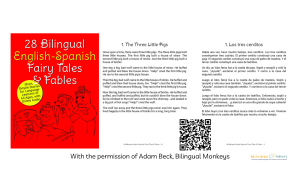
Bilingual books offer a unique opportunity for language learners, both teenagers and adults, to enhance their language skills, gain deeper cultural insights, and maintain their heritage language while acquiring a new one.

However, reading bilingual books effectively requires more than just skimming through the text. It involves strategic approaches that maximize language acquisition and comprehension. With our youngest, early simultaneous multilinguals, we want to follow other strategies than with older children, and focus on one language per setting; I explain this more in detail in my post How to Read Bilingual Books with Babies and Toddlers .

Teenagers and adults can use bilingual books to learn an additional language independently:

Understand the Structure of Bilingual Books

Bilingual books typically present the text in two languages side by side, either on the same page or on facing pages. This format allows readers to compare the languages directly. For teenagers and adults, this can be particularly helpful as they can easily reference the translation when encountering unfamiliar vocabulary or complex structures. Understanding this format is essential as it helps in developing a routine that enhances comprehension and retention.

Tip: Start by reading a paragraph or a section in your stronger language to grasp the context. Then, read the same section in your target language to notice differences in expression, vocabulary, and syntax.


Engage with the Text Actively

Active reading is crucial when working with bilingual books. This involves not just reading the text but also engaging with it through annotation, summarization, and reflection. For instance, after reading a passage, try summarizing it in the target language. This reinforces comprehension and helps in internalizing new vocabulary and grammar structures.

Tip: Use a notebook to jot down unfamiliar words or phrases and their translations. This practice aids memory retention and provides a quick reference for future reading sessions.

Leverage Cultural Contexts

Bilingual books often include cultural references that are unique to each language. For example, a word or phrase in one language might carry cultural connotations that do not directly translate into another language. Paying attention to these nuances not only improves language proficiency but also deepens cultural understanding.

Tip: When you encounter a culturally specific term or concept, take the time to research its background. Understanding the cultural context enhances your appreciation of the text and provides a richer learning experience.

Set Clear Goals

Whether you are reading for fluency, vocabulary acquisition, or cultural understanding, setting clear goals can make your reading sessions more productive. For teenagers and adults, this could mean focusing on particular aspects of language, such as idiomatic expressions or specific grammar structures.

Tip: Before starting a new bilingual book, define what you want to achieve. For instance, you might decide to focus on mastering verb tenses or expanding your vocabulary related to a particular theme.

Use Complementary Resources

Bilingual books are most effective when supplemented with other language-learning resources. This could include dictionaries, language apps, or even discussion groups where you can practice and discuss what you’ve read. For teenagers and adults, engaging with language communities can provide additional support and motivation.

Tip: Consider joining a book club or online forum focused on bilingual books. Discussing the text with others can provide new insights and help you see the language from different perspectives.

Conclusion

Bilingual books are a powerful tool for independent language learning, especially for teenagers and adults who are skilled readers and already have a foundational understanding of both languages.

By understanding the structure of these books, engaging actively with the text, leveraging cultural contexts, setting clear goals, and using complementary resources, readers can significantly enhance their language proficiency and cultural awareness.

References:

  • Baker, C. (2011). Foundations of Bilingual Education and Bilingualism. Multilingual Matters.
  • Cummins, J. (2000). Language, Power, and Pedagogy: Bilingual Children in the Crossfire. Multilingual Matters.
  • García, O. (2009). Bilingual Education in the 21st Century: A Global Perspective. Wiley-Blackwell.
  • Grosjean, F. (2010). Bilingual: Life and Reality. Harvard University Press.

This approach, integrating strategic reading techniques with cultural and linguistic insights, supports effective bi- and multilingualism and enriches the reader’s language learning journey.

Further readings:

How to Read Bilingual Books with Babies and Toddlers

How to Read Bilingual Books with Emergent Readers: A Guide for Simultaneous and Successive Bilinguals

I invite you to watch our video Reading Bilingual Books, or Not Reading Bilingual Books:

Quizzes and Games about Multilingualism

You can find several quizzes and games about Multilingualism online. In this post I share some I found particularly interesting:


If you know a game or quiz that should be added to this list, please let me know in the comments here below! 

Multi-Literacy-Friendly Home Checklist

A Multi-Literacy-Friendly Home

What is a multi-literacy-friendly home? And what does multi-literacy mean?

The term of multiliteracy was coined in the mid 90ies and designs an approach to literacy theory and pedagogy which highlights linguistic diversity and multimodal forms of linguistic expression and representation ad its two key aspects. It was mainly coined because of the diverse modes of communication – internet, multimedia, digital media etc., and the growing linguistic and cultural diversity due to increased transnational migration*.

I use this term here to define the multilingual literacy in multilingual families that focuses on the linguistic landscape in multilingual families' homes, and includes also the different means of communication. The multi-literacy-friendly home is a home where every language is represented through writing in any kind of way.

When we surround our children with the different writing systems of our home languages and make reading, exploring the written language, a habit from early on, our children will be more likely to find learning to read and write easier.


Human brains are naturally wired to speak,

but they are not naturally wired to read and write.


Every child is different and the way we, parents or adults in their life, integrate reading with our children into our daily and weekly life, will support our children's multi-literacy. 


With my Multi-Literacy-Friendly Home Checklist for Parents of 0 to 6 year old children you can find out how multi-literacy-friendly your home is. Ideally, all languages – including material for sign languages and dialects – are visible in your home, tangible and/or readable, decodable.   

You can fill in the form here below to access the download. 


*Cope, Bill; Kalantzis, Mary (2009). ""Multiliteracies": New Literacies, New Learning". Pedagogies4 (3): 164–195. doi:10.1080/15544800903076044S2CID 154335505

[activecampaign form=44]

Telling time across languages…

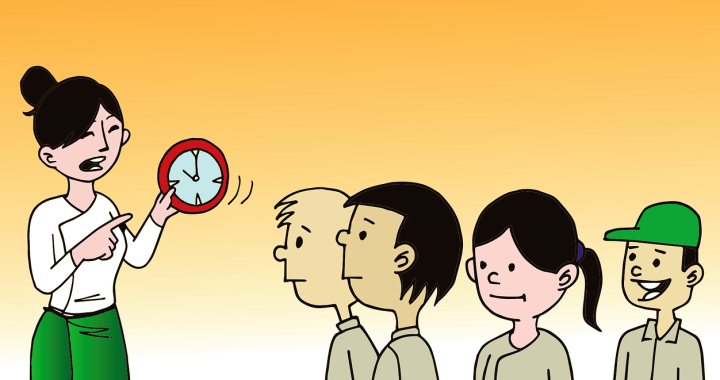
Image by MoteOo from Pixabay


Are you able to tell time in all your languages?

Speaking several languages doesn't mean that we feel confident in telling time in each of them. When we switch from one language to the other, we may prefer a more generic way to tell the time in order to avoid misunderstandings, when agreeing on an appointment for example.

Fact is that time can be indicated in different ways even in the same language, depending on where you are / with whom you are speaking.
In German one can say "viertel vor zwölf" or "dreiviertel zwölf" (lit. three quarter twelve) for "quarter to twelve", depending on the region.

"Viertel zwölf", literally "quarter twelve" actually means "quarter past eleven", 11:15, which is "a quarter of the 12th hour".


©dreiviertelzwölf.com


I personally find it difficult to switch between ways to tell time in German. I prefer checking twice to make sure what the person means when using "viertel" (without "vor" or "nach" – in oral speech people tend to talk fast and sometimes omit the preposition...) and "dreiviertel" to indicate the time.

If you read German, I invite you to have a look at a funny comic in the German newspaper Die Zeit, where they illustrate the difficulty of understanding the various uses of indicating time in German.

In one comment, "Norbert Z" says: "Außerdem ist drei viertel Acht genau eine halbe Stunde nach viertel Acht, und eine halbe Stunde vor viertel Neun. Außerdem darf sich jeder, der sich um viertel Neun mit anderen verabredet hat, stattdessen auch um viertel nach Acht erscheinen." / "three quarter eight is exactly half an hour after quarter past eight, and half an hour before quarter nine. Furthermore, everyone who arranges to meet at quarter nine, can also show up at quarter past eight"

The use of "half seven" in English, meaning 6:30, and "half zeven" in Dutch and "halb sieben" in German all indicate 6:30.

There are also ways to tell time more precisely, like in Swiss German: "foif voor halbi zwölfi" "five minutes before eleven thirty / half twelve" (11:25), same in German "fünf vor halb zwölf" or "fünf nach halb zwölf" (resp. 11:25 or 11:35). In Dutch we also have: "tien voor half drie" which means "ten before half three / half past two", i.e. "twenty past two" / "zwanzig nach zwei" (2:20) or also "vijf na half vier", "five after half four/half past three" (3:35) or "tien na half vier", which is "zwanzig vor vier" in German (3:40).

When learning a new language, being able to tell the time is part of the first lessons. Nevertheless, we if we usually learn the standard use of time telling, not the regional variants. When children are schooled in an additional language, teachers often assume that they learn how to tell time in their home language and the school language, and expect children to be able to use the school language spontaneously.
Not every multilingual family teaches how to tell times in all their languages as it can be quite different from language to language, and many parents find that it is more important that their children know how to tell and read the time in their school language.
I personally find that being able to tell the time in all our languages is part of the general life skills our children need to be able to do – and we, adults too! – in order to function in those languages.

When I asked if people are familiar with different ways to tell time in my facebook group, this is what some replied:

"When I talk to people from English speaking countries in German and we have an appointment at 12:30 and they say "Wir treffen uns um halb zwölf, oder?" I usually just agree. Never failed to be there in time because I know they really mean "halb eins", but the English "half twelve" interferes too much." (B.H.)

"I love Swiss German with its 'foif ab halbi zwölfi' (five past half past eleven) for 11.35 - this totally messed with my mind when I first heard it. Far too much Maths involved there for me (and I apologise for the horrendous spelling of the CH-De!)" (H.S.)

"The funny thing is, I learned "halb zwoelf" in German, before I ever heard "half twelve" in English, my native language... Just as I got used to it meaning 1130, I now had to learn it means 1230 in English!!! (because that seems to be a British thing and I'm Australian)" (F. C.)

And as time is considered in different ways across cultures – some use linear time others a more flexible one (or monochronic vs. polychronic): "When you are married to an Arab you need to check if they mean they will be back in an hour by the clock or an hour that extends as long as required" (J. OB.)


About UhrStunde in German, uur in Dutch, and why we can't say "es ist 13"...

Another interesting difference is the use of "Uhr" or "Stunde" in German, in contrast with "uur" in both contexts in Dutch. "Uhr" doesn't only define the object of the watch in German, but also the "time", Uhrzeit. It goes back to the Latin HORA "time, time of the year, time of the day, hour", for when we say "es ist fünf Uhr" (it is five o'clock). Uhr remains singular at any time it refers to (the same ways we don't say *it's five o'clocksBut in German we can also omit the word Uhr to tell when we're meeting: wir treffen uns um drei, the same way we can say it in English: we meet at three. Only when we use the 24 hours system, after the 12th hour we need to add "Uhr": wir treffen uns um dreizehn Uhr (lit. we meet at 13 hour), which applies to the time between 13:00 and 24:00. This kind of indicating hours of the day was introduced after WWI and are used in official settings. In this interesting article about this fact, they point out that the expression jetzt schlägts aber dreizehn! (lit. now it strikes thirteen) with the meaning of "now it's enough!", was in use before introducing the 24 hour countings, since the late 19 century. The reason for this expression was that, as the clock can only ring 12 times (and then starts from one again), and saying that the clock now will "strike thirteen" indicates something that goes beyond the possible or acceptable!

Do you have similar sayings in your language? 


  • I'm curious to know: can you tell the time in all your languages?
  • Can your children tell the time – also in different ways – in their languages?
  • Do teachers at your children's school teach different ways to tell times across languages?
  • What kind of telling languages do you prefer, feel more comfortable with?

 This is an ongoing post, which means that I will be adding more information, anecdotes, experiences etc. 


Further readings:
Dreiviertelzwölf

Kaenguru Comics in DIE ZEIT


Multilingual Language Timelines


[updated 12 December 2023]

When I shared my post on How to portray, feel and explain language use for a multilingual, in my facebook group Multilingual Families, several parents shared their multilingual journey with me. 

When we raise our children with multiple languages one of the most important things to consider is how we, the parents/caregivers, acquired and learned our languages.
Our own experiences with acquiring and learning languages determines what we expect from our children, and our expectations can be realistic, motivating, positive or demotivating, discouraging.

During my Language Consultations for multilingual families I encourage parents to describe their own multilingual language journey with the help of the Multilingual Language Timeline© that I have designed especially for parents, caregivers and educators.
This exercise allows us to realize how many languages we actually know or knew, how many we understand, and also how those languages have shaped and still shape our everyday life.

If you would like your multilingual language timeline to be shared in this post, please email me at utesinternationallounge@gmail.com with the subject "My Multilingual Language Timeline".


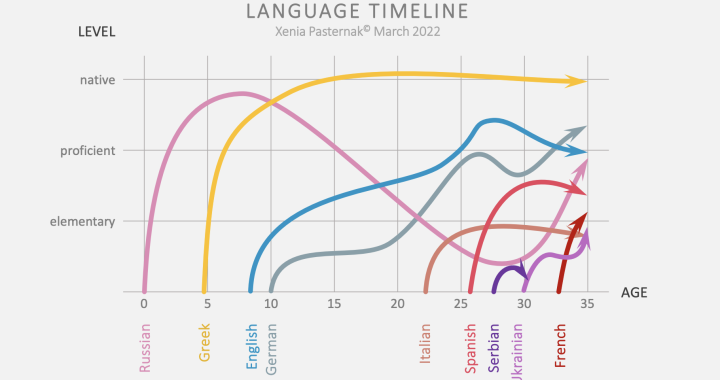
Xenia shared this multilingual language timeline with me. Born in Kyiv, she relocated to Greece at age 5 and to Germany when she was 30. Her current prevalent language is Greek – although it is not her mother tongue. In her twenties she discovered her love for languages. She worked on international projects. She learned Ukrainian as it was a prerequisite to get a job in Berlin, which she gladly welcomed as an excellent opportunity to get back to her roots. She also revived her Russian. When her daughter was born a year ago, she decided that she needed her first language, exposing her to the spectrum of Slavic languages.  Following the recent events, she could not help but continue with Ukrainian.

She learned Italian when she found out that languages are fun and not so difficult as previously expected. When the universe sent her a Chilean friend as her first Spanish teacher it took her 6 months to get the Cervantes B2, 3 more to get the C1 certificate. Serbian was a short but intense relationship after she spent two weeks restoring wineries in a tiny Serbian village. She interrupted this stay to study English language and literature in Thessaloniki, while also working. When she came to Berlin, she organized two architectural competitions in Kyiv and then in Ottawa and Brussels. Fate, again, signalized that she needed to start with French. Once her daughter was born, she dropped it for Russian. Xenia's name is Greek, but she looks Ukrainian. Currently, she uses more Greek (as family language and among friends), German (as community and work language), English (at work and with friends), Russian (approx. two hours per day with her daughter and when they meet her little friends).


Roya Caviglia, creator of the Infant Communication Baby Sign Language and owner of The English Voice Academy, shared her language journey in a short video on IG:


Julia Wilsch's Language Timeline


Julia Wilsch, a German mother of 2 children, living in the Netherlands, has shared her very diverse language journey with me. She spent the first 11 years of her life in Germany, where she attended a local primary school. During that period she grew up with German and Arabic (to a certain extent through music and the family's acquaintances), thanks to her mother who had studied Arabic. As they were always surrounded by Arabic speaking friends, it felt very natural to acquire the language later on in her teenage years and helped to develop her general language skills. When Julia was almost 12, they moved to the UK where Julia and her younger brother attended school in English. She had learned some English at the German school previous to their move, so the transition wasn’t too difficult, but thanks to some EAL lessons and lots of children's series on TV, friends and further exposure in daily life, she settled in relatively quickly. After 3 years in the UK, her family spent 6 months in Germany (she was 14) where she and her brother attended a German Gymnasium. During this very intense and short time, Julia started learning Spanish and continued learning French in school, as she had done in the UK. Her family then moved to Morocco, where Julia and her brother attended an American School, and learned Moroccan and Classical Arabic. Julia lived in Morocco from age 15 to 18. To her disappointment, no Spanish lessons were offered in High school whilst there, so she took lessons at the local Instituto Cervantes before graduating. At age 18 she then moved to the Netherlands for her  gap year (FSJ), followed up by a Bachelor degree, and learned – or better, acquired – Dutch quickly, and learned to read and write in Dutch. During her studies, she also spent some time in Spain (doing a Erasmus program) and in Latin America (doing field work for her master's degree) to improve her Spanish even more. In the Netherlands she also took some more courses to improve her Arabic and to make sure to keep the language alive. 

Since her children were born in 2020 and 2022, she focused more on polishing up her mother tongue, German, as her exposure to that language had been minimized during her stays abroad. She currently works as a German language coach.

Julia can speak, read and write in all the languages she has learned so far, but her oral speaking skills are the most developed.


My own multilingual language timeline is as follows: I acquired Italian and German from the start, as I grew up in Italy with German parents. I started understanding Swiss-German when I was 4 years old. I never spoke it until I moved to Switzerland (Zurich) for my studies at age 18. At school I learned French at age 6, English at age 11, Latin (12) and started to understand Dutch through my friends who were in the Dutch section at school.

My mother used to sprinkle her Standard German with some expressions from the local dialect of the region she grew up in. Whenever we visited my extended family in Germany, I would carefully listen to what the "grown ups" would say in that dialect and acquired a basic fluency in understanding of it, and catch myself using some expressions with my children every now and then. 

During my studies (Romance Languages and Literatures) I learned Old Occitan, Old French and Old Catalan, and I studied several Italian Dialects, like the dialect of Poschiavo and Ticino, Lombardy, Laconi (Sardegna) just to name a few.
When preparing for a conference in Budapest, I had a smattering of Hungarian (una infarinatura molto lieve).

When we moved to the Netherlands, I taught myself more Dutch. Although the two languages differ, I found Flemish very helpful when learning Dutch, as the pronunciation in TV shows was for me easier to understand. Funnily, in the Netherlands I speak way more English than anywhere else I lived before. Although living and working in international settings, the "main" languages were French and Italian, for some time also German, but only since we moved to the Netherlands, English became the most dominant language as the international community here tends to prefer English. So, after barely speaking English for decades, it became the language I use every day, where I read and write in the most now.

Thanks to some Norwegian friends and a conference that brought me to Norway, I learned some basics in Norwegian. When I discovered Korean Drama in 2019, and got "addicted to it", I decided to learn this language too. I'm not very consistent in learning it, but I enjoy listening to it.


I would love to publish your own multilingual language timeline in this post too!
Please email me at utesinternationallounge@gmail.com with the subject "My Multilingual Language Timeline".


Podcasts and audio material for multilingual children

Many of us are spending way more time on screen than necessary. We all would benefit from “off screen time” (funny that I share this in a post that you can only read… online).

As I am discovering more and more audio resources (audiobooks, songs, stories, podcasts), I thought I’d to share some audio resources that can help our children enjoy our languages.

Especially when we can not provide a language rich context for our children, due to complicated situations that do not allow us to meet with extended family or hire nannies or babysitters who could support our children’s language development in the target languages, we have to find alternative solutions.

Here are some suggestions about podcasts that members of my facebook group Multilingual Families kindly shared with me.

This is an ongoing list which means that I will update this post regularly.

If you would like me to include a podcast that you find particularly useful in your language, I would be very thankful if you could share your suggestions by indicating it in the comments here below:

[Podcast name]:

[language]:

[link]:

[target group (age group)]:

[where one can follow it]:

[main topics]:

[your name – if you wish to be mentioned in the post and]

Update: 12 September 2024

ARABIC

  • A post with links to Arabic Podcasts

[link]: https://www.al-fanarmedia.org/2020/07/for-kids-a-summer-of-arabic-podcasts-readings-and-online-activities/

[Ayesha Nicole]

  • Storytime with Teta

[link]: https://www.storytimewithteta.com/

Main topics: An Arabic-language podcast for children

[Ayesha Nicole]

Egyptian Arabic

  • Yuhu podcast for kids

[link]: https://www.listennotes.com/podcasts/yuhuhu-podcast-for-kids-in-egyptian-arabic-f5OrT2DcLhm/

[Ayesha Nicole]

CHINESE (MANDARIN)

  • Playful Chinese

[language]: Bilingual in English and Mandarin Chinese.

[target group]: Non-native parents and children, Chinese podcast for ABC parents and heritage speakers.

[listen on]: Apple Podcast at https://apple.co/31m1NJD

Main topics: Everyday Chinese you can use to keep Mandarin active with your children. It is in a playful story/topic format. There are occasional interview episodes with linguists, authors, and language learners.

[Amanda Hsiung Blodgett, “Miss Panda” and I am the host of the podcast and the creator of Miss Panda Chinese]

DUTCH

As I found hundreds of podcasts for children in Dutch, I share the sites where you can find them.

Here is a list of podcasts for teenagers ( please, check if the content is ok for your teenager; some are from teenagers for teenagers, others from psychologists; furthermore, there are some from Belgium, dus in het Vlaams)

ENGLISH

  • Circle Round

[link]: https://podcasts.apple.com/podcast/1246443751

[target group]: 4-10

[main topics]: “Created and produced by parents of young children, WBUR’s Circle Round adapts carefully-selected folktales from around the world into sound- and music-rich radio plays for kids ages 4 to 10. Each 10- to 20-minute episode explores important issues like kindness, persistence and generosity. And each episode ends with an activity that inspires a deeper conversation between children and grown-ups.”

[Ute Limacher-Riebold]

  • Purple Rocket Podcast

[link]: https://purplerocketpodcast.com/podcast/

[target group]: 4+

[main topics]: “Purple Rocket Podcast has a mix of content with quite a few long-running series, including “Grandpa’s Globe,” which is about twins Sawyer and Suzie, who use their grandfather’s magical globe to explore the universe. Other adventures involve everything from aliens to fairies. Mixed in with the series are occasional one-offs, some of which manage to impart little lessons for your kids. For example, “My Homework Ate Me” is a cautionary tale of procrastination.” (quote from WIRED)

[Ute Limacher-Riebold]

  • Stories Podcast

[link]: https://storiespodcast.com/

[target group]: 3+

[main topics]: Stories Podcast “performs a new story every week, drawing from a variety of sources and a variety of styles. There are retellings of classics like Snow White, some folktales, and myths from around the world, as well as original stories. Episodes range from 10 to 20 minutes, with most on the longer side. Everything here is G-rated and safe for all ages”.


GERMAN

  • Die Unsinkbaren Drei

[link]: https://kinder.wdr.de/radio/kiraka/audio/die-unsinkbaren-drei/index.html

[target group (age group)]: 4+

[main topics]: Bummkopp, Gräte und Kapitän Flitschauge sind die Bestatzung der Sturmhölle und erleben jede Menge Abenteuer zusammen. Und streiten dabei was das Zeug hält. Die unterhaltsamen Geschichten von jeweils etwa vier Minuten machen Spaß und vermitteln ganz nebenbei auch einige Fakten.

[Ute Limacher-Riebold]

  • Do Re MiKro

[link]: https://www.br.de/mediathek/podcast/do-re-mikro-die-musiksendung-fuer-kinder/517

[target group (age group)]: 6+

[main topics]: If you want your children to have access to classic music, try to listen to the podcast Do Re Mikro from the BR (Bayerischer Rundfunk)

[Ute Limacher-Riebold]

  • Geolino Podcast

[link]: https://open.spotify.com/show/0o5qbxarbs5TCegnJ3e6GA

https://podcasts.apple.com/de/podcast/geolino-spezial-der-wissenspodcast-f%C3%BCr-junge-entdeckerinnen/id1503254636

[target group (age group)]: 6+

[main topics]: Facts for young discoverers

[Ute Limacher-Riebold]

  • Mikado

[link]: https://www.ndr.de/nachrichten/info/sendungen/mikado/mikado_am_morgen/podcast4223.html

[target group (age group)]: 6+

[main topics]: Ein Thema und dazu vier Sendungen, eine täglich von Montag bis Donnerstag – das ist das Konzept von Mikado. Themen sind dabei beispielsweise das Wetter, „Drinnen Spaß“ oder Tiere im Winter.

[Ute Limacher-Riebold]

  • Radio Mikro

[link]: https://www.br.de/kinder/hoeren/radiomikro/podcast-rss-itunes-radiomikro-102.html

[target group (age group)]: 6+

[main topics]: radioMikro is a daily broadcast for children (on the radio channel Bayern 2) Monday – Saturday at 18.30 CET and on Sundays at  7.05 CET. The podcast is accessible via iTunes, the ARD Mediathek or in your browser.

[Ute Limacher-Riebold]

  • Schaulicht

[link]: https://schlaulicht.info/

[target group (age group)]: 6+

[main topics]:  All kind of topics: dragons, myths, journalism…

[Ute Limacher-Riebold]


For 6/8+ year olds and teenagers

  • SWR2 Wissen

[link]: https://open.spotify.com/show/76IHUGox6bXwXrCjDW63a1?si=497469007d4b495c

Follow our playlist for 6-12 year olds on PEaCH Spotify set up by Jessica Paolillo, content creator at Multilingual Families.


PORTUGUESE (BRAZIL)

  • Era uma vez um podcast

[link]:https://open.spotify.com/show/4q8oXx83A2mlflTmKzjTWH?si=65b06a0c1dc34914

[language]: Portuguese Brazil

[where one can follow it]: Spotify, Podcast app

[main topics]: stories

[Aline Brownjohn]

  • Histórias infantis de pai para filha

[link]: https://open.spotify.com/show/0CjRGovFGolnDgztRbVIbf?si=f5c79131ddad4d8c

[language]: Portuguese Brazil

[where one can follow it]: Spotify, Podcast app

[main topics]: stories

[Aline Brownjohn]

SPANISH

  • Eat your Spanish

https://www.eatyourspanishpodcast.com/

[language]: target language: Spanish ( lingua ponte : English)

[target age]: 3-6 years I think

[main topics] “is a podcast created Evan and Vanessa to share their deep love of music and the Spanish language with children everywhere. Their goal is to provide a constant source of warmth and comfort for all who listen and to make sure the Spanish content feels fun and easy to learn. “

[Jessica Paolillo; content creator at Multilingual Families]


On Spotify you can find PEaCH for Bilingual Children Spotify with more audio material (songs, stories, podcasts) for your children in a great and growing range of languages – have a look at our playlists! This is an initiative started and coordinated by Jessica Paolillo (content creator at Multilingual Families) (click on the picture):


Language Portrait


Originally developed as a language awareness exercise in education, the Language Portrait is now increasingly used as a research tool investigating how speakers themselves experience and interpret their heteroglossic practices and repertoires (Busch 2018).

It allows a multimodal approach as it combines discursive and presentational forms of symbolization (Langer 1948).

By providing a body image, body portraits offer the possibility of reflecting on one’s communicative repertoire both from the ‘inner’ perspective of the experiencing subject-body as well as from an ‘external’ perspective on the object-body.

In research, the Language Portrait became more widespread through the work of Krumm who collected and commented the portraits in Krumm & Jenkins 2001. Most studies that use the whole-body mapping are about themes like health, trauma, social inequality, political advocacy, migration, community development and education.

In German-speaking countries, the Language Portrait has been adopted in pre-school education, but also adult education and teacher training (Gogolin 2015), while the bodily and emotional dimensions of language learning has been emphasized by others (Coffey 2015). It is a great instrument to stimulate language awareness, not only in schools where it emphasizes that "languages and language-learning are linked to emotions, belonging and biographical experience" (Krumm & Jenkins 2001). We can explore language ideologies, the problematic classification of one person's first languages and the individual linguistic biography, as well as the overall experience in the context of social exclusion. Language Portraits can be used as a tool to gain insight into everyday linguistic practices of bodily and emotional language experience, as well as ideologically informed ideas and attitudes. 

With bi-modal "image-text" representation, invites to create meaning using both modes that are not necessarily (intrinsically) the translation or illustration of each other. The image functions rather as a means of opening a conversation and as a point of reference within the conversation. Through the creative process of visualization, participants experience the possibility of reflecting on linguistic practices and preferences.  


What is a Language Portrait?

The Language Portrait is an exercise I do with my clients and during my group trainings. The goal is for participants to visualize their linguistic repertoire using the outline of a body silhouette – or one they draw or design themselves.

In a Language Portrait, the languages we acquired and learned are not listed according to the degree of competence, nor the chronological order in which we learned them. When designing the portrait, talking about it, commenting and interpreting it, we become aware of the linguistic resources we usually may not deem important.

I have observed participants adding some of their languages in peripheral areas around the silhouette of the portrait, for several reasons: because they learned the language later in life, acquired it in informal contexts, or considered the language as less prestigious, or their fluency not proficient enough to be mentioned or included in the portrait itself.

By assessing (or re-assessing) our own language repertoire and validating it, we get a sense of self-empowerment. We can reflect on normative expectations and patterns and the way we perceive them and react to them.

The visualization allows us to explore our attitudes towards our languages, our bodily and emotional aspects of experiences with the languages. What Kramsch (2009: 60) observes about foreign languages applies to all our languages: "Far from being perceived as primarily a tool for communication and exchange of information the foreign language is first and foremost experienced physically, linguistically, emotionally, artistically". 

Language portraits can become performative, as they create a reality that we might not have expressed and realized before.

The multi-modal aspect of a language portrait allows us to change from one mode to the other. We can switch from the representation of language as an object, to the representation of moments in lived experience of language as a bodily-emotional state, to the representation of language ideologies, and attitudes towards particular languages or their use. During this process the image should not be considered as the representation of a hidden truth, but rather as a gesture that shows the interaction between language and emotion, language and perception (Busch 2018). – I personally prefer leaving a psychological interpretation to  professionals in the field. As a linguist, I merely use the language portrait to let participants become aware of their vast repertoire of languages, of the many layers and facets of communication they have across all their languages. In school settings, the language portrait can be used to explore and elaborate school language profiles (Busch 2010).

Furthermore, the Language Portrait is always a representation of the individual language repertoire in a given situation and setting, it is a synchronic view, a snap shot of the language use. Our experience with languages change over time. The way we perceive our languages, and the way others perceive them, influences us and changes our attitude towards them and our use of them.

Personally I find that asking participants to "use a different color for every language that you speak", like mentioned in most studies, can be limiting. Not only have colors different meanings across cultures, we also have individual preferences that should not play a role in this exercise. Therefore I suggest that whenever possible, a combination of colors and text should be allowed and not be object of discussion.


How to start this exercise: 

Like I just mentioned, I personally don't ask participants to choose colors that fit the different languages as I prefer them to be drawn naturally to choosing what they like. Instead of colors one can also draw different shapes (little circles, lines, triangles etc.), which can be as expressive.

With children I introduce this exercise like a fun activity to discover where our languages can be placed in our body:

"Show me where you would place your languages in this silhouette."

With adults I introduce this exercise the same way as for children, adding some more details:

"I would like you to indicate in the silhouette the languages and ways of speaking that are important for you. You can include dialects, registers, any kind of language or linguistic repertoire you prefer, including sign language."

After completion, participants will then present their portrait and explain, interpret their drawings. It is important to specify that there is no "right" or "wrong", not a "better" or "worse", and that changes can be made at any moment.

Further questions can be:

  • How do you experience your languages in your daily life?
  • Do you use different registers of your languages? (colloquial, slang etc.)
  • Do you use different varieties of your languages? (dialects, regional variants etc.)
  • How do you experience using your languages in your family, in your community, at work, in the broader society?
  • Are there any languages that you used to speak that are not in the portrait?
  • Are there languages you only speak in specific contexts and circumstances?
  • Do you understand, speak, read and write these languages?
  • If you use sign language and gestures: with whom, how and when do you use it? 

etc.


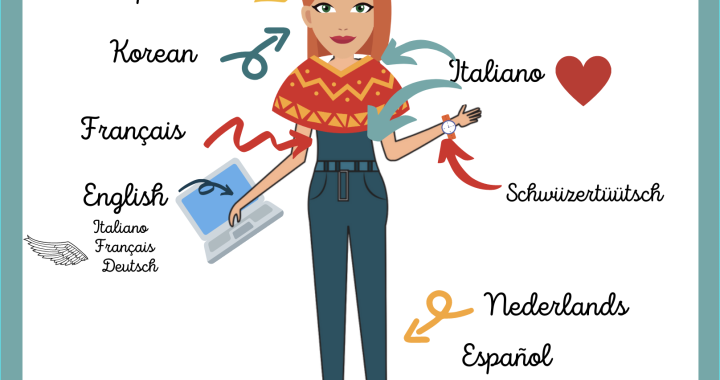
Explanation about the Language Portrait in the picture of this post

The Language Portrait of this post is one I did on Instagram for a challenge on IG (by @creciendoconlaspalabras). Here is why I placed my languages where you can find them in the portrait:

German: I place the language my parents speak in my head, together with Italian. It reflects my way of thinking and communicating. People assume that because I am German I would think and speak in a certain way, but then they are surprised that I don't meet their expectations. I am very organized in my way of working and I like to organize things (always have a plan B and C...), but in my planning I am also very flexible and even need to be. I use my imagination to adjust things if needed, which can be disorienting for some, but also refreshing for others. 

Italian: Italian is the language of my emotions, hence the position in my heart. It's the language I use most spontaneously (my children know that when I say something in Italian, it's getting serious...) I think very fast and speak fast, in Italian and in other languages too, when the situation allows me to. I can adjust to other paces, but my most natural one would be rather fast. I get impatient and loose interest when people take too long to explain things. 

French: French is my third language, chronologically speaking. I learned it at age 6 and never stoped since. I wrote most of my scientific work including my PhD in French (and Italian), I love French medieval literature (lit. provençale / occitane et ancien française), and fin de siècle

Swiss German: I placed it on my wrist because it's my "watch", it's my sense of punctuality. I learned being punctual the hard way when I moved to Switzerland at age 18 for my studies. Since then I always make sure to be 5-10 minutes early to every appointment. I acquired Swiss German at age 4 through watching TV (receptively) which made it easier to activate it once I moved to Switzerland 14 years later.

Spanish: I like Spanish music and funnily I started reading Spanish in my early 20ies for my studies, but never got to really learn how to speak it. I understand my friends when they talk Spanish, but will need to work on my oral skills to "get there". This is why the arrow points at my ears. I hope to soon be able to add another arrow pointing at my mouth.

English: I learned English at school when I was 11 (until I was 18) and didn't use it much until my late 30ies. It's only during the past 9 years that English has become the language I write in the most. Before it was Italian, French and German (that's why they are placed on my right hand & computer). I am constantly working on my writing skills in English though (currently I'm following a course on "memoire writing": I am very much aware that my vocabulary is rather technical in the field of linguistics and philology...)

Dutch and Spanish: I place both in my legs and feet because I love to dance (Rumba, Cha-cha-cha, Merengue, Samba, Salsa, Jive etc.), cycle and walk. Dutch makes me "move" – I live in the Netherlands and run my business from the Netherlands, so I was very eager to learn the language as quickly as possible. I now speak, read and write it, and hold workshops in Dutch too.

Korean: Korean is a language I want to learn by myself. I am teaching it to myself by watching Korean series, youtube videos and am also slowly starting to read it. But I'm still in the "listening" phase, so it will take some time to hear me speak it (I do practice speaking, but for now only when I am alone).


Musical Language Portrait


When I saw this reel of "Irish Eyes" by @rosebettmusic appear on IG I immediately thought that this could be a great musical alternative to the "picture" of a language portrait. You can find the lyrics of the song here.
What you can do is replace the Irish/English etc. by other nationalities/cultures/languages even, and find alternatives – for example, instead of "under stormy skies", "under blue blue skies" or whatever the person prefers.
Also "mother/father/sister/nana" etc. can be replaced by those people we ask about how they see us. 

What I particularly like is the many facets Rose Betts highlights in this song, and that everyone is "a map of the world".


How would your Language Portrait look like?
How would your Musical Language or Culture Portrait look like?
Please let me know in the comments! 


Busch, Brigitta, School language profiles: valorizing linguistic resources in heteroglossic situations in South Africa, Language and Education, 24,4, 2010, 283-294.

Busch, Brigitta, The language portrait in multilingualism research: Theoretical and methodological considerations, in Urban Language & Literacies, 2018.

Boehm, Gottfried, Jenseits der Sprache? Anmerkungen zur Logik der Bilder, Christa Maar und Hubert Burda (Eds) Iconic turn. Die neue Macht der Bilder, Köln, Du Mont, 2005, 28-44.

Coffey, Simon, Reframing Teachers' Language Knowledge Through Metaphor Analysis of Language Portraits, The Modern Language Journal 99, 3, 500-514.

Dressler, Roswita, Exploring Linguistic Identity in Young Multilingual Learners, TESL CANADA JOURNAL/REVUE TESL DU CANADA 51 Volume 32, issue 1, 2014, 42-52.

Gogolin, Ingrid, Die Karriere einer Kontur – Sprachenportraits, Inci Dirim et al Impulse für die Migrationsgesellschaft. Bildung, Politik und Religion, Münster, New York, Waymann, 2015, 294-304.

Kramsch, Claire, The Multilingual Subject, Oxford, OUP, 2009, 60.

Krumm, Hans-Jürgen, Jenkins, Eva-Maria, Kinder und ihre Sprachen - lebendige Mehrsprachigkeit: Sprachenportraits gesammelt und kommentiert von Hans-Jürgen Krumm, Wien, Eviva, 2001.

Langer, Suzanne, Philosohpy in a New Key. A Study in the Symbolism of Reason, Rite, and Art, New York, New American Library, 1948.