Parenting styles differ significantly across cultures, and starting a family in Norway or moving there with kids can bring unexpected adjustments. Norwegians are known for their child-centered, independent, nature-focused, and relaxed approach to discipline and parenting. Children are encouraged to explore nature, even in cold weather, and parents often trust them with more freedom than in many other countries. Schools and daycare centers prioritize play-based learning and egalitarian values, fostering a sense of autonomy from an early age.
This approach might feel unfamiliar to newcomers, but embracing it can lead to a rewarding experience for parents and children. For instance, I was surprised to see six- and seven-year-old children walk alone to school, and I had to learn to trust our children to do the same. My husband is Norwegian, and I often ask him to confirm and reassure me whether something is considered OK here, as many beliefs concerning what is safe and age-appropriate contradict what I’ve learned and experienced in South Mediterranean cultures.
The kids have so much freedom here; our town feels safe and child-friendly. When people ask me how I find raising kids here, I often reply that it feels like we’re back in time with stuff that matters, like kids being free, independent, and safe outside of the home. We live in the future regarding their education, how they are raised, and how the school and the family work together and take responsibility for children’s well-being and healthy upbringing. Norwegian society feels like a healthy society.
Here, I’d like to compare Norwegian parenting with other cultural styles and provide tips for adapting.
1. The “Barnehage” Culture: Early Independence
Norwegian children can start attending barnehage (kindergarten) as early as one year old. However, it is not mandatory, and it’s up to the family to decide when to start. The focus here is on play, social skills, and outdoor activities rather than academics. This contrasts with cultures that prioritize early literacy and structured learning.
Tip: If your home culture emphasizes early academics and this is important to you, you can balance it by incorporating some learning activities at home while embracing the Norwegian play-based approach.
2. Outdoor Life: “There’s No Bad Weather…”
Norwegian parents encourage outdoor play and activities in all weather conditions (Friluftsliv mindset). For instance, it’s common practice to let babies nap outside in strollers (up to -10 C), and that also applies to daycares and kindergartens. Parents in warmer climates or cultures tend to be more cautious about weather exposure.
Tip: Invest in proper outdoor gear for your child and join other parents in local parks or nature outings.
3. Trust and Freedom: “Barn Må Få Prøve Selv” (Children must try for themselves)
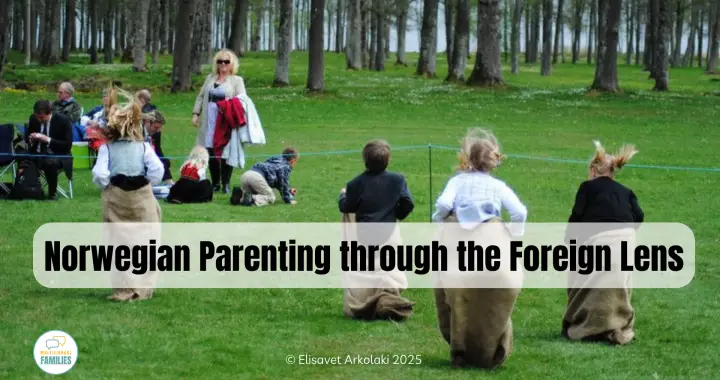
Norwegian parents encourage independence from an early age; kids climb trees, use knives, and even walk to school alone. This “free-range” approach also applies to daycare and school teachers, and it fosters resilience and problem-solving skills. Parents tend to be more protective or involved in children’s daily activities in many other cultures.
Tip: Start with small steps, like allowing your child to make decisions or handle simple responsibilities independently.
4. Work-Life Balance: Family Time Matters
Norway offers generous parental leave and flexible work schedules, in contrast with countries where long working hours may limit family time. Norwegian families prioritize hygge (cozy time together) in the evenings and weekends.
Tip: If you come from a fast-paced culture, try slowing down and embracing quality family moments over quantity of activities.
5. Discipline and Conflict Resolution: Calm and Respectful Parenting
Norwegians generally avoid yelling or harsh discipline; they use calm reasoning and positive reinforcement. There’s a focus on likestilling (equality), where children’s voices are valued in decision-making. Family decisions are often taken together with the kids and the kids have a say on matters that affect their everyday lives. This comes in contrast with cultures that may have a more authoritative or hierarchical parenting approach.
Tip: Observe and socialize with Norwegian parents and adopt techniques that work for your family.
Every culture has strengths, and adapting doesn’t mean giving up your own parenting style. The ideal scenario is that, with time, you can blend what works best for your family while respecting Norwegian norms. For me, the most challenging part was to learn how to manage my stress level and fears over the kids’ physical safety, and I’m still working on it. What helped me was to try and anchor my mind on rational thoughts like the following: since so many generations have been raised here this way, my own cultural beliefs and experiences make me think that safe experiences might be unsafe. My limiting beliefs should not be limiting my kids’ lives and journey towards independence and a fulfilling life, and that changed everything.

Elisavet Arkolaki
Elisavet Arkolaki is the author of a successful bilingual book series for children, with books available in 50+ languages: “A Sea of Stars” “Where am I from?”, “Cousins Forever”, “Happiness Street”, “Nelly’s Box”, and “Summer with Grandpa”. Passionate about travel and inspired by global learning, she raises her children between countries, cultures, and languages. She writes to build cultural understanding and sensitivity in young children while they are still eager to learn. She graduated from the University of Liverpool with a degree in Global Marketing (MSc), the University of Athens with a degree in French Language and Literature (BA), and was awarded a certificate of proficiency in English from the University of Cambridge.